War, Violence, Poverty: The Situation of Women on 25 November 2026
The Figures, Causes and Tasks Ahead in Türkiye and Around the World

Dear Young Comrades,
Today is 25 November. As women prepare to gather across Türkiye against violence, inequality and poverty, the Beyoğlu district governor's office has banned open-air meetings, marches, press statements, leafleting and sit-ins within the district for 24 hours from 00:01 on 25 November. In its statement, quoted by BirGün, the office cited public order and “social peace”. The decision applies to Beyoğlu; it should not be described as a nationwide ban.
The office also announced closures or controlled access for pedestrians and vehicles in and around Taksim Square, Gezi Park, İstiklal Avenue and Tünel Square from 15:00. The 25 November Women's Platform nevertheless reaffirmed its call to gather at Taksim Tünel at 19:30. According to bianet, women's organisations and lawyers criticised the decision.
This ban must be considered alongside a judicial assessment of the previous year's decision. When Istanbul's Sixth Administrative Court annulled the one-day Beyoğlu ban for 25 November 2025, it found that authorities had not demonstrated a clear, concrete and imminent danger of a crime being committed and stressed that tolerance of peaceful protest is essential to democracy. The decision reported on 14 November 2026 concerns the 2025 ban; it did not annul the 2026 ban.
Among the calls compiled by bianet are gatherings in Ankara on Yüksel Caddesi at 19:00, İzmir at Fuar Lozan Gate at 18:30, Diyarbakır at Dünya Junction at 17:30, Adana at Gazipaşa Park at 18:00 and Mersin at Kushimoto at 19:00. See the lists from bianet and Sendika.Org for other locations. This information is current as of the morning of 25 November; restrictions, transport and meeting arrangements can change, so check the latest announcements from local women's organisations and transport providers before attending.
Defending women's right to life and protecting their right to assemble peacefully are inseparable. Preventing people from speaking in the streets does not erase the demand to end violence; it makes that demand harder to hear in public.
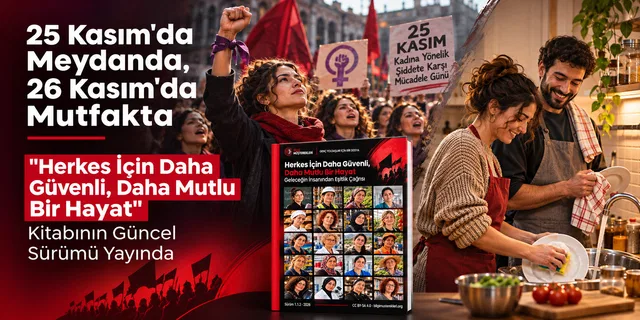
One of the posters says: “Against war, violence and poverty, we defend peace, our lives and our rights!”
This call invites us to consider the connections between war, violence and poverty through the demands for peace, life and rights. We begin with the evidence, experiences and struggles of women in Türkiye, then look at the situation around the world.
First, the Summary
The whole article in ten points:
- In Türkiye, 247 femicides and 289 suspicious deaths of women were reported in the first ten months of 2026. The recorded suspicious deaths outnumbered the femicides. (KCDP, 22 November 2026)
- In 89 per cent of the 246 femicides recorded by TKDF, the perpetrator was a man known to the victim. Of the 355 cases including femicides and suspicious deaths, 68.2 per cent occurred at home or in the woman's living space. (TKDF figures)
- Regular, detailed official data on femicides are not shared with the public. The femicide and suspicious-death figures used here come from women's organisations' monitoring of news reports, with different coverage and reference periods.
- In Türkiye, 64 per cent of working-age women are outside the labour force. The share in registered, full-time employment was 19.6 per cent in the first quarter; broad unemployment among women exceeded 40 per cent in September.
- According to DİSK, the Women's Empowerment programme accounts for four ten-thousandths of the proposed 2027 budget. Interest expenditure is 359 times that amount. (DİSK, 19 November 2026)
- In 2025, 78,000 women and girls were intentionally killed worldwide. An intimate partner or family member killed 60 per cent of them, approximately 47,000: an average of 129 a day, or about five an hour. (UN News, 24 November 2026)
- An estimated 840 million women have experienced physical or sexual violence by a partner or sexual violence by a non-partner during their lifetime, nearly one in three. The proportion has barely changed since 2000. (WHO, 19 November 2025)
- Only seven per cent of women who experience violence report it to the police. Between 63 and 97 per cent of reported cases do not result in conviction.
- Homicide rates are falling globally, but femicide rates are not falling as fast. In the Americas, between 2010 and 2025, the overall homicide rate declined nearly twice as fast as the femicide rate.
- War bears down on women. In 2025, verified conflict-related sexual violence cases were more than double the 2024 number. (Gender Snapshot 2026)
Our argument is that these are not ten unrelated problems. Violence at home, insecurity at work, budgetary choices and war at the front are four faces of the same order. Violence against women cannot be explained away as “culture” or “anger management”: it emerges from a social order based on unpaid care work, cheap and insecure women's labour, and male domination. Its solution cannot be left to conscience; it is a question of budgets, law and organisation.
Thinking about these relationships together does not mean reducing every case to a single cause. Class, gender, age, disability and migration status can shape the risks women face and their access to rights. The same law may be written for everyone, but the time, income, language support and safety needed to use it are not equally available. Equality must therefore be measured not only by the declaration of rights, but by the conditions that make those rights usable.
Now for the details.
Why 25 November?
On 25 November 1960, three sisters, Patria, Minerva and María Teresa Mirabal, were murdered by agents of the Trujillo dictatorship in the Dominican Republic for resisting the regime. In 1981, Latin American and Caribbean women meeting in Bogotá declared the date a day of struggle against violence. The United Nations officially recognised it in 1999.
This history reminds us that the day originated not in a “private family matter” but in a political murder of women resisting a dictatorship. State violence and male violence take different forms, but the struggle of 25 November demands rights and freedom against both.
Türkiye: Violence
The figures
First, a caution: regular, detailed and comparable official femicide data are not made public in Türkiye. The femicide and suspicious-death figures below are compiled by women's organisations from cases reported in the press. Their scope and periods differ, and incomplete reporting means they should be read as minimum figures.
We Will Stop Femicide Platform (KCDP):
- 247 femicides and 289 suspicious deaths of women in the first ten months of 2026. (22 November statement)
- For the same period in 2025, the figures were reported as 237 and 247; suspicious deaths rose by more than 15 per cent. (Artı Gerçek)
- In October 2026 alone, 20 women were killed and 39 died under suspicious circumstances. Fifteen of the 20 were killed with firearms and nine at home. Fifteen per cent of the women killed were under a protection measure. (Artı Gerçek, Yeniçağ)
DİSK's 19 November statement reported 245 femicides and 273 suspicious deaths for the same period. Different source records and update dates must be considered when comparing these figures; here we use the platform's 22 November statement.
Federation of Women's Associations of Türkiye (TKDF), for 1 January–23 November 2026:
- Over 327 days, 246 women were killed by men and 109 deaths were recorded as suspicious: 355 cases in total, approximately one every 22 hours. (report)
- In 89 per cent of the 246 femicides, the perpetrator was a man known to the woman.
- Of the 355 cases, including femicides and suspicious deaths, 68.2 per cent (242 cases) occurred at home or in a living space. Not all suspicious deaths can be classified as murder.
The difference between the organisations' suspicious-death counts, 109 and 289, must be read alongside their different coverage, methods and periods; these sources do not establish its precise cause. It does not make the data meaningless. It underlines the need for transparent, comprehensive public records.
Why did suspicious deaths outnumber recorded femicides?
On 22 November in Kadıköy, KCDP general secretary Fidan Ataselim drew attention to this development. The platform had long warned that failure to prevent femicide and protect women would be accompanied by more suspicious deaths.
A suspicious death may involve a reported fall, an apparent suicide, or a woman found dead at home or elsewhere whose circumstances require investigation. Some cases may involve homicide or violence; each must be independently and effectively investigated. A suspicious-death classification alone does not establish how a person died.
This is also a question of justice and knowledge. A suspicious-death classification is the beginning of an investigation, not its conclusion. Preserving evidence, ensuring families can access information and safeguarding independent investigation are public responsibilities to those who have died and those left behind. Neither treating uncertainty as proof of murder nor using it as an excuse not to investigate serves the truth.
Killed despite a protection order
Fifteen per cent of women killed in October 2026 were under a protection measure. Measures had been ordered, yet their lives were not protected.
Law No. 6284 is strong on paper; implementation is the problem. According to DİSK, Türkiye has only 86 Violence Prevention and Monitoring Centres (ŞÖNİM) across 81 provinces. In an earlier article, we cited the ministry's own table showing 112 women's shelters across the country.
Türkiye withdrew from the Istanbul Convention in 2021 by presidential decree. It then declared 2025 the “Year of the Family” and 2026–2035 the “Decade of Family and Population”. The language of protecting women has given way to protecting the family. This is not merely a change of words: when a woman is treated primarily as part of a family rather than as an individual, pressure to reconcile can take precedence over her safety. Many women are killed precisely because they want a divorce or refuse reconciliation.
Women in the Earthquake-Affected Regions: The Struggle After the Destruction
The earthquakes of 6 February 2023 destroyed not only buildings, but also livelihoods, care networks and access to services. Their effects were not the same for everyone: women, particularly women living in poverty, women with disabilities and migrant women, faced existing inequalities intensified by disaster. Recovery cannot be measured by the number of homes handed over alone. We must also ask who can live safely, access healthcare and make decisions about their own lives.
According to AFAD data in the Presidency of Strategy and Budget's 2026 report, 360,455 people were living in containers as of 26 January 2026: 223,072 in container settlements and 137,383 in rural containers. There were 242 container settlements. The total covers all residents, not only women, and describes the position on that date rather than in November. It nevertheless shows how long temporary accommodation can last.
Housing, privacy and the burden of care
Mor Çatı's 2023 field observations found that toilets in some tent settlements were distant and unlit, and that access to clean water and adequate lighting was difficult. Safe toilets and showers, menstrual products, clean water and healthcare are not luxuries: they are conditions of health, privacy and human dignity. The needs of pregnant women, new mothers, women with disabilities and older women require particular attention.
The same report shows how cleaning, cooking and childcare became more burdensome for women amid water shortages and difficult living conditions. In its report based on visits to Adıyaman, Kahramanmaraş, Hatay and Adana in September 2025, Mor Çatı reports that one container settlement received water for only one hour a day, without advance notice of the hour. This is a field observation, not a measurement that can be generalised to all settlements; it shows how infrastructure decisions can make care work more difficult.
Leaving violence requires more than a decision
Mor Çatı's 2025 monitoring reports that, because no new containers were allocated, some women had to continue living near the men who abused them. Rising rents, loss of income and transport difficulties also made an independent life harder to establish. The report identified some institutions' lack of permanent, easily accessible premises as another barrier to protection. These are interviews and observations in particular provinces, not a regional estimate of the prevalence of violence.
Housing eligibility, property and inheritance procedures also matter for women's safety. Where entitlement is defined through a man, or women face difficulty asserting their own rights, lack of secure housing can prevent them from leaving violence. Migrant women must also be able to access protection and support without discrimination. Telling a woman to “leave” is not enough: safe housing, income, legal assistance and accessible protection must be provided together.
Women's solidarity is part of rebuilding
Women were not merely recipients of aid. According to UN Women in January 2026, Women's Life Centres established in Hatay and Adana by KÖVED in cooperation with the Women's Coalition and with UN Women support had provided safe spaces and support to more than 6,500 women and girls since December 2023. The Samandağ centre offers psychological and legal counselling alongside solidarity activities. Such work does not replace public obligations; it shows why women's organisations' knowledge and decision-making power must be central to recovery.
An earthquake-resilient society cannot be built from resilient buildings alone. Recovery must also be measured by whether women can live safely and take part in decisions about rebuilding their lives.
Türkiye: Poverty and Labour
A way out of violence requires somewhere to go and an income to live on. Women's economic position is therefore central to any discussion of violence.
One in five women
- Sixty-four per cent of working-age women are outside the labour force. (DİSK/Genel-İş)
- In the first quarter of 2026, the official female employment rate was 30.4 per cent. DİSK-AR's registered, full-time employment measure was 19.6 per cent for women and 47.5 per cent for men. Only 6.6 million of 33.7 million working-age women were in such employment. (DİSK-AR via ANKA)
- In the third quarter of 2026, narrowly defined unemployment was 10.7 per cent among women and 6.8 per cent among men. (DİSK-AR)
- In September 2026, 1.353 million women were counted as narrowly unemployed, compared with 6.382 million under the broad measure. The broad female unemployment rate was 40.4 per cent. (Evrensel)
The broad count is 4.7 times the narrow count. It includes, alongside officially unemployed people, the potential labour force and people in time-related underemployment who want more hours; not everyone in it is unemployed or immediately available for work. Our article on TÜİK's two figures examines the gap.
Employment does not automatically mean security
- Of 10.753 million employed women, 3.150 million, or 29.3 per cent, worked informally. Among part-time women workers the figure was 60.7 per cent. (Genel-İş 2026 Women's Labour Report)
- In private-sector general services and residential services, estimated informality among women was 80.6 per cent, compared with 21.5 per cent among men. (bianet)
- According to the Workers' Health and Safety Assembly (İSİG), at least 15 women workers died in work-related incidents in October 2026. It says women's share of deaths in its records is roughly four times the two per cent reported in Social Security Institution statistics. İSİG points to uninsured agricultural workers missing from official records and also includes deaths during unpaid domestic work. The two measures therefore have different coverage. (Euronews)
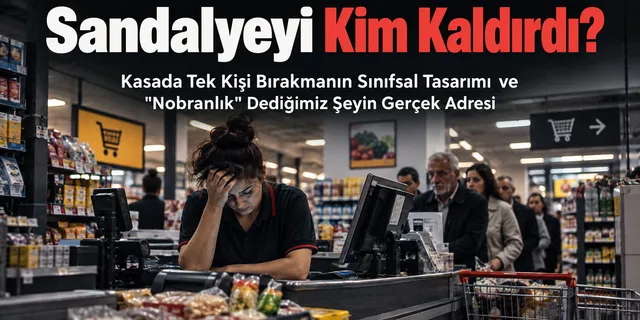
These figures challenge the idea that employment alone guarantees liberation. Part-time, informal and badly paid work may not provide independence; it can add a second shift to domestic responsibilities. The government's emphasis on “flexible work” risks offering half a job, lower pay and insecurity while leaving the care burden where it is.
The invisible shift
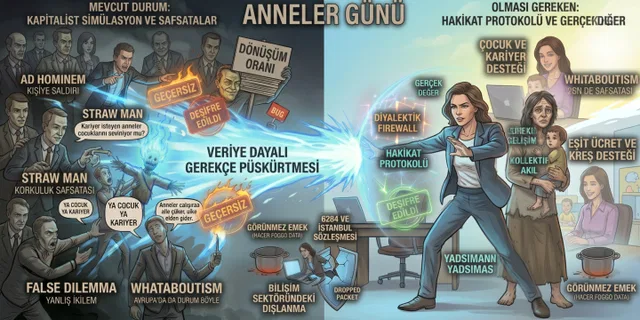
Why are so many women outside the labour force? We previously cited the figures: according to TÜİK's 2025 Time Use Survey, women spend four hours and three minutes a day on household and care work, compared with 58 minutes for men. Institutional care coverage for children under three is below one per cent.
Marxist theory calls this social reproduction. For workers to go to work each morning, someone must prepare meals, raise children and care for sick and older people. Much of this work is unpaid and falls on women under the names of “love” and “motherhood”. As Engels argued in 1884, the family is not a fixed natural unit; it changes historically with property relations. The budgetary counterpart of “Family Year” is insufficient public childcare and a continuing burden on women.
Socialising care does not mean devaluing caring relationships or abolishing responsibility between loved ones. It means refusing to make those responsibilities depend on one woman's unpaid labour and exhaustion. Public childcare, accessible services for older and disabled people, secure employment for care workers and an equal division of work at home are not alternatives to one another; they are complementary conditions for an equal life.
Time is a resource too. The invisible shift after paid work narrows the time available for rest, education, union activity and political participation. The right to care is therefore not only an economic demand; it is also a democratic demand for women's equal participation in public life.
The budget tells the story
DİSK's 25 November statement summarises its calculations:
- The Women's Empowerment programme accounts for four ten-thousandths of the proposed 2027 budget.
- Proposed interest payments are 359 times that amount.
- The Family Protection and Empowerment programme receives approximately three times the women's programme allocation.
- Türkiye has not ratified ILO Convention 190 on violence and harassment at work.
A government's priorities are revealed not only by speeches but by its budget. For every unit assigned to women's empowerment in this comparison, 359 go to interest payments. This is a political choice, not merely an oversight.
Where does Türkiye rank?
In the World Economic Forum's 2026 index, Türkiye ranks 126th of 145 economies, having closed 64.9 per cent of the measured gap. It ranked 135th the previous year, 130th for labour-force participation and 126th for estimated income; it is last in Europe. (bianet, Derin Bilim)
Some pro-government outlets presented the nine-place rise as a success. It takes considerable optimism to celebrate 126th place after a 6.4-point improvement over twenty years.
How Poverty Deepens in the Lives of Women and Children
Poverty is not simply the money left at the end of the month. It shapes what goes on the table, where a family lives, how a child gets to school, whether treatment is accessible when someone is ill, and what options a woman has when she faces violence. Each is a question of rights; when deprivations accumulate, they can intensify one another.
The unseen deprivation Hacer Foggo brings to light
Hacer Foggo, founder of the Deep Poverty Network, has described her field observations to bianet: children who do not want to attend school because they cannot bring food, and students who experience bullying or shame over their clothes or school meals. Some children's absences turn into housework and caring for siblings; others are pushed into work. These are observations, not rates that can be generalised to all children, but they help us understand the lives behind the figures.
A child's shame at being poor is not that child's failing. It reflects a society that allows unmet basic needs to become a source of humiliation among peers. Poverty can also narrow opportunities for play, friendship, rest and confidence in the future. Children must be recognised not merely as future workers but as people with rights today.
What the official figures do and do not say
According to TÜİK's 2025 child statistics, 36.8 per cent of children aged 0–17 and 37.8 per cent of girls were at risk of poverty or social exclusion, compared with 27.9 per cent of the total population. This composite measure covers at least one of relative income poverty, material and social deprivation, or very low work intensity. It does not mean that all those children experience the same deprivation or that all live in deep poverty.
A separate measure used in TEPAV's November 2026 study sets the relative income-poverty threshold at 60 per cent of median income. It found that 31 per cent of children, approximately 6.7 million, fell below that threshold in 2025. The two figures cannot be added because they measure different things. TEPAV estimates that direct child and family benefits reduced the child poverty rate by 0.6 percentage points. Social support matters, but its coverage, adequacy and continuity must be judged by whether it protects children's rights.
Lives forced between rent and food
The Open Space Association–Deep Poverty Network's 2026 housing report was prepared by Melek Bahat with Hacer Foggo as adviser. It examined the experiences of 20 single mothers living in deep poverty: 18 rented their homes; 10 households reported damp and mould and 13 needed repairs. All requested social housing for single mothers. This small, selected study does not represent every single mother in Türkiye, but it shows how housing, livelihood and safety problems intersect in these households.
In the report, one woman explains that fear of being found by her abusive husband prevented her from registering her address, creating obstacles to social assistance and her children's school registration. Another says that after she could no longer pay rent, she temporarily stayed with a neighbour and had to place her children in state care. These are individual accounts, not a trajectory that can be assumed in every case. They show what it can cost when secure housing, identity and address procedures, protection and social assistance are designed in isolation.
Care, violence and economic independence
For a woman with primary responsibility for a child, having to choose between paid work and leaving the child somewhere safe is not a genuinely free choice. Distant or costly childcare, irregular employment, unpaid maintenance and interrupted benefits can reinforce one another. For families with disabled children, transport, treatment and care needs can rise while the caregiver's opportunities for paid work diminish. These experiences differ among families; solutions must be built by listening to women's needs and decisions.
The 2026 impact report for the You Are Not Alone project evaluates work with 20 single mothers already supported by the association; Foggo and project officer Melek Bahat collected the data. Food, utility-bill and education support were combined with psychosocial and legal support and referrals to public services. The report assesses changes in the cases followed during the project; this small study has no control group and cannot, by itself, establish a population-wide effect. It nevertheless invites discussion of why sustained, multidimensional support tailored to people's needs matters more than a one-off response.
From the lunchbox to child labour
The Deep Poverty Network's activity report says its 2024 education study collected information about 119 students from parents in different Istanbul districts. It describes how access to school supplies, transport and food is constrained by family budgets. The selected field sample is not a national rate, but it illuminates how supposedly free education can become costly through meals, transport, supplies and digital access.
Access to adequate, balanced food matters for children's health, development and ability to learn. Free, healthy school meals should therefore be understood not as charity but as a public service that supports both the right to education and the right to food. Access to transport, preschool education, counselling, internet and learning materials should likewise not depend on family income or the ability to ask for help.
Without income security, some children may be pushed into paid work or unpaid family labour; some girls may carry a heavier share of sibling care and housework. It would be wrong to explain every child's work or absence from school solely through poverty. But poverty, discrimination and inadequate public services can combine to increase the risk of exclusion from education and exploitation. Preventing child labour requires more than placing responsibility on families: it requires income security, effective workplace inspections, quality education and child-protection services.
Not charity, but secure rights
Regular income support, social housing, free childcare and school meals, healthcare and secure employment must work together. Applications should respect privacy, and support should not end abruptly when someone starts work. The needs of migrants, disabled women and children, people affected by disasters and different family types must be addressed without discrimination.
Solidarity saves lives, but it does not replace public responsibility. Children's rights to food, education and play, and women's access to safe housing and income, cannot depend on charity.
The World: Violence
Women's struggles in Türkiye for life, safety, income and the right to organise are connected to struggles beyond its borders. Conditions and movements' demands differ from country to country; with those differences in mind, we turn to the global picture.
Home is the most dangerous place
The UN Office on Drugs and Crime (UNODC) and UN Women published the 2026 Femicide Brief on 24 November. Its main findings, reported by UN News, are:
- In 2025, 78,000 women and girls were intentionally killed worldwide.
- Sixty per cent, approximately 47,000, were killed by an intimate partner or family member. The estimate ranges from 37,100 to 56,700. (Rio Times)
- That is an average of 129 women and girls a day, or approximately five an hour. UN Women cautions that the difference from the 2024 estimate largely reflects variations in data availability across countries and should not be taken as evidence of an actual decline.
Rates of intimate-partner or family-related femicide per 100,000 women, by region:
| Region | Rate per 100,000 women |
|---|---|
| Africa | 2.9 |
| Americas | 1.4 |
| Oceania | 1.1 |
| Asia | 0.6 |
| Europe | 0.5 |
Africa has both the highest rate and the highest estimated number: 22,100 women and girls. But it would be wrong to call this a problem of poor countries alone. Europe's rate is lower, not zero. Another finding is particularly striking.
Homicide falls; femicide falls more slowly
According to the report, overall homicide rates are declining globally, while femicide rates are falling much more slowly. Between 2010 and 2025, the overall rate fell almost twice as fast as the femicide rate in the Americas, and about one and a half times as fast in Europe.
These rates show a trend; they do not by themselves establish its causes. Access to protection, judicial practice, economic dependence and access to firearms require separate investigation. The dismissal of domestic violence as a “private matter” is also part of the discussion about who benefits from protection policies.
One in three women
The comprehensive WHO study published last year supplies the rest of the picture:
- 840 million women have experienced partner violence or sexual violence during their lifetime.
- In the preceding twelve months alone, 316 million women experienced physical or sexual violence by an intimate partner: 11 per cent of women aged 15 and over.
- The lifetime prevalence has barely changed since 2000.
Twenty-five years. The internet spread, smartphones appeared, artificial intelligence arrived and the world economy grew many times over. Yet the fact that nearly one in three women experience this violence has not changed. Technological progress and social progress are not the same thing.
Growing silence, continuing impunity
UN Women's report, drawing on data from 54 countries, shows what happens after violence:
- Only seven per cent of women experiencing violence report it to the police.
- The share seeking help is 16 per cent in Asia, 31 per cent in Africa and 40 per cent in Latin America and the Caribbean.
- In the European Union, 64 per cent confide in someone close to them; 14 per cent go to the police.
- Between 63 and 97 per cent of reported cases do not result in a conviction.
- In most countries tracked over time, the share of women seeking help is falling.
Seeking help may put a woman's home, children, income or life at risk. The problem is not women's “lack of courage”; it is institutions that do not earn their trust. A reliable response requires complaints to be taken seriously, risks assessed, protection measures monitored and safe accommodation made accessible. When one link fails, the distance between a legal right and safety in practice widens.
The digital sphere
According to UN News, 70 per cent of the women in public life surveyed by UN Women, including journalists, activists and rights defenders, had experienced online violence. UN officials note that AI can produce fabricated images of a woman's body in seconds.
We have written often about AI on this blog, always asking the same questions: in whose hands, under whose control, for whose benefit? The deepfake example makes the stakes clear. Companies bring tools to market for profit; women bear the harm; protections are inadequate. A technology that pushes women out of digital spaces and public life cannot be treated as “neutral”.
The World: War
War is the first word on the poster. The figures explain why.
- In 2024, 676 million women and girls lived within 50 kilometres of deadly conflict, the highest number recorded since the 1990s. (UN News, September 2025)
- In 2025, verified conflict-related sexual violence cases were more than double the 2024 figure. Verified cases do not reflect the full scale of the problem. (Gender Snapshot 2026)
- In conflict-affected countries, child marriage rates are on average 14.4 percentage points higher than elsewhere. (UN Women, May 2026)
War has at least three consequences for women, all with a class dimension. First is direct violence: rape continues to be used as a method of war. Second is displacement: on migration routes and in camps, women face insecurity and exploitation. Third is the budget: money directed to weapons competes with spending on childcare, shelters and health services.
The destruction of war does not stop at the front line. For people who lose their homes, livelihoods or loved ones, access to healthcare, education, safe housing and a means of living also becomes precarious. Yet it is incomplete to see women only as passive victims of that destruction: their demands for peace and their right to make decisions about their own lives must stand at the centre of reconstruction.
Saying “no to war” is therefore more than a foreign-policy position for the women's movement; it is a defence of life itself.
Country by Country: War, Restrictions and Women's Struggles
The global picture is not experienced in the same way everywhere. In Gaza, bombardment, displacement and barriers to aid; in Afghanistan, restrictions on education and work; in Iran, state repression; and in Sudan and the Democratic Republic of the Congo, armed conflict are products of different histories and political decisions. We must examine their effects on women's lives, rights and organising together without reducing them to a single cause.
Gaza: Lives compressed into a tent

Deir el-Balah, Gaza, 26 June 2024. Photo: Ashraf Amra / UNRWA, Wikimedia Commons, CC BY-SA 3.0 IGO. Image resized.
Israeli airstrikes and ground operations in Gaza since October 2023 have devastated the lives, housing and access to healthcare of women and girls. In its April 2026 analysis, UN Women estimated that more than 38,000 women and girls were killed between October 2023 and December 2025. Its 8 October 2026 fact sheet also reports approximately 11,700 women and girls severely injured. These are distinct categories: one records lives lost, the other injuries that can cause lifelong disability. The agency also notes that deaths continued after the ceasefire took effect in October 2025.
The same fact sheet says nearly one million women and girls have been displaced. A UN Women statement of 17 November reports that heavy rain and sewage flooded makeshift shelters, with nearly a million people forced into flood-prone areas. A tent is not only a question of shelter. Without privacy, clean water, safe toilets or consistent healthcare, pregnancy, menstrual health, disability and caring responsibilities become part of a daily struggle for survival.
According to UNFPA's winter plan published on 19 November, approximately 10,000 pregnant women are in areas at high risk of flooding. The agency reports that more than 60 per cent of pregnant women in Gaza are anaemic and one in three pregnancies is classified as high risk. These figures do not mean all pregnancies have the same outcome; they show the urgency of antenatal and postnatal care amid inadequate nutrition and disrupted services.
War has also changed household structures. UN Women's September research estimates that women head nearly one in four households in Gaza, including women whose husbands have died, are missing, detained or severely injured. In the research, 68 per cent of women-headed households lacked adequate shelter, compared with 55 per cent of male-headed households. This does not mean every woman faces identical conditions; it raises the question of whose needs guide aid and reconstruction.
Palestinian women are not merely waiting for assistance. Women-led organisations are providing health, legal and psychosocial support. Full implementation of the ceasefire, protection of civilians, unimpeded humanitarian access and accountability for violations are essential, as is women's meaningful participation in decisions about assistance and reconstruction. Food and shelter are questions of human dignity, not bargaining chips.
Afghanistan: School doors closed on a country's future

Schoolgirls in Afghanistan, 2002; archival photograph. Photo: Nitin Madhav / USAID, Wikimedia Commons, public domain in the United States.
Under Taliban rule, girls have been barred from formal education beyond grade six since September 2021, and women from universities since December 2022. UNICEF's statement of 14 August 2026 reports that more than 2.6 million girls have been denied secondary education since 2021. Closing a school door means more than the loss of a lesson: it constrains a child's relationships, decisions about her future and place in public life.
The consequences extend beyond education. UNICEF estimates that, if restrictions continue, Afghanistan risks losing up to 20,000 women teachers and 5,400 women healthcare workers by 2030. This is a projection conditional on the restrictions continuing, not a loss that has already occurred. Where access to women health workers is particularly important for women patients, denying education can also weaken future care and treatment.
UN Women's statement of 20 November warns that restrictions on women training for healthcare professions, combined with restrictions in many communities on male healthcare workers treating women, make care harder to access. The agency reports that aid cuts caused nearly 300 humanitarian health facilities to close or suspend services in 2026, affecting more than one million women and girls. Restrictions and declining aid have different but mutually compounding effects.
Restrictions on women's work and movement combine with poverty and displacement to deepen inequality. Nevertheless, Afghan women, teachers and families defending girls' education continue to make their demands. Solidarity means supporting their struggle for education, employment and decision-making, not treating them as a silent community waiting to be rescued.
Iran: Woman, life, freedom

Solidarity demonstration for Jina Mahsa Amini in Copenhagen, 19 November 2022. Photo: FunkMonk, Wikimedia Commons, CC BY-SA 4.0. Image resized.
The “Jin, Jiyan, Azadî — Woman, Life, Freedom” movement that rose after Jina Mahsa Amini died in morality-police custody in 2022 brought a demand for equality against compulsory hijab and state control over women's bodies to the world. According to the March 2026 report of the UN Independent International Fact-Finding Mission on Iran, the existing legal framework enforcing compulsory hijab, and allowing arrest, detention and prosecution, remains in place. The mission identifies structural discrimination against women and girls.
The mission's statement of 28 October 2026 examines severe state repression, detentions and communication restrictions following protests that began in December 2025, alongside the harm to civilians from US and Israeli airstrikes. It notes continuing institutional discrimination against women and repression affecting Kurds, Baluch and other minorities. One violation cannot justify another: opposing state repression and protecting civilians from war are part of the same defence of rights.
Iranian women's demands cannot be reduced to a debate about clothing. They concern who decides over bodies, education, work, expression and organising. Both the choice to wear a headscarf and the choice not to must be protected as matters of individual freedom, not state coercion.
Sudan: Sexual violence, hunger and organising for peace
As the war between Sudan's army and the Rapid Support Forces entered its fourth year, UN Women's 14 April 2026 statement reported that 17.1 million women and girls needed humanitarian assistance and more than 4.3 million had been internally displaced. These are estimates of need and displacement that can change over time; they are not counts of deaths or survivors of sexual violence.
The agency reports that sexual violence has been used in the war to terrorise and control communities, and that women have been attacked at home, while fleeing and while seeking food, water or healthcare. In an October 2026 survey of 50 women's organisations supporting people displaced from El Fasher, 45 organisations reported that psychological distress among women and girls persisted. These are observations from 50 organisations, not a direct prevalence estimate for all displaced women.
In these conditions, Sudanese women are running community kitchens, supporting survivors, finding shelter for displaced families and leading local peace initiatives. Safe aid access and accountability for sexual violence are vital, as are funding for these organisations and a meaningful voice in peace talks.
Democratic Republic of the Congo and Myanmar: The invisible labour of crisis
In eastern Democratic Republic of the Congo, especially North and South Kivu and Ituri, conflict, displacement and sexual violence threaten women's safety. UNFPA's country update reports restricted access to safe childbirth and care for survivors of sexual violence, while insecurity, shortages of medicines and supplies, and funding gaps impede humanitarian assistance. Safe working conditions for midwives and health workers matter as much as access for aid to conflict areas.
In Myanmar, the economic cost of conflict also intersects with gender inequality. A June 2026 UNDP and UN Women report, based on a national survey conducted in 2025, found that 42 per cent of women had no income of their own, compared with 23 per cent of men. It also found that women carried nearly twice the unpaid care burden even when employed. These are findings from a particular survey period; not every household has the same experience.
Women's care and solidarity in these countries cannot be treated as an invisible substitute for collapsed services. Ending conflict, ensuring humanitarian access and supporting women-led local initiatives mean recognising women's rights and decision-making power without placing yet more responsibility on their shoulders.
Women in Wealthy Countries: Does Modernity Mean Equality?
When discussing restrictions on education in Afghanistan or the war in Gaza, it can be tempting to treat women's inequality as a problem belonging only to supposedly “backward” societies. Yet high incomes, technological development and legal recognition of women's rights do not in themselves eliminate violence, discrimination or the unequal distribution of care. Gains in these countries matter: rights won through women's organising must be assessed by how well they are implemented and protected. Without equating different conditions, we should ask: amid wealth, who is safe, and who controls their time and income?
Europe: Rights exist, but so does violence
According to a joint survey by Eurostat, the EU Agency for Fundamental Rights and the European Institute for Gender Equality, 31 per cent of women aged 18–74 in the EU reported experiencing physical violence, threats of physical violence or sexual violence as adults. Conducted across 27 countries between 2020 and 2024, the survey covers past experiences, not incidents in a single year. Differences in reporting and survey methods mean the figures should not be treated as a simple country ranking.
In Germany, Federal Criminal Police Office records for 2024 show that 132 women were killed by a current or former partner. This counts recorded intimate-partner killings, not all killings of women. More than 187,000 women and girls were also recorded as victims of domestic violence that year. Police figures cover incidents known to authorities and cannot be directly compared with experiences collected through surveys. Strong institutions matter, but reporting must also be safe and protection effective.
Pay and care: What the figures leave out
Eurostat's provisional figures for 2024 show that women's average gross hourly earnings in the EU were 11.1 per cent lower than men's. This unadjusted average also reflects differences in occupations and working conditions; it is not the pay difference between every woman and man doing the same job. Hourly pay does not capture all the effects of part-time work or care-related career breaks on annual income and pensions either.
The OECD's 2025 assessment finds that women in OECD countries do almost twice as much unpaid work as men and, combining paid and unpaid work, work an average of 24 minutes longer per day. Time-use data come from different years and use different methods across countries. Even so, they show why childcare, elder care and parental leave are not merely matters of “family policy”, but of women's rights to time and income.
The United States: Reproductive rights and racial inequality in health
The US Supreme Court's 2022 Dobbs decision removed federal constitutional protection for abortion. According to the Guttmacher Institute's 19 November 2026 summary, abortion provision was banned in 13 states, with limited legal exceptions; some other states apply different gestational limits. Travelling to another state or, in some circumstances, accessing telehealth may remain possible, but travel, accommodation, time off and care costs are not equally manageable. Exercising a right depends not only on the law but on whether care can actually be reached.
Another health disparity is visible in the US Centers for Disease Control and Prevention's 2024 data. The maternal mortality rate, counting pregnancy-related deaths during pregnancy or within 42 days of its end, was 44.8 per 100,000 live births for non-Hispanic Black women and 14.2 for non-Hispanic White women. This comparison does not explain any individual death; access to healthcare and social inequalities require separate investigation. Racism, class and gender are not experienced in isolation.
Japan and Australia: Different conditions, shared questions
In Japan, as women's participation in paid work has grown, the OECD's country assessment points to pay inequality and women's disproportionate burden of unpaid care. Expanded childcare and parental leave are important gains; sharing care and preventing a shift into insecure employment after childbirth matter too. Entering the labour force is not the same as having a secure job with prospects for advancement.
In Australia, the Institute of Health and Welfare reports that 32 women were killed by a current or former partner in 2024–25. It also reports that the intimate-partner homicide rate has declined over the long term. Progress and continuing loss must be seen together: a falling rate cannot make the people who died or the need for protection invisible.
Gains are protected through struggle

Women's strike in Reykjavík, 24 October 2005; archival photograph. Photo: Johannes Jansson / norden.org, Wikimedia Commons, CC BY 2.5 Denmark. Image resized.
In Iceland, women again came together in 2023 under a call to stop paid and unpaid work for equal pay and an end to violence. As the Nordic Council of Ministers recounts, the action was part of a tradition of women's strikes dating back to 1975. Equal-pay legislation is an important achievement, yet debate continues over the lower pay attached to female-dominated jobs. As Iceland Review reports, Icelandic women's organisations have also raised barriers to participation faced by migrant and low-paid women.
The conclusion is not that every country is the same. Shelters, healthcare, union rights and equality laws make a real difference. But a country's wealth does not prove that everyone can access those rights equally. Equality is not a reward that automatically arrives with higher incomes; it is won through women's organising and must be continually defended.
The World: Poverty and Inequality
120 years or 171 years?
The World Economic Forum's Global Gender Gap Report 2026, published on 16 September, says 69.2 per cent of the gender gap across 145 economies has closed and projects 120 years to parity at the current rate. The UN's Gender Snapshot 2026, published the next day, estimates 171 years to achieve Sustainable Development Goal 5.
These are not the same measurement: the WEF uses an index across four areas, while the UN looks at SDG 5 indicators. They are not interchangeable predictions. Both, however, show that progress is far too slow. A projection based on the present rate is not a law of nature; changing it is a political task, not a matter of patience.
One further note about Davos. The same forum brings together executives of companies that produce inequality. Its report measures, among other things, women's representation in leadership; in its LinkedIn-based sample of 39 economies, women hold only 19.1 per cent of CEO roles. Our concern, before the number of seats on the board, is the woman employed at minimum wage by that board. We can use the figure without accepting the framework.
The gender of poverty
From Gender Snapshot 2026:
- In 2024, 9.9 per cent of women and 9.5 per cent of men lived in extreme poverty. The gap was widest among people aged 15–34.
- Nearly one in five girls is married before the age of 18.
- On current trends, 1.1 billion women and girls could still experience food insecurity in 2030.
- Over the past two years, the institutional power of one in three gender-equality mechanisms has been eroded. (UN Women)
The report notes that household-based poverty measurement assumes resources are shared equally within a household and can therefore obscure women's deprivation. People under the same roof do not necessarily experience poverty in the same way: who controls money, who spends it and who must ask matters.
The final point matters too. Institutions set up to advance equality are losing power and funding. Progress is not merely slow; hard-won ground is being lost. We saw the attack on women's rights when discussing the rise of reaction in Europe.
The Women Behind Internet and AI Labour
When an AI application answers a question in seconds, the screen usually shows only the product's name. Behind that answer are people classifying text, labelling images, evaluating model outputs and screening harmful content. Content moderation and data annotation for AI are not the same job, but both depend on human judgement and labour to sustain digital services. Other links in the chain include miners, electronics assembly workers and caregivers. Women work across many of these links, though work, pay and decision-making power are not distributed in the same way everywhere.
India: A shift that does not end when the screen goes dark
The Guardian's 2026 investigation describes Monsumi Murmu in Jharkhand reviewing up to 800 images and videos a day. The violent content she encounters follows her into her sleep and everyday life. Raina Singh from Uttar Pradesh says that, after being hired for data annotation, she was moved without advance notice to assignments requiring her to review severe abuse content. These are two women's experiences; they do not mean every data worker sees the same material.
According to the report, only two of eight companies interviewed said they offered psychological support. Non-disclosure agreements can also make it difficult for workers to discuss their jobs with loved ones. Paid work at home can give some women income and greater room to make choices, but access to work is no substitute for advance disclosure of content, safe working hours and independent psychological support. Working from home does not end an employer's health and safety responsibilities at the front door.
Kenya: The value of data and the worker's pay
In a 2026 survey by WageIndicator and Kenya's Data Labelers Association, 57 respondents reported average earnings in the preceding month from their main platform or outsourcing company of 21,849.72 Kenyan shillings for women and 26,106.83 for men. This small voluntary sample does not represent the whole sector; the amounts are not standardised for hours worked and cannot on their own establish a gap in pay for equal work. They do, however, raise important questions about pay, contracts and security.
According to the preliminary findings, none of the women surveyed earned above the organisation's living tariff, which accounts for both living expenses and work-related costs. Searching for tasks, training and administration are not always paid. The cost of home-based work is not just an internet bill: time spent waiting for paid tasks can overlap with housework and care. This is not every woman's experience, but it shows the social conditions that can intensify insecurity.
The Philippines and Colombia: Who pays for a safer internet?
Human rights organisation Equidem's 2025 report draws on interviews with 113 data workers from the Philippines, Colombia, Kenya and Ghana. Workers describe intense quotas, insecure contracts, psychological strain and obstacles to seeking redress. One Colombian moderator reported having to review 700 to 1,000 cases per shift. This is one person's account, not a quota that can be attributed to every worker. The study is not statistically representative of the global workforce, and these findings are not female-specific rates.
The source also includes company responses to the report's allegations. The central question remains: why should the cost of a safer digital environment for users fall on workers' health and silence? Safer moderation requires limits on exposure to harmful content, paid breaks, training, accessible psychological support and independent channels for complaints.
Latin America: The waiting time hidden by flexibility
An exploratory preprint involving 30 data annotators in Latin America examines unpaid care, insecure income and the irregularity of platform work together. María, a worker in Caracas, describes logging in early to find tasks while also caring for children and an older parent. This small self-selected sample does not represent every woman worker in the region; an individual account should not be treated as a general rate.
In Rest of World's reporting, Venezuelan data worker Oskarina Fuentes, who lives in Colombia, describes monitoring notifications for tasks and sometimes waiting a long time for work to appear. Apparent flexibility can bind workers to perpetual availability rather than freeing their time. In households where care responsibilities are unequally shared, the cost of that waiting may also be unequally distributed.
Viet Nam and the Congo: The material foundations of the digital world
The internet is not made of software alone: phones, computers and network equipment are also produced through labour. According to the ILO's electronics industry estimate, approximately 9.7 million of the 17.4 million people employed worldwide in electronics hardware manufacturing and assembly in 2023 were women. This covers electronics manufacturing, not all technology workers or only people producing for AI. The ILO's study of Viet Nam finds that women make up most of the electronics workforce and that the nature of jobs differs by gender. Paid employment can offer important opportunities, but access to better-paid skilled roles, safe work and care services matters just as much.
Hardware and battery supply chains also reach into mining, though no particular device or AI application can automatically be traced to a specific mine. UNCTAD's report on the Democratic Republic of the Congo says women can make up as much as 40 per cent of artisanal and small-scale miners in some cobalt-producing areas and are often concentrated in poorly paid work such as washing, sorting and carrying ore. That estimate is not the proportion of women in the entire mining sector. Better protection, safe equipment and access to higher-paid roles must be part of any discussion of digital production's material foundations.
Invisibility is not fate: Women are organising
As Kenyan data labeler Joan Kinyua explains, workers established the Data Labelers Association to advance their shared demands for pay, recognition and security. The association launched publicly on 13 February 2025. That same year, content moderators from nine countries launched a global trade union alliance in Nairobi; women moderators from Türkiye have also shared their experiences as part of this international struggle.
Workers' demands are concrete: a living wage, secure contracts, paid breaks, limits on exposure to harmful content, independent health support and union rights. UNI Global Union's proposed safety protocols also call for collective bargaining and oversight with worker participation. Responsibility does not evaporate as the subcontracting chain lengthens: major companies benefiting from the service must also be accountable for working conditions.
Making AI labour visible is not merely a matter of counting women as victims. It means recognising their knowledge, professional skills and capacity to organise. The future of technology must be one in which the women who produce it have a voice and decision-making power, not only those who market it.
What Connects the Three Words?
Return to the poster: war, violence, poverty. Their juxtaposition is not accidental.
Poverty makes violence harder to escape. Without income, housing or childcare, leaving a violent home can be extraordinarily difficult. A woman may find no shelter, or no permanent housing and job after leaving.
Violence sustains poverty. Male domination cheapens women's labour. Women treated as secondary earners are pushed towards lower pay, informal work and shorter hours. Cheap labour also puts downward pressure on men's wages. The small power a male worker imagines he holds at home comes at a wider cost to the class.
War magnifies both. It directs budgets towards weapons, organises society around militarised obedience and sets women's hard-won rights aside on the pretext that “now is not the time”.
We must avoid crude reductionism. Saying “everything will solve itself after capitalism” is wrong and politely tells women to wait. Male domination predates capitalism and has its own habits, interests and defenders. Socialist experiences have not followed a straight line either: advances such as the socialisation of domestic work have coexisted with reversals. But the opposite error is also clear: without changing property and budget relations, a “change in mindset” alone cannot transform this picture. Childcare centres require resources as well as changed attitudes. Both struggles must advance together.
How Do We Build Equality Together?
The struggle against violence and the struggle over labour are not two separate agendas merely added together. Trustworthy workplace reporting procedures, women's participation in union decisions, equal pay and care services all address the same question: can women make decisions about their lives without fear or enforced dependence? The strength of organisation lies in asking that question not only from a platform, but also in workplace representation, neighbourhoods and homes.
In this struggle, the experience and independent voice of women's organisations are decisive. Solidarity is not redefining women's demands on their behalf; it means listening to the struggle they have built, sharing responsibility and monitoring implementation together.
Concrete Tasks
Anger is not enough: unless it becomes organisation, it can fade. Here are things we can do.
For everyone
- Follow today's calls to action. Check the latest announcements from your local women's platform for meeting places, times, restrictions and transport changes. The streets and the night belong to women.
- Share the evidence. Present women's organisations' records with their sources, scope and limitations.
- Demand data. Ask the ministry to publish comprehensive violence and femicide figures. Access to information is a right.
- Support those keeping records. Read and share the reports of KCDP, TKDF, Mor Çatı and İSİG; join or support them where possible.
In unions and workplaces
- Put ILO 190 into collective agreements. Its provisions can be incorporated even if the state has not ratified it: workplace procedures against violence and harassment, paid leave and relocation rights for affected workers.
- Put childcare at the top of the demands. Childcare is not a woman worker's private problem; it concerns the whole workplace. Men should sign too.
- Make equal pay for work of equal value concrete. Document low-paid departments where women are concentrated, so the disparities can become demands.
- Give women's commissions authority and a budget. A commission for show protects nobody.
For male comrades
- Read the book with a friend. A Safer, Happier Life for Everyone is a text to discuss together.
- Examine the division of work at home. Four hours and three minutes versus 58 minutes a day: where do you stand? Demanding equality in the square while expecting service at home is not credible.
- Challenge jokes, belittling and interruptions in meetings, workplaces and among friends.
- Do not take the lead in the march. Solidarity does not require taking the platform.
Political demands
- Return to the Istanbul Convention and fully implement Law No. 6284.
- Ratify ILO Conventions 190 and 189, the latter covering domestic workers.
- Establish a ŞÖNİM in every district and provide shelters with adequate capacity.
- Provide free, public, high-quality childcare and care centres.
- Effectively investigate every suspicious death of a woman.
- Adopt gender-responsive budgets and redirect resources from war and interest payments towards care.
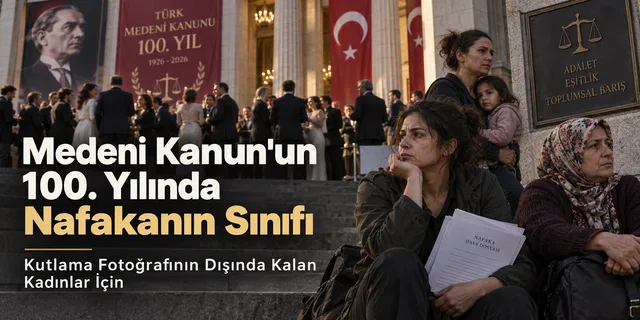
- Protect the right to alimony. We discussed this in our article on the centenary of the Civil Code.
Dear Comrades,
Each number represents a life cut short or constrained by the threat of violence. Taking data seriously does not mean reducing people to figures; it means making visible the public responsibility to protect those lives.
These numbers are not fate. Not opening shelters is a decision. Withdrawing from a convention is a decision. The proposed budget allocation is a decision. Withholding comprehensive data is a decision. What is decided can be changed, provided those who want change organise.
Today, women are calling for gatherings across Türkiye for peace, life and rights. Defending the demands raised in the streets tomorrow as well—in workplaces, homes and public institutions—gives solidarity continuity.
The class cannot be free without women's liberation. And without an organised class, women's gains cannot be made lasting.
Related Articles
- In the Square on 25 November, in the Kitchen on 26 November — Esen Kalaba introduces the book's version 1.1.2.
- Whose Family Is Safe? — family policy, budgets and unpaid care work.
- The Class of Alimony on the Centenary of the Civil Code — alimony and domestic labour.
- TÜİK: Two Figures, One Country — the gap between narrow and broad unemployment.
- Children's Rights Apply One Day a Week — child labour and early marriage.
- The AfD's 43.8 Per Cent Is No Aberration — reaction in Europe.
- Guides — our guides and resources.
Download the Book
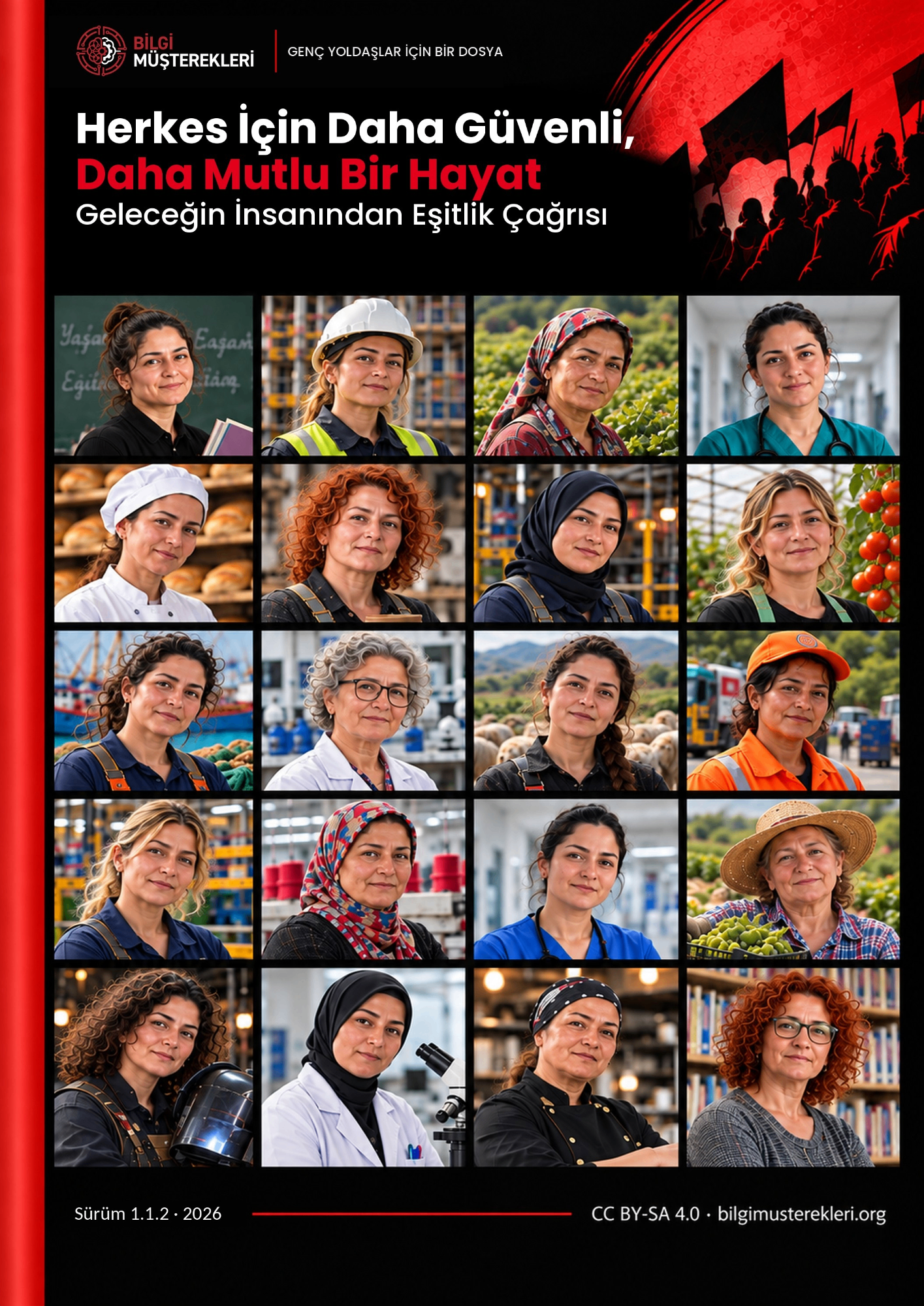
A Safer, Happier Life for Everyone: A Call for Equality from the Human of the Future explores equality from everyday life to collective struggle. It includes practical steps, urgent demands and support resources for women experiencing violence. Read more about version 1.1.2 in our introduction. The book is in Turkish.
Download: PDF (7.5 MB) | ePub (8.1 MB) | MD (384 KB)
Sources
World and local mobilisation
- UN News — Five women killed every hour by partners or family members, 24 November 2026
- UN Women Australia — 2026 Femicide Brief press release
- Rio Times — Africa figures and estimate range
- WHO — Lifetime toll: 840 million women faced partner or sexual violence, 19 November 2025
- UN Women and UN DESA — Gender Snapshot 2026 · press release · institutional power
- UN News — Gender Snapshot 2025 and conflict · UN Women — women in humanitarian crises
- World Economic Forum — Global Gender Gap Report 2026
Poverty among women and children
- Deep Poverty Network: Housing Problems of 20 Single Mothers Living in Deep Poverty, 2026
- Deep Poverty Network: You Are Not Alone Project Impact Report, 2026
- Open Space Association–Deep Poverty Network: Activity Report 2024–2025
- bianet: Hacer Foggo on child poverty, 15 January 2026
- TÜİK: Child Statistics, 2025
- TEPAV: Child Poverty and Birth Benefits in Türkiye, November 2026
Women in the earthquake-affected regions
- Presidency of Strategy and Budget: Kahramanmaraş and Hatay Earthquakes Reconstruction and Development Report, 2026
- Mor Çatı: Mechanisms to combat violence against women in the earthquake-affected region, 2023
- Mor Çatı: Field observations from September 2025, published in 2026
- UN Women Türkiye: Women's Life Centres, January 2026
Digital labour and AI
- The Guardian: India's women workers training AI (2026)
- WageIndicator and Data Labelers Association: Work and wages of Kenyan data workers (2026); preliminary findings
- Equidem: The human cost of content moderation and data labelling (2025)
- Lauren Benjamin Mushro: Gender and data annotation in Latin America (2025 preprint)
- Rest of World: Changing conditions for Venezuelan data workers (2025)
- ILO: The future of work in the electronics industry (2024); Viet Nam's electronics supply chain
- UNCTAD: Critical minerals and women's participation in mining (2026)
- Joan Kinyua: Organising across borders; UNI: Global moderators' alliance and safety protocols
Women in wealthy countries
- Eurostat, FRA and EIGE: EU gender-based violence survey (2024)
- Germany's Federal Criminal Police Office: Crimes against women and domestic violence (2024 data)
- Eurostat: Gender pay gap (2024 data); OECD: Inequalities in paid and unpaid work (2025)
- Guttmacher Institute: US state abortion laws (19 November 2026); CDC: Maternal mortality rates (2024 data)
- OECD: Japan employment outlook (2024); AIHW: Intimate-partner homicides in Australia (2024–25)
- Nordic Council of Ministers: Women's strikes in Iceland; Iceland Review: The 2023 women's strike
Country studies
- UN Women — the impact of war on women and girls in Gaza, October 2026 · UNFPA — Gaza winter plan, November 2026
- UNICEF — girls' education in Afghanistan, August 2026
- UN Iran Fact-Finding Mission — March 2026 report · October 2026 statement
- UN Women — the impact of Sudan's war on women, April 2026
- UNFPA — humanitarian situation in the Democratic Republic of the Congo · UNDP and UN Women — gender inequality in Myanmar, June 2026
Türkiye: violence
-
BirGün — Beyoğlu's 25 November 2026 ban and the district governor's statement · bianet — reactions and the 25 November Women's Platform's call
-
BirGün / ANKA — court decision on the 2025 Beyoğlu ban, 14 November 2026
-
bianet — 25 November actions in 32 locations, 24 November 2026 · Sendika.Org — local 25 November programmes
Türkiye: labour and poverty
- DİSK/Genel-İş — 2026 Women's Labour Report · 18 September statement
- bianet — general services employment in 2026
- DİSK-AR, first quarter 2026 — ANKA · third quarter · September figures — Evrensel
- İSİG October 2026 report — Euronews
- bianet — Global Gender Gap Report and Türkiye · Derin Bilim
Theoretical background
- Friedrich Engels, The Origin of the Family, Private Property and the State (1884)
- Alexandra Kollontai's writings on the socialisation of domestic labour.
Published by Bilgi Müşterekleri. Derived ratios such as “one every 22 hours” and “4.7 times” are calculated from the cited figures. The 22-hour average includes suspicious deaths as well as femicides. Women's organisations' press-based counts may understate the total. Reuse with attribution under CC BY-SA 4.0.