A World That Is Hell for Children
From Congo's Cobalt to the Sahel's Gold, from Gaza to Sudan: A Class Map of Global Violations of Children's Rights

Dear Young Comrades,
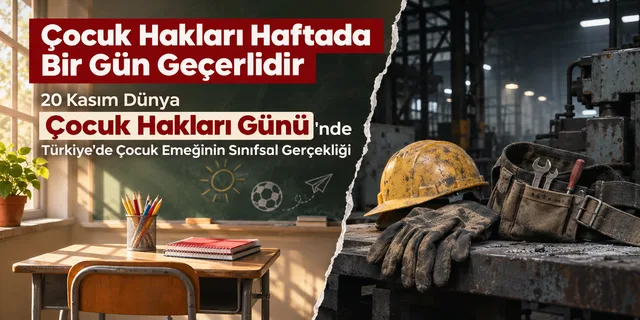
In Children's Rights Are Valid One Day a Week, published on 20 November, we discussed child labour in Turkey: MESEM, the children who die in fields and on construction sites, and those who are never counted. One reader's comment reminded us of a justified omission:
"Child cobalt workers in Congo! Child gold workers in Africa!"
Our reader is right. To speak of children in Turkey without speaking of children around the world would be to look at one link without seeing the chain. The child picking cotton in Şanlıurfa and the child carrying a sack of cobalt in Kolwezi stand at two ends of the same system. This article attempts to address that omission.
A warning before we begin: there are many figures below, and all are distressing. Our aim is not to paralyse readers with horror. Horror can immobilise; knowledge can move us to act. We suggest reading the figures not in isolation but in relation to one another: why are these children there, and who profits from their labour and deaths?
First, the Summary
First: Child labour is declining, but it has not ended, and the promise was broken. According to ILO and UNICEF estimates, nearly 138 million children were in child labour in 2024, including 54 million in hazardous work. Governments pledged in 2015 to eliminate child labour by 2025. The deadline passed; the promise was not kept.
Second: Africa bears the heaviest burden. Almost two-thirds of child labourers, around 87 million, live in sub-Saharan Africa. This is not a question of "backwardness". It is also a consequence of a system built to move the continent's minerals, cocoa and gold cheaply onto the world market.
Third: At the bottom of cobalt, coltan, gold, cocoa and mica supply chains are children; at the top are monopolies. A child in a mine earns a few dollars a day. When raw materials become phones, cars, jewellery or chocolate, value accumulates at the other end of the chain.
Fourth: Verified grave violations against children in war are at a record level. The UN verified 38,558 grave violations against 24,174 children in 2025, the highest verified number since its monitoring mandate was established in 1996. For the first time in three decades, government forces rather than armed groups were responsible for the majority of grave violations.
Fifth: Hunger is inseparable from political choices and conflict. In 2025, for the first time in the history of the Global Report on Food Crises, famine was confirmed in two separate contexts in the same year: Gaza and parts of Sudan. Wealthy countries also cut aid budgets.
Sixth: The rights to education, health and childhood exist only on paper for millions. Some 273 million children and young people are out of school. In 2024, 4.9 million children died before their fifth birthday. Twelve million girls are married each year.
Seventh: Wealthy countries are not innocent either. In the United States, the number of children found working in violation of child labour laws multiplied over a decade, while some states are weakening protections. This is not merely a problem of "distant countries"; it is bound up with capital's search for cheap labour.
Eighth: The answer lies not in the consumer's conscience but in organised struggle. "Ethical product" labels and voluntary corporate commitments have been tried for twenty-five years. The results speak for themselves. Historically, the organised strength of the working class has been essential to limiting child labour.
Now let us turn to the details.
The Big Picture: 138 Million Children
Let us acknowledge the good news first, because honesty requires it. According to ILO and UNICEF, the number of children in child labour fell from 246 million in 2000 to 138 million in 2024. Struggle can produce results; this system is not destiny.
The bad news is that progress is too slow. The report says it would have to accelerate elevenfold to end child labour in the next five years. Most child labour is in agriculture; the rest is in services and industry, including mining and manufacturing.
The geographical distribution maps inequality. While the number of children in child labour in Asia and the Pacific fell from 49 million to 28 million in four years, sub-Saharan Africa accounts for nearly two-thirds of the total, around 87 million children.
Consider one of its gravest forms. ILO estimates of forced labour put the number of children in forced labour at 3.3 million, more than half of them in commercial sexual exploitation. The ILO estimates annual illegal profits from forced labour at $236 billion. This is not a marginal detail of the "criminal underworld"; it is an industry in its own right.
Congo: The Child at the Bottom of the Phone, Car and Battery
Let us begin where our reader pointed.
Roughly 70 per cent of the world's cobalt is mined in the Democratic Republic of the Congo. Cobalt is a component of many lithium-ion batteries, found in phones, laptops and electric vehicles. A 2023 estimate put the share from informal, artisanal small-scale mines at 15–30 per cent. Children work in these mines.
How many? Nobody knows the exact number, and that uncertainty is itself significant. Estimates cited in a 2022 US Department of Labor report range from 5,000 to 35,000 children in artisanal cobalt mining. A frequently cited older UNICEF estimate puts the number working in mines across the country at around 40,000; these figures cover different years and populations and are not a current census. A 2023 report says children working in cobalt mines earn up to $2.50 a day, usually giving their earnings to their mothers for household needs and school fees. It is poverty, not parental "ignorance", that pushes children into mines.
Nor is it limited to cobalt. In conflict-affected eastern Congo, children extract tin, coltan, tungsten and gold. Coltan is a source of tantalum used in electronic capacitors. An Al Jazeera report from March 2026 describes the situation today. North Kivu's Rubaya mines account for an estimated 15–30 per cent of the world's coltan and have been controlled by Rwanda-backed M23 since 2024. A fifteen-year-old in the report left school at eleven after his father died in a mine collapse. He earns about $4 a day carrying coltan. The Congolese government says 200 people, including 70 children, died in a collapse at Kasasa on 3 March 2026; M23 disputes the toll as exaggerated. The number is contested. The presence of children in those mines is not.
Two points deserve attention.
First, who does the law protect? In 2019, a lawsuit was brought in the United States against Apple, Alphabet, Dell, Microsoft and Tesla on behalf of injured children and families of children killed in mines. An appeals court dismissed the case in March 2024, finding that buying cobalt through a global supply chain did not establish participation in the alleged forced-labour venture. The longer the chain, the easier it becomes for profit to flow upward while accountability is lost along the way.
Second, the market pushes children from one mineral to another. A 2026 Cobalt Institute presentation describes artisanal miners moving from cobalt toward copper in recent years, especially in 2025, as prices and regulations changed. When we hear that child labour in cobalt has declined, we should ask: did the child go to school, or to the copper pit next door?
Gold: Childhood Mixed with Mercury
Our reader's second subject was gold.
Across West Africa's gold belt — Mali, Burkina Faso, Ghana and Niger — small-scale mining supports millions of livelihoods. An ILO estimate from the early 2010s, reported by PBS, put the number of children working in small-scale African gold mines at up to one million, some earning around $2 a day, and estimated that children made up 30–50 per cent of miners in the Sahel. There is no current comprehensive count. We say this plainly: a child who is not counted is often a child who is not protected.
The most insidious hazard is mercury, used to separate gold from ore. Children mix it by hand and breathe its vapour when the mixture is burned. Human Rights Watch documented this in Mali and Ghana: mercury can damage the central nervous system and cause permanent brain injury, with children especially vulnerable. There are also collapsing shafts, heavy loads and years without schooling.
The Ghana report also shows the other end of the chain: at the time, about a third of the country's gold came from small-scale mines, with annual exports worth well over a billion dollars. Traders and refineries mix that gold into the global market. Nobody can tell whose lungs were exposed to mercury for a bracelet in a jeweller's window or a bar in a central bank vault. That uncertainty serves the system.
Cocoa and Mica: The Price of Sweetness and Sparkle
Two examples beyond mining deserve attention.
Cocoa. More than half of the world's cocoa comes from Côte d'Ivoire and Ghana. According to research by NORC at the University of Chicago for the US Department of Labor, 1.56 million children worked in cocoa production in the two countries in 2018–19, 1.48 million of them in hazardous work, including using machetes, exposure to pesticides and carrying heavy loads.
The industry's history is instructive. In 2001 chocolate companies signed the Harkin–Engel Protocol, promising to end the worst forms of child labour. In the years that followed, cocoa production rose by 62 per cent, while the prevalence of child labour in cocoa-growing areas increased rather than declined. Anyone wondering what voluntary commitments have achieved should look here.
Mica. This mineral gives cosmetics, car paint and electronic components sparkle or insulation. A 2019 Terre des Hommes investigation found that at least 10,000 children worked in Madagascar's mica sector. India's Jharkhand state is also associated with the same problem.
Two Ends of the Chain
Let us place these examples side by side.
| Raw material | Where children work | Evidence in the sources | At the other end of the chain |
|---|---|---|---|
| Cobalt | Southern DRC copper–cobalt belt | 2022 report: estimate of 5,000–35,000 children; 2023 report: up to $2.50 a day | Batteries, phones, electric vehicles |
| Coltan | North Kivu, DRC (Rubaya) | One child's reported earnings of around $4 a day; children killed in collapses | Electronic circuits |
| Gold | Mali, Burkina Faso, Ghana, Niger | Older ILO estimate of up to one million children; mercury exposure | Jewellery, bullion, reserves |
| Cocoa | Côte d'Ivoire and Ghana | 1.56 million children in 2018–19 | Chocolate industry |
| Mica | Madagascar and India | At least 10,000 children in Madagascar in a 2019 investigation | Cosmetics, automotive products, electronics |
A pattern recurs: raw materials leave poor countries while value accumulates in wealthy countries and corporate balance sheets. Child labour is the cheapest and most vulnerable link in that transfer.
War: Grave Violations Against Children
We cannot discuss children's rights violations through labour alone. A child's most fundamental right is to live.
The UN Secretary-General's Children and Armed Conflict report, published on 16 June 2026, covers 2025. Its figures include:
- 38,558 verified grave violations against 24,174 children, the highest verified total since the monitoring mandate began in 1996.
- Children killed rose by 34 per cent to 6,266; the combined number killed or maimed was 14,224.
- 6,607 children were recruited and used by parties to conflict.
- 8,322 incidents of denial of humanitarian access were recorded.
- The most violations were verified in Israel and the occupied Palestinian territories: 12,445 against 5,663 children, including 9,465 attributed to Israeli armed and security forces. The DRC, Nigeria, Myanmar, Somalia and Sudan followed.
Perhaps the report's most important finding is that, for the first time in thirty years, government forces rather than armed groups were responsible for the majority of grave violations. In a world where states speak of an "international rules-based order", government forces were also the leading perpetrators of attacks that killed or maimed children. These are only cases the UN could verify; the real number may be higher.
Back in Congo, the picture comes together. The places where children work in mines and where children are recruited into armed groups can overlap. A US Department of Labor report describes armed groups forcing children to work in mines in the east, where forced labour, conflict and mining intertwine. Wars are fought over minerals, and minerals help finance wars; children are at the bottom of both.
Hunger, Disease and Aid Cuts
A child who survives a bomb may still face hunger.
According to the 2026 Global Report on Food Crises, 35.5 million children experienced acute malnutrition in 2025, nearly 10 million of them severely. That year famine was confirmed in two separate contexts for the first time in the report's history: Gaza Governorate and parts of Sudan. Conflict and restricted humanitarian access were the principal drivers. In Sudan, 825,000 children under five were projected to suffer severe acute malnutrition in 2026.
The wider picture is grim. UN agencies estimated in March 2026 that 4.9 million children died before the age of five in 2024. Fifty-eight per cent of these deaths occurred in sub-Saharan Africa; most could have been prevented with known, affordable measures such as vaccination, malaria treatment, clean water and skilled birth attendance.
Meanwhile, wealthy countries cut aid budgets. A study in The Lancet projects that if USAID cuts persist, more than 14 million additional deaths could occur by 2030, including over 4.5 million children under five. This is a modelled projection, not a certainty. But the risk is clear.
A qualification is necessary. Defending "aid" as a system is not our task. Aid can return a small, conditional part of what exploitation extracts and often reinforces dependency. Yet a child endangered when aid is cut is real. The deeper question is why a continent whose minerals, cocoa and gold enrich the world must depend on someone else's budget decision for a child's malaria medicine.
School, Poverty and Stolen Childhood
We will keep these subjects brief, though each deserves an article of its own.
School. According to UNESCO's 2026 Global Education Monitoring Report, the number of children and young people out of school has risen for seven consecutive years to 273 million. One in six school-age children is excluded from education.
Poverty. UNICEF's State of the World's Children 2025 finds that 417 million children in low- and middle-income countries face severe deprivation in at least two basic areas, including nutrition, housing, health, education, water and sanitation. More than 19 per cent of the world's children live on less than $3 a day.
Child marriage. UNICEF estimates that 12 million girls are married each year. Some 640 million women and girls alive today were married as children. Poverty and war can lead families to regard marrying off a daughter as a form of "security".
These issues are connected. A child without schooling may go to work; work can keep a child from returning to school. A poor family's daughter may be married off, its son sent to a mine. Each problem can be both cause and consequence of the others.
Child Labour in a Wealthy Country: The United States
A reader might think this is a problem of "poor countries". It is not.
According to Human Rights Watch and US Department of Labor data, the number of children found employed in violation of child labour laws rose from 1,012 in fiscal 2015 to 4,030 in fiscal 2024, an increase of roughly 300 per cent in children identified through enforcement. In one prominent case, a sanitation contractor paid $1.5 million in penalties for employing 102 children in hazardous work at meatpacking plants in eight states. Unaccompanied migrant children are among those found in hazardous work in the United States.
While violations continued, some states also moved to weaken protections. According to the Economic Policy Institute, by June 2026 at least 13 states had introduced bills weakening child labour protections, and four had enacted them. A September 2026 Government Accountability Office report also called for the Department of Labor to better protect working children.
Turkey's MESEM and US laws promoting "work experience for young people" differ in their institutions, but invite comparison. The justification and the demand for cheap, compliant, unorganised labour are familiar.
Why Is the Picture Like This? A Class Reading
We have placed the figures side by side. Now let us connect them.
Child labour is not a cultural problem; it is a cost item. As we argued about Turkey in the first article, poverty pushes children into work and capital draws them in as cheap labour. In Capital, Marx describes how machinery brought women's and children's labour into capital's service, and how sending all members of a working family to market affected the value of the male worker's labour power. Today the scale is global. When a Congolese child works for $2.50 a day, the child's own childhood is stolen, and adult miners' wages can be pushed down too.
A poor country's poverty is no accident. A country that sells raw materials cheaply, buys expensive manufactured goods and services debt with its resources has less room for schools, healthcare and labour inspection. Lenin's analysis of imperialism centres on capital export and monopoly control dividing the world between a handful of creditor countries and a debtor majority. The "minerals for security" negotiations over Congo's cobalt are a contemporary expression of that relationship.
The supply chain is a machine for evading responsibility. A monopoly need not run the mine itself; it buys from intermediaries, refineries and traders. Profits accumulate higher up the chain while proving responsibility for violations at the bottom becomes difficult. In the cobalt case, the court found that participation in a particular forced-labour venture had not been established; that does not mean companies can never be held liable.
War and child labour are two sides of the same accumulation. Weapons are sold, mines seized and displaced people made vulnerable to cheap labour. Syrian children in Turkish textile workshops and Central American children in US meatpacking plants stand at the end of this cycle.
The "green transition" and digital age rest on these chains. Electric vehicles, data centres and phones rely on various minerals and metals. We are not against technology. But we cannot call it clean without asking who breathes the dirt produced in its making. As we said in the first article: the machine is new; the chain is old.
Two Perspectives
| Charity and "ethical consumption" | A class perspective | |
|---|---|---|
| The problem | Poor families' ignorance, "bad" companies | Accumulation based on cheap labour and raw materials |
| The child | A victim to be pitied | A member of our class whose rights have been taken away |
| Responsibility | Unclear: "all of us" | Identifiable: monopolies at the top and states that enable them |
| Solution | Donations, certification, labels, corporate pledges | Binding law, public oversight, unions, secure family incomes, free education |
| Agent of change | The consumer | Organised workers and local working communities |
| Twenty-five years on | Child labour in cocoa rose after Harkin–Engel | Child labour declined where organisation and public policy advanced |
One point needs emphasis: "boycott Congolese cobalt" is not a solution. Abruptly ending purchases from artisanal mines without alternative incomes could make families' livelihoods even more precarious and push children into more dangerous work. The issue is not whether cobalt is mined, but under whose conditions and for whose benefit.
What Is to Be Done? Concrete Tasks
What can those of us in Turkey do for a child in Kolwezi? More than we might think.
Demands:
- Binding supply-chain legislation with penalties that holds lead companies legally responsible throughout their supply chains, rather than voluntary pledges.
- Public traceability of imported gold, cocoa, minerals and electronic components.
- An end to arms sales to conflict zones and to military and commercial cooperation with states responsible for grave violations against children.
- Cancellation of poor countries' debts. Debt payments take resources away from schools and public services.
- Unconditional access to education and healthcare for migrant and refugee children in Turkey. We cannot speak for children around the world while remaining silent about those at our own door.
Organisation:
- Our unions should make international solidarity more than a ceremonial matter, building direct ties with global union federations and Congolese, Ghanaian and Ivorian workers' organisations in mining, metal, food and textiles.
- Tech workers should question their own industry's raw-material chains. Both software developers and hardware designers stand somewhere in that chain. We see this as part of our Organising 2.0 discussions.
- Spread this knowledge in schools, neighbourhoods and youth organisations. Every young comrade who tells a friend the story of their phone has made a start.
- Connect the struggle against child labour in Turkey to the struggle worldwide. Opposing MESEM and opposing child labour in cobalt mines are part of the same fight.
Dear Comrades,
Our reader's sentence with its two exclamation marks reminded us: a child has no homeland, just as capital has no homeland. Cobalt is mined in Congo, refined in China, turned into a battery in Korea and a brand in California, and enters our pockets in Istanbul. Capital is united along the chain. We are the ones who are scattered.
None of the numbers in this article is a law of nature. If the number of children in child labour fell from 246 million in 2000 to 138 million, that was not thanks to corporate conscience alone, but to struggle, public education and social protection. It can fall further. It can reach zero. But not by itself.
We called this world "hell" in the title. Gods did not build hell; people did. The class that built it has a name, an address and a balance sheet. What people built, people can dismantle.
Let the children of Congo, Mali, Gaza, Sudan and Şanlıurfa go to school, to play and to science — not to mines, battlefields or employers' tills.
Sources
Child labour: global data
- ILO and UNICEF, Child Labour: Global Estimates 2024, Trends and the Road Forward, 11 June 2025. Read the source
- ILO, forced labour data, 2021 global estimates. Read the source
Congo: cobalt and coltan
- Al Jazeera, "'It helps us survive': Poverty forces children into mine work in DR Congo", 20 March 2026. Read the source
- US Department of Labor, 2022 Findings on the Worst Forms of Child Labor: Democratic Republic of the Congo. Read the source
- Mining.com, "Families in the DRC increasingly rely on children working in cobalt mines". Read the source
- Cobalt Institute, presentation on artisanal copper and cobalt mining, 2026. Read the source
- JURIST, "US appeals court dismisses DRC child labor case against Tesla, other tech companies", March 2024. Read the source
Gold, cocoa and mica
- Human Rights Watch, A Poisonous Mix: Child Labor, Mercury, and Artisanal Gold Mining in Mali, December 2011. Read the source
- Human Rights Watch, Precious Metal, Cheap Labor: Child Labor and Corporate Responsibility in Ghana's Artisanal Gold Mines, June 2015. Read the source
- PBS NewsHour, report on Burkina Faso's gold mines and ILO estimates, 10 July 2013. Read the source
- NORC, Assessing Progress in Reducing Child Labor in Cocoa Production in Côte d'Ivoire and Ghana, October 2020. Read the source
- NBC News, investigation of Madagascar's mica mines and Terre des Hommes report, November 2019. Read the source
War
- UN Secretary-General, Children and Armed Conflict (A/80/723-S/2026/357), 16 June 2026. Read the source
- Arab News, report on the UN findings, 18 June 2026. Read the source
Hunger, health and aid cuts
- UNICEF and partners, Global Report on Food Crises 2026, 24 April 2026. Read the source
- FAO, WFP and UNICEF, Sudan statement, 15 May 2026. Read the source
- WHO, UNICEF and partners, Levels and Trends in Child Mortality, 18 March 2026. Read the source
- Cavalcanti et al., impact of USAID funding cuts on mortality, The Lancet, 2025. Read the source
Education, poverty and child marriage
- UNESCO, 2026 Global Education Monitoring Report, 25 March 2026. Read the source
- UNICEF, The State of the World's Children 2025: Ending Child Poverty, 20 November 2025. Read the source
- UNICEF, Is an End to Child Marriage within Reach?, May 2023. Read the source
United States
- Human Rights Watch, joint submission to the UN Universal Periodic Review, 8 April 2025. Read the source
- US Department of Labor, child labour enforcement data. Read the source
- Economic Policy Institute, "State lawmakers continued to weaken child labor protections in 2026". Read the source
- US Government Accountability Office, Child Labor: DOL Action Needed to Better Protect Working Children, September 2026. Read the source
Classical texts
- Karl Marx, Capital, Volume I, "Machinery and Modern Industry".
- V. I. Lenin, Imperialism, the Highest Stage of Capitalism.
- Friedrich Engels, The Condition of the Working Class in England.
Related Articles
- Children's Rights Are Valid One Day a Week (20 November 2026)
This article is a living document and will be updated as new information becomes available. CC BY-SA 4.0.