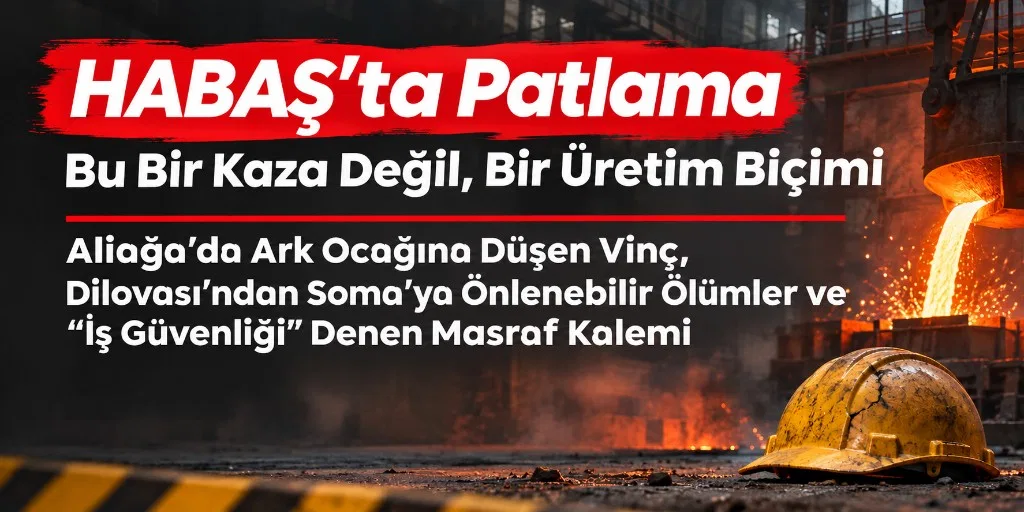
The Explosion at HABAŞ: This Is Not an Accident, It Is a Mode of Production
The Crane That Fell into the Arc Furnace in Aliağa, Preventable Deaths from Dilovası to Soma, and the Expense Item Called "Occupational Safety"
A living document. This piece was written in the first hours of the event. Official figures and testimonies have not yet settled. It will be updated as information arrives.
Update
The newest entry is at the top.
- 11 November, 13:35. Evrensel updated at 13:35 the page it had entered at 13:10. The headline says one more worker who was critically injured has died. The İSİG Meclisi's post on X: Abdullah Kılınç, critically injured in the explosion, has died. He was from Suruç in Şanlıurfa. He had been taken to hospital. The page writes him as the 19th worker. Yesterday at Forensic Medicine, from the DNA samples of families whose relatives could not be reached, 18 workers were established to have died. There is no match belonging to Barış Güney. Kılınç is not on the list of 17. The 19 is this page's count. It is not added to the 17. Güney is on that list. This page writes that the match is not there. The two sentences stand. No hospital name. (Evrensel)
- 11 November, 11:57. Evrensel. The minute is 11:57. There is no update line. The headline says a DNA sample belonging to Barış Güney was not found. 18 workers died. The DNA is finished, and there is no sample matching Güney. DHA dwells on the possibility that he remained under the wreckage. The search continues. The "what had happened" writes 9 November as 12:00. The mechanism is the pour and the arc furnace. 17 dead, 15 injured. The decision is 11. The boss Rüştü Başaran is in Istanbul. Abdullah Kılınç died at Çiğli Training and Research Hospital. The other treatment continues. This sentence does not give a new total. It says that in the last 10 years, together with the latest explosion, the total rose to 28. This 28 is not the number this essay builds from 11 and 17. The page does not write who was added to whom. The 18 and the 17 are on the same page. (Evrensel)
- 11 November, 11:45. İşçi Haber. The source is İHA. Abdullah Kılınç died at Çiğli Training and Research Hospital. It says the death toll rose to 18. The initial assessment is 17 dead and 15 injured. Treatment of 6 injured continues. The search for Barış Güney continues. This 18 is not the 18 of the pages that count Güner Gökçe as the 18th. It writes Kılınç on top of the 17. Evrensel at 13:35 writes the same death as 19. The two stand. (İşçi Haber)
- 11 November, 11:30. Milliyet. Kadir Özen, DHA. Entered and updated at 11:30. The headline says one more bitter piece of news in the disaster in which 18 people died. The body writes the initial assessment as 17 dead and 15 injured. Its time is 12:00 the day before yesterday. Abdullah Kılınç died today at Çiğli Training and Research Hospital. There is no new total. Barış Güney is missing. The DNA is finished, and there is no match. He may be under the wreckage, and the search continues. It says 11 suspects were taken into detention. Tuncay's sentence was a decision. The posts: chair of the board, factory manager and employer's representative, quality and planning manager-employer's representative, administrative manager, Aliağa branch manager, steelworks manager, mechanical maintenance chief, steelworks chief, periodic-inspection engineer, section engineer, crane mechanical-maintenance engineer. No names. It does not write Yücel Memiş and Sonay Tezcan as these 11. (Milliyet)
- 11 November, 10:43. Pusula Haber. The DNA is finished. There is no match with Barış Güney. The search in the wreckage continues. 17 dead, 15 injured, 1 missing. It writes the missing person as Barış Güney. Tuncay had not given a name. Kılınç is not there. Güner Gökçe is not there. (Pusula Haber)
- 11 November, 01:51. Evrensel updated at 01:51 the page it had entered at 00:01. The number of the dead is 18. The day after the explosion the workers were called in by force. A ban on telephones. "Wherever you go, you will get permission from us." Goods produced earlier were loaded onto trucks. How many workers were in the section was still not given yesterday. Elban reports that about 200 was what was said. The workers say more. Türk Metal made no statement beyond a condolence, did not raise its voice against the forced work, and did not put a single word on its site. The opening says the boss Mehmet Rüştü Başaran and 11 officials. Tuncay's 11 counted the chair inside. This sentence writes the chair outside the 11. The two stand. He was taken from his house in Kartal 30 hours later. There is not a single frame of the moment of detention. While Tuncay was speaking, work at the plant was still going on. At the hospital a list was shown: the living are here, those whose names are not on it should go to forensic medicine. The owners of the subcontracting firms said "we loved your son like our own son". Şevval Özçelik: he was killed at 12 o'clock, they hid it, they gave the news like a rag, "why are we looking for the people we love in the rubbish". A subcontracted worker says every morning "will something happen to us today". "When something happens to us we cannot complain, for fear of being fired." The Gebze branch of Petrol-İş made a statement at the end of the shift in front of Ravago Enplast. It says at least 29 in the last ten years. This is not this essay's at least 11. The page does not write how it added up the 29. (Evrensel)
- 10 November, 23:35. Yerel TV. Updated at 23:35. Elban's post: Abdulkadir Kınacı's prayer at Menemen Çınarlıdere Mosque, the prayers for İlker Sığırmacıoğlu and Hüsnü Ersoy at Aliağa Bozköy Mosque. Işıkhan was there too. It says 3 workers. The spelling is Sığırmacıoğlu. That is not the list's Sığırtmacıoğlu. Abdulkadir is not the list's Abdülkadir. (Yerel TV)
- 10 November, 20:25 GMT+1. Euronews. It says the number of the dead rose to 18. Mehmet Rüştü Başaran was detained among 11 people. According to T24 he was taken to the Public Order Branch Directorate, and the procedures continue. Kartal is not there. The place is the iron and steel plant located in the carbon-dioxide filling facility. This is not the steelworks sentence. The time is 11:30. The initial assessment is the pour, the overhead crane and the arc furnace. The plant says planned maintenance. Elban said that where there should have been more than 300, it was about 200. The 18 have no names. Güner Gökçe is not there. Kılınç is not there. (Euronews)
- 10 November, 20:43. Sabah. The cousins. İlker Sığırtmaçoğlu, 31, married. Hüsnü Ersoy, 38, married, father of twin girls. Bozköy Mosque, the afternoon prayer. Işıkhan, Deputy Minister Ahmet Aydın, Elban, AK Party İzmir provincial chair Bilal Saygılı. The coffins were draped in flags. The spelling is Sığırtmaçoğlu. (Sabah)
- 10 November, 20:37. BirGün. Ceylan Bıyıklı was buried at Bozköy. Evrensel at 16:26 wrote Emiralem. The two stand. The writing on the HABAŞ wreath was pulled off and torn up. The Smart Solar resisters. Her sister is one of the 85 workers fired because they left the yellow union TES-İŞ for DİSK/Enerji-Sen. The resistance continues. The page attributes this to sendika.org. (BirGün)
- 10 November, 19:33. Nefes. Entered and last updated at 19:33. With the body of Güner Gökçe reached, 18. 13 in İzmir and its districts, 5 in their home towns. Güner, Paşalı in Şenkaya, Erzurum. Ceylan Bıyıklı at Menemen Emiralem. BirGün the same evening writes Bozköy. Abdülkadir Kınacı, 57, 3 children, 4 days after he started the job. Çınarlı Dere Mosque, the afternoon prayer. Işıkhan, AKP Secretary General Eyyüp Kadir İnan, Elban, members of parliament, Menemen Mayor Aydın Pehlivan. In one place Sığırtmacıoğlu, in the programme Sığırtmaçoğlu. The 18 writes Güner on top of the 17. Kılınç is not there. This name is not added to the 17. (Nefes)
- 10 November, 17:49. Evrensel updated at 17:49 the page it had entered at 14:35. The headline says the boss Rüştü Başaran was detained. The standfirst: 17 dead, the chair of the board inside the 11, Başaran in Istanbul. The body: yesterday noon, 17 dead, 12 injured of whom 1 is critical. Treatment continues. After the morning's decision, AA says he was detained at his address in Kartal. Tuncay's 11 posts stay. The only name is Başaran. It does not write Yücel Memiş and Sonay Tezcan as these 11. A decision, for the 11. Taken, for Başaran. 9 November 11:45, the beam as a whole, the charging crane and the vessel. According to the family's application, 1 worker had not been reached. This sentence does not make 17 into 18. It does not say who. The death is burns at the degree of carbonisation. There are rumors and complaints about the earlier deaths. Euronews writes the same person as Mehmet Rüştü. This page writes Rüştü. The two stand. Tuncay's 15 injured are not on this page. The 12 stands. (Evrensel)
- 10 November, 17:09. Evrensel updated at 17:09 the page it had entered at 17:01. The headline and the standfirst say 18 workers. The first sentence writes that three of the 17 workers will be buried at Bozköy. İlker Sığırtmacıoğlu, Hüsnü Ersoy, Göksel Ünaldı. HABAŞ sent a condolence wreath. The company is silent. The wreath stands beside the wreaths of AKP Menemen Mayor Aydın Pehlivan and AK Party Menemen district chair, lawyer Hakkı Durmaz. The 18 and the 17 are on the same page. (Evrensel)
- 10 November, 17:04. Haberport. The missing worker was established to be Güner Gökçe. The death toll is 18. The funeral is tomorrow at Paşalı Village Cemetery in Şenkaya. It reports Tuncay's noon words as missing. It writes the explosion as yesterday noon. It is not added to the 17. Nefes's 18 is this name. İşçi Haber's 18 is Kılınç. The two stand. (Haberport)
- 16:26. Evrensel updated at 16:26 the page it had entered at 12:05. The headline now says the burial places are known too. The first sentence still says they "have begun to become clear". The list is the same 17 names. The cemeteries: İlker Sığırtmacıoğlu, Hüsnü Ersoy and Göksel Ünaldı at Aliağa Bozköy; Yasin Taşçı at Menemen Koyundere; Uğur Temel at Buca; Barış Güney at Afyonkarahisar Güneytepe; Orhan Altay at Buca Kaynaklar; Özcan Efe at Manisa Şehzadeler Kırtıkdere; Recep Fedai at Afyonkarahisar Şuhut Karacaören / Karaadilli; Abdülkadir Kınacı at Menemen Yahşelli Çınarlıdere; Ceylan Bıyıklı at Menemen Emiralem; Ferhat Maraşlı at Menemen Koyundere; Ersin Oğuz at Kınık Büyükovaköyü; Mustafa Sert at Menemen Asarlık; Kadir Kaan Özçelik at Menemen Ulukent; Serkan Kurt at Doğançay Örnekköy; Fatih Işık at Kırıkkale Yuva. The page writes that Günay Gökçe, among the names İSİG announced, is not in these 17. A subheading writes the same person as Güner Gökçe, from Şenkaya in Erzurum. This name is not added to the 17. It is not written as the same thing as Tuncay's sentence about a body that has not been reached. The list spells İlker Sığırtmacıoğlu. The subheading writes Sığırtmaçoğlu. Göksel Ünaldı's children say it was their father's first day at the job, that he was cleaning during the vessel maintenance, and that they understood when the gendarmerie came to the house after the explosion. One sentence writes Günaldı. Orhan Altay is from a village of Aşkale in Erzurum. Serkan Kurt lived in Karşıyaka. Recep Fedai is also written as a metal worker from Menemen. (Evrensel)
- 14:49. Habertürk. Entered at 14:48, updated at 14:49. Deputy Justice Minister Can Tuncay is at the plant. 17 dead, 15 injured, one critical. His time is 11:45. His account: while the vessel of the third arc furnace was being carried, the crane-way beam separated from the column bearings and connections and fell as a whole, the charging crane and the vessel fell, and the explosion came from that. The governor's evening words were a vessel change and the gas line. The "initial assessment" on DHA and NTV is the liquid-steel pour and the arc furnace. Hürriyet at 10:44 is maintenance and the gas line. This is a fourth account. According to the families' applications, one worker's body has not yet been reached. This sentence does not make 17 into 18. It does not say who. The detention decision is 11. The posts: factory manager and employer's representative, steelworks manager, mechanical maintenance chief, steelworks chief, periodic-inspection engineer, section engineer, crane mechanical-maintenance engineer, quality and planning manager, administrative manager, Aliağa branch manager, chair of the board. No personal names. The prosecutor's text is 6. NTV at 11:21 and Hürriyet write 7. It does not write Yücel Memiş and Sonay Tezcan as these 11. Tuncay's sentence is a decision. NTV at 13:58 writes it as the number of people taken. There is a preliminary expert report. The 11 decisions are according to that report. The detail of the report is not published. The cause of death, according to the forensic examination, is burns at the degree of carbonisation. This is not written as the cause of the explosion. There are rumors and complaints that workers had died before in the section of the scene. There are two separate investigations. The files may be merged. This text does not say which deaths. (Habertürk)
- 13:58. NTV updated at 13:58 the page it had entered at 11:04. The 17 names of 12:48 stay. It writes Tuncay's words as the number of people detained rising to 11. The injured sentence stays: 14, one of them critical. The time is 12:00. The "initial assessment" is again the pour and the arc furnace. Tuncay's 15, and his account of the beam, are not on this page. (NTV)
- 13:26. Bianet. Entered at 13:20, updated at 13:26. DNA continues. It writes that Şevval Özçelik told journalists she learned the news in the evening, and it also places her post on X. The post says it was hidden in the morning, the governor went off in his private car, and her brother was in a body bag. The two reports stand on the same page. The new sentence: his hands were burned at this workplace, they frightened him by saying that if he called it a workplace accident they would fire him and come after him, he went to Menemen State Hospital, he could not file a complaint, and he returned a week later. AA's page did not write the threat or the hospital. (Bianet)
- 10 November, no clock. DW. Pelin Ünker, Alican Uludağ. No minute. It writes the prosecutor's 6. The 11 is not there. HABAŞ's written statement builds the event as an "accident" "during planned maintenance work at one of the electric arc furnaces". It separates the governorate's first statement as the pour and the arc furnace, the governor's words as the vessel change, and Işıkhan's words as material falling during maintenance and breaking the natural-gas and oxygen pipes. Tuğçe Kızıldemir of DGD-SEN reports the information that a piece attached to the crane struck the natural-gas pipe. She says "a workplace murder happened there only 5 days ago. That place had not seen any inspection." The 5 is her sentence. Firdevs Avşar, chair of the İzmir branch of ÇHD, reports that it is being said the crane broke from its main connections around 11:30 and struck the gas pipes, and that a record was kept that an inspection could not be done because everything inside had burned. She says many past files were closed with compensation. The company's 2025 sustainability report. The lead says lost-time accidents rose 56 percent, and more than doubled among subcontractors. The body: company employees from 109 to 146, about 34 percent. Subcontractors from 38 to 83, about 118 percent. The total from 147 to 229. These are not deaths. The injured person could not start work on the next working day. The hours worked by company employees fell 3 percent. The frequency per million hours is 22 for company employees and 39.34 for subcontractors. Occupational-safety training was 65,700 hours in 2024 and 8,697 hours in 2025. A drop of about 87 percent. The same year, 4,363 person-trainings. Subcontractors who received basic safety training rose from 269 to 615. The hours fell and the number of people rose. The page does not explain this. In 2025 the steelworks control rooms were moved against the pressure risk. The brake and transmission of a loading crane were renewed. Whether this is related to the area of the explosion is not known. On 20 April 2021 the Court of Cassation overturned the acquittal of five defendants in the case of a subcontracted worker who died when the wire holding iron carried by a crane broke. This text does not give the worker's name. In the decision of 26 February 2024, HABAŞ was found 40 percent at fault and Mesan Transport 10 percent in the injury of a subcontracted worker in liquefied-natural-gas transport. This is not a death. (DW)
- 10 November, no clock. The İSİG Meclisi's October report. No minute. The series at 12:35 is this page's monthly count. Its HABAŞ sentence: the overhead crane broke and fell into the arc furnace. So far 17 dead, 12 injured of whom one is critical. Twelve-hour shifts over the last twenty years. Hakan Doğan and Eyüp Eğinli were added in the last two weeks to about twenty workplace murders. Yesterday 17 more workers died, and production continued. The twenty is their approximate count. This essay's count for the time before today is at least 11. The 17 are not added to that twenty. They are not inside the 1,930 either. It writes that the banner was hung "yesterday morning" and the explosion happened "the next day". The BBC wrote the banner on the day of the explosion. The two sentences stand. It writes that their friends were taken by the anti-terror police in front of the hospital. No names. It does not write Yücel Memiş and Sonay Tezcan as the inside of this sentence. It says the boss should be tried, and the ministers concerned, the labour minister first, should resign. (İSİG Meclisi)
- 13:11. Evrensel's identity report was revised. Entered at 12:05, updated at 13:11. The headline says the identities have become clear. The first sentence of the body says they "have begun to become clear". It attributes the list to the İSİG Meclisi. 17 names: İlker Sığırtmacıoğlu, Hüsnü Ersoy, Göksel Ünaldı, Yasin Taşçı, Uğur Temel, Barış Güney, Orhan Altay, Özcan Efe, Recep Fedai, Abdülkadir Kınacı, Ceylan Bıyıklı, Ferhat Maraşlı, Ersin Oğuz, Mustafa Sert, Kadir Kaan Özçelik, Serkan Kurt, Fatih Işık. NTV at 12:48, AA's new page and Yeni Şafak at 12:40 write the same 17 names, in another order. On the chief physician's 19:08 list, Fatih Işık was among the injured sent to İzmir City Hospital. These pages do not write that the injured Fatih Işık has died. It reports Şevval Özçelik's post on X: her brother was a 25-year-old mechanical engineer, he died in the morning, nobody told them; he had been at the job for 3 months, and this was the second explosion; "those whose names are not on the list should look to forensic medicine"; the governor went off in his private car instead of saying the names, while her brother was in a body bag. On AA the same sister tells journalists that she learned the news in the evening. The two reports stand. Ferhat Maraşlı's body was given to the family to be buried in Menemen. It writes Abdülkadir Kınacı as from Menemen and Ersin Oğuz as from Kınık. (Evrensel)
- 12:48. NTV updated at 12:48 the page it had entered at 11:04. The headline says the identities of the 17 workers are known. The body also writes that identification continues and that the families are at the gate while the DNA comparison is done. It then lists the 17 names. The injured sentence stays: 14, one of them critical, treatment continues. Merih Ak's 7 detentions stay. The prosecutor's text is 6. No names. It does not write that Yücel Memiş and Sonay Tezcan are inside these 7. (NTV)
- 12:40. Yeni Şafak updated at 12:40 the page it had entered at 12:09. 17 workers died, 14 were injured. It lists the 17 names. Autopsy and DNA continue. The families are at Forensic Medicine. It writes the time as 12:00. The governor had said 11:46. (Yeni Şafak)
- 10 November, no clock. AA opened a new page. No minute. The headline says the forensic procedures continue. Autopsy and DNA matching for the 17 workers continue. The bodies will be given to the families when the procedures end. The same page writes that the 17 names have been established. 6 of the injured were discharged. Still in treatment: 1 at Aliağa State Hospital, 4 at İzmir City Hospital, 3 at Çiğli. 6 plus 8 is 14. The close is 17 dead and 14 injured. The chief physician's 16 names of 19:08 are not this list of 14. Şevval Özçelik tells journalists that she learned in the evening of her brother Kadir Kaan Özçelik, a 25-year-old mechanical engineer, that he worked in the section of the explosion, that he had started 3 months earlier, and that he had injured his hands in an earlier workplace accident and returned a week later. He was unmarried. She says "you will answer one by one". (AA)
- 12:35. The İSİG Meclisi counted the first ten months of 2026. January 155, February 129, March 151, April 190, May 214, June 228, July 216, August 227, September 227, October 193. The total is at least 1,930. That is their count. The İSİG breakdown Evrensel reported on 7 October wrote September as 226 and the first nine months as 1,736. This post by the same body writes September as 227. October is in this list. The HABAŞ deaths of 9 November sit outside these ten months. (İSİG Meclisi)
- 11:50. Cumhuriyet writes the detention of Yücel Memiş and Sonay Tezcan. Ege İşçi Birliği announced that the two were later released. The allegation is "inciting the public to hatred and enmity". It does not write these two as the prosecutor's 6 or as NTV's 7. The page's balance is 17 dead and 13 injured, 2 of them critical. This is not the same count as the morning's 12, 13 and 14. It reports Memiş, in front of the hospital, saying that he did not know how many were dead that day, that this was the 6th worker in this basin this year, and that this should not be called fate. The 6 is his sentence at that moment. It is not this essay's count for Aliağa. (Cumhuriyet)
- 11:21. NTV updated at 11:21 the page it had entered at 11:04. The identities of the 17 workers are still being established at the İzmir Forensic Medicine Institute. DNA comparison of samples from the bodies and the families. The families are at the gate. No names. The injured: 14, one of them critical. Treatment continues. Regional correspondent Merih Ak says the detentions have risen to 7. The prosecutor's written statement was 6. The 7 people are not listed one by one in this text. It does not write that Yücel Memiş and Sonay Tezcan are inside these 7. Işıkhan is in İzmir, and the inspections continue. It writes that Deputy Justice Minister Can Tuncay will come to the plant in the coming hours. The mechanism, "according to the initial assessment": during the pouring of liquid steel the overhead crane broke loose and fell into the arc furnace. The governor's words at 17:43 were a vessel change and the natural-gas line. Hürriyet's 10:44 standfirst also says the gas line. The search is written in the past tense, as having continued until late at night. (NTV)
- 10:52. Cumhuriyet updated at 10:52 the page it had entered at 10:43. "According to the official statement that was made", 17 workers died, and treatment continues for 12 workers, 1 of them critical. It does not say which statement. DNA matching. The families are in front of Forensic Medicine. No names. (Cumhuriyet)
- 10:44. Hürriyet's page was opened at 07:00 and updated at 10:44. The headline is 17 dead and 13 injured, 1 of them critical. The body is 17 dead and 12 injured, 1 of them critical. The headline and the body are not the same count. The time is 11:46, maintenance. The standfirst writes that the overhead crane broke loose and fell onto the natural-gas line. The body writes that the falling pieces struck the natural-gas line. DHA at 10:13 and NTV at 11:21 write, as an "initial assessment", that during the pouring of liquid steel the crane fell into the arc furnace. 7 people are detained in the investigation. No names. The prosecutor's text is 6. It also writes that a person who wanted to address the people at the hospital was taken by the police. The sentence is one person. It is not the same as the two spokespeople taken in the afternoon. No name. "8 workers from 2018 until yesterday" is Hürriyet's count. This essay's count, for the time before today, is at least 11. (Hürriyet)
- 10:13. DHA. 17 workers died, 14 were injured, 1 of them critical. Treatment continues. It writes the time as 12:00. The governor had said 11:46. "According to the initial assessment", during the pouring of liquid steel the overhead crane broke loose and fell into the arc furnace. 4 prosecutors, 2 chief civil inspectors. Autopsy and DNA at Forensic Medicine through the night. The families are waiting. No names. This text has no detention count. (DHA)
- 10 November, no clock. AA's 9 November page was updated on 10 November. No minute. The opening is now 17 dead and 13 injured, 1 of them critical. On the evening of 9 November the same page opened with 16 and 13 of whom 2 were critical. The body keeps Erdoğan's 16 and his 13 of whom 2 are critical. The ministers' section still writes the explosion as one "in which 16 people died". Memişoğlu's words from 21:48 stay: 14 at the scene, 2 in hospital, 2 critical, "our 13 injured are in a good condition." A new section writes that the toll rose to 17, with Memişoğlu's message: one more person who was in a serious condition has died. No name. The prosecutor's office still has 6 suspects. Bayraktar had said the number may rise. NTV at 11:21 and Hürriyet at 10:44 write the detentions as 7. No names. (AA)
- 23:16. Evrensel's death-record report was revised again. Entered at 17:18, updated at 23:16. The headline and the address now say "at least 28 in 10 years". It writes today as 17. It adds the 11 from before today to today's 17 and says 28. This is not an official death toll. The same page at 19:36 wrote today as 16 and said 27. The 17th person is not listed. The dead are not named. On the same page, A-class occupational safety specialist Deniz İpek says at least seven workers have died since 2018, five of them subcontracted. That is his count. This essay's count, for the 10 years before today, is at least 11: five subcontracted, two interns. İpek reports the first workplace information as the crane striking a natural-gas pipe while lowering the ladle, and he says "if this information is confirmed". (Evrensel)
- 23:11. Evrensel's developing report was revised. Entered at 12:25, updated at 23:11. The headline and the standfirst say 17 workers died and many workers were injured, 2 of them critical. It quotes Memişoğlu's message: "one more of our citizens who was in a serious condition has, regrettably, died." The 17th person is not named. It still builds Erdoğan's sentence as 16 and "many". This is not a new statement by the president. The governor's 10 dead, his 15 injured of whom 4 were critical, the 20 people in the area, and the 4 people he assessed under the rubble stay in the body. The chief physician's 16 names stay. The sentence that the number of the dead and the injured is not fully known, and that there are workers whose identity has not been established, stays. The person who lost his brother and set himself on fire stays. No name. The publication ban stays. (Evrensel)
- No clock. On that evening AA's 9 November page opened with Erdoğan's 16 dead and 13 injured, 2 of them critical. The 10 November revision moved the opening up the page. It also places Memişoğlu's words from 21:48: 14 at the scene, 2 in hospital. It then writes that the work concerning those who remained under the rubble is complete, and that the briefing will continue. TRT at 22:16 was writing that the search continues. Bayraktar's words on AA are that the crane collapsed during maintenance done every two weeks. Habertürk at 21:48 had written the same minister's sentence as the chain breaking. Bayraktar's post on the same page says 16 workers died and 15 workers were rescued injured, 2 of them critical. This is not the spoken "about 15". It is not Erdoğan's 13, and it is not TRT's 12. Asked when the crane was maintained, Işıkhan says the inspectors determined that no serious trouble was found, that it is too early to say, and that the chief inspector has been assigned. The page also writes the prosecutor's 6 detentions. No names. (AA)
- 22:30. Sözcü updated its page at 22:30. The headline says the death toll rose to 17. It writes that Health Minister Kemal Memişoğlu announced that one more of the injured had died and the toll had risen to 17. The 17th person is not listed. This report does not give a new injured count. Sözcü writes the explosion as taking place at a carbon-dioxide filling plant. The same page also writes 6 detentions. No names. (Sözcü)
- 22:16. TRT Haber writes its source as AA. The page is 22:16. 17 people died, 12 were injured, 1 of them critical. It also writes that the search continues. The person by whom 16 became 17, the injured by whom 13 became 12, and the critical cases by which 2 became 1, are not listed one by one in this text. The dead are not named. (TRT Haber)
- 22:02. Evrensel's detention report was revised. The standfirst still says 10 dead and 15 injured, and 6 detentions in the investigation. The body first writes 5 detentions, then gives Erdoğan's 16 dead and 13 injured of whom 2 are critical. It also places the Menemen Chief Public Prosecutor's statement: the steelworks, around 12:00, 6 people detained. The number at 18:22 was 5. No names. The prosecutor's text does not say whether Yücel Memiş and Sonay Tezcan, detained in front of the hospital, are inside these 6. (Evrensel)
- 21:48. Three ministers at the plant. Habertürk's entry and its update are 21:48. Energy Minister Alparslan Bayraktar said the chain of an arc furnace broke during maintenance that is done every two weeks. 16 dead. About 15 injured, their treatment continuing. About 1,800 people work at the plant at the same time. Identity checks are under way, and some of them are complete. The prosecutor's office is carrying out a detention decision concerning 6 people, and the number may rise. The governor's account in the evening was a furnace-vessel change, falling material, and the natural-gas line. Bayraktar's sentence is the chain. Labour Minister Vedat Işıkhan said the workplace has 37 occupational-safety specialists, 2 workplace doctors and 1 health worker. Inspections were carried out in various periods. On the first examinations, material fell during the maintenance, the natural-gas and oxygen pipes broke, and the explosion came from that. In the evening the governor had spoken only of the natural-gas line. Health Minister Kemal Memişoğlu said 16 dead. 14 at the scene, 2 in hospital. Of the injured, 2 are critical, and one of them is in a very critical condition. He said "the condition of 13 of our injured is moderate and good". The critical course continues for 2 patients. At 17:43 the governor had said 2 in hospital and 8 from the impact and from being under the material, 10 in all. The minister's 14 and the governor's 8 are not the same breakdown. The 6 people by which 10 became 16 are still not listed one by one. The sentence "13 are moderate and good" is not the same count as Erdoğan's 13 of whom 2 are critical. This statement is from before the 17. The dead are not named. (Habertürk)
- 21:33. Milliyet gives the statement of the Menemen Chief Public Prosecutor's Office. Its last update is 21:34. The steelworks, around 12:00. After the examination, 6 suspects found to have been at fault were detained. Habertürk carried the same text at 21:18. The agency copy at 18:22 said 5. No names. (Milliyet, Habertürk)
- 21:30. Sabah writes the publication ban with a wider set of grounds. The court said posts had been made, in the written and visual press and on the internet, that do not reflect the truth and that amount to disinformation. These posts could cause public outrage, could set off events across the country, and could obstruct the investigation. The ground is public order and security. The ban covers news, interviews, criticism and commentary in the written press, the visual press, social media and on the internet until the investigation ends. The basis is again article 3/2 of Press Law no. 5187. This is Sabah's rendering of the decision of 20:31. Sabah's place is the HABAŞ iron and steel plant. No toll. (Sabah)
- 21:12. Evrensel published a separate report on the publication ban. Entered at 21:03, updated at 21:12. It writes today as 16 dead and many injured, 2 of them critical. It builds the court's sentence as "it was claimed". Its mechanism is the furnace-vessel change, the falling crane, the arc furnace. (Evrensel)
- 21:00. T24 writes the ban together with 16 dead, 13 injured of whom 2 are critical, and 5 detentions. It writes the explosion as taking place at a carbon-dioxide filling plant. Cumhuriyet's box did the same. The place in the decision and in AA is the iron and steel plant. (T24)
- 21:06. Evrensel's developing report was revised. In the version at 20:48 the headline had dropped 13 and said many workers were injured, 2 of them critical. The body also builds Erdoğan's sentence as "many", not 13. This is not a new statement by the president. AA and Sabah still write 13. The governor's sentence stays in this text: 10 dead, 15 injured of whom 4 were critical, 4 people assessed under the rubble, and 20 people in the area. The chief physician's 16 names are in it too. It then writes that the number of the dead and the injured is not fully known, and that, according to the statements, there are workers whose identity has not been established. The same report writes that a person who lost his brother in the explosion set himself on fire in front of the factory, was taken to hospital, and that his condition was not known at that hour. No name. The 21:06 revision also adds the publication ban. Sabah's text at 21:06 writes 16 dead and 13 injured of whom 2 are critical, and relays the governor's 10 and the 20 in the area. At 21:06 the death-record report was still in its 19:36 state: 16, 13 injured of whom 2 are critical, and with the 11 that is 27. The address at that hour said 21. The dead are not named. (Evrensel, Sabah)
- 20:31. The Aliağa Criminal Court of Peace, on the application of the Aliağa Chief Public Prosecutor's Office, imposed a publication ban. Until the investigation ends, news, interviews, criticism and commentary on the event in the case file are prohibited. The decision says the posts caused misinformation and obstructed the investigation. The basis is article 3/2 of Press Law no. 5187. Hürriyet's live page labels the item 20:31. The page's update time is 20:37. Son Dakika is 20:35, and its source is AA. Cumhuriyet's report is 20:39, its update 21:11. Cumhuriyet's "what had happened" box writes the explosion as taking place at a carbon-dioxide filling plant. The place in the decision and in AA is the iron and steel plant. The ban does not change the toll. Erdoğan's 16, the governor's 10, and the chief physician's 16 names stand. The dead are not named. (Hürriyet, AA, Cumhuriyet, Son Dakika)
- 20:10. Diken's report of 19:20 was revised. The page time is 20:10. The new text writes that the governor said 20 of the more than 300 workers were in the area. That is DHA's short transcript. Timeturk's longer transcript says about 200. The same page also writes the 5 detentions and 11 workers in the last 10 years. The word "rolling mill" and the call-back for tomorrow remain. The governor's place in the evening was the steelworks. The toll is still 16 dead and 13 injured, 2 of them critical. (Diken)
- 19:36. Evrensel revised the death-record report it had published at 17:52. The headline now says "at least 11 in 10 years". The standfirst and the body write today as 16 dead and 13 injured, 2 of them critical. They add the 11 from before today to today's 16 and write 27. The 17:52 text had written today as 10. The governor's 10, and the 4 people he assessed under the rubble, are not in this revision. The 6 people by which 10 became 16 are not listed one by one. The address at that hour said 21. The same page was revised again at 23:16. The dead are not named. (Evrensel)
- 19:23. Evrensel's developing report also moved its headline to 16 dead and 13 injured, 2 of them critical. The body still keeps the governor's sentence: 10 dead, 15 injured of whom 4 were critical, and 4 people assessed under the rubble. The same text writes, as the governor's, that 20 of the more than 300 workers were in the area. That is DHA's short transcript. Timeturk's longer transcript says about 200. It says 11 workers in the last 10 years. It keeps today outside those 11. This entry is the page as it stood at 19:23. The same page dropped 13 at 20:48 and wrote "many". At 21:06 it added the publication ban. (Evrensel)
- 19:20. Diken wrote that HABAŞ management called back, for tomorrow, the workers in the sections other than the one where the explosion happened. The workers were told: "Tomorrow everyone is to come to the workplace, be present in their unit, but there will be no production." Diken calls that section the rolling mill. In the evening the governor had said the steelworks, and a furnace-vessel change. The same report repeats Erdoğan's number: 16 dead, 13 injured of whom 2 are critical. The hour of the call is not given. (Diken)
- 19:08. Yalçın Koçyiğit, chief physician of Aliağa State Hospital, read out the names of the injured. The copy is İHA's. Habertürk's entry is 19:04, its update 19:10. Son Dakika is 19:08, and its source is İHA. Discharged: Osman Akın, Mustafa Taştan, Uğur Bayram. Transferred to İzmir City Hospital: Mehmet Güneş, Fatih Işık, Serkan Kaygısız, Yılmaz Belevi. Transferred to Çiğli Training and Research Hospital: Osman Aydoğan, Abdullah Kılıç, Nuri Elek. Still being treated in Aliağa: Muharrem İri, Yılmaz Çam, İsmail Kavas, Okan Gülçiçek, Kemal Evren, Mahsun Dursun. The list has 16 names. At 17:43 the governor had said 15 injured, 4 of them critical. Erdoğan said 13 injured, 2 of them critical. The chief physician does not say which of them are critical. The names of the dead are not on this list. It also writes that the search continues. Türkiye Gazetesi's report at 19:46 gives the same list. That report's opening sentence still says 16 dead and 13 injured. (Habertürk, Son Dakika, Türkiye Gazetesi)
- 19:03. After the cabinet meeting, President Recep Tayyip Erdoğan announced the death toll as 16. He put the injured at 13, of whom 2 are critical. At 17:43 the governor had said 10 dead and 15 injured of whom 4 were critical, and had assessed that 4 people remained under the rubble. The announcement does not count, one by one, the 6 people by which 10 became 16. The injured fell from 15 to 13, and the critical cases from 4 to 2. It is not said whether those two differences were entered in the death toll. It is also not written whether the 4 people under the rubble are inside the 16. (Hürriyet, AA)
- 18:53. soL wrote that TKP İzmir has called people to Aliağa Democracy Square at 19:30 this evening. The call says "the HABAŞ boss will account for the workplace murders". The party statements are in the section below. (soL)
- 18:22. The Menemen Chief Public Prosecutor's Office detained 5 suspects assessed to have been negligent or responsible in the explosion. No names, no posts. The agency copy still describes the explosion as the overhead crane breaking loose and falling into the arc furnace during the pouring of liquid steel. The same copy also reports that the governor, at the scene, said there was no production and that the falling material struck the natural-gas line. This detention is separate from that of Yücel Memiş and Sonay Tezcan in front of the hospital. (Habertürk, İHA)
- 18:14. On the instruction of Interior Minister Mustafa Çiftçi, 2 chief civil inspectors were assigned to investigate the event. This is separate from the Social Security chief inspector Işıkhan announced at 14:28. (Hürriyet, AA)
- 17:52. Evrensel wrote the day's balance as 10 dead and 15 injured, 4 of them critical. In the same report the last 10 years before today are 11 workers: 5 subcontracted, 2 interns. The afternoon summary had said "9 in the last 10 years". This text meets the named list. The headline says 11. The address of the report still says 21. The 11 are the count from before today. Today's 10 sit outside it. This entry is the page as it stood at 17:52. The same page was revised at 19:36: today became 16, and the total became 27. At 23:16 today became 17, and the total became 28. (Evrensel)
- 17:43. İzmir Governor Süleyman Elban spoke at the scene. The Timeturk transcript is 17:43, DHA's is 17:44. The time is 11:46. During a furnace-vessel change the overhead crane fell, the material fell into the arc furnace, and there was an explosion in the steelworks. 2 workers died in hospital, and 8 died from being struck by the falling material and from being under it. Total 10. There are 15 injured in hospital. 4 are in a serious condition, 11 are lighter. The 4 serious cases were transferred to the hospital in İzmir, and 11 remain in Aliağa. Three more may be transferred; they are not critical. He assesses that 4 people remain under the rubble. The search will go on until the last point is checked. There was no iron and steel production at that moment. The explosion happened when the falling material struck the natural-gas line. He was told that the line, which has more than 300 workers on a normal shift, had about 200 during the vessel change. DHA's shorter transcript writes the same place as "20 of the more than 300 workers were in the area". The Labour Minister and the Energy Minister had set off from Ankara. The Health Minister was expected shortly after. He said no word on detentions had yet come from the prosecutor's office, and that it probably would. DHA writes that AKP İzmir MPs Mahmut Atilla Kaya and Ceyda Bölünmez Çankırı were with him, that workers' relatives ran to the plant, and that some of them broke down. (Timeturk, DHA)
- 16:15. The İSİG Meclisi reported that, after the workers' massacre at HABAŞ, Ege İşçi Birliği spokespeople Yücel Memiş and Sonay Tezcan, who were describing the workers' conditions in front of Aliağa State Hospital, were detained.
- 16:08. Umut-Sen wrote that Yücel Memiş and Sonay Tezcan were dragged by the police and detained while trying to make a statement in front of the hospital. The post demands their immediate release.
- 16:14. Evrensel added three records to the plant's older death list: 29-year-old Evren Erik, injured in the 25–26 July 2018 explosion, died on 3 August; on 29 August 2022 Oktay Eryılmaz, nine months from retirement, fell from a crane and died; in August 2025 two intern workers died. The summary sentence says 9 workers in the last 10 years. The named list counts at least 11 workers before today. Five were subcontracted, two were interns. (Evrensel)
- 15:52. Hürriyet wrote that hundreds of workers' relatives and residents were waiting in the hospital garden, and that police and gendarmerie had put a wide security cordon in place. (Hürriyet)
- 15:35. Evrensel wrote that riot police had massed in front of Aliağa State Hospital, where the injured were taken, and that the police were blocking entry and exit. Relatives were waiting in the garden while transfers continued. (Evrensel)
- 15:30. HABAŞ said the explosion happened during planned maintenance on one of the electric arc furnaces, and called it a "distressing accident". (AA)
- 15:27. Mehmet Şeyhmus Ensari, president of the Federation of Occupational Health and Safety Associations, called the explosion "not an accident, but systematic workplace murder". (Cumhuriyet)
- 15:04. Justice Minister Akın Gürlek announced that the Menemen Chief Public Prosecutor's Office had assigned 4 prosecutors, and that the prosecutors and a panel of experts were examining the scene. (Hürriyet)
- 14:55. The İzmir Governor's Office raised the death toll to 6. One worker taken to hospital critically injured, and two workers pulled from the rubble, died. The search continues. This statement does not recount how many remain under the rubble. By late afternoon AA wrote 6 dead and 13 injured, and that the fire had been put out. BirGün's standfirst and AP attribute 8 people still under the rubble to the Governor's Office. That number is not in the 14:55 text as quoted. (Evrensel, BirGün, AA, AP)
- 14:28. Labour Minister Vedat Işıkhan said a chief inspector had been assigned by the Social Security Institution. (Hürriyet)
- 13:58. The Governor's Office's first balance: 3 workers dead, 14 injured of whom 3 were critical, 10 workers under the rubble. The explosion happened when the overhead crane broke loose during the pouring of liquid steel and fell into the electric arc furnace. Around 12:00. İzmir Metropolitan Mayor Cemil Tugay said the fire had been put out, that the collapsed platform was being lifted, and that the death toll would become clear once the rubble is removed. (Haberler.com, Hürriyet)
- Around 12:00, the first hours. The first reports put the time at 11:30. Health Minister Kemal Memişoğlu said "1 dead, 15 injured, 3 of them critical". Some local sources gave 4 dead. The section was written up as a zinc plant or a carbon-dioxide filling plant. Later official statements locate the event at the arc furnace in the steelworks.
- During the day. Ege İşçi Birliği hung a banner on the HABAŞ fence: "HABAŞ'ta iş cinayeti! Artık yeter!" ("Workplace murder at HABAŞ! Enough!"). The banner was taken down. The same BBC text relays this from the account of Birleşik Metal-İş (United Metal Workers' Union): the profit drive of capital that treats workers' health as a cost item, the subcontracting regime, and the lack of public inspection are costing workers their lives. After the previous two workplace murders, what precautions the employer took, and whether the public bodies carried out their duty of inspection, must be brought into the open. No hour is given. (BBC) An unconfirmed worker's testimony that reached Umut-Sen's communication group says there was maintenance in that section and that a piece of material like a column fell onto the natural-gas tank. The first workplace information relayed by Deniz İpek also says the crane struck a natural-gas pipe while lowering the ladle.
First, in Brief
Today, Monday 9 November 2026, an explosion and then a fire broke out at the arc furnace of the HABAŞ iron and steel plant in Aliağa, İzmir. After the cabinet meeting, President Recep Tayyip Erdoğan announced the death toll as 16. He put the injured at 13, 2 of them critical. At 17:43, at the scene, Governor Süleyman Elban had said 10 workers died. 15 were injured, 4 of them critical. He assessed that 4 people remained under the rubble. The evening announcement does not count, one by one, the 6 people between 10 and 16. In the evening the chief physician of Aliağa State Hospital read out the names of 16 injured workers. The governor's 15, Erdoğan's 13, and these 16 names are not the same count. The dead are not named. At 19:36 Evrensel revised the report it had published at 17:52: today is 16, 13 injured of whom 2 are critical, and with the 11 that is 27. The 17:52 text had said 10. The governor's 10 is not in that revision. At 21:06 Evrensel's developing report dropped 13 and wrote many injured, 2 of them critical, and said the toll is not fully known and that there are workers whose identity has not been established. Sabah at the same hour still writes 13. At 20:31 the Aliağa Criminal Court of Peace imposed a publication ban. The ban did not change the toll. At 21:48 Memişoğlu said 16: 14 at the scene, 2 in hospital. At 22:30 Sözcü writes that the minister announced the toll had risen to 17 because one more of the injured had died. At 22:16 TRT writes 17 dead and 12 injured, 1 of them critical. The 17th person is not listed. Added to the 11, 17 is at least 28. Evrensel's total at 19:36 was 27. At 23:11 Evrensel moved the headline to 17 dead and many injured, 2 of them critical. It quotes Memişoğlu's message that one more person who was in a serious condition has died. No name. At 23:16 the death-record page writes today as 17 and, with the 11, 28. That is their sum. On the evening of 9 November AA's page opened with 16 and 13 of whom 2 are critical. In the 10 November revision the opening is 17 dead and 13 injured, 1 of them critical. The body keeps the 16 and Memişoğlu's 2 critical cases. DHA at 10:13 and NTV at 11:21 write 14 injured, one of them critical. Hürriyet's 10:44 headline is 13 injured of whom 1 is critical; its body is 12. Cumhuriyet at 10:52 writes 12 of whom 1 is critical, as an official statement. At 11:21 there were no names. In the afternoon NTV at 12:48, AA's new page, Yeni Şafak at 12:40 and Evrensel at 13:11 wrote the same 17 names. The same pages also write that DNA continues. Fatih Işık is also on yesterday's injured list. The pages do not write this as the same person. Ege İşçi Birliği announced that Yücel Memiş and Sonay Tezcan were released. At 16:26 the burial places were written. There is a name outside the list. The page writes it both as Günay Gökçe and as Güner Gökçe. It is not added to the 17. At 14:49 Tuncay said a detention decision for 11 people, and put the injured at 15, one of them critical. According to the families' applications one body has not been reached. This is not an 18th death. NTV at 11:21 writes that the detentions have risen to 7. At 21:33 the Menemen prosecutor's office writes that 6 suspects found to have been at fault are detained. The number at 18:22 was 5. No names. TRT at 22:16 writes that the search continues. Memişoğlu on the AA page says the rubble work is complete. The governor tied the explosion to 11:46, to a furnace-vessel change, and to the falling material striking the natural-gas line. The written statement from the afternoon had tied the event to the pouring of liquid steel. At 18:22 the prosecutor's office detained 5 people assessed to have been negligent. No names. At 16:15 the İSİG Meclisi reported that Ege İşçi Birliği spokespeople Yücel Memiş and Sonay Tezcan had been detained in front of the hospital. Umut-Sen wrote that the two were dragged by the police and detained while trying to make a statement. Diken's report at 19:20 writes that HABAŞ called the workers in the sections other than the one where the explosion happened back for tomorrow: be present in your unit, there will be no production. Diken calls that section the rolling mill. The governor's place in the evening was the steelworks.
The theses of this piece, briefly, are these:
- This is not the first time at HABAŞ. In Evrensel's report at 17:52, 11 workers are counted at this plant in the last 10 years before today's explosion. Five were subcontracted, two were interns. At 17:43 the governor raised today's death toll to 10. In the evening Erdoğan said 16. Added to the 11, that is at least 27. The announcement does not list, one by one, the 6 people by which 10 became 16. Evrensel's text at 17:52 wrote today as 10. The same report was revised at 19:36: today is 16, 13 injured of whom 2 are critical, and with the 11 that is 27. The governor's 10 is not in that paragraph. The developing report at 21:06 dropped 13 and wrote "many". Sabah still writes 13. At 21:48 Memişoğlu said 16: 14 at the scene, 2 in hospital. At 22:30 Sözcü writes that the toll rose to 17. At 22:16 TRT writes 17 dead and 12 injured, 1 of them critical. The 17th person is not listed. Added to the 11, 17 is at least 28. Evrensel's total at 19:36 was 27. The same paper at 23:16 writes today as 17 and moves its own sum to 28. That is not an official figure. On the morning of 10 November the pages write today as 17. The injured count is not the same: AA's opening is 13 of whom 1 is critical, and its body keeps 2 critical cases and 16 dead; DHA and NTV at 11:21 write 14, one of them critical; Hürriyet's headline is 13 and its body is 12; Cumhuriyet at 10:52 writes 12 as an official statement. The 17th person is not listed. No names. NTV writes the detentions as 7. The prosecutor's text is 6. No names. In the afternoon the same 17 names were written. The same pages also write that DNA continues. Fatih Işık is also on yesterday's injured list. Yücel Memiş and Sonay Tezcan were released. At 16:26 the burial places were written. There is a name outside the list. The page writes it both as Günay Gökçe and as Güner Gökçe. It is not added to the 17. At 14:49 Tuncay said a detention decision for 11 people, and put the injured at 15, one of them critical. According to the families' applications one body has not been reached. This is not an 18th death.
- The explosions are not the first either. There were explosions at this plant in 2018, in 2019 (during pouring from the arc furnace into the ladle; the roof collapsed) and in September 2025 (7 injured). In 2019 workers were saying that the interval between maintenance shutdowns had been cut from 16 hours to 8.
- Basic safety measures were either absent or not operated. In the evening the governor said there was no production at that moment, and that the explosion came when the falling material struck the natural-gas line. The written statement at midday said the crane fell into the furnace during the pouring of liquid steel. The two official accounts contradict each other. What does not contradict is this: the crane broke loose, the load came down on the gas line, and there were workers in the area. On 10 November DHA and NTV repeat the afternoon's written sentence as an "initial assessment": during the pouring of liquid steel the crane broke loose and fell into the arc furnace. Hürriyet's 10:44 standfirst writes the maintenance and the natural-gas line. The governor's evening words were a vessel change and the gas line. The three accounts stand. At 14:49 Tuncay added a fourth: while the vessel of the third arc furnace was being carried, the crane-way beam fell as a whole, and the charging crane and the vessel fell. HABAŞ's written sentence is planned maintenance and an "accident". These accounts stand. The number passed to the governor is that the line, with more than 300 workers, went on with about 200 during the vessel change. DHA's shorter transcript says 20.
- The problem is not an individual error. It is the tempo of production. Where maintenance is counted as "lost production" and safety as an "expense", the crane breaks and the pipe explodes.
- The legislation exists on paper and is absent in the factory. The occupational safety specialist, the workplace physician, the risk assessment and the committee are under the employer's control. An inspection that depends on the employer is not an inspection.
- Impunity is the insurance of this order. In one case the court found HABAŞ 70 percent principally at fault. In another, the sentences fell to 2 years and 6 months with a good-conduct reduction, and the worker who died was counted "secondarily at fault".
- HABAŞ is not an exception. It is the rule. At Soma, at Ermenek, at Amasra, at İliç, at Hendek, and last year at Dilovası, the same chain ran: a known danger, a postponed measure, an inspection for show, and at the end a death called "fate". The Dilovası case, whose fifth hearing was held only last week, shows in court records how the inspection apparatus does not work.
- The way out is organising. 97 percent of the workers who died were not union members. Where the union is organised and the union stays silent, occupational safety has to be in the workers' own hands.
Now to the detail.
What Happened? A Record of the First Hours
The explosion took place at midday, at the HABAŞ plants on the Bozköy/Çakmaklı side of Aliağa. After a sound heard from kilometres away, dense smoke rose from the plant. People who live in the area say "explosions happen here often". (Haberler.com)
The figures changed by the hour:
| Source | The picture announced |
|---|---|
| Health Minister Kemal Memişoğlu (first statement) | 1 dead, 15 injured, 3 of them critical |
| Aliağa Mayor Serkan Acar | 1 dead, 1 intubated, 15 in hospital; workers under the rubble, the number missing may rise |
| Some local sources (the first hours) | 4 dead |
| İzmir Governor's Office (13:58) | 3 dead, 14 injured of whom 3 are critical, 10 people under the rubble; around 12:00 |
| İzmir Governor's Office (14:55) | Death toll 6. One of the critically injured died in hospital, and 2 workers pulled from the rubble died. The search continues |
| Anadolu Agency (late afternoon) | 6 dead, 13 injured; the fire has been put out, the search continues |
| İzmir Governor Süleyman Elban (17:43, at the scene) | 10 dead: 2 in hospital, 8 from being struck by the falling material and from being under it. 15 injured, 4 critical. 4 people assessed still under the rubble. 11:46, a furnace-vessel change. No production. The falling material struck the natural-gas line |
| Evrensel (17:52) | 10 dead, 15 injured of whom 4 are critical |
| AP (evening headline) | 10 dead, 4 missing, 15 injured. It writes the critical cases as 2. The governor's Turkish transcript and Evrensel say 4 |
| President Recep Tayyip Erdoğan (after the cabinet; Hürriyet 19:03, AA) | 16 dead, 13 injured of whom 2 are critical. The governor's 17:43 figure of 10 dead, 15 injured of whom 4 were critical, and the 4 people assessed under the rubble, are not itemised in this announcement |
| Yalçın Koçyiğit, chief physician of Aliağa State Hospital (İHA, 19:08) | The names of 16 injured: 3 discharged, 4 at İzmir City Hospital, 3 at Çiğli, 6 still in Aliağa. He does not separate the critical cases. No death toll. Not the same count as the governor's 15 or Erdoğan's 13 |
| Evrensel, developing report (19:23) | Headline: 16 dead, 13 injured of whom 2 are critical. The body still keeps the governor's 10 dead, 15 injured of whom 4 were critical, and 4 people under the rubble. It writes the headcount as 20 |
| Evrensel, death record (19:36; revision of the 17:52 text) | Today 16 dead, 13 injured of whom 2 are critical. With the 11 from before today, 27. The 17:52 text had written today as 10. The governor's 10 is not in this paragraph. The address at that hour said 21. At 23:16 the page moved today to 17 and the total to 28 |
| Diken (20:10; revision of the 19:20 page) | 16 dead, 13 injured of whom 2 are critical. It writes the headcount as 20. 5 detentions. 11 in the last 10 years. It calls the section the rolling mill |
| Aliağa Criminal Court of Peace (reported 20:31) | Publication ban. Until the investigation ends, news, interviews, criticism and commentary are prohibited. No toll |
| Evrensel, developing report (20:48 / 21:06) | Headline: 16 dead, many injured of whom 2 are critical. The 13 of the 19:23 headline is not in this headline. The body still keeps the governor's 10. It says the toll is not fully known and that there are workers whose identity has not been established. At 21:06 it adds the publication ban |
| Sabah (21:06) | 16 dead, 13 injured of whom 2 are critical. It relays the governor's 10 dead, 15 injured of whom 4 were critical, and 4 people under the rubble. It writes the headcount as 20 |
| Sabah (21:30) | The wider grounds of the publication ban: disinformation, public outrage, events set off across the country, public order. No toll |
| Energy Minister Alparslan Bayraktar (21:48, at the plant) | Maintenance every two weeks, the chain of an arc furnace broke. 16 dead. About 15 injured. About 1,800 people work at the plant at once. A detention decision concerning 6 people, the number may rise |
| Labour Minister Vedat Işıkhan (21:48) | During maintenance, material fell and the natural-gas and oxygen pipes broke. 37 occupational-safety specialists, 2 workplace doctors, 1 health worker |
| Health Minister Kemal Memişoğlu (21:48) | 16 dead: 14 at the scene, 2 in hospital. 2 critical, one of them very critical. "The condition of 13 injured is moderate and good." This is not Erdoğan's 13 of whom 2 are critical. The statement is from before the 17 |
| Menemen Chief Public Prosecutor's Office (Milliyet 21:33, Habertürk 21:18) | The steelworks, around 12:00. 6 suspects found to have been at fault are detained. The 18:22 text said 5. No names |
| TRT Haber (22:16, source AA) | 17 dead, 12 injured of whom 1 is critical. The 17th person is not listed. The search continues |
| Sözcü (22:30) | Memişoğlu announced that the toll rose to 17 because one more of the injured had died. No new injured count. It writes the place as a carbon-dioxide filling plant. 6 detentions |
| Evrensel, developing report (23:11) | Headline and standfirst: 17 dead, many injured of whom 2 are critical. Memişoğlu's message: one more person who was in a serious condition has died. No name. Erdoğan's sentence is again 16 and "many". The toll is not fully known |
| Evrensel, death record (23:16) | Today 17. With the 11 from before today, 28. That is their sum. The 19:36 version wrote today as 16 and said 27. The address now says 28. The 17th person is not listed |
| AA (evening of 9 November, no clock) | That evening the opening was 16 dead and 13 injured of whom 2 are critical. The 10 November revision moved the opening to 17 and 13 of whom 1 is critical. The body keeps the 16 and the 2 critical cases. Memişoğlu: the rubble work is complete, the briefing will continue. TRT at 22:16 wrote that the search continues. Bayraktar's post: 16 dead, 15 injured of whom 2 are critical were rescued. His spoken sentence was "about 15". AA's mechanism is "the crane collapsed". Habertürk at 21:48 wrote "the chain broke" |
| DHA (10 November, 10:13) | 17 dead, 14 injured of whom 1 is critical. It writes the time as 12:00. The governor had said 11:46. "Initial assessment": during the pouring of liquid steel the crane broke loose and fell into the arc furnace. No names. No detention count |
| Hürriyet (10 November, 10:44; the page opened at 07:00) | Headline 17 dead, 13 injured of whom 1 is critical. Body 17 dead, 12 injured of whom 1 is critical. Maintenance, the natural-gas line. 7 detentions in the investigation. No names. The prosecutor's text is 6. "8 workers from 2018 until yesterday" is its count |
| Cumhuriyet (10 November, 10:52) | "According to the official statement", 17 dead, 12 injured of whom 1 is critical. It does not say which statement. DNA. No names |
| NTV (10 November, 11:21) | The identities of the 17 workers are at Forensic Medicine. DNA. 14 injured, one critical. Merih Ak: 7 detentions. The prosecutor's office: 6. No names. The "initial assessment" is again the pour and the arc furnace. The search is in the past tense, until late at night |
| Cumhuriyet (10 November, 11:50) | Yücel Memiş and Sonay Tezcan were released. The allegation is incitement to hatred and enmity. Balance: 17 dead, 13 injured of whom 2 are critical. Memiş's "the 6th worker this year" is his sentence at that moment |
| Yeni Şafak (10 November, 12:40) | 17 dead, 14 injured. 17 names. Autopsy and DNA continue. It writes the time as 12:00 |
| NTV (10 November, 12:48) | Headline: the 17 identities are known. The body also says identification and DNA continue. The same 17 names. 14 injured, one critical. 7 detentions |
| AA (10 November, new page, no clock) | The 17 names have been established. Autopsy and DNA continue. 6 discharged, 1 at Aliağa, 4 at City Hospital, 3 at Çiğli. Total 14. The chief physician's 16 names are not this list. Kadir Kaan Özçelik's sister says she learned the news in the evening |
| Evrensel (10 November, 13:11) | It attributes the list to İSİG. The same 17 names. The headline says clear; the first sentence says they have begun to become clear. Şevval Özçelik's post on X says he died in the morning and it was hidden. Ferhat Maraşlı's body was given to the family |
| Bianet (10 November, 13:26) | Şevval tells journalists she learned the news in the evening. The post on X says it was hidden in the morning. His hands were burned at this workplace. He was not allowed to complain |
| NTV (10 November, 13:58) | The 17 names stay. It writes Tuncay as "11 people were taken". 14 injured, one critical. The beam account is not there |
| Habertürk (10 November, 14:49) | Tuncay: 17 dead, 15 injured of whom one is critical. Time 11:45. The beam and the charging crane. A detention decision for 11, posts listed, no names. One body not reached. Not an 18th death |
| Evrensel (10 November, 16:26) | The same 17 names, with burial places. Günay Gökçe and Güner Gökçe are not on the list. Ünaldı's children: the first day, vessel maintenance |
| AA (10 November, no clock) | Opening: 17 dead, 13 injured of whom 1 is critical. The body keeps Erdoğan's 16, Memişoğlu's 14+2, and the 2 critical cases. The ministers' section says "16 people died". The prosecutor's office: 6. NTV and Hürriyet write 7 |
Interior Minister Mustafa Çiftçi said the search and rescue was continuing. Labour Minister Vedat Işıkhan said a chief inspector had been assigned by the Social Security Institution to investigate. Justice Minister Akın Gürlek announced that the Menemen Chief Public Prosecutor's Office had opened an investigation, assigned 4 prosecutors, and that the prosecutors and a panel of experts were examining the scene. İzmir Metropolitan Mayor Cemil Tugay said the fire crews had put the fire out, that work to lift the collapsed platform was continuing, and that the death toll would become clear once the rubble is removed. AA reports that one injured worker was transferred by helicopter ambulance from Aliağa State Hospital to İzmir City Hospital. At 18:14, on Çiftçi's instruction, 2 more chief civil inspectors were assigned. This is separate from the Social Security chief inspector. (AA, Hürriyet, Evrensel, BirGün)
TRT at 22:16 writes that the search continues. On the AA page Memişoğlu says the work concerning those who remained under the rubble is complete, and that the briefing will continue. The two sentences stand at the same time. On the morning of 10 November NTV and DHA write the search in the past tense: it continued until late at night. After the cabinet, President Erdoğan announced the death toll as 16. He put the injured at 13, 2 of them critical. Governor Elban's balance at 17:43 had passed the 6 deaths of 14:55: 10 workers died. He assessed that 4 people remained under the rubble. The 14:55 statement had not given the number under the rubble again. The 17:43 balance also does not count, one by one, where the 10 people named as under the rubble at 13:58 were entered. The evening's 16 does not count the 6 added on top of the 10 either. At 19:08 the chief physician read out the names of 16 injured. The governor's 15 and Erdoğan's 13 are not the same count as this list. At 19:36 Evrensel revised the report it had published at 17:52: today is 16, 13 injured of whom 2 are critical, and with the 11 that is 27. The 17:52 text had said 10. The governor's 10 is not in that revision. At 21:06 Evrensel's developing report dropped 13 and wrote many injured, 2 of them critical, and said the toll is not fully known. Sabah at the same hour still writes 13. At 20:31 a publication ban was imposed. The ban did not change the toll. The dead are not named. So our first word is this: those workers first. The 17 names written on the afternoon of 10 November are these: İlker Sığırtmacıoğlu, Hüsnü Ersoy, Göksel Ünaldı, Yasin Taşçı, Uğur Temel, Barış Güney, Orhan Altay, Özcan Efe, Recep Fedai, Abdülkadir Kınacı, Ceylan Bıyıklı, Ferhat Maraşlı, Ersin Oğuz, Mustafa Sert, Kadir Kaan Özçelik, Serkan Kurt and Fatih Işık. This is the list on NTV, on AA, on Yeni Şafak, and the list Evrensel attributes to İSİG. The same pages also write that the DNA comparison continues. At 16:26 burial places were written onto the same list. The page places two spellings, Günay Gökçe and Güner Gökçe, outside these 17. This name is not added to the 17. We send our solidarity to the search-and-rescue teams, to the health workers doing overtime in the hospitals, to the families waiting at the gate, and to the relatives of the workers who lost their lives.
Evrensel's 15:35 update reports that riot police massed in front of Aliağa State Hospital, where the injured were taken, and that the police were blocking entry and exit. Relatives were waiting in the garden while more injured workers were still being brought in. (Evrensel) Hürriyet's 15:52 entry adds that hundreds of workers' relatives and residents were waiting in the garden, and that police and gendarmerie had put a wide security cordon in place. (Hürriyet)
At 16:15 the İSİG Meclisi reported this: after the workers' massacre at HABAŞ, Ege İşçi Birliği spokespeople Yücel Memiş and Sonay Tezcan, who were describing the workers' conditions and speaking out against workplace murders in front of Aliağa State Hospital, were detained. (İSİG Meclisi) Umut-Sen wrote that the two were dragged by the police and detained while trying to make a statement, and demanded their immediate release.
According to what BBC reports from the İSİG Meclisi, Ege İşçi Birliği hung a banner on the HABAŞ fence the same day: "HABAŞ'ta iş cinayeti! Artık yeter!" ("Workplace murder at HABAŞ! Enough!"). The banner was taken down during the day. (BBC) Mehmet Şeyhmus Ensari, president of the Federation of Occupational Health and Safety Associations, called this explosion, four days after Eyüp Eğinli's death, "not an accident, but systematic workplace murder". (Cumhuriyet)
What the governor said in the evening
At 17:43 Governor Süleyman Elban, at the scene, described a picture different from the written text of midday. (Timeturk, DHA)
According to Elban, the explosion happened at 11:46, during a furnace-vessel change. The overhead crane fell, the material fell into the arc furnace, and there was an explosion in the steelworks. There was no iron and steel production at that moment. The explosion happened when the falling material struck the natural-gas line. Of the 10 workers who died, 2 died in hospital and 8 from being struck by the material and from being under it. Four of the 15 injured are critical. He assesses that 4 people remain under the rubble.
This account confirms the two details that had been coming from the site since the afternoon: maintenance, and natural gas. It does not hold with the Governor's Office's written statement of 13:58. That text had written the explosion as "the overhead crane breaking loose and falling into the arc furnace during the pouring of liquid steel". The detention report at 18:22 repeats the same midday sentence. On the same day, two causes are being given for the same event.
How many workers were in the area? Elban passed on a number he said he had been told. In Timeturk's longer transcript the sentence appears twice: on a normal shift that line has more than 300 workers, and during the vessel change there were about 200. In DHA's shorter transcript the same place stands as "20 people of the more than 300 were in the area". Whichever is right, the area had not been cleared.
Elban called this picture an "accident". He closed the wish that it not happen again with "may God not show it to us". DHA writes that AKP İzmir MPs Mahmut Atilla Kaya and Ceyda Bölünmez Çankırı were with him. The Labour Minister and the Energy Minister had set off from Ankara. When the press asked about detentions, he said no word had yet come from the prosecutor's office, and that it probably would. At 18:22, 5 suspects were detained. No names, no posts. The two spokespeople who had wanted to make a statement in front of the hospital had been taken in the afternoon. It was not written whether the 5 taken in the evening are workers, shift supervisors, or managers.
At 19:03 Hürriyet wrote that, after the cabinet meeting, Erdoğan announced the death toll as 16 and the injured as 13, of whom 2 are critical. AA gives the same number. The governor's 10 dead, his 15 injured, and the 4 people he assessed under the rubble are not in this sentence. At 19:08 the chief physician read out the names of 16 injured. These 16 are not the governor's 15, and they are not Erdoğan's 13. At 19:36 Evrensel revised the report it had published at 17:52: today is 16, 13 injured of whom 2 are critical, and with the 11 that is 27. The 17:52 text had said 10. The governor's 10 is not in that paragraph. The developing report at 21:06 dropped 13 and wrote "many". Sabah still writes 13. At 20:31 a publication ban was imposed. The ban did not change the toll. At 22:30 Sözcü writes that the toll rose to 17. At 22:16 TRT writes 17 dead and 12 injured, 1 of them critical. The 17th person is not listed. At 23:11 Evrensel moved the headline to 17. Memişoğlu's message is that one more person who was in a serious condition has died. No name. At 23:16 the death record writes 28 together with the 11. That is their sum. AA's 10 November opening is 17 dead and 13 injured, 1 of them critical. The body keeps the 16 and the 2 critical cases. DHA at 10:13 and NTV at 11:21 write 14, one of them critical. Hürriyet's 10:44 headline is 13 of whom 1 is critical, and its body is 12. Cumhuriyet at 10:52 writes 12 of whom 1 is critical, as an official statement. No names; DNA comparison continues at Forensic Medicine. NTV writes the detentions as 7. The prosecutor's text is 6. No names. In the afternoon the same 17 names were written. The same pages also write that DNA continues. Fatih Işık is also on yesterday's injured list. Yücel Memiş and Sonay Tezcan were released. At 16:26 the burial places were written. There is a name outside the list. The page writes it both as Günay Gökçe and as Güner Gökçe. It is not added to the 17. At 14:49 Tuncay said a detention decision for 11 people, and put the injured at 15, one of them critical. According to the families' applications one body has not been reached. This is not an 18th death. (Hürriyet, AA)
The voice from the site
The official statement at midday said "the overhead crane broke loose". The testimony from the site was adding two details: maintenance work and natural gas. According to what a friend of ours passed on, after speaking with a worker employed where the explosion happened, and as it reached Umut-Sen's communication group:
"There was already maintenance work in that section. A piece of material like a column fell onto the natural-gas tank, and it exploded."
In the evening the governor said the falling material struck the natural-gas line. The detail the testimony tells as "a piece of material like a column" and "the natural-gas tank" does not match the governor's sentence about a "line", one for one. A line and a tank are not the same thing. What matches is that gas is inside the explosion. According to the same testimony, those who got out two or three minutes before the explosion survived, and the lightly injured were being kept outside. These two pieces of information are still unconfirmed. The governor assesses that 4 people remain under the side that collapsed. The testimony had said "a large number of workers".
The question at midday was this: why was liquid steel still being poured in a section where maintenance was under way? HABAŞ, in the statement carried by AA, had said the explosion happened during planned maintenance on one of the arc furnaces, and had called it a "distressing accident". It was not stated on which furnace the maintenance was running, and on which the pour continued. In the evening the governor denied the pour: there was no production, the vessel was being changed. The written text of midday and the words of the evening contradict each other. The question narrowed. It did not go away. If there was no production, why could a crane drop a load onto the gas line in a section where the vessel was being changed?
Occupational safety specialist Deniz İpek, drawing on the first workplace information, had reported that the crane struck a natural-gas pipe while lowering the ladle, and had warned: what must be questioned is not only the crane operator, but where the natural-gas line runs, how it is protected, and whether there are emergency shut-off systems. (Evrensel) In the assessment Evrensel published at 17:52, İpek still builds this sentence as "if this information is confirmed". The governor's words in the evening confirmed the part about the strike. İpek's real question stands: how did the gas ignite, was there an emergency shut-off, and if there was, why did it not stop the explosion? The same page stands at 23:16. There İpek says at least seven workers have died since 2018, five of them subcontracted. That is his count. This essay's count, for the 10 years before today, is at least 11. (Evrensel)
This warning matters. Because after every workplace murder the first sentence assembled is one ready to dump the blame on the worker at the bottom: "operator error", "carelessness", "failure to follow the instruction". It was not announced who the 5 people detained at 18:22 are. Yet in a plant where an overhead crane carrying a heavy load and a natural-gas line come together in the same space, the fact that a single error can turn into a disaster is a problem of the design itself.
What the Parties Said
The statements came in the afternoon. Some were written before the hour at which the governor said 10 dead. Below, each text stands with the number it used when it was published.
EMEP
General President Seyit Aslan did not count the event as an isolated accident. He wrote that HABAŞ had been turned into "a slave camp where workers' lives are counted as nothing". He said maintenance was being postponed so that production would not be interrupted, that faults were being closed with temporary methods, that production went on with old equipment, and that subcontracting and precarity handed the worker's life to the employer's profit. (Evrensel)
Drawing on the company's own 2025 sustainability report, Aslan reported this: lost-time accidents rose by about 56 percent in one year, and by 118 percent among subcontracted workers. The company lists crushing, contact with extreme heat, and falls among the hazards that can cause high-consequence injuries. We have not reopened the report in these lines. What is passed on is Aslan's text.
His questions are these: Where is the Ministry of Labour and Social Security? How many inspections have been carried out at HABAŞ to this day? What measure was taken after the earlier workplace murders? Why does death repeat in the same workplace? How many more workers does the ministry wait to see die before it inspects? Aslan counted, along with the employer, the public institutions that do not inspect and do not apply a sanction. He demanded an effective investigation of the HABAŞ management, the occupational-safety officials, and the public officials found negligent. "Workers' lives are worth more than the employers' profit."
The EMEP İzmir provincial organisation published a separate text. It wrote the explosion as the third fatal event at the plant in three weeks. It said at least seven workers in the last ten years. The named list in this piece counts at least eleven before today. The provincial organisation's demands are these:
- The HABAŞ employer and the managers, and all those responsible, should be tried at once.
- The cause of the explosion should be investigated by an independent panel. The inspections to this day, and their results, should be made public.
- Production should be stopped, with wages paid, until occupational health and safety is secured. Approvals for new investment and for increases in capacity should be suspended.
The provincial organisation called the HABAŞ workers, the factory and port workers in Aliağa, the unions and the labour organisations to a joint struggle. (Cumhuriyet)
TİP
General President Erkan Baş wrote this at 16:00: "The employers' power has declared war on the workers. This many workplace murders can have no other explanation. In the vocational training centres, in the mines, in the factories, a country's labourers are being massacred. You go on brushing it aside by saying 'nature of the work, fate, accident'. You will certainly account for the lives you have taken." (Haberler)
The TİP İzmir provincial organisation wrote that a workplace murder is not fate, but the result of the absence of inspection and of precarious work. "Workers' lives cannot be sacrificed to capital's hunger for profit." The same text counted the explosion as one more added to the workplace massacres that have become routine in the Turkey of the Palace. "Death for the worker and wealth for the employer cannot be fate. The killer of the workers is the Palace regime." (Cumhuriyet)
Yeni Parti
The message of General President Özgür Özel was written while the Governor's Office's first balance still stood: 3 workers dead, 14 people injured. Özel wished mercy for the dead, condolences for the families, and recovery for the injured. He wished that those under the rubble would be brought out alive. "May Aliağa, and all of İzmir, be spared." The message does not enter the cause of the death, or who is responsible. (Cumhuriyet)
DEM Parti
The Central Executive Board issued a written statement at 16:20. The official number it used is the afternoon's number: at least 6 dead, 13 injured of whom 3 were critical. The same text wrote that hospital sources, eyewitnesses and local sources were saying the death toll was 16, and that the number could rise with the critically injured. In the evening the governor said 10 dead, and assessed that 4 people remain under the rubble. The DEM's 16 is not a confirmed official number at that hour. In the evening Erdoğan also said 16. The number DEM relayed in the afternoon landed on the same figure as the president's evening number. The DEM text had not written it as an official number. The statement demanded that the rescue go on with every means, that the cause, the negligence and the lack of inspection be brought out in the open, and that no one responsible go unpunished. It recalled that workers had died at the plant this year too. "We do not accept the pro-capital, rent-seeking mentality that counts workers' right to life as nothing and makes negligence and those responsible invisible." (Evrensel)
TKP
General Secretary Kemal Okuyan said that to call what happened today a workplace murder "falls short". "We have comrades from the party inside. The death toll, unfortunately, is very high. May the working class of Turkey be spared." That party workers died does not follow from this sentence. Okuyan wrote that there are comrades from the party inside, and that the death toll is high. (Cumhuriyet, soL)
The TKP İzmir provincial organisation went to the plant and to the front of the hospital. Provincial President Tuğçe Sezen Gedik said, in front of the hospital, "HABAŞ works like a massacre machine." The provincial organisation wrote that it would follow the uncovering of every aspect of what happened. soL's 18:53 update reported that the same organisation has called people to Aliağa Democracy Square at 19:30 this evening: "The HABAŞ boss will account for the workplace murders." (soL)
TKH
The Communist Movement of Turkey wrote that the event was not an isolated accident but a murder that came in plain sight. It counted those who say "fate", "accident" and "the nature of the work" as those responsible for this order. It read the rise in workplace murders over the last 25 years as a systematic policy of exploitation, beyond negligence. "The disaster in Aliağa, İzmir, is an open picture of the merciless and bloody class war between labour and capital. Until the factories, the banks and the political power belong to labour, these murders will not end." It asked the account of the Minister of Labour and Social Security, of the public officials who do not inspect, and of the factory management that imposes work without rules. The text uses the afternoon's number: 6 dead, 14 injured of whom 3 were critical, 10 workers not yet reached. (Cumhuriyet)
EHP
On the new account the Labourers' Movement Party opened after its access was blocked, @emekcihareketi, there is an afternoon post. The number is the Governor's Office's first balance: 3 workers died, 14 workers were injured of whom 3 were critical, and the search under the rubble was continuing. It recalls Eyüp Eğinli from four days earlier, and that in 2020 the Aliağa Labour Court found HABAŞ 70 percent principally at fault in a worker's death. It writes that the employer counts occupational safety as nothing in order to cut the cost and not to interrupt production, and that the AKP government leaves inspection as a show. Its demands are these: let it be stated whether the measures that would protect workers were taken in a plant that works with liquid steel; let the investigation run with independent experts and with the participation of the unions and the workers' representatives; let the company managers and the public officials responsible for inspection be tried; let subcontracting be abolished; let the right to stop work be recognised until healthy and safe conditions are secured; let inspection be done with the participation of the workers and the unions.
SOL Parti
The official account @solpartibilgi wrote in the evening by quoting BirGün's report, "the death toll has risen to 10". The heading: "Workers are dying in Aliağa, and the AKP and capitalist order that is responsible is watching." It condemns the massacre at HABAŞ. It does not count what happened as an accident or as fate: "a workers' massacre that came in plain sight". It writes the responsible party as the capitalist order that cheapens labour and reduces a human life to a profit calculation. It counts, in the same sentence, the employers and "the AKP government that protects them, does not take the necessary measures, and does not carry out its duty of inspection". "Workplace murders will not end until this order, which leaves the workers' right to life to the mercy of the employers, changes."
Technically: The Arc Furnace, the Ladle and the Crane
Let us explain briefly for young comrades. In plants like HABAŞ, which make steel from scrap, the heart of production is the electric arc furnace (EAF). Scrap is melted, above 1,600 degrees, by an electric arc struck between huge electrodes. The molten steel is taken into giant vessels called ladles, and these ladles are carried by overhead cranes to the casting machines. A ladle carries tens of tonnes of liquid metal, sometimes more than a hundred.
There are three great dangers in this chain:
- Liquid metal meeting water or moisture. Water vaporises instantly under liquid steel. Its volume grows hundreds of times and creates the effect of an explosion.
- Lack of maintenance on cranes that carry heavy loads. If the rope, the hook, the brake and the rail system are not inspected regularly, the crane can break loose.
- Gas lines. If the pipe or tank of the natural gas used in the furnaces and in preheating ends up under a falling load or under splashing metal, fire and explosion are inevitable.
All of these are known risks. They are written, one by one, in the engineering literature, in the regulations, in international standards. So the matter is not "not knowing". The matter is who will be made to pay the cost of applying what is known.
This Is Not the First Time at HABAŞ
HABAŞ is one of Turkey's largest steel producers. Sector news often reports that it has risen in the world ranking of steel producers, and that it has received approval for new rolling-mill and cold-rolling investments. (SteelRadar, SteelOrbis) Capacity is growing. Is the worker's safety growing at the same speed? The record says something else:
| Date | Event |
|---|---|
| 25–26 July 2018 | Explosion while broken electrodes were being removed from the 150-tonne third furnace; 5 workers injured, Mevlüt Şimşek critically. One of the injured, 29-year-old Evren Erik, died on 3 August |
| 29 August 2018 | Explosion at the continuous-casting machine; Veli Yılmaz, Ramazan Şen and Hüseyin Gül were taken to hospital with severe burns. The soL report dated the same event 30 August |
| October 2018 | Hasan Bostancı fell from the dust-collection chimney and died |
| 8 May 2019 | A 120-tonne ladle tipped while being placed on the transport vehicle; about 80 tonnes of liquid steel spilled and 11 workers were injured. The worker's account at the time: during the pour, liquid metal met water and the roof collapsed in the explosion |
| 14 August 2020 | Şaban Karaca, a subcontracted worker, was crushed between steel blocks and died of internal bleeding |
| 7 October 2020 | Kadir Özdemir (36), a staff worker, fell 10 metres and died while worn sheets were being replaced. The court later found HABAŞ 70 percent principally at fault |
| 6 November 2020 | Raif Çatan, a worker of the subcontractor YÜKSAN at HABAŞ Port, fell into the sea at night and died |
| 29 August 2022 | Oktay Eryılmaz, nine months from retirement, fell from a crane and died |
| 11 January 2024 | Kemal Özdemir (50), a subcontracted cleaner at the port, was killed when a metal coil fell on him |
| August 2025 | Two intern workers died |
| September 2025 | Explosion, 7 workers injured, one critically |
| 21 October 2026 | Hakan Doğan (55), a worker of the subcontractor Akyaka, fell 8 metres from a stairway and died |
| 5 November 2026 | Eyüp Eğinli (20), a worker of the subcontractor Çeksan, died when a machine tyre burst while being inflated; two workers were slightly injured |
| 9 November 2026 | Explosion at the arc furnace. At 17:43 Governor Elban raised the death toll to 10: 2 in hospital, 8 from being under the falling material and from being struck by it. 15 injured, 4 critical. 4 people assessed still under the rubble. The first balance was 3 dead, 14 injured, 10 people under the rubble. After the cabinet Erdoğan put the dead at 16 and the injured at 13, of whom 2 are critical. The announcement does not list, one by one, the 6 people by which 10 became 16. At 19:08 the chief physician read out the names of 16 injured. At 19:36 Evrensel wrote today as 16 dead and 13 injured of whom 2 are critical, and with the 11 said 27. The 17:52 text had said 10. The governor's 10 is not in that paragraph. The developing report at 21:06 dropped 13 and wrote "many". Sabah still writes 13. At 20:31 a publication ban was imposed. At 22:30 Sözcü writes 17. At 22:16 TRT writes 17 dead and 12 injured, 1 of them critical. The 17th person is not listed. At 23:11 Evrensel moved the headline to 17. Memişoğlu's message is that one more person who was in a serious condition has died. No name. At 23:16 the death record writes 28 together with the 11. That is their sum. AA's 10 November opening is 17 dead and 13 injured, 1 of them critical. The body keeps the 16 and the 2 critical cases. DHA at 10:13 and NTV at 11:21 write 14, one of them critical. Hürriyet's 10:44 headline is 13 of whom 1 is critical, and its body is 12. Cumhuriyet at 10:52 writes 12 of whom 1 is critical, as an official statement. No names; DNA comparison continues at Forensic Medicine. NTV writes the detentions as 7. The prosecutor's text is 6. No names. In the afternoon the same 17 names were written. The same pages also write that DNA continues. Fatih Işık is also on yesterday's injured list. Yücel Memiş and Sonay Tezcan were released. At 16:26 the burial places were written. Günay Gökçe and Güner Gökçe are outside the list. They are not added to the 17. At 14:49 Tuncay said a detention decision for 11, and 15 injured of whom one is critical. The body that has not been reached is not an 18th death |
Sources: Evrensel, 9 November 2026, 16:14, Evrensel, 19:23, Evrensel, 17:52; the page was revised at 19:36, Timeturk, Governor Elban, Hürriyet, Erdoğan, 19:03, AA, soL, Evrensel, on Eyüp Eğinli
Evrensel's 16:14 update adds three records to the death list from before today's explosion: 29-year-old Evren Erik, injured in the explosion of 25–26 July 2018, died on 3 August; on 29 August 2022 Oktay Eryılmaz, nine months from retirement, fell from a crane and died; in August 2025 two intern workers died. That update's summary sentence said 9 workers in the last 10 years. The named list, including the interns, counts at least eleven workers before today. Five were subcontracted, two were interns. Evrensel's report at 17:52 brought this summary to 11, and wrote today separately: 10 dead. With the 10 deaths the governor announced, together with the 11 from before today, the number rose to at least 21. In the evening Erdoğan announced today's toll as 16. If that number holds, together with the 11 from before today it is at least 27. Evrensel's text at 17:52 did not write 16. The same report was revised at 19:36: today is 16, 13 injured of whom 2 are critical, and with the 11 that is 27. The governor's 10 is not in that paragraph. The developing report at 21:06 dropped 13 and wrote "many", and said the toll is not fully known. Sabah still writes 13. The announcement does not list, one by one, the 6 people by which 10 became 16. It has not yet been stated how many of today's workers were subcontracted. In the evening the chief physician read out the names of 16 injured. The dead are not named. Only four days before today's explosion, 20-year-old Eyüp Eğinli had lost his life. According to Ege İşçi Birliği, with him the number of workers killed in Aliağa this year had risen to five. With the governor's figure of 10 dead, this year's number was at least 15. With Erdoğan's 16, it is at least 21. If 17 holds, this year's number is at least 22. At 23:16 Evrensel adds 17 to the 11 from before today and writes 28. That is their sum. The 17th person is not listed. On the morning of 10 November the pages write today as 17. The injured count is not the same. In the afternoon the same 17 names were written. The same pages also write that DNA continues. Fatih Işık is also on yesterday's injured list. Yücel Memiş and Sonay Tezcan were released. At 16:26 the burial places were written. There is a name outside the list. The page writes it both as Günay Gökçe and as Güner Gökçe. It is not added to the 17. At 14:49 Tuncay said a detention decision for 11 people, and put the injured at 15, one of them critical. According to the families' applications one body has not been reached. This is not an 18th death.
What were the workers saying in 2018?
What HABAŞ workers told Evrensel after the 2018 explosion hurts even more when read today. (soL) According to the workers:
- The casting machine had not been overhauled since it was installed. Faults were being patched over.
- The number of casting channels had been raised from six to eight, but no reinforcement had been done.
- Maintenance would take four or five days, but management did not want to stop production.
- New and inexperienced workers were constantly being hired, and the heavy load was falling on the experienced worker.
- Production capacity was rising, and safety measures were being treated as an expense.
2019: "A hell of 1,640 degrees"
A year later, after the explosion of May 2019, Ercüment Akdeniz wrote in his Evrensel column about an interview with a HABAŞ worker. The headline said everything: "A hell of 1,640 degrees." That explosion, too, happened at the same point as today's, while scrap melted in the arc furnace was being poured into the ladle: the crane hook had trouble seeing the ladle's lifting lug, the spilled liquid metal met the water underneath, and the roof collapsed in the explosion. What the worker told:
- The pause in work for maintenance had been cut from 16 hours to 8.
- Working time had in practice risen from 8 hours to 12–13, and the tempo had increased.
- There was not even a camera system that would let the crane operator see the ladle's lifting lug. The workers were working by guesswork.
- The occupational safety specialists were not impartial, because they were tied to the company. Despite the ISO certificates, the neglect continued.
- Experienced workers had left, and new workers on lower wages had come in their place: "For the employers, every new worker means a lower wage and less objection."
And the heaviest sentence of that piece: "For them, the cheapest spare part is the worker."
Akdeniz wrote then that the workers did not count this as fate, but that they "did not yet have an organisation that could get past the union bureaucracy". After the explosion there was neither a stoppage nor a protest.
When HABAŞ workers held an action at the end of the shift in 2022 for their bank-promotion payments, the picture was the same. The workers said wages were the lowest in the region, that workplace accidents and the pressure of flexible working continued, and that the union leadership stayed invisible on these matters. They wanted the right given to everyone, with no distinction between subcontracted, intermediate staff and union members. (Evrensel)
In 2018, "they will not stop production in order to do the maintenance". In 2019, "the maintenance interval was cut in half". In 2026, "there was maintenance work in that section". Is it a coincidence that the first testimony from the site today begins like this?
The crane question in heavy industry is not only HABAŞ's question either. Only three months ago, in August 2026, again in Aliağa, at the Eltaş Transformer factory in the Aliağa organised industrial zone, 23-year-old Özer Şahin was killed under a 700-kilogram transformer part being carried by a crane. (Evrensel)
How Should Safety Work in a Steelworks?
Let us say this first. Nothing we will describe below is an unknown, new or expensive technology. All of it is written in the engineering literature, in international standards, and to a large extent in Turkey's own legislation. The problem is not a lack of knowledge. It is the will to apply it. We can think of safety in a steelworks in five layers.
First layer: remove the danger at its source
The basic principle of the science of occupational safety is a hierarchy. First remove the danger. If you cannot, replace it with something less dangerous. If that too is impossible, separate it by an engineering measure. Then take an administrative measure. As a last resort, give personal protective equipment. In Turkey this hierarchy runs backwards. The worker is given a hard hat and a pair of gloves, and it is said that "the measure has been taken".
In a steelworks, a measure at the source means this:
- The route of the gas line. Natural-gas pipes and tanks are run outside the crane paths, the liquid-metal transport line and the possible splash zones. If they must cross, they are placed inside enclosures that can withstand impact and heat.
- Keeping water and liquid metal apart. Systems that detect a leak instantly are installed on the furnace cooling panels. There is no pool of water, damp scrap or wet floor in the casting area. Scrap is dried before it enters the furnace, and it is scanned for closed containers that can explode, such as cylinders and barrels.
Second layer: engineering measures
- Redundant crane systems. Cranes that carry liquid metal are different from ordinary cranes. They have a double rope, a double brake, an overload limiter, electrical equipment protected against extreme heat, and a second system that holds the load if a rope breaks. The failure of a single part must not cause the ladle to fall.
- Monitoring the crane and the hook. Rope wear, brake temperature and load are watched continuously by sensors. There are camera systems that let the operator see the ladle and the hook directly. When a HABAŞ worker said in 2019, "there is no camera to see the ladle lug, we work by guesswork", that was a confession that this layer was missing.
- Automatic gas shut-off. On the gas line there are detectors that sense a drop in pressure and a leak, and emergency valves that close automatically and can be operated remotely. When a pipe is damaged, the gas must be cut within seconds.
- Structures that can withstand an explosion. Control rooms, changing rooms and rest areas are built at a distance the effect of an explosion cannot reach, or in resistant structures. The testimony that "there were a large number of workers underneath, on the side that collapsed" requires that we ask how the area where the workers were was designed from this point of view.
Third layer: the organisation of work, and administrative measures
- A ban on simultaneous operations. Maintenance, repair or construction is not done in the same area at the same time as the pouring of liquid metal. What the international literature calls simultaneous operations (SIMOPS) never happens without a separate risk assessment and a special permit.
- A permit-to-work system. Every dangerous job, such as hot work, work at height, confined space and work near an energy line, begins with a written permit. The permit form shows what other jobs are being done in that area, which energy sources have been shut off, and who is responsible.
- Lockout and tagout. The energy of the equipment under maintenance, whether electrical, gas or hydraulic, is cut, locked and tagged. The key to the lock is with the worker doing the maintenance. Nobody can turn the energy back on until that worker leaves.
- The danger zone and the limit on personnel. During pouring, the area the ladle will pass through and the surroundings of the furnace are closed off. Only the workers required for that job are there. It is known at once who is where, and who has remained inside in an emergency.
- The maintenance calendar and the pressure of production. The duration of maintenance is set by what the equipment needs, not by the production plan. The person who decides to shorten the maintenance is the person who accepts the risk, and the responsibility is theirs.
- Working time. Shifts of 12–13 hours lower attention and reaction time. In heavy industry a long shift is a risk factor in itself.
Fourth layer: emergency
- The Explosion Protection Document, the emergency plan and the evacuation plan are kept alive by drills, not on paper.
- Escape routes are more than one, they are open, and they are marked.
- The region has a health infrastructure that can treat burns. Yet in Aliağa the critically injured are still being sent to Menemen, to Bozyaka, to Çiğli. The occupational hospital with a burns and microsurgery unit has not been finished for years.
Fifth layer: who inspects
Who inspects whether all these measures are applied? The biggest structural problem in Turkey is here.
It Exists on Paper, It Is Absent in the Factory: The Gaps in the Legislation
At first glance, Turkey's occupational health and safety legislation looks complete. Law No. 6331 on Occupational Health and Safety, enacted in 2012, regulates the risk assessment, the employment of an occupational safety specialist and a workplace physician, the workers' representative, the occupational health and safety committee, and the right to refrain from work in the face of danger. There are separate regulations for the periodic inspection of lifting equipment, for protection from explosive atmospheres, and for the prevention of major industrial accidents. Turkey ratified ILO Conventions 155 and 187 on occupational health and safety, and, after Soma, Convention 176 on safety in mines.
So why do seven workers die every day? Because there is a contradiction at the heart of this order:
| In the legislation | In the factory |
|---|---|
| An occupational safety specialist and a workplace physician are employed | The employer pays the specialist's and the physician's salary. Most work through a joint health and safety unit (OSGB), on contracts of a few hours. The specialist who proposes stopping production knows the contract will not be renewed |
| A risk assessment is made | The risk assessment is often a copy-and-paste file, prepared without asking the worker |
| A workers' representative is elected | In most places the representative is appointed, or is there for show. Their protection is weak |
| An OHS committee is set up | Committee meetings are held for the minutes. The worker's voice remains a minority |
| A worker may refrain from work in the face of a serious and imminent danger | The worker who refrains meets dismissal, mobbing, or a minute that says "did not come to work". A non-union worker cannot in practice use this right |
| Ministry inspectors inspect | The number of inspectors is far behind the number of workplaces to be inspected. A significant part of the inspections is done after a workplace murder |
| A sanction is applied in cases of grave fault | Administrative fines are low. In criminal cases, good-conduct reductions, the suspension of the pronouncement of the verdict, and postponements are common |
So the legislation has put the tools that would protect the worker into the employer's hands. The specialist is the employer's, the physician is the employer's, the risk assessment is the employer's, the committee is under the employer's control. An inspection that depends on the employer is not an inspection.
In Court, What Is a Worker's Life Worth?
After workplace murders, the second act is played in the courtrooms. The HABAŞ cases show plainly how this act is written:
- In the Kadir Özdemir case, the Aliağa Labour Court found HABAŞ 70 percent principally at fault in March 2023 and ruled that a total of 471,000 lira in material and moral compensation be paid to the family. The family's lawyer, Onur Can Ergün, was saying that the Social Security Institution records showed accidents were frequent at the factory, and that workers were being made to work without precautions so that production would continue and costs would fall. The criminal case in which the factory director, the occupational safety specialist and the responsible engineer were tried went on for years. (Evrensel)
- In the Raif Çatan case, Raif Çatan, who worked for the subcontractor YÜKSAN at HABAŞ Port, was assigned as a slinger although he was a crane operator, was not given a life jacket, fell into the sea and died. In July 2025 the sentences of three years each given to five defendants, including the HABAŞ Port Director, fell to 2 years and 6 months with a good-conduct reduction. A new expert report taken on appeal found the shift supervisors without fault and the worker who died "secondarily at fault". The case was heard on 27 October 2026 and postponed to 12 January 2027. (Evrensel)
The price of a death in which a company was found 70 percent at fault is a sentence that can be postponed, converted into money, and melted away by a good-conduct reduction. In a judicial order where even the worker who died can be declared "secondarily at fault", we see plainly how responsibility is slid to the very bottom of the chain. In that case the calculation for capital is simple: an investment in safety is a certain expense; its penalty is an uncertain, low and distant possibility. When a board that calculates the rate of profit puts these two figures side by side, it is obvious which one it will choose.
This is why we say workplace murder, not "work accident". Because a death that could be foreseen, that could be prevented, and whose not being prevented rests on a choice of cost, is not an accident.
Aliağa: A Basin of Death
Aliağa is not only HABAŞ. Refinery, petrochemicals, shipbreaking, iron and steel, the port, power plants: a significant part of Turkey's heavy industry is piled into this district of a hundred thousand people.
According to the Aliağa report published by the Workers' Health and Safety Assembly (İSİG) in 2022 (Cumhuriyet):
- Between 2013 and 2022 at least 97 workers died in the district.
- 28 percent of the deaths were in shipbreaking, 27 percent in the metal branch. So more than half were in these two sectors.
- The death rate in shipbreaking is about 30 times Turkey's official death rate from work accidents.
- The great majority of those who died in chemicals and construction were subcontracted workers.
- The critically injured cannot be treated in the district. They are sent to Menemen, to Bozyaka, to Çiğli. An occupational hospital with a burns and microsurgery unit has been "under construction" for years.
Years ago a headline in bianet said this: "Aliağa Is No Different from Tuzla: There Are Many Work Accidents, but Nobody Hears." The years that have passed show that the unheard voice is still unheard.
Turkey's Picture: Seven Workers Every Day
The explosion at HABAŞ is only the loudest moment of a silent war that takes place in Turkey every day.
- According to the Workers' Health and Safety Assembly, in 2025 at least 2,105 workers lost their lives while working; 94 of them were children. In the metal branch alone, 108 workers died. (soL)
- In the first nine months of 2026 at least 1,736 workers died. In September alone, 226 workers. (Evrensel)
- At 12:35 on 10 November the İSİG Meclisi counted the first ten months: January 155, February 129, March 151, April 190, May 214, June 228, July 216, August 227, September 227, October 193. The total is at least 1,930. September has moved from the 226 of the 7 October report to 227. The HABAŞ deaths of 9 November sit outside these ten months. (İSİG Meclisi)
- 97 percent of the workers who died in September were not union members.
The 1,736 of nine months means seven workers a day on average. The 1,930 of ten months is also more than six a day. If this many soldiers died in a war, mobilisation would be declared in the country. But when those who die are workers, it passes in the news bulletins as an "accident", and the next day it is forgotten.
We said this too in Reading the İHD 2025 Report Through a Class Lens: in Turkey, the great majority of deaths that result from rights violations take place in the factory, on the building site, in the field. The state is everywhere in the square. In the factory, it is absent.
Neglected Fields in Turkey, Through Events
Mines: from Soma to Amasra, to İliç
Soma, 13 May 2014. In the largest workplace murder in Turkey's history, 301 mine workers lost their lives. The inadequacy of the gas-measurement systems, the absence of escape routes and refuge chambers, the subcontracting system and the pressure of the "coal quota" were laid bare. The then Prime Minister's words, "this is in the nature of the work", were fixed in memory as a summary of the mentality that looks at workplace murders.
Ermenek, October 2014. Only five months after Soma, a mine in Ermenek, Karaman, was flooded and 18 workers lost their lives. The lesson had not been learned.
Amasra, 14 October 2022. In a firedamp explosion at the Amasra pit of TTK, a public enterprise, 43 mine workers died. It later emerged that warnings had been made about gas accumulating in the pit, and that the risks had been written in the reports. Even the state's own enterprise could not protect its own workers.
İliç, 13 February 2024. At the gold mine in İliç, Erzincan, the cyanide heap-leach field slid and nine workers were left under the earth. Warnings about the slides on the site had been made beforehand. This disaster also showed that workers' health and environmental health are two faces of the same logic of capital.
Construction: the fall from height becomes ordinary
Construction is one of the sectors in which the most workers are killed every year. Even in İSİG's figures for September 2026, falling from height was second among the causes of death, with 41 deaths. Even the simplest measures, such as scaffolding, guardrails, safety harnesses and safety nets, are seen as an "expense" in the lower links of the subcontracting chain. Under each of Istanbul's giant projects, the airport, the bridges, the residences, there are the graves of workers whose names are hardly mentioned. The detention in 2018 of workers who objected to the conditions on the airport construction is an example of how demanding occupational safety is treated as a crime in this country.
Chemicals and explosive atmospheres: Hendek
Hendek, 3 July 2020. In the successive explosions at the fireworks factory in Hendek, Sakarya, 7 workers died and more than a hundred people were injured. It was debated that the factory had had explosions before, that it was close to a residential area, and that it stored explosive material above its capacity.
Shipyards and shipbreaking
The successive deaths at the Tuzla shipyards at the end of the 2000s showed how the subcontracting system turns into a machine of death in heavy industry. Today the death rate on the Aliağa shipbreaking sites is about 30 times the Turkey average. Asbestos, heavy metals and toxic paints threaten not only the workers' present but their years ahead.
Invisible deaths: occupational diseases
Workplace murders also have a silent kind. These do not come with an explosion. They come over years:
- Silicosis. Young workers employed in denim-sandblasting workshops in the 2000s filled their lungs with sand dust and caught fatal silicosis within a few years. Sandblasting jeans was banned in 2009, but the same danger continues today in stone and quartz processing workshops and in the production of kitchen countertops.
- Asbestos. In shipbreaking, in the demolition of old buildings and in the clearing of earthquake rubble, asbestos is a danger that will turn into cancer decades later. After the 6 February earthquakes, the exposure of the workers who cleared the rubble, and of the people of the region, to asbestos was not adequately prevented, despite the warnings of expert organisations.
- Informality. The number of occupational diseases that appears in Turkey's official statistics is incredibly low compared with industrialised countries. This does not show that workers do not fall ill. It shows that the occupational disease is not diagnosed and is not recorded. In an order where the workplace physician is tied to the employer, linking the worker's illness to the job means holding the employer responsible.
Heat, the service bus, the heart attack: new forms of the workplace murder
Every month in the İSİG reports, traffic and service-bus crashes and heart attacks and brain haemorrhages are in the first ranks. Long working hours, night shifts, working in extreme heat, and poorly maintained service buses carrying exhausted workers: all of these are deaths produced by the work, but most are recorded as a "natural death" or a "traffic accident".
Child workers
In 2025 at least 94 child workers lost their lives while working. Sending children to factories as cheap labour through the Vocational Education Centres (MESEM) makes this picture still heavier. It is no coincidence that three of the seven workers who died at Dilovası, which we will describe in the next section, were children.
Dilovası: A Document of the Absence of Inspection
What happened?
On 8 November 2025 a fire broke out in the perfume-filling workshop belonging to Ravive Kozmetik in Dilovası, Kocaeli. Seven workers lost their lives: Tuğba Taşdemir (17), Nisanur Taşdemir (15), Cansu Esetoğlu (15), Hanım Gülek (52), Esma Gikan (31), Şengül Yılmaz (59) and Tuncay Yıldız. Three were children. Six were women. (bianet)
The preliminary findings pointed to the fire starting when ethyl alcohol ignited, from static electricity or electrical contact, while it was being transferred into a tank.
What did the SGK report find?
The Social Security Institution's investigation report took Dilovası out of being an "accident" and turned it into the document of a chain of neglect. According to the report (Milliyet):
- The workshop had started production without fire-service approval and without an occupancy permit.
- There was no effective earthing, adequate ventilation, measures for an explosive atmosphere, fire escape, or fire detection and alarm system. So in a place where flammable alcohol was being worked with, almost none of the basic measures we listed above existed.
- The building had a single exit door. There was no emergency exit. In the first moments some workers were able to escape. The others remained behind the flames.
- No social-security registration had been made for the day of the fire for any of the seven workers who died.
- The report found the operator principally at fault, the owner of the building secondarily at fault, and the public institutions at fault in administrative terms because they had not carried out their duties of licensing and inspection. The workers and the shift supervisor were found without fault, because they were working according to the production plan the employer had set.
A 17-year-old former worker who testified in court said that she had started work at 15, that she had been employed without insurance, without protective equipment and without occupational safety training, that in busy periods she stayed for the night shift, and that the building had no fire escape. (Kısa Dalga)
How was the inspection "done"?
The most instructive side of the Dilovası case is the way the inspection apparatus appears in the court records.
- In March 2024, a year and a half before the fire, the tax office had established that there was perfume-filling activity in the building. The neighbourhood head had complained to CİMER. Despite this, the municipal police inspection recorded a minute saying "no activity". (Cumhuriyet)
- The former municipal police director said the upper floor of the building was not inspected.
- The former deputy director of the municipal police accepted that the licensing unit had told him the business was licensed, that he did not check the address on the licence, and that the inspection minute he drew up was undated. The families claim this minute was drawn up after the fire.
- The worker who testified said municipal officials came almost every other day but did not inspect: "They took perfume and left."
- Two employees who provided the occupational health and safety service said that when they went to the address given to them, they saw another company operating there.
These records show us one thing plainly. On paper there were the tax office, the municipality, the municipal police, the licensing unit and the OHS service: five separate links of inspection. None of them protected the lives of seven workers. Because each of them either worked on paper or did not work at all.
What is happening in the case?
The indictment prepared in December 2025 named 16 defendants. For four company officials, seven counts each of life imprisonment were sought on the charge of "killing with probable intent". For eight defendants, 5 to 12 years in prison were sought for causing death by conscious negligence. (NTV) The investigation of the municipality and electricity-distribution officials was separated. In July 2026 a separate indictment was prepared against seven public officials.
The charge of probable intent matters. Because the prosecution is saying this: to continue working while knowing a danger this plain is to accept the result. This is still an exceptional approach in workplace-murder cases in Turkey, and it is the product of the persistence of the families, the lawyers and the labour organisations.
But the course of the case tells something else:
- Kurtuluş Oransal, one of the factory owners, died in prison while detained. His son, Altay Ali Oransal, loaded all the responsibility onto his father in court, said the company was his "on paper", and formed this sentence: "Thousands of accidents happen, but I have not heard of company owners being tried." (Evrensel) This sentence is as much an expression of a class consciousness as it is a confession. The employer sees impunity as a right.
- At the fourth hearing, in September 2026, the municipality's former senior managers were released under judicial supervision, and two former municipal police managers were detained again. (Evrensel) The families reacted to responsibility being dumped, once again, onto the lowest rank.
- At the fifth hearing, held at the beginning of November, two defendants, Ali Osman Akat and Abdurrahman Bayat, were released with a ban on leaving the country. The detention of Altay Ali Oransal, İsmail Oransal, Gökberk Güngör, and of the public officials Cengiz Taşdemir, Nizamettin Balcı and Necati Temiz, continues. The case was postponed to 23 March 2027 for a financial expert report. (bianet, Ekmek ve Gül)
- The families say they no longer trust justice, and that they fear the defendants will be released one by one.
From Dilovası to HABAŞ
Dilovası was a small, unlicensed, informal workshop. HABAŞ is a giant industrial company that boasts of ISO certificates, sustainability reports and a world ranking. At first glance they look like two separate worlds. But what they share is striking:
| Dilovası | HABAŞ |
|---|---|
| No measure for an explosive atmosphere | It is claimed the gas line was unprotected under the crane path |
| A single exit door, no fire escape | A large number of workers were under the section that collapsed |
| Child workers, uninsured workers | Most of those who died were subcontracted workers |
| The tax office and the neighbourhood head had warned; the municipality said "no activity" | Workers have been saying since 2018 that maintenance is postponed |
| The inspector "took perfume and left" | The occupational safety specialist is on the employer's payroll |
| The employer: "I have not heard of company owners being tried" | In the cases of a company found 70 percent principally at fault, the sentences are reduced |
Informality in the small workshop, recorded neglect in the big factory. The form is different. The logic is the same: the worker's life is an item in the cost account of production, and it is the item most easily cut.
A Class Reading: Whose Life, Whose Account?
Let us ask the three basic questions of this disaster. In whose hands? Under whose inspection? To whose benefit?
In whose hands is production? The plant is in the hands of a large capital group. It is not the worker who decides at what speed to produce, when maintenance will be done, when the line will be stopped. It is a management that calculates profit.
Under whose inspection is occupational safety? On paper, the state's. In practice, both the occupational safety specialist and the workplace physician are on the employer's payroll. Ministry inspectors, most of the time, arrive after the funeral. As we saw at Dilovası, the municipal inspector "takes perfume and leaves" too.
To whose benefit? It is capital that gains from postponing maintenance, from subcontracting, from the practice of dismissing the experienced worker and hiring them again at a lower wage. The one who pays the price is the worker left under the rubble.
Let us underline this last point. In August 2025, before the MESS collective agreement, HABAŞ workers told Evrensel about an "exit and re-entry" practice. Workers with more than 14 years of seniority were being made to leave and then pressed to be hired again at a lower wage. Wages were falling from 60–70 thousand lira to 43 thousand. Those who did not accept were dismissed. In the same report the workers were saying, "We work every day with the risk of death and accident." Türk Metal, which is organised in the factory, was, in the workers' words, "playing the three monkeys." (Evrensel)
The link between showing the experienced worker the door and the rise in workplace murders is not a coincidence. In heavy industry, the most important bearer of safety is the knowledge of the worker who has stood at that furnace for years. That worker knows which sound is danger and which vibration is a fault. Capital that removes the senior worker as a cost has in fact also removed the living memory of safety.
"But doesn't technology make everything safer?"
On this blog we often write about algorithmic management and the watching of the worker with sensors. As we also showed in the chip tracking at Astor, capital does not hesitate at all to use technology to watch the worker's every movement: how many minutes you stopped, how long you stayed in the toilet, which zone you were in. The same technology could much more easily watch the wear on a crane's rope, the drop in pressure on a gas line, and who is in the area where liquid metal will be carried. It could make it known at once, after an explosion, how many people are under the rubble, instead of guessing for hours. Technology exists to watch the worker. Why does it not exist to protect the worker? The answer is not technical. It is a class answer. Surveillance raises productivity. Protection raises the cost.
Two Ways of Seeing
| The language of capital | The language of the working class |
|---|---|
| "An unfortunate work accident" | A workplace murder that could be foreseen and prevented |
| "Fate, the nature of the work" | The rate of profit, the tempo of production, the subcontracting chain |
| "The crane broke loose" | Whose decision was the maintenance of the crane, the place of the gas line, the continuation of pouring during maintenance? |
| "Operator error will be examined" | The one responsible is the decision-maker who accepted the risk. The design in which a single error can become a disaster must be examined |
| "We took the measure, we gave hard hats and gloves" | The measure is the removal of the danger at its source |
| "We have an occupational safety specialist" | A specialist whose payroll comes from the employer cannot inspect independently |
| "Our risk assessment is ready" | A risk assessment is a living process done together with the worker, not a file |
| "Maintenance disrupts production" | Maintenance is the precondition of production |
| "We passed the inspection" | Inspection must be unannounced, regular, and open to the public |
| "Whoever refuses to work is undisciplined" | Refraining from work is the worker's right to live |
| "Our investments continue" | Why does safety not grow at the same speed while capacity grows? |
| "The judicial process is under way" | If the company is found 70 percent at fault, the sentences are reduced, and the worker who died is counted "secondarily at fault", for whom is justice working? |
| "We are in harmony with our union" | A union that stays silent does not protect the worker. The worker needs their own committee |
What Should Be Done Now?
Immediately
- Production should be stopped until search and rescue is finished. Work should not resume in the other sections of the plant either, until a full safety inspection has been done.
- The names, the posts and whether they were subcontracted of the workers who died and were injured should be announced to the public. Workers are not figures.
- The evidence at the scene should be protected. The crane maintenance records, the gas-line plans, that day's permit-to-work forms, the maintenance and production plan, the camera recordings and the shift lists should be seized at once.
- The investigation should begin not with the operator but with the decision-makers: the production manager, the maintenance manager, those responsible for occupational safety, and the board.
On the legal and institutional plane
- Independent occupational safety. Occupational safety specialists and workplace physicians should be appointed from a public and independent body, paid from a fund collected from employers. The specialist should take authority from the public and from the worker, not from the employer.
- Workers' inspection. Workers' representatives should be elected by the workers in a secret ballot, their job security should be strengthened, and they should have the authority to stop production in the face of danger. Every sanction against a worker who uses this authority should be counted void.
- Unions' authority in occupational health and safety. The way should be opened for unions to carry out independent occupational safety inspections in workplaces, whether or not the workers there are members.
- The number of inspectors, and unannounced inspection. The number of ministry inspectors should be increased. Inspections should be unannounced, regular, and their results open to the public.
- Corporate criminal responsibility. In workplace murders, not only the employees at the lower ranks but the company itself and the managers who take the decisions should be tried. In grave neglect, the principle of probable intent should be the rule, not the exception. Good-conduct reductions, postponements and the suspension of the pronouncement of the verdict should not be applied in workplace-murder cases.
- A ban on subcontracting. The employment of subcontractors in heavy and dangerous work should be banned. That most of those who died were subcontracted is proof of how responsibility is evaporated along the chain.
- Occupational diseases and the health infrastructure. Public centres that can diagnose occupational disease should be spread. Regional workers' health monitoring centres should be established in industrial basins such as Aliağa, Dilovası, Gebze and Tuzla. The occupational hospital in Aliağa, with a burns and microsurgery unit, which has been kept waiting for years, should be completed at once.
- Transparency. Every workplace's risk assessment, inspection reports and accident records should be open to the workers and to the public. Workplace murders and occupational diseases should be published completely and in real time by the official institutions.
For us, on the front of organising
- Workplace OHS committees. Alongside the official committees, independent committees that workers set up among themselves should record the dangers, photograph them, document them.
- A commons for reporting danger. An open-source reporting system in which workers can report, without giving their names, dangers, faults, lack of maintenance and near misses, and in which the data stays with the workers. Every near miss is the herald of the next death. If the testimonies circulating in WhatsApp groups today turn into a regular record, they become evidence before the next disaster arrives.
- Solidarity across the basin. The steelworks, refinery, shipbreaking and port workers of Aliağa, and the chemical and metal workers of Dilovası, should come together at the scale of the basin, not factory by factory. A workers' health network that also includes occupational safety specialists, physicians and lawyers can record accidents and dangers independently. The network model we described in Organising 2.0 was thought precisely for basin organisations of this kind.
- Data for İSİG. The reports the Workers' Health and Safety Assembly publishes every month make visible what the official statistics cover over. Carrying every piece of information from the site to İSİG and to the labour press is a resistance against being made to forget.
- Taking ownership of the cases. The Dilovası hearing of 23 March 2027, the Raif Çatan hearing of 12 January 2027, and the case that will be opened on today's explosion at HABAŞ: these are class cases in which the families must not be left alone. The hearings have to be attended, followed, and the public informed.
- Calling the union to account. The stance of the union organised in the factory, in the face of this disaster, should be asked openly. A union that does not protect the worker is not the worker's union. It is the union of the order.
Dear Young Comrades
Today in Aliağa a crane broke loose, a furnace exploded, a building collapsed. But what collapsed is not only a factory wall. What collapsed is the curtain that covered the fact that the thing called "occupational safety" is an expense item in this order.
At Soma they said "it is in its nature", at Ermenek "a natural event", at Amasra "fate", at Dilovası "an accident", and today in Aliağa they say "the crane broke loose". The words change, but the function of all of them is the same: to tie the death not to a decision but to a misfortune. To make invisible the name of the one who decided, the signature of the one who made the cost account, the neglect of the one who did not inspect.
In this piece we described, layer by layer, how safety in a steelworks ought to be. None of this is a dream. A redundant crane, an automatic gas shut-off valve, a permit-to-work system, a building with two exits, an independent inspector: all of these are possible in today's world. What is missing is not the technology. It is the power that will force capital to apply these measures.
What protects the life of a worker in a steel factory is not the employer's good will. It never was. What protects that worker is the historical struggle of the working class, which won the eight-hour day, the occupational safety laws and trade-union rights by organising, by resisting, by paying a price. If those gains are being worn away today, the reason is the weakening of that struggle.
That power exists today too. In the families of the seven workers at Dilovası going to Kandıra for every hearing. In Raif Çatan's brother following the case for years. In the insistence of the workers waiting at the rubble today, and of our comrades passing on information from the site. And most of all, in the workers in the factory, on the building site, in the mine being organised enough to say "we will not work in these conditions".
So today we will not only mourn. We will wait with hope for the workers under the rubble, we will remember those who lost their lives by their names, we will build solidarity for the injured. And then, tomorrow morning, we will go on organising. Because there is only one way to stop workplace murders: for the power to decide how production will be done to pass into the worker's hands.
Occupational safety is not a favour. It is a right. And no right has been given to those who are not organised.
Together, before the next disaster arrives.
Sources
The HABAŞ explosion (9 November 2026)
- Diken: 16 dead, 13 injured; workers called in for tomorrow (19:20)
- Habertürk: the chief physician's list of the injured, İHA (19:04)
- Son Dakika: chief physician Yalçın Koçyiğit, the names of 16 injured (19:08)
- Türkiye Gazetesi: the same list; the opening still says 16 dead and 13 injured (19:46)
- SOL Parti: workers are dying in Aliağa (@solpartibilgi)
- EHP: the HABAŞ post, on the new account (@emekcihareketi)
- soL: 10 workers dead; TKP's call for 19:30 (18:53)
- Cumhuriyet: statements from the socialist parties (17:31)
- Evrensel: EMEP General President Seyit Aslan (17:16)
- Evrensel: the DEM Party executive (16:20)
- Haberler: Erkan Baş (16:00)
- Cumhuriyet: Yeni Parti General President Özgür Özel (15:08)
- Habertürk: 5 people detained over the explosion at HABAŞ (18:22)
- İHA: 5 people detained over the explosion at HABAŞ
- Timeturk: Governor Elban, the death toll is 10 (17:43)
- DHA: 10 dead, 15 injured; the governor's statement at the scene (17:44)
- Evrensel: HABAŞ's record of death (17:52; 16 and 27 at 19:36, 17 and 28 at 23:16)
- Evrensel: developing report, 23:11, headline 17, Memişoğlu's message
- İSİG Meclisi: Yücel Memiş and Sonay Tezcan detained (16:15)
- Umut-Sen: Memiş and Tezcan dragged and detained (16:08)
- Evrensel: the death toll at HABAŞ rose to 16 (21:06; the headline now says "many")
- Sabah: 16 dead, 13 injured of whom 2 are critical (21:06)
- Sabah: the publication ban, the wider grounds (21:30)
- Habertürk: three ministers at the plant (21:48)
- Milliyet: 6 suspects detained (21:33)
- Habertürk: 6 suspects detained (21:18)
- Evrensel: 6 people detained (22:02)
- TRT Haber: 17 dead, 12 injured of whom 1 is critical (22:16)
- Sözcü: the death toll is 17 (22:30)
- DHA: 17 dead, 14 injured of whom 1 is critical; drone (10 November, 10:13)
- Hürriyet: headline 13 injured of whom 1 is critical, body 12; 7 detentions (10 November, 10:44)
- Cumhuriyet: Forensic Medicine, "official statement" of 17 dead and 12 injured of whom 1 is critical (10 November, 10:52)
- NTV: Forensic Medicine, 14 injured of whom one is critical, 7 detentions (10 November, 11:21)
- İSİG Meclisi: at least 1,930 workers in the first ten months of 2026 (10 November, 12:35)
- Cumhuriyet: Memiş and Tezcan released (10 November, 11:50)
- Yeni Şafak: 17 names, DNA continues (10 November, 12:40)
- NTV: 17 identities, the DNA sentence stays (10 November, 12:48)
- AA: forensic procedures and the 17 names (10 November, no clock)
- Evrensel: the identities, Şevval Özçelik (10 November, 13:11)
- Bianet: Şevval Özçelik (10 November, 13:26)
- NTV: 11 detentions, the injured sentence stays at 14 (10 November, 13:58)
- Habertürk: Tuncay, 11 decisions, the beam (10 November, 14:49)
- DW: the company's accident report (10 November, no clock)
- İSİG Meclisi: the October report, the HABAŞ sentence (10 November, no clock)
- Evrensel: the burial places (10 November, 16:26)
- Evrensel: the publication ban (21:12)
- T24: the publication ban (21:00)
- Cumhuriyet: publication ban (20:39, updated 21:11)
- Son Dakika: the Aliağa Criminal Court of Peace imposes a publication ban (20:35)
- BBC Turkish: the death toll at HABAŞ rises to 10
- Cumhuriyet: İSAF says the deaths are not the first
- AP: explosion at a steel plant leaves 10 dead and 4 missing
- BirGün: disaster in İzmir, at least 6 dead
- AA: Erdoğan, after the cabinet: 16 dead, 13 injured of whom 2 are critical
- Haberler.com: a new statement from the İzmir Governor's Office
- Hürriyet: explosion at the Aliağa HABAŞ iron and steel factory (live; the 19:03 entry says 16 dead)
- Cumhuriyet: explosion at a HABAŞ plant
- Manisa Flash Haber: explosion at the HABAŞ plants in Aliağa
- Umut-Sen communication group: a worker's testimony passed on from the site (unconfirmed)
The past of HABAŞ
- soL: production threatens the workers with an excessive hunger for profit; three workers severely injured at HABAŞ (30 August 2018)
- Evrensel: Ercüment Akdeniz, "A hell of 1,640 degrees" (13 May 2019)
- Evrensel: HABAŞ workers held an action at the end of the shift for their promotion payments (17 November 2022)
- Evrensel: HABAŞ found principally at fault in the workplace murder (7 March 2023)
- Evrensel: before MESS, the HABAŞ employer also began the attacks; the exit-and-re-entry trick (8 August 2025)
- Evrensel: the case of Raif Çatan, who lost his life in the workplace murder at HABAŞ Port, was heard (27 October 2026)
- Evrensel: two young workers lost their lives in workplace murders (5 November 2026)
- SteelRadar: ministry approval for HABAŞ's hot-rolling mill
- SteelOrbis: HABAŞ's cold-rolling investment enters the environmental assessment
Aliağa and Turkey as a whole
- Cumhuriyet: İSİG's Aliağa report, at least 97 workers lost their lives in 9 years (26 July 2022)
- bianet: Aliağa is no different from Tuzla; many work accidents, but nobody hears
- Evrensel: a 23-year-old worker in Aliağa lost his life in a workplace murder (8 August 2026)
- soL: in 2025, 2,105 workers died while working (İSİG)
- Evrensel: İSİG, 226 workers in September, at least 1,736 in the first nine months (7 October 2026)
- Law No. 6331 on Occupational Health and Safety (Official Gazette, 30 June 2012)
Dilovası
- bianet: two defendants released in the Dilovası workplace-murder case
- Ekmek ve Gül: the fifth hearing in the Dilovası workers' massacre case
- Evrensel: Dilovası workplace-murder case, the municipality's senior managers released (10 September 2026)
- Evrensel: İlhami Şahbaz, the search for justice in Dilovası, an impression from a courtroom (27 March 2026)
- Cumhuriyet: a ruling at the fourth hearing of the Dilovası case
- Kısa Dalga: the Dilovası fire case, "the municipal police took perfume and left during the inspection"
- Milliyet: the chain of neglect in the fire in which 7 workers died (4 December 2025)
- NTV: the sentences sought in the Dilovası fire disaster
- BirGün: a justice vigil began in Dilovası
Pieces by Bilgi Müşterekleri: The Card Around Our Necks: Chip Tracking at Astor · Organising 2.0 · Gig Economy Dossier
This piece is one of Bilgi Müşterekleri's living documents; it is shared under a CC BY-SA 4.0 licence. You may copy, change and share it if you credit the source.