Reading the İSİG Assembly's Ten-Month Report Through the Lens of Class: Who Dies, How and Why?
Children at the Workbench, Older Workers on Scaffolding, Migrants Unregistered: A Class Map of 1,930 Deaths in Ten Months

On 10 November, the Health and Safety Labour Watch (İSİG Assembly) released its October 2026 report. According to the report, at least 1,930 workers died while working during the first ten months of the year. In Euronews' calculation of 10 November, adding the 17 deaths then reported in the HABAŞ explosion in Aliağa brought the figure to at least 1,947, and the total recorded since 2016 to at least 21,956. This interim calculation does not include other deaths in November. According to İSİG's figures reported on 13 November, the death toll in the HABAŞ explosion subsequently rose to 19. (Euronews; bianet)
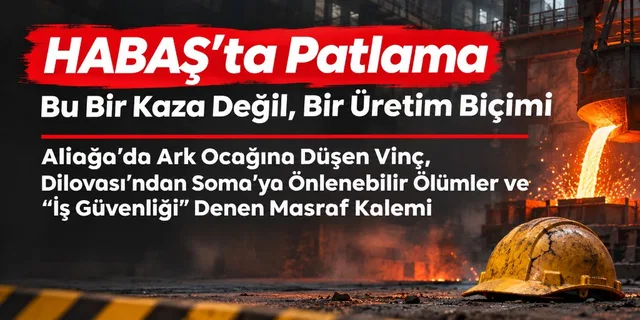
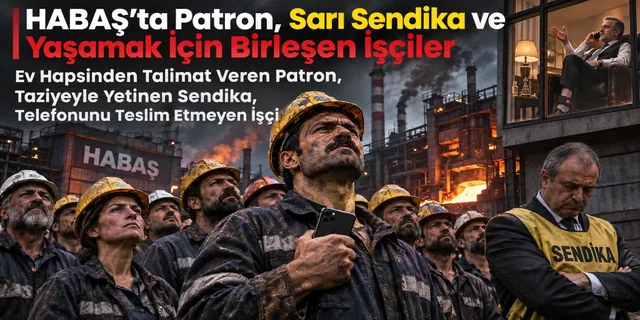
Read this piece as a continuation of our two articles on HABAŞ (The Explosion at HABAŞ: This Is Not an Accident, It Is a Mode of Production and In Front of the Turnstile). There we looked inside a single factory. Here we seek the same logic across the country, in the toll of ten months.
Summary: Ten Theses
- An average of at least six workers die each day. Dividing 1,930 deaths by 304 days gives 6.3 a day. This is not a mere "accident rate"; it is the ordinary operation of a system of production.
- The number is growing. The figure reported for the same period last year was 1,737, an increase of roughly 11 per cent. The October increase was 14 per cent. Another 159 deaths added to the interim calculation of 10 November would exceed the annual total for 2025. That is not the same as reaching the highest annual total of the past decade: at least 2,427 deaths were recorded in 2020.
- 87 per cent of those who died in October were wage earners. Fifteen years ago the share was around 80 per cent. Death follows proletarianisation: as the number of small producers falls, the number of wage workers grows.
- 94 per cent of those who died in October were recorded as non-union. Only 11 of the 193 workers who died that month were known to be union members. This is the most revealing line in the report.
- Children are dying, and younger children are among them. Nine children died in October. Deaths of children aged 14 and under rose from one to four compared with the previous October. MESEM is one state-organised part of this picture.
- Older workers are dying. Fifty-nine workers aged 50 and over died, including eight aged 65 and over. Workers who cannot live on their pensions die at work even after retirement.
- Invisible labour is dying. Women account for 2 per cent of deaths in the official statistics and about 8 per cent in İSİG's findings. Twenty-five migrant workers died in October. The report also includes unpaid domestic workers who died while cleaning windows.
- The deaths bear the fingerprints of a system. Crushing, transport crashes, falls from height and heart attacks associated with work intensity all raise questions about decisions on time, pace and cost.
- The official count understates reality; even İSİG's figure is a floor, not a ceiling. Seventy per cent of İSİG's information comes from national media; the rest comes from workers' relatives, unions and local sources. Deaths that do not reach them are not counted. Over twenty years, the difference between SGK's reported deaths and death-benefit files exceeds 24,000, though the two measures are not directly equivalent.
- The solution is not only technical but organisational. There are regulations, laws and experts. What is missing is workers' power to stop unsafe work. That power can be built through organisation.
What Do the Figures Tell Us?
Ten Months, Month by Month
İSİG's updated monthly distribution is as follows:
| Month | Deaths |
|---|---|
| January | 155 |
| February | 129 |
| March | 151 |
| April | 190 |
| May | 214 |
| June | 228 |
| July | 216 |
| August | 227 |
| September | 227 |
| October | 193 |
| Total | 1,930 |
Two things stand out.
The first is seasonality. From April onward, the number never falls below 190. June is the peak, with 228. When agriculture enters harvest, construction sites fill up and tourism enters its season, deaths also increase. Heatstroke, longer shifts, crowded agricultural transport: summer is the season of profit in the capitalist calendar and of death in the workers' calendar.
The second is the weight of the words "at least". At the start of the year the reported figure for January was 146; it is now 155. February rose from 126 to 129, March from 148 to 151, and July from 214 to 216. Deaths that become known later are added to the past. İSİG's figure is not a closed account but an open ledger. The 1,930 we count today may change as new information arrives.
Across the Years
The following figures for the first ten months were reported at the beginning of November in each respective year:
| Year | First ten months, as originally reported |
|---|---|
| 2018 | 1,640 |
| 2019 | 1,477 |
| 2020 | 1,734 |
| 2021 | 1,847 |
| 2022 | 1,521 |
| 2023 | 1,634 |
| 2024 | 1,540 |
| 2025 | 1,737 |
| 2026 | 1,930 |
Because figures are updated later, comparisons between years may shift. Among the first-ten-month figures listed here, 2026 is the highest. İSİG counted at least 2,105 deaths in all of 2025. Adding another 159 to the interim calculation of 10 November would exceed that total, but this would not establish a ten-year record. According to İSİG's annual report, at least 2,427 workers died in 2020. The monthly average for the first ten months of 2026 is 193.
One more comparison: in November 2022, İSİG calculated that at least 30,000 workers had died while working during the AKP's twenty years in power and asked: "In what war do we lose so many of our friends?" The calculation of 10 November recorded at least 21,956 deaths since 2016: the population of a medium-sized district.
Who Dies?
Wage Workers: The Gravestone of Proletarianisation
Of the 193 people who died in October, 167 (87 per cent) were wage workers or civil servants, while 26 (13 per cent) were self-employed farmers or tradespeople. İSİG recalls that fifteen or sixteen years ago the distribution was 80 to 20.
This apparently small shift tells a larger story. A farmer who sells their land, a shopkeeper who closes their shop, an artisan whose workshop fails becomes a wage worker. The dispossession we discussed in Factory for Sale by Owner appears in this report's lines of death. Capital sends those it has dispossessed first to the labour market, then to the construction site, and finally into İSİG's table.
Non-Union Workers: The Report's Most Important Line
İSİG recorded at least 11 workers who died in October (6 per cent) as union members and 182 (94 per cent) as non-union. The Assembly also notes that the union status of some workers could not be confirmed. Of the known union members, five worked in mining, four in metal and two in chemicals. The February report's ratio was even more striking: only one of the 126 workers who died was a union member.
We should not read this simplistically as "unions protect". Workers at HABAŞ were represented by Türk Metal, and the union confined itself to condolences. But the broader picture is clear: where there is no organisation at work, where nobody stands behind the worker who says "this scaffolding is unsafe", death can come silently. Lack of union organisation does not appear as a separate cause in the table, but it stands behind every line.
Children: The State's Apprentice Workbench
Nine child workers died in October: four aged 14 and under, five aged 15 to 17. Four worked in agriculture, three in construction, one in metal and one in accommodation. According to Evrensel's comparison, deaths of children aged 14 and under quadrupled compared with October of the previous year.
İSİG describes the Vocational Training Centres (MESEM) programme as turning children into free or very cheap labour through the state, and says child labour is concealed in some construction deaths. In The Reckoning of the Chalk we asked whose children benefit from the education budget. This report shows the other side of the answer: for a poor child, the workbench takes the place of school. While a wealthy family's child attends a preparatory course at 15, a poor family's child stands on scaffolding.
Older Workers: Retirement Is a Fairy Tale
Around 39 per cent of the 175 workers whose ages were known in October were either under 18 or aged 50 and over. Fifty-one workers aged 50 to 64 and eight aged 65 and over died. Deaths among those aged 30 to 49 rose from 61 to 74; this 21 per cent increase was the largest numerical rise.
Both ends of working life are stretching. Children start early; older workers cannot afford to stop. In One Salary in Ten Months we described how inflation erodes pensions. Retired workers return to work to make up for that lost income, and sometimes they do not return home.
The Invisible: Women, Migrants and Domestic Workers
Fifteen women workers died in October: six in agriculture, three in accommodation and three in general services. İSİG says SGK statistics put the share of women at 2 per cent, while its own findings put it at roughly four times that. One reason for the difference is that women's labour is concentrated in unregistered agriculture, cleaning and domestic work, and deaths among unregistered workers can also go unrecorded. At the request of the women's movement, İSİG has for the past five years included deaths of unpaid domestic workers while working; three were recorded in October. A woman who falls while cleaning windows is also a victim of occupational homicide: that labour is part of social reproduction, the work of sustaining those who go to the factory the next morning.
Twenty-five migrant workers died in October; 17 were Syrian. İSİG stresses that wars and military interventions increase migrant labour and that migrant worker deaths rise with it. For capital, migrant workers are among the cheapest and quietest parts of the reserve army of labour: without documents or language, complaints and objections become harder, and in death their names are often unknown. The report describes one worker's nationality as "Egyptian Ukrainian". Even this ambiguity shows the uncertainty into which migrant labour is pushed.
How Do They Die?
The causes of death in October were as follows:
| Cause | Deaths |
|---|---|
| Crushing and collapse | 43 |
| Traffic and worker transport crashes | 35 |
| Falls from height | 30 |
| Heart attacks and brain haemorrhages | 20 |
| Violence | 16 |
| Explosions and burns | 9 |
| Electrocution | 9 |
| Struck by or falling objects | 6 |
| Suicide | 4 |
| Poisoning and drowning | 2 |
| Other | 19 |
To read this as merely a technical list is to read it as capital would prefer. Yet each line raises questions about cost and working conditions.
Crushing and collapse can result from not placing a spotter beside machinery, erecting formwork without adequate calculation or cutting the cost of mine supports.
Traffic and worker transport crashes can follow from working people for twelve hours and then crowding them into an old minibus. İSİG links transport deaths to the expansion of logistics networks, long working hours, old vehicles and inadequate maintenance. The algorithmic pace discussed in our gig economy dossier also enters the picture: the app sets the delivery time, and the courier pays the price of speed.
Falls from height are produced on construction sites where harnesses, guardrails and nets are treated as a "waste of time". İSİG says construction deaths occur largely on urban transformation sites. Where land rents turn over fastest, the scaffolding is erected weakest.
The line for heart attacks and brain haemorrhages is the one most often overlooked. İSİG associates these 20 deaths with intense work. It is easy to say that these workers "died of natural causes". But Marx's chapter on the working day in Capital addresses precisely this: by extending the working day, capital consumes not only labour power but also the worker's life. The twelve-hour shifts reported at HABAŞ for the past twenty years are one expression of this in Türkiye.
There are four workers in the suicide line. These deaths, too, must be considered in relation to work: workplace pressure, debt, bullying and a lack of prospects can push a person to this point.
The report also includes an international line: 13 seafarers on vessels operated by Türkiye-based companies died in attacks connected with the Russia-Ukraine war in the Black Sea. The labour cost of war is charged not to those who decide on war, but to the sailors compelled to carry cargo through a war zone.
Official Numbers, Real Numbers
Where does İSİG's information come from? According to the Assembly, 70 per cent is collected from national media; the remaining 30 per cent comes from co-workers, families, associations, unions, workplace physicians and local media. These are the deaths the Assembly was able to learn about. A death that reaches neither the media nor another source, a migrant quietly removed from a field, a child who dies in an unregistered workshop may not enter the table. İSİG's figure must therefore be read as a floor, not a ceiling.
The official picture has further problems. SGK's 2024 figures record 1,897 insured workers under 4/a dying as a result of occupational accidents; the total is 1,905 when self-employed 4/b insured workers are included. (FirstİSG) SGK also publishes a different measure: death-benefit files opened following occupational accidents and diseases. Between 2005 and 2024, the publicly reported worker death total was 27,695, while 52,455 death-benefit files were recorded in the same period. The difference exceeds 24,000. Death-benefit files and deaths reported in a given year are not identical measures: files may concern earlier events or cases resolved later. The difference cannot therefore be read directly as a count of additional deaths, but the scope and methods of the figures need to be made clear.
Occupational diseases remain almost invisible. Workers who die slowly from silicosis, asbestos or chemicals often do not enter the occupational homicide table because their illness is not diagnosed or its relationship to work is not established.
There is also the question of workplace size. According to a calculation from SGK's 2025 data, workplaces with fewer than 50 employees recorded 5.98 deaths per 1,000 reported accidents, while those with 50 or more recorded 1.46. This measure describes deaths relative to reported accidents, not the risk of death per worker. An accident in a small workplace is roughly four times as likely to be fatal. Subcontracting means large companies transfer dangerous work to small firms; risk is moved outside, and death follows.
A Class Reading: Not Accident but Homicide; Not Fate but a System
Engels' Word
Some people find the term "occupational homicide" exaggerated. Yet its roots reach back to Engels' The Condition of the Working Class in England in 1845. Engels used the concept of "social murder": if society places thousands of people in conditions where an early, unnatural death is inevitable, and maintains those conditions while knowing this, it is no less murder than that committed by an individual with a sword. The difference is that the perpetrator is less visible.
İSİG's use of "homicide" instead of "accident" is not merely a rhetorical choice; it is a contemporary expression of that analysis. Its description of HABAŞ stands in the same place: "This massacre is the Soma of the system of exploitation in factories."
Marx's Deluge
In the chapter on the working day in Capital, Marx gives capital's motto in French: Après moi le déluge, "after me, the flood". Unless compelled by society, capital does not take the worker's health or length of life into account. The English Factory Acts did not arise from employers' consciences but from workers' struggle for a ten-hour day.
As that pressure weakens in Türkiye, the flood grows. The Occupational Health and Safety Law No. 6331 was enacted in 2012, but obligations for small workplaces were repeatedly postponed, inspections fell far short of need and penalties remained too weak to deter. At Soma, 301 miners died; most of those responsible were released in a short time. The Dilovası case was heard only years later. As we described in our HABAŞ article, impunity is the name of class justice: a worker's death remains an "expense item" for the employer, and as long as it costs less than prevention, prevention is neglected.
The Two Faces of the State
The state is not a neutral referee in this picture. İSİG says twelve-hour shifts have been in place at HABAŞ for twenty years and that the state has encouraged this system. It describes MESEM as a state programme that cheapens child labour. It also reports that production continued after the explosion, a banner was removed from the factory wall and people protesting were detained outside the hospital.
This is another appearance of the asymmetry we discussed in our article on the Human Rights Association report: the state is absent at the factory and present in the square; missing from occupational safety inspections, meticulous when it comes to taking down a banner.
Whom Does Technology Serve?
Another contradiction deserves attention. Today, a card around a worker's neck can measure how many minutes they remain still. Sensor technology can also monitor a furnace's temperature, a crane's load or gas levels in a shaft in real time and stop production when danger arises. The decision about what to install is not merely technical but a class decision: monitoring workers brings profit, protecting workers creates a cost.
In Hours Gained, Share Shrunk we showed that productivity gains in the age of artificial intelligence do not automatically translate into shorter working hours. This report reveals the starkest consequence of that argument: productivity rises but the working day does not shorten, the pace quickens, and the cost returns as heart attacks, transport crashes and workers falling from exhaustion.
Two Languages, Two Classes
The same death is described in two different languages. The language we choose also tells us which class we stand with.
| The language of capital and power | The language of workers and class |
|---|---|
| Occupational accident | Occupational homicide |
| Fate, natural death, misfortune | Preventable death |
| Isolated incident | Ordinary result of the mode of production |
| Worker carelessness | Pace, shifts, exhaustion |
| Safety is an expense item | Life is not negotiable |
| An investigation has been launched | Put those responsible on trial; the minister must resign |
| Flexible work, twelve-hour shifts | An eight-hour day and humane hours |
| Vocational education, MESEM | Child labour |
| Condolences and sympathy | Organisation and solidarity |
| Statistics | One thousand nine hundred and thirty names |
In The Class of Words we discussed how hegemony is built through language. The term "occupational accident" is one of its most successful products: it describes a death without an actor, a cause or anyone responsible. Changing the word is the first step towards changing how we see.
What Is to Be Done? Concrete Tasks
İSİG's call is clear: workers' organisation, solidarity and struggle. To bring that call into daily life, we can propose the following.
At work
- Learn and teach the right to refrain from work under Article 13 of Law No. 6331. A worker facing serious and imminent danger may ask the occupational health and safety committee, or the employer where there is no committee, to establish the danger and decide on precautions. If the committee or employer rules in favour of the request, the worker may refrain from work until precautions are taken, while retaining pay and other rights. If the serious and imminent danger is unavoidable, the worker may leave the dangerous area for a safe place without waiting for that procedure. (Law, Article 13)
- Demand that occupational health and safety committees actually meet in workplaces with at least 50 employees and continuous work lasting more than six months, and that worker representatives be chosen by workers rather than appointed by the employer.
- Record dangerous situations in writing and with dates. Photographs, written records and messages matter, as did the actions of the HABAŞ worker who did not hand over their phone.
- In workplaces without a union, take the first step towards organising around occupational safety. "We want to live" can unite workers even before a demand for wages.
In society
- Report deaths to İSİG. Every death we hear about in local media, our neighbourhood or village is a missing line in the ledger.
- Speak out against MESEM with parents, teachers and education unions. A child's place is at school, not on scaffolding.
- Put the demand for an eight-hour working day back at the centre of the agenda. Twelve-hour shifts are a systematic source of exhaustion and death.
- Make solidarity with migrant workers part of the occupational safety struggle. A workplace that cannot protect undocumented workers cannot protect documented workers either.
- Follow court cases against impunity. Keeping Soma, Dilovası and HABAŞ in public memory and not leaving courtrooms empty is a responsibility.
In our organisations
- Make each month's report a subject of reading and discussion: not to memorise numbers, but to find the lines for our own sector and province.
- Discuss the occupational health and right-to-life provisions in our Labour Constitution proposal at local meetings, filling the constitutional debate with labour's concerns.
- Try the networked, cross-workplace organising model proposed in Organising 2.0 and Class Back on the Table as an occupational safety network: a shared solidarity line through which workers from factories, construction sites and warehouses exchange information about risks.
Dear Young Comrades
Every number in this article is a person. One of the names in October's report is Türkan Keskin: on 22 October, she died after being caught in a beet-harvesting machine in Polatlı. There are 1,929 others like her in the ledger for these ten months. Each had a mother, a child, a friend, someone waiting for them to come home in the evening.
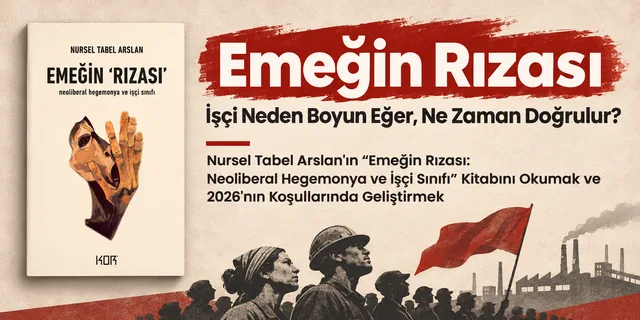
We tell you these numbers not only to mourn but to think. The question we asked in The Consent of Labour stands before us here with all its weight: why does a worker submit, and when do they stand upright? Part of the answer is in this report. In October, 94 per cent of those who died were recorded as non-union; the membership status of some workers could not be confirmed. An unorganised worker cannot stand alone against the system that kills them. An organised worker can stop work, and workers who can stop work can also stop death.
Engels called these deaths "social murder" 181 years ago. Since then the working class has won the eight-hour day, factory laws and safety committees through struggle. None came from the employer's conscience. The path to winning back what we have lost today is the same.
Life is a right. Protecting that right is possible only together.
Sources
- On İSİG's October 2026 report: Euronews, worker deaths in Türkiye, 10 November 2026; Evrensel, October report, 10 November 2026; Medyascope; Rudaw.
- Earlier 2026 monthly reports: bianet, February; Cumhuriyet, March; Evrensel, July.
- First-ten-month figures for earlier years: Halk TV (2025), Diken (2024), bianet (2023), BirGün (2022), Medyascope (2021), bianet (2020), Medyascope (2019), BirGün (2018).
- Annual totals: bianet, 2020; Yeni Ankara, 2025.
- HABAŞ death toll: bianet, İSİG's 13 November statement.
- SGK data: FirstİSG, 2024 statistics; CNBC-e, ILO on occupational deaths; soL, death-benefit file comparison; Evrensel, small workplaces, 26 July 2026.
- Friedrich Engels, The Condition of the Working Class in England (1845).
- Karl Marx, Capital, Volume I, Chapter 10: The Working Day.
- Occupational Health and Safety Law No. 6331, Articles 13 and 22.
Related Bilgi Müşterekleri articles: The Explosion at HABAŞ · In Front of the Turnstile · Labour Constitution · The Consent of Labour · Factory for Sale by Owner · Hours Gained, Share Shrunk · The Reckoning of the Chalk · One Salary in Ten Months · The Card Around Our Necks · Gig Economy Dossier · The Class of Words · Organising 2.0 · Class Back on the Table