A Generous Package, a Silent Table: What Do the Layoffs at Canva Tell Us?
Why Is the Cost of Artificial Intelligence Charged to the Worker?

On 3 November 2026 the Australian design platform Canva announced a "restructuring" that affects 22 per cent of its staff, 1,271 people. Some are being laid off, some are having their roles changed, and some are being asked to move to Sydney. The company did not say how many people will lose their jobs outright. CEO Melanie Perkins called it the "hardest moment" in the company's thirteen-year history. The business press, for the most part, told the story through the generosity of the severance package.
Let us ask a different question: Why is a company that produces 4 billion dollars of revenue a year, that has 265 million users, and that has placed artificial intelligence at the heart of its product, discarding a fifth of its staff? And what does this tell us about where labour is going in the age of artificial intelligence?
First, the Summary: Ten Theses
- The crisis is in growth, the bill is in labour. For the first time in ten years Canva's growth slowed, and it cut its 2026 revenue-growth forecast from 30 per cent to 20 per cent. This is not a bankruptcy. It is a profit expectation being revised down. The line chosen for the correction was the staff.
- Artificial intelligence is not cheap labour. It is expensive constant capital. By Canva's own account, the cost of AI tasks came out much higher than expected. As the compute bill swells, capital looks for a way to balance the cost in the line that is easiest to cut: the wage.
- Canva is an "intermediate monopoly". It dominates its own field, but it depends on the owners of the frontier models. OpenAI, Google and Anthropic are both its suppliers and its rivals. In the chain of monopolies, the link below pays rent to the link above, and when it is squeezed it squeezes its workers.
- Training one's own rival. Canva says it helped develop Claude Design, which Anthropic released in May and which shook the design sector. Platform capital feeds on one another's data and labour; in the end the big fish eats the small one.
- Canva first turned the designer into a template, and now it is the turn of its own workers. The company that spent ten years converting graphic-design labour into drag-and-drop templates is now applying the same deskilling to its own specialists: "combining narrow specialisms into broad roles."
- "Small and strengthened teams" is the name of intensification. Cutting layers of management and widening roles means more work, for the same wage, for the worker who remains.
- The return to the office, and the move to Sydney, is a hidden layoff. The worker who cannot leave family and country behind "leaves of their own accord". Taking remote work back is also taking supervision back.
- The generous package is real, but it is a favour, not a right. Six months' pay, health insurance and a 10,000-dollar grant matter to the workers. But there is no worker at the table where the decision is made. The package is an investment in reputation before a stock-market flotation.
- Not one company, a wave. Atlassian, WiseTech, Microsoft, Dropbox, Block... In 2026, 344 technology companies laid off more than 139,000 people. Across the sector, the bill for investment in artificial intelligence is being charged to the same place.
- The answer is organisation. Turning the productivity that comes with technology into a shorter working time, rather than into layoffs, is possible only when organised computing and design labour sits at the table.
Now let us take them one by one.
What Happened? Canva in Figures
Canva was founded in Perth in 2013 by Melanie Perkins, Cliff Obrecht and Cameron Adams. The simple idea was to make design easy "for everyone". Today it has more than 5,700 employees in 37 countries. By the figures the company itself announced, at the end of 2025 it had more than 265 million monthly active users, more than 31 million paying users, and 4 billion dollars of annual recurring revenue (ARR). It has been profitable since 2017, one of the rare profitable companies among the billion-dollar ventures.
These are the points that stand out in the note Perkins sent to employees on 3 November (TechCrunch, People Matters, Yahoo Finance):
- 1,271 roles, 22 per cent of the staff, are affected. The number of people who will be laid off was not stated separately.
- "Our growth has slowed for the first time in ten years." "Small changes will not be enough." "We have to rebuild Canva and return to our roots as small and strengthened teams."
- The Product, Growth and Platform units are being merged into a single product organisation. Layers of management are being reduced. Narrow specialist roles are being gathered into broad roles.
- Sydney is becoming the primary centre of operations. From January 2027, hybrid employees will be in the office two or three days a week.
- In August the revenue-growth forecast had been cut from 30 per cent to 20 per cent. According to Perkins, demand for the AI features outran expectations, and the company slowed the rollout in order to rebuild the architecture and bring down the cost per unit.
- The early investor Blackbird cut Canva's valuation from 42 billion dollars to 34.9 billion. T. Rowe Price and Franklin Templeton also wrote down the value of their shares.
What is offered to those who leave is this: at least six months' pay regardless of country, the lifting of the vesting cliff for those who joined in the last year, 12 months of health insurance in the countries where it is supported, career coaching, a year of LinkedIn Premium, the right to keep the company computer, and a grant of 10,000 dollars, in which the company takes no share, for those who want to start a venture (Fast Company).
It is also worth looking back. In March 2025 Canva laid off 10 of a 12-person technical writing team. Employees told the Australian Financial Review that managers had encouraged them to use generative artificial intelligence and had assured them this would not lead to layoffs. The company denied the link with artificial intelligence then too, and said "we are evolving our technical content writing function."
Put the two events side by side and a pattern appears: Try it first in a small unit, then scale it.
Artificial Intelligence Is Not Cheap: The Growing Weight of Constant Capital
The common story is this: artificial intelligence makes the work cheap, and that is why companies lay workers off. The Canva case shows that this story is only half true. Canva's problem is not that artificial intelligence makes the work too cheap. It is that artificial intelligence itself is very expensive.
Perkins told investors plainly that "the average cost of serving an AI task is very high" (Fast Company). Most of this traffic is thought to come from free users. Every click on a "magic design" is a bill paid to the GPUs turning in somebody's data centre.
Let us say it in Marx's language. The organic composition of capital is rising. Inside total capital, the share that goes to machines, energy and computation, that is, to constant capital, is growing. The share that goes to the wage, that is, to variable capital, is falling in relative terms. Although it is living labour that creates value, competition forces every capitalist to invest more in the machine. That investment presses on the rate of profit. Where does capital first try to make up that pressure? From the line that has no bargaining power, is unorganised, and is easiest to cut: the worker.
Canva's move in 2026 is a textbook case of this logic:
- Demand for artificial intelligence is exploding, and the compute bill is swelling.
- Revenue growth is slowing, and the valuation is falling.
- The company says that by developing its own model, Craft, and the Canva 2.0 architecture, it has cut the cost per task by 90 per cent.
- And in the same year a fifth of the staff is leaving the table.
Who receives the gain that comes from the fall in cost? A shorter working time? Wages? No. The recovery of the valuation, and the polishing of the flotation story. What we said about Microsoft in Forty Percent of the Code, a Quarter of the Staff holds here too: A rise in productivity is a question of property. Technology does not decide who receives it. The balance of power between classes does.
The Chain of Monopolies: The Squeeze on the Intermediate Monopoly
Canva is a giant among design platforms. But in the artificial-intelligence layer it is a tenant. Until it developed its own model, it bought frontier models from others. The owners of those models sell a service to Canva and, at the same time, release tools that produce design directly for the end user:
- ChatGPT and Gemini produce images, presentations and social-media content from simple prompts.
- Claude Design, which Anthropic released in May 2026, startled even Adobe and Figma. Canva says it helped develop this tool.
This is a familiar move of monopoly capitalism: The monopoly that holds the infrastructure first collects rent from the companies that work on top of that infrastructure, then enters their market. As when Amazon copies the products of sellers on its own platform, or Google promotes its own services in search results. The chain we described for journalism in The Price of the Summary is being built here for design.
Canva's development of its own model, Craft, is an attempt at vertical integration, to escape this dependence. The acquisitions of Leonardo.Ai, Serif/Affinity and Cavalry point the same way. So Canva is deepening its own monopoly against the monopolies above it, and it is taking the cost of that race out of its staff. This is how the centralisation of capital works. Small capital has to grow so as not to be eaten by big capital, and it makes its own workers pay the price of growing.
The Dialectic of the Template: The Company That Deskilled the Designer Is Deskilling Its Own Workers
Canva's history is the history of the deskilling of design labour. The typography, composition and knowledge of colour that a graphic designer spends years learning were sunk into templates. Image pools that had grown largely with the contribution of volunteer photographers, such as Pixabay and Pexels, were bought. In October 2025 the professional design suite Affinity was made free, while the AI features were tied to a paid Canva subscription. The free tool is the door that opens onto the paid layer.
This is exactly what we called "mental Taylorism" in the call The Revolt of Crystallized Labor and in The Computing Worker's Handbook. Taylor took the knowledge in the craft worker's head and moved it onto the instruction card in management's hand. Canva takes the knowledge in the designer's head and moves it into the template, and now into the model. Knowledge is separated from the worker and becomes the property of capital.
The irony of the dialectic is this: the process does not stop. It turns back on its own maker. Perkins's sentence, "we are combining narrow specialisms into broad roles," means that the same logic is being applied to Canva's employees. First the technical writers, then the engineers will "own" the documentation. First the specialist designer, then the product worker who "does a bit of everything". As we described in Is This the End of Software Engineering, or the Expropriation of the Craft?, the programmer's role is shifting from production to supervision. The worker who supervises is fewer in number, works more intensely, and is more easily replaced.
A Class Translation of Corporate Language
Perkins's note is a good example of the language technology companies use for layoffs. Warm, familiar, emotional. But every sentence has another face.
| The company's language | What it means in class terms |
|---|---|
| "We have to rebuild Canva" | We are repricing the staff |
| "Small and strengthened teams" | Fewer people, the same work; intensification for the worker who remains |
| "Combining narrow specialisms into broad roles" | Deskilling and multi-tasking; several jobs for one wage |
| "Reducing the layers of management" | Supervision handed over to AI tools and metrics dashboards |
| "Sydney will be our primary centre" | Forcing those who cannot move to leave; the path of a silent downsizing |
| "Face-to-face collaboration" / the return to the office | Taking back the autonomy that remote work had won |
| "The hardest decision in our history" | The decision is ours, the cost is yours |
| "A generous support package" | An investment in reputation; protection of the brand before the flotation |
| "Growth has slowed" | The profit expectation has fallen; the shareholder's expectation comes before the wage |
Note this: the note never names artificial intelligence as the reason for the layoffs. It was not named in the technical-writer cuts of 2025 either. But the whole context is artificial intelligence: its cost, the competition, the product architecture. Not tying the layoff to artificial intelligence is the company's attempt to persuade the user ("buy our AI products") and the worker ("artificial intelligence is not your enemy") at the same time. The technology must not look bad, and the decision must look like a personal tragedy. What is there is neither the nature of the technology nor a CEO's personal pain. What is there are the necessities of the accumulation of capital.
On the Debate About "How Generous"
The sentence shared most often in the business press and on LinkedIn was this: "Many companies will lay people off this year. Very few will do it like this."
Let us be honest first. Six months' pay, a year of health insurance and the protection of share rights sit far above the legal minimum in many countries. Set beside the notice pay and the seniority compensation a worker receives in Turkey, and especially beside the insecure computing worker who receives no compensation at all, this package is an important protection for the workers. To belittle it would be to belittle the few months of breathing space of a person who has been laid off.
The question that has to be asked is not the size of the package. It is who holds the decision:
- The decision that affects the future of 1,271 people was taken at a table where none of those people had a vote.
- The package was not won as a right. It was given as a favour, at the company's discretion. What is generous today can be stingy tomorrow, when market conditions worsen.
- The generosity of the package made the layoff itself unquestionable. The debate moved from the question "why" to the question "how".
- For a company preparing a flotation, reputation is an asset line. The package is a public-relations investment that turns the layoff story into a story of "the good company".
Let us also touch on the founders' philanthropy. Perkins and Obrecht announced that they would give away a large part of their wealth. Canva transferred 50 million dollars to Malawi through GiveDirectly, and pledged 100 million dollars more. There is no need to doubt that this was done with good intentions. But philanthropy is the moral face of an order in which the owners of property decide how surplus value is distributed. The same people can hand out money to the poor in Malawi one week and lay off a fifth of their staff the next. The contradiction is not in the persons. It is in the system: It is possible to be a good capitalist, but it is not possible to be exempt from the laws of capital without ceasing to be a capitalist.
Not One Company, a Wave
It would be misleading to read Canva as a separate case. 2026 is a year in which the same pattern is repeated across the technology sector:
- In March Atlassian laid off 1,600 people. WiseTech announced a cut of 2,000.
- Microsoft offered a "voluntary exit" to about 60,000 employees, and its share rose on the day of the announcement.
- SUSE, Squarespace, Dropbox and Block have also announced cuts recently.
- According to Layoffs.fyi, in 2026, 344 technology companies laid off 139,004 people.
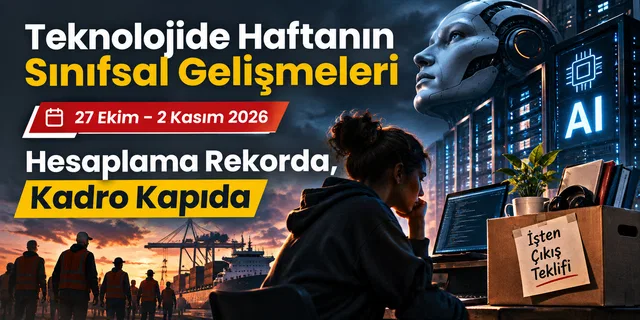
The common point is this: all of them are investing heavily in artificial intelligence, and all of them are balancing the cost of that investment, and the story of "efficiency", with a cut in staff. We did not choose the subtitle of the latest issue of our weekly series, "Compute at a Record, the Payroll at the Door", for nothing. The question we asked in Bubble or Debt? becomes concrete here. While the bubble inflates, the winners are clear. Whether it bursts or not, those who pay the bill are clear too.
Seen from Turkey
Canva is very widespread in Turkey: teachers, small businesses, associations, social-media managers, freelance designers. These layoffs have three meanings for us.
First, the price of design labour. Canva, and the AI tools that follow it, are cheapening the labour of graphic designers, agency workers and freelancers in Turkey, who already work for low pay and without security. "We'll do it in Canva" has become the sentence a designer hears most often in a wage bargain. The same pressure has now turned back on Canva's own employees. This tells us: Everyone who does not own the tool is a member of the same class, whatever the size of the tool.
Second, the lack of organisation among white-collar workers. The picture we described in The Poverty of the White Collar (in Turkish) is the same in Australia and in Turkey. As long as the computing and design worker does not see themselves as a worker, the layoff remains "a sad but inevitable business decision". Canva's workers received a generous package because the company decided so. In a software or design company in Turkey, the same decision is usually delivered with a Slack message and the legal minimum compensation.
Third, dependence. Public institutions, schools and civil-society organisations are handing more and more of their design and communication work to these closed platforms. What is free today becomes paid tomorrow. Data that is open today trains the model tomorrow. The captive-customer relation we described for schools in Google Classroom's Real Class holds for design tools too.
So What Is to Be Done?
What is needed is not to be against the technology. It is to question the ownership of the technology and of its gain. Concrete tasks:
- Collective agreements with a technology clause. The entry of AI tools into the workplace should be negotiated in advance with workers' representatives. The conversion of the gain from higher productivity into wages, and into a shorter working time, should be written into the agreement.
- A mandatory right of consultation and objection before a layoff. In collective layoffs, workers' representatives' access to the reason, the scope and the alternatives should be a right, not a favour.
- Put the words "move to AI, your job is safe" in writing. The verbal assurance given to Canva's technical writers turned into a layoff a year later. Not a spoken promise. A contract.
- The joint organisation of computing and design workers. Everyone who writes code, makes a design, produces content or manages a project is a worker of the same branch. The network form of organising we described in Organising 2.0 shows a path for this scattered section, much of which works remotely.
- Solidarity networks of freelance designers. Minimum-fee schedules, shared contract templates, the tracking of payments. The designer who bargains alone always loses.
- Investment in common tools. Free software such as Penpot, Inkscape, GIMP, Krita and Scribus, and public image archives, should come first in public institutions and in schools. Where knowledge is a commons, the owner of the tool cannot show the worker the door by a one-sided decision.
- Question public institutions' dependence on closed platforms. Which platform schools, municipalities and associations hand their design and communication work to, on what terms, and which data they hand over, should be discussed in the open.
Dear Young Comrades
Canva's story tells us something very old, in a new language. "Making design easy for everyone" really was a beautiful idea. Millions of people made their first poster, their first presentation, their first invitation with it. But as that beautiful idea grew as the property of a company, it became subject to the laws of capital. First the designer's knowledge was turned into a template, then the template into a model, then the model's bill was charged to the worker.
Do not look here for a bad CEO or a greedy management. You can believe that Melanie Perkins is genuinely sorry. You can accept that the package really is generous. The question is not whether persons are good or bad. The question is that a decision affecting the lives of 1,271 people can be taken by looking at a table of shareholder expectations and compute costs, without those people having any say.
Artificial intelligence is neither a saviour nor an enemy. Who an instrument serves, whose hand it is in, under whose supervision it works, and to whose benefit it runs, is what decides. If today the bill for this instrument goes to the worker and the gain to the shareholder, what will change that is not the technology. It is organised labour.
The machine is new, the chain is old. What will break the chain is what it has always been: standing together.
Sources
- TechCrunch, "Canva lays off over 1,200 people amid slowing growth", 4 November 2026: https://techcrunch.com/2026/11/04/canva-lays-off-over-1200-people-amid-slowing-growth/
- Bloomberg, "Canva Cuts Jobs, Restructures Workforce as Growth Slows for First Time", 3 November 2026: https://www.bloomberg.com/news/articles/2026-11-03/canva-announces-layoffs-job-changes-for-about-22-of-workforce
- Yahoo Finance, "Canva's First Growth Slowdown in a Decade Triggers a 1,271-Role Restructure": https://finance.yahoo.com/technology/articles/canva-first-growth-slowdown-decade-092457264.html
- People Matters, "Canva layoffs: 22% employees to exit, company offers six months' salary": https://www.peoplematters.in/news/strategic-hr/canva-layoffs-22percent-employees-to-exit-company-offers-six-months-salary-to-affected-staff-53173
- Fast Company, "Canva's big layoffs say a lot about the AI design landscape": https://www.fastcompany.com/91635513/canvas-big-layoffs-say-a-lot-about-the-ai-design-landscape
- Fast Company, "Canva's restructuring affects 1,200+ people. But its severance package is earning praise": https://www.fastcompany.com/91635782/canva-just-laid-off-1200-people-but-its-severance-package-is-earning-praise
- Inc., "Canva's 22% Layoffs: What It Means for Creatives": https://www.inc.com/kamya-marwah/canva-layoffs-restructuring-ai-creative-jobs/91430692
- Yahoo Finance, "Canva Becomes the Latest Company to Carry Out Mass Layoffs": https://finance.yahoo.com/markets/stocks/articles/canva-becomes-latest-company-carry-140810389.html
- Startup Daily, "Canva sheds 10 technical writing staff after directing them to use artificial intelligence", 3 April 2025: https://www.startupdaily.net/advice/future-of-work/generating-your-ai-grave-canva-sheds-10-technical-writing-staff-after-directing-them-to-use-artificial-intelligence/
- People Matters SEA, "Canva's AI-driven job cuts send ripples through the tech industry": https://sea.peoplemattersglobal.com/news/business/canvas-ai-driven-job-cuts-send-ripples-through-the-tech-industry-45029
- BloombergHT, "Canva yapay zeka desteğiyle 4 milyar dolarlık gelire ulaştı", 18 February 2026: https://www.bloomberght.com/canva-yapay-zeka-destegiyle-4-milyar-dolarlik-gelire-ulasti-3769510
- Wikipedia, "Canva": https://en.wikipedia.org/wiki/Canva
Related pieces from Knowledge Commons
- Forty Percent of the Code, a Quarter of the Staff
- Is This the End of Software Engineering, or the Expropriation of the Craft?
- The Poverty of the White Collar (in Turkish)
- Bubble or Debt?
- The Week's Class Developments in Technology - 27 October-2 November 2026
- The Price of the Summary
- Google Classroom's Real Class
- The Class of Cognitive Surrender
- The Revolt of Crystallized Labor
- The Computing Worker's Handbook
- Organising 2.0
This piece is one of the living documents of Knowledge Commons. It is shared under the CC BY-SA 4.0 licence. You may copy, change and share it if you credit the source.