Strasbourg Has Spoken, Silivri Is Silent: The ECtHR's Can Atalay Judgment
A Technical Reading of an Elected Representative's Imprisonment, a Clash Between Two High Courts, and the Class Limits of Law

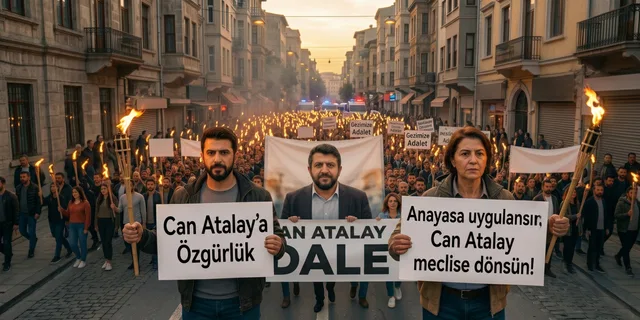
Around midday on 17 November 2026, Workers' Party of Türkiye (TİP) leader Erkan Baş announced the news in a post on X: the European Court of Human Rights (ECtHR) had issued its judgment concerning Can Atalay, elected to represent Hatay in parliament. As Baş summarised it, the Court found Atalay's continued imprisonment after his election unlawful, held that preventing him from taking his seat violated both his rights and the will of the people who elected him, found that his continued detention was intended to silence him and suppress pluralism, and called for his immediate release.
In this article we go beyond the headlines to read the judgment itself: which rights were violated and why, how the judges voted, what timetable lies ahead for Türkiye, and, above all, what this three-and-a-half-year legal crisis means in class terms. The Court limited its examination to Atalay's detention after his election and the failure to implement the Constitutional Court's judgments; it did not examine the merits of the Gezi criminal proceedings in this application. We build on our earlier articles about Atalay: The Liquidation of a Legal Order and the People's Intellectual, Parliament Is Opening, But What Is It For?, and On the Framework Law Statement.
First, the Judgment in Ten Theses
- The judgment: Şerafettin Can Atalay v. Türkiye, application no. 11503/24, was deliberated by the ECtHR's Second Section, a chamber of seven judges, on 29 September 2026 and delivered on 17 November 2026.
- Four violations: the right to liberty (Article 5 § 1), judicial review of detention (Article 5 § 4), the right to free elections (Article 3 of Protocol No. 1), and the prohibition on restricting rights for an ulterior purpose (Article 18).
- The votes: the Article 5 § 4 violation was unanimous; the other three violations and the indication on release were decided by six votes to one. The dissenting judge was Saadet Yüksel, elected in respect of Türkiye.
- The indication under Article 46: Türkiye must end Atalay's detention and secure his immediate release, allow him to take his seat and perform his parliamentary duties, and adopt general measures to ensure full implementation of Constitutional Court judgments.
- Compensation: 32,500 euros in respect of non-pecuniary damage.
- The gravest finding, Article 18: the Court found that continued detention pursued the ulterior purpose of silencing Atalay and suppressing pluralism, and was capable of having a chilling effect on human rights defenders. This is among the gravest findings the ECtHR can make against a state.
- The chain of evidence: the Court considered the unprecedented refusal of the Court of Cassation's Third Criminal Division to implement a Constitutional Court judgment for a second time, its criminal complaint against Constitutional Court judges, statements by the President and his chief adviser, and the connection to the Kavala case.
- The judgment is not yet final: this is a Chamber judgment. Within three months, until 17 February 2027, Türkiye may request referral to the Grand Chamber.
- The Kavala reality: in the same Gezi case, the ECtHR has called for Osman Kavala's immediate release since 2019; the Grand Chamber did so again in August 2026, and the Istanbul 13th Assize Court rejected the request again on 13 October 2026. Strasbourg is not a key; it is a record.
- The class lesson: this case is not simply a jurisdictional struggle between two courts. It concerns a lawyer who defended public space against profiteering, held captive along with the will of voters. The power to secure implementation lies not in Strasbourg but here, in an organised society.
Let us look more closely.
Background: From Gezi to Hatay
In the Court's own words, Can Atalay is a lawyer and human rights defender. During the 2013 Gezi protests he was part of Taksim Solidarity. Paragraph 7 of the judgment contains a striking detail in its account of the evidence cited against him in the indictment: it included social media posts about administrative cases seeking the annulment of urban development plans and telephone conversations with journalists about those cases.
Let us underline this: part of Atalay's alleged "crime" concerned his use of law to defend public space. The Taksim pedestrianisation project, the proposed reconstruction of the artillery barracks and the buildings planned in place of the park were attempts to enclose public space for urban profit. Gezi was an objection to opening a park, an urban common, to capital accumulation. Reading the Gezi case as a "terrorism" case therefore codes the defence of the commons as a crime. We discussed this framework in Who Is Osman Kavala and Why Is He Still Inside?.
The timeline is as follows:
| Date | Event |
|---|---|
| 19 February 2019 | Gezi indictment: 16 people including Atalay are accused of attempting to overthrow the government by force under Article 312 of the Criminal Code. |
| 25 April 2022 | Istanbul 13th Assize Court sentences Atalay to 18 years and orders his detention, finding that he aided Kavala under Article 39. |
| 28 December 2022 | The regional court of appeal dismisses his appeal. |
| 14 May 2023 | Atalay is elected MP for Hatay for TİP while his case is before the Court of Cassation. |
| 13 July 2023 | The Third Criminal Division rejects his request for immunity and release. |
| 28 September 2023 | The Court of Cassation upholds his conviction. |
| 25 October 2023 | The Constitutional Court finds violations of liberty and electoral rights by nine votes to five and indicates release and a retrial. |
| 8 November 2023 | The Third Criminal Division refuses to comply and files a criminal complaint against Constitutional Court judges. |
| 21 December 2023 | The Constitutional Court again finds violations by eleven votes to three; the violation of the right of individual application is unanimous. |
| 3 January 2024 | The Third Criminal Division refuses compliance a second time and sends its decision to parliament. |
| 30 January 2024 | The Court of Cassation's letter is read in the General Assembly and Atalay is declared to have lost his seat. |
| 22 February 2024 | The Constitutional Court holds that the removal had no legal basis and was a factual situation; the judgment is published on 1 August 2024. |
| 16 April 2024 | Application no. 11503/24 is lodged with the ECtHR, which grants priority treatment. |
| 27 August 2024 | The ECtHR communicates the application to Türkiye; the statement of facts is published on 16 September. |
| 1 October 2026 | Atalay begins a 24-hour hunger strike from Silivri on parliament's opening day. |
| 17 November 2026 | The ECtHR delivers its judgment. |
As of 17 November 2026, Hatay, one of the provinces most devastated by the 2023 earthquakes, has been deprived of one of its elected representatives for three and a half years.
The Technical Core: Immunity, Article 14 and Foreseeability
The dispute centres on Article 83 § 2 of the Constitution. It provides two exceptions to parliamentary immunity: being caught in the act of an offence carrying a heavy penalty, and situations covered by Article 14 of the Constitution provided that an investigation began before the election. Article 14 prohibits the abuse of fundamental rights; it refers to activities aimed at destroying the integrity of the state and the democratic, secular republic, but does not list which offences fall within its scope.
The legislature never made that list. Who, then, is to determine it?
The Constitutional Court's answer in Gergerlioğlu (2021), Leyla Güven (2022) and Atalay (2023): Article 14 cannot be filled in by judicial interpretation in a sufficiently foreseeable way. Unless the legislature specifies the offences, the exception cannot be applied. If it cannot be applied, the elected representative benefits from immunity and there is no legal basis for continued detention.
The Court of Cassation's Plenary Criminal Divisions' answer on 26 October 2022: as paragraph 62 of the ECtHR judgment records, the highest criminal formation accepted that the Constitutional Court's interpretation was binding under Article 153 and had to be followed. The Third Criminal Division itself had applied this principle in a decision in April 2023.
The Third Criminal Division's reversal in July 2023: only three months later, when Atalay was concerned, the division departed from its own approach and that of the Plenary Criminal Divisions. It argued that the legislature had deliberately left the list to the courts, and that offences in Article 3 of the Anti-Terrorism Law, including Article 312 of the Criminal Code, fell within Article 14 of the Constitution. It then accused the Constitutional Court of acting as a "super court of appeal" and of "judicial activism", and filed a complaint against its members.
The ECtHR's finding under Article 5 § 1 rests on this dispute. Its reasoning has three layers:
- Detention following conviction becomes unlawful when the legal connection is broken. Article 5 § 1 (a) permits detention after conviction by a competent court. But when the Constitutional Court establishes a violation in a binding judgment and orders release, the legal link between conviction and detention is broken. The ECtHR had said this in the cases of journalists Mehmet Hasan Altan and Şahin Alpay: a court's questioning of a final, binding Constitutional Court judgment is contrary to the rule of law and legal certainty.
- Quality of law. A provision applied through mutually incompatible interpretations by high courts does not meet the requirement of foreseeability. The Court refers expressly to the warning of the dissenting judge in the Court of Cassation's Fourth Criminal Division.
- Contradiction within the Court of Cassation. The Third Criminal Division's departure from the Plenary Criminal Divisions deepened the lack of foreseeability.
The finding under Article 5 § 4 was narrower but unanimous: the individual application to the Constitutional Court is normally an effective remedy, but because its judgments were not implemented, it did not provide Atalay with review capable of resulting in release. The ECtHR confined this finding to the special circumstances of the case; it did not say that individual applications to the Constitutional Court are generally ineffective. Strasbourg is not discarding that system, but demanding that its decisions be implemented.
The violation of Article 3 of Protocol No. 1 concerns electoral rights. In the Court's view, preventing Atalay from taking his seat and ultimately removing his membership was incompatible with the rule of law, interfering not only with his right to stand for election but also with the free expression of the will of the people. The Constitutional Court's characterisation of the 30 January 2024 removal as a factual situation without legal foundation was part of this assessment.
The Gravest Finding: Article 18 and the Ulterior Purpose
Article 18 of the European Convention on Human Rights prohibits states from restricting rights for purposes other than those prescribed in the Convention. The ECtHR uses it rarely because it means telling a state that a person is being held for an ulterior political purpose, not for the stated legal one. Türkiye is unfortunately familiar with such findings: they were made in the Kavala cases (2019 and 2026), Demirtaş cases (2018/2020 and 2025) and the Tuğluk case (2025).
The Court applies the standard of proof beyond reasonable doubt and derives proof from the totality of contextual elements. In Atalay's case, that chain included:
- The person: Atalay is a lawyer and human rights defender; the Court recalls the special importance of that role.
- The case: Atalay was tried in the same criminal case as Kavala, in whose case the Court found an Article 18 violation. His situation could not be viewed in isolation from a background in which political opponents, rights defenders and journalists had been detained on apparently exaggerated charges.
- The unprecedented refusal: lower courts had failed to implement Constitutional Court judgments in the Altan, Alpay and Berberoğlu cases, but in Berberoğlu the trial court ultimately complied. In Atalay's case, the Court of Cassation resisted a second time, even after the Constitutional Court had found a violation of the right of individual application. The ECtHR described this as unprecedented.
- The criminal complaint: the complaint against Constitutional Court judges raised serious questions about the unity of the legal order.
- The executive's voice: the President's 10 November 2023 remarks supporting the Court of Cassation, the chief adviser's posts about a "national judiciary", and the President's January 2024 analogy about digging a tunnel from prison to parliament for someone sentenced to 18 years. The Court considered that the statements were not sufficient evidence in isolation but had to be assessed in the wider context. The tunnel remark came after the second refusal of 3 January 2024, not before it. (10Haber)
- International observers: the Venice Commission's assessment of the Council of Judges and Prosecutors following the 2017 constitutional changes, and the Council of Europe Commissioners for Human Rights' reports of 2020 and 2024.
The conclusion in paragraph 168 is clear: continued detention without recognition of Atalay's immunity pursued the purpose of silencing him and suppressing pluralism, and was capable of having a chilling effect on the work of human rights defenders. The Court found this purpose particularly grave given their place in a pluralist democracy.
The Dissent: What It Says and What It Does Not
Judge Saadet Yüksel's partly concurring, partly dissenting opinion comes from the judge elected in respect of Türkiye, who sits as part of the Court's composition. Yüksel agreed that Article 5 § 4 had been violated: she too accepted that non-implementation of the Constitutional Court's judgments deprived Atalay of effective review.
Her objection was that until 2021, domestic law had not disputed that the offences covered by Article 14 could be determined through judicial interpretation. In her view, Article 5 § 1 of the Convention does not necessarily require the exception to be listed in legislation; case-law can suffice. Thus the majority's adoption of the Constitutional Court's interpretation took the assessment of liberty and electoral rights beyond the non-implementation of its judgments.
This objection has technical weight, but one point remains: even Yüksel accepts that failure to implement a binding Constitutional Court judgment resulted in a rights violation. The dispute is not whether Atalay's rights were violated, but under which provisions and to what extent.
What Happens Next? The Procedural Timetable
The note at the beginning of the judgment says that it will become final under Article 44 § 2 of the Convention. There are three possibilities:
- Referral to the Grand Chamber (Article 43): either party may request referral to the 17-judge Grand Chamber within three months of the judgment, until 17 February 2027. A five-judge panel decides whether to accept the request. If accepted, the case is heard again; if rejected, the Chamber judgment becomes final on that day. Türkiye's past practice, including its October 2025 request in a Demirtaş case, makes such a request a strong possibility. It could delay finality for months.
- Finality without a request: if three months pass without a referral request, the judgment becomes final.
- Early finality: if the parties declare that they will not request referral, the judgment becomes final at that point.
After finality:
- Committee of Ministers supervision (Article 46 § 2): the Council of Europe's Committee of Ministers, composed of member states' government representatives, supervises execution. Türkiye must submit an action plan.
- Compensation: 32,500 euros must be paid within three months of finality; after that, interest accrues at the European Central Bank's marginal lending rate plus three percentage points.
- Reopening in domestic law: Article 311 § 1 (f) of the Code of Criminal Procedure permits a request to reopen within one year of a final ECtHR judgment where the statutory conditions are met, including that a criminal judgment was delivered in violation of the Convention and was based on that violation. Not every finding of a violation automatically opens this route. Since this judgment did not examine the merits of the Gezi trial, its applicability requires separate assessment. The Constitutional Court has already twice indicated retrial without implementation; the problem is not simply a lack of legal instruments but the will to act.
- Infringement proceedings (Article 46 § 4): if Türkiye fails to implement the final judgment, the Committee of Ministers can refer the question back to the Court by a two-thirds majority. Examples include Azerbaijan in Ilgar Mammadov (2019) and Türkiye in Kavala (2022).
There is also a domestic political timetable. Registration in the parliamentary roll lies with the parliamentary authorities. That is the technical meaning of Erkan Baş's appeal to Speaker Numan Kurtulmuş: release concerns the courts, while registration and the oath concern parliament. The Constitutional Court's 22 February 2024 finding that the removal was a factual situation provides a legal basis for renewed registration.
The Kavala Mirror: How Strong Is the Judgment?
We must be honest with young comrades. ECtHR judgments are declaratory; Strasbourg has no police force, prison governor or enforcement officer. The other side of the Gezi case shows this clearly:
- 10 December 2019: the ECtHR finds violations of Articles 5 and 18 in Kavala's detention and calls for his immediate release.
- February 2022: the Committee of Ministers initiates infringement proceedings against Türkiye.
- 11 July 2022: the Grand Chamber finds that Türkiye has failed to implement the judgment.
- 25 August 2026: in the second application, the Grand Chamber finds violations under six Articles (3, 5, 6, 10, 11 and 18) and calls for release.
- 13 October 2026: the Istanbul 13th Assize Court unanimously rejects Kavala's requests for release and retrial, stating that the ECtHR is not an appellate court above national courts and referring to his pending Constitutional Court application. An appeal against the refusal was also rejected, as Agos reported on 14 November.
Atalay's case has a particular weight in this picture. In Kavala's case the government could shelter behind the claim that the ECtHR is a foreign court. In Atalay's, Türkiye's own Constitutional Court first found the violations, twice. Strasbourg is reminding a state that has failed to apply its own constitutional rule on the binding force of judgments (Article 153 § 6) of that obligation. The rhetoric of a "national judiciary" must this time be turned against the national Constitutional Court itself.
A Class Reading: Not Two Courts, but Two Understandings of Law
One could read the case through a liberal framework as a jurisdictional dispute between the Constitutional Court and the Court of Cassation. That does not explain why the conflict emerged over this person.
In the chapter on the working day in Capital, Marx writes that when right confronts right, force decides. Bourgeois law is presented as a measure above classes, but which interpretation counts as law is determined within the balance of forces in society. That is what happened in Atalay's case: the same constitutional text, the same Articles 83 and 14, and the same Plenary Criminal Divisions decision. The interpretation changed with the person. A principle applied in April 2023 was abandoned in July when the lawyer for Gezi was involved.
We can see this on three levels:
The law of rent and the law of the commons. The Gezi case codes obstacles to urban profit as "terrorism". The inclusion of administrative cases against development plans in the indictment's evidence shows that even using the law in the public interest can be treated as a threat. What we said about class divisions within the legal profession in Whose Law Is the Republic's Law? appears even more sharply here: law is "independent" when it serves capital and "activist" when it does not.
The dispossession of representation. Months after Hatay's working people lost homes, jobs and relatives in the earthquake, they elected a representative. His seat has remained empty for three and a half years. The right to vote remains on paper: ballots are counted but the result is not implemented. Even for those who regard electoral rights as the fundamental achievement of bourgeois democracy, this undermines the regime's own legitimacy. In Parliament Is Opening, But What Is It For? we called this "an empty chair, a seized mandate".
The selective suspension of the rule of law. A post by the chief adviser quoted in the judgment presents the Court of Cassation's position as a defence of the "national judiciary" against "Westernist and neoliberal judicial approaches". This is not genuine anti-imperialism; it is an authoritarian regime of capital borrowing anti-Western language to disable its own constitutional checks. The same regime carefully protects capital's European connections, the customs union and credit flows. What is "national" is not the judiciary but the authority that decides against whom it will be used.
There is another limit we should discuss openly. The ECtHR is not a revolutionary institution; it is a legal instrument of stability within Europe's bourgeois order. In Yasak, a 2024 Chamber judgment was voted "worst judgment of the year" by Strasbourg Observers readers; only in 2026 did the Grand Chamber reverse it. Judgments take years, and their execution is supervised by a political body made up of governments. Welcoming the Atalay judgment while treating the institution as a saviour would hand the struggle to the courtroom, and then to waiting.
The judgment's value is that it provides a record for organised struggle. It establishes the violations of the applicant's electoral and liberty rights and, without ruling on the merits of the Gezi conviction, identifies the political purpose of his continued detention. It addresses the defence that courts merely interpret the Constitution differently and records the political nature of detention under Article 18. Pressure built in the streets, workplaces and parliament turns that record into power.
The Judgment and the Government: Two Readings
| What the ECtHR says | What the governing side said |
|---|---|
| Constitutional Court judgments bind all state bodies, including the judiciary, under Article 153 § 6. | "There is no hierarchy between high courts; the Constitutional Court is not a super court of appeal" (Court of Cassation statement, 10 November 2023). |
| Filling in Article 14 by judicial interpretation did not satisfy foreseeability. | "The legislature deliberately left the scope to the courts" (Third Criminal Division). |
| The dispute cannot be explained away as a difference of interpretation; its purpose must be examined. | "The courts interpret the Constitution differently" (Justice Minister Yılmaz Tunç, January 2024). |
| Continued detention pursued the aim of silencing Atalay and suppressing pluralism. | Opponents are "digging a tunnel" to save a person sentenced to 18 years, whom the President labelled a terrorist (January 2024). |
| Removal of parliamentary membership interfered with the free expression of the people's will. | "Parliament cannot discuss which court is right; it applies Article 84" (governing-party MPs, 30 January 2024). |
| Türkiye must secure Atalay's immediate release and allow him to take his seat. | As of 17 November implementation is awaited; the Kavala precedent has been non-compliance. |
The quoted defences focus on jurisdiction and interpretation rather than Atalay's rights. The argument moves through authority, hierarchy and interpretation, ending with a political label.
Concrete Tasks
What can be done to prevent the judgment from remaining on paper depends on who we are.
For legal workers:
- Bar associations and legal organisations can submit information to the Committee of Ministers under Rule 9. Documenting every failure to implement the judgment helps prevent supervision in Strasbourg from becoming a routine exercise.
- Share a Turkish summary of the judgment and its Article 18 reasoning within the profession; discuss it in trainee education and bar assemblies.
For unions and labour organisations:
- From Soma to Hatay, Can Atalay has represented working people. This judgment is not just an "opposition issue" but a question of legal protection for the working class. A judicial order that refuses an elected representative's rights today may exercise the same arbitrariness tomorrow in union-organising and occupational homicide cases.
- Share short summaries at workplaces and union branches; organise signatures and messages of solidarity.
For political parties and parliament:
- Opposition parties can make a joint written call to the parliamentary Speaker for registration in the roll, and use parliamentary questions and motions of inquiry to keep the timetable public.
- Ask from the parliamentary rostrum whether Türkiye will seek Grand Chamber referral by 17 February 2027, and expose any attempt to use referral simply to buy time.
For Hatay:
- Labour and earthquake solidarity organisations can turn "we want the representative we elected" into a local campaign. Hatay's people are the holders of that electoral will and the strongest foundation for the judgment.
For young people and tech workers:
- Turn the technical judgment, available in English on HUDOC, into openly licensed Turkish summaries, information cards and short videos. Knowledge is a common; making a court judgment understandable to everyone is also a form of solidarity.
Dear Young Comrades,
The judgment delivered from Strasbourg has repeated in official language what we have said for years: Can Atalay is inside in order to be silenced, not for the sake of law. But that sentence alone does not open the door. Kavala has held the same sentence since 2019 and is still in Silivri.
We should therefore see the judgment not as an end but as a tool. History has taught us that rights do not become reality automatically through court decisions. From the eight-hour day to universal suffrage, every gain we now call "law" was first won in the streets, workplaces and strike tents, then put on paper. Atalay himself made that point when he began his hunger strike on 1 October: no one will save us but ourselves.
Gezi defended a park. Today we must defend the rights of the lawyer who defended that park, the will of the people of Hatay who elected him, and the meaning of the rights to vote and stand for election in this country. This is not one person's cause but the cause of us all.
Freedom for Can Atalay, representation for Hatay, equal justice for everyone! Let us organise and win together.
Sources
Primary sources
- ECtHR, Şerafettin Can Atalay v. Türkiye, application no. 11503/24, Second Section judgment, 17 November 2026 — HUDOC.
- ECtHR, statement of facts and questions communicated to the government, 27 August 2024, published 16 September 2024.
- Erkan Baş, X post, 17 November 2026 — x.com/erkbas.
News
- bianet, ECtHR judgment on Can Atalay, 17 November 2026.
- Agos, immediate release and parliamentary duties, 17 November 2026.
- Karar, four separate violations, 17 November 2026.
- Medyascope, ECtHR judgment, 17 November 2026.
- 10Haber, reactions to the President's remarks, 8 January 2024.
- Evrensel, Atalay begins a 24-hour hunger strike, 1 October 2026; Medyascope, the strike ends, 2 October 2026.
- Euronews, Kavala's release and retrial requests rejected, 13 October 2026; Agos, appeal rejected, 14 November 2026.
- Gazete Oksijen, Council of Europe timetable on Kavala, 19 September 2026.
- Medyascope, the ECtHR seeks the government's response, 17 September 2024.
Related Bilgi Müşterekleri articles
- The Liquidation of a Legal Order and the People's Intellectual: Can Atalay
- On Can Atalay's Framework Law Statement
- Parliament Is Opening, But What Is It For?
- Mass or Class? The Workers' Party of Türkiye Dossier
- Who Is Osman Kavala and Why Is He Still Inside?
- Tayfun Kahraman and the Law Everyone Needs
- Whose Law Is the Republic's Law?
- Whose Contract Is the Constitution?
- Human Rights Begin with Labour: Why a Labour Constitution?