The Week's Class Developments in Technology — 20–26 October 2026
They Booked the Profit and Split the Strike

The Week's Class Struggle in Technology
20–26 October 2026
About this series: Every Monday we gather the developments of the previous week in the world of technology that matter for the class. We look at each heading through three questions: What happened? What does it mean in class terms? Why does it matter for us? We try to see not the news itself but the relation behind the news. This is the third issue of the series. You can find the second issue here and the first here. In this issue we also report what became of the headings we said last week we would keep watching.
The Week's Class Developments in Technology — Issue 3 · 20–26 October 2026
First, a Short Summary
Dear young comrades,
The sentence that holds this week together is this: capital booked the profit and split the strike. In Taiwan, Micron settled with the union at its larger plant and left the union at the smaller plant at the gate. In South Korea, once a court narrowed what a strike could do to production, the Samsung Biologics union postponed the 26 October strike. In the United States, Netflix announced that its profit had grown six days after cutting about a thousand jobs; the same week eBay and Electronic Arts cut staff too. In Turkey, surveillance stepped out of the data centre and onto the worker's neck as a card, and censorship, when a username changed, went after the channel's identity instead.
The week's table, in brief:
What was left over from last week
- Micron: After the Taipei rally on 19 October, the company signed with the Taichung union on 21 October. In Taoyuan, on 22 October, 11 union officers held a 24-hour warning strike. Members rejected the company's offer: 1,633 of the 1,637 who voted were against it. The 23 October talks were postponed to 27 October because of a typhoon.
- Samsung Biologics: The three-week strike announced for 26 October was postponed on 20 October. On 16 October a court had ruled that nine production processes must keep a full crew even during a strike. As of 19 October, 1,515 of 4,006 members, 37.8 per cent, had said they would join.
- Netflix: On 20 October it reported third-quarter profit. Net income was 3.66 billion dollars, up 44 per cent on the same quarter a year earlier. In the same release it said the layoffs would pull the fourth-quarter operating margin down by about 120 basis points.
- Activision: There is no public result from the talks offered for 21–22 October. As of 22 October no strike had been called. Call of Duty: Modern Warfare 4 launched worldwide on 23 October.
- AEMO: On 21 October the company asked the Fair Work Commission to stop or suspend protected action by about 110 Professionals Australia members. The Commission temporarily suspended some actions by control-room operators. The ASU ballot was due to close on 22 October; we could not confirm the result in this issue.
What is new this week
- eBay (21 October): It is cutting about 1,000 people, 9 per cent of the workforce. The second round this year. About 800 were cut in February.
- Electronic Arts (21 October): It told staff it would cut about 3 per cent of the global workforce and close the BioWare studio in Edmonton. Early development of the next Mass Effect was also stopped. The figure reported via Bloomberg is about 400 people.
- Data centres: A group that includes Nvidia, Microsoft and Cisco told the British government it has about 12 months to head off data-centre protests. In India, Amazon said its facility near Mumbai will not use water for cooling and will not draw power from the local distribution network. Around Washington, DC, a construction union says data-centre jobs are about half of what its members are doing now.
- Turkey: We wrote about the tracking card workers wear around their necks at the Astor Enerji plant. After Halk TV changed its YouTube username, the channel was blocked again on 23 October, this time by channel ID. The age-verification regulation still comes into force on 1 November.
Below we first recall the technology pieces we published this week, then open each development in detail.
This Week at Bilgi Müşterekleri: Our Technology Pieces
Between 20 and 25 October we published eleven pieces on technology, labour and surveillance. If you missed them, start here.
Artificial intelligence, ownership and the bubble
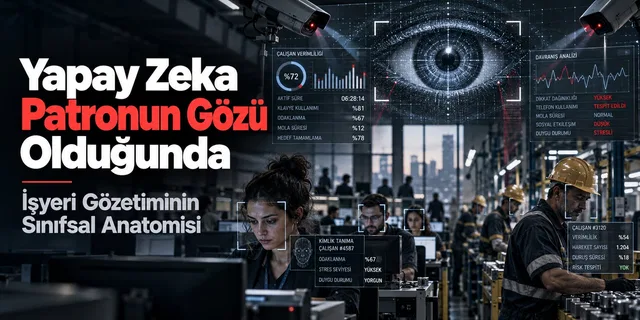
- When AI Becomes the Boss's Eye (20 October) — A class anatomy of workplace surveillance. From the keyboard to location, from scoring to dismissal, why it is not a technical detail whose hand is on the measuring tool.
- Mythos, Model 2 and the Secret Framework (21 October) — The order of secret models: first the barracks, then the bank, the people last. How an old regime of scientific secrecy repeats itself in a new machine.
- The Singularity at the IMF Lectern: To Whom, and on Whose Behalf, Did Jack Clark Speak? (21 October) — What a monopoly executive who says "the singularity has begun" said, and what he left unsaid. The machine is new, the chain is old.
- Whom Is the University For? (22 October) — Artificial intelligence, cognitive surrender and the class of thinking. The line from the market university to a common university.
- Bubble or Debt? (24 October) — Meta's 145 billion dollars and the class character of the AI bubble. Who won while it inflated, who pays if it bursts?
- The Philosophical Trap in Evrim Ağacı's AGI Video (25 October) — We asked whose question "what will you do?" really is, and where a technical story of the future hides its class subject.
Commons and organising
- International Open Access Week (21 October) — "Open" is not always "fair". The conditions for turning knowledge from a commodity into a commons.
- Organising 2.0 (22 October) — An idea for a justified revolt. A wider network does not take the place of a spine. An update for young comrades.
Surveillance, censorship and the card at work
- We Stand with Journalists on 24 October (22 October) — No to censorship, freedom for the news. The labour of those who produce the news, set beside the right to receive it.
- Questions for Press Workers (24 October) — Twenty questions, one answer: the union. Without organisation there is no way forward.
- The Card Around Our Necks (25 October) — Chip tracking at Astor. What the system sees, who reads it, what it turns into. Details below, in the Turkey section.
The Week's Table: Capital's Language, Labour's Question
| Development | Capital's language | Labour's question |
|---|---|---|
| Micron, the Taichung deal | "A quarterly profit-sharing bonus", "sincere communication" | If the text is secret and the other union was not at the table, is this sharing? |
| Taoyuan's rejection | The offer is "structural" and "global" | If 99 per cent of those who voted said no, whom does the deal bind? |
| Samsung Biologics postpones | "Continuity of production", "critical processes" | If a strike cannot stop production, is postponing a defeat or a new position? |
| Netflix's third quarter | "Discipline", "focused choices" | What kind of discipline is it to cut a thousand people while profit rises 44 per cent? |
| eBay and EA | "Strategic priorities", "fewer but bigger games" | If money still flows to AI and acquisitions while the workforce shrinks, what exactly was cut? |
| Activision QA | Talks in "good faith", the launch will not be disrupted | We have had no contract for two years; after the game ships, where is the leverage? |
| AEMO | "Public safety", "the cost to consumers" | Why is the action of the labour that keeps the grid up the first thing suspended? |
| Britain and India data centres | "Benefit to the community", "we will use water responsibly" | Is the promise of benefit written before the bill arrives? |
| The Astor card | "Workplace safety", "process improvement" | Who turns the data from the card around the neck into which decision? |
| The Halk TV YouTube block | "Law 5651, Article 8/A" | If the identity number is blocked once the username changes, is the target the account or the broadcast? |
I. Sharing the Profit: Splitting the Agreement
1. Micron: Taichung Signed, Taoyuan Stayed at the Gate
Date: 19–23 October 2026 · Region: Taiwan · Subject: Semiconductors, profit sharing
What happened? Last issue we wrote about the 19 October rally in Taipei and the demand for 15 per cent. The rally took place. According to Focus Taiwan, hundreds of workers gathered on Ketagalan Boulevard; the demand was not Micron's alone. They wanted wages, higher employer pension contributions, and profit-sharing rules made clear in law. The Chunghwa Telecom union said its Taoyuan and Kaohsiung branches had won strike authorisation, that it has about 20,000 members, and that a walkout before year-end did not look likely.
The break came on 21 October. Micron and the Taichung union signed a labour-management agreement and withdrew from the mediation set for 22 October. The text was not published. The next day, 22 October, 11 union officers from Taoyuan began a 24-hour warning strike, from 09:00 until 09:00 the next morning. Focus Taiwan calls it symbolic. It was not designed to stop production. Union chair Jerry Lin said the two unions had set four joint demands, that Taoyuan representatives were not adequately included in the talks, and that the company would not disclose the text, citing confidentiality. Lin said the vote on the agreement closed at 9 in favour, 2 against and 1 invalid, and claimed that if 12 Taoyuan representatives had had a vote the result would have been 9 to 14. That is the union's account, not an independent count.
The same day, Micron Taiwan chair Lu Donghui set out the shape of the offer. According to the Central News Agency on 23 October, the company said it would add a quarterly profit-sharing bonus on top of the existing annual plan, make a structural pay adjustment, raise shift allowances, give three extra days of paid leave, and lift the pension contribution rate to 10 per cent. The Straits Times reports that the quarterly bonus is designed, from fiscal 2027, for the global workforce. This is not what the unions asked for: 15 per cent of operating profit, paid quarterly, and a one-off bonus equal to 83 months of salary.
On 22 October members voted on the offer. The count the union published: 1,637 members voted, 1,633 voted against. That is about 99 per cent of those who voted and about 70 per cent of the whole membership. The talks on 23 October did not happen, because of a typhoon. The new date is 27 October. The union says it has also been hearing dissatisfaction with the offer from rank-and-file members in Taichung. That, too, is the union's report; it does not mean the Taichung agreement has collapsed.
Micron has about 15,000 workers in Taiwan. According to Focus Taiwan, about 3,000 people work in Taoyuan and 2,335 are in the union; about 12,300 work in Taichung and around 11,000 are in the union. The plant that signed is the bulk of employment.
A class reading: Last week we said a one-off bonus is not a rule. This week the company moved one step further and offered a quarterly bonus and a 10 per cent pension contribution. That shows part of the demand was heard. The part that was not heard is the real part: the rate was not fixed in a contract at 15 per cent, the text was not written with both unions, and the overwhelming majority of Taoyuan members rejected the offer. Capital's classic move is very clear here: split the working class plant by plant, sign with the larger one, and keep the smaller one's strike at the gate. The confidentiality clause is part of the same move. If a worker cannot learn the formula of their own profit share from their fellow union member, what stands there is not a commons but an administrative favour.
Why does it matter for us? We know the same method in computing. A deal for "becoming agile" is signed with one team, and another team is dissolved on performance grounds. If the rule is not written down, next quarter's bonus can be taken back. We will report the result of the 27 October talks in the next issue. If the Taichung text becomes public, the difference between an "agreement" and "sharing" has to be read line by line.
2. Samsung Biologics: It Was Not the Date That Was Emptied, It Was the Strike
Date: 20 October 2026 (postponement) · Region: South Korea · Subject: The right to strike, profit sharing
What happened? Last issue we put the three-week strike said to begin on 26 October on the watch list. On 20 October the union postponed that date for the time being. The union notice carried by Asia Business Daily says a change of strategy was needed after the court ruling of 16 October. Aju Press also writes that participation fell short of what was expected: as of 19 October, 1,515 of 4,006 members, 37.8 per cent, had said they would join the strike. The rate did not rise even after members were allowed to join for a single day. The union asked for talks on the evening of 19 October and planned a temporary general meeting on 22 October to raise a strike fund. No new strike date was announced.
The court ruling was in last week's issue: in Incheon, nine production processes must continue during a strike at normal staffing, normal hours and normal scale. Critical links in the chain, from flask and incubator through virus filtration to bulk filling, were put on that list. The company finds it unacceptable to set aside 15 per cent of operating profit as a performance bonus. That position was already in the company's statement of 2 October, and we have not seen a report that it changed this week.
A class reading: Postponing a strike is not, by itself, a retreat. But the reason for the postponement is instructive. The court did not ban the strike; it pruned the strike's power to stop production. If production does not stop, a strike turns into a long press statement paid for with lost wages. Participation sticking at 38 per cent is also a result of that pruning: members do not appear willing to risk three weeks of pay for an action that does not paralyse production. Here capital uses both the law and the arithmetic of turnout.
Why does it matter for us? In Turkey we know strike postponements on the grounds of "national security" and "public health". In biotechnology the ground is "the product will spoil"; in computing its cousin is "the system will crash". As the definition of critical infrastructure widens, the right to strike stays on paper. That is why the right to strike in computing has to be defended before the "critical system" excuse settles in.
II. The Profit Statement and the Layoff
3. Netflix Reported Its Profit; eBay and EA Cut Staff
Date: 20–21 October 2026 · Region: United States, Canada · Subject: Employment, profit
What happened?
- Netflix (20 October): Last week we wrote about the cut of about 1,000 people. Six days later the third quarter arrived. According to AP, net income was 3.66 billion dollars, 44 per cent higher than the 2.55 billion dollars of the same quarter a year earlier. Earnings per share were 87 cents; the estimate was 82 cents. Revenue was 12.87 billion dollars, up 12 per cent year on year and in line with the estimate. CNBC reports that the company pulled its 2026 revenue forecast down to 51.1 billion dollars. That is the bottom of the 51 to 51.4 billion dollar range it had given before. The fourth-quarter revenue guide is 13.44 billion dollars. The company also said the headcount reduction would pull the fourth-quarter operating margin down by about 120 basis points. It lowered its advertising-revenue outlook. The share price fell after the release. The cut was not made as the result of a collapse in profit. It was made just before a profit announcement.
- eBay (21 October): About 1,000 people, about 9 per cent of the workforce. According to CNBC this is the second round this year; about 800 were cut in February. At the end of 2025 the company had roughly 12,300 employees. CEO Jamie Iannone's note to staff said the strategy was "working" and that choices had to be made about where to focus. The company says hiring will continue in some areas. In July it bought Depop from Etsy for 1.4 billion dollars. The stated reason is not artificial intelligence but "strategic priorities". CNBC also notes that the company has been increasing its spending on artificial intelligence. That link is the context of the report, not the company's own justification.
- Electronic Arts (21 October): The company wrote to employees that it would cut about 3 per cent of the global workforce, close the BioWare studio in Edmonton, and stop early development of the next Mass Effect. Reuters attributes a cut of about 400 people, and roughly 50 of them at BioWare, to a Bloomberg source familiar with the company. EA last reported a workforce of 14,500. In August a 55 billion dollar take-private led by Saudi Arabia's Public Investment Fund, Silver Lake and Affinity Partners had closed. This is the first major studio decision after that sale.
A class reading: Three companies, three different sentences, one relation. Netflix grows its profit while cutting staff, and even the cost of the cut is measured inside the margin as "120 basis points". eBay says "the strategy is working" while shrinking the workforce for a second time, and in the same year buys a platform for 1.4 billion dollars. EA, after a 55 billion dollar private-capital deal, closes a studio that is thirty years old. In none of these three stories is artificial intelligence the name of the justification. The justification is writing the cost of profit and of acquisition onto the worker. Last week we said artificial intelligence is a narrative as much as it is a cause. This week the same result arrived in a plain language of "priorities", without even that narrative.
Why does it matter for us? In Turkish technology companies too, a layoff arrives a few days before the results, in a "restructuring" email. Netflix's own admission is instructive: the cost of the person who was cut is written into the remaining profit as a point on the margin. The Tech Worker's Handbook is there to recall the procedure in Article 29 of the Labour Law on collective redundancies. We described the melting of positions without anyone being fired in our Local 34 piece.
4. Activision: The Game Shipped, the Contract Did Not
Date: 21–23 October 2026 · Region: United States · Subject: Game labour, generative artificial intelligence
What happened? Last issue we wrote that quality-assurance workers had authorised a strike. The company had offered to return to the table on 21 and 22 October. There is no public minute of those talks. According to a Newzino roundup from around 22 October, no strike had been called by that date and neither side had reported an outcome. The strike fund opened on 19 October stood at nearly 11,000 dollars that day. Call of Duty: Modern Warfare 4 launched worldwide on 23 October. The company had said it had plans so that players and the launch would not be disrupted.
The demands stand where they stood last week: wages, limits on generative artificial intelligence, the use of contractors, and accommodations under disability law. Bargaining for a first contract has been going on for more than two years.
A class reading: Strike authorisation is not a strike. The company's sentence, "we have a plan, the game will ship", knows that. Testing labour, invisible in launch week, becomes visible in the days after launch, when player bug reports pour in. The moment of heaviest leverage is not the moment authorisation is won. It is the moment the game is live. That is why capital uses the language of "good faith" before launch and stretches the calendar again afterwards.
Why does it matter for us? Software has the same calendar: on release day everyone is a hero, and on the Monday after release the bug shift turns into unpaid overtime. News of "good-faith talks" does not end until a limit on artificial intelligence and a limit on contractors are written into a contract. Next issue we will look at whether a strike was called after the launch.
5. AEMO: While the Action Continued, Part of It Was Suspended
Date: 21–22 October 2026 · Region: Australia · Subject: Critical infrastructure, the right to strike
What happened? On 21 October AEMO applied to the Fair Work Commission. The request was to end or suspend protected industrial action by about 110 Professionals Australia members. The company says the combined effect of the notified actions created a risk to public safety, energy-system operations and the economy that could not be fully managed. Until the application is decided, the Commission temporarily stopped some actions by control-room operators. What was suspended: some internal operational briefings, the assessment of part of the planned transmission outages, and replies to industry participants' questions. The company writes that it respects employees' lawful right to take action and that the application was not a step taken lightly.
The ASU ballot we were watching last week was due to close on 22 October. While preparing this issue we could not confirm that ballot's result on the Fair Work Commission's published list. We are not inventing a result. We will look again next issue.
A class reading: "Public safety" here is not a neutral technical term. The moment the labour that runs the grid takes action, the action itself is declared a danger. The work that was suspended is also instructive: the briefing, the outage plan, the answer to the industry's question. That is the invisible coordination of the system. If risk appears when that coordination stops, this also proves that the labour is indispensable. When indispensable labour bargains, the first response is to thin the bargaining by administrative means.
Why does it matter for us? The data centre, the payment system, hospital software, election infrastructure: each can be declared "critical" in turn. Where something is declared critical, the right to strike is the first right to be narrowed. AEMO is not a distant Australian story. It is a rehearsal of the strike debate in computing.
III. The Two Sides of the Data Centre
6. Twelve Months for Britain, and "We Will Bring Our Own Water" for India
Date: 22 October 2026 · Region: United Kingdom, India · Subject: Data centres, water, electricity
What happened? According to a Guardian report of 22 October, a group that includes Nvidia, Microsoft and Cisco gave the British government a warning: it has roughly 12 months to head off data-centre protests before they reach a point like the one in the United States. Dry summers and rising energy bills are enlarging the public reckoning of the warehouses that run the models. A government spokesperson said data centres should create jobs, supply chains and local investment, prioritise clean power, and use water responsibly.
The same day CNBC wrote about a similar tension in India. Neighbourhood objection to the Amazon facility near Mumbai continues. Amazon told CNBC it does not use water for cooling and does not draw power from the local distribution network that supplies homes and shops. There is also a demand to cancel the permissions given for Google's 15 billion dollar project in Visakhapatnam. On 14 October, junior electronics minister Jitin Prasada said they would prepare a policy so that households do not compete with data centres for electricity and pay higher bills. The detail of that frame is still missing this week. The objection has not stopped.
A class reading: Two sentences should be read side by side. The companies tell the government, "you have a year to manage the protest". The government says, "we will create benefit". The benefit is promised before the objection grows, not after the plant is built and the bill arrives. Amazon's sentence, "we will not use the water, we will not draw power from the local grid", is less a checkable commitment than an attempt to close the language of objection. Whether the commitment is tied to a contract, a permit and an independent measurement sits outside the news.
Why does it matter for us? Last week we wrote about the moratorium in Oregon and the dry taps in Batam. This week capital said, in its own words, that it fears that objection spreading to Britain and India. In Turkey too, data-centre incentives are told as "investment". The bill for water, electricity and land should not wait until after the foundation is poured.
7. The Construction Union Wants the Data Centre
Date: 24 October 2026 · Region: United States · Subject: Construction labour, data centres
What happened? A report published on 24 October about IBEW Local 26, around Washington, DC, says local officers describe about half of current jobs as data-centre sites. In Virginia, a very large share of these facilities is said to be built with union labour. An apprentice in the report describes working 60-hour weeks at 43 dollars an hour plus overtime, and hoping to buy a home with it. For the union, this wave is a door of work standing in for blue-collar employment that has been shrinking for decades.
A class reading: The data centre is not the object of a single class interest. The electrician who builds it and the neighbourhood that pays for its water and electricity are not on the same side. It is legitimate for a construction union to say "we want the work". It is a separate class relation that the operating cost of that work is written onto the public's bill. The answer is not to declare the construction worker an enemy of the data centre. The answer is to defend union employment in construction while also tying the promises on water, electricity and jobs in operation to a contract. Otherwise the job one union wins becomes another worker's bill.
Why does it matter for us? In Turkey too, the sentence "let the investment come, there will be jobs" stops the conditions of the incentive from being discussed. Shutting the data-centre debate into ecology alone, or into employment alone, suits capital. Both have to be asked together: who builds it, who runs it, who pays for the water and the electricity, and who is left unemployed if it closes?
IV. From Turkey
8. Astor: The Tracking Card Around the Neck
Date: 25 October 2026 · Region: Turkey · Subject: Workplace surveillance
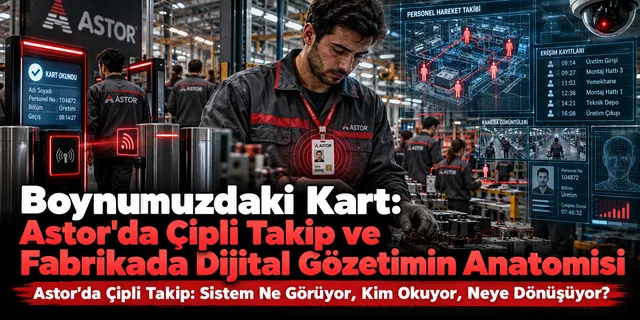
What happened? Starting from Evrensel's report of 25 October, we published The Card Around Our Necks. At Astor Enerji's plant in Ankara, blue-collar workers carry a tracking card around their necks throughout the shift. According to the company's reply to Evrensel, cards were issued to 840 workers in the pilot. The cards are an ENGES product. The company says they work by Bluetooth, that there is no camera, microphone or GPS, and that the aim is workplace safety and process improvement. Workers say that taking the card off is in practice impossible, that they are questioned when they stay in one place, and that time in the toilet and the rest area can be seen. The detail, the technical layers and the data-protection argument are in that piece.
A class reading: Last week we wrote that Amazon watched a worker's Reddit posts and that a call-centre conversation was being scored. This week the same relation stands in a Turkish factory, in a plainer object: the card around the neck. "There is no GPS" does not mean location inside the factory is not measured. Measurement is wherever the receiver is. The data can be written into a safety report, a productivity report, or a performance file in a wage round. The difference is not technical. It is political: who reads the data, and which decision do they turn it into?
Why does it matter for us? The tech worker's workplace has similar tools: screen recording, location, time-keeping software, a "productivity" dashboard. What the card is in the factory, the agent is in the office. The legitimacy of both stops at the worker's written consent and at the purpose of the data. Do not wait for the next factory story to ask where that limit is. Ask about the tool in your own workplace this week.
9. The Username Was Not Enough; the Channel ID Was Blocked
Date: 23 October 2026 · Region: Turkey · Subject: Censorship
What happened? Last issue we wrote about the blocks on Halk TV's accounts, on the Workers' Party of Turkey's X account, and on journalist Bahadır Özgür's account. This week the block went down one more layer. According to the decision announced by the Freedom of Expression Association and reported by BirGün on 23 October, the YouTube channel blocked on 14 October under the username @Halktvkanali was blocked again, this time by channel ID. The channel had changed its username to @Halktv-eu. BirGün's report says that, at that hour, YouTube had still not made the channel invisible from Turkey despite the new decision. The same report recalls that the X account of about 3 million followers and the TikTok account of about 256,000 followers had been closed to access from Turkey by the platforms.
On 22 October we wrote the call for 24 October. On 24 October we asked press workers twenty questions. We put the answer down as the union. The age-verification regulation still comes into force on 1 November. We have not seen a statement this week that the date has been postponed.
A class reading: Changing a username looks like a technical escape. A decision that reaches the channel ID shows that the target is not a handle but the broadcast. Censorship here does not close a sentence of content. It closes the channel's technical identity. Age verification on 1 November is the identity side of the same line: if every account is tied to e-Devlet, staying by changing a handle becomes harder too. Two different pieces of regulation, one regime.
Why does it matter for us? While the press worker's job grows uncertain, the viewer's access is also being tied to an identity regime. Archiving, mirroring and union solidarity do not replace one another. All three are needed together. Next issue, the day after it comes into force, we will look at the Freedom of Expression Association's case before the Council of State.
The Common Class Meaning of These Developments
First axis: profit sharing, a divided contract
At Micron the company put a quarterly bonus and a 10 per cent pension contribution on the table. That shows the demand was not ignored. The same company signed with one union, hid the text, and had the other union's members reject it. Sharing is not sharing unless the formula is a rule everyone can read. At Samsung Biologics the 15 per cent demand is still on the table; the date was postponed because a court pruned the strike's power over production. High-technology workers in East Asia are still meeting on the same formula: a fixed percentage of profit to labour. Capital's reply is still the same: either hide the percentage, or make the strike meaningless.
Second axis: the profit statement and the layoff in the same week
Netflix's net income rose 44 per cent while a thousand people were outside. eBay cuts for a second time while saying the strategy is working. EA closes BioWare after a 55 billion dollar privatisation. In these stories artificial intelligence is not even the name of the justification. The justification is priority. As long as the worker does not set the priority, the workforce shrinks whatever the technology is.
Third axis: the job and the bill at the data centre
In Britain the companies give the state a deadline to prevent protest. In India the company promises it will not use the water and the electricity. In the United States a construction union wants to work on that site. Each says a true piece, not the whole. The whole question is this: who builds it, who runs it, who pays for the water and the electricity, and who is unemployed when it closes?
Fourth axis: surveillance and censorship are tying themselves to the same identity regime
At Astor the card is around the neck. At Halk TV the block moved from the username to the channel ID. On 1 November a social-media account will be tied to e-Devlet verification. All three say "security". All three narrow the decision of the person who is measured, blocked and required to identify themselves.
What We Will Watch Next Week
| Date | Development | Why we are watching |
|---|---|---|
| 27 October | Micron–Taoyuan talks | How will the rejection vote land on the table? Will the Taichung text be published? |
| 1 November | The age-verification regulation | What will the platforms do, and where is the Freedom of Expression Association's case? |
| Ongoing | Activision QA | Is there a strike decision after launch, and is the artificial-intelligence clause on the table? |
| Ongoing | AEMO | The ASU ballot result, and the ruling on the suspension application at the Fair Work Commission |
| Ongoing | Samsung Biologics | A new strike date, and the result of the 22 October fund meeting |
| Ongoing | The Astor card | The worker's written demand, and the reply of the union and the ministry |
| Ongoing | Halk TV | Whether the YouTube identity block is applied, and the workers' jobs |
Concrete Tasks: What Falls to Us
- Write down the measuring tools in your workplace this week. The card, location, screen recording, call scoring, the "productivity" dashboard. Ask which of them was notified to you in writing. If it was not, use the right of access under the data-protection law. Our Astor piece describes the factory version of this question.
- If there is profit sharing, ask for the formula. If the bonus arrives as "a management decision", what is the rate, which profit is it a percentage of, and who calculates it? The text hidden at Micron shows what an unwritten bonus looks like.
- Recall the collective-redundancy procedure once more. Article 29 of the Labour Law. For "restructuring" emails that arrive, as at Netflix, a few days before a profit announcement, that procedure has to be recalled.
- Talk about 1 November around you. Age verification is not only an app update. If you work on a team that will build this system, say in the team what it means for privacy to tie an identity to an account.
- Make solidarity with press workers a union question. Archiving a blocked account is necessary. It is not enough. As we wrote in the twenty questions, if the labour that produces the news is not organised, the archive scatters too.
- Ask locally about the data-centre incentive. Ask which document the promises on water, electricity and jobs are written into. The sentence "investment is coming" does not cancel that document.
- Correct this roundup. If you have the 27 October Micron talks, the ASU vote, or a minute from the Activision table, write to us. This series grows by common labour.
Not Opposition to Technology, but a Say over Technology
Dear young comrades,
This week a union officer in Taoyuan stood at the gate, a worker in Taichung signed a text, Netflix's profit statement grew in the absence of a thousand people, and a worker at Astor went to the toilet with a card around their neck. Different countries, the same sentence: we produce this technology, we run it, we pay its price; why is the decision not ours?
This question is not against technology. We write code, we build systems, we process data. We ask the question both from inside and from outside. If the formula of profit is secret, if the inside of a strike has been emptied by a court, if a layoff passes as a "priority", and if the card around the neck is fastened in the name of "security", the answer is not in an individual choice. It is in the association built with the comrade at the next desk.
Until we meet again next Monday.
Knowledge belongs to everyone.
Our Related Pieces
Earlier issues of the series
- The Week's Class Developments in Technology — Issue 2 · 13–19 October 2026
- The Week's Class Struggle in Technology — Issue 1 · 6–12 October 2026
Pieces cited in this issue
- The Card Around Our Necks
- Bubble or Debt?
- When AI Becomes the Boss's Eye
- Questions for Press Workers
- We Stand with Journalists on 24 October
Tech workers and organising
Sources
1. Micron
- Focus Taiwan, "Workers rally in Taipei for pension reform, profit-sharing rules", 19 October 2026 — https://focustaiwan.tw/society/202610190023
- Taipei Times, "Micron signs deal with union, both call off mediation", 22 October 2026 — https://www.taipeitimes.com/News/biz/archives/2026/10/22/2003866387
- Focus Taiwan, "Micron Taoyuan union reps begin symbolic strike after Taichung deal", 22 October 2026 — https://focustaiwan.tw/business/202610220016
- Reuters, via Investing.com, "Micron faces strike from one Taiwan union after deal with another", 21 October 2026 — https://www.investing.com/news/economy-news/micron-taiwan-union-sign-deal-withdraw-from-mediation-4961824
- Central News Agency (CNA), the Taoyuan rejection vote and the 10 per cent pension contribution, 23 October 2026 — https://www.cna.com.tw/news/afe/202610230158.aspx
- The Straits Times, "Taiwan union rejects Micron bonus proposal", 23 October 2026 — https://www.straitstimes.com/asia/east-asia/taiwan-union-says-micron-workers-reject-bonus-proposal
2. Samsung Biologics
- The Asia Business Daily, "Samsung Biologics Union Postpones Second Strike", 20 October 2026 — https://www.asiae.co.kr/en/article/2026102017063415622
- Aju Press, "Samsung Biologics Union Postpones Second General Strike", 20 October 2026 — https://www.ajupress.com/view/20261020171270417
- Money Today, the company calling the 15 per cent demand unacceptable, 2 October 2026 — https://www.mt.co.kr/en/thebio/2026/10/02/2026100216184175209
3. Netflix, eBay, EA
- AP, "Netflix posts higher Q3 profit", 20 October 2026 — https://apnews.com/article/netflix-amazon-disney-skydance-332fc9ae36c9ecc788cb163a70e655ed
- CNBC, "Netflix posts third-quarter earnings beat", 20 October 2026 — https://www.cnbc.com/2026/10/20/netflix-nflx-earnings-q3-2026.html
- CNBC, "EBay to lay off 9% of workforce", 21 October 2026 — https://www.cnbc.com/2026/10/21/ebay-layoffs-workforce-cuts.html
- Reuters, via US News, "EA to Shutter BioWare Studio", 21 October 2026 — https://money.usnews.com/investing/news/articles/2026-10-21/ea-to-shutter-bioware-studio-cut-jobs-as-it-narrows-game-slate
- Variety, the EA memo and the closure of BioWare, 21 October 2026 — https://variety.com/2026/digital/news/ea-layoffs-bioware-shutting-down-respawn-dice-star-wars-battlefront-3-1236918715/
4. Activision
- CWA, "Activision Quality Assurance workers vote to authorize strike", 15 October 2026 — https://cwa-union.org/news/releases/activision-quality-assurance-workers-vote-authorize-strike
- Aftermath, the company's offer to meet on 21–22 October — https://aftermath.site/activision-qa-workers-union-strike-call-of-duty-layoffs/
- Vertical Slice, the strike fund, 19 October 2026 — https://www.verticalslice.news/activision-union-workers-begin-fundraising-to-prepare-for-possible-strike/
- Newzino, a roundup noting that no strike had been called as of 22 October — https://newzino.com/story/activision-quality-assurance-workers-vote-to-authorize-strike-e2cbda
5. AEMO
- AEMO, "Enterprise agreement update", 21 October 2026 — https://www.aemo.com.au/newsroom/news-updates/enterprise-agreement-update
- On Notice, the ASU ballot due to close on 22 October, 11 October 2026 — https://onnotice.com.au/news/aemo-strike-ballot-to-close-22-october/
- Fair Work Commission, the published list of ballot results — https://fwc.gov.au/workplace-disputes/other-workplace-disputes/industrial-action/ballot-results
6 and 7. Data centres
- The Guardian, "AI firms say UK has a year to head off datacentre protests", 22 October 2026 — https://www.theguardian.com/uk-news/2026/oct/22/ai-firms-say-uk-has-a-year-to-head-off-datacentre-protests-before-construction-is-threatened
- CNBC, "India data center boom raises water and power concerns", 22 October 2026 — https://www.cnbc.com/2026/10/22/india-data-center-google-amazon.html
- Briefs, IBEW Local 26 and data-centre employment, 24 October 2026 — https://www.briefs.co/news/a-union-is-championing-data-centers-near-washington-d-c/
8 and 9. Turkey
- Evrensel, "Astor'da işçilere çipli takip", 25 October 2026 — https://www.evrensel.net/haber/6006472/astor-da-iscilere-cipli-takip
- Bilgi Müşterekleri, "The Card Around Our Necks", 25 October 2026 — https://bilgimusterekleri.org/en/blog/boynumuzdakikart/
- Freedom of Expression Association, "No social media without identity from 1 November", 13 October 2026 — https://ifade.org.tr/basin-bultenleri-ve-duyurular/uyardigimiz-gun-geldi-1-kasimdan-itibaren-kimliksiz-sosyal-medya-yok/
- BirGün, "Halk TV'nin YouTube kanalına bir erişim engeli daha", 23 October 2026 — https://www.birgun.net/haber/halk-tv-nin-youtube-kanalina-bir-erisim-engeli-daha-742149
- Freedom of Expression Association, the Halk TV YouTube channel-ID block — https://ifade.org.tr/engelliweb/halk-tvnin-youtube-kanali-kanal-kimligi-uzerinden-de-erisim-engellendi/
- Bilgi Müşterekleri, "We Stand with Journalists on 24 October", 22 October 2026 — https://bilgimusterekleri.org/en/blog/bizsusarsak/
- Bilgi Müşterekleri, "Questions for Press Workers", 24 October 2026 — https://bilgimusterekleri.org/en/blog/basinemekcilerinesorular/
This piece is issue 3 of Bilgi Müşterekleri's series "The Week's Class Developments in Technology" (week 44 of 2026). It is a living document and may be updated with corrections and additions. It is shared under a CC BY-SA 4.0 licence.