Philosophers and Artificial Intelligence
Reading Philosophy's Great Questions with Class

Who Is Inside the Mill?
Philosophers, Artificial Intelligence, and Reading the History of Philosophy with Class
A Philosophy Guide for Young Comrades
Dear Young Comrades,
In recent months we keep meeting the same table in chatbot answers, social-media posts and conference slides. In the left-hand column there are philosophers: Socrates, Aristotle, Descartes, Hume, Kant, Hegel, Marx, Nietzsche, Heidegger, Wittgenstein, Foucault, Turing. In the right-hand column, today's artificial-intelligence questions: "Are we handing thinking over to the machine?", "Is disembodied intelligence possible?", "Does the machine really understand?", "Can there be a neutral artificial intelligence?"
Look at this table carefully. It is a table into which labour has gone; it is instructive, and in most places it is right. But it leaves three questions unanswered:
- Who asked these questions, and under what conditions? In the table, philosophical problems are eternal questions that seem to circulate of their own accord for centuries, now and then "coming back onto the agenda." Yet every question was born from inside a definite mode of production, a definite division of labour.
- Who is the subject of the table? In the table "the human" "externalises" memory onto writing, muscle-power onto the machine, judgement onto artificial intelligence. Which human? Whose memory, whose muscle, whose judgement? Who is doing the externalising, and who is being externalised?
- Why are the rows equal? In the table Marx stands between Nietzsche and Heidegger as one of fifteen "perspectives." Yet he is the frame that makes most of the other rows concrete, that explains why they are being asked again now.
In this piece we will rebuild the same table from the start. We will not drop the philosophers; we will give their questions their due. But under every row we will add one more question: Whose labour, whose property?
This piece is a continuation of Artificial Intelligence, Philosophy and the Illusion of Ownerlessness, which we published on 13 September. There we dismantled the claim that artificial intelligence is an "ownerless," spontaneously developing natural event. Here we go further back and look at the history of philosophy itself.
Method: The History of Questions Is the History of the Division of Labour
A note on method before we begin.
Marx and Engels say in The German Ideology that ideas "have no history of their own." This does not mean that philosophy is worthless. It means that ideas do not wander in a sky independent of the material life of the people who produce them, and of the way that life is organised.
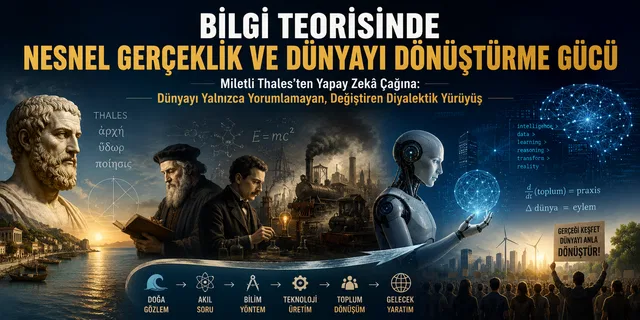
One of those who took this method furthest is Alfred Sohn-Rethel. In Intellectual and Manual Labour (1970) he defends this thesis: abstract, conceptual thought — that is, philosophy — was born in the social conditions in which intellectual labour was separated from manual labour. It was no accident that the first Greek philosophers appeared in Ionia, in cities where money and commodity exchange had become widespread. Exchange was an abstraction people performed every day. The philosopher turned that abstraction into a concept.
Philosophy was born from the separation of intellectual labour from manual labour. Artificial intelligence, for its part, is mechanising intellectual labour itself. That is why artificial intelligence is not merely a subject of philosophy; it touches the condition of philosophy's birth.
That is why the questions in the table have come back all at once. It is true that artificial intelligence "reopens very old questions" philosophically. But it does so not by the magic of the technology itself, but by the point at which a two-thousand-five-hundred-year division of labour has now arrived. Capital is doing to intellectual labour, for the first time at this scale, what it has until now done to manual labour.
Now let us look at the philosophers one by one.
Socrates and Plato: Who Owns Memory?
What the table says
In Plato's Phaedrus (274c–277a) Socrates tells an Egyptian myth. The god Theuth invents writing and takes it to King Thamus: "This will increase wisdom and memory." Thamus refuses: "On the contrary, it will bring forgetfulness into the souls of those who learn. People will remember not from inside themselves but from foreign marks outside. They will not be wise; they will appear wise."
The table carries this scene into the present: writing externalises memory, the search engine access to knowledge, artificial intelligence judgement. The question is built accordingly: "If we hand thinking over to the machine, do we become knowledgeable, or do we merely come to have access to knowledge?"
A class reading
One detail of the myth is always skipped: look at to whom writing is offered. To a king. In ancient Egypt writing was the monopoly of a caste of scribes. Tax records, the accounts of grain stores, land measurements were kept in writing. Writing never appeared as "humanity's memory." It first appeared as the account-book of the class that appropriated the surplus product.
Plato's own political project also turns this division of labour into ontology. In The Republic thinking falls to philosopher-rulers, defence to the guardians, production to artisans and farmers. Everyone will "do their own work." For the artisan to philosophise is contrary to justice.
That is why today's question is not only "is memory weakening?" The real question is this: Where does memory stand, and whose is it?
- In the age of writing, memory was in the library. The library belonged sometimes to the temple, sometimes to the palace, then to the university, and at last to the public. The public library is a gain of struggle.
- In the age of the search engine, memory moved onto a company server, but at least it still gave a link to the source.
- In the age of generative artificial intelligence, memory is torn from its sources and compressed into model weights. The answer arrives; the author disappears. Knowledge is sold back, by subscription, with the owner's name wiped off.
Thamus's fear was that "people will forget." Ours is another: humanity's common memory is turning into a service that a single company lets out for rent. The name of this is not forgetfulness; it is enclosure.
Aristotle: The Shuttle That Weaves by Itself, and the Right of Judgement
What the table says
Aristotle divides knowledge into kinds: theoretical knowledge (epistēmē), the skill of making (technē) and practical wisdom (phronēsis). From this the table draws a strong question: can a machine know a great deal, do a great deal, and still lack the capacity to decide "what ought to be done"? Intelligence is not wisdom.
This is true. But Aristotle says one more thing on this subject, and it never enters the tables.
Aristotle's forgotten dream
In Book I of the Politics (I.4) Aristotle writes: if every tool could do of itself the work given to it — like the statues of Daedalus or the tripods of Hephaestus — if the shuttle could weave by itself, if the plectrum could play the lyre by itself, master-craftsmen would have no need of helpers, nor masters of slaves.
This is the oldest known expression of the dream that automation will set the human free. In the same paragraph Aristotle defines the slave as a "living tool."
Two thousand years later Marx quotes this passage in the machinery chapter of Capital. Beside it he also sets the lines of the poet Antipater, who praises the water-mill as glad tidings that will free women grinders from labour. Then he gives this verdict: these ancient thinkers could not have known that the machine would be the surest instrument for lengthening the working day. The shuttle that weaves by itself did indeed come. But it did not end slavery. It brought children working fourteen hours at the loom.
Everyone who says today "artificial intelligence will free us from drudgery, we will work three days a week" is repeating Aristotle's dream. Marx's answer still holds: who the machine will free is decided not by the machine but by the owner of the machine.
Whose is the right of judgement?
Aristotle has one more sentence. In the same book of the Politics (I.13) he says that in the slave's soul "the deliberative faculty is not present at all." That is: the slave thinks but does not decide. Decision belongs to the master.
Now let us return to the table. We ask "can the machine decide what ought to be done?" Yet what is happening in workplaces today is this: the decision is already being given neither by the machine nor by the worker. Algorithmic management systems decide which route the courier will follow, how many seconds the call-centre worker will speak, how many steps the warehouse worker will take. The criteria of those decisions are set by the management that bought the system.
In the Gig Economy Dossier we called this mental Taylorism. Taylor took the knowledge of manual labour from the worker and carried it to the engineer's desk. Artificial intelligence takes the judgement of intellectual labour from the employee and carries it into the company's model.
Aristotle's question was not "can the machine be wise?" It was "who deliberates, who only executes?" That question is being asked again today in every workplace.
Descartes: Where Is the Body of Disembodied Intelligence?
What the table says
Modern artificial intelligence has a tacit Cartesianism: if intelligence is information-processing, the body is secondary. Phenomenology and the embodied-cognition approach object to this. The model has read every text in which the word "pain" appears, but it has never felt pain. Is using a concept the same thing as living in the world of the concept?
Descartes's fallen limit
Let us first give him his due, because Descartes has a foresight on this subject that is not mentioned in the tables. In Part Five of the Discourse on the Method (1637) he proposes two criteria for distinguishing the human from the machine. The first is language: a machine can produce words, but it cannot arrange them in the various ways needed to answer appropriately to the sense of everything said before it. The second is flexibility: the machine acts not by knowledge but by the arrangement of its organs, and therefore fails in unforeseen situations.
Large language models have, at least in appearance, surpassed Descartes's first criterion. This is not a small event in the history of philosophy. A limit counted "proper to the human" for three hundred and eighty-nine years has fallen. We should take that fall seriously rather than deny it.
A class reading: the body is elsewhere
But let us return to the claim of "disembodied intelligence." Is the model really disembodied?
The model has a body. Only that body is not in front of the user's eyes:
- In data centres: thousands of processors, megawatts of electricity, millions of litres of water for cooling. Local resistances against data centres in Chile, Uruguay, Arizona and Ireland are resistances against precisely this body. The slogan of the actions in Spain says everything: "Tu nube seca mi río" (Your cloud is drying my river).
- In mines: the metals that are the raw material of the chips come from an extractive chain running from the Congo to Chile.
- At labelling desks: Time magazine's 2023 investigation brought to light workers in Kenya who, for less than two dollars an hour, read and labelled the heaviest content (violence, abuse, hate speech). The model's capacity to "avoid harmful content" was learned by passing through these workers' nervous systems.
So disembodied intelligence is an appearance. It is an instance of what Marx called commodity fetishism: a social relation appears as a natural property of a thing. On the screen we see only text. The labour, energy and ore that make the text possible are invisible.
Phenomenology's objection is right: intelligence cannot be separated from the body. But the Marxist objection goes one step further. The second of the Theses on Feuerbach says: the question whether objective truth belongs to human thought is not a theoretical but a practical question. The individual's body is not enough. The real body of intelligence is the social body: production, labour, circulation.
The model is not disembodied. Its body is in Nairobi, in the Atacama, and in the wells of Arizona. The only thing that looks disembodied is its cost.
Hobbes, Leibniz, Babbage: Entering the Mill
What the table says
In Leviathan (1651, ch. 5) Hobbes writes that reasoning is "nothing but reckoning, that is adding and subtracting." Leibniz goes a step further and dreams of a universal language in which all disputes will be settled by calculation: Calculemus! (Let us calculate!)
But the same Leibniz, in the Monadology (1714, §17), also writes his famous objection. Let us imagine a thinking machine. Let us enlarge it to the size of a mill and go inside. We see parts pushing one another. But we see nothing that would explain perception.
The table carries this mill into the present: when we go inside the transformer we see embedding vectors, attention layers, matrix multiplications. So where is meaning?
The row that is not in the table: Charles Babbage
In the table one jumps from Hobbes and Leibniz to Turing. A man is missing in between, and the real family tree of artificial intelligence begins with him.
In the 1790s the French Revolution's new metric system needed huge tables of logarithms and trigonometry. The engineer who took on the work, Gaspard de Prony, struck on an idea when he read Adam Smith's division of labour in the pin factory: divide calculation like a factory too. Calculation was split into three grades. At the top, a few mathematicians choosing the formulae. In the middle, computers turning the formulae into simple steps. At the bottom, dozens of workers doing only addition and subtraction — many of them, the story goes, former wig-makers left jobless after the Revolution.
Charles Babbage studied this organisation and reached this conclusion: if the lowest grade is doing only addition and subtraction, a machine can do it. That is how the Difference Engine was born. In the book he wrote in 1832, On the Economy of Machinery and Manufactures, Babbage put a chapter titled "On the division of mental labour." The book's main principle is today called the "Babbage principle": if you divide the work into parts, you can have each part done by the cheapest labour adequate to that part. Marx read this book carefully and used it in Capital.
Matteo Pasquinelli, in The Eye of the Master: A Social History of Artificial Intelligence (Verso, 2023), traces this line to the present. His thesis is this: artificial intelligence developed not by imitating the human brain but by imitating the division of labour. First labour was broken into parts; then the parts were handed to the machine.
So the practical answer to "is thinking calculating?" was given not in the philosophy chair but in the workshop. Intellectual labour passed to the machine to the extent that it was divided into parts small enough to be mechanised.
The man in Searle's room
Now let us come to 1980. In "Minds, Brains, and Programs" John Searle constructs the Chinese Room thought experiment. A man who does not know Chinese sits in a room. Chinese symbols come in under the door. The man looks at the rule-book in his hand, finds which symbol to answer with which symbol, and pushes the answer back under the door. To those outside, the room speaks perfect Chinese. But the man in the room understands not a word.
Searle built this to show that the machine does not understand. But look at the experiment with a Marxist eye. What Searle describes is not a machine; it is a worker. A worker who processes symbols whose meaning he does not know, according to a rule-book given to him, on someone else's account, remaining invisible himself while the result is presented outside as "intelligence."
Today this room really exists. On data-labelling platforms millions of people classify images whose context they do not know, and often texts not in their own languages, according to instructions written by the company. Outside, the model is marketed as "understanding." No one asks what the person in the room understood.
Leibniz went into the mill and did not find perception. We went into the mill and found the miller.
Hume and Kant: The Machine That Learns from the Past, Capital's A Priori
What the table says
According to Hume, a large part of our knowledge comes from habit. If B has always followed A, we begin to expect B. But there is no logical guarantee that nature will behave the same way tomorrow. Machine learning is in large part a Humean machine: it learns regularities in past data and predicts the future from them. Correlation is not causation.
Kant answers Hume: the mind is not an empty vessel. It organises experience with its own categories. The table sets this up well too: the model does not see "raw reality." The tokeniser, the architecture, the training objective, the selection of data and the reward system determine in advance how the model will see the world.
A class reading: whose past is the past?
Let us add a class layer to Hume's problem. A machine that learns from past data does not learn from a neutral record of the past. It learns from the property and power relations of the past. A model that scores credit counts as "normal" who was able to get credit in the past. A model that does hiring counts as "success" who was hired in the past. An application from a poor neighbourhood gets a low score because few people from that neighbourhood were hired in the past. Result: the model carries the inequality of the past into the future as if it were a law of nature.
The technical literature calls this "bias" and proposes a technical correction. Yet the problem is not an error; it is the method itself: every system that learns from the regularity of what exists reproduces what exists. It cannot foresee change — that is, rupture, the strike, the revolution. Because these are, by definition, events that break the regularity of the past.
Whose desk are Kant's categories on?
Kant's categories of mind were universal; they were the same in all humans. The model's "categories" are not universal. They are chosen by someone. And the most decisive element of that choice is the objective function: what is the model being trained to optimise?
If a recommendation system's objective is watch-time, the world appears to it as "things that produce watch-time." If an advertising model's objective is the click, the human appears to it as "probability of a click." These categories are not the mind's; they are the business model's.
Kant's a priori was the structure of reason. The model's a priori is the structure of the profit calculation. To ask how the model sees the world is to ask what its owner wants from the world.
Hegel: Is Recognition for Sale, and What Does the Slave Know?
What the table says
For Hegel, self-consciousness does not form in solitude. It requires recognition by another consciousness. The table ties this to artificial-intelligence companions: is a user who says "you are the only one who really understands me" really being recognised, or is a mirror of themselves being shown to them?
A good question. But the table tells only half of Hegel's most famous section.
The other half of the master–slave dialectic
In the Phenomenology of Spirit (1807) the struggle between master and slave begins with the master's victory. The master is recognised; the slave works. But then the dialectic turns. The master relates to the world only through the slave's labour and becomes dependent on the slave. The slave, through labour, shapes the world, and in that shaping comes to consciousness of their own power. For Hegel the road to independent consciousness does not pass through the master but through the labouring slave.
This is the most valuable thing Marx took from Hegel. Let us apply it to artificial intelligence:
- Who is the master, and on what are they dependent? Artificial-intelligence companies depend on the text, code and images produced by millions of people in order to train their models. They need a continual supply of new human data. When models are trained on data they themselves have produced, they degrade. This is the current proof that the master cannot do without the slave.
- What does the slave know? The programmer, the translator, the designer who uses the model every day knows better than the company's marketing department where it errs, where it fabricates, which work it can really do and which it cannot. This knowledge, when it becomes organised, is a power.
- Is recognition for sale? Artificial-intelligence companions turn the need for recognition into a subscription product. Loneliness itself becomes a market. Yet in Hegel recognition is reciprocal: the one who recognises me is someone with a will of their own, who must also be recognised by me. A system optimised only to please me is not one that recognises; it is one that serves. And the owner of that service is a company that extracts income from my loneliness.
Recognition cannot be bought as a product. Recognition is built among people who work side by side, who struggle side by side. The philosophical name of comradeship is mutual recognition.
Marx: The Conversion of the General Intellect into Fixed Capital
In the table Marx was one of fifteen rows. Here he is at the centre, because he holds the thread that binds the other rows together.
The fragment on machines
In 1857–58, in the Grundrisse — the preparatory notes for Capital — Marx wrote a few pages later called the "Fragment on Machines." These notes were published only in 1939. The reason they are being reread in the age of artificial intelligence is these sentences:
Nature does not make machines, locomotives, railways, the electric telegraph. These are organs of the human brain, created by the human hand. They are the power of objectified knowledge. The development of fixed capital indicates to what degree general social knowledge has become a direct force of production. Here Marx uses an English term: general intellect.
Marx's observation in this fragment runs in two directions:
- Social knowledge is objectified in the machine and confronts the worker as an alien power. Knowledge is taken from the worker's head and becomes the property of the machine — that is, of capital.
- But the same process shrinks the share of direct labour-time in the production of wealth and undermines the very foundation of a system that measures value by labour-time. The fragment points to this contradiction.
The large language model is this fragment realised almost word for word. The model is a statistical compression of the texts, code, translations and arguments written by millions of people. Social intelligence has been converted into fixed capital on a single company's server. In our call The Revolt of Crystallized Labor we named this the expropriation of the general intellect.
Capital: the machine uses the worker
In the machinery chapter of Capital Marx draws a distinction: in handicraft and manufacture the worker uses the tool. In the factory the machine uses the worker. The worker is turned into a living appendage of the machine.
The experience of people working today with a code assistant, a translation engine, a customer-service artificial intelligence is this reversal in the form it takes in intellectual labour. The programmer is turning from a person who writes code into a person who inspects, corrects and approves the code the model has written. The translator is no longer a translator but a "post-editor," and the wage falls accordingly. This is what Marx, in Results of the Direct Production Process, called real subsumption: capital becomes master not only of the product of labour but of the labour process itself, of its inner organisation.
Who creates value?
Here is a question that never appears in the tables. Does the machine create value?
According to Marx, no. The machine transfers its own value to the product bit by bit, but it does not create new value. New value is born only from living labour. So where do the enormous revenues of the artificial-intelligence companies come from?
From three sources:
- Rent: monopoly over computing infrastructure and foundation models gives these companies the power to take a share of the value others produce. As the model becomes an infrastructure, every business that uses it pays its owner a kind of rent.
- The intensification of exploitation: workers who use the model turn out more work in the same time, but their wages do not rise. The difference born of increased productivity stays with the employer.
- Appropriation without payment: the training data — that is, the past labour of millions of people — was taken without any payment. We showed this in Learning from Everyone Is Permitted, Learning from the Monopoly Is a Crime: learning from everyone's labour is counted "fair use"; learning from the monopoly's output is counted "theft."
The Marxist question is not "does the machine think?" It is "who owns the social intelligence inside the machine?" And the answer to that question is given not by an analysis of concepts but by a change in a property relation.
From Nietzsche to The German Ideology: Whose Side Is Neutrality?
What the table says
In On the Genealogy of Morality (III, §12) Nietzsche says "there is only a perspective seeing, only a perspective knowing." The table ties this to the claim of "neutrality" in artificial intelligence: which data, which language, which culture, which answer will be refused? Every choice is a perspective. That is why alignment is not a technical problem but a problem of value.
True. But perspectivism goes this far here and then stops. Because when we say "everything is a perspective," all perspectives are equalised. Yet perspectives are not equal. Behind some of them there is a company, a budget, a law firm, a government.
We discussed Nietzsche at length in The Man Who Wept for the Commune. His perspectivism comes together with a defence of aristocracy: the "noble" perspective is superior to the perspective of "the herd."
Marx and Engels's more precise answer
The German Ideology says something more precise: the ideas of the ruling class are in every epoch the ruling ideas. The class that holds the material power of society also holds its intellectual power.
In artificial intelligence this is not an abstract principle but a concrete production process:
- Selection of data: which part of the internet is counted "high quality" and taken into training? The company decides.
- Reinforcement learning from human feedback (RLHF): low-paid evaluators determine which answer the model will learn as "better." But according to what? According to the instructions the company wrote. It is not the evaluator's own value that is written into the model, but the company's.
- Codes of conduct: the company's policy team writes what the model will refuse, on which subject it will be "balanced." We dismantled this with the Microsoft example in Who Holds the Leash on Artificial Intelligence?: in the hierarchy of the rules there is the model, the operator and the user — but neither the worker who produces the model nor the human whose data is taken.
Neutrality is the form in which property makes itself invisible. Anyone who says "let the model be neutral" must ask "which side is the model's owner on."
Heidegger and Lukács: Who Makes the World Calculable?
What the table says
In "The Question Concerning Technology" (1953) Heidegger says that modern technology is not a sum of tools; it makes the world visible in a certain way. Modern technology turns everything into a resource standing ready to hand, a "standing-reserve" (Bestand). The Rhine is no longer a river; it is the water source of a hydroelectric plant. Heidegger calls this way of seeing the world Gestell (enframing).
The table ties this beautifully: in the age of artificial intelligence the human ceases to be a person and becomes a user, nature a resource, culture training data.
Lukács said it earlier
This observation is true. But Heidegger was not the first to make it, and he is not the one who makes it best.
In 1923, four years before Heidegger's Being and Time, Georg Lukács published the chapter "Reification and the Consciousness of the Proletariat" in History and Class Consciousness. There he showed this: under capitalism, social relations appear as relations among things. The production process is increasingly rationalised, broken into parts, made calculable. The worker's labour, and their personality too, are broken down into measurable units. This logic of calculability spills out of the factory and spreads into law, bureaucracy, science, everyday consciousness.
This is the materialist and historical explanation of what Heidegger called Gestell. The difference is here: Heidegger binds this way of seeing the world to the essence of "Technology," to the destiny of Western metaphysics. Lukács binds it to commodity production and the law of value. It is not technology that turns the river into a resource. It is the capital relation that sees the river as an input that yields profit. The same turbine can carry another meaning inside another property relation.
The danger of a classless critique of technology
This difference is not an academic detail. A critique that blames "Technology" instead of class, "modernity" instead of capital, can easily slide in a reactionary direction: toward a longing to return to the root, the soil, tradition, an "authentic" past. Heidegger himself joined the Nazi Party in 1933 and took up the rectorship of the University of Freiburg. This does not invalidate every observation of his. But it shows where a critique of technology can go when it is torn from class.
A part of the critique of artificial intelligence today is advancing on the same line: "the machine is killing the soul; let us return to the good old days." Against this, in From Futurism to Techno-Fascism we showed the opposite direction: futurism, which sees technology as a power to be worshipped, also walked side by side with fascism. Both extremes make the same error: they tear technique from social relations and either demonise it or sacralise it.
It is not "Technology" that turns the world into a storehouse of calculable resources; it is capital. A critique that blames technique turns back to the root. A critique that blames capital looks forward.
Wittgenstein and Voloshinov: Do Words Have a Class?
What the table says
In the Philosophical Investigations (§43) the later Wittgenstein says that the meaning of a word is, in most cases, its use in the language. Language is made of "language-games" embedded in actions and social practices. From this the table draws an interesting conclusion: the model jokes, apologises, argues — that is, it takes part in more and more language-games. Then instead of asking "is there real meaning inside the model?" we should ask "under what conditions do we ascribe understanding to a being?"
This is a strong answer to Searle's Chinese Room, and it should be taken seriously.
Whose language-game?
But Wittgenstein has one more concept: Lebensform, form of life. Language-games are played inside a form of life. The question is this: whose form of life's language-games is the model learning?
The overwhelming majority of the training data is English. Turkish is a small share. Kurdish, Laz, Zazaki are almost absent. Those who write most on the internet are those who have the time, the education and the connection. So the model does not learn a neutral "human language"; it learns the language of the form of life that has the loudest voice on the internet.
Voloshinov: the sign is the arena of class struggle
Here a Marxist philosopher of language who is never mentioned in the tables comes in. In 1929, in Marxism and the Philosophy of Language, Valentin Voloshinov advances this thesis: in the same society different classes use the same language. That is why different class accents intersect in every word. The sign is the arena of class struggle. The ruling class tries to give the sign a single accent, to present it as "univocal," "neutral."
Let us give an example. The word "flexibility." In the employer's mouth it means "productivity and competitiveness." In the worker's mouth it means "insecurity, on-call work, an uncertain shift." The word "reform." For the government, "structural transformation"; for the labourer, most of the time, "the pruning of rights."
The large language model is a probability machine. It learns the most probable use of a word. The most probable use is the most repeated use — that is, the use of the mainstream media, of corporate communication, of textbooks. The model flattens a multi-accented sign toward its ruling accent. It does this not out of ill will but by statistics. But the result is the same.
Wittgenstein said "meaning is use." Voloshinov added: use cannot be shared equally among classes. The model learns the most probable meaning, and the most probable meaning is the meaning of those who rule.
Walter Benjamin: Not the Question of Aura, but of Politics
What the table says
In "The Work of Art in the Age of Mechanical Reproduction" (1935–36) Benjamin discusses how photography and cinema dissolve the "aura" of the work of art — that is, its uniqueness, its here-and-now. The table carries this to generative artificial intelligence: when a thousand images can be produced in a second, what is scarce is not the work but attention, context and the human story.
The last page the table erases
The tables never say how Benjamin's essay ends. The essay closes with an epilogue, and that epilogue is the purpose of the whole essay: fascism tries to give the masses a chance of expression without touching property relations. The result is the aestheticisation of politics. The point this aestheticisation will reach is war. Benjamin ends thus: to fascism's aestheticisation of politics, communism replies by politicising art.
When you tear Benjamin from this epilogue, what remains is a debate about "originality." Yet Benjamin's question was not "what is an original work?" It was "in which class's hands will the new technical means be, and which politics will they serve?"
Today this question has come back in all its sharpness:
- The aestheticisation of politics: around the world, far-right movements are building an aesthetic with images produced by artificial intelligence: heroised leaders, enemy-ised migrants, nostalgia for a "golden age" that never was. A visual language that gives feeling to the masses without touching property relations.
- The devaluation of art labour: visual artists, voice artists, translators, screenwriters are being forced to compete with models trained on their own works.
- And the politicisation of art: in 2023 in the United States the 148-day strike of the screenwriters (WGA) and the 118-day strike of the actors (SAG-AFTRA) brought one of the first major gains that put a limit on the use of artificial intelligence by collective agreement. This is the present counterpart of Benjamin's call: not to defend the aura, but to determine the conditions of the tool's use by the organised power of the art worker.
In the age of generative artificial intelligence the question is not "can the machine make art?" Benjamin's question holds: in whose hands is the tool of art, and which politics does it serve?
Foucault: The Panopticon Was Born as a Workplace
What the table says
In Discipline and Punish (1975) Foucault analyses Jeremy Bentham's Panopticon design as the model of modern power: from the tower in the centre every cell can be seen, but the person in the cell cannot know whether they are being watched. That is why they begin to supervise themselves. The table carries this to artificial intelligence: old surveillance asked "what did you do?" Algorithmic surveillance asks "what will you do?" We are passing from surveillance to prediction, from prediction to steering.
The detail that is not in the table: the birthplace of the Panopticon
The idea of the Panopticon was not born in a prison. Jeremy Bentham's brother Samuel Bentham, while managing the workshops of an estate in Krichev, in Russia, in the 1780s, designed a structure in which a few foremen could watch a great many workers. Jeremy took the idea from there and generalised it as a universal model applicable to prisons, schools, hospitals, factories.
So the Panopticon was born from the need to supervise the working human. Foucault's analysis of disciplinary power is valuable. But if we leave the motor of that power as an abstract "technology of power," we cannot explain why it spread so far. The Marxist answer is this: behind discipline there is the compulsion of accumulation. To extract more surplus value from every minute of labour, every minute of labour must be seen.
Today this logic is seen in its most naked form in platform work. The courier's position is tracked second by second, delivery time is scored, the courier whose score falls is sacked by "account closure" — that is, without seeing a human face. As we showed in the Gig Economy Dossier, the algorithm here is at once foreman, inspector and the employer's proxy.
The target of surveillance is also widening. As we showed in the piece we wrote on Anthropic's activist monitoring system, the same tools can pass easily from knowing the consumer to filing the opponent.
The Panopticon was born not in the prison but in the workshop. Algorithmic surveillance too was first set up to watch the worker, then spread to all of us. The history of surveillance is the history of supervising labour.
Turing and Searle: The Test Is Being Run Today in the Labour Market
What the table says
In 1950, in "Computing Machinery and Intelligence", Alan Turing found the question "can machines think?" undefined and proposed a game in its place: can an interrogator, looking at written answers, tell whether the one opposite is a human or a machine? Searle, as we saw above, argued that behaviour is not proof of meaning. The table says that this seventy-year quarrel is lived today every day on the chat screen.
The real question of the imitation game
The first form of Turing's game begins not with a machine but with a gender imitation: a man tries to persuade the interrogator that he is a woman. Then a machine is put in the man's place. That is, from the start the test measures not "what a thing is" but whether a role can be played successfully.
Today this test is being run not in the philosophy seminar but in the labour market. The question is not "does the machine think?" but "can the machine play the role of the human who does this job, without the customer noticing?" In customer service, in translation, in copywriting, in the writing of code, whether this test is passed is the employer's only criterion.
Indeed OpenAI's charter defines artificial general intelligence (AGI) not by a cognitive but by an economic criterion: "highly autonomous systems that outperform humans at most economically valuable work." In the Illusion of Ownerlessness we summarised it thus: AGI is not a cognitive threshold; it is a threshold in the labour market.
Turing's own story also carries a bitter lesson. This mathematician, who played a vital role in the breaking of the Enigma cipher in the war, was convicted by the British state in 1952 for homosexuality and forced into chemical treatment. He died in 1954. The state's apology did not come until 2009, the pardon until 2013. The man who asked whether the machine could imitate the human was not counted, in his own state's eyes, a "sufficiently correct" human. The question of recognition appears again as a question of power.
The Turing test is being run today not in the laboratory but at the hiring desk. The question asked is not "does the machine think?" but "can the machine imitate you cheaply?"
Clark and Chalmers: Extended Mind, or Rented Mind?
What the table says
In 1998, in "The Extended Mind", Andy Clark and David Chalmers give an example. Otto, who has Alzheimer's, writes addresses in a notebook and looks at the notebook when he needs to. Healthy Inga calls addresses from her memory. According to the authors, Otto's notebook can be counted a part of his cognitive system, just like Inga's memory. The mind does not end at the skull's boundary. The table applies this to artificial intelligence: is artificial intelligence a tool, or a part of our thinking system?
Whose is Otto's notebook?
There is a detail skipped in the article that today changes everything: Otto's notebook is Otto's. No one can take it from him, change its price, update its terms of use unilaterally, or read what is in it and use it for advertising.
Today's artificial-intelligence assistant is not like that:
- The company can raise the price, remove the free version, close the account.
- The model is updated one day and may become unable to do a job it could do yesterday.
- The chat history — that is, the content of the "extended mind" — sits on the company's server. Who will have access depends on the clauses of a contract.
- And most important: the person who uses the tool every day may in time lose the skills they cannot do without it. This is the counterpart, in intellectual labour, of the handicraft worker who loses their craft when they enter the factory. Harry Braverman, in Labor and Monopoly Capital (1974), named this process deskilling.
Clark and Chalmers asked "where does the mind end?" We add a second question: whose property is the place where the mind extends? If a part of my extended mind is a company's property, that company owns a part of my thinking process. This is a new form of property in the history of philosophy.
Otto's notebook was Otto's. Ours is rented. The extended mind, unless it is made common, is a rented mind.
A Supplement: Spinoza and the Tale of the "Autonomous Agent"
Sometimes Spinoza too has a place in the tables, and it is good that he does, because he illuminates better than anyone one of today's most talked-of concepts: the "autonomous agent."
According to Spinoza everything is subject to nature's necessary laws. The human too is a part of nature, not "a kingdom within a kingdom." What we call free will is, most of the time, an illusion born of not knowing the causes that determine us. Freedom is not to flee necessity but to grasp necessity and act according to it. Engels, in Anti-Dühring, takes this idea over through Hegel: freedom is the insight into necessity. We worked this through at length in Spinoza and the Roots of Materialist Dialectics.
Today artificial-intelligence companies market their models as "autonomous agents": systems that decide on their own, complete tasks, use the computer themselves. A Spinozist eye asks this: what are the causes that determine this autonomy? Who set the agent's goal? Who decided which tools it may reach? When it errs, who is responsible?
The answer comes out at the same place every time: what makes the agent look "autonomous" is the invisibility of the causes behind it — that is, of its owners. Just as in Spinoza's example of the stone that, not knowing the hand that threw it, would think it "fell of its own will."
The machine's autonomy is the owner's invisibility. Real autonomy is the collective grasping and supervising of necessity. The social name of this is planning.
Rebuilding the Table
Now we can go back to the beginning. The same philosophers, the same questions. But this time with a third column.
| Thinker | The table's question | The class question |
|---|---|---|
| Socrates / Plato | If we hand thinking over to the machine, do we become knowledgeable? | On whose server does humanity's common memory stand, and to whom is it rented? |
| Aristotle | Can the machine be wise? | Why did the shuttle that weaves by itself not end slavery? Who deliberates, who only executes? |
| Descartes | Is disembodied intelligence possible? | In which country, which mine, which labelling desk is the model's body? |
| Hobbes / Leibniz / Babbage | Is thinking calculating? | How, and in whose interest, was intellectual labour broken into parts? Who is working inside the mill? |
| Hume | Is learning from a pattern understanding? | Which inequality of the past is the machine that learns from the past carrying into the future? |
| Kant | Is the model learning the world, or its own structure? | Who writes the model's categories — that is, its objective function? |
| Hegel | Can artificial intelligence recognise us? | On whom is the master dependent? What does the worker know about the machine? |
| Marx | Whose property is humanity's collective knowledge? | How did the general intellect become fixed capital, and how is it taken back? |
| Nietzsche → Marx–Engels | Is a neutral artificial intelligence possible? | By what process are the ruling class's ideas written into the model? |
| Heidegger → Lukács | Is artificial intelligence turning the world into a resource? | What makes the world calculable — technique, or commodity production? |
| Wittgenstein → Voloshinov | Is using language understanding? | Which form of life's, which class's, accent is the model learning? |
| Benjamin | What is originality in the infinitely produced work? | Which politics does the tool of art serve? How is the art worker organising? |
| Foucault | Is artificial intelligence shaping us? | Why was surveillance first born in the workplace? Why does accumulation want to see everything? |
| Turing / Searle | Is speaking like a human thinking? | Why is the test being run in the labour market? Who is the worker in Searle's room? |
| Clark / Chalmers | Is artificial intelligence a part of our mind? | Whose property is the place where our mind extends? |
| Spinoza | Is the autonomous agent free? | Whose interest does the invisibility of the causes that determine autonomy — that is, of the owners — serve? |
The second column is not wrong. It is philosophy's inheritance, and without knowing it we cannot build the third column. But a thought that remains in the second column explains artificial intelligence and cannot change it. The third column is the actionable form of the explanation.
The Last Question: Is the Human Intelligence?
Most tables of this kind end with a jarring question: "If the machine can do more and more of the things we call intelligence, was it wrong from the start to define the human only through intelligence?"
Dear Young Comrades, the answer to this question has been waiting ready in the Marxist tradition for a hundred and eighty years.
First: the human is defined not by intelligence but by conscious and purposeful labour. Marx tells this in chapter seven of Capital with a famous comparison: a bee puts many an architect to shame by the structure of its honeycomb. But there is something that distinguishes the worst architect from the best of bees: the architect builds the structure in their head before they build it in reality. At the end of the labour process a result appears that already existed, at the beginning, in the labourer's mind. What defines the human is not calculating power but the practice of transforming the world according to a purpose: praxis.
Second: the sixth of the Theses on Feuerbach says: the human essence is not an abstraction inherent in each single individual. In its reality it is the ensemble of social relations.
From these two propositions this follows: "can the machine be human?" is a question wrongly asked. Humanity is not a list of capacities sitting inside an individual, such that the machine might tick the list one by one and become human. Humanity is an ensemble of relations. The machine enters these relations, changes them, but cannot take their place. The real question is in which relations, and for whom, the machine will work.
And the eleventh thesis: the philosophers have only interpreted the world, in various ways; the point is to change it.
The tables interpret artificial intelligence. Our work is to change the relations inside which artificial intelligence works.
What Is Being Covered Over?
In accounts that read the history of philosophy through artificial intelligence and leave class outside, five things remain systematically invisible:
- Living labour. Data labellers, content moderators, evaluators who give human feedback, data-centre workers. The model's "intelligence" passes through their labour. They are not in the account.
- Past labour. The millions of writers, programmers, translators, artists who constitute the training data. In the account they are anonymised as "data."
- Property. To whom the model, the computing infrastructure, the data belong. In the account subjectless words such as "humanity" and "technology" cover this question.
- Material infrastructure. Energy, water, ore, land. In the account it evaporates as "the cloud."
- Struggle. Strikes, unionisation efforts, lawsuits, data-centre resistances. In the account the history of philosophy flows as a conversation among ideas. Yet each of these ideas was born inside a struggle, and the answer to today's questions will also be given inside a struggle.
Concrete Tasks
Reading philosophy is a job. Reading philosophy with class is a second job. Turning this reading into practice is a third. Ten items for young comrades:
- Go to the primary source. Most of the texts we cite in this piece are free and online. The writing myth in the Phaedrus is two pages. The machine fragment in the Grundrisse is twenty pages. Read the texts, not the tables.
- Add the third column to every philosophical question. When you meet the question "does the machine understand, think, have consciousness?" in an artificial-intelligence debate, write this underneath: "Whose labour, whose property, whose decision?"
- Make the worker in Searle's room visible. Follow and share what is written on the conditions of data-labelling, content-moderation and evaluator workers. Watch the unionisation efforts of content moderators in Kenya.
- Enter the mill in your own workplace. How are artificial-intelligence tools being used at work? Which decisions were taken from the employee and given to the algorithm? Whose workload rose, whose wage fell? Take notes, talk with your friends.
- Be conscious against deskilling. Use the tool, but do not let it think in your place. Keep and develop your own skills. This is not an individual solution, but it is a precondition of organised struggle.
- Pay attention to the accent of words. Weigh words such as "productivity," "flexibility," "transformation," "autonomous agent" not by the meaning the model and corporate language give them, but by your own class's experience.
- Neither sacralise nor demonise technique. Remind the person who says "the machine will save us" of Aristotle's shuttle, and the person who says "the machine is killing the soul" of Lukács. What determines is not technique itself but the property relation inside which it works.
- Stand with art workers. Support the struggle of illustrators, voice artists, translators seeking rights against models trained on their own labour.
- Defend open source and open knowledge. Contribute to initiatives that work for models, data and research to be produced and shared in common. But do not forget that open source by itself does not solve the property problem.
- Start a reading group. Take the table in this piece; discuss one row each week. Read a philosopher's primary text and its class reading side by side. Put the discussion into writing, share it.
Dear Comrades,
Three hundred years ago Leibniz left us a thought experiment: bring a thinking machine to the size of a mill, go inside, and look for perception. You will not find it.
We ran this experiment again. We went into the mill of artificial intelligence. We walked among the gears, the matrices, the probability distributions. We did not find perception; that much is true. But we found something else.
We found a woman in Nairobi, at a screen, classifying images whose meaning she does not know. We found a river flowing into a data centre's cooling system. We found a writer whose books were taken without permission, an artist whose drawings are imitated, a translator made a "post-editor" and whose wage was cut in half. And above them all we found a handful of companies holding the mill's title-deed.
Philosophy's great questions have come back; that is true. But this time it is not only the philosophers at the table. The millers are there too.
We went into the mill. We did not find perception; we found the miller. Now it is time to ask whose the mill will be.
Comradely.
Related Pieces
For all our philosophy pieces: bilgimusterekleri.org/en/tag/felsefe/ For all our artificial-intelligence pieces: bilgimusterekleri.org/en/tag/yapayzeka/
The philosophy and political economy of artificial intelligence
- Artificial Intelligence, Philosophy and the Illusion of Ownerlessness (13 September 2026)
- The Revolt of Crystallized Labor: A Call to the 20th Karaburun Science Congress (24 July 2026)
- For the Restitution of the General Intellect: The Socialist AI Manifesto Is Out
- Who Holds the Leash on Artificial Intelligence?
- Learning from Everyone Is Permitted, Learning from the Monopoly Is a Crime (9 September 2026)
Philosopher portraits
- Spinoza and the Roots of Materialist Dialectics (18 August 2026)
- The Man Who Wept for the Commune (3 September 2026)
- From Futurism to Techno-Fascism (7 September 2026)
- From Having to Being: Reading Erich Fromm with Class (14 September 2026)
Algorithmic management and surveillance
- Gig Economy Dossier (31 August 2026)
- Anthropic's Activist Monitoring System (11 September 2026)
Sources
Primary texts
- Plato, Phaedrus, 274c–277a. Project Gutenberg
- Plato, The Republic. Project Gutenberg
- Aristotle, Politics, I.4 and I.13. Project Gutenberg
- René Descartes, Discourse on the Method (1637), Part Five. Project Gutenberg
- Thomas Hobbes, Leviathan (1651), ch. 5. Project Gutenberg
- G. W. Leibniz, Monadology (1714), §17.
- Charles Babbage, On the Economy of Machinery and Manufactures (1832). Project Gutenberg
- G. W. F. Hegel, Phenomenology of Spirit (1807), "Lordship and Bondage."
- Karl Marx, Friedrich Engels, The German Ideology (1845–46). marxists.org
- Karl Marx, Theses on Feuerbach (1845). marxists.org
- Karl Marx, Grundrisse (1857–58), "Fragment on Machines." marxists.org
- Karl Marx, Capital, Volume I (1867), "The Labour-Process and the Process of Producing Surplus-Value" and "Machinery and Large-Scale Industry." marxists.org, labour-process, marxists.org, machinery
- Friedrich Engels, Anti-Dühring (1878), "Morality and Law: Freedom and Necessity." marxists.org
- Friedrich Nietzsche, On the Genealogy of Morality (1887), III, §12.
- Georg Lukács, History and Class Consciousness (1923), "Reification and the Consciousness of the Proletariat." marxists.org
- Valentin Voloshinov, Marxism and the Philosophy of Language (1929).
- Walter Benjamin, "The Work of Art in the Age of Mechanical Reproduction" (1935–36). marxists.org
- Alan Turing, "Computing Machinery and Intelligence," Mind, 1950. Oxford Academic
- Ludwig Wittgenstein, Philosophical Investigations (1953), §23 and §43.
- Martin Heidegger, "The Question Concerning Technology" (1953).
- Michel Foucault, Discipline and Punish (1975).
- John Searle, "Minds, Brains, and Programs," Behavioral and Brain Sciences, 1980. DOI
- Andy Clark, David Chalmers, "The Extended Mind," Analysis, 1998. DOI
Secondary sources
- Alfred Sohn-Rethel, Intellectual and Manual Labour: A Critique of Epistemology (1970; English 1978).
- Harry Braverman, Labor and Monopoly Capital (1974).
- Matteo Pasquinelli, The Eye of the Master: A Social History of Artificial Intelligence, Verso, 2023.
- Billy Perrigo, "OpenAI Used Kenyan Workers on Less Than $2 Per Hour to Make ChatGPT Less Toxic," Time, 18 January 2023. Time
- OpenAI, OpenAI Charter (2018). openai.com
- Stanford Encyclopedia of Philosophy entries: Leibniz on the Mind, Hegel's Phenomenology, Heidegger, Wittgenstein, Foucault, The Chinese Room Argument