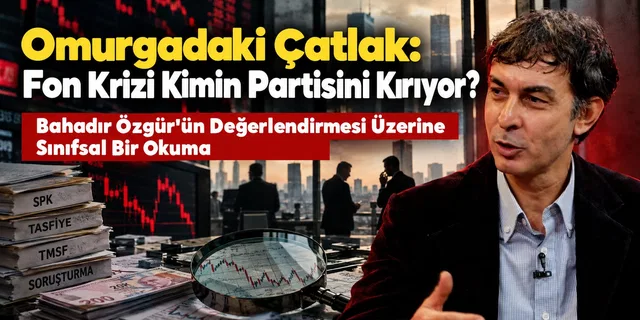
Six and a Half Trillion: The Money Wiped Off the Exchange, the Life Missing from the Table
A Ledger on the Thirty-Seventh Day of the Fund Crisis — What Did Not Reach the School, the Pensioner, the Poor, the Young?

Six and a Half Trillion: The Money Wiped Off the Exchange, the Life Missing from the Table
A Ledger on the Thirty-Seventh Day of the Fund Crisis — What Did Not Reach the School, the Pensioner, the Poor, the Young?
Dear Young Comrades,
Yesterday afternoon a one-sentence post dropped from an X account and reached more than 800,000 people in a single night:
"From the fund crisis of 16 September until today, 6.5 trillion TL has been wiped off Borsa Istanbul. About 130 billion DOLLARS. That is more than the national wealth of 75 countries on this earth." — @finansaljoker, 22 October 2026
The figure is large. So large that it has no equivalent in the head. What we want to do in this piece is exactly this: check the figure, then set it beside the items that touch people's lives in this country. Beside the school, the pension, the student grant, the assistance that goes to a poor household.
But first a warning, because the point of this file is the right anger, not the wrong one: not all of the money "wiped" off the exchange went into someone's pocket. Part of it was inflated paper value that had never existed. The real question is who sold while that paper value was inflating, and in whose hands it remained when it deflated. We will tell that too.
First, the Summary: What Should We Know in Five Minutes?
- The figure is roughly right. On Capital Markets Board (SPK) data, the total market value of companies traded on the exchange was 23.04 trillion TL at the end of August and had fallen to 16.61 trillion TL by mid-October: a loss of 6.43 trillion TL, about 28%. In dollars, 142.5 billion (about 134 billion if the exchange-rate effect is left out). Yesterday the BIST 100 fell another 3%. The post's "6.5 trillion / 130 billion dollars" is consistent with these data.
- But "from 16 September until today" is not quite exact. Part of the loss was in the exits that began when the SPK tightened the fund rules on 28 August. Measured only from 15 September to 16 October, the loss for BIST All is given as more than 3.5 trillion TL. The crisis burst on 16 September, but the exit through the door had started earlier. This detail matters, because the question of who knew in advance sits exactly here.
- The phrase "75 countries" is not an exaggeration. It is too small. 130 billion dollars is larger than the annual national income (GDP) of more than 140 countries in the world, on the IMF's 2026 estimates. As much as a year of production in Ghana, in Ethiopia, in Venezuela. (The post's term "national wealth" is technically wrong; the right term is "national income".)
- Set beside life: 6.43 trillion TL is 2.2 times this year's education budget, 7 times all the social assistance distributed this year, 4.6 years of pension for the 4.9 million people on the lowest pension, 33 years of KYK grant for every university student in Turkey, and about 24 to 40 years of a free school lunch for every child in school.
- The fund plunder itself: 7 portfolio management companies, 131 funds, 455,758 investors, a total size of 826 billion TL (about 18 billion dollars). Paid so far: 40.8 billion TL to 45,747 accounts, only 5% of the size of the funds.
- Who is in the file? 85 people in pre-trial detention, proceedings against 207 people (6 October). AKP Deputy Chair and former Family Minister Fatma Betül Sayan Kaya resigned; she and her husband are alleged to have made about 2.2 billion TL before the crisis, and the money was returned to a Treasury account. On 19 October the SPK Chair resigned, and the Deputy Minister of Treasury, whose son-in-law is in custody, retired. It was not announced that an investigation had been opened against any of them.
- Yesterday the fund law passed Parliament. An interim payment of up to 1 million TL for the small investor, a buy-back power for the Savings Deposit Insurance Fund (TMSF), a promise that "no public resource will be used". But the same law also leaves a door ajar for whoever "voluntarily returns unjust gain".
- The class summary: While the paper value was up, those at the top sold; while it was down, the wage-earner and the pensioner held on. The loss was not privatised. It is being socialised: in the interest rate, in the exchange rate, in the budget, in every postponed rise.
Now let us go into the detail.
Checking the Post: Where Does the Figure Come From?
Every large figure circulating on social media should be checked twice. Our job is not to feed the anger. It is to give the anger solid ground.
Market value: SPK data
Alp Börü, in Nefes, drew the following table from the SPK report "Information on the Market Value of Companies Whose Shares Are Traded on the Exchange":
| Period | Total market value | Change |
|---|---|---|
| August 2026 | 23.038 trillion TL (479.2 billion $) | — |
| September 2026 | 17.739 trillion TL | −5.299 trillion TL |
| October 2026 (latest data) | 16.609 trillion TL (336.7 billion $) | −1.130 trillion TL |
| Total | −6.428 trillion TL (−27.9%) |
The loss in dollar terms is 142.5 billion dollars. If the exchange rate is held constant, 133.7 billion dollars; the 8.8 billion dollars in between comes from the lira's loss of value.
Add yesterday's fall (22 October): the BIST 100 closed the day down 3.08%, at 11,220 points; every sector index fell. So the post's 6.5 trillion TL / about 130 billion dollars, if you take the end of August as the starting point, is sound.
"From 16 September until today", or "from August until today"?
A distinction has to be made here. On the reckoning of Gazete Oksijen and Ekonomim, between 15 September and 16 October alone:
- BIST 100: more than 2 trillion TL,
- BIST 30: more than 1.7 trillion TL,
- BIST All: more than 3.5 trillion TL lost.
On Bloomberg HT's reckoning, the value wiped out in September alone was 4.5 trillion TL. The loss from the May peak (22.64 trillion) to 2 October (16.21 trillion) is again 6.43 trillion TL.
Different figures come from different starting points and different index coverage. The right reading is this: the collapse became visible on 16 September, but it began on 28 August. That day the SPK tightened the fund rules, and heavy exits from the funds followed. Those who knew the door would close got out before the door. The question we asked in the third piece of this series, Who Got Out Before the Door Closed?, still stands for that reason.
"The national wealth of 75 countries"
This is the part of the post that was shared most, but the concept has slipped. "National wealth" is the sum of all of a country's assets (land, buildings, machines, financial assets); it is a concept so large that no country's national wealth can be said to be less than 130 billion dollars. What is meant is almost certainly national income, that is, one year's GDP.
On that measure the post did not exaggerate. It said too little. On the IMF's 2026 estimates, only 70 countries have a GDP above 130 billion dollars. Just under the line stand Ghana (128.6 billion $), Ethiopia (127.1 billion $), Venezuela (124.2 billion $) and the Democratic Republic of the Congo (122.3 billion $). The number of countries and territories below it is more than 140.
So the value wiped off the exchange in 37 days equals everything Ethiopia, a country of 130 million people, produced in a year. About 7% of Turkey's own national income (1.82 trillion $).
Thirty-Seven Days: A Short Chronology
In earlier pieces we told the first days in detail. Here we only recall the line:
| Date | What happened |
|---|---|
| February 2025 | According to the Minister of Justice, abnormal movements in some funds and shares are noticed for the first time. |
| October 2025 | The SPK fines two executives of Pusula 8.9 million TL each; the funds are not stopped. |
| 4 November 2025 | It is reported that Şimşek warned the SPK. |
| August 2026 | The prosecutor's office obtains permission to investigate. |
| 28 August | The SPK tightens the fund rules; heavy exits from the funds begin. |
| 13–16 September | Five funds of Pusula say "net asset value could not be calculated", and default. On 16 September the BIST 100 falls 5.54%, and the circuit breaker trips. |
| 17 September | The SPK puts 131 funds of 7 portfolio management companies into liquidation. The Financial Stability Committee: "temporary and manageable". |
| 26–29 September | AKP Deputy Chair Fatma Betül Sayan Kaya resigns; prosecutors ask for the couple's assets to be frozen. |
| 6 October | Justice Minister Gürlek: 85 in pre-trial detention, proceedings against 207 people, 5 people returned their unjust gain. |
| 7 October | Sayan Kaya and her husband are called to give statements as suspects. |
| 8 October | The opposition's motions for an inquiry into the fund plunder are rejected by AKP and MHP votes. |
| 16 October | The 2027 budget comes to Parliament: 27.3 trillion TL. |
| 19 October | SPK Chair Mahmut Sütçü resigns on "health" grounds; Deputy Minister of Treasury and Finance Osman Çelik, whose son-in-law is in custody, files for retirement. |
| 20 October | Şimşek: liquidation is finished in 66 of the 131 funds, and 40.8 billion TL has been paid to 45,747 accounts. The BIST 100, in dollar terms, is at its lowest since June 2025. |
| 21 October | The number of detentions rises to 88. |
| 22 October | The Central Bank (TCMB) cuts the interest rate by 100 basis points (to 36%). The exchange falls 3%. In the evening the fund law passes Parliament. |
Looking at this table, one thing stands out: the warning was there nineteen months ago. The fine was imposed eleven months ago. The minister's warning was given eleven months ago. The tightening of the rules came three weeks before the crisis. The crisis was not a surprise. It was a postponed explosion.
What Does "Wiped Out" Mean? Paper, Pocket and Class
We have to stop here and make one concept clear, or our anger will go to the wrong target.
Market value is a company's number of shares multiplied by the last traded price. When a share's price falls from 100 lira to 70, all of that company's shares are counted as having "lost" 30 lira at once; yet that day perhaps one per cent of the shares changed hands. So the whole of the 6.5 trillion TL loss is not cash that left one till and entered another.
Marx named this: fictitious capital. A share is a claim on future profit; it does not itself produce value, it is the shadow on paper of value that will be produced. This shadow can break away from real production and inflate on its own. Recall the Gündoğdu Gıda example we have followed since the first piece of this series: the share of a dairy whose production had stopped rose 25 times. In the later balance sheet the number of employees, 217 at the end of 2024, had fallen to 2. That rise was never real value; when it deflated, what "disappeared" was a value that had never existed.
Shall we then say "there is no loss"? No. Because the real matter is not the paper itself. It is the moment the paper changes hands.
- While the shadow inflates, someone sells and takes the real money.
- Someone buys and holds the shadow.
- When the shadow deflates, the seller is long gone; the buyer remains, having turned the real money they accumulated with their labour into paper.
That is the plunder: the changing of hands of real accumulation through paper value. The allegation about the Sayan Kaya couple is the textbook example: between April and July, about 63 million TL put into Özata Denizcilik shares and sold for about 1.3 billion TL before the crisis; the spouse putting in 99.7 million TL and pulling out 826 million TL. A total of about 2.2 billion TL. These figures are allegations; the presumption of innocence applies. But the structure is not an allegation: the gain of the one who got out early is paid out of the loss of the one who stayed late.
Who stayed late? On the March 2026 data of the Central Securities Depository (MKK), 72% of the 6.8 million investors on the exchange have a portfolio under 50,000 TL; only 0.56% are above 1 million TL. The fund investor is the most cautious of these: the holder of severance pay who says "I don't understand, let an expert manage it", the person who put in their retirement lump sum, the person who wanted to put a wedding fund to work. The average per person across 455,758 investors comes out at roughly 1.8 million TL, but this average misleads; a few large accounts pull the average up, and the majority by number are small accounts.
The Real Reckoning: What Would 6.5 Trillion Have Been Enough For?
Let us now put the figure inside life. In the comparisons below, to be cautious, we use the SPK's figure of 6.43 trillion TL, not the post's 6.5.
A reminder: this is not a reckoning of "this money could have been spent there", because stock-market value is not a till that can be transferred to the budget. This is a reckoning of scale: to see how many times the value that evaporated on paper in a month is the money this country sets aside for social needs. Scale shows priority.
Education: every school, every university, two years
| Item | Amount | How many times is 6.43 trillion TL? |
|---|---|---|
| 2026 central-budget education spending (all levels) | 2.896 trillion TL | 2.2 times |
| 2027 proposal: total education | 3.747 trillion TL | 1.7 times |
| 2027 proposal: the Ministry of National Education alone | 2.459 trillion TL | 2.6 times |
| 2027 proposal: higher education | 872 billion TL | 7.4 times |
So the value wiped off the exchange equals the money that would run every state school, every teacher's salary, every university in Turkey for more than two years.
This year, while the budget was debated in Parliament, opposition MPs asked for resources for a free school meal, compulsory pre-school, and teachers waiting for appointment. The answer was always the same: "the means of the budget."
The school meal: one portion, one generation
On a reckoning often cited in education-economy work (bianet, November 2025), the cost of giving one meal for 185 days to the 17.96 million students in formal education in 2024–25, at 36 to 62 TL per portion depending on the level, is between 120 and 205 billion TL. Pull that up by about 30% for one year of price rises: 160 to 270 billion TL.
6.43 trillion TL means a hot meal every day, for 24 to 40 years, for every child in this country at school. It means a whole generation never listening to a lesson hungry, from primary school to high school. In the budget this is called "there is no resource".
The pensioner: fifty-six months of pension
On 25 September in Ankara, in front of the Constitutional Court, Ali Şekeroğlu, carrying a banner that read "Not for money, for our honour", lost his life. We told it in Not for Money, for Our Honour. Now let us look at the figures:
- The lowest pension was 20,000 TL in January 2026, and 23,552 TL from July.
- The number of people receiving this pension is about 4.9 million.
- The amount the Treasury paid for this "floor top-up" between January and July is 69.5 billion TL; the annual equivalent is roughly 119 billion TL.
The comparison:
| Reckoning | Result |
|---|---|
| 6.43 trillion ÷ 4.9 million pensioners on the lowest pension | About 1.31 million TL per person = 56 months (4.6 years) of pension |
| 6.43 trillion ÷ the annual cost of the floor top-up | 54 years of floor support |
| 6.43 trillion ÷ about 16.5 million pensioners and beneficiaries | About 390,000 TL per person |
When a rise of 500 lira more was asked for the pensioner, the answer was "budget balance". The value that evaporated in 37 days means a one-off 390,000 lira for every pensioner in this country.
The poor: all social assistance, seven years
On Takvim's compilation, the social assistance distributed across 44 items in 2026 totals 917 billion TL; 388 billion TL of it goes through the Ministry of Family and Social Services. In the 2027 proposal, social assistance is 1.341 trillion TL.
| Item | Amount | How many times is 6.43 trillion TL? |
|---|---|---|
| 2026, all social assistance (44 items) | 917 billion TL | 7 times |
| 2027 proposal: social assistance | 1.341 trillion TL | 4.8 times |
| 2026 assistance through the Ministry of Family and Social Services | 388 billion TL | 16.6 times |
| General health-insurance premiums of those unable to pay (state support) | about 100 billion TL | 64 times |
| Birth assistance (to 1.18 million mothers, up to July) | 22.5 billion TL | 286 times |
Let us also note an irony: the politician named in this crisis, and who resigned, was Minister of Family and Social Policies between 2016 and 2018. It is alleged that someone who ran the ministry of the assistance that goes to the poor made, from a single share transaction before the crisis, a gain close to one tenth of the ministry's entire annual birth-assistance budget.
The young: 33 years of the grant
There are about 4 million students at university; in the budget debates in Parliament it was said that the KYK dormitories are 98% full, and that private dormitory fees have risen to 20,000–30,000 TL. The KYK grant and loan for an undergraduate is 4,000 TL a month; the opposition asked for at least 6,000 TL.
| Reckoning | Result |
|---|---|
| 12 months × 4,000 TL for every university student | About 192 billion TL a year → 6.43 trillion = 33 years |
| 12 months × 6,000 TL for every student | About 288 billion TL a year → 22 years |
Not until the young person starting university today finishes, but until their child finishes university too: a non-repayable grant for every student, without exception.
And interest: whose priority?
Let us add one more item, because class priority appears there in its barest form:
| 2026 budget | Amount |
|---|---|
| Interest expenditure | 2.742 trillion TL |
| Education | 2.896 trillion TL |
| All social assistance | 917 billion TL |
| 2027 proposal: interest | 3.975 trillion TL (14.6% of the budget) |
In 2027 the state sets aside more money for interest than for the whole of education. Who receives the interest? The banks holding the bonds, the large funds, the wealthy depositors. So both in years of crisis and in quiet years, the budget flows the same way: the wage-earner pays the tax (in 2027, VAT 5.7 trillion, income tax 5.5 trillion), and capital receives the interest.
The whole thing in one table
| 6.43 trillion TL equals: |
|---|
| One third of the 2026 central budget (18.9 trillion) |
| 2.2 times the 2026 education budget |
| 2.3 times 2026 interest expenditure |
| 7 times all social assistance in 2026 |
| 4.6 years of pension for the 4.9 million pensioners on the lowest pension |
| 33 years of KYK grant for every university student |
| 24 to 40 years of a free school lunch for every schoolchild |
| One year of national income of Ethiopia, of Ghana |
The Scale of the Fund Plunder: The Real Money Under the Paper
Stock-market value shows the scale. But the concrete, cash part of the plunder is in the funds.
The figures
| Indicator | Value | Source |
|---|---|---|
| Funds put into liquidation | 131 (7 portfolio management companies: Tera, Pusula, Hedef, Atlas, A1, Pardus, Bulls) | SPK, 17 September |
| Investors affected | 455,758 | The reasoning of the fund law |
| Total size of the funds | 826 billion TL (about 18 billion $) | Oksijen / Euronews |
| Paid so far | 40.8 billion TL, to 45,747 accounts | Şimşek, 20 October |
| The ratio of what was paid to the size of the funds | about 5% | Calculation |
| Funds whose liquidation is finished | 66 / 131 | Şimşek, 20 October |
| In pre-trial detention | 85 (6 October); detentions 88 (21 October) | Gürlek; Diken |
| People against whom proceedings were opened | 207 | Gürlek |
| Loss on the initial-public-offering index | about 54% in 40 days | Oksijen |
| Of the last year's 36 offerings, those left below the offering price | 23 (64%) | Cumhuriyet |
One more reckoning: the average of the 40.8 billion TL paid is about 890,000 TL per account. The funds that were easy to liquidate, and small in size, were paid first. The real knot is in the large funds full of inflated shares; their assets are the paper at the bottom.
The line that runs through politics
This crisis is not only the story of "a few bad portfolio managers". In the last month three names were pulled out of the state:
- Fatma Betül Sayan Kaya — AKP Deputy Chair, former Minister of Family and Social Policies. She resigned on 26 September. A request to freeze the couple's assets, a statement as suspects. The alleged gain is about 2.2 billion TL, returned to a Treasury account. The question of YENİ Parti MP Gökhan Günaydın is the right one: while effective remorse in the SPK legislation requires payment of twice the gain, what does returning one times the gain mean? Exemption from investigation?
- Mahmut Sütçü — SPK Chair. On 19 October, the 32nd day of the crisis, a few hours after the meeting of the Economic Coordination Board, he resigned on "health" grounds.
- Osman Çelik — Deputy Minister of Treasury and Finance. The same day he filed for retirement. His son-in-law İskender Balcı (the son of BDDK member Mustafa Balcı) is in custody in the investigation; it is reported that Balcı was on the board of Özata Denizcilik, which Tera is alleged to have inflated, and that he left just before the crisis burst.
Murat Yetkin's headline says everything: "The deputy minister and the SPK chair are gone, and there is still no investigation." Those who leave, leave by resignation, by retirement, by voluntary return. The fund investor waits for a liquidation "whose method the Board will determine".
Let us repeat: all of this is allegation, and there is no court judgment. But we do not have to wait for a conviction to understand how an order works. Who information reaches, and when, is a class question.
Yesterday's Fund Law: What It Brings, and What It Does Not
On the evening of 22 October the "Bill on Certain Investment Funds Whose Liquidation Has Been Decided" became law. The opposition called it "a cover for the robbery"; the government passed it by vote. To be fair, let us also write what it does bring:
What it brings:
- A special liquidation and buy-back mechanism for the funds covered by the liquidation decision of 17 September.
- An interim payment: an investor whose net investment is under 1 million TL will be able to receive the amount they invested (indexed by the average of the consumer and producer price indices); those at 1 million TL and above will receive at most 1 million TL. If the money is not enough, the SPK will be able to give priority to the smallest investor.
- Those whose order was stuck on TEFAS, the fund-trading platform, on 17 September will also count as entitled.
- The TMSF is authorised to take back assets unlawfully removed from the funds; collection by the procedure for public receivables, and the sale of real estate before a court decision.
- Those who engaged in manipulation, misuse of information, or market fraud will not be able to benefit from the payment.
- The Treasury, or any other public resource, will not be used in the payments.
What it does not bring, and what is worrying:
- The "voluntary return" door: those who left the fund and made a gain above inflation will be able to deposit this excess "voluntarily" into the account the SPK announces. Will voluntariness stand in place of criminal liability? The Sayan Kaya example shows that this question is not abstract.
- There is no independent mechanism for identifying those who received the information in advance. The opposition's motions for a parliamentary inquiry were rejected on 8 October. The supervision will be done by the structure of the period in which the crisis took place: the SPK.
- The value of the assets: the assets in liquidation are largely inflated shares. If "the exchange price does not reflect the real value", the SPK will be able to make a block sale, a sale to the controlling shareholder, a sale off the exchange. Who will buy, and at what price, is unclear; the door is open to the crisis opportunism of big capital gathering them up cheaply.
- The limit of the promise that "no public resource will be used": there may be no direct payment from the budget. But the cost of the crisis is already being loaded onto the public through other channels. We tell this in the next section.
- The workers are absent. There is not a single line in the law for the workers who lost their jobs in the companies these funds inflated (at Gündoğdu, from 217 to 2).
How Is the Loss Socialised?
Where does a worker, a student, a pensioner who says "I never went into the exchange, what is it to me?" pay this bill from? From four channels:
1. Interest and credit. Yesterday the Central Bank cut the interest rate by 100 basis points, and the exchange still fell 3%. During the crisis the Central Bank opened cheap liquidity to the banks. Every expansion in the Central Bank's balance sheet comes back, sooner or later, as inflation, that is, as the melting of the wage's purchasing power.
2. The budget. In the 2027 budget, 3.975 trillion TL was set aside for interest. As confidence in the market is shaken, the state's borrowing cost rises; the wage-earner pays that cost in tax. In 2027, VAT and income tax together are 11.2 trillion TL: almost half of total revenue. The rich and the poor pay indirect tax at the same rate; so the poor pay more relative to their income.
3. Postponed demands. Every crisis turns, in the next collective agreement, in the minimum-wage bargaining, in the pension rise, into the sentence "we are going through a hard period". When the rise to be given in January to the pensioner, the civil servant and the minimum-wage earner is discussed, you will hear this sentence. Do not forget that part of that sentence comes from this crisis.
4. The destruction of small savings. Most of the 6.8 million investors stuck in the funds, or down 30% to 50% on the exchange, are working people who went into the exchange so that their wage would not be beaten by inflation. Deposits are below inflation, housing is out of reach, foreign currency is restricted; turning towards the promise of "a 20% monthly return" looked rational. This is not an individual mistake. It is the product of the structure.
In short: profit private, loss public. The gain above is written into individual accounts, the loss below into the whole of society. This is not a "malfunction" of capitalism. It is its normal operation; the crisis only makes this operation visible.
What Is to Be Done? Demands and Tasks
We are not giving a moral lesson; we are not blaming the worker who went into the exchange. We are putting down concrete work.
Demands
- An independent parliamentary inquiry commission. Let it be made public who, since the beginning of 2025, got out of the fund and the share, when, and with what information. Let it be asked why the warnings of the SPK and BIST were not acted on.
- "Voluntary return" must not be impunity. The investigation should continue against the person who returns unjust gain too; the legal condition for effective remorse (twice the gain) should be applied without exception.
- Priority in payment from the small to the large should be a legal obligation; it should not be left to the SPK's discretion. Accumulations of labour such as the retirement lump sum and severance pay should be documented and protected first.
- Liquidation sales should be transparent. In block sales, the buyer, the price and the date should be announced to the public; the door should be closed to whoever stocks up cheaply out of the crisis.
- Workers should be counted. The number of people who lost their jobs in the companies the funds inflated should be established; the rights of these workers should also be met out of the assets taken back.
- The budget priority should change. Against a budget that sets aside more money for interest than for education: a free school meal, a non-repayable grant of at least 6,000 TL, and the lowest pension raised to the level of the minimum wage. To whoever says "there is no resource", show the table in this piece.
Tasks
- Inform the people around you. Acquaintances who have money in a fund should follow the SPK and Public Disclosure Platform (KAP) announcements, keep their documents, and act together rather than alone. An organised 455,000 and a scattered 455,000 are not treated the same.
- Use the figure correctly. It is easy, and wrong, to say "6.5 trillion was stolen". The right sentence is: "Paper value was inflated, those at the top got out with real money, and when it deflated the small savings were left holding it; we all pay the loss." This sentence is longer, but it is a sentence the other side cannot rot.
- Make the link. The transfer on the exchange and the hungry child at school, the pensioner in front of the Constitutional Court, the student who cannot find a place in a dormitory, are two faces of the same reckoning. Tell this link in the union, at school, in the neighbourhood.
A month ago, in the second piece of the series, Circuit Breaker, we wrote that the worker who does not own a single share on the exchange pays this bill too. This is the breaking point of the machine that transfers small savings to big capital; even at the breaking point, the bill is sent to the same class. Thirty-seven days later the bill is clear: 6.43 trillion lira. And so is who will pay it.
Paper burns, labour remains. And it is labour that will call in the account.
In solidarity, Knowledge Commons
Sources
The post and market data
- Finansal Joker, post on X — 22 October 2026
- "6.4 trillion TL evaporated from the exchange" (SPK market-value data) — Nefes, 21 October 2026
- "In September the fund crisis wiped 4.5 trillion TL off the market value of listed companies" — Cumhuriyet, 5 October 2026
- "The fund crisis's bill to Borsa Istanbul: 6.43 trillion TL wiped out" — YatırımX, 5 October 2026
- "The fund crisis deepens: the loss on the IPO index approached 54 per cent" — Gazete Oksijen, 20 October 2026
- "The fund crisis shook the markets: BIST 100 at its lowest since 2025" — YatırımX, 20 October 2026
- "The exchange closed the day down (22 October 2026)" — CNBC-e
- IMF 2026 nominal GDP ranking — Worldometers
The fund investigation and political developments
- "Minister Gürlek announced the latest state of the fund investigation" — Forbes Türkiye, 6 October 2026
- "The freezes were lifted in the fund investigation, the AK Party deputy chair resigned over the share allegation" — Euronews, 28 September 2026
- "Returning 2.2 billion lira to the Treasury did not save her" — Serbestiyet, 29 September 2026
- "The fund investigation: Fatma Betül Sayan Kaya and her husband were called to give statements" — Euronews, 7 October 2026
- "The fund crisis: the deputy minister and the SPK chair are gone, and there is still no investigation" — Yetkin Report, 19 October 2026
- "SPK Chair Sütçü resigned, Deputy Minister Osman Çelik retired" — Memurlar.net, 19 October 2026
- "The fund-plunder motions were rejected by the votes of the AKP and the MHP" — sol.org.tr
The fund law
- "The fund regulation was adopted in Parliament" — bianet, 22 October 2026
- "The fund law was adopted" — Bloomberg HT, 22 October 2026
- "The bill on fund liquidation passed Parliament" — Diken, 22 October 2026
Budget, pension, education, youth, social assistance
- "The 2026 budget is 18.9 trillion TL" — Forbes Türkiye
- "The 2027 budget was announced: 27.3 trillion lira of spending" — Dünya, 16 October 2026
- "The 2027 budget bill is in Parliament" — BirGün, 16 October 2026
- "917 billion TL of social assistance from the state: 44 separate items" — Takvim, 27 July 2026
- Noyan Doğan, "The lowest pension is 20,000 TL" — Hürriyet
- The lowest pension (July 2026: 23,552 TL) — e-Yaşam Rehberi
- "How much is the KYK grant?" — GZT, 14 August 2026
- Ministry of Youth and Sports, 2026 budget debates — TBMM
- Ministries of Family and Social Services and of National Education, 2026 budget debates — TBMM
- "The cost of giving every student one meal is 13 per cent of the Ministry of National Education budget" — bianet, 4 November 2025
Notes on the reckoning: The comparisons take as their basis the SPK's market-value loss of 6.43 trillion TL. The school-meal reckoning is a rough range, made by updating the 2024–25 student numbers and the cost per portion by about 30%. The number of university students (about 4 million) and of pensioners and beneficiaries (about 16.5 million) are approximate. All information about the people in the fund investigation is in the nature of allegation; there is no final court judgment.