A Class Look at Bill Gates’s AI Warnings
When the Owner of the Monopoly Complains About the Monopoly

The Wolf’s Lament for the Lamb: A Class Look at Bill Gates’s AI Warnings
Dear Young Comrades,
On 26 August 2026 Bill Gates published a 5,700-word manifesto on his own site, Gates Notes: "The turbulent AI era is here. The choices we make now are critical." The same day he gave interviews to Axios, CNN, CBS, and the Washington Post. The headlines were copies of one another: "Gates sounds the alarm."
One of the richest people in the world, a man who spent forty years building a software monopoly, whose fortune comes from this very sector, comes out and says "jobs will disappear, inequality will grow, young people will be left unemployed." And he says it with examples concrete enough to make it hard to doubt his sincerity.
That is exactly why we have to take this text seriously. But not in the way he wants.
Because there are two ways of taking a text seriously: either you believe what it says, or you ask from whose mouth, from what position, and in order to impose which solution it is being said. We will do the second.
Part One: What Did Gates Say? — A Compilation
First let us put the material on the table. Gates’s AI interventions over the last eighteen months came in three waves that look contradictory but are in fact pieces of a single logic.
Wave 1 — Enthusiasm (February–March 2025): "Free intelligence"
On Jimmy Fallon’s show Gates said AI "will replace doctors and teachers within the next 10 years." In a conversation with Harvard’s Arthur Brooks he turned this into a gospel of abundance: "In the next decade this will become free and commonplace — great medical advice, great tutoring." In the same conversation he spoke of an "age of free intelligence" and added: "It’s very deep and a little scary — because it’s happening so fast and there’s no upper bound."
The summary of that period was this: Humans "won’t be needed for most things."
Wave 2 — Warning (October 2025): "We’re in a bubble, but it isn’t tulip mania"
On CNBC’s Squawk Box he conceded that AI investments are a bubble, but with a dot-com analogy: "A bunch of these investments will be dead ends." Still, he said the value is "extremely high," and that just as the internet turned out to be very valuable in the end, this too is passing through a phase of "mania."
Pay attention: Even the bubble critique was framed as capital’s internal affair. Whose money will burn? The investor’s. Whose life will burn? That question was not asked.
Wave 3 — Alarm (26 August 2026): "There is no plan"
This is the main text. In Gates’s own words: "Even under the best circumstances, the transition to this new AI era will be one of the most turbulent times in human history." And: "Unfortunately, right now we are not preparing for it. … There is no plan to ease the entry into the AI era."
He names three risks:
1. Jobs will disappear forever. Work in law, customer service, medicine, software, and manufacturing will go — "over the course of a decade rather than a few generations." New jobs will appear, but "without the right policies there will be far fewer than exist today." He also describes the real breaking point clearly: "When AI provides nearly error-free work" human oversight will become unnecessary and "companies will have every economic incentive to let it." In blue-collar work too, he says "smart" robots will compete in construction and hospitality "by the end of the decade." And he is especially worried about young people: entry-level jobs are closing.
2. AI will spread the capacity to do harm. Fraud, deepfakes, surveillance, cyberattacks, bioterror. "Even criminals with very limited skills will be able to target victims at every scale." It will also concentrate the power of those who are already powerful: autonomous weapons, cheap and effective manipulation of public opinion.
3. It may blunt children’s development. AI companions "don’t push you outside your comfort zone"; they are addictive; they steal the lessons learned from human relationships. He is worried about the weakening of critical thinking.
He also proposes three solutions:
- A new architecture of governance: Inter-agency coordination at the national level; at the international level a new global body that is a mix of nuclear oversight + civil aviation + ozone treaties. "Some cooperation between the U.S. and China will be required."
- "Human Reserved" domains: Some jobs, like nature reserves, should be set aside for people. His example is personal: the paid caregivers who looked after his father with Alzheimer’s. "No robot could or should have done it."
- Rebalancing the tax treatment of labor and capital: "I believe we should tax AI tokens and robots." The rationale is clear: An employer who hires a worker pays payroll taxes; an employer who buys a robot writes it off as an expense; the system nudges you toward replacing people with machines.
And there is a confession — the text’s most honest, and at the same time most deceptive, paragraph:
"I want to acknowledge a potential bias. I have benefited enormously from the technology industry. … I still have financial ties to it."
Then he adds: Profits will go to the Gates Foundation, so his views are not shaped by a motive of personal profit. "Of course, readers will have to decide for themselves whether this clouds my view."
Fine. Let us decide.
Part Two: Class Critique
1. Not "there is no plan" — there is a plan, but it is not yours
The most repeated sentence in Gates’s text: "There is no plan."
This is false. There is a plan. Only the subject doing the planning is not the "leaders, experts, and communities" Gates describes.
The plan is the plan of capital accumulation. Data-center investment calendars, model-training budgets, layoff waves, "restructuring" announcements, supply-chain deals, chip export controls — all of these are extremely planned. They are calculated to raise the rate of profit, to cut living labor’s share, to liquidate the competitor.
What Gates calls "there is no plan" in fact means there is no social plan against this plan. And the reason that plan does not exist is not the speed of technology; it is the present balance of class struggle.
Indeed Gates admits this without noticing: "If someone had a credible plan for slowing down AI advances globally, I would likely support it. However, I don’t think that’s going to happen. The geopolitical and economic incentives are pushing too hard to go full speed ahead."
What is named in that sentence as "geopolitical and economic incentives" has a real name: competition among monopoly capitals and the imperialist struggle over redivision. Gates describes this like weather — rain is falling on him, he is looking for an umbrella. Yet the one making it rain is the accumulation regime of which he himself is a shareholder.
2. Erasing the agent: "AI will take the jobs"
Pay attention to the grammar of the text, because ideology hides there.
"AI will take on work in law, customer service, medicine." "Robots will compete with people." "Jobs will disappear."
The subject of the sentences is always the machine. Yet no machine fires anyone. The one who fires is the boss. The one who cuts wages, tightens the shift, fragments and deskills the job, and replaces it with something cheaper is capital. The machine is a means of production, and the property in that means of production is in someone’s hands.
Marx put the matter exactly this way 160 years ago: The machine, considered in itself, is a tool that shortens labor-time; under its capitalist use it is a form of capital that lengthens the working day, holds down wages, and stands up against the worker as a competitor. The problem is not in the machine; it is in whose hands the machine is.
Gates actually touches this fact once — then immediately pulls his hand away: "Market forces will make adoption go faster and faster and, unless we intervene, there will be fewer good jobs available and the benefits will accrue to a small group." For a moment the agent becomes visible here: the market, that is, capital. But the "we" he means when he says "unless we intervene" is not the working class; it is the state and philanthropic elites.
3. Confessing an interest does not abolish the interest
Gates’s "bias" paragraph is a textbook example of the bourgeois ritual of transparency: Declare your interest, and thereby count yourself as having risen above it.
But a declaration does not change a position. In the same text he also writes: "Many of the leading AI companies, including OpenAI, Anthropic, Google, and Microsoft, are partnering with the foundation." That is: An actor in institutional partnership with the biggest players in the sector he wants regulated is drawing the frame of how that sector will be regulated.
That the profit goes to the foundation does not correct this picture; on the contrary, it completes it. Philanthropy is the conversion of untaxed surplus-value into governance power. A budget of $200 billion not subject to public oversight decides which disease, which seed, which language a model will be trained in. This is not a democratic process; it is private capital standing in for public policy. The distance between Gates’s sentence that "solutions should be developed through a public democratic process" and his own foundation’s de facto policy-making is the text’s greatest contradiction.
4. The robot tax: Where is the limit of reform?
Do not misunderstand: A tax on tokens and robots is a concrete demand worth discussing. The idea of making capital’s liquidation of living labor more expensive through tax can, and should, enter the agenda of union struggle. That Gates has defended this proposal since 2017 is a sign of a crack even inside the bourgeoisie.
But let us see its limit.
A robot tax does not touch the property relation. It does not ask whose the machines will be; it proposes to make their use a little more expensive and to channel the resulting revenue into "retraining and a safety net." That is, the worker is deemed worthy not of owning the means of production, but of compensation for being severed from them.
Gates’s own wording confesses this: "A tax would slow the rush away from human labor a little." A little. And the sequel: "With all the accelerated innovation we will have, we’ll be able to afford a little inefficiency as the price for keeping people employed."
In this sentence employment is not a right; it is a sacrifice made from efficiency, a cost to be borne. Its class translation is this: We need a reason outside you in order to keep employing you.
Our frame is different: The counterpart of a rise in productivity is not charity; it is the shortening of working time without loss of wages. If the machine reduces labor-time, whose the reduced time remains is a question of property and power.
5. "Human Reserved": A monument to care labor, silence toward the care worker
Gates’s most emotional section is the place where he describes the paid caregivers who looked after his father. A sincere page. And for that very reason the clearest example of class blindness.
Care labor is one of capitalism’s lowest-paid, most precarious, most feminized, and most migrant fields of labor. Gates says this labor is "irreplaceably human" — but he says not a word about the wages, shifts, lack of unions, or residence permits of those who do this labor.
Declaring something "Human Reserved," by itself, does not protect a job. A branch not under threat of automation is not automatically a good branch; it may only be a branch not worth automating because of its cheapness. Indeed Gates’s own example gives this away: He says you cannot tell a 55-year-old construction worker "go work in elder care" — because that job is low-paid and stigmatized.
Moreover the "nature reserve" metaphor is not innocent. The species protected in a nature reserve is a species whose decision is made by someone else. This is the question Gates himself asks and does not answer: "Who gets to decide what we reserve for humans?"
Our answer is ready: That decision is made by those who do the work. At the collective-bargaining table, in the union, in the workplace committee. Which job technology enters, at what speed, under what oversight, is a matter of bargaining — not a matter of the philanthropist’s mercy.
6. Where does intelligence come from? The expropriation of crystallized labor
The text’s greatest silence is here.
Gates announces a world in which "intelligence will no longer be the constraining factor." But he never asks where that intelligence comes from.
These models did not fall from the sky. They were manufactured from centuries of scientific accumulation, from millions of books and articles, from technicians advising one another on forums, from developers writing open-source code, from volunteers writing Wikipedia, from translators, from journalists, and from the labeling workers in Nairobi, Manila, Ankara who spend hours filtering violent content in order to "align" the models.
That is, artificial intelligence is crystallized social labor. It is the form in which what Marx called, in the Grundrisse, the "general intellect", social knowledge transformed into a direct productive force, has taken.
Capitalism encloses this common accumulation with patents, copyright, closed data pools, API walls. In the sixteenth century the enclosure of the commons dispossessed the peasant of land and compelled the sale of labor-power; today the enclosure of knowledge turns collectively produced mental accumulation into the property of a few monopolies and sells it back as a rental to those who produced it. (We discussed this frame earlier here.)
So long as Gates does not name this expropriation, the promise of "equality" hangs in the air. Because what is to be shared was already all of ours.
7. Mental Taylorism: What Gates sees but does not name
Gates says jobs will "disappear." The thesis we defend in our presentation is different and, I think, more accurate:
AI does not destroy the job; it fragments it, cheapens it, renders it invisible, and surveils it.
At the beginning of the twentieth century Taylor poured the knowledge in the artisan’s head onto cards, split the work into micro-steps, and took planning from the shop floor into the office. What is happening today is the repetition of this in mental labor: The experienced worker’s tacit knowledge — from clicks, call logs, code, diagnosis — is extracted and transferred into the model; then that model comes back as the "assistant" of a cheaper worker doing the same job.
The result is not unemployment; it is deskilling and the collapse of bargaining power. The worker is still there; but the knowledge of the job is no longer in them — it is on the employer’s server. Gates’s observation that "entry-level jobs are closing" is correct — but the reason is that the rung on which one learned to enter the trade has been handed over to the model.
8. Global governance, or a cartel agreement among monopolies?
Gates’s biggest proposal is a new international institution. It sounds reasonable. Look at who will found it:
That is, the table will be set by a handful of imperialist centers that hold the models and the chips. The rest of the world — including Turkey — will not be a rule-maker but a rule-taker. It will import its model, its chip, its data center, its energy; in return it will give its data and its market.
This should not be called global governance; it should be called the international cartel regulation of monopoly capital. Even the analogy to the nuclear-oversight regime gives this away: That regime is one in which those who have the weapons oversee those who do not.
The emphasis on "models in local languages" in the foundation’s Africa programs should also be read in this frame. It may be well-intentioned; but its objective function is the opening of not-yet-commodified basins of language and health data to global platforms. Aid, at the same time, builds a market.
9. Neither techno-optimism nor catastrophism: Both are inside the same fence
Gates’s text interestingly holds both tones: On one side miracles in agriculture, health, education; on the other bioterror and models that run out of control.
These two tones are not rivals of each other; they are partners. Both keep the debate on the axis of "what will the technology do?" Yet the real question is always the same, and it is never asked:
In whose property, under whose control, and in whose interest is this technology being developed?
So long as that question is not asked, optimism and catastrophism alike turn into an internal accounting capital conducts with itself. Gates’s text is, to date, the most honest, most comprehensive, and for that very reason the most instructive example of that internal accounting.
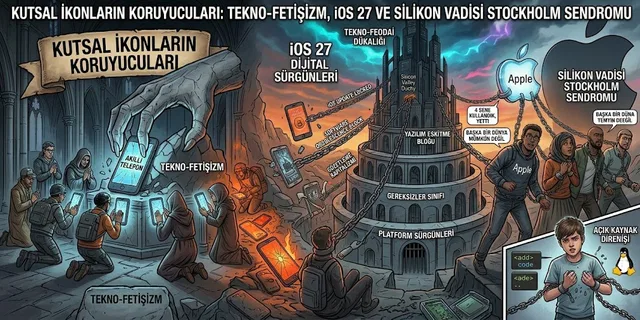
And let us add this: We do not share approaches that name this tableau "techno-feudalism." The platform worker is not a serf; they are a waged, precarious proletarian compelled to sell their labor-power. The order before us is not a new feudalism; it is the digital phase of monopoly capitalism — and this distinction, because it determines the subject and the form of struggle, is not academic but practical.
Two Frames Side by Side
| Gates’s Frame | Class Frame |
|---|---|
| The subject is technology: "AI will take the jobs" | The subject is capital: The one who fires is the boss, not the machine |
| "There is no plan" | There is a plan — the plan of capital accumulation; what is missing is labor’s counter-plan |
| The transition must be managed | The property relation must be changed |
| Solution: experts, leaders, philanthropists | Solution: the organized working class, the union, collective bargaining |
| Let robot/token tax compensate the loss | Let the rise in productivity be reflected in working time without loss of wages |
| Some jobs should be "reserved for humans" (who decides: unclear) | Those who do the work decide the use of technology |
| Knowledge is a resource; access to it should be widened | Knowledge is the product of collective labor; its enclosure must be ended |
| Global institution: let the model-owning countries found it | Technological sovereignty of peoples against imperialist cartelization |
| Philanthropy fills the public vacuum | The governance of untaxed wealth is not democracy |
| Worry for the young: "entry jobs are closing" | Task for the young: organization in place of the closing rung |
Concrete Tasks
Criticism is commentary until it becomes a demand. Headings that can be put on the table from today:
In the workplace and in the contract
- An AI clause in collective agreements. Notification to the union before a new algorithmic system is brought in; sharing of data and impact assessment; a right of objection.
- Algorithmic transparency. The criteria of every system that measures performance, assigns shifts, hires or fires must be open to the worker; "the machine said so" cannot count as a reason.
- A ban on dismissals due to automation, and job security. The price of a rise in productivity cannot be unemployment.
- Shortening of working time without loss of wages. If AI raises productivity, the time gained must go to the worker, not to the profit margin.
- The right to disconnect and a ban on algorithmic surveillance outside working hours.
- A right against the expropriation of tacit knowledge. Data produced by the worker in the course of the job cannot be fed into model training without their knowledge and consent.
- Visibility of labeling, moderation, and "human-feedback" workers. This labor is the invisible link in the chain; union organizing must reach it.
At the public and social level
- Public compute and model infrastructure. Capacity for universities, public institutions, and municipalities that is not dependent on the monopolies’ APIs.
- Defense of the knowledge commons: open access, open data, open source — against the copyright and patent regime’s enclosure of knowledge.
- Public oversight of data centers’ energy and water load. Gates himself concedes that this objection is rising; this is where environmental struggle and labor struggle intersect.
- The valuing of care labor: The real counterpart of the "Human Reserved" discourse is wages, staff posts, unions in the care sector, and equal rights for migrant laborers.
- Regional and inter-people cooperation against technological dependence; not articulation to a "global governance" table set by imperialist centers.
Closing: Let’s Meet in Karaburun, 3–5 September
Dear Young Comrades,
The most affecting place in Gates’s text is his concern for the young. He writes that entry-level jobs are closing, that young people are the cohort that looks most negatively on AI, and that they are right to do so.
Correct diagnosis. But the result of the diagnosis cannot be waiting for a billionaire to design institutions in your name.
There is only one thing to put in the place of that closing rung: organization. Those who know that knowledge is produced in common learning also to take it in common.
We are meeting to continue this debate face to face. The 20th Karaburun Science Congress convenes 3–5 September 2026 in Karaburun, Izmir. This year’s axis of the congress is "The Revolt of Crystallized Labor." The title of our presentation:
"The Revolt of Crystallized Labor: The Expropriation of the General Intellect in AI Models, Mental Taylorism, and the Digital Panopticon"
The three concepts we have touched on briefly in this piece — digital enclosure, mental Taylorism, the digital panopticon — we will open there, with empirical material and in discussion. Labor in the Age of Artificial Intelligence, our book that treats the subject in more depth, is also out.
Gates’s text will be on our table too: not only to oppose it, but to understand how the bourgeoisie reads its own crisis.
Because they too are planning a transition. The difference is this: In their plan, we are the object.
See you in Karaburun.