Criticising Utopia Is Not Enough: A Comradely Reading of Issue 73 of Teori ve Eylem
Class Notes for Young Comrades on the Post-Capitalism Dossier and Fourteen Pieces

Criticising Utopia Is Not Enough: A Comradely Reading of Issue 73 of Teori ve Eylem
A journal's strength is measured not where it is right, but in whether it can see for itself the place where it falls short.
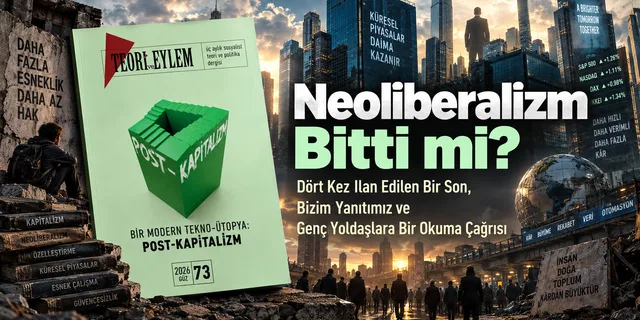
Masthead. Teori ve Eylem, a quarterly journal of socialist theory and politics, Issue 73, Autumn 2026, 234 pages. Cover dossier: "A Modern Techno-Utopia: Post-Capitalism". Opening epigraph from Lenin's Marxism and Revisionism. There are fourteen texts in the issue: two pieces on neoliberalism, one study of the political economy of the US–Israel alliance, a post-capitalism dossier of five pieces (three original, one Morozov translation, one critique of Fuchs), a Lenin translation, the second part of a critique of jineology, an essay on the October Revolution, and three current analyses (Koç, NATO, construction rent).
Dear Young Comrades,
This piece is not a journal notice; it is a reading notebook. As we did when we read the July issue of Birlik ve Mücadele, we are reading a journal from cover to cover and sharing our notes with you. This time we change the tone a little: we will keep praise and criticism on the same page. Because Teori ve Eylem is not, for us, a publication of the opposing camp; it is the journal of comrades who ask the same questions and, most of the time, arrive at the same answers. To criticise a comrade's writing takes more care than to criticise an enemy's. In the enemy's text you find what is wrong; in the comrade's text you have to find what is missing. What is missing is, most of the time, more important than what is wrong.
This is not our first encounter with this issue. In "Has Neoliberalism Ended?", which we published on 19 September, we introduced issue 73, read Mustafa Yalçıner's opening piece in detail, and closed with a call: read this issue, discuss it, write. In that piece we said the journal asked the same question through fourteen doors. This piece is the answer we ourselves have given to that call: this time we go in through all fourteen doors. In the Yalçıner section we will not repeat what we said in the 19 September piece; we will summarise it and build on it. We suggest you read that piece first.
Why this issue? Because the cover dossier is given over to the question we too have been working on for months: does technology of itself surpass capitalism? Paul Mason's thesis that "information dissolves the law of value," Srnicek and Williams's "full automation," Varoufakis's concept of "techno-feudalism," Fuchs's theory of "user labour": all of them are put on the table in this issue. We had entered the same debate in our Karaburun paper and in the Socialist AI Manifesto with the concepts of "the expropriation of the general intellect" and "mental Taylorism." To read this issue is to put our own line to the test.
Our method of reading: four questions
We asked every piece the same four questions. These are an expanded form of the criteria we used when classifying the answers in the Acemoğlu debate.
Does it see class? Does the analysis tie the social fact to a class relation, or does it remain in abstractions such as "the state," "the market," "technology"?
Does it ask about property? Is who holds the means of production, knowledge, land and data at the centre of the analysis?
Does it constitute a subject? Does the working class appear in the text only as an exploited object, or as a subject that organises, resists and makes demands?
Does it speak with data? Are the claims supported by facts and figures, are the facts correct, are the sources traceable?
The map below gives the general look of the issue. We discuss the details in each piece's own section.
| Piece | Does it see class? | Does it ask about property? | Does it constitute a subject? | Does it speak with data? |
|---|---|---|---|---|
| Yalçıner, Is This the End of Neoliberalism? | Strong | Strong | At the level of a call | Weak |
| Sancar, The Transformation of the State in Turkey | Strong | Medium | Weak | Medium |
| Güler, The US–Israel Alliance | Medium | Strong | None | Medium |
| Cengiz, Modern Utopianism | Strong | Medium | At the conceptual level | None |
| Alikoç, Paul Mason | Strong | Strong | Weak | Inside the book |
| Koşar, The End of Work | Strong | Medium | Medium | Strong |
| Morozov (translation) | Medium | Strong | None | Medium |
| Deniz, Critique of Fuchs | Strong | Medium | Weak | Weak |
| Lenin (translation) | Strong | Strong | Strong | Historical |
| Alikoç, Jineology-2 | Medium | Weak | Weak | Strong in archaeology |
| Akdağ, The October Revolution | Strong | Medium | Historical | Weak |
| Bal, Koç's Centenary | Strong | Strong | At footnote level | Medium |
| Yaşar, NATO 3.0 | Medium | Medium | At slogan level | Without sources |
| Araman, Construction Rent | Medium | Strong | None | Strong |
The first two columns of the table are usually full; the last two are usually empty. This summarises the general character of the issue: the diagnosis is strong, the subject is weak, the data are scattered. Now let us go piece by piece.
Mustafa Yalçıner: "Is This the End of Neoliberalism?"
What does it say? Yalçıner takes up the proclamations of "the end of neoliberalism" that have come in three waves since the 2000s: the left governments in Latin America and Syriza/Podemos, the Obama rescue packages after 2008, the pandemic aid. And last, Trump's customs protectionism. His thesis is this: neoliberalism is not a package of economic-policy measures, nor an ideology born at Mont Pelerin. It is the present form of monopoly capitalism, the imperialist bourgeoisie's "savage assault" on rights already won. State intervention is not the opposite of neoliberalism; it is its instrument. So only "the successful development of the workers' movement" can bring neoliberalism to an end.
Its strengths. The piece's most valuable move is to carry the debate from the plane of policy onto the plane of class power. This is a solid correction to the left optimism that says "the state is intervening, so neoliberalism is over": in 2008 the state did intervene, but it gave the money to GM and the banks. His unpicking of the "small state" deception is also well judged. Starting from Marx's passage in The Eighteenth Brumaire on the continuous "perfection" of the state machine, Yalçıner shows that what shrank was the social state and what grew was the apparatus of violence and of finance. His illustrating that the slogan of the "free market" is "nothing but a lie" under monopoly capitalism through the peasant's dependence on seed and input monopolies stays in a young reader's mind. He also reads protectionism as an instrument of the imperialist struggle over partition. In our 19 September piece we said the same thing in another sentence: the customs wall is not the end of neoliberalism; it is its new uniform. This approach overlaps with the frame we set out in our BRICS piece.
Its gaps. First, a problem of concept. Once neoliberalism is treated as almost identical with monopoly capitalism, what the concept adds to monopoly capitalism becomes unclear. Yalçıner rejects periodisation, but his own narrative distinguishes the "period of concessions" of 1945–75 from the period after 1980. The criteria of that distinction should have been set out plainly: the wage share, union density, the composition of public spending. Second, there is almost no serial data in the piece. Figures such as real wages, labour's share of national income, the number of strikes, the unionisation rate were the material that would have proved the "assault" thesis with numbers. The Turkey data are limited to the examples of 12 September, SEK and Et Balık Kurumu. Third, the piece's thesis is very close to David Harvey's definition of "the restoration of class power," but Harvey is not mentioned. Duménil and Lévy are absent too. So the piece turns into a polemic in the tone of "everyone is wrong," choosing its interlocutors largely from among blog and journal pieces.
There are also places that need correction at the level of fact. Chrysler was rescued in 1979, GM in 2009. The sequence "first Chrysler and GM, in the '80s the banks" muddles the chronology. Thatcher's phrase about "two million workers left unemployed by the pits she closed in her first two years" looks as if it attributes the period's total rise in unemployment to mine closures. The mass closures came mainly after the 1984–85 strike; the last deep pit closed in 2015. Podemos was never the leader of the government; between 2020 and 2023 it was a junior coalition partner. Errors of this kind do not refute the thesis, but they weaken the thesis's credibility.
Our question to the author. On which concrete indicators would a change allow us to speak of "the end of neoliberalism"? If this question is not answered, the concept becomes untestable against any fact. Such a concept ceases to be a tool of analysis and turns into a declaration of stance. We proposed our own answer to this question in our 19 September piece. Our answer had two steps. First, a distinction: monopoly capitalism is an epoch, the epoch Lenin analysed in 1916. Neoliberalism is a phase inside that epoch, a class response given to the crisis of the 1970s. An epoch closes only with revolution. A phase can be rolled back according to the balance of forces in the class struggle. Yalçıner's almost identifying the two concepts makes this second possibility invisible. Second, a criterion: neoliberalism opened with defeats (PATCO, the British miners, 12 September). So its closing too can be measured only by gains. The question in the 19 September piece still stands: "Who ended it, with which strike, with which gain? If there is no answer, nothing has ended." The concrete indicators are also clear: real wages, the ratio of the minimum wage to the hunger line, the unionisation rate, public services being made to cost money, and the Medium-Term Programme's targets for flexible employment and retirement. None of these indicators has been reversed today. We agree with Yalçıner's conclusion, namely that neoliberalism has not ended. But it is possible and necessary to reach that conclusion by a measurable path, without dissolving the concept into monopoly capitalism.
Nuray Sancar: "Neoliberalism and the Transformation of the State in Turkey"
What does it say? Sancar rejects the concepts of "authoritarianisation" and "illiberal democracy" because they hide the class conditions of the transformation. She derives Turkey's "palace regime" from the institutional needs of neoliberal accumulation. Those needs arise from international finance capital's demand to overcome bureaucratic and democratic obstacles, and from the Turkish bourgeoisie's search for expansion inside dependence. She establishes a common ground between Hayek and Schmitt: turning the state into a security apparatus against social struggles. The piece's conclusion is that the state is advancing "in fascism's favour."
Its strengths. The piece's strongest section is the analysis of the architecture of governance. Regulatory agencies, the Investment Advisory Council, free zones, organised industrial zones and build-operate-transfer guarantees are shown as channels of capital's unmediated participation in the state. In Sancar's phrase, the "small state" is an intervention that "makes immediate the class relation at the core of the capitalist state." Her explaining parliament's being set aside in practice by capital's direct entry into decision-making is an intuition close to Poulantzas and a productive one. The conversion of "civil society" into clientelism through the distribution of aid — that is, the "taking of those who receive aid as political hostages" — is a basic mechanism for understanding AKP hegemony. We took up this mechanism in Why Do Workers Vote for the Right? as well. The most current and most valuable part of the piece is the section on expropriation. Forest laws, HESs and JESs, EIA exemptions, İliç, the reserve-building-area law and the mining fields in Kurdish regions are gathered under the same logic of "accumulation by dispossession." To read the Kurdish question on the plane of political economy, through land and nature, is something the left in Turkey rarely does.
Its gaps. There is an inner tension in the piece. The concept of "authoritarianisation" is criticised because it focuses on the leader's arbitrary will. But the palace-regime section is told largely through Erdoğan's moves, family foundations and corruption. Conflict and compromise among fractions of capital are absent from the piece: TÜSİAD–MÜSİAD, "crony" construction and energy groups, export industry. The transformation is tied largely to "the demand of international monopolies." The Turkish bourgeoisie's own inner dynamic — which fraction needs this regime, and why — remains in the background.
The second gap is heavier: against what was the regime built? Gezi 2013, Soma 2014, the Metal Storm 2015, the 7 June–1 November 2015 turning-point and the end of the resolution process are not mentioned. When the social movement facing the regime is invisible, the regime looks like a one-sided capital project. Yet every regime is the result of a class struggle. As we tried to show in our 12 September Dossier, to understand a coup one also has to understand the strikes before the coup. The third gap is the women's dimension: withdrawal from the Istanbul Convention, the ideology of a "year of the family," and the pushing of women's labour back into the household are constitutive parts of the regime, but they do not appear in the piece at all. The fourth gap is conceptual: it is said "in fascism's favour," but fascism is not defined. Without Dimitrov's definition or a discussion of mass movement, this characterisation hangs in the air.
There are also places that need correction at the level of fact. Milton Friedman did not "take charge" of Chile's economy. In 1975 he visited Pinochet and advised; the "Chicago Boys" ran the economy. The WTO's Doha Round never concluded, so the source of the transformation in Turkish agriculture cannot be Doha "specifications." The real sources of the transformation were the World Bank's ARIP programme and the sugar and tobacco laws of 2001. The "use" of heirloom seed was not banned; trade in unregistered seed was restricted. That distinction matters for correctly constituting the demand of the peasant struggle.
Our question to the author. What are the criteria of the characterisation "in fascism's favour"? In terms of mass base, party–state relation and the form of violence, where does today's regime part from fascism? This is not an academic question; it is a practical one. The answer determines which alliance will be built and which form of struggle will be chosen.
Hüseyin Sinan Güler: "The Political Economy of the US–Israel Alliance after 1985"
What does it say? Güler criticises three approaches that explain the US–Israel relation: the Israel lobby (Mearsheimer–Walt), realism, and shared values/Evangelical ideology. He says these explain the appearances of the relation but do not put capital accumulation at the centre. He puts 1985 forward as a turning-point: in the same year the United States signed its first free-trade agreement with Israel, and Israel's Economic Stabilisation Programme began. After that date Israel, while keeping its function as a military "forward outpost," turned into a regional centre of accumulation interwoven with US finance capital in finance, high technology, the war industry and logistics. The Abraham Accords and the India–Middle East–Europe Economic Corridor (IMEC) are the current forms of this restructuring.
Its strengths. This is the issue's most orderly piece in terms of method. There is a clear problem, a clear plan and traceable sources. His testing the three approaches with the question of "time" is a good historical-materialist move: the lobby existed in the 1960s too, so how will it explain the qualitative leap of the 1990s? Realism would expect Israel's importance to decline after the collapse of the USSR; instead it increased. He shows concretely the return flow of military aid (FMF) to US arms monopolies, joint production, and the state's guarantee of demand. While doing this he also openly opposes conspiracy reductionism: the continuity of the alliance is born not of one group's will but of structural needs. The use of Palestine as a "security-technology laboratory" and the marketing of "combat proven" shows in a startling way the bond between colonialism and capital accumulation. This finding also explains one of the origins of the surveillance economy we described in our Palantir piece.
Its gaps. The piece's central claim, namely "the interweaving of finance capitals," is left almost without data. Figures for mutual foreign direct investment, the number of Israeli companies traded on NASDAQ, large acquisitions, US venture capital's share in Israel, were the material that would have proved this thesis. Even the annual 3.8 billion dollars of military aid set by the 2016 agreement is not written. The critical Marxist literature on the subject is also missing. Nitzan and Bichler's The Global Political Economy of Israel and the thesis of the "arms-dollar/petro-dollar coalition" are exactly this piece's subject, but they are not mentioned.
The more important gap is the class dimension. At the centre of the 1985 Stabilisation Programme was a wage-freeze agreement signed among the government, Histadrut and the employers. The class content of the programme was exactly that: the breaking of the organised power of the Israeli working class. The piece skips this agreement. The programme was prepared with 1.5 billion dollars of emergency aid from the United States and with the advice of US economists. That information would have strengthened Güler's thesis of integration, but it too is absent from the piece. The labour of Palestinian workers — that is, labour under occupation, the permit regime and the work bans after 7 October — has no place in the piece at all. The political economy of a settler-colonial economy remains incomplete without dispossession of land and colonial labour.
A correction is also needed at the level of fact. The United States voted for the UN partition plan in 1947 and was the first country to recognise Israel in 1948. But it applied an arms embargo to the region, and Britain was closer to the Arab side, mainly through the Jordanian army. Israel obtained its weapons in 1948 from Czechoslovakia. Mass US military support came after 1967, and especially after 1973. This chronology already supports the author's thesis that "the function increased over time."
Our question to the author. Where does Israel stand in the imperialist hierarchy? A dependent forward outpost, a sub-imperialist regional power, or a small imperialist country with its own export of capital? The characterisation "regional centre of accumulation" opens this question but does not answer it.
The post-capitalism dossier
Before we turn to the cover dossier of five pieces, let us drop a general note. There is a division of labour in the dossier: Cengiz discusses the frame and the strategy, Alikoç Mason and the law of value, Koşar the employment data, Morozov techno-feudalism, Deniz digital labour. This division of labour is consistent, but the dossier has no introductory piece. The reader has to work out for themselves why the five pieces are arranged in this order, and at which points they agree or part. As we will show below, the pieces even contradict one another in places.
Ahmet Cengiz: "Post-Capitalism as Modern Utopianism"
What does it say? Cengiz takes two facts together: the political defeat of 1989–91 and the economic crisis of 2008. He says these created a "historical asymmetry": the material preconditions of socialism have matured, but the working class as a revolutionary subject has weakened. Post-capitalist theses are the utopianism of this period of asymmetry. Their common ground is to avoid revolution and the problem of power. Cengiz examines Srnicek and Williams's Inventing the Future and Holloway's and Drau-Klick's proposals of "commoning." He finds the commons, cooperatives and neighbourhood networks legitimate, but says that when they are detached from the aim of power they will remain "islands." Capitalism does not die of itself. Material preconditions become the support of a new society only through revolution.
Its strengths. The concept of "asymmetry" is the dossier's most productive idea. It explains post-capitalism not as an error of thought but as the ideological product of a definite relation of class forces. To look for the material origin of ideology is exactly what historical materialism should do. The distinction between material precondition and political action is plain and functional: a good antidote to spontaneous determinism. His reading Srnicek and Williams from their own texts, with long quotations, and his honestly reporting that they present full automation as "a political demand," is fair. To the charge that "Marxists belittle everyday gains" he gives a concrete historical answer with the SPD's cooperatives, mutual-aid funds and clubs between 1890 and 1914: it was the class struggle that brought those structures into being. The thesis of "not an island but a network" that we defend in our Joining Local Government handbook is in the same direction.
Its gaps. The other face of the SPD example is not mentioned. That "organisational world" was also the world that produced Bernstein revisionism and the vote for war credits in 1914. Whether the network of cooperatives and funds served revolutionary power or integration into the system sits at the heart of the very question Cengiz is discussing. The piece does not open this question.
The second gap: the demands for a shorter working week and a basic income are not discussed at all. Yet these demands intersect with the historical demands of the workers' movement. The struggle for the eight-hour day was also a struggle over "free time." To show, while criticising the utopianism of the post-capitalists, how we would take these demands into a class programme would have carried the criticism from being destructive to being constitutive. The source of the concept of "non-reformist reform" is André Gorz, but he is not mentioned in the piece.
The third gap: the discussion of artificial intelligence, platform labour and the "general intellect" is referred to the journal's previous issue and to the other pieces in the dossier. One would have expected a framing piece in 2026 at least to locate, in a single paragraph, the new situation created by large language models. The concluding section also ends with a call to "mastery in revolutionary politics." It is a right call, but a young reader does not know what to turn this call into in practice.
Our question to the author. Can the demand for full automation and a shorter working week be articulated into a workers' party's transitional programme? If it can, what separates these demands from post-capitalist utopianism?
Fulya Alikoç: "Paul Mason and His Post-Capitalism"
What does it say? Alikoç traces the theoretical family tree of Mason's book Postcapitalism. Mason sees capitalism as a "complex system" that adapts through long waves, and says that information technology has exhausted this capacity to adapt, is eroding the law of value, and is shifting the revolutionary subject onto the "networked individual." According to Alikoç this thesis has very little that is original. The thesis is nothing more than a combination of Drucker's information society, Romer's information goods and Benkler's peer production, with a distorted reading of Marx. The famous "Fragment on Machines" in the Grundrisse does not say that the law of value has become invalid. It ties the development of knowledge as a productive force to the capital relation. Mason's post-capitalism is a current form of revisionism in the sense Lenin described.
Its strengths. The method of tracing a family tree is effective: it shows that the theses Mason presents as "new" were borrowed from bourgeois economists and management theorists. She reads the Grundrisse from the primary text and uses the passage "the machine can only work when workers are present in masses" as a strong counter-proof. She reconstitutes the real problem as the contradiction between the social nature of knowledge and private property — that is, as the production relations braking the productive forces. This is a classical, but today vital, re-framing. The distinction she draws among raw data, digital production material and the digital commodity is also an important analytical contribution. This distinction names something we sensed but did not name in our distillation debate.
Its gaps. The problem of fairness is more marked here. The strongest Grundrisse passage on which Mason rests is not taken up. This is the passage that says labour-time will cease to be the measure of wealth and that capital works towards "its own dissolution." The most convincing way to refute Mason is to face his strongest support. The Marxist debate on the Fragment itself is also absent from the piece: autonomists (Virno, Vercellone) on one side, critics such as Heinrich on the other. The reader does not learn that the Fragment is read differently not only by Mason but by a wide Marxist current.
The answer on "zero marginal cost" also remains incomplete. Alikoç says the value of the digital copy converges on zero, but is "recovered with every copy sold." Yet in the Marxist literature it has long been argued that the price of information commodities is essentially a monopoly rent based on intellectual property. Alikoç's own monopoly argument leads directly to this conclusion, but the category of rent is never used. Artificial intelligence is touched on in only a single sentence. Large language models are today the most discussed field of application of the "Fragment." The compressing of the text, code and knowledge humanity has produced in common into a model, and its being made monopoly property — the process we call "the expropriation of the general intellect" — was the most current answer that could have been given to Mason. It was not used. Rifkin's The Zero Marginal Cost Society was also a natural interlocutor of this debate, but it is not mentioned.
Our question to the author. Is the price of the digital commodity an expression of value, or a monopoly rent? The answer determines which demand we will raise against the platform monopolies: a wage, expropriation, or opening to the commons?
Arif Koşar: "A Post-Capitalist Assumption: The End of Work"
What does it say? Koşar starts from Musk's interview with The Economist and from the anxiety large language models have created among white-collar workers. He argues that post-capitalist theorists detach automation from capital accumulation and set up a one-way technology–employment causality. According to Marx's law of accumulation, automation relatively reduces the number of workers in the individual enterprise. But the growth of total capital, the birth of new sectors and the dispossession of small property-owners increase the absolute number of workers. The real danger is not an unemployment spreading through society, but intensifying exploitation, insecurity and the "imposition of work."
Its strengths. Empirically the strongest piece in the dossier. The distinction between individual capital and total capital applies Marx's law of accumulation correctly to the automation debate. The figures also make this distinction concrete. Amazon's robot count was thirty thousand in 2015 and had passed a million by 2025; in the same period the number of employees passed one and a half million. The number of wage-workers in the world was one billion in 1991 and rose to 1.78 billion in 2024. In China the share of wage-workers rose from 30 percent to 62 percent. These data break the West-centred "end of work" narrative with the reality of the Global South. His showing that Rifkin's 1990s forecast that warehouse jobs would shrink has been realised in exactly the opposite way is also instructive. His showing the methodological weakness of Frey and Osborne's estimate that "47 percent of jobs are at risk," and Mason's dependence on that estimate, is a concrete refutation. His emphasis on the disciplinary function of the reserve army of labour overlaps exactly with the frame we set out in our Unemployment Dossier.
Its gaps. First, the risk of a straw man. The generalisation of "the disappearance of work that post-capitalist theorists greet with great joy" does not fit all the theorists. In the same dossier Cengiz shows that Srnicek and Williams present full automation not as a likely future but as a political demand. Koşar, however, counts them among those who believe work disappears of itself. There are two different readings of Srnicek and Williams inside the dossier, and the editors could have noticed this tension and turned it into a dialogue among the authors. Benanav is mentioned only for one productivity figure. Yet Benanav's main thesis — that the problem is not automation but stagnation and underemployment — is very close to Koşar's own thesis and deserved to be discussed.
Second, there is no data at all on the employment effect of generative artificial intelligence between 2023 and 2026. The piece opens with large language models, but the examples are an Amazon warehouse and a South Korean factory. Yet there are documented falls in entry-level white-collar jobs, especially in the employment of young software workers. We compiled these in our Physical AI piece. These data do not refute Koşar's thesis; on the contrary they make it more fine-grained: artificial intelligence is not throwing existing workers out in a mass; it is closing the entrance. Platform and data labour are also not taken up at all: data labellers in the Global South, content moderators, "ghost workers." Yet these represent the exact opposite of the "end of work" narrative: a new and invisible layer of workers created for artificial intelligence.
Third, the rise in wage employment and the rise in informality are not thought together. About half the world's workers work outside regular wages and social protection. If "workerisation" and the "surplus population" are growing at the same time, the relation between the two should sit at the heart of the thesis. Let us also drop a small technical note: in the numerical example of the organic composition, where it says "constant capital" it should say "variable capital." In an example that serves as an introduction to Capital for a young reader, this mix-up is not instructive.
Our question to the author. Does the speed at which generative artificial intelligence substitutes for cognitive labour change the Amazon and Korea pattern? This question can be answered only with post-2023 data, and the journal is one of the most suitable places to collect that data.
Evgeny Morozov: "Critique of Techno-Feudal Reason" (translation)
What does it say? This is the translation of Morozov's long article in issue 133/134 of New Left Review (2022) (translators Ebrar Kamcı and Ada Gökduman). Morozov argues that the diagnosis of "techno-feudalism," which has spread on the right and the left, is analytically rotten. Technology companies are not rentiers; they are capitalist producers. Rent and dispossession are not the sign of a return to feudalism; they have been constitutive parts of capitalist accumulation from the start. Morozov builds this thesis by passing through the Brenner–Wallerstein debate, Harvey's concept of "accumulation by dispossession," the theorists of cognitive capitalism, Zuboff and Durand. In the end, in the line of Fraser and Moore, he proposes an expanded concept of capitalism that grasps exploitation and expropriation together.
Its strengths. The translation is the theoretical backbone of the dossier and an important gain for the Turkish-language reader. The last sentence of the text states its thesis plainly: feudalism talk serves to whitewash the reputation of capitalism. We confirm this finding from our own experience. In our first pieces in July 2026 we used the concept of "techno-feudalism"; in September we explicitly abandoned this frame and returned to the frame of monopoly capitalism. Morozov's argument supplies the theoretical ground of this self-criticism. His showing, through the equalisation of profit rates, that even an automatic firm that employs no workers can obtain profit is a solid reading of Capital III. Google's "original sin" finding reads today like a prophecy: Spotify pays a licence for content; Google does not pay for the content it indexes. Morozov wrote this in 2022. In 2026 the same sin has turned into the unlicensed scraping of the whole internet as artificial-intelligence training data.
Its gaps. Some of the gaps are Morozov's, some the journal's.
There is no class subject in Morozov's text. Workers, platform labourers and struggle almost never appear; "socialist emancipation" is mentioned in a single sentence. More important, to think monopoly, finance capital, the rentier state and the fusion of state and capital together, Morozov turns to Fraser, Moore and Braudel. Yet a ready frame for this work already exists: Lenin's theory of imperialism. Lenin appears in the text only in a footnote, in the context of "parasitism." In a sense Morozov is reinventing the wheel. The distinction between rent and profit also remains incomplete. High R&D spending does not prove that a company does not obtain rent, because a landowner also invests in the land. The categories of monopoly price and surplus profit are not discussed.
The journal's gap is the absence of a framing note. A 2022 text is published four years later with no introduction at all. In these four years Varoufakis's book Technofeudalism (2023) and the English edition of Durand's book came out, and generative artificial intelligence exploded. Hundreds of billions of dollars are flowing into data centres; huge contracts are being signed between the Pentagon and artificial-intelligence companies. These developments strengthen Morozov's theses that "they are investing" and "the state is at the centre." But the growth of the "original sin" makes the dimension of expropriation more central than the piece foresaw. A one-page introduction could have told the reader this. In a footnote of the text it is written that Durand's book's "English edition has not yet been published." This note has been left un-updated.
The quality of the translation is also a serious problem. The equivalent of "userism" appears in four different forms in Turkish. "Operaismo" is also translated inconsistently. The heaviest error is the translation of the term expropriation, in the Fraser context, as "kamulaştırma" (nationalisation). Fraser's pair "exploitation and expropriation" has become, in Turkish, "exploitation and nationalisation." Yet the whole argument of the text rests on this distinction. In Turkish, "kamulaştırma" means the state's taking of private property. What is at issue here is capital's unpaid taking. This error reverses the conclusion of the text. The translation of the concepts of formal and real subsumption as "domination," everyday-language slips, and the skipping of the number of the seventh chapter also show that the copy-editing was rushed.
Our question to the journal. Does Morozov's text make Lenin's theory of imperialism unnecessary, or is it a roundabout return to it? To ask this question in an introduction would have turned the translation from a rendering into an intervention.
Engin H. Deniz: "From Necessity to Fetishism: The Debate on Free Time and Fuchs's Theory of Digital Labour"
What does it say? Deniz shows, starting from E. P. Thompson's study of time-discipline, that capital's shaping of free time is not a new fact. He then argues that Christian Fuchs, with the concept of "audience/user labour" taken over from Dallas Smythe, "stretches" the theory of value. In Fuchs's formula the unpaid labour of users appears as an item of variable capital, and the conclusion "the rate of exploitation is infinite" is reached. According to Deniz this is to confuse labour-power with labour, and circulation with production. The user is the concrete worker who has come out of the factory having produced surplus-value and received a wage. To turn that worker's free time into production time erases the class relation. Platforms are giant apparatuses of circulation that take a share, through advertising budgets, of the surplus-value produced in other sectors.
Its strengths. Putting the distinction between labour-power and labour, and the wage relation, at the centre is right. The thesis that "leaving data is not producing surplus-value" is a necessary brake on a popular left discourse of the kind "everyone who browses Instagram is an exploited worker." The objection from measurability is also in place: a "labour" for which socially necessary labour-time cannot be constituted cannot be a category of the theory of value. The finding on the function of platforms as apparatuses of circulation is strong and overlaps with Morozov's argument in the same issue on the equalisation of profit rates. The journal has not made this link, but the reader can. Deniz emphasises that real productive labour is in the platforms' wage employees, and gives Meta's mass dismissals as an example. In this way he makes visible the wage labour that had been made invisible.
Its gaps. The piece's most important gap is that it postpones, in a footnote, to another piece the productive/unproductive labour distinction that is the core of the debate. The sentence "We are not producing surplus-value!" therefore remains a claim rather than an argument. Marxist counter-criticisms of Fuchs are also rich in the literature, especially studies that read advertising revenue as a form of rent (Rigi, Prey and others). These are not mentioned. Deniz's own thesis of the "apparatus of circulation" would have been much stronger if it had been joined to this literature.
The second gap is, from our point of view, the most important: artificial intelligence. While rejecting the concept of user labour, the piece carries the risk of making something invisible. A user's browsing a social-media platform may not produce surplus-value. But the appropriation as training data of an artificial-intelligence model of the text, code, translation and works of art written by millions of people is something else. What is at issue here is the taking of already produced social knowledge, that is, of the general intellect. This is not the production of value; it is a problem of expropriation and rent. To say "it is not user labour" may be right. But if the conclusion "so there is no problem" is drawn, claims of social right over data commons and training data also remain without ground. Deniz does not draw this conclusion, but the piece does not close this door either. The contradiction we showed in our Distillation piece sits exactly here: learning from everyone's labour is counted as "fair use"; learning from the monopoly's output is counted as "theft."
The third gap concerns the title. The title says "from necessity," but Marx's passage in Capital III on the realm of necessity and the realm of freedom, and the concept of "disposable time" in the Grundrisse, are not used at all. The shortening of the working day is also not discussed. The concept of "fetishism" is not derived from the theory of commodity fetishism either; it remains a characterisation. Instead of giving a section of the piece to neoclassical economics' labour–leisure preference, to constitute Marx's concept of free time would also have bound the piece to Cengiz's piece. There are also places in the footnotes that need attention. A quotation from Fuchs is attributed to Mattelart; there are spelling errors such as "Karl Max"; and Smythe's name is written in three different forms.
Our question to the author. Is data a product of labour, a raw material, or an object of rent? The answer determines which demand we will raise against the platforms.
Lenin: "Marxism and Revisionism" (translated by Fulya Alikoç)
What does it say? In this short text, written in 1908 on the twenty-fifth anniversary of Marx's death, Lenin says this: after Marxism had defeated rival doctrines outside it (Proudhon, Bakunin, Dühring), tendencies belonging to those doctrines passed into Marxism as "revisionism." Revisionism appears in philosophy as a return to Kant, in political economy as the claim that "small production is durable, crises are fading," and in politics as the thesis that "democracy makes the class struggle unnecessary." Its source is class: capitalism continually reproduces small production and the petty bourgeoisie.
Its strengths. The text itself is a classic and is rightly chosen for the dossier. The criticism of revising the theory in the name of "new data" maps directly onto Mason's thesis that "information technology is eroding the law of value." Lenin's looking for the class basis of revisionism in "new middle strata," in side jobs and in work at home is still productive today. Platform labour, "owner-operator courier work" and subcontracting chains are, as we showed in our Gig Economy Dossier, today's forms of the "new small producer." The warning that revisionism "can take infinitely varied forms" is also well chosen as the journal's cover epigraph. The translation is in general fluent.
Its gaps. The text already has more than one translation in Turkish. What the new translation brings, and what was missing in the earlier ones, is not said. The translation is made not from the Russian original but from the English Collected Works. The real gap is context: the text is published with no one-line introduction, only a source footnote. Its bond with the dossier is established indirectly, through the epigraph and the quotation at the end of Alikoç's Mason piece. The reader has to establish for themselves the relation of the 1908 Bernstein and Böhm-Bawerk debate to the techno-utopia of 2026.
This gap of context has a further result. To use a classic text as if it were the "conclusion" of a dossier carries the risk of getting accepted in advance the judgement that still needs to be proved, namely the judgement that "post-capitalism is revisionism." Lenin's text should come after an argument, not in place of an argument. There are also problems at the level of copy-editing. The same passage appears in the epigraph and inside the text in two different translations. The editor's notes of the English edition have been added without a source. The phrase "See the present edition, Vol. 14" sends the Turkish reader to the volume of the English edition. Names such as "Social-Narodnik" and "Broussists" are unexplained. A young reader is left alone with these.
Our question to the journal. After 1914 Lenin added the labour aristocracy to the class basis of revisionism. Is the class basis of today's revisionism, that is, of techno-utopianism, the petty bourgeoisie, or a new labour aristocracy formed of high-waged computing workers? The concept of the "mental proletariat" that we discussed in The Tearing of the Illusion was an attempt at an answer to this question. The journal could open this question in a later issue.
Fulya Alikoç: "Jineology: A Critical Analysis-2"
What does it say? In the second part of her critique of jineology, the theoretical frame of the Kurdish women's movement, Alikoç takes up jineology's historical narrative. She examines the headings of the Palaeolithic and Neolithic periods, the "first women's revolution," the "male counter-revolution," and the "second women's revolution" envisaged in the twenty-first century. Her thesis is this: jineology rests on an essentialism of "woman's nature" and "man's nature" and makes this essence the determinant of history. In this way the determination between mode of production and superstructure is reversed. In the end the women's movement is pulled away from the aim of overthrowing capitalism and made the legitimiser of the project of "the commune beside the state."
Its strengths. The critique of essentialism is consistent and well documented. The piece's strongest place is the analysis of an inner contradiction, showing that jineology gives a detailed answer to "how" male domination was established and an empty answer to "why." The answer, in Alikoç's phrase, remains at the level of "anger, fear, sometimes jealousy" or "the cunning man." This in turn becomes a tacit assumption of "man's nature." The author uses the current literature of archaeology and anthropology and follows 2024–2025 publications as well. Her documenting that a quotation from Kollontai is dated 1909, that is, that it belongs not to the Soviet period but to bourgeois society, is careful source criticism.
Its gaps. This piece is the issue's most sensitive text and the one that most needs care. Its gaps are important in that measure.
First, a problem of fairness. The thought of the Kurdish women's movement is read almost only through a training compilation (Jineoloji Ders Notları). The movement's practices are not assessed: women's cooperatives, women's assemblies, regulations banning polygamy and bride-price, co-chairing. A movement's ideological discourse and the equality struggle it actually conducts should be distinguished. Marxists judge a movement not only by what it says about itself but by what it does.
Second, no link is made with Marxist feminism. Jineology's findings on "maternal labour" and "sexism in the working-class family was not questioned" were a natural opportunity to speak with Marxist feminism. The debate on domestic labour, Lise Vogel's work and social-reproduction theory are not mentioned at all. Yet capitalism's dependence on unpaid care labour was the strongest materialist answer that could have been given to jineology's essentialism: to look for women's oppression not in "mentality" but in the organisation of reproduction. When this answer is not given, Alikoç's criticism too turns into a text that discusses women's labour only in prehistory.
Third, a problem of defence concerning Soviet family law. The author finds jineology's criticism of Soviet family policy "groundless and wrong." Showing that the Kollontai quotation has been torn from its context is right. But it is a historical fact that abortion was banned in 1936, that divorce was made harder, and that the 1944 family law removed paternity suits for children born outside marriage. To accept these facts and explain them is a requirement of Marxist self-criticism. To deny them hands the other side an easy card.
Fourth, a similar problem of method. The author rightly criticises jineology's etymological speculations. But she herself defends Morgan and Engels's schema of family stages in a form that current anthropology has largely left behind, and with an unsourced reference to "Soviet ethnography." The method of Engels's Origin is still valuable today, but the schema in its detail deserves a critical update.
Fifth, the national-democratic dimension and the politics of alliance. Jineology is the women's policy of a national movement. Criticism made without asking of which social stratum it is the ideology, and to which needs of the national movement it answers, turns into an ahistorical criticism of ideas. The 2025–26 process and this process's political texts are also not discussed. Tone is also a problem. The simile of "discussing the sex of angels," the comparison drawn with the AfD's co-chairing practice, and the footnote reference to an AfD leader's sexual orientation get in front of a scientific settling of accounts. To characterise as a whole as "deviation," without proposing a common ground, the women's policy of a movement with which one acts together on labour and women's platforms can make practical alliances on the street harder. A distinction needs to be made between the mass base and the ideological leadership.
Finally the piece uses concepts established in the first part without explaining them, and ends without a concluding section. It is hard to read independently.
Our question to the author. You too accept the places where jineology approaches Engels. Can these proximities be used as a ground of dialogue? How can criticising the strategy of "the commune beside the state" be reconciled with supporting the demand for democratic autonomy under conditions of national oppression?
Yusuf Akdağ: "Notes on an Undated Debate, on the 109th Anniversary of the October Revolution"
What does it say? Akdağ discusses three questions: Was revolution in a backward country "early"? Can socialism be built in one country? What was the cause of the Soviet defeat? His answers are these: October was not untimely; the uneven development of imperialism made it possible at the weakest link in the chain. Socialism was successfully built until the mid-1950s. Defeat was not inevitable. After the Twentieth Congress a "modern revisionist-bureaucrat bourgeoisie" seized the state and commanded the transition to monopoly state capitalism. The objective conditions of new revolutions are more mature today.
Its strengths. The argument from uneven development against the thesis of an "early revolution" is well built. Marx and Engels's correspondence with Vera Zasulich, Kautsky's 1902 finding that "the centre of revolution is shifting to the East," and Lenin's reply to Sukhanov are used in the right place against schematic progressivism. The emphasis that preserves the human being as the subject of history, against economism, is right. Against the liberal narrative that reads the defeat as "socialism is impossible," to see restoration as the result of a class struggle is an important stance. The detailed reporting of the self-criticism in the report of the Nineteenth Congress of the CPSU is also valuable: managers who took revenge for criticism, favouritism, the inflating of plan figures. This shows a young reader the inner contradictions of the Soviet experience from Soviet documents themselves.
Its gaps. The piece's historiography is largely from a single source: the official texts of Lenin, of the Stalin period and of the party. Archival research, Soviet historiography and critical Marxist literature — for example the work of Bettelheim or of Lewin — is not used. The characterisations "Trotskyist" and "left liberal-postmodern" take the place of discussion. The label stands in for the argument.
The real problem is an unexplained transition. The author accepts from the Nineteenth Congress document that in 1952 a bureaucratic stratum, the suppression of criticism and the weakening of mass control existed. But he does not ask how these were born from the structure of the 1930s. How did a "bureaucrat bourgeoisie" form as a class? On which relation of property and distribution did it rest? How was it able to seize power in the three years after Stalin's death? The piece's explanation rests on a will: "policy was abandoned." This explanation contradicts the materialist method the piece announces at the start. For a class to seize power in three years requires that that class have been formed earlier. Lenin's last writings on the bureaucracy, "Better Fewer, But Better" and the Letter to the Congress, would have strengthened the author's own thesis, but they are not used. Subjects such as the dissolution of Soviet democracy, the famine of 1932–33, the purges of 1937–38 and the deported peoples are also not mentioned at all. The phrase "oppression of women was ended" ignores the steps backward of 1936. Read together with the jineology piece in the same issue, it is clear that the journal has a debt of self-criticism on this matter.
There are also small but striking errors at the level of fact. The party changed its name at the Nineteenth Congress (1952); the "(B)" was dropped. The phrase "Twentieth Congress of the CPSU(B)" is therefore wrong. To use "CPSU(B)" for the October period is an anachronism; the party's name then was the RSDLP(B). The bond with the present is also weak. The claim that "the working class is approaching half the world's population" is without data. Koşar's figures in the same issue could have supported this claim. No bond is made with the concrete class struggle in Turkey or with the technology debate that is the subject of the dossier.
Our question to the author. What should the institutional guarantees of workers' democracy be under the dictatorship of the proletariat? Can this question be answered with a call to "vigilance and ideological education"? Perhaps the most important lesson to be drawn from October 109 years on sits in the answer to this question.
Ekin Bal: "From Anıtkabir to ATO Congresium: Koç's Centenary and a New Photograph of the Capital–Power Alliance"
What does it say? Bal takes up two scenes of the Koç Group's centenary celebration in June 2026: the visit to Anıtkabir on 3 June, the reception at ATO Congresium on 4 June. He reads this staging as an ideological spectacle in which Turkey's largest capital group presents itself as "above classes" and as "the state itself." At the protocol table the leaders of the government, the MHP and the CHP sit side by side. Koç is both in an institutionalised collaboration with the AKP regime and keeps the bridges open with the opposition. The piece's central thesis is this: the criticism of "crony capital" is right, but insufficient. Because it makes long-established big capital invisible.
Its strengths. This is the issue's boldest current analysis. Its targeting the illusion that "old/secular capital is innocent" is a well-placed class intervention against the liberal blindness inside the opposition. In Bal's phrase, "scratch a little and from under every long-established holding comes the 'crude' founder of once upon a time." His telling Vehbi Koç's growth in the shadow of the state through import licences, tenders and agencies is instructive. His documenting Koç's support for 12 September with the letter written to Evren overlaps with the section on the capital–junta relation in our 12 September Dossier. His grounding the TÜSİAD–MÜSİAD distinction not in cultural identity but in the mode of accumulation, and his using Gültekin-Karakaş's analysis of "both adversary and kin," is well judged. His showing that the privatisation of Tüpraş itself built the summit positions the state as capital's founding partner. The sentence "for big capital the character of the regime is, as a rule, a secondary matter" is the piece's sharpest and most accurate finding.
Its gaps. The author himself accepts the piece's largest gap: workers remain at footnote level. "The century of Koç workers" is passed in a short note. Yet the most direct way of reading a capital group's centenary in class terms is to tell the century of that group's workers. Wage levels at Tofaş, Ford Otosan, Arçelik and Tüpraş, subcontracting and flexible work, workplace deaths, MESS collective agreements, the function of Türk Metal are absent from the piece. Birleşik Metal-İş's January 2015 strike also covered Koç workplaces and was postponed by the Council of Ministers on grounds of "national security." That postponement was the most concrete photograph of the "capital–power alliance."
The 2015 Metal Storm is passed in a single sentence, and in that sentence there is an error of fact. It is written that the state intervened in 2015 "with state-of-emergency powers." Yet in 2015 there was no state of emergency; the state of emergency was declared in July 2016. The postponement of the strike was done with ordinary powers, by a Council of Ministers decision. This distinction matters, because knowing that the postponement of a strike is an ordinary power also makes possible the demand that this power be abolished.
The second gap is Koç's transnational dimension. Ford Otosan's investment in Romania and Arçelik/Beko's acquisitions and plant closures in Europe are not mentioned. This dimension would have shown that Koç is not only a group that "grew in the shadow of the state" but a monopoly with its own export of capital. The question of "the imperial expansion of Turkish capital," which the NATO piece in the same issue does not open, could also have been made concrete here. The third gap is the 2025 hole in the history of tension. The prosecution of TÜSİAD executives in 2025 was the freshest evidence with which to test the thesis of an "untroubled relation." There are also inconsistencies in the footnotes. The text says "Financial Times"; the footnote points to another newspaper. Which court issued the nullity decision is given differently in the text and in the footnote. The ratio "7 percent of national income" is the company's own declaration and is reported without being questioned.
Our question to the author. How is the century of Koç workers to be written? This question is not a footnote; it is the subject of a dossier. The journal could publish a follow-up piece with workers' testimonies from Koç workplaces.
Ali Yaşar: "The NATO Summit, NATO 3.0 and Turkey"
What does it say? Yaşar says the appearance of "unity" at the 7–8 July 2026 Ankara Summit is misleading. "NATO 3.0" means the acceptance of the split between the United States and the European imperialists in the face of weakening US hegemony and the rise of China, but this split's not yet turning into a rupture. The only real agreement reached at the summit is armament and partnership against the peoples. Turkey's "palace regime," meanwhile, binds the country more tightly to US strategy through its army, its defence industry and the "Mecca Agreement" signed with Saudi Arabia and Pakistan. The task is exit from NATO and the struggle for independence and peace.
Its strengths. His reading NATO not as an "alliance of values" but as an instrument for managing competition among imperialists is consistent from a Leninist point of view. In the author's phrase, in this alliance "competition is the essence; acting together and alliance is an attitude that shows flexibility according to the matter." The effort to set the decline of hegemony on a material basis with shares of world production is a right method. This reading also overlaps with the finding in our 19 September piece: the war economy is not the opposite of neoliberalism; it is one of its present forms. His emphasising that the bill for armament will be charged to workers, and his drawing attention to the sectarian potential of the Mecca Agreement, are points the mainstream press does not see.
Its gaps. The piece's most basic problem is that it cites no sources at all. The origin of the figures, the quotations and the concept of "NATO 3.0" is not documented. The publication without footnotes of a current analysis in a theory journal makes it impossible for the reader to test the claims. There is also a point in the chronology that needs attention. The 5 percent defence-spending target (3.5 percent core plus 1.5 percent related spending, by 2035) and Spain's objection to this target were subjects of the 2025 Hague Summit. What Ankara added to this target, or what it changed, should be distinguished. Otherwise the reader may take a decision of a year earlier for a new decision. There is also the impression that, when shares of world production are given, the GDP share and the manufacturing share are being mixed.
The more important gap is Turkey's position. On the one hand Turkey is drawn in the piece as a pure "collaborator" and "apparatus." On the other, its own regional expansionism is not analysed at all: the military presence in Syria, Libya, Iraq, Somalia, the support given to Azerbaijan. The defence industry is defined as a subcontractor that takes "crumbs." But Baykar's buying Piaggio Aerospace in Italy and setting up a joint venture with Leonardo is an example of the export of capital. The capital structure of ASELSAN, TUSAŞ and Roketsan, and the size of defence exports, are facts that complicate the thesis of "dependence." A judgement given without touching on these remains incomplete. The debate on sub-imperialism or "intermediate imperialism" is a question that Güler's Israel piece in the same issue also leaves open. It would be in place for the journal to set aside a special dossier for this question in a later issue.
The tasks of the working class, meanwhile, remain in a single paragraph, at slogan level. Concrete steps are absent from the piece. The war budget could have been compared with the minimum wage and with pensions. The class situation of defence-industry workers could have been told. International examples such as dockers' refusing arms shipments to Israel could have been recalled. The frame of "independence" also needs to be explained: how does a national-liberation language square with a class line? Is the demand for "exit from NATO" by itself an internationalist demand, or can it slide onto a nationalist line? These questions are not asked in the piece.
Our question to the author. Is Turkey a collaborator of imperialism, or a regional power with its own account? The conclusion the piece reaches, namely "exit from NATO," takes on a different meaning according to the answer given to this question.
Sinan Araman: "Rent and Turkey as a Construction Site - 3"
What does it say? In the third part of the series Araman argues that in the AKP period Turkey has turned into a "republic of contractors." Construction was instrumentalised as a shelter of accumulation in periods of crisis and as the locomotive of the economy. The state transferred resources for this: low interest, public–private partnership (PPP) guarantees, land transfer through TOKİ and Emlak Konut, tax and zoning amnesties. Despite record housing production, housing turned into a speculative investment vehicle. Tenancy rose, home-ownership fell, the housing crisis deepened, wealth concentrated in real estate.
Its strengths. Empirically the richest piece in the issue. Some figures are a thesis on their own: between 2010 and 2025 the price of a hundred-square-metre flat rose about forty times, while the general price level in the same period rose about sixteen times. The number of contractors passed 450 thousand in 2020. The 1.34 million dwellings TOKİ produced are only 3.4 percent of the total stock. Mediation files in tenant–landlord disputes passed 440 thousand. Crossings on the Yavuz Sultan Selim Bridge remained at 30 percent of the guaranteed crossings, and the public paid the difference. The replacing in 1984, under contractor pressure, of Law 2487 of 1981, which gave priority to cooperatives, by Law 2985 is an instructive example of how the state changed housing policy under the pressure of a capital fraction. The naming of the construction-capital fraction is also important: Cengiz, Kolin, Kalyon, Limak, MAPA. His seeing behind the post-2018 low-interest policy the aim of keeping the construction sector on its feet is a hypothesis worth discussing, one that relates monetary policy to class interest.
Its gaps. The piece's large gap is the complete absence of construction workers. The labour side of the "concrete economy" is not treated at all. Construction is, in the İSİG Assembly's figures, one of the sectors in which workplace deaths are densest every year. Istanbul Airport appears in the piece only as a PPP example. Yet that site was the place where dozens of workers died and where a large workers' resistance took place in 2018. Subcontracting, migrant and informal labour-power, and the absence of unions are also absent from the piece. A rent analysis remains incomplete when it is detached from the production of surplus-value. The source of rent is, in the end, the labour of the construction worker and of the tenant.
The second gap is the earthquake. On 6 February 2023 we lost more than fifty-three thousand people by official figures. The bond between buildings "pardoned" by the zoning amnesty and this destruction is the most tragic concretisation of the concept of "rent." TOKİ's role after the earthquake, reserve areas and urgent expropriations should also have been at the centre of a rent analysis. Urban transformation is constantly mentioned in the piece but not analysed. Law 6306, cases of dispossession such as Fikirtepe, Tarlabaşı and Sulukule, and the exclusion of tenants from transformation are the class face of the housing crisis.
The third gap is resistance and an alternative. Urban and nature struggles such as Gezi, Validebağ, Akbelen, and tenant and housing organisations have no place in the piece. Cooperativism appears only as the history of the period before 1981 and does not turn into a programme proposal. Yet the housing cooperatives of the 1970s and today's tenant unions in Europe are the concrete material of a socialist housing programme.
There is also a problem at the theoretical level. The piece rests on Lefebvre and Harvey's thesis of the "secondary circuit." According to this thesis, in a period of overaccumulation capital shifts into the built environment. But the data in the piece show that construction contracts more in crises, that is, that it behaves cyclically. This is not a confirmation of the thesis; it is a tension that at least needs to be qualified. Because the types of rent (absolute, differential, monopoly rent) are referred to earlier parts, this part's theoretical backbone remains incomplete when it is read independently. There are also places at the level of data that need to be checked. The figure of "eight and a half million empty dwellings" rests on an opinion column; TÜİK does not publish an official empty-dwelling statistic. Cross-country comparisons of the number of contractors can be misleading because "contractor" definitions differ from country to country. There is also an unfinished sentence in the text and mixed-up chart numbers.
Our question to the author. Is the fall in the rate of home-ownership a monopolisation in housing, or the spread of middle-class multiple dwelling-owners, that is, of small rentiers? If the second is right, this is a separate problem for class alliances. What relation does a tenants' movement establish with a retired teacher who lets out two flats?
What the issue says, and what remains missing
Let us gather what we have said so far in a single table.
| What the issue says strongly | What remains missing or weak |
|---|---|
| Neoliberalism is not a policy; it is a class assault | The criteria and serial data of this assault |
| The "small state" is the shrinking of the social state; the apparatus of violence grows | Against what the regime was built: Gezi, Soma, the Metal Storm, 2015 |
| Post-capitalism is the utopianism of a period of defeat | A proposal to take demands such as a shorter working week into a class programme |
| Information does not invalidate the law of value; the problem is private property | Monopoly rent in information commodities; artificial intelligence and the expropriation of the general intellect |
| Work is not ending; the world is being workerised | The post-2023 effect of generative artificial intelligence; data labellers, ghost workers |
| Techno-feudalism whitewashes capitalism | An answer to Morozov with Lenin's theory of imperialism; an introduction to the translation |
| Leaving data is not producing surplus-value | Expropriation over training data and the demand for the commons |
| Revisionism has class roots | The class basis of today's revisionism: petty bourgeoisie or labour aristocracy? |
| Jineology is essentialist | Social-reproduction theory; self-criticism of Soviet family law; the language of alliance |
| October was not untimely; defeat was not inevitable | The material basis of the bureaucracy in the 1930s; the guarantees of workers' democracy |
| Criticism of "crony capital" whitewashes long-established capital | The century of Koç workers; Koç's export of capital |
| NATO is an instrument for managing competition | Turkey's own expansionism; sources and chronology |
| Turkey is a republic of contractors | Construction workers, workplace deaths, the earthquake, the tenants' movement |
The left-hand column is what the issue has gained for us. The right-hand column could be the agenda of the next issue.
General suggestions for improving the journal
So far we have read the pieces one by one. Now let us look at the journal as a whole. The suggestions below should be read as a comradely contribution. They are all things we know because we wrestle with the same problems in our own publications.
An introductory piece for every dossier
The five-piece post-capitalism dossier is the most valuable part of the issue. But the dossier has no door. A one-page editorial introduction could have said this: why the dossier was prepared now, why the pieces are arranged in this order, at which point they agree with one another and at which they part. If tensions such as Cengiz's and Koşar's different readings of Srnicek and Williams are plainly marked in an introduction, they cease to be a defect and turn into the richness of the debate. The same holds for the translations. Morozov's 2022 text and Lenin's 1908 text should be given to the reader with introductions that tell why they are published in this issue and how they should be read today.
Fact-checking and copy-editing
None of the factual errors we found in this issue refutes the pieces' theses. But all of them put into an opponent's hand a card with which to say "these people do not even know the facts." A few examples: Friedman's "taking charge" of Chile's economy, the claim that there was a state of emergency in 2015, the "(B)" in the CPSU's name, the chronology of the Chrysler and GM rescues, the translation of Fraser's "expropriation" as nationalisation, the mix-up of variable and constant capital in the organic-composition example. Our suggestion is simple: that each piece be read, by at least one person other than the author, solely for facts and sources. This reader can be named in the masthead as a "facts editor." A guide is also needed for consistency of spelling: the writing of proper names (Slobodian, Thatcher, Smythe), the consistency of terms such as "surplus-value" and "surplus value," the use of the apostrophe.
A standard for footnotes and sources
In one of the issue's current analyses there are no footnotes at all. In some others the sources rest on opinion columns, secondary blogs or broken links. A theory journal's strength comes from the reader's being able to follow every claim. Our suggestion: in every current analysis at least one primary source (an official document, a declaration, a statistical-office figure) should be compulsory. For online sources an access date should be given; broken links should be checked before publication.
A translation policy
Translations are an important contribution of the journal, but they require a policy. Our suggestions are these. A term list should be added to every translation, and over time the journal should form its own glossary of terms: expropriation, subsumption, userism, operaismo. Classic texts, if they can be had, should be translated from the original language. If the same text has other translations in Turkish, the reason for the new translation should be explained. Editor's notes should be marked in a form separate from the original text.
Putting the subject at the centre of the text
The issue's most widespread gap is that the working class appears only as an object. It is exploited, assaulted, impoverished. But it does not appear as a subject that organises, resists, strikes, makes demands. In the Koç piece, Koç workers are in a footnote. In the construction-rent piece there are no construction workers. In the NATO piece there are no defence-industry workers. In the piece that tells the transformation of the state in Turkey, the social movement facing the regime is absent. Our suggestion: at the end of every current analysis there should be a short section headed "what can the class do?" In this section there should be concrete demands, existing experiences of organisation, and international examples. The journal's name is Teori ve Eylem. The "Action" part should be visible in every piece.
Working with current data
The issue's strongest pieces, Koşar's and Araman's, are those that speak with current data. It is possible to make this a standard. The journal could publish in every issue a "class indicators" page: real wages, labour's share of national income, the unionisation rate, the number of strikes, workplace deaths, broadly defined unemployment, the house-price-to-wage ratio. Such a page would be both a shared database for the authors and would turn the journal into a reference for the reader. The figures of the İSİG Assembly, DİSK-AR and TÜİK are ready material for this work.
A direct reckoning with artificial intelligence and platform labour
The post-capitalism dossier conducts the debate through Mason's 2015 book and Morozov's 2022 article. Yet since 2023 generative artificial intelligence has changed the ground of the debate. Large language models are the most concrete, most contested counterpart of the concept of the "general intellect" in the Grundrisse. The knowledge humanity has produced in common is being compressed into these models and becoming the property of a handful of monopolies. The same models are narrowing employment in entry-level white-collar jobs and creating millions of invisible data workers in the Global South. These do not refute the dossier's theses; on the contrary they strengthen them. But it is necessary to reckon with these developments directly. Our suggestion: in later issues a dossier headed "Artificial Intelligence and Labour" should be prepared. This dossier should cover headings such as the expropriation of the general intellect, training data and intellectual property, data-labelling labour, algorithmic management, and the organisation of computing workers. We too are ready to contribute to this debate with the paper The Revolt of Crystallized Labor and with The Computing Worker's Handbook.
Women's labour and social reproduction
In the issue the women's question is discussed only in the critique of jineology, and there too at the level of prehistory. In the pieces on neoliberalism, the transformation of the state, construction rent and the future of work, women's labour does not appear at all. Yet the transferring of care labour onto households, the ideology of a "year of the family," and the pushing of women into informal and part-time jobs are constitutive parts of the neoliberal assault. The strongest answer to be given to jineology is also a Marxist analysis of women's labour. Our suggestion: a dossier that takes up social-reproduction theory and the data on women's labour in Turkey.
A culture of self-criticism
Two pieces in the issue, Akdağ's October piece and Alikoç's critique of jineology, take a defensive stance on matters such as the steps backward in the Soviet experience's women's policy or the material basis of the bureaucracy in the 1930s. A journal that can openly discuss the errors of its own tradition is much stronger against its opponents. We too are trying this in our own publications. We explicitly abandoned the "techno-feudalism" frame of our July pieces in September, and we wrote this to our readers. In our 12 September Dossier we used the principle "neither saint nor murderer." Our suggestion: a section headed "Debate" or "Self-Criticism," open to different views and to counter-pieces, should be opened in the journal. For example a right of reply could be granted to a defender of Srnicek and Williams or of jineology. A strong thesis is not afraid to face the strongest counter-thesis.
Reaching the young reader
The issue is 234 pages and its language is largely academic. Long sentences, unexplained concepts and names ("Broussists," "Integralists," "subjectivist determinism") can leave a young reader at the door. Our suggestions are these:
- A five- or six-sentence summary and three or four key concepts should be added at the head of every piece.
- A short summary of the previous parts should be put at the head of serial pieces (Jineology-2, Rent-3).
- In every issue a "concept box" should be published: monopoly rent, the general intellect, the reserve army of labour, primitive accumulation, and the like.
- The journal should be published online in open access and under a CC licence, and an EPUB format should also be offered. Knowledge multiplies to the extent that it is not enclosed.
The international bond
The journal is one of the publications that brought the July issue of Birlik ve Mücadele, which gathered writers from nineteen countries, to the Turkish-language reader. This international network is one of the largest possibilities in the journal's hands. By giving more frequent space to writers from different countries from inside this network — for example by showing how the post-capitalism debate is being conducted in India, in Brazil or in Germany — Teori ve Eylem can carry the debate beyond Turkey's borders.
Concrete tasks for young comrades
While reading this issue we suggest the following.
- Order of reading. Start with our "Has Neoliberalism Ended?" of 19 September and with Yalçıner's opening piece. Then read in order Cengiz's framing piece, Koşar's empirical piece and Alikoç's critique of Mason. Leave Morozov to the end, and while reading take with you the chapter of Capital III on the equalisation of profit rates. Read Lenin's text after these four pieces.
- Reading group. Set the two readings of Srnicek and Williams in the dossier, that is, Cengiz's and Koşar's, side by side, and compare them with a short section from the book itself. Who is right? Write your results.
- Data notebook. Take Koşar's and Araman's figures and update them with the figures of your own city or your own branch. Rent increase, workplace death, youth unemployment? The class's data should be collected by the class itself.
- A counter-piece. Write a reply to a piece in this issue and send it to the journal (teorieylem@gmail.com). Journals are alive to the extent that their readers write.
- List of questions. Use the "our question to the author" sections in this piece as the agenda of a discussion meeting.
- The artificial-intelligence link. After reading the dossier, read our Distillation piece and the Socialist AI Manifesto. We tried there to look for answers to some of the questions the dossier left open.
Dear Young Comrades,
Issue 73 of Teori ve Eylem builds a strong front against the illusion that technology will of itself surpass capitalism. It shows in a convincing way that neoliberalism is a class assault, that "techno-feudalism" whitewashes capitalism, that work is not ending and that the world is being workerised. These findings are our findings too, and to see them gathered so neatly together is cheering.
But criticising utopia is not enough. The post-capitalists' error was to hand the subject over to technology. While criticising this error one has to bring the subject back onto the stage: the metalworker on strike, the construction worker on the site, the courier under the algorithm's supervision, the young woman labelling data, the family put out of their home by a rent increase. In this issue the subject remains, most of the time, in a sentence of a call or in a footnote. The journal's name is a programme: theory and action. This issue largely does justice to theory. Our expectation of the next issue is that action too should enter the pages with the same weight.
Comradely criticism is a form of walking together. We wrote these notes in that feeling.
Comradely.
Knowledge belongs to everyone.
Sources
The journal examined
- Teori ve Eylem, Issue 73, Autumn 2026, EOS İletişim Yayıncılık, Istanbul, ISSN 2547-992X. Contact: teorieylem@gmail.com
Principal texts discussed in the journal
- Evgeny Morozov, "Critique of Techno-Feudal Reason", New Left Review 133/134, 2022
- V. I. Lenin, "Marxism and Revisionism", 1908
- V. I. Lenin, Imperialism: The Highest Stage of Capitalism, 1916
- Karl Marx, Grundrisse, "Fragment on Machines"
- Karl Marx, Capital III, ch. 48, "The Trinity Formula", the realm of necessity and the realm of freedom
- Karl Marx, The Eighteenth Brumaire of Louis Bonaparte, 1852
- Paul Mason, Postkapitalizm: Geleceğimiz İçin Bir Rehber, 2015
- Nick Srnicek and Alex Williams, Inventing the Future: Postcapitalism and a World Without Work, 2015
- Aaron Benanav, Automation and the Future of Work, Verso, 2020
- Christian Fuchs, Digital Labour and Karl Marx, Routledge, 2014
- Yanis Varoufakis, Technofeudalism: What Killed Capitalism, 2023
- Cédric Durand, How Silicon Valley Unleashed Techno-Feudalism, Verso, 2024
- Nancy Fraser, Cannibal Capitalism, Verso, 2022
- David Harvey, A Brief History of Neoliberalism, 2005
- Jonathan Nitzan and Shimshon Bichler, The Global Political Economy of Israel, Pluto, 2002
- Lise Vogel, Marxism and the Oppression of Women, 1983 (new edition Haymarket, 2013)
Related pieces from Knowledge Commons
- The Revolt of Crystallized Labor: A Call to the 20th Karaburun Science Congress
- For the Restitution of the General Intellect: The Socialist AI Manifesto Is Out
- Learning from Everyone Is Permitted, Learning from the Monopoly Is a Crime, 9 September 2026
- The Tearing of the Illusion: A Materialist Intervention Against Digital Capitalism’s Myth of "Goodness" and the Call to "Pace the Frontier", 29 July 2026
- Has Neoliberalism Ended?, 19 September 2026. First part of this piece: introduction to the journal, the Yalçıner reading, the epoch/phase distinction
- Saving Acemoğlu Does Not Save the Class, 9 September 2026
- Why Do Workers Vote for the Right?, 19 September 2026
- 12 September: The History, Balance Sheet, and Present of a Class Coup, 11 September 2026
- TÜİK: Two Figures, One Country: 8.1% and 30.6%, 31 August 2026
- Gig Economy Dossier, 31 August 2026
- Against Whom Is 'Physical AI' Arming?, 17 September 2026
- The Computing Worker's Handbook, 2 September 2026
- BRICS Behind the Curtain
- The Declaration of Techno-Fascism: The Palantir Manifesto and the Dialectic of Class Struggle in the Digital Age, 11 August 2026
- Listening to the World's Pulse from Nineteen Countries
- Our New Dossier Is Out: Joining Local Government
- Knowledge Commons Guides
This piece will be updated with replies that come from the journal's writers or editors. The right of reply is always open. bilgimusterekleri.org