Not a Day, but Rights
The History of 24 November, the Meaning of 5 October, and the True Value of Teachers

Dear Young Comrades,
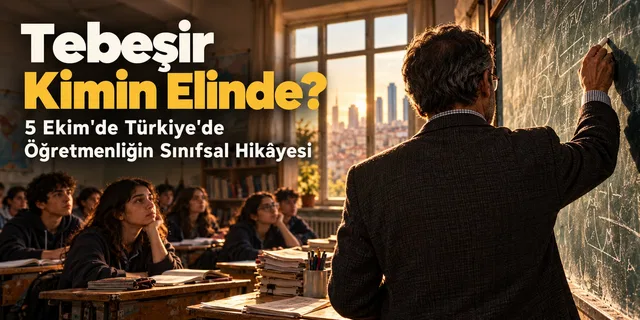
Today flowers were given in schools, ceremonies were held, and speeches celebrated the "sacred profession". Tomorrow morning the same teachers will enter the same crowded classrooms with the same pay and insecurity. This article looks at the history behind the flowers and what the speeches leave unsaid.
Summary
- Where does 24 November come from? The regulation naming Mustafa Kemal head teacher of the People's Schools took effect on 24 November 1928. Fifty-three years later, in 1981, the military administration that followed the 12 September coup declared it Teachers' Day.
- What is 5 October? On 5 October 1966, the ILO and UNESCO adopted the Recommendation concerning the Status of Teachers, setting out standards for pay, job security, organising and professional autonomy. In 1994 UNESCO established World Teachers' Day on its anniversary.
- Why is 5 October not Türkiye's national Teachers' Day? The national date was established 13 years earlier. The international date marks a rights instrument; Türkiye's official national day remains 24 November. This choice also raises the question of whether teachers' rights are overshadowed by ceremonies.
- Why do some object to 24 November? The administration that established the day had closed TÖB-DER, the largest teachers' organisation, and dismissed, imprisoned and displaced thousands of teachers. The objection is not to Atatürk's role as head teacher, but to a "day" being given by those who silenced teachers.
- What do teachers want today? A living wage, secure permanent jobs, appointments without interviews, a minimum salary in private schools, professional autonomy, schools free from violence, and public, scientific education.
- The conclusion: Teachers' value is measured not by a day on the calendar but by their rights. Those rights are won not by waiting, but by organising.
24 November 1928: A Part of History Worth Defending
After the alphabet reform, People's Schools were established to teach adults to read and write. Their regulation was adopted by the Council of Ministers on 11 November 1928 and took effect on 24 November. It named Mustafa Kemal head teacher of the schools.
This is the part of the history worth defending: a public education campaign that taught poor villagers, workers and women to read and write. Presenting criticism of 24 November as opposition to that campaign distorts the debate.
24 November 1981: Who Established the Day, and Under What Conditions?
The centenary of Atatürk's birth was declared "Atatürk Year" in 1981. That year, Kenan Evren's administration made 24 November Teachers' Day. The rules for celebrations were subsequently set out in a regulation published in 1992.
Consider what the same administration was doing to teachers:
- Their organisation was closed. TÖB-DER was founded in 1971 after TÖS, the teachers' union, was closed following the 12 March military intervention. Before the 1980 coup it was the country's largest teachers' organisation, with 650 branches and more than 160,000 members; some sources put membership at 200,000. The legally established association was closed on allegations that it was a "secret organisation", and its assets were confiscated.
- Its leaders were imprisoned. Sixty-four TÖB-DER leaders and representatives received prison sentences of four to nine years, and its chair Gültekin Gazioğlu was stripped of citizenship.
- Teachers lost their jobs. Sources give different numbers for teachers dismissed under Martial Law No. 1402: 3,854 in one account and 2,515 in another. Whatever the exact figure, thousands were removed from their profession; thousands more were transferred or forced into early retirement.
The administration that dismantled teachers' organisation, silenced them and took away their livelihoods gave them a "day" a year later. This is the political meaning of 24 November in our reading: the organised teacher who claims rights and participates in society is replaced by a teacher with ceremonies and flowers, but no voice.
The 12 September coup was a class coup. The implementation of the 24 January economic decisions required wages to be suppressed and unions shut down. Teachers were a particular target: they educated the workforce and were an organised presence reaching villages and neighbourhoods. First their organisation was crushed, then their profession was declared "sacred". Sanctification is a cheap way to avoid talking about pay and rights.
5 October: Not Just a Celebration, but a Rights Instrument
On 5 October 1966, a special intergovernmental conference in Paris adopted the Recommendation concerning the Status of Teachers. Türkiye was represented at the conference. In 1994 UNESCO declared its anniversary World Teachers' Day.
The instrument calls for a decent living wage, job security, consultation with teachers' organisations on education policy, collective negotiation and professional freedom. Eğitim Sen describes it as akin to an international collective agreement.
We must be clear: 5 October is also a day designated by an intergovernmental organisation, and the recommendation is not legally binding. Teachers are poor in many countries that observe it. Its value lies not in UNESCO's signature but in its language of rights and in teachers' unions around the world taking it up as a day of struggle.
Why Did Türkiye Not Choose 5 October as Its National Day?
The formal answer is straightforward: 24 November was established in 1981, and 5 October in 1994. Türkiye already had its own day and did not change it.
In our view, the real question is whether Teachers' Day is connected to a rights instrument. Adopting 5 October as the national day could place the question "Where do we stand on the principles adopted in 1966?" on the official agenda every year. Teachers and unions also raise their demands on 24 November; our objection is that the language of official ceremonies can overshadow those demands.
| 24 November | 5 October | |
|---|---|---|
| Origin | The 1928 head-teacher title | The 1966 Recommendation concerning the Status of Teachers |
| Established by | The post-coup military administration, 1981 | UNESCO in 1994, with teachers' organisations contributing |
| Context | Teachers' organisation closed, leaders imprisoned | A demand of the international teachers' movement |
| Position of teachers | Celebrated and thanked | Rights holders and participants |
| Language | Sacrifice, sanctity, gratitude | Pay, security, organising, autonomy |
| Role of the state | Organises ceremonies | Called upon to implement non-binding rights standards |
Who Objects?
For years Eğitim Sen has said that 24 November is a product of the post-coup period and has emphasised 5 October. In its statement this year, the union recalled the official day's origins and called for lasting solutions instead of rhetoric.
The objection has three parts:
- Origin: A day given by those who punished teachers cannot be their day.
- Function: Ceremony is put in place of demands for rights. Teachers praised one day a year are impoverished on the others.
- Accountability: A legal struggle has been waged against the closure of TÖB-DER and the failure to return its confiscated assets. Celebrating the coup administration's day without confronting 12 September risks treating that account as settled.
The objection is not directed at the child or parent who brings a teacher flowers today. That affection is real. As Eğitim Sen's Sakarya branch says, no one objects to an additional day on which teachers' problems are discussed. Let us use today to talk about teachers' actual conditions too.
What Are Teachers' Conditions Today?
Pay. According to TÜRK-İŞ's October 2026 research, a family of four in Ankara needed 38,024 lira a month for food and 123,856 lira to meet basic needs overall. Teachers' pay varies by grade, career stage, family circumstances and additional payments. For example, one calculation for the second half of 2026 puts the net basic salary of a grade 1/4 teacher at 83,254 lira. This example is below the poverty threshold calculated for a four-person household, although a household may have other income.
Hourly-paid teaching. Teachers paid per lesson earn mostly 15,000–20,000 lira a month and at most 30,000 lira, according to Eğitim Sen's Sakarya branch: below the four-person household food threshold. Data gathered from provincial authorities by Türk Eğitim-Sen show 71,757 hourly-paid teachers in the 62 provinces that responded for the 2025–2026 school year.
Those awaiting appointment. Unions estimate that nearly 500,000 teachers are awaiting appointment. In Türk Eğitim-Sen's same 2025–2026 survey, 55 responding provinces reported a need for 80,449 established teaching posts. There is a shortage and there are teachers waiting, yet appointments are insufficient. We see this as a policy choice, not merely a failure of planning: a large reserve of applicants can put pressure on the pay and voice of those already employed. It is education's version of what Marx called the reserve army of labour.
Private schools. The statutory salary floor protecting private-school teachers was removed in 2014. The Private Sector Teachers' Union describes six-day weeks and more than 45 hours of work without extra-lesson or supervisory pay, as well as 10- or 11-month contracts. Its message captures the issue: "We do not want to work like seasonal workers."
Debt and safety. In Eğitim-İş's survey of 9,034 teachers, more than 68% of respondents were reported to be trapped in debt, and 80.05% said they had encountered situations in which they felt unsafe at school, frequently or rarely. These are the responses of survey participants; they should not be assumed to represent every teacher.
Autonomy. Career stages divide people doing the same work into different pay and title categories. Question-by-question data entry turns teachers into data clerks. Eğitim Sen argues that interviews weaken merit-based appointments and open the door to political patronage.
Taken together, teachers are divided into permanent, contract, hourly-paid and private-school employment, while those awaiting appointment face uncertainty about entering the profession. The 12 September regime silenced teachers by closing their organisation; today fragmentation produces a similar effect.
Teachers' Demands
These are demands raised across teachers' organisations that we also support:
- A living wage. No teacher's income should fall below the poverty threshold; additional payments should count towards pensions.
- Secure permanent jobs for all. End insecure hourly-paid and contract teaching; equal status and equal pay for equal work.
- Appointments to meet the need, without interviews. Fill vacant posts and remedy the grievances of teachers harmed by interview procedures.
- A salary floor in private schools. Equal pay guarantees with public-sector teachers, 12-month contracts, and payment for extra lessons and supervision.
- Professional autonomy. End inequalities created by career stages, reduce bureaucracy and develop education policy with teachers' organisations.
- Safe, well-equipped schools. Sufficient support staff, reasonable class sizes and effective measures to protect teachers from violence.
- Public, scientific, secular and free education. Teachers' conditions and children's education flow from the same budget and the same policy choices.
- Collective bargaining with the right to strike. The 1966 Recommendation calls for negotiation with teachers' organisations and ways to defend their interests in disputes; we advocate bargaining with the right to strike as a way to put those principles into practice.
- Accountability for 12 September. TÖB-DER's reputation and assets should be restored, and Teachers' Day should be a day teachers themselves choose.
What Falls to Us?
- Teachers: Whatever your status, the demands of the hourly-paid teacher beside you, your colleague in a private school and your friend awaiting appointment are yours too. Status differences divide workers; a union is a way to overcome the division.
- Students and parents: Give the flowers, but add a question: "Teacher, what do you need, and what can we do?" Supporting teachers' action is the most lasting gift.
- Young comrades: Find out how many hourly-paid teachers work in your neighbourhood school. Join the actions of teachers awaiting appointment and private-sector teachers. Mark 5 October on your calendar as a day of struggle.
Dear Comrades,
Today we remember teachers: those who taught literacy in the People's Schools, those who taught through production in the Village Institutes, those who organised in TÖS and TÖB-DER, those dismissed and displaced after 12 September, and those teaching today for less than the food threshold.
But remembering is not enough. A teacher's value is measured not by a date on the calendar but by what is written on their payslip, how many months their contract lasts and who decides what and how they teach. Real respect means securing their rights. No one will give those rights as a gift; teachers, students and working parents will win them by organising together.
Not a day, but rights. Not a ceremony, but collective bargaining. Not sanctification, but secure jobs.
Sources
- TÜRK-İŞ, October 2026 hunger and poverty thresholds
- Karekod, 2026 teachers' salaries
- ILO, ILO-UNESCO Recommendation concerning the Status of Teachers, 1966
- Rıfat Okçabol, World Teachers' Day, soL
- Rıfat Okçabol, From then to today, soL
- soL, Teachers' Day and the 12 September regime
- Mustafa Demir, Teachers' organising after 12 September, Eğitim Bilim Toplum, winter 2026
- bianet, Why has TÖB-DER been closed for 40 years?
- bianet, TÖB-DER comes back to life
- bianet, 24 November is a product of the post-coup period
- bianet, Eğitim Sen's "Teachers Change the World" campaign
- NTV, The history of Teachers' Day
- Hürriyet, On Teachers' Day celebrations
- Habere Güven, Eğitim Sen's 24 November statement, 23 November 2026
- Taraklı Medya, Eğitim Sen Sakarya's 24 November statement, 24 November 2026
- Yeni Mesaj, From the head-teacher legacy to the cost-of-living crisis
- Mektepli Gazete, Türk Eğitim-Sen: 71,757 hourly-paid teachers in 62 provinces, 27 March 2026
- Elips Haber, Insecurity, debt and violence at school, 24 November 2026
- Elips Haber, Private-sector teachers' 24 November message, 24 November 2026
- Urfa Değişim, Teachers' Day and the demand for dignity, 24 November 2026
This article is shared under CC BY-SA 4.0.