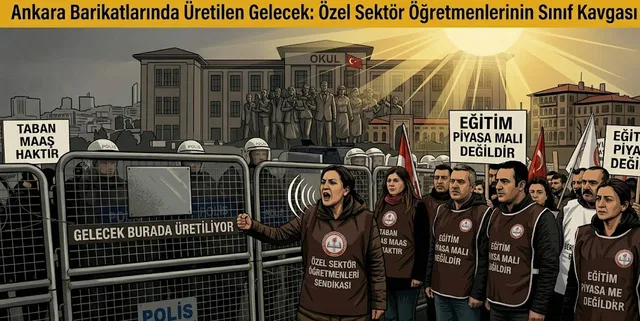
Whose Hand Holds the Chalk?
The Class Story of Teaching in Turkey, on 5 October

Whose Hand Holds the Chalk?
The Class Story of Teaching in Turkey, on 5 October
Dear Young Comrades,
Today is 5 October, World Teachers' Day. Most of the world remembers its teachers today. Turkey remembers its teachers on 24 November. The difference between these two dates looks like a detail of the calendar, but it is not. The story of teaching in this country is hidden in the distance between these two dates.
In this piece we will tell that story from the beginning: from the first teacher-training school in the last century of the Ottoman Empire to the Village Institutes, from the platform of the Turkish Teachers' Union (TÖS) to the exile lists of 12 September, from the lesson-paid teacher's payslip of 24,000 lira to the private-school teacher's contract that ends in June. Then we will set out the teaching that ought to be, and our demands.
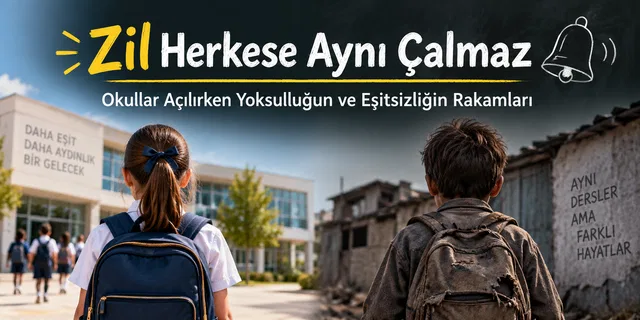
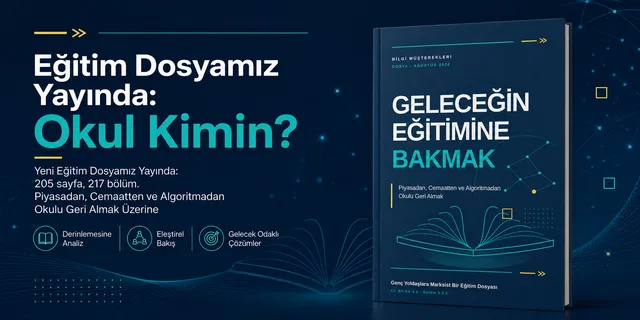
This piece is the continuation of Our Education Dossier Is Out: Whose School Is It?, which we published in August, and of The Bell Does Not Ring the Same for Everyone, which we wrote as the schools were opening. Most of the figures come from those two texts and from their sources; here we will read them again through the teacher's eyes.
First a Short Summary
Two days, two meanings. 5 October is the anniversary of the Recommendation concerning the Status of Teachers, adopted by UNESCO and the International Labour Organization (ILO) on 5 October 1966; since 1994 it has been marked as World Teachers' Day. So its origin rests on a document of rights: on the teacher's working conditions, pay, and the right to organise and to have a say. Turkey's 24 November was declared in 1981, by the administration of 12 September, as the day on which Atatürk accepted, in 1928, the title of Head Teacher of the Nation's Schools. At the same time that administration was closing the teachers' largest organisation, dismissing thousands of teachers, sending them into exile, and putting them on trial. The teacher was given a day; their voice was taken.
The story of teaching is a class story. In this country the teacher was defined sometimes as the "soldier" of nation-building, sometimes as the one who would bring light to the village, sometimes as a "dangerous element," and today, increasingly, as an item of cost. Behind every definition was the question of who expected what from education.
The brightest moment was a method. The Village Institutes (1940–1954) raised the teacher from inside production, the land, and the people. They were closed when they began to ask the question of the land. We take from there not the period, but the method.
The organised teacher was always punished. TÖS (1965–1971) organised sixty per cent of teachers; it was closed on 12 March. TÖB-DER organised sixty-nine per cent of teachers in 1980; it was closed on 12 September, hundreds of its members had been killed, and thousands lost their jobs. In 2016 the emergency decrees (KHK) set the same mechanism working again.
Today's teacher is a fragmented worker. Permanent, contracted, paid by the lesson, a private-school teacher, a course teacher, an unappointed teacher. People who do the same work have been divided into six separate laws and six separate wages. As of July 2026 even the most senior public teacher is 22,000 lira below the poverty line; the lesson-paid teacher is below the hunger line; a large part of the 177,738 private-school teachers work around the minimum wage, and on an annual contract.
Our thesis is this: Education must not be a commercial field, because when education is a commodity the teacher too becomes a cost. Respect for the teacher is shown not with flowers and ceremonies, but with security, with pay, with a voice, and with organisation. At the end of the piece we turn this into sixteen concrete demands.
Now let us go into the detail.
Two Dates: 5 October and 24 November
What is 5 October the day of?
In the autumn of 1966 an intergovernmental conference meeting in Paris adopted a document prepared jointly by the ILO and UNESCO: the Recommendation concerning the Status of Teachers. The document defined teaching not as a "self-sacrifice" or a "sacred duty," but as a profession with rights and obligations. In it were principles such as the teacher's pay being comparable with that of other qualified professions, job security, class sizes being kept reasonable, professional autonomy, and, most important, the participation of teachers' organisations in the determination of education policy.
In 1994 UNESCO declared the anniversary of this recommendation World Teachers' Day. Today teachers' unions across the world use 5 October as a day of demands. The Education and Science Workers' Union (Eğitim Sen) too marks this day every year as "a day of struggle for our rights and our demands," and reminds us that Turkey has not fulfilled the obligations born of the 1966 recommendation (Eğitim Sen, 5 October statement).
By UNESCO's reckoning the world needs 44 million new teachers by 2030. In our education dossier we wrote that the annual cost of closing this gap is about 120 billion dollars, and that this is of the order of three times the size forecast for 2030 for the artificial-intelligence market in education. It is not that the resources do not exist; the resources are going somewhere else.
How did 24 November come about?
On 1 November 1928 the Turkish Alphabet Law was adopted. The Nation's Schools were opened to teach the new script to the people; the Council of Ministers gave Mustafa Kemal the title "Head Teacher of the Nation's Schools," and this title was made official on 24 November 1928 by the regulation of the Nation's Schools (TRT Haber).
But 24 November's being Teachers' Day happened not in 1928, but in 1981. In the centenary of Atatürk's birth, the administration of 12 September declared this date the official teachers' day. Before that, another tradition existed in the teacher-training schools: to mark 16 March 1848, the day the first teacher-training school was opened (Rıfat Okçabol, soL).
Now let us look at the other face of that year. TÖB-DER, which in 1980 organised about sixty-nine per cent of teachers, was closed, and its assets were transferred to the treasury. In the years up to the coup, between 210 and 230 of its members had been killed. According to TÖB-DER's sources, 3,854 teachers were dismissed under the martial-law statute no. 1402; 64 executives and representatives of the organisation received prison sentences of between four and nine years; its general president was stripped of citizenship; thousands of teachers were exiled or forced into retirement (soL, "the eyewash of 12 September").
So in 1981 the teacher was given a day, and in the same year the teacher's organisation, voice and job were taken away. This was not a contradiction; it was a method: the teacher who is sanctified is the teacher who is silenced. The teacher of the ceremony receives flowers; the teacher of the union receives an investigation.
In our 12 September dossier we told in detail that the coup was a class coup. The teachers' story is one of the plainest pages of that coup: in the field of education the coup first targeted the organised teacher, then set up the Council of Higher Education (YÖK), then rewrote the curriculum on the line of the "Turkish-Islamic synthesis."
Let us put the two days side by side:
| The teacher of 24 November | The teacher of 5 October |
|---|---|
| "A sacred profession," "a self-sacrificing private" | A worker with rights and obligations |
| The teacher of the nation and of the state | The teacher of the child, of the people, and of science |
| Flowers, a plaque, a ceremonial speech | Pay, security, class size, a right to speak |
| Individual self-sacrifice is praised | The organised demand is counted as legitimate |
| Declared in 1981 by a coup administration | Born in 1966 of an international document of rights |
| It rewards silence | It institutionalises the voice |
Of course we can also make 24 November belong to our own teacher, and shout the demands on that day too; the teachers' unions in Turkey do this. But knowing how the day was born lets us choose what meaning we will load onto it.
The Story of Teaching
Now let us begin from the start. We will read every period with the same three questions: In whose hands was the teacher? Under whose oversight? For whose benefit were they put to work?
From the neighbourhood school to Darülmuallimin
In the Ottoman Empire education was largely in the hands of religious institutions. In the primary schools (sıbyan) the "hoca" was mostly not a teacher, but the neighbourhood's mosque functionary; they took their pay from the foundation or from the tip the parent gave. Knowledge was memorisation, authority was religious. The madrasa was higher education, but its door too was open essentially to those who were men and urban.
In the nineteenth century the empire, in order to compete with European capitalism, had to train bureaucrats, officers and engineers. When the rüştiye schools opened with the Tanzimat were left without teachers, the first teacher-training school was opened in Istanbul on 16 March 1848: Darülmuallimin. In 1870 the women's teacher-training school, Darülmuallimat, followed it.
The class reading is this: The teacher came to this country not by the demand of the people, but by the need of the state. The modern teacher was the hand of the central state reaching into the provinces. This birthmark kept alive, in every later period, the question "whose man is the teacher?"
The Republic: the nation's teacher
The Law on the Unification of Education of 3 March 1924 gathered education into a single hand, the hand of the state. The madrasas were closed, the school was secularised. This was a great step against religious authority, and we do not belittle it.
But the role cut out for the teacher of the new school was also plain: the vanguard of nation-building. The comparison of a "teachers' army" is a product of this period. What was expected of the teacher was to carry into the provinces a curriculum and an identity written at the centre. For children who spoke Kurdish, Laz or Arabic, the school was at the same time the place where the door of language was closed; we discussed this in detail in the national-question section of the education dossier.
And a class fact: in the 1920s and 1930s four fifths of the population lived in the village, and the literacy rate was below ten per cent. The teacher trained in the city did not want to go to the village; and those who went were, in the peasant's eyes, most often "the state's official." There was a distance between the peasant and the school, and that distance had to do with whose hands the land was in.
The Village Institutes: the teacher from inside the people
To close this distance, the boldest experiment in Turkey's history of education was made.
İsmail Hakkı Tonguç, brought to the Directorate General of Primary Education in 1935, started in 1936 courses that trained instructors from peasant youth who had done their military service as corporals. In 1937 the first village teacher-training schools were opened. On 17 April 1940, in the period of the Minister of National Education Hasan Ali Yücel, the Village Institutes Law no. 3803 was adopted. As the law passed through Parliament it received 278 votes; a group of deputies did not take part in the vote (bianet, the Village Institutes at 81). The number soon reached 21 institutes; in 1942 the Higher Village Institute was opened at Hasanoğlan.
What was the method?
- The student was taken from the village and returned to the village. The teacher was not a stranger sent from outside the village, but the village's own child.
- Education was inside production. The students built the buildings of their own schools, sowed the field themselves, and learned smithing, carpentry and beekeeping. This was the closest application in Turkey of the polytechnic education Marx proposed in 1866 — the joining of mental and manual labour.
- Culture was kept broad. Every student played a musical instrument; the world classics were read. As we told in our piece The Melodious Heart: Telling Ruhi Su to Young Comrades, the musicians, writers and painters who passed through the gate of Hasanoğlan changed the cultural life of a generation.
- The teacher in the village did not only give lessons. They were a health officer, an adviser on agriculture, a teacher of literacy courses.
Up to 1954 the institutes trained, according to the sources, between 17,000 and 20,000 teachers, and thousands of instructors and health officers. Fakir Baykurt, Mahmut Makal, Talip Apaydın, Mehmet Başaran… The current called village literature came out of these schools.
Why, then, were they closed?
In 1946 the passage to multi-party life was made. In the same year land reform was being debated in Parliament, and the large landowners were strong both inside the Republican People's Party (CHP) and inside the Democrat Party (DP). The teacher who was a graduate of a Village Institute came out in the village against the ağa, with a peasant who could read and write, who asked for their right, who thought "whose is the land?" The institutes were branded "a nest of communism." In 1946 first Hasan Ali Yücel was removed from the ministry, and then Tonguç was removed from his post. In the period of Reşat Şemsettin Sirer the curriculum was changed, the production lessons were reduced, coeducation was abolished, and the Higher Village Institute at Hasanoğlan was closed. On 27 January 1954 the Democrat Party government completed the liquidation by merging the institutes with the teacher-training schools under statute no. 6234.
In the education dossier we had opened this subject with this question: Why does an apparatus dismantle its own part? Because that part was not doing what the apparatus needed it to do. The Village Institutes were institutions the state had founded, but as they grew by their own logic they entered into conflict with the class structure of the state.
And a note of honesty: we do not exalt the Village Institutes without criticism. They were institutions of the single-party regime; their curricula were not independent of the official ideology; they were silent on the mother tongue; their boarding structure at times worked with a harsh discipline. We take from there not the period, but the method: to raise the teacher from inside the people, to join education with production, to open the school to the problems of the community.
The 1950s and 1960s: the teacher meets the union
In the 1950s the DP government opened the village to the market, the tractor arrived, migration from the village to the city began. The teacher-training schools grew crowded, and the teacher was increasingly defined as a "civil servant." But the 1961 Constitution, adopted after 27 May, recognised the right of public employees to form unions.
On 8 July 1965 the Turkish Teachers' Union, TÖS, was founded. In a short time it reached 65,000 members and organised about sixty per cent of the teachers in the country (bianet, remembering TÖS at 55). For a period its general president was Fakir Baykurt, a graduate of the Village Institutes. The line running from the Village Institutes to TÖS is not an accident: the teacher those schools raised saw their own interest and the people's interest in the same place.
TÖS did not ask only for pay. At the Revolutionary Education Council it organised in 1968, it defended the view that education had to be independent, scientific, democratic, and on the side of the people. For this reason it was also attacked: on 8 July 1969, in Kayseri, the cinema hall where the TÖS general assembly was being held was set on fire.
And the boycott of 1969. In December 1969 more than a hundred thousand teachers in Turkey, that is more than two thirds of teachers, stopped work. The state's answer is the table we recorded in the education dossier:
| Measure | Number |
|---|---|
| Teachers placed under investigation | 50,300 |
| Punishment of a pay cut | 45,520 |
| Exile within the province | 6,600 |
| Suspended from work | 2,118 |
| School principals removed from post | 400 |
| Expelled from the profession | 11 |
Fifty thousand investigations, eleven expulsions. The aim was not a purge; it was mass intimidation. The number punished is small, the number deterred is large. Keep this mechanism in mind, comrade; fifty years later it will appear before us again.
After the memorandum of 12 March 1971, TÖS was closed and its executives were arrested. The constitutional amendment of 1971 also abolished civil servants' right to a union.
The 1970s: TÖB-DER, and the teacher's largest organisation
When the union was closed, the teachers organised in an association. TÖB-DER (the Association for the Unity and Solidarity of All Teachers) reached 220,000 members and 670 branches at the end of the 1970s. In 1980, 69.2 per cent of the teachers in Turkey were in this single organisation. This is the highest rate of organisation in Turkey's history, both of the public employee and of teaching.
The same years were also the years when the teacher's life was cheapest. In fascist attacks, 210 to 230 teachers who were members of TÖB-DER were killed. Schools, teachers' houses and teacher-training schools became targets. The state's other hand, meanwhile, protected structures such as the Ülkücü Teachers' Union (ÜLKÜ-BİR), which stood on the same line as the idealist hearths.
The 1970s were at the same time the years of the teacher shortage. While schooling rose rapidly, teacher training could not keep up; ways such as accelerated programmes and training teachers by correspondence were tried. This is the first example of a pattern that would be repeated in every later decade: the state tries to close the teacher shortage not by training teachers, but by cheapening teaching.
12 September: the teacher's organisation, job and voice
We saw it above: TÖB-DER was closed, thousands of teachers became "1402s," were exiled, were tried. But the effect of 12 September on teaching did not end with these.
- In 1981 YÖK was founded, and in 1982 teacher training was transferred to the universities, to the faculties of education. The tradition of the Village Institutes and of the teacher-training schools, of training the teacher inside the community, came to a definite end.
- The 1982 Constitution made the ban on strikes for public employees a constitutional provision.
- The curriculum was rewritten on the line of the Turkish-Islamic synthesis; compulsory religious instruction entered the constitution.
- Blacklisting became an ordinary part of teaching. The file of the "objectionable" teacher followed them from one province to the next.
And 24 November was declared Teachers' Day.
The 1990s: the union again
The teachers' movement was founded from zero for the second time after 12 September. In 1990 Eğit-Sen was founded, and then Eğitim-İş; the two united in 1995 and took the name Eğitim Sen. These unions existed for years without a legal basis, by a struggle that was de facto legitimate; only in 2001 did the Public Employees' Unions Law no. 4688 come out. That law too recognised neither the right to strike nor a real collective agreement.
The neoliberal wave of the 1990s entered education too. In 1997 the passage was made to eight-year compulsory education; schooling increased, but the resources did not. Crowded classes, double-shift schooling, and, for the first time in this history on a large scale, lesson-paid teaching began to turn into a permanent part of the system.
The 2000s: the institutionalisation of precarity
The education policy of the Justice and Development Party (AKP) government advanced, as we named it in the education dossier, on three prongs: marketisation, religiousisation, and precarisation.
For the teacher this meant the following:
- The KPSS (2002) tied entry into teaching to a central examination. The examination ranking was presented as "merit"; hundreds of thousands of prospective teachers waited years for an appointment.
- Contracted teaching was set up in the middle of the 2000s, transferred to the permanent staff in 2011, and brought back in 2016. Today there are 64,509 contracted teachers; more than two thirds of them are women.
- Lesson-paid teaching ceased to be a "temporary solution" and turned into a permanent strategy of cost.
- Private schools grew with state incentives; the share of private education rose from 1.9 per cent in 2002 to 8 per cent today, and the number of private schools rose from 2,395 to 14,700.
- The authority-and-privilege mechanism turned union membership from a class choice into an instrument of career. While Eğitim Sen was first in the branch of service in 2002 (22.84 per cent), today it is in fourth place (6.24 per cent). In the same period the membership of the union close to the government increased 24.6 times.
And 2016. With the emergency decrees issued after the coup attempt of 15 July, tens of thousands of teachers were dismissed. Left, socialist, Kurdish and Alevi teachers who had no tie to the putschists also entered these lists. In September of the same year, in the Kurdish provinces, more than ten thousand teachers were suspended in a single act. In Eğitim Sen's records there are 806 members dismissed by decree. Even today, 320 education workers have been under investigation for taking part in an event on 21 February, International Mother Language Day.
In 1969, fifty thousand investigations and eleven expulsions. In 2016, tens of thousands of expulsions. The target is the same: the organised teacher who asks questions and objects.
2024: the Teaching Profession Law
The Teaching Profession Law no. 7528, published in the Official Gazette on 18 October 2024, rearranged entry into teaching (a summary of the text of the law, Alo Maliye). Prospective teachers will now pass through a four-term "preparatory training" at the National Education Academy attached to the ministry; the academy has its own disciplinary regime, and its own punishment of "removal from the academy." The career steps were written into the law.
The class meaning of the law gathers at three points:
- Teacher training is being taken from the university and tied to the ministry. In place of scientific autonomy comes administrative oversight. Let us not forget that the next government too will be able to shape the same academy according to its own ideological line.
- The oral interview institutionalises arbitrariness in the name of "merit." Thousands of prospective teachers who scored high in the examination and were eliminated at the interview organised under the name "Teachers Wronged by the Interview."
- The career steps divide again the teachers who do the same work. In Eğitim Sen's words, this is the erosion of the principle of "equal pay for equal work."
Today's teacher: six separate laws, a single job
Today there are 1,187,409 teachers in Turkey. In state schools, 1,009,671; in private schools, 177,738. Fifty-nine per cent are women. But these numbers describe not a single profession, but a fragmented labour power.
| The teacher's status | What does it mean? |
|---|---|
| Permanent | A state civil servant; there is job security, there is no right to strike |
| Contracted | 64,509 people; they do the same work with less security |
| Paid by the lesson | At least 71,757 people in 62 provinces; paid per lesson, monthly income about 24,000 lira |
| Private-school teacher | 177,738 people; a worker subject to the Labour Code, most of them on an annual contract |
| Course, study-session and private-lesson teacher | Even the number is unknown; piece-rate, seasonal, largely off the books |
| Unappointed teacher | Hundreds of thousands; the estimates go up to 600,000–700,000 |
And the wages. After the July 2026 rise, the poverty line of the Confederation of Turkish Trade Unions (TÜRK-İŞ) in the same month was 120,325 lira:
| Grade | Salary | Distance from the poverty line |
|---|---|---|
| Newly appointed (9/1) | 72,578 TL | −47,747 TL |
| Expert teacher | 91,775 TL | −28,550 TL |
| Chief teacher (the highest) | 97,871 TL | −22,454 TL |
| Lesson-paid teacher | ~24,000 TL | below the hunger line too |
In the table there is not a single line above the poverty line. Even Turkey's most senior teacher is 22,000 lira below the poverty line. On the other hand, in 55 provinces there are 80,449 vacant established posts. There is a vacancy, there is a teacher, but there is no appointment. This is not an error of planning; it is a strategy of cost.
Add to this table the violence, the crowded classes, the growing bureaucratic load, the pressure of parents and of administrators, the systematic erosion of professional standing. Teaching, a profession that was once, for the children of poor families, a secure road of moving up a class, has today become the door of precarity.
The Unseen Teacher: the Worker of the Private School and of the Course
In the education dossier we had given one section the heading "an invisible section of 177,738 people." Today that section is no longer invisible, because it has made itself visible.
Exit in June, entry in September
The private-school teacher is not a public employee; they are a worker within the scope of the Labour Code. On paper they have the right to strike. In practice this right cannot be used, because at the centre of the mechanism stands the annual contract: the teacher signs a contract in September, the contract ends in June, through the summer either no wage is taken or a low wage is paid, and in September it is either signed again or it is not. There is no need to dismiss the teacher who objects, or who joins a union; their contract is "not renewed."
The report Justice in the Private Education Sector, prepared by the Citizenship Association and Dissensus Research with the support of the ILO, turned this mechanism into figures (T24):
| Indicator | Rate |
|---|---|
| Working on a fixed-term contract (annual, or of 10 months) | 92.4% |
| Working on an indefinite contract | 1.3% |
| Anxious that their contract will not be renewed | 55.1% |
| Receiving part or all of their salary in cash | 22.1% |
| Social-security contributions paid on the minimum wage | 27.5% |
| Receiving no extra pay for study sessions and parent meetings | 76.8% |
| Made to work on public holidays | 62% |
| Disturbed outside working hours | 67.9% |
The teachers in the report define themselves as "seasonal workers." This is a correct definition.
What happened in 2014?
This table has a starting date. The Private Education Institutions Law no. 5580, of 2007, provided that the wage paid to the private-school teacher could not be less than the monthly pay and the social benefits paid to a teacher in the same position in state schools. In 2014 this provision was removed. From that day to this, the great majority of private-school teachers have been pushed to around the minimum wage (Sözcü).
In the same years private-school fees multiplied. The ceiling rates of increase set by the Ministry of National Education (MEB) for 2026–2027 are 30.74 per cent in the intermediate years, and 43.92 per cent at the start of a stage. The annual fee of a private school goes up to 2,751,000 lira. While the school's income rises by 30 to 44 per cent, by how much did the teacher's wage rise? There is no record of this question that is open to the public.
This, then, is the concrete form, on the teacher, of the commercialisation of education: the difference between the fee the parent pays and the wage paid to the teacher is the school's profit. And this profit is taken out of the teacher's unpaid study session, out of the uninsured summer months, out of the salary given in cash. Marx's famous example in Capital holds here to the letter: when a teacher works for a school proprietor, they do not only work on the children's heads; they also toil to enrich the proprietor. That the proprietor has put their money into a school instead of a sausage factory does not change the relation.
The teachers of the private sector are organising
But this year something changed. Under the lead of the Private Sector Teachers' Union, private-school teachers stopped work in the first half of 2026, walked to Ankara, and held an action in front of Parliament. In June, joint actions were organised together with public teachers and with those wronged by the interview.
The result: a table was set up with the participation of the Ministry of Labour, the MEB, the Treasury, representatives of the employers, and the TOBB Education Assembly. The first meeting was held in July, the second on 12–13 August. The union's demands are under three headings: a wage floor, the abolition of the fixed-term contract, and the regulation of the sector. The proposal reported by the union's general president, Eren Edebali, is plain: either the public teacher's gross wage, or twice the minimum wage, should be accepted as the floor. In Edebali's words: "If there is no wage floor, there is no concrete gain either" (Cumhuriyet). The union defines this process as "a de facto collective bargaining"; the table concerns about 12,500 workplaces and hundreds of thousands of education workers (bianet).
Comrade, do not miss the importance of this. A section that for years was said to be "unable to organise," said "not to see itself as a worker," by organising sat the state and the employer down at the same table. Remember the irony we wrote in the education dossier: in Turkey the teachers who had the right to strike could not strike, and the teachers who had the organisation with which they could strike had no right to strike. The teachers of the private sector have begun to break the first half of this equation.
The public and the private: two ends of the same mechanism
Let us repeat the most important finding here. The public teacher and the private-school teacher have been set up as each other's rivals. Yet they are at the two ends of the same mechanism:
- The public school is made scarce, the family turns to the private school, the private sector grows.
- The private sector works with cheap labour, and the general wage level of teaching is pressed down.
- The pressed-down wage level produces, in the public sector, the argument that "the teacher's salary is already above the market."
- As lesson-paid teaching spreads in the public sector, the floor in the private sector falls too.
The public teacher's security protects the private-school teacher's wage. The organisation of the private-school teacher increases the public teacher's bargaining power. And behind the two of them stand the course and study-session teachers, whose number is not even known, that is the lowest layer of educational labour: a reserve army made up, piece-rate, seasonal, off the books, and largely of young teachers who could not be appointed.
Why Is Teaching a Class Matter?
So far we have told a story. Now let us open the logic underneath that story.
What does the teacher produce?
The teacher does not produce a product. They reproduce a person's labour power: reading and writing, reckoning, language, order, discipline, knowledge. From the point of view of capitalism the school is the place where the next generation of workers is prepared. For this reason capital wants two things from the school: that it be cheap, and that it raise a docile person.
The teacher's relation to both of these is one of tension. A cheap school means a cheap teacher. A school that raises a docile person wants a docile teacher. The whole history of teaching is the history of these two pressures, the pressure of the wage and the pressure on speech.
But the teacher has a third possibility too: to teach the asking of questions. Remember the last word of the education dossier: Education is not neutral; it either teaches silence or it teaches questioning. The teacher who teaches the asking of questions is always a risk for capital. The graduate of the Village Institutes was closed down when they asked the peasant "whose is the land?"; TÖS was closed when it asked "education for whom?"; TÖB-DER was closed when it said "revolutionary education." Whenever the teacher began to ask the question of the class, they were punished.
Why must education not be a commercial field?
When a service becomes a commodity, three things happen:
The first: access is tied to the wallet. In a country where the cost of starting school is equal to one month's income of a household on the minimum wage, and where the private-school fee has risen to 98 minimum wages, "equality of opportunity" is nothing but a discourse.
The second: the teacher turns into an item of cost. When the school is run for the purpose of profit, the teacher's wage is an expense that reduces the profit. The employer's interest is to keep the teacher as cheap, as insecure, and as replaceable as possible. The annual contract, the salary in cash, the unpaid study session: all of these are the result of this logic.
The third: the teacher's pedagogical autonomy disappears. The parent turns into a customer, the student into a product, the teacher into a service provider. "Customer satisfaction" comes before pedagogy. A teacher's being able to say to a child "this is wrong" becomes difficult in a place where that child's parent is the school's source of income. And the same logic is seeping into the public school too: data dashboards, performance indicators, the teacher's work being divided into measurable pieces under the name of "personalisation" supported by artificial intelligence. What we call mental Taylorism in the field of computing is at work in the classroom too.
For this reason our thesis is plain: If education is to remain a right, educational labour cannot remain a commodity. The demand for an education that is free, public, scientific, secular and in the mother tongue, and the demand that the teacher work with security, with a humane wage and in organisation, are two faces of the same demand.
With what is respect shown?
In this country respect for the teacher is most often spoken of as a feeling. "Let there be no disrespect to our teachers," "the teacher is sacred." Yet respect is a material relation. If you want to ask a society how much respect it has for its teacher, ask these questions:
- Is the teacher's wage above the poverty line?
- Is the teacher's job secure, or are they a worker whose contract ends every June?
- With how many children is the teacher working in the classroom?
- Does the teacher have a say in the writing of the curriculum?
- Is the teacher punished for being a member of a union?
- When violence is used against the teacher, does the state protect them, or does it say "get on well with the parent"?
The answers given to these questions are a much more accurate measure of respect than the speeches made on 24 November. Respect for the teacher is to give the teacher a voice and security. When the flower and the plaque take the place of that respect, what there is is not respect, but a cover.
And this: the thing that erodes the teacher's standing in society most is their being impoverished. The teacher who carries food in a courier bag in the evenings, who cannot pay the rent without giving private lessons at the weekend, appears, in the parent's eyes and in the child's eyes, as "someone the state does not value." Standing is built, or destroyed, not by words but by material conditions.
The Teaching That Ought to Be
It is easy to criticise; it is hard to say what one wants. Now let us describe the teaching that ought to be. This description is not a utopia; every element in it is something that has been applied somewhere in the world, in some period, or that has been tried in this country's own history.
| Today's teaching | The teaching that ought to be |
|---|---|
| Permanent, contracted, lesson-paid, private, course: six separate statuses | A single status: equal pay for equal work, equal security |
| Even the most senior teacher is below the poverty line | The wage above the poverty line, comparable with other qualified professions |
| In the private school, an annual contract and the minimum wage | A legal floor indexed to the public teacher's wage, an indefinite contract |
| Entry by oral interview and by a ministry academy | Scientific, autonomous, public teacher training; transparent, objective appointment |
| The public teacher without the right to strike, the private teacher unable to strike | The right to strike, and a real collective agreement, for everyone |
| A curriculum written from above, work measured by a data dashboard | The teacher and the union having a say in the writing of the curriculum; pedagogical autonomy |
| Union membership an investigation, or an instrument of career | Union security; in a dismissal on account of membership, the burden of proof on the employer |
| Classes of 30–40 | Classes of at most 20–24 |
| The teacher alone against the parent, the administrator, the violence | A school assembly: the common government of the teacher, the parent, the student and the education worker |
| Teaching not a door of rising, but a door of poverty | Teaching the respected, secure and free profession of the people's children |
The spirit of this table joins the method of the Village Institutes with the principles of the 1966 recommendation: the teacher is raised from inside the people, works for the benefit of the people, and, organised, has a say.
Our Demands
We have gathered these demands under four headings. None of them is technically impossible; each is a budget decision, an article of a statute, or a change of regulation. What is missing is not the means; it is the power.
Pay and security
- Teachers' wages should be raised above the poverty line. At the least, the wage of the teacher newly appointed should be equalised with the TÜRK-İŞ poverty line and indexed to inflation.
- Lesson-paid teaching should be abolished. The staffing-norm vacancy of more than 80,000 should be closed by permanent appointment; the teachers working today as lesson-paid should be taken onto the permanent staff as a priority.
- Contracted teaching should be abolished, and all contracted teachers should be transferred to the permanent staff.
- The oral interview should be abolished, appointments should be made by transparent and objective criteria; the injury of the prospective teachers eliminated at the interview should be remedied.
Private-school and course teachers
- The legal wage floor should be brought back. Let the provision removed in 2014 return: the private-school teacher's wage should not be able to be less than the public teacher's wage.
- An end should be put to the annual-contract regime. An indefinite contract, or at least a contract of many years; the non-renewal of the contract should be counted as a dismissal without grounds.
- A payment guarantee fund should be set up, the wage should be paid through the bank, insurance should be paid on the real wage; work in study sessions, at the weekend and on holidays should be paid for separately.
- The income-to-wage ratio of private schools should be disclosed to the public. This should be compulsory for every school that receives an incentive or a tax exemption from the public.
- The statistics of the course, study-session and private-education sector (institution, worker, student, turnover) should be collected and published regularly. A field that is not measured is a field that is not regulated.
Voice and organisation
- The right to strike, and a real collective agreement, for all education workers. The ban on strikes for public employees should be lifted; the 1966 recommendation should be made into a norm that can be applied in Turkey.
- The authority-and-privilege mechanism should be abolished. Union membership should cease to be an instrument of career; appointments to management should be independent of union membership, and open to oversight.
- The teachers dismissed by emergency decree should be returned to their posts, and the investigations opened on account of events such as 21 February should be dropped.
- School assemblies should be set up. The teacher, the parent, the student and the education worker should decide in common on the school's budget, its working, and its problems.
The public character of education
- Education should be taken out of being a commercial field. The transfer of public resources to private schools should end; the opening of new schools for profit should be stopped, and the network of public schools should be widened so as to leave no need for the private school. Our long-term aim is that all schools be public, free, and under democratic oversight.
- Teacher training should be public and autonomous. In place of the structure of the National Education Academy under the oversight of the ministry, the education faculties of the universities should be strengthened; teacher training should be tied again to the community, to the school and to production. The method of the Village Institutes should be thought again in today's conditions.
- The share of the MEB budget inside the central budget should be raised to at least 12 per cent, and the investment share to 17 per cent; class sizes should be lowered, and a guidance counsellor and sufficient support staff should be appointed to every school.
To the Young Comrades: What Can You Do?
Some of you reading this piece are prospective teachers, some are new teachers, some are students, and some are a teacher's child. A few suggestions for all of you:
See your teacher as a worker. Do you know the wage, the contract, and how many jobs the person who teaches you works? Respect for your teacher begins with knowing their conditions.
If you are a prospective teacher, begin organised. Meet the union on the day you enter the profession. The teacher who enters alone remains alone; the teacher who enters organised is less afraid that in June their contract will not be renewed.
If you work in a private school or in a course, keep a contract notebook. Write down your wage, your working hours, the unpaid study sessions, the payments in cash. This record is both a legal security and the first document of organisation. The table that structures such as the Private Sector Teachers' Union won this year was built precisely with these records and with this courage.
Break down the wall between the public and the private. Let the public teacher put a shoulder to the private-school teacher's action, and the private-school teacher to the lesson-paid teacher's demand. A divided teacher cannot bargain.
Learn your history. Read the Village Institutes, TÖS, TÖB-DER, the boycott of 1969, Fakir Baykurt, Mahmut Makal. Knowing when teaching was strong in this country shows what to do today: every moment it was strong was the moment it was with the people, and organised.
And teach the asking of questions. In the classroom, at home, in the street. "How many lira is this school's budget? How much does its teacher get? How many children are in the classroom? And who decided these three figures?"
Dear Comrades,
A hundred and seventy-eight years have passed from the first teacher-training school, opened on 16 March 1848, to today. The shortest sentence of these hundred and seventy-eight years is this: In this country the teacher was born of the need of the state, grew with the need of the people, and was punished every time they grew.
The Village Institutes were closed because they worked. TÖS was closed because it was organising the teachers. TÖB-DER was closed because it had brought together two thirds of the teachers. But the teachers' movement was founded again every time. This year the private-school teachers, who were said to be unable to organise at all, set up a table. The story of the teacher in this country is not a story of defeat; it is the story of the foundings again.
Today is 5 October. We remember our teachers. But we owe them more than a flower. We owe them security, a humane wage, a voice, and organisation. And no one will give this to them; we will take it together.
The chalk is still in the teacher's hand. The real question is who will decide what is written on the board.
In comradeship
Pieces and Dossiers of Ours That Connect
- Our Education Dossier Is Out: Whose School Is It? (29 August 2026). The full text of the dossier: PDF, EPUB, Markdown. For the history of the teachers' movement and for private-school teachers, especially Part III and Part IV.
- The Bell Does Not Ring the Same for Everyone (13 September 2026)
- 12 September: The History, Balance Sheet, and Present of a Class Coup (11 September 2026)
- The Melodious Heart: Telling Ruhi Su to Young Comrades (20 September 2026)
- TÜİK: Two Figures, One Country: 8.1% and 30.6% (31 August 2026)
- For all our dossiers: Guides
Sources
The history of Teachers' Day
- ILO/UNESCO, Recommendation concerning the Status of Teachers (5 October 1966)
- Eğitim Sen, statement for World Teachers' Day, 5 October
- TRT Haber, why does Turkey celebrate Teachers' Day on 24 November?
- Rıfat Okçabol, "24 November, Teachers' Day", soL
- soL, "The eyewash of 12 September, which put the teachers on the target board: 24 November, Teachers' Day"
- Ünal Özmen, "I am angry with you, my teacher", BirGün
The Village Institutes and the teachers' movement
- bianet, the Village Institutes at 81: How and why were they closed?
- bianet, the Village Institutes at 81: What was the mission of the institutes?
- Sami Evren, "Remembering TÖS at 55", bianet
- Evrensel, Fakir Baykurt and the organised teachers' struggle
- Erdal Atıcı, "Lessons to be drawn from the TÖS experience", Cumhuriyet
Today's teacher
- Teaching Profession Law no. 7528 (Official Gazette, 18 October 2024), Alo Maliye summary
- Türk Eğitim-Sen, 71,757 lesson-paid teachers in 62 provinces, a teacher shortage of 80,449 in 55 provinces (4 August 2026)
- MEB Personel, the highest teacher's salary remained below the poverty line (30 July 2026)
- Eğitim Sen, the State of Education at the End of the 2025–26 Education Year (25 June 2026)
- MEB, Formal Education Statistics 2024–2025
Private-school teachers
- T24, the "seasonal worker" reality of private-school teachers (Citizenship Association and Dissensus Research, with ILO support)
- bianet, private-sector teachers at the table with the ministry for the second time
- Cumhuriyet, private-sector teachers and the ministry met: "If there is no wage floor, there is no concrete gain either"
- Cumhuriyet, interview with Eren Edebali
- Sözcü, the rights taken from private-school teachers in 2014
- Halk TV, what is the Private Sector Teachers' Union demanding?
Theoretical background
- Karl Marx, Capital, Volume I, "The Production of Absolute and of Relative Surplus-Value" (the example of the school proprietor)
- Karl Marx, Instructions for the Delegates of the Provisional General Council (1866), on polytechnic education
- Antonio Gramsci, Prison Notebooks, the notes on "The Unitary School"
- Knowledge Commons, Looking at the Education of the Future: Taking the School Back from the Market, the Community and the Algorithm (2026)
The figures in this piece are taken, as of 5 October 2026, from sources open to the public and from the data appendix of our education dossier. Where the sources differ (such as the number of Village Institute graduates, or the number of members TÖB-DER lost), a range is given.
Licence: CC BY-SA 4.0. Knowledge Commons, Knowledge Belongs to Everyone.