Karaburun at Twenty: The Map of Labor, the Algorithm of Capital
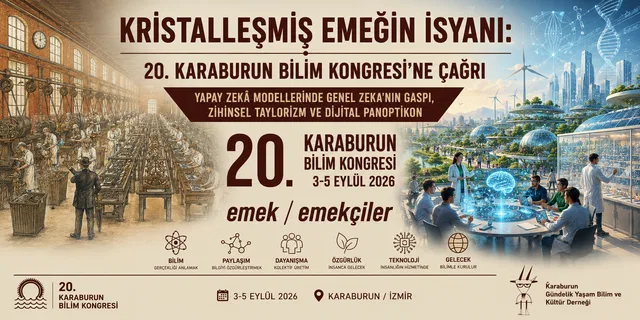
The 20th Karaburun Science Congress Convenes Under the Theme "LABOR/LABORERS"

Karaburun at Twenty: The Map of Labor, the Algorithm of Capital
The 20th Karaburun Science Congress convenes under the theme "labor/laborers." Reading the program booklet side by side, one sees five independent researchers arrive at the same conclusion from different fields: artificial intelligence is not a technological miracle but a new stage in the control of labor. This essay is a first assessment of the program’s class map.
Dear Young Comrades,
This essay is a first assessment based on the program booklet and brochure of the 20th Karaburun Science Congress (3–5 September 2026, İzmir Karaburun). The congress has only just begun; impressions of the sessions and where the debates actually went will be added as a second part of this essay when the congress ends.
But there is already much to say from the moment the program was announced. Because a congress’s program is a map of how the community that builds it reads the world.
Karaburun’s title this year is plain: "labor/laborers." For twenty years, in a district at the tip of İzmir, in the municipal marketplace, the youth center, and in front of a cartoon house, this congress has been one of the longest-running experiments in carrying science into the street while the academy’s doors close. The program’s introductory text opens with Brecht’s poem "Questions From a Worker Who Reads": Who built Thebes of the seven gates? In the books you will find the names of kings. That question is the thread that binds every session of this year’s congress.
In this essay we will discuss four things: the veins along which the program is woven, the common language that emerges in the artificial-intelligence sessions, a warning note that must be dropped into the "techno-feudalism" debate, and the concrete tasks that fall to us from this program.
Part One: The Program’s Class Map
Rather than recount one by one nearly thirty sessions and more than a hundred papers spread over three days, let us look at the veins along which the program is woven. Four main veins are visible.
The reproduction of labor and care labor
The program gives this topic fully five sessions: A3, B4, A7, C7, and B5, where Karaburun’s own women’s cooperatives speak. A range that runs from breast-milk sharing to post-divorce domestic labor, from poor youth crowded into MESEM vocational programs to the mechanization of tea in Rize.
This is an open declaration that the labor debate in Turkey no longer ends at the factory gate, but extends into the kitchen, the daycare queue, and the hospital corridor.
Digitization, artificial intelligence, and labor
This vein too spreads across five sessions: B3 (Digitization and Labor), A9 (Digitization and Class Struggle), B8 (Labor in the Platform Economy), B7 (The Proletarianization of Professionals), and the communications workers’ paper in A6.
That the opening talk announces Ahmet Haşim Köse treating artificial intelligence as "not merely a technology that raises productivity; a moment of accumulation that expands capital’s fields of valorization, reorganizes the labor process, and produces new forms of monopolistic concentration" shows that this vein stands not at the margins of the congress but at its center.
Trade-union crisis and alternative organizations
A5, A8, and the closing session. From the Temel Conta strike to independent workers’ organizations, from a collective’s experience in architecture to Latin American self-management practices, the question "how will we organize?" is asked again every day of the program.
And the closing session’s platform belongs not to academics but to workers from DİSK/Dev Yapı-İş, DGD-SEN, BİRTEK-SEN, Limter-İş, and the Digel Tekstil resistance.
Fascism, hegemony, and the state
A1, A9, A10. A line that runs from rethinking anti-fascism in the age of late fascism to AI-supported twenty-first-century fascism, from how political parties view labor struggle to reading law as a field of class struggle.
Why are the four veins together?
That these four veins stand together is no accident. The introductory text says it plainly:
"While technology enlarges humanity’s collective intelligence, capitalists use this development to fragment labor processes, intensify the control of labor, and expand the reserve army of labor."
This sentence is the imprint, on a congress program, of the frame this blog has defended for three years. Digital enclosure, mental Taylorism, and the digital panopticon are no longer the concepts of a few researchers; they are the spine of a science congress.
Part Two: A Common Language in the Artificial-Intelligence Sessions
When one reads the abstracts in this vein side by side, something striking appears: independent researchers, from different fields, have arrived at the same conceptual point.
The newsroom: from journalist to "prompt operator"
Kazim Bozkurt and Fevzi Efe Sekitmez read digital newsrooms through the concepts of "new Taylorism" and "online assembly-line labor"; they describe the journalist as a laborer who ceases to be the conceptual designer of their own news and turns into a "prompt operator." Following Pasquinelli, they name large language models "digital foremen who crystallize the journalist’s cognitive labor, transfer it into fixed capital, and seize editorial autonomy."
Software: the labeler of one’s own code
Ahmet Gire, as a software worker, asks why software labor is among the first branches of mental labor to surrender to mechanization, and gives a striking answer: through the documentation and commit messages that collective work requires, the software worker has, without noticing, become "the labeler of their own code for AI." Skills absorbed into the machine begin to look like a property of capital’s property.
Digital flexible Taylorism
Fuat Yücel Filizler gathers the line from Babbage’s principle to agile production under the concept of "digital flexible Taylorism" and writes that algorithmic management turns the worker’s body, mind, even emotions into a "data mine." The note at the end of his paper names a gap this blog also feels: in Turkey, digitization and artificial intelligence have "begun, however haltingly, to reach the left’s agenda through the efforts of a very small number of Marxist researchers."
The dematerialization myth
Hazal Akpınar attacks the "dematerialization myth": narratives of the cloud, automation, and the knowledge economy perform an ideological function that makes invisible the energy and water consumption of AI data centers, rare-earth elements, and "ghost labor" regimes in the Global South. Exploitation does not disappear; it becomes invisible.
Crystallized labor
My paper in session B3 (The Revolt of Crystallized Labor) adds this claim to the picture: artificial intelligence is the form, crystallized in machines, of the general intellect Marx names in the Grundrisse, and this collective inheritance is subjected to digital enclosure behind walls of intellectual property and trade secrecy. Mental Taylorism and the digital panopticon are the two faces of that seizure in the labor process.
Convergence
Five separate papers, five separate fields, the same result: artificial intelligence is not a "technological miracle" but a new stage in the control of labor. This is the most important theoretical convergence the congress has put forward this year.
Part Three: A Discussion Note — "Techno-Feudalism" and "Cloud Lords"
Varoufakis’s concept of "cloud lords" and the phrase "techno-feudalism" appear in several places in the program abstracts; in my own paper I also used the word "techno-feudalism" to name the dystopian scenario. That creates a debt of warning.
The feudalism analogy is attractive for saying that technology monopolies operate through rent; but analytically it misleads. Amazon, Microsoft, and Google are not feudal lords; they are monopoly capitalist corporations at the top of global labor chains that produce surplus value. The data labeler, the courier, the content moderator, and the software worker are not serfs under a seigneur; they are workers who sell their labor-power.
The moment we say "feudalism," we open the door to the illusion that capitalism is over and that class struggle has given way to a kind of digital peasant revolt. So whatever name is given to the dystopia scenario, the frame is monopoly capitalism; this congress’s session titles already say as much.
Two Readings: How It Is Told, How It Works
| Capital’s narrative | What the congress program shows |
|---|---|
| Artificial intelligence is a neutral, laborless technological leap | Artificial intelligence is the crystallized form, in the machine, of the working class’s collective mental production; it is fed by data labor |
| Automation abolishes work | Living labor does not vanish; it relocates: data labeling, content moderation, micro-work, logistics |
| Owner-operator courier work means "being your own boss" | The sole proprietorship, motorcycle, uniform, fuel, and traffic fines sit on the worker’s back; the algorithm is in the boss’s hand |
| The cloud is immaterial, clean | It rises on data centers, mines, and the energy of the Global South |
| Multi-skilled journalism builds skills | Hyper-deskilling: five jobs dumped on one person, and SEO metrics |
| The software worker is empowered by AI | The software worker, through commit messages, becomes the labeler of the model that will take their place |
| Platform companies are only "technological intermediaries" | They are employers who take no responsibility for accidents and deaths and set wages unilaterally |
Part Four: What Karaburun’s Twenty Years Say
Onur Hamzaoğlu’s presentation on behalf of the Organizing Committee, "The Karaburun Science Congress at Twenty," will treat the congress’s own history as a labor question.
This matters; because Karaburun is a congress held in the tenth year of the Academics for Peace dismissals, with solidarity academies (Kocaeli, İzmir) on the organizing committee, backed by Eğitim Sen and the Turkish Medical Association. That session A4 is titled "academy and labor," that Can Furat speaks on "science labor and the necessity of trade-union struggle," that Sinem Yıldız and Alper Çavuşoğlu define the academic targeted by anti-intellectualism as a "thought laborer" is no accident. The congress frames the scientist not as an authority on the podium but as a laborer.
One session of the program is held in memory of Zeynep Erk Emeksiz, another of Şemsa Özar, another of Alexey Rûyan Aydın: the congress walks by remembering its own losses.
Concrete Tasks
We can list the work that follows from this program, in a form that will continue after the congress ends, as follows.
- For computing workers and organizations. The common point of Gire’s paper and mine is that software labor produces the conditions of its own mechanization. This does not mean "let us not use AI"; it means carrying the ownership and terms of use of the models trained on our labor onto the collective-bargaining table. From the congress papers, an "algorithmic control" demand dossier should be drawn up for the computing union.
- For unions and DİSK/KESK components. The courier papers in session B8 record once more that the owner-operator courier is a worker and that existing unions leave them outside. The Courier Rights Association’s death reports, the "we do not want to die" convoys, and protests organized rapidly over digital networks are a repertoire the traditional union must learn. What the Sector No. 10 barrier is for computing, the "self-employed" status is for the courier; the two are two fronts of the same struggle.
- For academics and students. The gap Filizler identifies is real. Field research in Turkey on digitization’s direct effects on production and labor processes is scarce. Çiçek’s interviews with software workers and lawyers, Kıyak’s with Trendyol, Getir, and Yemeksepeti couriers, Bozkurt and Sekitmez’s with local journalists in İzmir show how it is done. To every young researcher looking for a thesis topic: examine the algorithm in your own workplace.
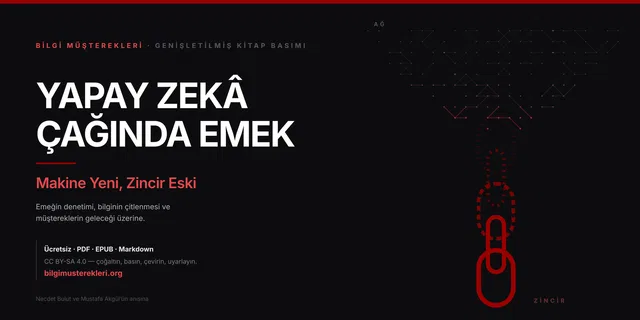
- For Knowledge Commons. To compile the artificial-intelligence and labor papers from this congress into a dossier, with the authors’ permission. The congress booklet set five separate papers side by side; we can make that convergence visible.
Dear Young Comrades,
Brecht’s worker who reads asked about the gates of Thebes. Today the question is this: who trained the large language models? Who labeled the data, who wrote the commit message, who moderated the content, who carried the electricity to the data center? The books write only the names of CEOs.
For twenty years Karaburun has been a congress that tries to write the names of those who carry the stones. What its program writes this year is that those stones are now silicon and data — and that those who carry them are still us.
Until that hidden, collective power that produces artificial intelligence seizes its own work, no technology will emancipate anyone.
Come, friends, let us be one.
Sources
- 20th Karaburun Science Congress, "labor/laborers," Program Booklet (paper abstracts), 3–5 September 2026, Karaburun. kongrekaraburun.org
- 20th Karaburun Science Congress, Program Brochure, 3–5 September 2026.
- Karaburun Science Congress Organizing Committee, "Introduction," Program Booklet, pp. 8–9.
- Ahmet Haşim Köse, "Today’s World: Observations on Capital and Labor," Opening Session abstract, pp. 21–22.
- Kazim Bozkurt and Fevzi Efe Sekitmez, "New Taylorism in Digital Newsrooms: An Analysis of Hyper-Deskilling and Online Assembly-Line Labor," Session B3 abstract, pp. 69–71.
- Ahmet Gire, "The Construction of the Collective Worker and Mechanization: Artificial Intelligence and the Software Labor Process," Session A9 abstract, pp. 154–156.
- Fuat Yücel Filizler, "Digital Taylorism and Class Struggle," Session A9 abstract, pp. 152–154.
- Hazal Akpınar, "The Dematerialization Myth: Artificial Intelligence, the Metabolic Rift, and the Invisibilization of Living Labor," Session A9 abstract, pp. 151–152.
- Zeynep Kıyak, "Faster, More Precarious: Platform Courier Labor in Turkey," Session B3 abstract, pp. 67–69.
- Büşra Kocakaya, "'Owner-Operator Courier Work': Lies and Truths"; Mesut Çeki, "Organizing and Solidarity Practices on Two Wheels," Session B8 abstracts, pp. 144–147.
- Oğuz Demirkapı, "The Revolt of Crystallized Labor: The Seizure of the General Intellect in Artificial Intelligence Models, Mental Taylorism, and the Digital Panopticon," Session B3 abstract, pp. 73–75.
- Knowledge Commons, "Gig Economy Dossier," bilgimusterekleri.org, August 2026.