Does the Winner Really Win?
Block Lists, the Delegate Chain and a Democratic Path to Union Unity

Dear Young Comrades,
This year, elections and election procedures were on the agenda at branches of Genel-İş. Alongside the elections in İzmir, workers in Ankara and Dersim raised objections about election schedules and transparency. Red lists, blue lists, green lists, white lists: newspapers announced that one list or another had won, celebrations followed, and those who lost quietly stepped aside.
Today I want to ask a question that looks simple but is anything but: Does the winner really win?
If one list takes every seat at the end of a union election, what happens to the wishes of the hundreds of workers who voted for the others? Where does a woman worker who knows occupational safety, a young technician who understands collective bargaining, or an experienced cleaner who knows subcontracted colleagues stand in the union the next day? Too often they are left out, withdraw, and wait until the next election labelled as “the opposition”.
Let us discuss why this is a structural rather than a personal problem, what the Marxist tradition can contribute, and what we can do. Let us keep our three questions close at hand: In whose hands? Under whose control? For whose benefit?
1. What Did We See at the Ballot Box This Year?
First, the concrete picture. These reports largely convey workers' own accounts; where something is one side's allegation, we say so.
- İzmir Branch No. 2 (İZENERJİ): Evrensel reports that 195 delegates were elected from 18 units in a branch with about 4,400 members. The Red List won in 11 units, the Blue List in six and the White List in one. Before the vote, Red List chair candidate Arif Yıldız alleged that the delegate election had been called hastily without timely notice, leaving the opposition no time to prepare. The report does not include a response from the management.
- İzmir Branch No. 11: The Red List won five of nine units, the Green List two, and the Blue and White Lists one each. Multiple lists and tendencies were present.
- Ankara Branch No. 1 (Çankaya): Workers objected to an election expected in November being brought forward to 20 July, calling it a “snap election”.
- Dersim Branch: Municipal workers made a public statement, saying that membership lists and the election schedule had not been shared with them.
The issue is not confined to Genel-İş. At Hak-İş affiliate Özçelik-İş's Kayseri branch, an opposition list went to court, arguing that delegate election notices had not been posted at workplaces. Candidate Mustafa Çelikbilek alleged that he had been branded a “traitor” and dismissed after announcing his candidacy; the report says no response was obtained from branch management. At Sağlık-İş, members said there was only one list and that they did not know who would be on the leadership until the general assembly.
The confederations, industries and political affiliations differ, but the concern recurs: control over the schedule, candidacies and delegate lists, coupled with winner-take-all outcomes, can narrow workers' representation. These objections do not prove one another; each case must be examined on its own terms.
2. How Does a Block List Work? A Simple Calculation
In Turkish unions whose general assemblies are made up of delegates, elections often have two stages. Article 10 of Law No. 6356 also provides that an assembly may consist of members or delegates, depending on the constitution:
- First stage: Members elect delegates at workplaces or in units.
- Second stage: Delegates meet in a branch or general assembly and elect the executive, audit and disciplinary boards.
When a winner-take-all block-list system is used at both stages, the outcome can look like this. These figures do not describe a real election; they are a hypothetical illustration. Because the law limits branch executive boards to five members, this nine-seat example represents a hypothetical national-level board, not a branch board.
Suppose List A receives 52% of votes, List B 38%, and List C 10%.
| Block list (winner takes all) | Proportional representation (D'Hondt, nine seats) | |
|---|---|---|
| List A (52%) | 9 seats, or 100% | 5 seats |
| List B (38%) | 0 seats | 3 seats |
| List C (10%) | 0 seats | 1 seat |
| Share of votes for lists without a seat | 48% | 0% |
| Majority on the board | A | Still A |
| Place for opposition | Outside the room | Around the table |
Look twice. In this example, List A retains a majority under proportional representation. The example shows that a majority can be preserved; it is not guaranteed under every distribution. Under D'Hondt, small lists can still fail to win a seat depending on the votes and number of seats. Here, each list wins representation and members' different preferences are reflected in the board.
The delegate stage can amplify the distortion. If List A wins narrowly in most units, it may take all their delegates. Depending on the distribution of votes and delegates, 52% of the overall vote could become 70–80% of the delegates at an assembly; these figures are illustrative. A subsequent block-list vote could give it the entire board. Two stages can magnify a small advantage into exclusive control.
3. What Did Lenin Say? Equal Representation Is the “ABC of Democracy”
The Marxist tradition brings two principles to this discussion of union democracy.
3.1. Organisation by industry: unity
Soon after the October Revolution, the First All-Russian Congress of Trade Unions met in January 1918. It described unions as class organisations of the proletariat organised along industrial lines. Lenin cited the resolution at the Tenth Party Congress in 1921. The resolution establishes an industrial basis for organisation; it does not by itself demonstrate that the slogan “one union in every industry” originated there or was adopted everywhere in the same form. We advance that goal as a voluntary form of class unity.
To see the importance Lenin attached to union unity, read chapter six of “Left-Wing” Communism: An Infantile Disorder. He argues against revolutionaries abandoning unions with reactionary leadership and for working where the masses are. Unity is a condition for collective strength, not merely a convenient slogan.
3.2. Equal representation: democracy
But unity cannot be separated from democracy. Lenin wrote a short, forceful note in September 1917: Violations of Democracy in Mass Organisations. He objected to two practices:
- Soldiers in the Petrograd Soviet electing one representative per 500 people while workers elected one per 1,000;
- Small and large unions having different representation ratios in the Trade Union Bureau.
He compared unequal representation to Tsar Nicholas II's unequal treatment of peasants and landowners. He proposed that the Central Committee condemn the practices, demand equal suffrage in the Soviets and union congresses, and distribute the resolution to workers in plain language. A note attributed to Lenin states:
“One representative, everywhere, to an equal number of electors” is the ABC of democracy. Anything else is a fraud.
Lenin was addressing unequal numbers of electors per representative. How equal-sized groups of voters are represented when they support different lists is a separate electoral question. This note does not explicitly propose proportional representation. We draw on the concern for equal representation to argue for proportional representation as a response to today's problem.
3.3. The two principles belong together
Comrades, consider the dialectical point:
- One union without democracy can become one bureaucracy. If a single group controls everything, opposition has nowhere else within the industry organisation to go: it may be silenced or driven out. State-imposed unity after 12 September 1980 illustrates a top-down model.
- Democracy without unity can give way to fragmentation. If opposition is excluded, those who lose may form another union. Employers can then divide workers among competing unions. Municipal workers today are organised among Genel-İş, Belediye-İş and Hizmet-İş.
Our answer is a united union in each industry, with proportional representation within it. A place for opposition can help reduce pressure to split; it cannot by itself resolve every disagreement. Unity must be voluntary and built from below.
4. Why Insist on Block Lists?
It is easy to blame individuals. We need to understand the structure. There are four supports for block lists.
1. Material basis: bureaucracy as a layer. In Turkey, union leadership often means leaving the workplace. Pay, official cars, networks and careers can turn a worker's responsibility into a status. Losing a seat may then feel like a loss of class position. Robert Michels's “iron law of oligarchy” is not a law of nature; it points to how material interests can be reproduced in organisational structures. A study of Law No. 6356 argues that the balance favours leaders over members and proposes judicial supervision of delegate elections and limits on pay and tenure.
2. Legal framework: law and constitution. Law No. 6356 provides for an assembly of members or delegates and leaves the rules for electing delegates to the union constitution. Article 14 places elections of officers and delegates at the general assembly under judicial supervision and provides for voters to mark candidates' names on the ballot. Article 16 separately regulates delegate elections outside the assembly and court challenges to those elections.
Proportional representation is not legally mandatory. But in a 2014 decision, the Court of Cassation's 22nd Civil Chamber found provisions for proportional representation in a public-sector union's national and branch officer elections compatible with democratic principles, citing both Laws No. 4688 and No. 6356. A constitution providing for such a system can therefore be defended, but any specific arrangement must be assessed against the applicable law and case law. The same decision upheld the invalidation of a separate ban on standing for a third term: proposals to limit tenure must also reckon with that legal debate.
3. Ideological justification: “a harmonious leadership.” A common argument for block lists is that leadership is a team effort and representatives from different lists would prevent decisions. We should not dismiss concerns about responding quickly during bargaining, strikes or attacks. But there are answers:
- In the example above, the winning list keeps a majority under proportional representation; this is not guaranteed for every vote distribution.
- Separate direct election of a chair, and different methods for forming executive and oversight boards, could be discussed. These are proposals requiring assessment of necessary legal and constitutional changes, not claims that they are automatically possible under current law.
- Exclusion itself can produce deadlock. An opposition forced outside may take disputes to court or the press, or leave. An opposition inside can record objections and vote. Which is more damaging to the organisation?
4. Cultural legacy: factionalism and “us versus them.” When an election becomes a derby between two teams rather than a debate within the class, the loser becomes an “enemy”. The Kayseri candidate's account of being called a traitor illustrates the danger of reproducing that language inside unions.
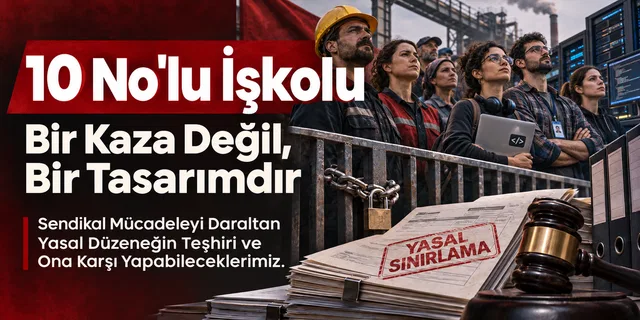
5. The Delegate System: A Chain That Can Dilute Members' Will
Delegate systems are a practical response to the difficulty of bringing thousands of members into one room. But three risks arise in practice:
- Dilution: Members elect delegates, who elect the leadership. A delegate may speak for a private bargain rather than for those who elected them.
- A patronage network: A few hundred delegates can be easier to influence than thousands of members, whether through jobs, shifts and promotions or, in some cases, threats. This makes the preparation of delegate lists a crucial site of struggle.
- Control of information and timing: Who holds the election, when, and using which membership list? Workers in Dersim, Ankara and Kayseri have objected to different aspects of access to lists, scheduling and time to stand.
For these reasons, ending the delegate chain for leadership elections is a demand worth making. Workplace ballot boxes could enable all members to elect boards directly and secretly under judicial supervision. In large unions, a general assembly could continue as a forum for debate and programmes. Such a system would require constitutional changes and, in some respects, changes in law. That too belongs on the organising agenda.
There are examples elsewhere, though institutions differ. In Germany, BetrVG § 14 provides for proportional representation in ordinary works-council elections with multiple lists. Majority voting applies when there is only one list or when the simplified procedure under § 14a is used. Seats in ordinary list elections are allocated by the D'Hondt method, with additional rules such as minimum representation for the minority gender. A works council is not a union executive board, and the comparison must respect that distinction. Germany is no socialist paradise, but different lists can be represented in ordinary multi-list workplace elections. Should organisations committed to class unionism aim any lower?
6. Why Might the Winner Lose?
Return to the title. A winning block list takes everything in the short term. But it risks losing:
- Knowledge. Workers with expertise in safety, law, subcontracting or communication may be left outside the union's collective intelligence. The leadership risks an echo chamber.
- Legitimacy. If many members feel the leadership is not theirs, participation in strikes, actions and collective decisions can suffer, weakening workers against the employer.
- Oversight. Without opposition on the inside, warnings may come late. Arbitrary decisions, corruption or improper compromises can be harder to challenge early.
- The future. Alienated workers may leave or join a rival union. Where unionisation is already low, every worker lost is a setback.
A block-list victory can be a game in which even the winner loses. The seats are won, but the class may lose strength.
7. Two Union Models Side by Side
| Patterns criticised today | Our proposal |
|---|---|
| Multiple competing unions in one industry | One united class union in each industry, built voluntarily |
| Block list: the winner takes every seat | Proportional representation: seats reflect votes |
| Members elect delegates; delegates elect leaders | Members directly elect leaders at workplace ballot boxes |
| Management controls the election schedule and membership lists | A constitutionally fixed schedule and equal, privacy-protecting access to necessary information |
| Opposition is branded “traitorous” or “divisive” | Opposition is protected in the constitution and represented on boards |
| Protections concerning leaders' pay and tenure remain contested | Pay linked to workers' wages and term limits, subject to legal debate |
| Agreements are signed behind closed doors | Members vote to approve collective agreements |
| Accountability is often confined to assembly cycles | Reports open to all members every six months |
| Unity is maintained from above | Unity is built from below through participation |
8. Concrete Tasks: What Should We Do?
In your own union:
- Read the constitution. How are elections held? How is the number of delegates determined? Who can access membership lists? We cannot change rules we do not know.
- Prepare a proportional representation motion. Propose that executive, audit and disciplinary boards be formed by D'Hondt proportional representation where multiple lists stand. Try to secure support from rival lists too. Assess the wording against applicable law and case law.
- Build a shared demand for transparency. Fix the election schedule in the constitution, provide candidates equal access to necessary information with personal-data safeguards, and post delegate election notices at workplaces. Workers on different lists can support these demands together.
- Do not withdraw when you lose or exclude when you win. Even without proportional representation in the constitution, a winning list can involve others in committees, education and workplace representation, subject to applicable appointment rules. Demonstrate the principle in practice.
Between unions:
- Build a platform for industry unity. Joint workplace committees of workers from different unions in the same municipality, factory or industry can be the first building blocks. Unity comes through common struggle at work, not only agreements between headquarters.
- State the democratic conditions of unity. Pair the call for one union with proportional representation, direct election and ending the delegate chain for leadership elections. Do not let it become a plan for bureaucratic absorption.
In law:
- Develop demands to amend Law No. 6356. Take to confederations, bar associations and researchers proposals for proportional officer elections, direct secret voting by all members under judicial supervision, judicial supervision of delegate elections outside general assemblies, and limits on leaders' pay. Discuss tenure limits in light of the right to stand and relevant court rulings.
In computing:
- Build it right from the start. In A Handbook for Tech Workers we argued for organising computing as a distinct industry on a democratic and inclusive basis. New and growing tech unions can debate proportional representation in their constitutions and demand the constitutional and legal changes needed for direct elections. Tech workers can put their knowledge of transparent voting infrastructure at the service of the whole class.
9. Closing: How Can We Change the World If We Cannot Organise Among Ourselves?
Dear Young Comrades,
We revolutionaries oppose electoral thresholds and expose rules that tilt the ballot in favour of those in power. But if we defend a system in our own organisations that reduces 48% of votes to no seats simply because it is “our tradition”, our talk of democracy loses credibility.
In 1917, even during the revolution's most critical months, Lenin did not treat unequal representation in workers' organisations as a detail. He wrote that those who call themselves democrats cannot tolerate it. Can it be a detail for us today?
Class unity is built not by erasing the class's diversity but by organising it. A union is stronger when it can carry different voices within it. If we want the winner truly to win, we must build a union in which those who lose can also gain representation.
One union in each industry! Proportional representation on boards! End the delegate chain! Voice, authority and decisions to the workers!
Sources
Marxist classics
- V. I. Lenin, Violations of Democracy in Mass Organisations, September 1917, Collected Works, vol. 25, p. 308.
- V. I. Lenin, The Role of the Trade Unions under the Proletarian Dictatorship, March 1921, referencing the 1918 First All-Russian Congress of Trade Unions.
- V. I. Lenin, “Left-Wing” Communism: An Infantile Disorder, chapter 6, 1920.
- V. I. Lenin, Draft Theses on the Role and Functions of the Trade Unions under the New Economic Policy, 1921–22.
Reports from Turkey (2026)
- Evrensel, İZENERJİ workers vote for struggle, 16 October.
- Evrensel, Debate over a snap election at Genel-İş, 9 October.
- Evrensel, Delegate elections at Genel-İş Branch No. 11, 21 October.
- Evrensel, Objections to a snap election at Genel-İş, 25 June.
- Evrensel, Dersim workers call for a transparent election, 9 October.
- Evrensel, Özçelik-İş Kayseri candidate says he was labelled a traitor, 28 March.
- Evrensel, Workers' will should guide Sağlık-İş, 30 June.
Law and research
- Law No. 6356 on Trade Unions and Collective Labour Agreements, Turkish Ministry of Labour and Social Security.
- Study of Law No. 6356 and intra-union democracy, DergiPark.
- Court of Cassation, 22nd Civil Chamber, E. 2014/747, K. 2014/832, on proportional representation and a tenure restriction.
- Germany: Betriebsverfassungsgesetz § 14 and application of D'Hondt, works-council elections.
Related article
This is a living document. Please contribute criticism, corrections and examples from your own union.
Licensed CC BY-SA 4.0. Reproduce, share and improve with attribution.