Four Ways of Standing Side by Side
Reading Zeki Gül's 'On Comradeship, Shared Direction, Shared Time and Fellow-Feeling', and Extending It with Our Readings of Organising 2.0 and the Liberation Declaration

Today a short but dense piece by our teacher Zeki Gül appeared in Evrensel: On comradeship, shared direction, shared time and fellow-feeling (in Turkish). The piece asks why the professional chambers, the unions and the democratic mass organisations have lost strength, and it does not settle for the explanation we are used to, "the enemy outside". It turns the organisations back on themselves. With four concepts, four different ways of "standing side by side", it builds a measuring stick.
We find this piece very valuable. Valuable, because it is neither a complaint nor an accusation. It is an accounting. Valuable, because it sets the problem of organisation not as a problem of morals, but as a problem of relations and of how things work. And valuable, because it sits exactly between the two texts we have written in the last two weeks:
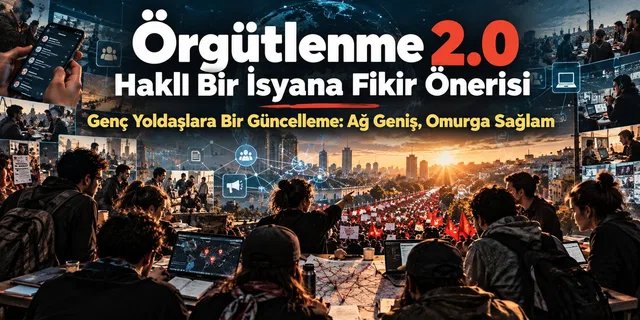
- Organising 2.0: An Idea for a Justified Revolt, which we published on 22 October, was talking about the structure of organisation: the cell, the assembly, the spine, the bridge. We had said: "A network without a spine falls apart, a spine without a network calcifies."
- Liberation Is in Our Hands, Unity Is in the Hands of the Class, which we published today, was talking, while reading TİP's Liberation Declaration, about the relation between organisations: factionalism, the common assembly, every left force acting together on the class line. We had said: "Liberation is not in the hands of a single organisation. It is in the hands of the class."
- Our teacher Zeki's piece talks about the layer of relation that was missing between these two: the thread that binds people to one another inside the structure, and why that thread has rotted.
Structure, unity between organisations, and human relation. When the three come together, "tightening the ranks" can stop being a slogan and turn into a plan of work. In this piece we try to bind the three texts to one another.
Below there is first a short summary, then the detail. Our aim is not to answer our teacher's piece. It is to deepen it, and to bind the idea of standing side by side in the class struggle to concrete steps that will tighten our ranks.
Summary: Twelve Theses
-
Zeki Gül's piece says that the strength of organisations is set not by "the posters, the words, the boards that function", but by how far the organisation touches people's lives. This is a basic finding that puts the problem of organisation in the right place, in the relation.
-
The four concepts are not a ladder. They are four conditions that feed one another. Shared direction is a common direction, shared time a common moment, fellow-feeling a common feeling, comradeship a common responsibility. When one is missing, the others turn idle.
-
Shared direction, in Marx's language, is only the first step of the passage from a class "in itself" to a class "for itself". Thinking the same thing does not found an organisation. As long as agreement in ideas does not turn into unity in action, it is an audience.
-
Shared time deepens with Ernst Bloch's concept of "the simultaneity of the non-simultaneous". The permanent worker and the subcontractor, the pensioner and the intern, the generation of 1978 and the generation of the pandemic, who live in the same year, are not living the same historical time. A common struggle begins by translating these different times to one another.
-
Fellow-feeling cannot take the place of justice, because solidarity is not a feeling. It is the sharing of the cost. In the age of the algorithm, feeling is the thing most easily consumed and most quickly forgotten. The measure of solidarity is not the number of shares. It is the money in the strike fund.
-
Comradeship is not a relation of loyalty. It is a relation of responsibility among equals. As our teacher stresses, keeping silent and obeying in the name of comradeship produces a new inequality. Lenin's old formula still holds here: freedom in discussion, unity in action.
-
Under the four ways there is an invisible fifth ground: a shared class position. Direction, time, feeling and responsibility hang in the air when they do not rest on a common material position, on a common place inside the relations of production. What makes an organisation lasting is that people see they are inside the same relation of exploitation.
-
Organisations turning into "half-closed circles" is not a fate. It is the result of a way of working. Legal siege, bureaucratisation, the distance between the member and the leadership, and decision processes that close, pull the organisation into itself. This process can be reversed.
-
The "network with a spine" of Organising 2.0 is a way of pouring the four ways into an institutional form. The cells carry fellow-feeling and comradeship, the open assemblies shared direction, the spine shared time and continuity, and the bridge shared direction across the border. The spine does not run the network. It carries it.
-
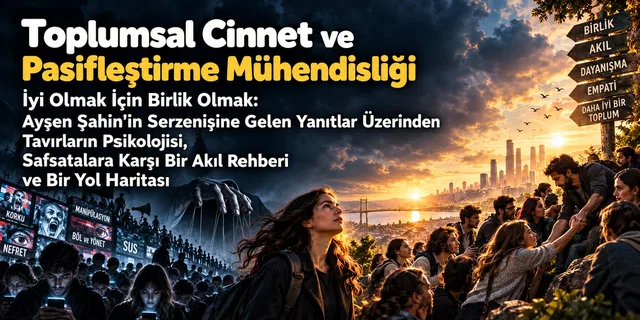
The "feeling of being trapped" in Organising 2.0 is the lack of one of the four ways. The unit error is the lack of comradeship. Atomisation and learned helplessness are fellow-feeling failing to turn into solidarity. The short time horizon is the lack of shared time. Facing every trap there is a door, and that door is a form of relation.
-
The four ways are necessary not only inside the organisation, but between organisations. In our reading of the Liberation Declaration we had counted factionalism the greatest enemy of unity. Factionalism is the form the "half-closed circle" takes between organisations: each organisation putting its own flag forward, not going to someone else's action, turning the common action into its own propaganda. When a comrade is detained, standing by them without asking which organisation they are from is the first measure of comradeship between organisations.
-
Tightening the ranks is not a call. It is a plan of work. Welcoming the new member, opening the decision, giving criticism a procedure, counting invisible labour, pairing the generations, and organising life: each of these is a piece of work that can be begun tomorrow morning.
Part One: What Does the Piece Say?
The starting point of Zeki Gül's piece is this: the professional chambers, the unions and the democratic mass organisations are losing strength not only because of the economic crisis and political repression, but also because of the structural and human problems inside themselves. What sets the organisation's bond with society is how far the organisation can touch people's lives.
After this finding, four concepts are set out:
- Shared direction (yöndaşlık): in our teacher's definition, "looking in the same intellectual direction, sharing similar aims and political acceptances". But he warns at once: "Looking in the same direction does not mean walking the same road."
- Shared time (zamandaşlık): not merely living in the same period, but "taking on the responsibility of the historical moment that is being lived". Seeking the ways of moving together against common problems without erasing the differences.
- Comradeship (yoldaşlık): taking on responsibility for common aims, and standing by one another. But this also requires keeping the right to criticise, tolerance of different views, accountability, and standing against the gathering of power in one hand. Keeping silent and obeying in the name of comradeship produces a new inequality.
- Fellow-feeling (duygudaşlık): "Trying to understand someone else's pain, anxiety and hope." And perhaps the sharpest sentence of the piece: "Fellow-feeling cannot take the place of justice."
The piece notes that in the period after the pandemic face-to-face relations narrowed, meetings moved onto the screen, and solidarity was squeezed into digital declarations. But it does not unload the problem onto digitalisation. The real problem is that organisations cannot build a bond with their members, that the channels of participation narrow, and that decision processes close. The proposal that comes out is plain: organisations should turn to the real problems of their members, strengthen democratic working and accountability, count differences not as a threat but as a source of common reason, and stop being "half-closed circles". The four elements can turn into a lasting social force only with an egalitarian and democratic organisation.
Part Two: Why Is the Piece Valuable?
The courage to look inside, not outside
Most of the debates on organisation in Turkey begin, rightly, with repression, and end with repression. The 2020 regulation that brought the splitting of the bar associations, the cases opened to remove the leaderships of professional organisations, the obstacles of branch and threshold in the way of union organising, are real. But an analysis that only lists these, without noticing, positions the organisation as a passive object: things are done to it, and it either resists or collapses.
Our teacher Zeki's piece makes the organisation a subject again. Beside the question "what was done to us?" he puts the question "what did we do to ourselves?" This is the healthiest form of self-criticism, because it does not look for a culprit. It looks at how things work.
Setting the problem in the relation, not in morals
The four concepts of the piece are not traits of personality. They are forms of relation. It does not say "let everyone be more self-sacrificing". It asks "which form of standing side by side is missing?" This overlaps with the most basic acceptance of the Marxist method: in the sixth of the Theses on Feuerbach, Marx says that the human essence is "the ensemble of social relations". An organisation is like that too. The essence of an organisation is not its rules. It is the ensemble of the relations among its members. If those relations have dried up, the rules remain as paper.
Not making digitalisation the scapegoat
Since the pandemic an easy explanation has been circulating: people sank into the screen, and that is why the organisations emptied. Our teacher refuses this. The screen is a factor, but it is not what decides. What decides is the closing of decision processes, and the member finding no place for themselves in the decision. This distinction matters, because an organisation that blames the digital is saved from discussing its own closedness. We had looked from the same place in The Human in the Loop and The Computing Worker's Handbook: a tool does not found an organisation. A tool can only make an organisation that already exists visible and continuous.
Putting democracy inside comradeship
The most precious move of the piece is that it defines comradeship together with the right to criticise and with accountability. We know that in the history of the left the word "comradeship" has at times been mixed up with loyalty, with unquestioning attachment, with "keeping silent inside against the outside". Our teacher refuses this confusion plainly: a unity built by keeping silent produces inequality. This is to say that democracy inside the organisation is not a luxury. It is part of the definition of comradeship.
Part Three: Deepening the Four Concepts
Shared direction: looking the same way is not an organisation
In The Poverty of Philosophy (1847) Marx explains that workers are first a mass that stands in a common position against capital, under common conditions, but that they become a class "for themselves" only by uniting inside the struggle. The later Marxist literature summed this up as the distinction between a class "in itself" and a class "for itself".
Shared direction stands somewhere between these two states. There are people who think the same things, who are angered by the same news, who share the same slogans. But if these people do not know one another, do not decide together, and do not pay a cost together, what is there is not an organisation. It is an audience. To say it in today's language: shared direction can be measured by the number of likes; an organisation is measured only by the number of people who come to the meeting and take on a task.
This is why the first principle in our piece Organising 2.0 was "shrink the unit, grow the number": a hundred lasting committees instead of three thousand people for one day. A one-day crowd is the photograph of shared direction. A lasting committee is the place where shared direction turns into comradeship. The error we called the "unit error" in the same piece binds here too: the person who stands alone against the state feels trapped, and stretches this accurate observation into the conclusion "we are all helpless". Yet the wall looks insurmountable at the scale of the individual. At the scale of the organisation, doors appear. The person who is alone inside a crowd of shared direction begins, when they change the unit, that is, when they become part of a committee of five, to see a door in the same wall.
There is also a danger particular to Turkey here. For a long time the opposition has been creating a wide field of shared direction, but it cannot turn this field into an organisation. The voter, the supporter, the follower: all of them share a direction. None of them, of themselves, is a comrade. The wider the field of shared direction and the narrower the organisation, the more disappointment this gap produces. The error we told in Why Do We Deceive Ourselves? (in Turkish) is born here too: taking the size of the crowd that looks the same way for the strength of the organisation.
Shared time: different times in the same year
Our teacher's definition of shared time can be widened, very fruitfully, with a concept the German Marxist philosopher Ernst Bloch developed in the 1930s: the simultaneity of the non-simultaneous (Ungleichzeitigkeit des Gleichzeitigen). Explaining the rise of Nazism, Bloch says that people who live in the same calendar year are not living the same historical time. The peasant, the shopkeeper, the clerk, the worker: each carries their own past, their own fears, their own time. Fascism exploits these different times. The left has trouble translating them to one another.
Look at the people working at the same moment today in a hospital, a plaza, a factory:
- A permanent employee is living the time of job security and of the collective agreement.
- The subcontracted worker in the same corridor is living the time of the contract renewed every year, the time of uncertainty.
- The intern or the new graduate is living the time of the ladder pulled out from under them, which we told in The Poverty of the White Collar (in Turkish).
- The pensioner who still has to work is living the time of becoming poor.
- The generation that lived through 12 September is living the time of defeat and of a reckoning that was never made. The generation that finished secondary school on a screen during the pandemic is living the time of never having seen a meeting.
These people are inside the same year, but they are not inside the same moment. If shared time, as our teacher Zeki says, is "taking on the responsibility of the historical moment", the first responsibility is to see these different times and to translate them to one another. A great part of organisations speaks only the time of its own founding generation. When young people come to the meeting, they hear not their own time being spoken, but someone else's memory. After a while they stop coming.
In The Eighteenth Brumaire of Louis Bonaparte Marx writes that people make their own history, but not under conditions they have chosen themselves, under conditions they find directly before them. And he adds: the tradition of all the dead generations weighs like a nightmare on the brain of the living. Shared time requires both carrying this tradition and not being crushed under it. The experience of the past should be a compass, not a wall.
Shared time also has a dimension of horizon. In Organising 2.0 we had counted the time horizon as the fourth source of the feeling of being trapped: "On a short horizon everything looks like a trap; on a long horizon the doors become visible." The person who thinks by the electoral calendar counts every arrest a defeat. The person who thinks with the horizon of a generation counts every arrest a datum for the next step of organising. When we compared 1.0 with 2.0 we had also written time as a separate line: the old model looks to the calendar of congresses and elections, the new model to the horizon of a generation and to small, measurable victories. What our teacher Zeki calls "the responsibility of the historical moment" is to carry these two horizons together: not to miss the urgency of the moment, but to see the moment as part of an accumulation the length of a generation. This is also why, in our reading of the Liberation Declaration, we proposed planning May Day not as a one-day spectacle but as the result of a year's organising.
Fellow-feeling: the distance between feeling and cost
"Fellow-feeling cannot take the place of justice." This sentence is one of the most accurate sentences written about today's digital capitalism. Perhaps our teacher did not aim at this directly, but what he says is exactly this.
The platform economy produces feeling, measures it and sells it. A piece of news about an injustice produces first anger, then compassion, then a share. Within a few hours the feed is renewed and the feeling leaves its place to a new one. We had taken up this mechanism in detail in The US Midterms, Techno-Capital and Algorithmic Politics (in Turkish) and The Human in the Loop. The algorithm produces fellow-feeling in abundance. But it does not turn it into an organisation, because an organisation is contrary to the platform's business model. The organised person stays less in the feed.
An important distinction comes out of this: fellow-feeling and solidarity are not the same thing. Fellow-feeling is understanding someone else's pain. Solidarity is sharing the cost of that pain. Saying "we are with you" to a worker on strike is fellow-feeling. Putting money in the strike fund, going to the watch, boycotting the employer's product, finding a job for the friend who was sacked, is solidarity. The first is necessary. The second founds an organisation.
In Organising 2.0 we had written the counterpart of this distinction on the plane of action: the visibility action and the cost action. "Visibility actions aim to show something." A press statement, a rally, a petition campaign gives morale and builds a bond, but it loads no cost onto power. "Cost actions aim to stop something." A strike, a slowdown, a boycott, a blackout cannot be ignored. Fellow-feeling is the emotional ground of the visibility action. Solidarity is that of the cost action. The visibility action is not bad. But when it is not part of a process that organises the capacity to impose costs, it too, like fellow-feeling, is exhausted inside itself.
We should also make a warning here. There is the fatigue of fellow-feeling as much as the lack of it. The person who meets a new piece of painful news every day, after a while, stops feeling in order to protect themselves. This is not a moral collapse. It is the natural defence of an unorganised subject. A load that cannot be carried alone is put down. The organisation is the name of dividing this load. The lone person either cannot bear the pain or becomes indifferent. The organised person can turn pain into a task.
In Organising 2.0 we had named this fatigue learned helplessness: a society that lives again and again that it will get no result stops trying. We had also written the remedy: a small but real gain. "A small victory that is won teaches more than a great march that is lost." What keeps fellow-feeling alive is not more painful news. It is seeing that the pain can be stopped somewhere. Stopping an eviction together, getting a sacking taken back, watching a hearing in a crowd that will not fit in the hall. The last task of the same piece was this too: "Take care of your comrade. Getting out of the trap is not a sprint; it is a changing of the watch." Fellow-feeling should turn not only to the pain outside, but also to the fatigue of the comrade beside us.
Comradeship: responsibility among equals
The word "yoldaş" in Turkish comes from a plain and beautiful root: a companion of the road. One who walks the same road. Not a relative, not a friend, and not merely a citizen of the same country. The American political theorist Jodi Dean, in her book Comrade: An Essay on Political Belonging (Verso, 2019), defines comradeship in exactly this direction: comradeship is an egalitarian political relation that rests not on personal closeness, identity or an emotional bond, but on being on the same side. You do not have to love your comrade. You have to trust them. And this trust rests on a common struggle and on common rules. In May, in From the Garden to the Barricades: The Epistemology of Comradeship and the Sublimity of Solidarity, from Epicurus to Marx, we had followed the philosophical root of this relation: the history of knowing together and living together, running from the friendship in Epicurus's Garden to the comradeship on the barricade of the class struggle.
This definition strengthens our teacher Zeki's stress. Because comradeship is a relation among equals, there is no place for obedience inside it. One comrade does not owe another silence. They owe them the truth. In a short text he wrote in 1906, Lenin formulated this as "full freedom in discussion and criticism, unity in action". The two sides of the formula cannot be separated from each other: without unity in action, freedom of discussion turns into club talk. Without freedom of discussion, unity in action turns into a chain of command.
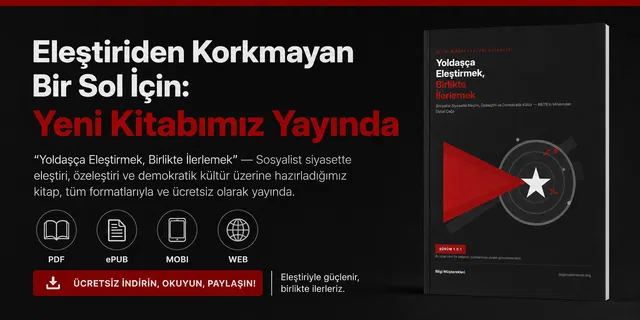
The corruption most often lived in our organisations is the second half of this formula swallowing the first. "Now is not the time", "a show of unity against the outside", "criticism serves the enemy". These sentences look, in the short term, as if they protect unity. In the long term they push the member who criticises out of the organisation, and the member who does not criticise into passivity. What remains is a small core that takes the decisions and a circle that watches it. This is what our teacher calls the "half-closed circle". The book we published in August, For a Left That Does Not Fear Criticism, was taking up exactly this problem: criticism as a comrade is not an attack that weakens the organisation. It is a work of care that keeps it standing.
Comradeship also has a side of accountability. Trust in a comrade is not blind trust. If it is not plain by whom, why, and on what grounds decisions are taken, trust binds itself over time to persons. Trust that binds itself to persons leaves together with the person. Institutional trust is built with open minutes, with rotating tasks, and with a decision that can be taken back.
Finally, the limit of comradeship does not end at the door of the organisation. In Liberation Is in Our Hands, Unity Is in the Hands of the Class we had proposed that Lenin's principle of "freedom in discussion, unity in action" can be adapted not only inside one party, but also between parties and organisations: views are discussed openly, and the decision taken in common is applied together. And we had set the most basic measure: when a comrade is detained, sacked or attacked, being beside them without asking which organisation they are from. A common standing-by today for the detained students Nehir Dizdar and Nevin Tekin is the most concrete test of this comradeship between organisations.
Part Four: A Map of the Four Ways
When we set the four concepts side by side, we can show what each of them shares, what it turns into when it is left alone, and its organisational counterpart, like this:
| Way | What is shared? | What does it turn into if left alone? | Its organisational counterpart |
|---|---|---|---|
| Shared direction | A common direction, a common aim | An audience, a follower, a voter | An open assembly, a common minimum programme |
| Shared time | A common moment, a common responsibility | The nostalgia of a generation, or the anger of a generation | Pairing between generations, a founding place for the young |
| Fellow-feeling | A common feeling, understanding the pain | A wave of shares, the fatigue of feeling | A solidarity fund, a watch, a network of mutual aid |
| Comradeship | A common responsibility, a common cost | Loyalty, or turning into a sect (if there is no criticism) | A workplace committee, open minutes, a procedure for criticism |
| A shared class position (the ground we add) | A common position in the relations of production | If it stays invisible, the other four hang in the air | The union, the chamber, organisation by branch and by workplace |
These four ways are not lined up like the steps of a ladder. They are a dialectical whole: fellow-feeling gives life to shared direction, shared direction gives a direction to shared time, shared time gives continuity to comradeship, and comradeship turns fellow-feeling into a cost. When one of the links breaks, the chain comes apart.
The invisible fifth ground: a shared class position
Our teacher Zeki's four concepts are, in the main, subjective and relational concepts: thought, the consciousness of time, feeling and responsibility. To set them on a Marxist ground we want to propose a fifth: a shared class position (sınıfdaşlık).
A shared class position is not a feeling or a preference. It is an objective position. The physician, the engineer, the lawyer, the journalist, the programmer, the courier, the teacher, the nurse: the great majority of all of them today are people who live by selling their labour, whose control over the labour process is steadily decreasing, whose wage and working conditions are set by someone else. In The Poverty of the White Collar (in Turkish) and Whose Law Is the Republic's Law? we had shown this proletarianisation inside the professions with figures: under the myth of the free profession, a waged and insecure majority is growing.
One root of the squeeze the professional chambers are living today is here too. The chambers were founded to organise the profession as "a community of independent professionals". Yet most of their members are now the waged employees of a hospital chain, a holding company, a law office, a software company. If the chamber does not see this transformation, it cannot touch the member's daily problem, that is, the wage, the shift, the mobbing, the job security. And in the place it cannot touch, it becomes a stranger to its member. The material answer to our teacher's question, "how far does the organisation touch people's lives", lies exactly here.
Shared direction, shared time, fellow-feeling and comradeship become lasting when the shared class position becomes visible. Because then standing side by side is not a kindness. It is what the common interest requires.
Part Five: Why Do Organisations Turn into Half-Closed Circles?
Let us take our teacher Zeki's diagnosis one step further and look at the mechanism. Why does an organisation close in on itself?
Legal and political siege. An organisation under repression turns inward to protect itself. Working with a small number of trusted people, a closed consultation instead of an open meeting, a cautious language toward the public. This reflex of defence is understandable. But when it becomes lasting, it blocks the veins by which the organisation renews itself. The real success of repression is not to close the organisation. It is to make the organisation close itself.
Bureaucratisation. More than a century ago the German sociologist Robert Michels argued that every organisation that grows passes inevitably into the hands of a small governing minority, and he called this "the iron law of oligarchy". Michels's observation describes a true tendency, but it is not a law. The tendency works when mechanisms that will stand against it are not built inside the organisation: rotating tasks, a limit on the length of a task, open minutes, the right of recall, the leadership giving a regular account to the member. These were also the principles Marx brought forward in what he wrote on the Paris Commune: representatives who are electable, responsible and recallable at any moment, and who do not earn above the average worker's wage. These principles can be applied today to a union, a chamber, an association.
The distance between the member and the leadership. If the member meets the organisation only at dues and at election time, the organisation is a service institution for them. Where a service is expected, participation is not expected. As the organisation looks at its member like a customer, the member too begins to look at the organisation like an insurance company.
The culture of meetings. Long, agendaless, resultless meetings in which the same people always speak leave outside the young, women, everyone who looks after a child, everyone who works shifts. As we wrote in our guide Event Organizing and Comradeship: those who cannot organise among themselves, how will they change the world? Carelessness is the most silent form of exclusion.
Factionalism. The half-closed circle does not form only inside one organisation. It also forms between organisations. Each organisation putting its own flag forward, turning the common action into its own propaganda, not going to an action someone else has called. In Liberation Is in Our Hands, Unity Is in the Hands of the Class we had counted factionalism the greatest enemy of unity. Factionalism is the closing inside the organisation showing itself outward: the organisation that is closed to criticism inside is also closed, outside, to doing common work with other organisations. The remedy of both is the same: an open assembly, written rules, and concrete work done together.
The blockage of generations. When the founding generation does not leave its place, the young either found their own organisations or do not organise at all. While telling the student plenums in Serbia in They Walked Past the Algorithm (in Turkish), we had seen the counter-example of this: when the young take on opening a place themselves, not when a place is opened for them, they can show a great organisational creativity.
Part Six: Meeting Organising 2.0
In Organising 2.0 we had proposed a model suited to today's scattered, flexible and platformised labour: the network with a spine. It had four layers:
- The cell: a committee, in the workplace, the neighbourhood, the campus, the newsroom, of between five and thirty people, lasting, and with a concrete piece of work.
- The assembly: an open meeting where the committees take common decisions, where everyone has the right to speak, and where delegates can be recalled.
- The spine: the union, the confederation, the professional organisation or the political organisation. It provides legal protection, resources and continuity. It does not run the network. It carries the network.
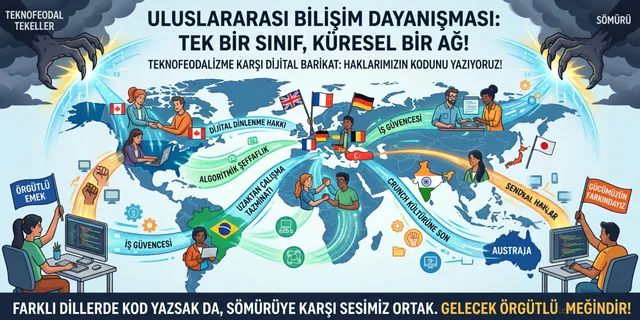
- The bridge: solidarity across the border. Since capital is transnational, the organisation facing it must be so too.
Our formula was this: a network without a spine falls apart, a spine without a network calcifies.
A special note has to be made here for the organisations on our teacher Zeki's list, that is, the professional chambers, the unions and the democratic mass organisations: these are the spine in Organising 2.0. What our teacher calls the "half-closed circle" is the view, from inside, of what we call the "calcifying spine". When the spine sets out to run the network, that is, when it takes the decision inside itself and leaves the cells only the application, the cells either fall apart or break from the spine. When the spine carries the network, that is, when it puts the legal protection, the resource and the continuity at the service of the cells, the organisation both grows and renews itself.
Our teacher Zeki's piece adds something very important to this model: the nodes of the network, that is, the small committees, live only if there is a real relation of comradeship inside them. The spine does not calcify only if it carries the responsibility of shared time. The open assembly is of use only if it can turn shared direction into a common programme. And the whole structure is an empty diagram if it cannot turn fellow-feeling into solidarity, that is, into the sharing of the cost.
When we match the seven principles of Organising 2.0 with the four ways, a table like this comes out:
| Principle of Organising 2.0 | Which way does it strengthen? | How? |
|---|---|---|
| Shrink the unit, grow the number | Comradeship, fellow-feeling | In a committee of three to five, everyone knows one another; no one is lost inside the crowd |
| Open up decisions, scatter the faces | Comradeship, shared direction | An open decision provides accountability, a scattered face provides endurance against repression |
| Measure first, then escalate | Shared time | Knowing the organisation's real strength is weighing the responsibility of the moment correctly |
| Don't wait for the threshold | Shared time | Organising now, without waiting for authorisation or an election |
| Ask about ownership | A shared class position | Making the common position and the common interest visible |
| Organise life | Fellow-feeling | Turning pain and need into mutual aid, care and legal support |
| Cross the border | Shared direction, shared time | Building a common moment with comrades in other countries who walk in the same direction |
This matching shows us this: structural proposals and human relations are not alternatives to each other. A good structure makes it easier for good relations to be born of themselves. Good relations keep the structure from remaining on paper.
The trap and the door, once more
Let us read the table of "the trap and the door" in Organising 2.0 this time with our teacher Zeki's concepts. Behind every trap sentence there is a missing way of relation, and behind every door an organisational form that builds that way:
| The trap sentence | The way that is missing | The door |
|---|---|---|
| "I can't do anything on my own" | Comradeship | Change the unit: build a committee of five |
| "Decisions are always taken somewhere else" | Comradeship (accountability) | An open assembly, a reasoned decision that can be taken back |
| "The organisation is distant and abstract" | Fellow-feeling | A base committee in the same building, in the same workplace |
| "Whatever we do, it goes to waste" | Fellow-feeling (learned helplessness) | A small and winnable demand, a network of solidarity |
| "No one will come" | Shared direction (but unorganised) | A small structure test: measure, then escalate |
| "It's my turn" | Comradeship (a risk that is not shared) | Rotating spokespeople, the sharing of the risk |
| "We have to hold on until the election" | Shared time (a short horizon) | Organising that accumulates on the horizon of a generation |
| "This is happening only to us" | Shared direction (across the border) | The bridge: solidarity across the border |
| "They are another organisation" | Comradeship between organisations | A common map of troubles, the smallest common task |
| "Are we defending the boss?" | A shared class position | Ask about ownership: the cooperative, ownership by readers and workers |
We added the row before the last, because, as our reading of the Liberation Declaration showed, this is one of the most widespread trap sentences of the left in Turkey today.
Part Seven: From Inside the Organisation to Between Organisations
Our teacher Zeki's piece looks, in the main, inside a single organisation: at the relation of the chamber, the union, the association with its member. Liberation Is in Our Hands, Unity Is in the Hands of the Class, which we published today, was looking between organisations. When we join the two looks, we see that the four ways hold on both planes:
| Way | Inside the organisation | Between organisations |
|---|---|---|
| Shared direction | Members sharing a common programme | Common minimum demands: an end to the minimum-wage squeeze and to insecurity, to detention, to trustees, to censorship and to access blocks |
| Shared time | Translating the times of the generations to one another | A common calendar; a ladder of escalation announced in advance; planning May Day as the result of a year's organising |
| Fellow-feeling | Seeing the trouble of the member beside us | A common map of troubles at the level of the district; counting the pain of another organisation's comrade as our own pain |
| Comradeship | The right to criticise, accountability, open minutes | Freedom in discussion, unity in action; not leaving a comrade alone without asking which organisation they are from; not turning the action into propaganda |
| A shared class position | Seeing the waged majority inside the profession | Accepting that liberation is in the hands not of a single organisation but of the class; holding the unity of the class before the growth of each organisation |
In our reading of the Liberation Declaration we had said that unity between organisations becomes lasting not with texts signed between general headquarters, but with people who do work together in the neighbourhood and the workplace. This is the counterpart, on the plane between organisations, of our teacher Zeki's question, "how far does the organisation touch people's lives". A signed text of alliance is shared direction. The members of three different organisations who stop an eviction together in the same tenants' committee are comrades.
The road map we proposed in that piece can also be read as the steps of building the four ways between organisations:
- A common map of troubles (fellow-feeling): drawing out together the real problems of people in the district.
- Trust with the smallest common task (comradeship): beginning not with a great text of alliance, but with the smallest piece of work that can be done together.
- Writing the rules at the start (comradeship, accountability): setting in writing in advance what will be done in a disagreement, and how the spokesperson will rotate.
- A calendar of escalation announced in advance (shared time): planning the common moment together.
- A common assessment after every action (comradeship, criticism): seeing failure not as personal, but as data.
- Recognising the separation (turning difference into common reason): not ignoring differences of view, but standing together in action.
The rules of the common assembly are also the counterpart, between organisations, of our teacher Zeki's stress on democracy: the delegates to the assemblies are elected not by general headquarters but by the committees, and they can be recalled; the spokesperson rotates, a single face does not come forward; no organisation can capture the assembly with its membership numbers, and what determines weight is in how many committees work is done. This last rule is especially important: the measure of unity between organisations is not the size of the flag. It is the load carried in the field.
History has given this lesson many times. When the workers went into the street on 15–16 June 1970, passing beyond the distinction of unions, the class stood side by side without asking under which flag it was. Germany in 1933 showed what is lost when the left forces count one another the main enemy. France in 1936 showed which gains a united front can bring. In Gezi too, in the forums that thousands of people from different organisations and with no organisation built together, we lived another form of the same lesson.
Now there are concrete structure tests in front of us. In our reading of the Liberation Declaration we had counted four: going to the hearings with the common participation of every left organisation for the detained students Nehir Dizdar and Nevin Tekin; taking a common stand in the minimum-wage process in December; building a tenants' committee between organisations in every district; planning May Day as the result of a year's organising. Each of these tests is a place where our teacher Zeki's four ways are tried at the same time. Are we looking in a common direction, are we taking on the responsibility of the moment, are we counting the comrade's pain as our own pain, and are we paying the cost of these together?
Part Eight: What Can Be Done to Tighten the Ranks?
Let us try to turn our teacher Zeki's concluding proposals (turning to the member's real problem, democratic working, accountability, counting difference as common reason, coming out of the half-closed circle) into concrete applications. These are not a prescription. They are proposals open to discussion.
For the professional chambers
- Putting the waged member at the centre. Rebuilding the chamber's agenda according to the real condition of the majority of the members: the wage, the shift, the workload, mobbing, performance pressure, algorithmic control. Every chamber can do a survey of "the member's condition" once a year and publish the results openly.
- Bringing the chamber and the union side by side. The chamber is the organisation of the profession, and the union is the organisation of the job. The two are not each other's rivals. They complete each other. Common workplace representations, a common desk of legal support, a common calendar of campaigns can be built.
- Workplace representations. The chamber's presence should be felt not only in the building at the provincial centre, but in every hospital, every construction site, every courthouse, every company. Small workplace groups that meet regularly are the counterpart, in the profession, of the "network" layer in Organising 2.0.
- A founding place for interns and new graduates. Places set aside for young colleagues in the governing bodies and the working groups, but not as decoration, with a real authority of decision and of budget.
For the unions
- The first thirty days of membership. As we wrote in The Computing Worker's Handbook, a new member who has not spoken with a person and has not been included in a piece of work within the first month has, in all likelihood, gone. A welcome conversation, a committee, a task for every new member.
- Open minutes and a reasoned decision. The grounds of the leadership's decisions being open to the members together with the decisions. This is the cheapest way of carrying trust from persons to institutions.
- Rotating tasks and a limit on the length of a task. The same people sitting in the same chair for decades distances even the best-intentioned official from the member.
- A solidarity fund. The strike, the sacking, the lawsuit: the organisation, not the members one by one, being able to carry the cost of these. This is the most concrete place where fellow-feeling turns into solidarity.
For the democratic mass organisations, and for all of us in general
- Giving criticism a procedure. Criticism is either whispered in the corridor or explodes on social media. Both wound the organisation. A regular, open and recorded meeting of criticism and self-criticism flows this energy into the organisation, in a way that will strengthen it. Not punishing the person who brings the criticism. Looking not at who brought it, but at what they brought.
- Counting invisible labour. Taking the notes of the meeting, welcoming the newcomer, making the tea, keeping the channel in order, translating. These pieces of work keep the organisation standing, and they mostly remain on women and on the young. They should be made visible and distributed in rotation.
- Pairing between generations. Having an experienced member and a new member work together on a project. This is the most practical form of shared time: the old generation passes on its experience, the new generation brings the language and the tools of its own time. Learning goes both ways.
- Organising life. The organisation should exist not only on days of action, but also in people's daily needs: legal advice, solidarity on rent and debt, childcare, lessons and courses, preparation for earthquakes and disasters. The examples we recalled in Organising 2.0, from the Emergency Response Rooms in Sudan to the ACORN tenants' unions, show how an organisation that touches people's lives grows. The "concrete material tasks" we proposed giving to the local assemblies in our reading of the Liberation Declaration were these too: tenants' committees, carrying provisions to the strike tent, stopping an eviction together. Legitimacy, as we wrote in Organising 2.0, is built with life itself.
- Winning back the face-to-face, and making the digital our own tool. Screen meetings take the distant member in. But the organisation grows with trust built face to face. Beside every online meeting, a regular face-to-face gathering. In the digital tools too, resting not on someone else's platform but on an infrastructure we host ourselves, open source and encrypted.
- Turning difference into common reason. Instead of founding a separate organisation for every different view, tables where different views can stand side by side around a common minimum programme. The common coordination in the farmers' movement in India, or the plenums in Serbia, show that difference does not prevent deciding together. On the contrary, it enriches it.
Between organisations
- Not waiting for the general headquarters. The general headquarters of the organisations beginning to do work together at the base, without waiting for one another. Sitting at the same table, in a district, with friends from at least three different left organisations.
- Not turning the common action into propaganda. In the common action, a common banner, a common spokesperson, a common statement. Carrying one's own flag is legitimate. Turning the common field into one's own shop window wears comradeship down.
- Going to someone else's action. The other organisations also going to a hearing, a strike tent, a commemoration that one organisation has called. Looking not at who is calling, but at what they are calling to.
- Inviting couriers, warehouse workers, call-centre workers and computing workers into the assemblies. A share, in the common assemblies, set aside for workers who come from the workplace. The shared class position being visible at the table between organisations too.
- Talking about factionalism openly. Each organisation opening, inside itself, a plain discussion on factionalism. An organisation closed to criticism is also closed to partnership.
From the half-closed circle to the open organisation
| The half-closed circle | The open organisation |
|---|---|
| Decisions are taken in a small core | Decisions are taken, with their grounds, in open assemblies |
| Criticism escapes to the corridor or to social media | Criticism has a procedure and a record |
| The new member is left on their own | The new member is welcomed, and bound to a committee and a task |
| The time of the founding generation is spoken | The times of different generations are translated to one another |
| Solidarity stays limited to a declaration | Solidarity becomes concrete with a fund, a watch, mutual aid |
| The member is a customer waiting for a service | The member is a comrade who decides and takes on work |
| Invisible labour stays always with the same people | Invisible labour is counted and shared in rotation |
| Trust is bound to persons | Trust is bound to rules, to openness, and to decisions that can be taken back |
| Professional identity is spoken | The common class position and the common interest are spoken |
| Other organisations are counted rivals | The members of other organisations are counted comrades; unity is in the hands of the class |
| The spine runs the network | The spine carries the network |
Concrete Tasks
For every comrade who reads this piece, pieces of work that can be begun this week:
- If you are a member of an organisation, bring to the next meeting a friend who has never come, and sit beside them throughout the meeting.
- If you are in the leadership of an organisation, announce to the members in writing, together with their grounds, the decisions taken in the last three months.
- At work, talk at a tea break with three people who live the same problem. Three people are the core of the committee in Organising 2.0.
- Start a small but regular contribution to a solidarity fund. Regularity is more important than the amount.
- Arrange a meeting with a comrade of a generation different from yours, in which you will talk about their experience or about the problems of your time.
- Write a criticism of yours, with its grounds and its proposal, not in the corridor but in an open channel inside the organisation.
- Take on, for a month, an invisible piece of work in your organisation (taking notes, welcoming, keeping order), and then hand it to someone else.
- Go to a hearing, a commemoration or a strike tent that another organisation has called. The hearings of the detained students Nehir Dizdar and Nevin Tekin are a good beginning.
- Meet with friends from three different organisations in your district and write together the first lines of a common map of troubles.
- Take over, for a while, the load of a tired comrade. A changing of the watch is also a work of organisation.
- Open our teacher Zeki's piece, Organising 2.0, and our reading of the Liberation Declaration to discussion together, in a reading group, in your organisation, or in your workplace committee.
Dear Young Comrades
Standing side by side is not appearing shoulder to shoulder in a photograph. It is looking in the same direction, carrying the responsibility of the same moment, understanding one another's pain, and, most important, paying the cost of these together. Our teacher Zeki Gül reminded us of these four ways. We proposed putting a ground under them: seeing that we are inside the same relation of exploitation.
If organisations are weak today, this is the result not only of the repression outside, but also of the closing inside. The good news is this: the closing inside is something that is in our hands. Opening the door, shortening the meeting, sitting beside the newcomer, explaining the decision, listening to the criticism, sharing a friend's rent. None of these requires a great revolution. But each of them builds the organisation that a great change requires.
We have to build these four ways not only inside our own organisation, but also between organisations. Look not at who is calling, but at what they are calling to. When a comrade is detained, do not ask which organisation they are from. Liberation is not in the hands of a single organisation. It is in the hands of the class. And the unity of the class comes before the growth of each organisation.
Comradeship can begin as a feeling. But it becomes lasting only as a relation, with its rules, its openness, and its shared cost. Tightening the ranks is not becoming more like one another. It is being able to walk the same road together with our difference.
The road is long. But what makes the road long is walking it alone. When we walk together, the road may not grow shorter, but the load grows lighter.
We thank our teacher for this valuable piece. Let us grow the discussion together.
Sources
The subject of the piece
- Zeki Gül, On comradeship, shared direction, shared time and fellow-feeling, Evrensel, 2 November 2026 (in Turkish).
Theoretical sources
- Karl Marx, Theses on Feuerbach (1845), thesis 6.
- Karl Marx, The Poverty of Philosophy (1847), part II, "Strikes and Combinations of Workers".
- Karl Marx, The Eighteenth Brumaire of Louis Bonaparte (1852), part I.
- Karl Marx, The Civil War in France (1871), on the Paris Commune.
- V. I. Lenin, "Freedom to Criticise and Unity of Action" (1906), Collected Works, vol. 10.
- Ernst Bloch, Erbschaft dieser Zeit (Heritage of Our Times, 1935), the concept of "the simultaneity of the non-simultaneous".
- Robert Michels, Political Parties (1911), "the iron law of oligarchy".
- Jodi Dean, Comrade: An Essay on Political Belonging, Verso, 2019.
Related pieces from Knowledge Commons
- Organising 2.0: An Idea for a Justified Revolt (22 October 2026)
- Liberation Is in Our Hands, Unity Is in the Hands of the Class (2 November 2026)
- "Event Organizing and Comradeship" Guide Is Out
- For a Left That Does Not Fear Criticism: Our New Book Is Out
- From the Garden to the Barricades: The Epistemology of Comradeship and the Sublimity of Solidarity, from Epicurus to Marx
- The Computing Worker's Handbook
- The Poverty of the White Collar (in Turkish)
- Whose Law Is the Republic's Law?
- They Walked Past the Algorithm: How the Plenum Beat the Ballot in Serbia (in Turkish)
- Why Do We Deceive Ourselves? (in Turkish)
- The Human in the Loop
- The US Midterms, Techno-Capital and Algorithmic Politics (in Turkish)
- Questions for Press Workers: Without Organisation There Is No Way Forward
This piece is one of the living documents of Knowledge Commons. It is shared under the CC BY-SA 4.0 licence.