The Computer's First Union: BİL-İŞ and Turkey in 1968
The Programmer's Union Is Not a New Idea; It Is a Forgotten Experience

This piece has a story. At the symposium of the Association for Labour Research (Emek-Ar), which we wrote about in Class Is Back at the Table, we were talking in one of the breaks between sessions with our teacher Haluk Yurtsever about the organising of computing workers. While we spoke of how often we hear the sentence "programmers do not unionise", of the white collar's lack of organisation, and of the obstacle of branch 10, which we discussed in The Computing Worker's Handbook, he reminded us of something: in this country, computer workers had founded a union long before. When the thing we call a computer was still a machine the size of a room, running on punched cards; in 1968, at IBM Türk. Its name was BİL-İŞ.
After that conversation we began to follow the trace. What we found is part of a history and part of a lesson for today. Thanking him for the reminder, let us tell it first briefly, then in detail.
Summary
- BİL-İŞ (the Information Processing Workers' Union) was founded in 1968 on the initiative of IBM Türk workers. It was born in the first decade of Turkey's computer sector, from inside the sector's almost only large employer.
- This was not an accident. The 1961 Constitution and Laws 274 and 275 of 1963 had recognised the right to form a union, to bargain collectively and to strike; DİSK had been founded in 1967; 1968 was the year of occupations, boycotts and a rising workers' and youth movement in Turkey. BİL-İŞ was that wave reaching the computer rooms.
- There were socialists in the founding cadre. Necdet Bulut, one of the first people in Turkey to take a doctorate in computer science, was among those who, while working at IBM, began the union organising together with comrades from the Workers' Party of Turkey.
- The union's fate was tied to its remaining a workplace union. Progressive technical staff wanted to turn the union into a branch union affiliated to DİSK; the leadership's manoeuvres prevented this.
- After 12 September its collective-bargaining power was taken, but the sign stayed. In 2008, when IBM Türk workers entered a real struggle for their rights, they had to leave BİL-İŞ and move to Tez-Koop-İş. The reports of that period described BİL-İŞ as a body with no authority to make a collective agreement and under the influence of management.
- Today BİL-İŞ is still on the official register. With its 2019 statute it stands on the ministry list, in branch 10, as an independent union of a few dozen members.
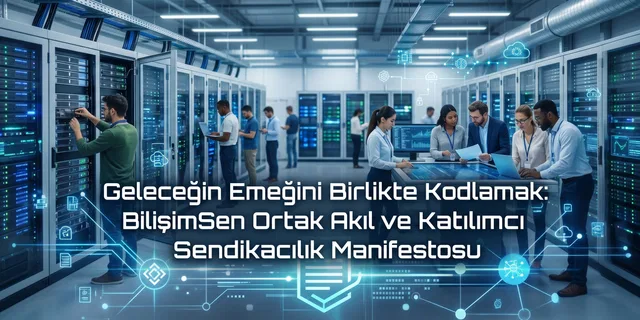
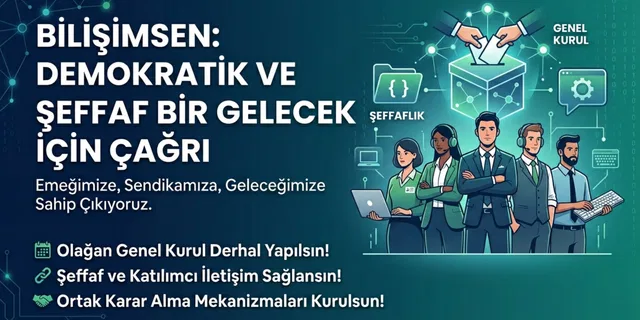
- Computing workers today are trying to organise under Bilişim-Sen. The official founding of the Computing Workers' Union was completed on 20 November 2025. This piece invites membership. The door is bilisimsen.org.
- The lesson has two layers. First: the organising of the computing worker is as old as the sector itself; "it cannot happen here" is historically false. Second: a union shut inside a single workplace, unable to bind itself to the class and to the branch, can become the employer's instrument whatever the founders' intention.
From a Conversation to a History
The importance of what Haluk reminded us of is not only that it is a piece of historical information. There is a widespread intuition among computing workers: we are something new, the union is a tool of the old world, our work is different. This intuition thinks itself "modern", but it is fed by the absence of history. A trade's not knowing its own organising past is both the result and the cause of that trade forgetting to recognise itself as a worker.
The story of BİL-İŞ is a document against that forgetting. But if we tell it only as "look, they did it", it remains incomplete. The second half of the story also shows how a union can be kept alive by being emptied. The two have to be read together. The third link is today: beside the old name whose sign still stands, there is an address where computing workers are trying to organise again.
Turkey in 1968: The World That Made the Union Possible
The Door the Constitution Opened
The 1961 Constitution, prepared after 27 May, bound for the first time in Turkey's history the right to form a union, to make a collective agreement and to strike to a constitutional guarantee. Law 274 on Trade Unions and Law 275 on Collective Agreements, Strikes and Lockouts, both of 1963, made these rights practicable. These laws did not come of themselves; they were won by the struggle of the working class, and in particular by the pressure of the Saraçhane rally of 31 December 1961.
One feature of this legal frame is very instructive for today: it was possible to found a union at the workplace level. Branch thresholds and notary conditions did not, as they do today, build a wall in front of organising. The workers of a company could come together and found their own union. BİL-İŞ was born exactly like that. Yet, as we shall see, this ease was also to be the source of a weakness.
The Rising Class Movement
The second half of the 1960s was the period in which the working class of Turkey came onto the political stage:
- The Workers' Party of Turkey had been founded by trade unionists in 1961 and had entered Parliament in the 1965 elections. The party brought workers, intellectuals and technical staff under the same roof.
- DİSK was founded in February 1967 against the "above parties" and conciliatory line of Türk-İş. A new centre, claiming class unionism, had been born.
- 1968 was the year of factory occupations, university boycotts and the protests against the Sixth Fleet. Class struggle had settled at the centre of everyday politics.
- Two years later this wave was to reach the great workers' resistance of 15-16 June 1970, and the hundreds of thousands who took to the street against the change in the law aimed at closing DİSK.
BİL-İŞ was the arm of this picture reaching into the computer rooms. Its founders were not ahead of their time. They were exactly inside it.
Planned Development and the Arrival of the Machine
The first computer in Turkey, in 1960, was an IBM 650 that came to the General Directorate of Highways. The State Planning Organisation, founded in 1960, and the five-year development plans that began in 1963, enlarged the data-processing need of import-substituting industrialisation. Public institutions, banks and large industrial companies began to set up "information processing centres".
The great majority of these machines were IBM's, and in those years IBM rented its machines more than it sold them. Installation, maintenance, programming support and training were done by the company's own technical staff. Thus an important part of computer labour in Turkey was gathered under a single employer: systems engineers, maintenance technicians, programmers, keypunch operators.
For a union this was a very important condition. Capital had centralised, but labour had centralised with it. A workforce working in the same building, bound to the same manager, compared on the same wage scale, could see its own common interest.
The Founding of BİL-İŞ
The sources give the year of founding as 1968, confirming one another. Politeknik's piece of 2008 says it plainly: IBM workers had organised as early as 1968 and founded their own union (Politeknik, 2008). In our archive searches we reached the information that the founding date was 3 December 1968, that one of the presidents of the first period was Mehmet Başar, and that the 13 January 1970 issue of the magazine Ant gave wide space to the resistance of IBM staff and to the union's struggle. The issues of Ant can be read in the TÜSTAV archive; it is strongly probable that this issue is one of the most vivid witnesses of that history.
Even the union's name carries the spirit of the period: Information Processing Workers. Not "computing professional", not "technology worker", not "white collar". Worker. The computer worker of 1968 did not hesitate to give himself this name.
Necdet Bulut and the Socialist Cadres
One of the people behind the founding is Necdet Bulut, whom we also named in The Computing Worker's Handbook. Born in Sivas in 1938, Bulut was one of the first people in Turkey to take a doctorate in the computer sciences. He joined IBM in 1963 and became one of the company's few engineers in Turkey. As Tolga Binbay reports, Bulut began the process of union organising at IBM together with five comrades from the Workers' Party of Turkey, and at the end of this work IBM had to sit, for the first time in its own history, at a collective-agreement table (soL, Tolga Binbay).
Bulut then moved to the Computer Centre of the Middle East Technical University, and from there to Karadeniz Technical University; he was president of the Turkish Informatics Association and in 1977 stood as a parliamentary candidate for the Workers' Party of Turkey. On 26 November 1978 he was badly wounded in an armed attack in Trabzon, and he died on 8 December. One of Turkey's first computer doctorates was, that is, also one of its first computing unionists, and one of the people targeted by fascist violence on the road to 12 September.
This detail matters especially today. It is the shortest answer to the young colleague who says "I am a technical person, politics is not my business": in the founding generation of this trade, technical depth and class consciousness met in the same person.
The name of the computer engineer Aydın Meriç also comes up among the founding and leading cadre; it is reported that Meriç later took a senior post in DİSK. This is a sign of how closely the BİL-İŞ experience was bound up with DİSK's line of class unionism.
The Breaking Point: Workplace or Branch?
The most instructive moment in the story of BİL-İŞ is perhaps the least known. As Politeknik reports, progressive technical staff wanted to turn the union into a branch union affiliated to DİSK. The leadership's manoeuvres prevented this.
This can look like a small organisational choice. It is not. One of the oldest lessons of union history lies here:
- A workplace union is alone in front of a single employer. Its membership, its power, its resources and its knowledge are limited to that one workplace. The employer can watch this body closely, influence its leader, and reward and punish its member.
- A branch union binds together all the workplaces that do the same work. A struggle in one workplace is carried to the others, and the pressure of one employer is balanced by the solidarity of the members in the other workplaces.
- Affiliation to a confederation binds the union to the general struggle of the class. The computer worker stands on the same front as the metal worker, the textile worker and the municipal worker.
When BİL-İŞ was prevented from affiliating to DİSK, the union was in a sense left face to face with a single employer. Independently of the founders' intention, this was a structure that worked, in the long run, in the employer's favour.
After 12 September: The Form Remains, the Content Empties
The 12 September coup closed DİSK, tried its leaders and took class unionism as a target. Law 2821 on Trade Unions and Law 2822 on Collective Agreements, Strikes and Lockouts, both of 1983, forced unions to the branch level and tied the authority for a collective agreement to high thresholds. This order, which we told in detail in 12 September: The History, Balance Sheet, and Present of a Class Coup, was the instrument of weakening the union movement by the legal road.
It was not possible for a small union organised in only one company to keep its collective-bargaining authority in this order. BİL-İŞ, which had previously made collective agreements, lost this power after the 1980s. What is striking is that it did not disappear.
2008: Stepping Outside the Sign
Forty years later, in 2008, IBM Türk workers organised again. For five years they had received no rise despite inflation reaching 56 per cent; there were wage gaps of up to four times among people doing the same work; there were dismissals they found unjust. This time their road went not through BİL-İŞ but through Tez-Koop-İş. Of about 400 technical workers, 258 joined Tez-Koop-İş, the Ministry of Labour issued the authorisation determination, and IBM objected (Politeknik, 2008).
The reports of those days described BİL-İŞ like this: a union organised only at IBM Türk and without the authority for a collective agreement (bianet). Politeknik went further: the union was under the control of management and was at the same address as the company. Computing workers had been forced to leave BİL-İŞ membership and move to another union in order to seek their rights.
The bitter irony of the story is here. The union that workers had founded with their own hands in 1968 had, in 2008, become a sign that workers had to step outside in order to seek their rights.
Today
BİL-İŞ is still on the official register. It appears on the union list of the Ministry of Family and Social Services, with its 2019 statute, as the "Information Processing Workers' Union (BİL-İŞ)" (the Ministry, Main Statute 2019). According to sources that compile union statistics, it is an independent union of about seventy members in branch 10, Commerce, Office, Education and Fine Arts; its address is a plaza in Levent, Istanbul (Sendikadata). The same source shows the founding date as 2013; this is in all likelihood the date of the restructuring after Law 6356 of 2012.
The name of 1968, that is, lives in a register with a few dozen members, in a period when hundreds of thousands of computing workers are at work.
Bilişim-Sen: Today's Address of Organising
The sign's still standing does not mean that organising has stopped. Computing workers today are trying to come together under the Computing Workers' Union (Bilişim-Sen). As we reported in Beyaz Yakalının Sefaleti, according to the union's activity report of 13 June 2026 its official founding was completed on 20 November 2025. In 2026 an İzmir unit was set up, a games-sector working group was founded, and organising meetings were held in Istanbul and İzmir. In September it came before the public with a demand for reinstatement against the dismissals at DeFacto Teknoloji. We told that evening in Four Chairs at DeFacto's Door. The limit we recorded in the same piece still stands: this work has not yet reached a determining level of unionisation across the sector. The address has been set up; the spine is still thin.
This piece does not speak in the union's name. Knowledge Commons has no organic tie to Bilişim-Sen beyond membership. The invitation is ours. We call to membership everyone who works in computing, who writes code, who builds the system, who labels data, who designs and who gives support. The door is bilisimsen.org. If you are already a member, set up a committee at your workplace; ask for the statute, the budget and the decisions that have been taken. The Computing Worker's Handbook tells this step by step. A democratic union is built by the insistence of the person who comes through the door, not by the favour of the leader. The emptied sign of BİL-İŞ is the reason not to wait at the door.
1968 and Today: What Changed?
The real question of our conversation with Haluk was this too: if computer workers could found a union in 1968, why is the organising of the workers of artificial intelligence, software, the data centre and the platform economy still so contested today? There is no single answer, but putting the conditions side by side shows the way.
| 1968 | Today |
|---|---|
| Computing labour was largely gathered under a single employer, in a few places | It is scattered across thousands of companies, subcontractors, freelancers and remote workers |
| Founding a union at the workplace level was legally possible | Law 6356, the catch-all branch numbered 10, and the thresholds stand in front of organising |
| The worker could call himself an "information processing worker" | The "professional" identity taught for years covers the belonging to a class |
| Behind them, a rising workers' movement, DİSK and the Workers' Party of Turkey | The wave of 1968 is not here. Computing workers are trying to organise under Bilişim-Sen; the address exists, the spine is still thin |
| Wages, job security and unjust dismissal were common problems | The same problems continue; algorithmic control, performance dashboards and dismissals by means of artificial intelligence are added to them |
| The way out was limited; one had to stay and struggle | Emigration and individual bargaining make the "individual exit" more attractive than the "collective voice" |
The most important row of the table is perhaps the first. Capital today is far more centralised than in 1968: cloud infrastructure, platforms and artificial-intelligence models are in the hands of a handful of monopolies. Labour, the other way round, is fragmented. As we told in Beyaz Yakalının Sefaleti, the centralisation of capital and the scattering of labour are two faces of the same process. In the computer room of 1968, capital and labour were face to face in the same building. Today the workers who do the work of the same monopoly work without ever seeing one another, inside different companies, different contracts and different countries.
There is also something that should not be forgotten: the computing worker of 1968 organised because there were common problems. There are today too. As we told in Forty Percent of the Code, a Quarter of the Staff and The Human in the Loop, in the age of artificial intelligence the programmer's work shifts towards supervision, the lower rungs of the learning ladder are pulled away, and the gain in productivity flows not to the worker but to the company. The problem is not missing. What is missing is the organisation. The place where that organisation is being tried today is Bilişim-Sen.
The Lessons We Draw from BİL-İŞ
The idea of a union in computing was never "early". It was born in the sector's first decade, from inside the Turkish organisation of the world's largest computer company. "Programmers do not unionise" is not an observation. It is a prejudice produced by the absence of history.
Technical expertise and class consciousness can meet in the same person. Necdet Bulut's life is the proof. One of this country's first computer doctorates was also one of its first computing unionists.
If a union is shut inside a single workplace, it can become the employer's instrument. The fate of BİL-İŞ was drawn on the day it could not bind itself to DİSK and to the branch. For every computing organisation founded today, the real question is this: will it stay inside a single company, or will it lean on the whole branch and on the class?
Form is not content. A union's having a name, a statute and a registration number does not mean that it is the workers' organisation. What makes a union a union is the members' control, internal democracy and independence from the employer. The three questions of Knowledge Commons hold here too: In whose hands? Under whose control? To whose benefit?
Today's address is Bilişim-Sen. Let knowing the history not become an excuse for standing at the door. Computing workers are trying to organise under this union today. Join. Become a member. Set up the committee at your workplace. Do not stay inside the wall of a single company.
The real enemy of organising is the employer's reflex, but its real ally is the rest of the class. The computer workers of 1968 drew their power not from their own workplace but from the workers' movement rising behind them. Today too the computing worker will grow strong not alone but together with the courier, the warehouse worker, the call-centre worker and the teacher. The network model we proposed in Organising 2.0: An Idea for a Justified Revolt is a draft of how this alliance can be built in today's conditions.
Concrete Tasks
- Let us put the history on record. The 1970 issues of Ant, the union publications of the period and the testimonies of the people who worked at IBM Türk in those years should be gathered. An oral-history study with the founding generation that is still alive is an urgent task.
- Let us tell Necdet Bulut and BİL-İŞ to computing workers. This history should enter the education programmes of the professional chambers, the computing unions and the student societies. Every programmer should know that this trade has an organising past.
- Let us join Bilişim-Sen and set up a committee at the workplace. The door is bilisimsen.org. If we are members, let us ask for the statute, the budget and the decisions. The Computing Worker's Handbook writes what to ask.
- Let us stay awake against being shut in the workplace. In every computing organisation that is founded, bodies at the branch level, with a confederal tie and a strong internal democracy, should be defended. Structures set up by the employer, such as the "in-company representative" and the "employee council", should not be allowed to take the union's place.
- Let us grow the demand for a separate branch for computing. In the catch-all branch numbered 10, the voice of hundreds of thousands of computing workers is lost. Recognising computing as a separate branch is not a technical detail of law. It is the right to organise itself.
- Let us build the ring of alliance. The programmer, the systems administrator, the designer, the content worker, the data labeler, the courier and the warehouse worker work on different rungs of the same monopolies. Common calendars of action and networks of solidarity make this ring concrete.
Dear young comrades,
A small story told in a break between sessions, over a glass of tea, sometimes pierces a great forgetting. BİL-İŞ, which Haluk reminded us of, is such a story. In 1968, in the years when the computer was still crawling in this country, the people at the machine called themselves workers and organised. Then that organisation was taken from their hands, emptied, and turned into a sign.
What falls to us is neither to glorify the past nor to lament the defeat. What falls to us is to learn together that generation's courage and the mistake they made. Their courage says this: it can be done. Their mistake says this: if you stay alone, in a single workplace, it is hard to keep what you have won.
Today the name of that door is Bilişim-Sen. We call everyone who works in computing to membership. The machine is new, the chain is old. And the way to break that chain is the same today as it was in 1968: to be organised, and to be together with the rest of the class.
Sources
- Politeknik, "Let us support the unionisation of computing workers!" (June 2008)
- Tolga Binbay, "Your voice remains forty years on", soL
- bianet, "IBM Workers Say 'We Too Have Read the Fable of the Yellow Ox'"
- Ministry of Family and Social Services of the Republic of Turkey, BİL-İŞ Main Statute (2019)
- Sendikadata, the BİL-İŞ union page
- TÜSTAV, the Ant magazine archive
- Ant (magazine), Wikipedia
- Genel-İş, "Looking from Today at the Great Workers' Resistance of 15-16 June 1970"
- The past of the computer in Turkey, Wikipedia
- Bilişim-Sen
- Computing Workers' Union (Bilişim-Sen), Activity Report, 13 June 2026
The pieces of ours on which this essay is built
- Class Is Back at the Table
- The Computing Worker's Handbook
- Beyaz Yakalının Sefaleti
- 12 September: The History, Balance Sheet, and Present of a Class Coup
- Forty Percent of the Code, a Quarter of the Staff
- The Human in the Loop
- Organising 2.0: An Idea for a Justified Revolt
- Four Chairs at DeFacto's Door
This piece is one of Bilgi Müşterekleri's living documents; it is shared under a CC BY-SA 4.0 licence. You may copy, change and share it if you credit the source.