In Front of the Turnstile: The Boss, the Yellow Union and the Workers Who United to Live, at HABAŞ
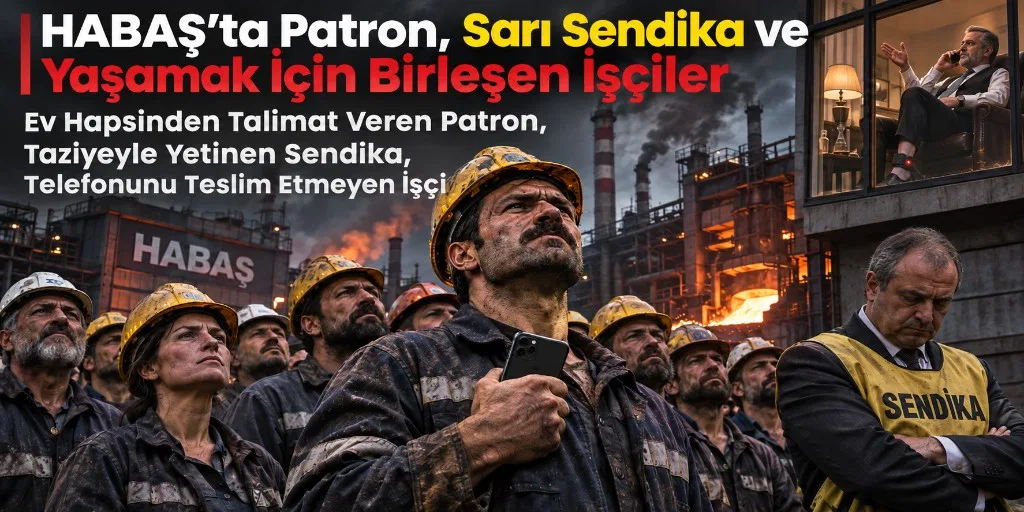
The Boss Giving Orders from House Arrest, the Union That Settled for a Condolence, the Worker Who Would Not Hand Over the Phone
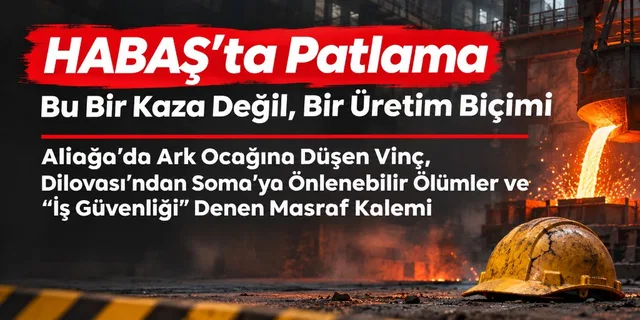
In our first essay, The Explosion at HABAŞ: This Is Not an Accident, It Is a Mode of Production, we took up the explosion at the HABAŞ iron and steel plant in Aliağa on 9 November through the chain of neglect and through occupational safety. Four days have passed. In those four days something else happened in front of the factory: the workers began to speak. This essay is the essay of those four days. It is not the essay of the explosion. It is the essay of who did what after the explosion.
Update, 14 November 2026: We have updated this essay with what has happened since the evening of 13 November. The workers taken to the gendarmerie station were released. The management withdrew the phone ban and gave paid leave to the permanent workers. HABAŞ made its first statement. The militant unions were in front of the factory. The details are under the heading "14 November: The First Step Back".
First, the Summary
- The toll grew. The number of dead rose to 19, the number of injured to 14. Eleven people were detained, nine of them were arrested. The chair of the board, Mehmet Rüştü Başaran, and one suspect were released under house arrest.
- The boss did not want to stop production. The day after the explosion the workers were called to the shift. According to what reached the press, while there was no production they were brought in by the service buses and kept waiting through the shift, and goods already produced were loaded onto lorries.
- A phone ban arrived. A notice hung at the factory gate said that a worker who did not hand over their phone would not pass the turnstile. The workers say this order came from the boss under house arrest.
- The workers did not go in. On 13 November the night and morning shifts did not enter the factory. The workers closed the road. Their demands were clear: paid leave until the wreckage is cleared and safety is secured, an independent inspection, worker participation in the risk assessment, leave to mourn the dead.
- The workers won a first gain. On 14 November the management withdrew the phone ban and gave paid leave to the permanent workers. The subcontracted workers were left out of this decision, and the demand for an independent inspection was not met.
- The union stood on the other side. Türk Metal, the union organised in the factory, settled for four days for a condolence message. When its representatives called the workers inside, the workers drove them from the area. The union began to say "workplace murder" only once the anger had grown.
- The state chose its side. The gendarmerie and the water cannon intervened. According to the Aegean Workers' Association, close to 20 people were taken away; official statements counted 9, all of whom were released the next morning. A broadcasting ban was placed on news of the explosion, and parliamentary motions for an inquiry were rejected by the votes of the AKP and the MHP. The general secretary of the ruling party, meanwhile, launched a "donation campaign" with the business world.
- The workers built their own voice. The account of the unionist Başaran Aksu became a board of testimony for HABAŞ workers who hid their names. Families, workers' associations and militant unions met in front of factories from Aliağa to Istanbul.
- The main thesis. At HABAŞ, death was not lived once. It has been produced for years. The four days after the explosion showed the three legs of this order plainly: the boss who does not stop production for the sake of profit, the yellow union that manages consent, and the state that protects the two of them. Against them stands the workers' will to act together in order to live.
The Four Days After the Explosion
9 November: The Explosion and the Hidden Dead
The explosion happened on 9 November, around 11:46, during maintenance and a boiler change at one of the electric arc furnaces. According to what Hürriyet relayed, an overhead crane fell, and the falling material struck the natural-gas line. The Minister of Labour also said, in the first examinations, that the falling material had torn the natural-gas and oxygen pipes. An engineer working in the area, meanwhile, told haber.sol that, according to what was being said, one of the columns carrying the crane had collapsed. This is a claim; the expert report is awaited. But the question is already clear: when was the column line under a crane that carries 200 tonnes last looked at?
The number of dead was announced in pieces through the day: first 3, then 6, 10, 16. At night the Minister of Health said 17. Today there are 19 dead. Forensic Medicine announced that the deaths were due to "burns at the degree of carbonisation".
Families were sent back and forth between the factory, the hospital and forensic medicine. Şevval Özçelik, the sister of 25-year-old Kadir Kaan Özçelik, wrote this that night: her brother had died in the morning, but the family had not been told. He had been at the job for three months, and this was the second explosion he had seen. The next day she added this: "The dead cannot defend their right. This is our duty."
Let us keep this sentence in mind. The rest of the essay tells who took this duty up, and who did not.
10 November: The Workers Called to the Shift
The day after the explosion, hundreds of workers were called to the shift. According to what Evrensel relayed, the workers were told not to go to places without permission, and goods already produced were loaded onto lorries. One worker's words sum up the situation: "People are dying here, and we are being called to the shift."
According to what Başaran Aksu relayed on 12 November, there was no production in the factory. The workers were brought in by the service buses, kept waiting through the shift, and then sent back. This has to be read as a practice of keeping the worker in place, of keeping standing not the owner of the factory but its order. While the wreckage was still there, the worker's place was the factory again. Mourning would be kept at home. The production calendar would not slip at all.
The boss, Mehmet Rüştü Başaran, was detained at his house in Kartal about 30 hours after the explosion, and then released under house arrest. Başaran Aksu called this decision "a prize of resting at home".
The same day, the spokespersons of the Aegean Workers' Association, Yücel Memiş and Sonay Tezcan, who wanted to make a statement in front of the hospital in Aliağa, were detained. The only thing they said was "Let us no longer call this fate." When they were released they said this: "We will go on raising the voice of the HABAŞ workers." They kept that word.
11–12 November: The Phone Ban and the Mouths That Closed
A notice was hung at the factory gate: a worker who did not hand over their mobile phone would not pass the turnstile. According to what Agos relayed, the workers say this order came from the chair of the board, under house arrest.
The phone ban has two functions, and both come out at the same place.
The first is to block testimony. A week before the explosion, a recording shot from inside the factory had entered circulation. When the inside of the factory begins to be seen, capital's first job is to try to take the camera from the worker's hand. In The Card Around Our Necks, which we wrote on the chipped card at Astor, we told how surveillance in the factory works in one direction: the boss sees the worker at every moment, and the worker's seeing the boss is forbidden. The phone ban at HABAŞ is the barest example of this.
The second is to leave the worker alone in an emergency. The workers' objection was exactly this. A worker who had lost 19 friends four days earlier was being asked to leave at the gate the means of reaching their family in the next explosion.
Something else that happened in the meantime is also striking. According to a post on Başaran Aksu's account, a local news page had taken down its post about HABAŞ. And a broadcasting ban was placed on news, comment and criticism about the explosion. The reaction of Sevda Karaca, an EMEP member of parliament, was short: "You go after that boss first."
The phone was banned in the factory, the news on the screen, the motion in parliament. The three bans have a common point: all of them block seeing.
13 November: In Front of the Turnstile
On the morning of 13 November the workers on the night and morning shifts did not enter the factory. According to Evrensel's report, the workers gathered in front of the turnstiles and chanted slogans calling on the management and on Türk Metal to resign.
Their demands were open and concrete:
- Paid leave until the wreckage is cleared and the safety measures are in place, and production stopped until then
- An independent inspection of the factory (for example by the Chamber of Mechanical Engineers)
- Five days of paid mourning leave for the dead
- The participation of workers from every section in the risk assessment
- Shipments stopped before the funerals are given to the earth
None of these demands asks for a privilege. All of them are things that already have a place in the law, in the regulations, in the science of engineering. What the workers wanted was that what is necessary in order to live be applied in the factory, not on paper.
The company cancelled the 16:00–24:00 shift. The workers saw this as a move to stop the action from growing. The gendarmerie asked for the road to be opened; the workers said they would not open it until the demands were met. Then the water cannon and the gendarmerie intervened. About 20 workers were detained. Among them was Yücel Memiş, who had also been detained three days earlier. Evrensel reporters Hatice Çoruk and Emirhan Durmaz were also about to be detained; this was stopped when other journalists stepped in.
The toll of the four days is this: 19 dead in the explosion, and house arrest for one boss. Then detention for 20 workers who wanted to protect their lives.
14 November: The First Step Back
A detention that was never recorded. Those taken to the station were released during the night. According to the official account, the gendarmerie took 7 workers and 2 people from the Aegean Workers' Association, and all of them were released after an identity check (T24). Göktuğ Burucuoğlu, a lawyer and member of the board of the Izmir Bar Association who was at the station, said that no formal detention had been made, and yet the workers were held at the station unlawfully. Evrensel also wrote that the workers were driven with shields and beaten as they were taken, and held without any record. The worker was at the station but not on paper. The boss's house arrest, by contrast, is written in every document.
A shift beside the wreckage. A subcontracted worker of 23 or 24 who spoke to BirGün described the day after the explosion like this: "Inside it was a real crush. Everywhere smelled of blood. The dead had not even been brought out yet... In the evening they ring and say, you are going to do shipments." By his account the lorries were sent out through the back, over the weighbridge, so that they would not be seen. "It says HABAŞ on my chest, but I have nothing," he says. Another worker said human remains had been found in the wreckage, and repeated the demand: "Our friends' demand is clear. We want five days of paid leave."
The management stepped back. According to the Aegean Workers' Association, the management first withdrew the phone ban, then announced paid leave in a message sent to the permanent staff. Some reports say the leave was given to the steel shop. The association called this "an important but insufficient" gain. It asked that the leave also cover the subcontracted workers, that an inspection be carried out by a board independent of the employer, and that workers' committees be set up section by section in the factory. The statement also says one thing honestly: at first a wider body of workers joined the action, participation fell as it went on, but those who kept resisting opened the way to the first gain.
This is not a small thing. Workers who for four days had been told "wait, go in, leave your phone" made the boss under house arrest withdraw his order, one morning, by not passing the turnstile. But the limit of the gain is instructive too. The leave was given to the permanent workers, not to the subcontracted ones. The worker with HABAŞ on his chest but "nothing" stayed outside the door again. Even while stepping back, the boss divides the workers. The road to a wider unity runs through bringing the subcontracted and the permanent workers together behind the same demand.
The company's first word. Four days after the explosion, on the evening of 13 November, HABAŞ published its first statement on its website. It called the event "a grievous accident", presented itself as "a national institution that has been the first in iron and steel exports for the last fifteen years", and added: "We are following with sensitivity the malicious social media posts that ignore the presumption of innocence." It also asked the public "not to give credit to social media posts in need of confirmation". Odatv read this sentence as a threat of legal action.
There is not one name of a dead worker in the statement, not one sentence about the workers' demands. A phone ban at the factory gate, a call to the public to "give no credit to social media", an implicit warning of legal action to those who testify. All three want the same thing: that what circulates be the information the company approves, not what the worker tells.
Unions at the gate, a barrier at the door. On 14 November, at the shift change, Bağımsız Maden-İş, DGD-SEN, DİSK/Enerji-Sen, İnşaat-İş, KATAŞ-SEN, OTİS, the Private Sector Teachers' Union, Tarım-Sen, TSS-İş and Yapı Yol-İş were in front of the factory. Workers going in and out wanted to watch the statement. The company's private security put up a barrier between the action and the workers. Türk Metal representatives also tried to stop the workers from seeing the action, and pushed them to board the service buses or to go inside. The sentence that defines a yellow union could not have been written more clearly: to stop the worker from hearing any other voice.
The Smart Solar resisters in Aliağa also spoke at the statement. They had been dismissed for moving from TES-İŞ to DİSK/Enerji-Sen. "We do not want to die while working," they said. The unions' demands were these: that the explosion be investigated in all its aspects and no evidence be destroyed; that the boss, the employer's deputies and the responsible public officials be called to account; that the Türk Metal officials who did not protect the workers' safety also be tried, and that the metal workers tear out this union's authority at HABAŞ; that the Minister of Labour resign; that independent and continuous inspections be carried out in all the heavy-industry plants of Aliağa; that subcontracting end; that the worker's right to stop production be guaranteed.
What has not changed? The boss is still under house arrest. The expert report has not been announced. The report that the TMMOB Izmir Provincial Coordination Board announced it would prepare is not out yet. There is no independent inspection and no parliamentary inquiry. The subcontracted worker is outside the paid leave. The first step won in front of the turnstile shows that the remaining demands can be won by the same road. But they will not come of themselves.
The Yellow Union: Between the Condolence and the Turnstile
A Short History of the Concept
The phrase "yellow union" was born in France at the end of the nineteenth century. When the windows of the place where a group of workers who had come to terms with the employer during a strike were gathering were broken, yellow paper was stuck in place of the glass. Since that day, an organisation that carries the worker's name and looks after the employer's interest has been called "yellow".
What defines a yellow union is not that it does not strike, or strikes little. Its real definition is that it stops the worker from making their own decision themselves. The yellow union does not represent the worker. It manages them. Its job is not to carry the anger to the table. It is to keep the anger outside the table. The mechanism we told in The Consent of Labour, which we wrote on Nursel Tabel Arslan's book, works here: exploitation continues not only by force, but by consent, and the yellow union is the institutional address of consent.
What Did Türk Metal Do at HABAŞ?
Türk Metal, affiliated to Türk-İş, is the union organised at HABAŞ. What they did in the four days after the explosion was this:
- The head office published a condolence message. According to Başaran Aksu's observation, the explosion hardly appeared at all on the union's branch accounts. There was not a single criticism of the boss, nor a single self-criticism about their own responsibility.
- It made no sound about the workers being called to the shift. According to workers who spoke to Evrensel, the union did not stand with the workers who were called to production before the funerals had left.
- On the morning of 13 November it called the workers inside. When Türk Metal representatives called the workers in front of the turnstile to go in, an argument broke out. Angry workers drove the union officials and the security chief from the area. The accounts differ on the detail of the incident. Evrensel writes that blows were used in the scuffle. Hürriyet relays that someone described as a factory official attacked a union representative. Toplumsal Muhalefet writes that Türk Metal representatives attacked Yücel Memiş, who was speaking. Whatever the detail, the picture is the same: the union representative was standing on the employer's side of the turnstile.
- When the anger grew, the language changed. The same day, in the afternoon, Türk Metal deputy general president Mürsel Öcal made a statement in front of the factory: "We do not call what we have lived through a work accident. This has a single name. And that is workplace murder." As the reason for four days of silence he also said "it is out of our respect for our funerals". In the video Başaran Aksu shared, while the statement was going on the workers are seen answering the question "Who killed?" with a slogan.
- The next day it put up a barrier in front of the workers. On 14 November, while the militant unions were making a statement in front of the factory, Türk Metal representatives, together with the company's private security, tried to stop the workers from watching it. The union that had said "we will no longer stay silent" the day before did not want the worker to hear any other voice.
Respect for the funerals is not shown by staying silent toward the boss who calls the worker into the factory before the funerals have left. Respect is to stand, together with that worker, in front of the turnstile.
This Is Not a New Stance
Türk Metal's conduct at HABAŞ did not begin with the explosion.
November 2022. HABAŞ workers collected about 3,000 signatures for the bank promotion payment and sent them to the head office in Istanbul. According to what Evrensel relayed, the factory management's answer was a single sentence: "The boss knows."
August 2025. Before the MESS collective agreement, a "clock-in, clock-out" practice began at HABAŞ. According to the workers' account, workers with more than 14 years' seniority, whose wage was above 60,000 lira, were asked to leave the job and enter again. The aim was to bring the wages down to around 43,000 lira and to make the new agreement on that floor. A list of 280 people was spoken of; whoever did not accept was fired. According to the workers, Türk Metal stayed silent through this process and settled for telling them "apply to the court".
According to a claim voiced in parliament, wages were cut by 33 percent with this practice. After Evrensel put this on its front page, the newspaper's Izmir office was shot at. Members of parliament asked from the floor of the Assembly about the link between these two events. The investigation did not examine this link.
To understand the function of the yellow union, it is enough to set these three dates side by side. It stayed silent while the wage was being cut, it stayed silent while the worker was dying, and when the worker came out in front of the turnstile it spoke, and the first thing it said was "go inside".
The Argument over the "Gentlemen's Agreement"
Başaran Aksu goes one step further. According to him, a "gentlemen's agreement" made among the metal unions of the three confederations left the metal worker without a choice, enlarged Türk Metal, and weakened Birleşik Metal-İş. Aksu sees the "tearing up and throwing away" of this agreement as a debt to the workers who died at HABAŞ.
We do not know the detail of this claim, and the unions concerned need to hold the argument openly. But the question under it is in the right place: if a worker cannot freely choose which union to join, is that union their union? In Turkey, a worker who wants to change unions being fired is not an exception. It is the rule. Workers who joined Birleşik Metal-İş at Panelsan have been resisting in front of the factory since 3 August. According to what Aksu relayed, workers who changed unions at Smart Solar were also fired. What keeps the yellow union standing is not only its own bureaucracy. It is the partnership of boss and state that stops the worker from knocking at another door.
The Boss's Order: Incentive, Prize and Death
The Chronology of Death
According to the figures of the İSİG Meclisi, at least 45 workers have died in HABAŞ enterprises since the factory opened. Thirty-eight of them are after 2013, when İSİG began to keep a regular report. İSİG reminds us that this number is "at least", and that many deaths could not be learned of.
Some stops from Evrensel's roundup:
- 2013: Four separate accidents in the factory. The Ministry of Labour defended that an inspection had been made five months before the accidents and that the shortcomings had been remedied.
- 2017: An explosion in an LPG tanker belonging to HABAŞ. The worker Nail Demirci died, 10 people were injured.
- 2018: Two explosions a month apart, 8 workers injured by burning.
- 2019: Eighty tonnes of liquid steel poured into the working area from an overturned ladle.
- 2020: Kadir Özdemir died by falling from a height. Raif Çatan fell into the sea and died at the port where he was made to work without a life jacket being given.
- September 2025: Seven workers were injured in a furnace explosion.
- 21 October 2026: Hakan Doğan died.
- 5 November 2026: Eyüp Eğinli died.
- 9 November 2026: Nineteen workers died.
Three separate workplace murders in the last three weeks. After a factory has given so open a signal, what happens cannot be called an "accident".
The Company's Own Report
According to what Evrensel relayed, the company's 2025 sustainability report contains figures against the company itself. Lost-day work accidents rose from 109 to 146 among employees, and from 38 to 83 among subcontracted workers. The report counts crushing, extreme heat and falling among the risks of high-consequence injury. According to figures relayed in parliament, occupational-safety training hours fell from 66,000 hours to 9,000. The weekly working time is entered as 61 hours.
This report does not prove that the explosion was known in advance. But it shows that the company knew the risks were growing, and that it cut the training anyway. The report was a warning. No one read it as a warning. Because a sustainability report is written not for the worker, but for the investor and the export market.
No Penalty, There Is Incentive
HABAŞ's last ten years moved on two parallel lines. On one side the deaths, on the other the state's support:
- Tax reduction: According to what Umut-Sen relayed, in 2024 the company benefited from 1.16 billion lira of tax reduction and public incentive. The incentive certificate given for the automotive investment in Dilovası covers interest support, customs and VAT exemption, an 80 percent tax reduction, and the state's meeting of the employer's social-security premium for seven years.
- Capacity mechanism: In January 2026 HABAŞ was among the companies receiving the highest payment, with 46.2 million lira.
- EIA decisions: A "no EIA required" decision was given for the Aliağa cold-rolling mill. A zoning change covering 123 dönüm of forest land at Çakmaklı was approved. The slag storage plant, which the judiciary had previously cancelled, was brought back onto the agenda.
- Prizes: In June 2025, at the TİM ceremony the president attended, the first prize of the steel sector was taken.
- Wealth: According to the Forbes Türkiye 2025 list, Mehmet Rüştü Başaran is 35th, with a fortune of 950 million dollars.
On the side of the judiciary the picture is this: on 21 May 2026 the Kocaeli 1st Heavy Penal Court sentenced Başaran to 4 years, 10 months and 10 days in prison for the 2017 LPG tanker explosion. The decision has not become final, and Başaran did not enter prison. In the Kadir Özdemir file the court found HABAŞ 70 percent primarily at fault and ruled that 471,000 lira in compensation be paid to the family.
471,000 lira, and 1.16 billion lira. The ratio between these two numbers shows what a worker's life is worth in this order.
"After Me, the Flood"
In the working-day chapter of Capital, Marx sums up this logic in a single sentence: "Après moi le déluge! is the watchword of every capitalist and of every capitalist nation." Capital does not take the worker's health and lifespan into account unless society forces it to.
At HABAŞ this forcing was not there. The ministry's inspection announced that "no serious problem was found". The court sentences either did not become final or were cut against the subcontractor. The union stayed silent both while the wage was being cut and while the worker was dying. For this reason capital advanced by its own logic: by postponing maintenance, by cutting training, and by enlarging the subcontract. According to the 2025 report, the increase in accidents is greatest among the subcontracted worker. Of the 11 workers who died in the ten years before the explosion, 5 were subcontracted.
The Workers Write: The Testimonies That Reached Başaran Aksu
After the explosion, the X account of Başaran Aksu, an organising specialist of Bağımsız Maden-İş and the organising coordinator of Umut-Sen, became a board on which he shared the testimonies of HABAŞ workers who hid their names. These testimonies are not verified one by one, and the names of those who wrote them are hidden. But independent people telling the same things shows a pattern. For this reason we read them not as a document, but as the class's own voice. The worker whose phone was banned in the factory made their voice heard by another road.
Speed and fear. One worker writes this: "At HABAŞ no one knows about anyone else. Hurry, hurry, 'come on, come on, nothing will happen', and people's lives run out." According to them, in the big refineries in the area the permits are taken, the precautions are taken, and then the work is done. At HABAŞ the crews work inside one another, and tonnes of material pass over one another. "Whoever makes a sound is out of the job." They say HABAŞ is the factory in Aliağa with "the worst conditions and the lowest wage". They tell that even the managers are afraid of the boss, and that they ignore problems so that he will not hear them.
Old cranes. Another worker, who worked as a subcontractor in the shipping section, writes this: "The tools, the implements, the cranes I worked with were all old. The most basic problem of this disaster is that the maintenance of the cranes was not done on time." They tell that they were fired on the pretext of "productivity" because they sought their right, and that the wage of their last days was not paid.
The accident is treated as if it is not there. A worker who worked at a subcontracting firm writes that they saw two work accidents in a few months, and that one of them nearly ended in death. An ambulance was not even called, so that it would not be entered on the record as a work accident. Occupational-safety training is not given; even the test at the end of the training "they solve". The workers have no proper clothes or shoes. They tell that, because there was no toilet in the area where they worked, they used the toilet of the petrol station across the road for a week.
The words of an occupational-safety specialist. An occupational-safety specialist who lives in Aliağa, whose spouse is contractor personnel at HABAŞ, says this: "Nonconformities reported again and again are not taken into account by the employer. The day after the accident, things that perhaps should have been done months earlier were done in a rush."
The same order outside the factory too. The testimonies are not limited to the factory. A worker who worked at the filling plant in Kartal tells that, despite being a heart patient, they were made to work without a break, and that they were fired without compensation on the day of the explosion because they spoke of mobbing. An employee of the group's bank writes that nothing is bought for the branches so that it will not be a cost, and that at raise periods everyone's "stomach turns". Someone who worked as a security guard at the boss's villa tells that they waited in the cold, in a hut with no heater, and that they went to a petrol station a kilometre away because there was no toilet. Another worker writes that there are no fringe benefits, that the meals are too bad to eat, and that even Sunday overtime is paid very low.
The neighbouring factory. Başaran Aksu also shared testimonies coming from Kılıçlar Demir Çelik, in the area called "the Pit" across from HABAŞ. The word is short: "The HABAŞes are not far away." The Aliağa basin is not the geography of a single boss. It is the geography of the same model of accumulation.
In all of the testimonies there are the same three elements: speed, fear and being counted as nothing. Speed is the rhythm of profit, fear is the discipline that keeps that rhythm going, and being counted as nothing is the worker's body and needs not entering the account. The absence of a toilet and the postponement of crane maintenance are products of the same account. In both, the worker is seen as a cost item.
The Reactions: Who Is on Which Side?
After the explosion everyone spoke. But everyone did not say the same thing. What was said has to be separated according to whom it stands beside.
| The Language of the Officials and of Capital | The Language of the Workers and of Solidarity |
|---|---|
| "An accident during planned maintenance" (the company) | "An accident is not fate, it is a massacre" (Umut-Sen) |
| "Steps will be taken with determination about those who were negligent" (the Minister of Labour) | "Show a single determined step you took before" (Başaran Aksu) |
| House arrest for the boss | Detention for the worker spokespersons who spoke in front of the hospital |
| A broadcasting ban on news of the explosion | Worker testimonies circulating on social media |
| Rejection of the parliamentary inquiry motions (AKP and MHP votes) | Statements in front of factories, in the squares |
| "A Thousand Shoulders for One Grief" donation campaign from the business world | The demand for paid leave, independent inspection, worker participation |
| A condolence message and the call to "go inside" (Türk Metal) | Not passing the turnstile, closing the road |
| The phone ban | "The dead cannot defend their right. This is our duty" |
| "We are following malicious social media posts" (HABAŞ) | The workers who made the company withdraw the phone ban by not passing the turnstile |
The Ministry
The Minister of Labour, Vedat Işıkhan, went to Aliağa and announced that steps would be taken "with determination" about those who were negligent. Başaran Aksu's answer was three questions: show a single determined step taken before, if the neglect is yours then who will take the step, resign. According to Aksu's account, since Işıkhan took office in June 2023 at least 7,102 workers have died in workplace murders. According to İSİG's latest report, 193 in October alone, and at least 1,930 workers in the first ten months of the year, lost their lives. These numbers tell what the ministry's inspection is. And the word the minister chose for the explosion was, according to Evrensel's weekly round-up, this: "This work accident has caused serious trouble." Nineteen dead, one "trouble".
The Donation Campaign
At the call of Eyyüp Kadir İnan, general secretary of the AKP, the Izmir Chamber of Commerce, the Aegean Region Chamber of Industry and the Izmir Commodity Exchange launched the "A Thousand Shoulders for One Grief" campaign for the families of the workers who died.
Help to the families is of course not something to be belittled. But one thing has to be said plainly: a worker's death is met not by alms, but by the trial of those responsible and by precaution. That the government which gave HABAŞ the incentive, which gave the EIA approval, which gave the prize, is also the one leading the donation campaign after the death is not a contradiction. It is the continuation of the same policy. First you support the boss, then you manage the mourning. What the workers wanted was not a donation. It was paid leave and an independent inspection. Meeting these demands would not have needed a campaign. A single decision would have been enough.
Parliament
The motions given by Yeni Yol, the CHP, the DEM Party and the Yeni Parti for an inquiry into the deaths at HABAŞ were rejected by the votes of the AKP and the MHP. Parliament did not find an event in which 19 workers died, at one of the country's largest steel exporters, worth investigating.
Solidarity: Acting Together in Order to Live
This was the real subject of this essay. When the boss, the union and the state looked in the same direction, what did the workers do?
Did the Families Stay Silent? No
After her brother's funeral, Şevval Özçelik said "I am open to every kind of talk, to every interview." The families' voice could not be drowned by campaigns. In the video Başaran Aksu shared, the words of a mother who lost her son at HABAŞ were these: "Enough now, tell these holdings to stop!"
The Workers Did Not Pass the Turnstile
The importance of what happened on the morning of 13 November lies in whom the action came from. A union centre did not organise this. The workers on the shift decided among themselves. They wrote their own demands themselves. They drove the representatives of their own union from the area. This is the plainest form of what we told in Organising 2.0: organisation is born first in the workplace, in the worker's own decision. The statute and the sign come afterwards.
The Aegean Workers' Association is an instructive example here. It is not a registered union. It is a workers' association. Its spokespersons were detained twice in four days. This also shows what the state is afraid of: the worker building their own voice outside the union bureaucracy.
Factory Gates and Squares
The solidarity did not stay limited to Aliağa:
- 10 November, Aliağa: Umut-Sen and the militant unions called the workers of Tüpraş, SOCAR, Petkim, İzmir Demir Çelik, Kocaer and the ship-breaking yards first to the front of HABAŞ, then to Aliağa Democracy Square. This call matters, because it addresses all the workers of the basin. What happened at HABAŞ can happen in the factory across the way too.
- 10 November, Istanbul: In front of the HABAŞ plant in Zeytinburnu a statement was made, "If it is fate, let the bosses die". At the protest in front of the head office in Şişli the question was asked, "Where was the ministry while 11 workers died in ten years?"
- Ankara and Gebze: The Ankara Labour and Democracy Forces said "We want to live like human beings, not to die". In Gebze the Ravago Enplast workers made a statement in front of their own factory. Eğitim Sen also asked that all those responsible be called to account.
- 14 November, Aliağa: At the call of the militant unions, ten unions and the Smart Solar resisters were in front of HABAŞ at the shift change: "An accident is not fate, it is murder."
- 14 November, Tokat and Istanbul: The Tokat Labour and Democracy Platform made a statement in the city centre. In Istanbul, members of the TKP opened the banner "Murder in the factory, ease in the yalı" in front of the Bosphorus waterfront mansion where the boss is said to be spending his house arrest.
- Izmir Metropolitan Municipal Council: CHP group spokesperson Banu Gençkan recalled HABAŞ's turnover of about 145 billion lira and the roughly 18 billion lira of incentives it received from the state, and said that even the budgets of the 30 districts the council was discussing, added together, do not reach that turnover.
The Philosophy of Solidarity
Solidarity must not be mixed up with pity. Pity flows from above downward. The donation campaign is the example of this: the strong one helps the weak one, and the relation of power stays as it is. Solidarity flows horizontally. Those who share the same conditions give a shoulder to one another against a common threat, and try to change the relation of power.
The worker standing in front of the turnstile in Aliağa did not ask for a donation. They refused their workmate's death being the herald of the next death. Against capital, which says "after me, the flood", they said "let no one die after us". This is the worker acting together with others in order to protect their own life, that is, the most basic form of class consciousness. It is learned not in the textbooks, but at the factory gate.
Why Does This Matter? A Class Reading
What was lived in four days at HABAŞ gives a cross-section of the labour regime in Turkey. In this cross-section four things are plainly visible.
First, death is a cost item. Postponing maintenance, cutting training, enlarging the subcontract and not renewing the crane brings profit in the short term. If a price is to be paid, it is paid with the worker's body. If a penalty comes, it comes years later, and it is light. Compensation, beside the incentive, is a drop in the ocean. So long as this account does not change, the HABAŞes will continue.
Second, the yellow union is a part of this account. The yellow union manages the conflict between boss and worker. It pushes the conflict not to the table, but outside the table. A union that stays silent at HABAŞ while the wage is being cut, and that calls the worker into the factory before the funeral has left, is the representative not of the worker but of the continuity of production.
Third, the state is not neutral. The one that gives the incentive, the prize, the EIA approval is the same state as the one that brings the broadcasting ban, rejects the motion, and applies house arrest to the boss and detention to the worker. As we told in our Framework Law series, on the playing field of the ruling class the rules are written not for the worker, but for capital.
Fourth, the working class has its own voice, and this voice cannot be crushed by bans. The phone was left at the gate, but the testimonies came out. A ban came on the news, but the inside of the factory was seen. The union stayed silent, but the workers spoke. The first step of organising is to hear one another. In Aliağa this step was taken.
Concrete Tasks
For the workers of HABAŞ and of the Aliağa basin:
- Put the demands you wrote in front of the turnstile on record as a workplace list of demands, and multiply it on every shift.
- In every section, set up small groups of workers you trust. Note the testimonies, the accident records and the nonconformities inside these groups, with date and time. One day these records will be needed in a court, in parliament, or in the press.
- Learn Article 34 of the Labour Code and the right to refrain from working in Article 13 of Law No. 6331 on Occupational Health and Safety. If there is a serious and imminent danger, the worker may refrain from working, and cannot be dismissed for using this right.
- If you think your union does not represent you, learn your right to change unions, and the legal roads against the pressures you may meet while using this right. Use this right not alone, but together.
- Make the demand that the paid leave given to the permanent workers also cover the subcontracted workers a common demand. The mourning and the safety of a worker on the same shift, passing the same wreckage, cannot be divided by the type of contract.
For militant unions and labour organisations:
- Do not leave the meeting built in front of the factory on 14 November as a one-day statement. Together with the section committees the Aegean Workers' Association proposes, turn it into the beginning of a workers' assembly across the basin.
- Make the legal support network for the detained workers continuous.
- Together with the Chamber of Mechanical Engineers, TMMOB and the İSİG Meclisi, develop a proposal for a "workers' inspection committee" for an independent inspection of HABAŞ.
- If there are agreements among unions that restrict the worker's right to choose, ask that these be argued openly before the public.
For all of us:
- Make the families' voice heard. Do not forget that what they asked for is not a donation, but justice.
- Follow the cases. Ask whether the sentence in the 2017 tanker-explosion case has become final, and when the expert report in the new investigation will be announced.
- Share the worker testimonies, but protect the identity of those who testify. A worker whose identity is exposed loses their job.
- Stand by the journalists. There is a journalism whose office was shot at for writing about HABAŞ, and whose reporters were about to be detained. As we said in Questions for Press Workers, the worker of the news and the worker of the factory are on the same front.
Dear Young Comrades
In this essay you saw a boss, a union and a state looking in the same direction. But the thing I most want you to see is the workers standing in front of the turnstile.
Those workers did not stand there to be heroes. They stood in order to live. Four days earlier they had lost 19 friends, and they did not want their own names to be on the next list. They also knew they could not do this alone. That is why they stood together.
What we call class consciousness is most often told with large concepts. But at its core it is a simple thing: to grasp that one's own life is bound to the lives of others, and to act accordingly. The HABAŞ workers did this in front of the turnstile. They did not give up their phones, they did not lower their voices, they did not obey the union's call to "go inside".
Remember Şevval Özçelik's words: "The dead cannot defend their right. This is our duty." This duty is not only the families'. It is the duty of everyone in this country who lives by working.
The next day they got the first answer. The boss withdrew the phone ban and gave paid leave to the permanent workers. A small but real gain. Proof that standing together in front of the turnstile is stronger than staying silent one by one. But the leave was not given to the subcontracted workers, no independent inspection came, and the boss is still in his mansion. So the struggle is not over; it has just begun. Those who could not be there can multiply this voice where they are, in their own workplace, in their own school. Because in this order HABAŞ is not the name of a single factory. It is the name of a mode of production. And those who will change that mode of production are those who keep it standing every day with their own labour.
Sources
News
- sendika.org, "Sendikalar HABAŞ önünde: 'Kaza-kader değil cinayet, hesabı sorulacak'" (Unions in front of HABAŞ: "Not accident or fate but murder, it will be accounted for"), 14 November 2026
- Evrensel, "Sendikalar HABAŞ önünden haykırdı: 'Kaza değil katliam, sorumlular hesap versin'" (Unions cried out in front of HABAŞ: "Not an accident but a massacre, let those responsible account for it"), 14 November 2026
- Dayanışma Datça, "HABAŞ İşçileri Direnerek Kazandı: Yönetim Geri Adım Attı!" (The HABAŞ workers won by resisting: the management stepped back; statement of the Aegean Workers' Association), 14 November 2026
- Odatv, "HABAŞ patronu Başaran'ın Boğaz'daki yalısında protesto" (Protest at the HABAŞ boss Başaran's Bosphorus mansion), 14 November 2026
- Evrensel, "Bu hafta ne oldu? (14 Kasım 2026)" (What happened this week?), 14 November 2026
- Evrensel, "Tokat'ta HABAŞ işçi ölümlerine ilişkin basın açıklaması" (Press statement in Tokat on the worker deaths at HABAŞ), 14 November 2026
- BirGün (Aycan Karadağ), "19 işçi hayatını kaybetmişti: HABAŞ'ta yas izni isteyen emekçilere gözaltı" (Nineteen workers had died: detention for workers asking for mourning leave at HABAŞ), 14 November 2026
- T24, "19 işçinin öldüğü HABAŞ'ta cep telefonu yasağına karşı eylem: Gözaltına alınan 9 kişi serbest bırakıldı" (Action against the phone ban at HABAŞ, where 19 workers died: the 9 detained were released), 14 November 2026
- İzmir Gaste, "HABAŞ eyleminde karakol süreci sona erdi: İşçiler serbest bırakıldı!" (The station process in the HABAŞ action is over: the workers were released), November 2026
- Evrensel (Emirhan Durmaz), "HABAŞ işçilerine müdahale: Darbedilerek gözaltına alınan işçiler serbest bırakıldı" (Intervention against HABAŞ workers: the workers beaten and detained were released), 13 November 2026
- Milliyet / AA, "HABAŞ'tan İzmir'deki demir çelik fabrikasında meydana gelen patlamaya ilişkin açıklama" (Statement from HABAŞ on the explosion at the iron and steel plant in Izmir), 13 November 2026
- TMMOB, "MMO: HABAŞ faciasının takipçisiyiz" (Chamber of Mechanical Engineers: we will follow the HABAŞ disaster), 11 November 2026
- Hürriyet / İHA, "19 işçi patlamada hayatını kaybetmişti! HABAŞ'ta çalışanları isyan ettiren uygulama" (Nineteen workers had died in the explosion: the practice that made the HABAŞ workers rise up), 13 November 2026
- Agos, "HABAŞ'ta işçiler protestoda: En az 20 gözaltı" (Workers in protest at HABAŞ: at least 20 detentions), 13 November 2026
- Evrensel, "HABAŞ'ta işçiler 'artık yeter' dedi, fabrikaya girmedi" (At HABAŞ the workers said "enough now" and did not enter the factory), 13 November 2026
- Medyascope, "HABAŞ'ta fabrika önünde eylem yapan işçilere jandarma müdahale etti" (The gendarmerie intervened against workers acting in front of the factory at HABAŞ), 13 November 2026
- Sondakika / ANKA, "Aliağa'da Türk Metal Sendikası HABAŞ patlamasında ölen 19 işçi için adalet istedi" (In Aliağa, Türk Metal asked for justice for the 19 workers who died in the HABAŞ explosion), 13 November 2026
- Evrensel, "İşçi katili HABAŞ ve tüm suç ortakları için hesap vakti" (Time to account for worker-killer HABAŞ and all its accomplices), 11 November 2026
- Evrensel (Emirhan Durmaz), "HABAŞ'ı büyüten düzen: Teşvik, ödül, onay ve işçi ölümleri" (The order that enlarged HABAŞ: incentive, prize, approval and worker deaths), 10 November 2026
- Evrensel, "HABAŞ patronu katliamın geleceğini biliyordu" (The HABAŞ boss knew the massacre was coming), 10 November 2026
- Evrensel, "Evrensel'in HABAŞ gerçeğini katliamdan önce ortaya koyan haberleri TBMM gündeminde" (Evrensel's reports that set out the truth of HABAŞ before the massacre are on the agenda of parliament), 10 November 2026
- Evrensel, "İSİG Meclisi Ekim ayı iş cinayetleri raporunu yayımladı" (The İSİG Meclisi published its October workplace-murders report), 10 November 2026
- Evrensel, "EMEP Milletvekili Sevda Karaca'dan HABAŞ'ta yayın yasağına tepki" (EMEP MP Sevda Karaca's reaction to the broadcasting ban at HABAŞ), 9 November 2026
- Evrensel, "Ankara Emek ve Demokrasi Güçleri'nden HABAŞ açıklaması" (The Ankara Labour and Democracy Forces' statement on HABAŞ), 10 November 2026
- Diken, "'On yılda 11 işçi ölürken bakanlık neredeydi?': Şişli'de HABAŞ protestosu" ("Where was the ministry while 11 workers died in ten years?": the HABAŞ protest in Şişli), 10 November 2026
- haber.sol (Aslı İnanmışık), "HABAŞ faciası: Katliam sonrası vardiyaya çağrılan işçiler, kolon devrildi iddiası" (The HABAŞ disaster: workers called to the shift after the massacre, the claim that a column collapsed), 10 November 2026
- Cumhuriyet, "HABAŞ'taki patlamanın ardından 'Buna artık kader demeyelim' dediler, gözaltına alındılar" (After the explosion at HABAŞ they said "let us no longer call this fate", and were detained), 10 November 2026
- sendika.org, "Gözaltına alınan Ege İşçi Birliği sözcüleri serbest" (The detained spokespersons of the Aegean Workers' Association are free), November 2026
- Egede Son Söz, "İnan'ın HABAŞ çağrısına İzmir iş dünyasından karşılık: Bir Acıya Bin Omuz" (The Izmir business world's answer to İnan's HABAŞ call: A Thousand Shoulders for One Grief), 11 November 2026
- Evrensel, "MESS grup toplu sözleşmesi öncesi HABAŞ patronu da saldırılara başladı: Giriş-çıkış hilesi" (Before the MESS group agreement the HABAŞ boss also began the attacks: the clock-in, clock-out trick), 8 August 2025
- Evrensel, "HABAŞ işçileri promosyon hakları için vardiya çıkışında eylem yaptı" (HABAŞ workers acted at the end of the shift for their promotion rights), 17 November 2022
Başaran Aksu's posts (X, @BasaranAksu_2, 9–13 November 2026)
- Account home page
- Worker testimonies: 1, 2, 3, 4, 5, 6, 7, 8, Kılıçlar Demir Çelik
- On Türk Metal: silence apart from the condolence, the statement in front of the factory and the slogans, the "gentlemen's agreement"
- The ministry and the death figures: the answer to Işıkhan, 7,102 workers
- Calls to action: 10 November, Aliağa and Istanbul, 14 November, in front of HABAŞ
- The families: Şevval Özçelik, a mother's words
Related essays from Knowledge Commons
- The Explosion at HABAŞ: This Is Not an Accident, It Is a Mode of Production
- The Card Around Our Necks
- The Consent of Labour
- Organising 2.0
- Rejecting the Ruling Class's Playing Field
- Questions for Press Workers
Theory
- Karl Marx, Capital, Volume I, the chapter "The Working Day"
Note: The worker testimonies in this essay are taken from messages that workers who hid their identity sent to Başaran Aksu, and that he shared on his public account. The testimonies have not been independently verified one by one. They are presented as a pattern that completes itself. Where the accounts of the details of events differ, this is stated separately in the text.
This essay is shared under the CC BY-SA 4.0 licence.