Dossier: A History of the European Working Class Is Out
From Enclosure to Today, from the Commune to the Anti-Fascist Front, from the Welfare State to Footsteps: A Class School for Young Comrades

No Right Was Given, All Were Taken: A History of the European Working Class Is Out
From enclosure to today, from the Commune to the anti-fascist front, from the welfare state to footsteps: a class school for young comrades
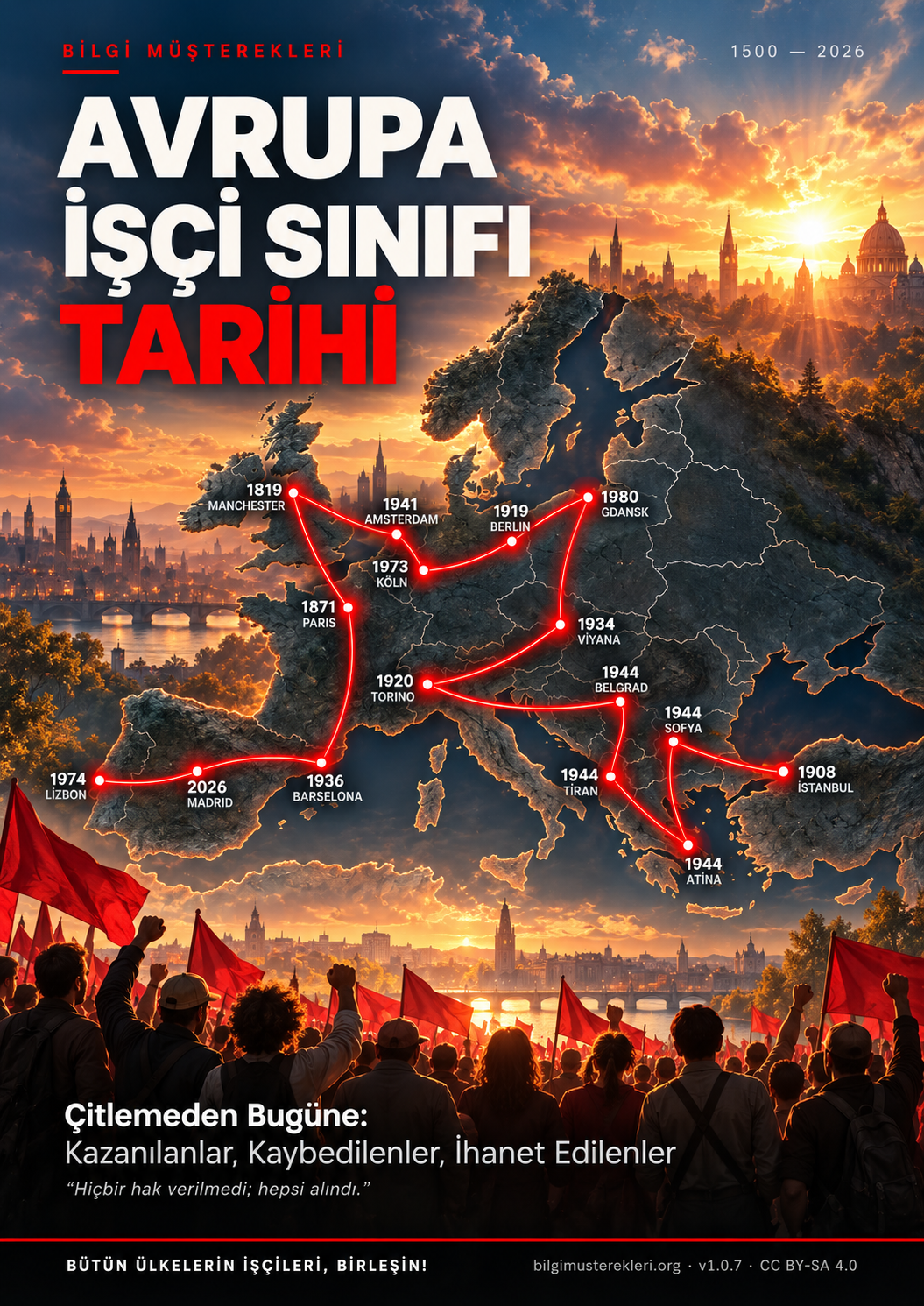
A History of the European Working Class, version 1.0.7. All our dossiers are on the Guides page.
Dear Young Comrades,
This month we set the news coming from Europe one under another. In Saxony-Anhalt the AfD took 43.8 percent. In Berlin, Elif Eralp's party, defending a socialist programme, came first in the election. In Madrid a retired woman, Maricarmen, was carried from her home on a stretcher and a neighbourhood rose. In Germany secondary-school students emptied the schools against conscription and marched saying "The rich want war, students want a future."
While we read this news the same question kept coming to mind: None of this is new. So how well do we know this history?
Without knowing where reaction in Europe comes from, how the welfare state was built and how it was dismantled, why social democracy at critical moments always chose the same side, why the socialist experiences in the East dissolved, we cannot read today. Those who cannot read today cannot build tomorrow either.
Today we publish our own answer to this question:
A History of the European Working Class: From Enclosure to Today: What Was Won, What Was Lost, What Was Betrayed.
Version 1.0.7. A single volume, 1,224 pages. Licensed CC BY-SA 4.0: reading, copying, translating, adapting and criticising are free.
- PDF (A4, 1,224 pages, with numbered contents and bookmarks)
- ePub (for e-readers)
- Markdown (to correct, translate, adapt)
This piece tells what the book is, how it was built, what it defends, and how it can be read.
The book at a glance
| Scope | From about 1300 to 27 September 2026: from the dissolution of feudalism to today's Europe |
| Structure | Introduction, Chapter 0 (Marxist Toolbox), thirteen parts, ninety-three chapters, nine theoretical interludes, Closing, Conclusion, eleven appendices |
| Scale | About 435 thousand words, 1,224 pages |
| Images | 226 public-domain or freely licensed photographs and documents compiled from Wikimedia Commons; each one's author and licence under it and in the "Image Sources" section at the end of the book |
| Geography | From England to Albania, from Portugal to Finland; a separate part on the two-way relation between Turkey and Europe |
| Voice | "We"; "Dear Young Comrades" at the openings of parts; a language that tells from the beginning to a reader who knows nothing, and speaks with evidence |
| Licence | CC BY-SA 4.0: any use is free, provided the source is given and sharing is under the same licence |
Why a history of the European working class?
What we have read in Turkish on the history of the European working class mostly falls into one of three moulds.
The progress narrative: "The industrial revolution brought hard years but in the end welfare came." In this narrative rights arrive of themselves; as the market and democracy mature, working hours shorten, wages rise, social security is founded. There is no one who struggles, who strikes, who goes to prison, who is shot.
The party-history narrative: Internationals, congresses, programme debates. It tells of leaders but not of the factory, the mine, the neighbourhood. The working class is a crowd standing behind the leaders.
The two-totalitarianisms narrative: "Fascism and communism were two faces of the same coin; in the middle stood intelligent social democracy." This is the official narrative of the Cold War, and today it is everywhere from European Parliament resolutions to schoolbooks.
This book does a fourth thing: it tells Europe as the laboratory of class struggle. Every right that was won was taken by fighting. Every position that was lost was lost together with conciliation in the class's own ranks.
We can summarise the book's stance in a single sentence: the history of the European working class is not a history of defeats; it is a school that shows that every right won is the product of a struggle, every right lost the product of a compromise. From this school we learn method, not lament.
Four questions
The book interrogates every period, every event, every institution with the same four questions. Every chapter ends with the answers to these four questions:
In whose hands? Under whose control? To whose benefit? Who decides?
These four questions are more than a history book. Once you have learned them, you look with the same eye at a factory, a municipal budget, an artificial-intelligence company, a collective agreement, a school's governing board. The real thing the book wants to leave you is this gaze itself.
Nine theses
The book does not claim to be a neutral academic text. Those who wrote it are communists who defend a class stance in today's world and believe that humanity's future will again be a socialist world. This stance is set out plainly in nine theses:
One: The working class was not born, it was made. It was made by enclosures, by the driving of the peasant from the land, and by the "bloody legislation"; and it made itself. In Marx's phrase, capital came into the world "dripping from head to foot, from every pore, with blood and dirt."
Two: The bourgeoisie has two faces. It was revolutionary against feudalism; from the first day it was counter-revolutionary against the worker. The same French Revolution both abolished feudal privileges and, with the Le Chapelier Law (1791), banned workers' organisation. In the June Days of 1848 the roads parted in blood; in 1871 the Commune was drowned.
Three: The role of social democracy is the dossier's centre of gravity. The tragedy of the European labour movement is not only the strength of the enemy. There is an apparatus that came out of the movement and at critical moments chose cooperation with the bourgeoisie: "yes" to the war credits in 1914, the suppression of the revolution in 1918–19 by agreement with the generals, the killing of Rosa Luxemburg and Karl Liebknecht, the "lesser evil" policy in the last years of Weimar. But the book is not a catalogue of betrayals. It analyses social democracy in its dual character: what is the material basis of its being both a branch of the labour movement and a pillar of the bourgeois order?
Four: The communist movement is tested too. The criticism of social democracy is not made in order to cover the errors of the communist movement. The KPD's sectarianism of 1929–33 and the thesis of "social fascism" are among the reasons a united front could not be built in Germany, and the book takes them up openly, with self-criticism.
Five: It was the working class that saved Europe from fascism. The Red Army, the partisan armies, the resistance movements, the strikes. The narrative of "the Allies' victory" covers this fact.
Six: The welfare state is the product of fear. The rights of the "golden age" of 1945–1975 were not the generosity of capital. They were the product of a working class that came out armed and organised, of the existence of a system in the East in which capitalism had been abolished, and of the rent flowing from the colonies. When the fear ended, the rights were taken back.
Seven: Yellow unionism is not a deviation, it is a weapon. From the strike-breaking "yellows" in France in 1899 to fascist corporatism, from unions split by outside finance in the Cold War to today's tables of "social partnership."
Eight: Socialism was not defeated; revisionism collapsed. What collapsed in 1989–91 is not socialism but the bureaucratic state capitalism built over thirty years after the 20th Congress of 1956. The construction of socialism, for all its errors, defeated fascism, turned a backward agrarian country into an industrial power, and universalised social rights.
Nine: Type I begins with a communist world. We tell this thesis separately below.
The book's map
| Part | Period | What do we learn in this part? |
|---|---|---|
| Introduction | The Pale Blue Dot, the Kardashev scale and 1 May 1890: why is this history our history? | |
| Chapter 0: Marxist Toolbox | Value, exploitation, class, the state, crisis, imperialism; the class-power scale, fractions of capital, the social wage, the balance-of-forces matrix | |
| I. Origins | ≈1300–1750 | The dissolution of feudalism, enclosures and primitive accumulation: the forcible making of the working class |
| II. England | 1750–1850 | The first industrial working class, the Luddites, Peterloo, the Chartists |
| III. Bourgeois revolutions and 1848 | 1789–1852 | From the sans-culottes to the June Days, to the Communist Manifesto |
| IV. The age of Internationals | 1864–1914 | Mass parties, the Paris Commune, unions and the birth of bureaucracy |
| V. The great betrayal and the revolutionary wave | 1914–1923 | War credits, the October Revolution, the German Revolution, Rosa and Karl, the councils |
| VI. The road to fascism | 1924–1939 | Italy, the last years of Weimar, Austria 1934, Spain |
| VII. Anti-fascist fronts | 1939–1945 | Resistance country by country: Yugoslavia, Albania, Greece, Bulgaria, Italy, France |
| VIII. Yellow unionism | 1899–2026 | From strike-breaking to corporatism, from Cold War splits to "social partnership" |
| IX. Welfare and fear | 1945–1975 | Post-war rights country by country; "Soviet fear" and the material basis of the gains |
| X. Socialism in the East | 1944–1991 | People's democracies, the 20th Congress, the GDR, Czechoslovakia, Poland, Hungary, Yugoslavia, Albania, the dissolution |
| XI. When the fear ended | 1973–2026 | Thatcher, Kohl, the class construction of the EU, Hartz, capitalist restoration, today's Europe |
| XII. Imperialism and booty | 1492–2026 | Colonial rent, the labour aristocracy, Europe as the booty recedes, and today's imperialist networks |
| XIII. Turkey and Europe | 1838–2026 | Ottoman debt, the workers who went to Germany, the Customs Union, from "Almancı" to "white-collar migrant" |
| Closing and Conclusion | 2026–2040 | Lessons and tasks, footsteps, forecasts for organisation, the world of the future |
| Appendices A–K | Chronology, figures, glossary, people, organisations, reading list, comparative tables, answers to false narratives, bibliography, map plan, ecology |
Between the parts we placed nine theoretical interludes. In these we give the historical narrative a breath and open a concept in depth: the joint consumption of the worker and the land (the metabolic rift), how the state governs by force and consent, the factory outside the factory (the home, care, the reproduction of labour-power), how a class makes itself through culture and memory, why crisis repeats, the ordinary and extraordinary forms of the bourgeois order, the five steps of property, the history of the labour process and of time, and last the forms of organisation: party, union, council, cooperative, neighbourhood.
What is in every chapter?
Every chapter of the book was built on the same skeleton. After you have read a few chapters you know where to find what:
- Scene: A concrete moment that opens the chapter. A factory gate, a rally, a barricade.
- Thesis: The chapter's claim, in two to four sentences.
- Main text: The event, and always beside it its class analysis.
- Concept box: Definitions from zero of the concepts that appear in the chapter.
- Critical moment: A table of five columns. What did the class want? What did social democracy or the union bureaucracy do? What was capital's counter-move? Which fraction of the bourgeoisie gained what? What was the result?
- Capital's weapons of class war: The law, police, press, yellow union, migration regime that capital used in that period.
- The labour process and Whose is time?: Who designed the work, who held the knowledge, who set the speed?
- The tie to Turkey: The counterpart of the same years in Turkey.
- Reply to a false narrative: A widespread official or liberal mould, and the class reply.
- Four questions and a reading-and-watching suggestion.
The official narrative and the book's reply
Appendix H of the book is given over entirely to moulds of this kind. Below we set a few examples side by side:
| What does the official narrative say? | The book's reply |
|---|---|
| "The industrial revolution brought hard years but welfare came of itself." | The eight-hour day, the right to a union, social security: none of them came of itself. Each was taken by strike, barricade, prison, bullet. |
| "The welfare state is the work of intelligent social democrats." | The welfare state is the product of a working class that came out armed and organised, of the socialist system in the East, and of colonial rent. When the fear ended it was dismantled. |
| "Fascism and communism were two faces of the same coin." | Big capital financed fascism and carried it to power; those who defeated it were the working class, the partisans and the Red Army. |
| "Nazism was the madness of the unemployed masses." | What was decisive was which fraction of the bourgeoisie turned to fascism and why, and why the working class was divided. |
| "1989 is the bankruptcy of socialism." | What collapsed in 1989–91 is the bureaucratic state capitalism founded after 1956. The "shock therapy" that followed the collapse took back the rights of millions. |
| "Ostalgie is East Germans' emotional attachment to the past." | Ostalgie is the class expression of the longing for the job, housing, crèche and security lost through Treuhand's dispossession. |
| "Migrants threaten Europe's welfare." | European welfare was built over centuries with migrant and colonial labour. What threatens welfare today is not those who built it but those who dismantle it. |
| "White-collar workers are not workers." | The proletariat is the class of those who, because they are without means of production, must sell their labour-power in order to live. Working at a desk, a screen, in a warehouse or on a line does not change this. |
First the tool, then the history: Chapter 0
Before entering the chronology the book sets up a toolbox. The most important sentence of Chapter 0 is the spine of the whole book:
The proletariat is not the class of those who do bodily labour, but of those who, because they are without means of production, must sell their labour-power in order to live.
This definition brings back together, inside the same class, the millions today divided as "white-collar," "professional," "self-employed," "precariat." It shows how the software worker and the courier, the teacher and the warehouse worker, fit in the same sentence.
Beside this definition Chapter 0 also has these tools:
- The class-power scale: A tool that measures how strong a class is through organisation, structural power, workplace power and political representation.
- A map of the fractions of capital: The bourgeoisie is not a single piece. Which of the industrial, financial, landed, exporting and home-market fractions gained in which period, and why?
- The social wage: The wage is not only the figure on the payslip; health, education, housing and retirement are also parts of the wage. When they are dismantled, the wage has fallen.
- The balance-of-forces matrix and a six-dimension integrated formula:
The condition of the class = property + control + organisation + structural power + social reproduction + hegemony
Chapter 0 also builds a philosophical spine: alienation, dead and living labour, reification, metabolic repair, free time and the subject. The chapter ends with a set of twenty exercises for reading groups.
A special part: Turkey and Europe
We wrote this book looking from Turkey, and we did not hide it. Part XIII tells the two-way class relation between Europe and Turkey from 1838 to today:
- the Ottoman Empire's indebtedness to European capital, the railways and the first strikes,
- Britain and Turkey: from empire to financial centre,
- the workers who went to Germany: from "guest worker" to lasting class, from the 1973 Ford Cologne strike to today,
- workers from Turkey in the Netherlands, Belgium, France, Austria, Sweden and Switzerland,
- the Customs Union and Turkey's becoming a "cheap-labour ring" for European capital,
- the class content of "democracy" discourse and of political relations,
- from "Almancı" to "white-collar migrant": culture, identity and class,
- today's two-way migration, a common class and internationalist tasks.
In the rest of the book too every chapter has a "tie to Turkey" box. While you read the law that banned workers' organisation in Paris in 1791 you see the strike bans of 12 September; while you read Weimar's "lesser evil" policy you see our "not enough but yes"; while you read the Hartz reforms you see our flexible-work laws, side by side.
The Pale Blue Dot and Type I: Where does the book start, where does it arrive?
The book opens from an unusual place: from the photograph Voyager took in 1990 from six billion kilometres away, which Carl Sagan called the "pale blue dot." From that distance neither borders are visible, nor stock exchanges, nor title deeds. A single species is visible, on a single planet. As you draw near, the fences appear: whose land, whose factory, whose labour.
The second scene is the Kardashev scale. On this scale humanity is still a Type 0 civilisation: it cannot organise the planet's energy, infrastructure and communication consciously at planetary scale. Type I is the civilisation that can do this.
The book's ninth thesis stands exactly here:
Humanity can truly pass to Type I only in a communist world in which classes have disappeared and the producers consciously manage their own relations at planetary scale.
Production for profit, competition among monopolies, nation-state conflict and war are the exact opposite of the conditions of a planetary civilisation. Class society, however much its technical capacity grows, organises the planet not as a common home but as a hunting ground. In Marx's phrase, class societies are "the prehistory of human society"; humanity's real history begins with communism.
This is not a prophecy, it is a conditional proposition: The technical possibility exists, the social form does not. The class that will found that social form is the working class.
The third scene is 1 May 1890: the first day workers across Europe went into the street on the same day, for the same demand, for the eight-hour day. The book begins by binding these three scenes to one another, and in the Conclusion it returns to the same place, to the call "Workers of all countries, unite!"
Footsteps: the book ends in the present
This is not a museum book. One of the closing chapters, Chapter 92: Footsteps, compiles the signs of awakening in Europe in 2024–2026: anti-war actions, student movements, anti-fascist struggles, the housing marches in Spain, strike waves and the turn of youth to the left in Germany.
Chapter 93, which follows, sets out our forecasts for the organisation of the class in Europe in 2026–2040. Digital transformation and artificial intelligence will be either an instrument of unemployment and surveillance, or the foundation of a world in which working time is shortened and planning is again possible. Which it will be, technology will not decide; class struggle will.
The historical background of what we have written on this blog in recent weeks is also in this book. If you have read AfD's 43.8 Percent Is Not a Deviation, Elif Eralp: "We Wrote History, Comrades", Maricarmen's Stretcher, Elif's Key: Europe's Housing Crisis and the Class of the Home and The Rich Want War, Students Want a Future, this book tells the origins of those pieces.
How is it to be read?
Do not let 1,224 pages frighten you. We do not expect you to read this book from beginning to end in one sitting. We propose several paths:
For those who want to read from the start: Begin with the Introduction and Chapter 0. Once the toolbox is set up, each part can be read on its own.
For those who want to understand today: Begin with Part XI (When the Fear Ended), Part XIII (Turkey and Europe) and Chapter 92 (Footsteps); then go backwards.
For those who want to enter the social-democracy debate: Part V (1914–1923) and Part VI (The Road to Fascism), especially the chapters that tell the last years of Weimar.
For those who want to discuss the experiences of socialism: Part X (Socialism in the East) and Theoretical Interlude K7 (The Five Steps of Property and Control).
For those who want to found a reading group: In Appendix F there is a ten-week reading programme. For each week there is a reading from the book, a short piece from a classic, a watching suggestion and discussion questions, ready. Our proposal is simple: once a week, ninety minutes, the same day, the same hour. Each week one person tells a ten-minute "scene," then the discussion begins. The last fifteen minutes are always given to the same question: What does this correspond to today in our workplace, our school, our neighbourhood?
A living document
This book is not a finished work; it is a living document. We say this plainly, because honesty is a class stance.
In the text we marked about six hundred facts (to be verified). These are dates, election results, death and turnout figures that need to be checked again against primary sources. We gave disputed figures not as a single number but as a range. There is no invented quotation, invented source or invented person. Where we were not sure, we wrote "we are not sure."
The Contribution and Development section at the end of the book tells how you can contribute:
- Correction of fact: If you see a wrong date, figure or name, report it with the source.
- Closing "(to be verified)" marks: A primary source for each mark.
- Documents and archive: Strike leaflets, union publications, workers' newspapers, photographs, posters.
- Testimony: The accounts of workers and families who have worked in Europe, migrated, taken part in strikes and organisations. Especially the experiences of workers who went from Turkey. There is a five-question testimony template in the book.
- Translation: Especially German, Kurdish, English and French.
- Criticism: Comradely criticism directed at the analysis, the theses and the method.
The aims of version 1.1 are also clear: to close at least half of the "(to be verified)" marks, to produce the planned maps and charts, an index of people-places-concepts, a new appendix of testimonies of workers from Turkey in Europe, a shortened guide for reading groups, and the publication of each part as a separate piece on this blog.
Every contribution will be assessed. Those accepted will enter the text in the next version, and the names of those who contributed will, if they wish, be mentioned in the version notes.
Concrete tasks for young comrades
A book is written not to be read but to be used. Our proposals:
- Found a reading group. Three people are enough. Follow the ten-week programme in Appendix F. Keep a shared notebook: what did we learn each week, what could we not discuss, which question do we carry to the next week?
- Carry the four questions to your workplace, your school, your neighbourhood. Read a collective agreement, a municipal budget, an urban-transformation project, a school canteen with these four questions, and write.
- Record your family's testimony. If you have a relative who went to Germany, the Netherlands, France, speak with them using the five-question template in the book. That testimony can be part of this book in the next version.
- Close one "(to be verified)" mark. Follow a fact to its source in the library, the archive, official statistics. Writing history begins with verifying history.
- Translate or tell a chapter. Summarise a chapter in your own language, turn it into a presentation, a podcast, a fanzine. The licence is open to this.
- Follow the footsteps. Follow the indicators in Chapter 92 in your own surroundings: a strike, a housing action, a student boycott. Every year on 1 May we will update this chapter together.
Dear Young Comrades,
While writing this book we returned again and again to the same sentence: No right was given; all were taken.
The eight-hour day is the work of the workers hanged in Chicago, of the millions who went into the street on 1 May 1890. Social security is the work of the partisans who defeated fascism. Crèches, people's housing, free healthcare are the work of the balance of forces between the workers who abolished capitalism in the East and the bourgeoisie in the West that feared them. Every right dismantled today is dismantled because that balance of forces was broken.
But this history teaches us one thing more: a balance of forces is not permanent. Peasants dispossessed by enclosures founded a union in Manchester a century later. The Commune was drowned; forty-six years later October came. Weimar was lost; twelve years later the red flag flew in Berlin. The young people marching today in Berlin, in Madrid, in the streets of Wedding are not the last page of this history; they are the first lines of a new page.
From the pale blue dot a single species is visible. The day that species takes its own fate in hand at planetary scale will be the day classes disappear. This book tells the past of the road to that day. We will write its future together.
Workers of all countries, unite!
Comradely.
Knowledge belongs to everyone.
Download, read, share
- PDF (A4, 1,224 pages)
- ePub
- Markdown
- All our dossiers and guides: Guides
Related pieces
The Europe and Germany line · for all of them the Germany tag
- AfD's 43.8 Percent Is Not a Deviation
- A Class Soldier in Berlin: Elif Eralp
- Elif Eralp: "We Wrote History, Comrades"
- What Awaits Elif Eralp?
- Maricarmen's Stretcher, Elif's Key: Europe's Housing Crisis and the Class of the Home
- The Rich Want War, Students Want a Future
- A Communist Traveler in Berlin
- The Ulm 5 Trial
- The Surplus Value on the Thermometer
The class, history and ideology line · for all of them the class tag
- Why Do Workers Vote for the Right?
- Has Neoliberalism Ended?
- What Is This Thing Called Racism?
- To Defend Stalin Is to Defend Socialism
- Dossier: The Real Russia
- Dossier: The Real China
- BRICS Behind the Curtain
- 12 September: The History, Balance Sheet, and Present of a Class Coup
- The Class Anatomy of Geography and the City
- Revolutionary Possibilities of the 21st Century and the Reconstruction of Scientific Socialism
- Criticising Utopia Is Not Enough: A Comradely Reading of Issue 73 of Teori ve Eylem
The labour, technology and future line
- For the Restitution of the General Intellect: The Socialist AI Manifesto Is Out
- The Machine Is New, the Chain Is Old: A Class Anatomy of Remote Work
- Against Whom Is 'Physical AI' Arming?
- Gig Economy Dossier
This piece and A History of the European Working Class are published under a CC BY-SA 4.0 licence. Copy, translate, discuss, use.