US Midterm Elections, Techno-Capital and Algorithmic Politics
The Money Network, the Feed Network: When the Owners of the Platforms Become a Side in the Election

Dear young comrades,
On 3 November 2026, that is, in six days, the midterm election is being held in the United States. The whole of the House of Representatives, a third of the Senate, dozens of governorships and thousands of state-legislature seats are at the ballot box. Looked at from Turkey, this election is reduced to the question "will Trump win, or will he lose?". What is actually of interest, though, is the two networks woven around the ballot box: the money network and the feed network. The first determines who finances the election; the second determines what the voter sees and what the voter does not see. The same companies sit at the junction of the two.
In this essay there is first a short summary, then the detail.
First, a Summary: Ten Theses
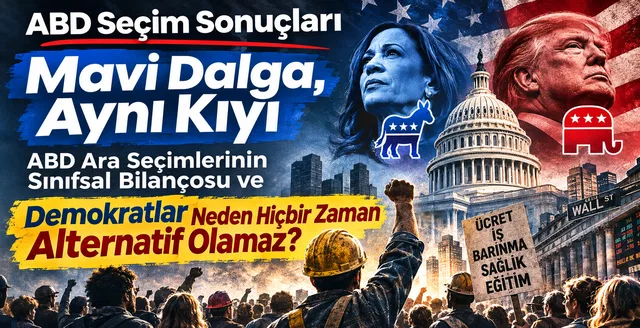
- The wind is with the Democrats. In the generic ballot polls the Democrats are ahead by 9 points on average; Trump's approval is around 37%, the second-lowest level, since 1946, for entry into a midterm. The House is in all likelihood changing hands; the Senate, for the first time, is seriously in play.
- The issue that determines the election is the cost of living. 71% of voters do not approve of Trump's handling of inflation. So the everyday life of the class appears to have drowned out the noise of the culture wars.
- The most expensive election in history. Political advertising spending is estimated at 11.6 billion dollars. The largest 50 donors have, by themselves, given 2.77 billion dollars.
- A one-person party: Elon Musk. With about 446 million dollars, by a wide margin the largest donor of this election. More than a quarter of the Republicans' donations comes out of a single man's pocket.
- Artificial intelligence capital is in the field, for the first time, with its own super PACs. Andreessen Horowitz and OpenAI's Greg Brockman are in "Leading the Future"; Meta is in its own super PACs; David Sacks's group is directly on the Trump line; Anthropic is on the other side, with "Public First".
- The subject of the fight is in whose hands regulation will be. Techno-capital's main demand is the removal, at the federal level, of the states' power to regulate artificial intelligence (preemption). Trump supports this with an executive order and a draft law.
- The relation between Trump and techno-capital is an exchange. In return for support and money: an absence of regulation, state contracts, the transfer of assets such as TikTok into "friendly hands".
- Algorithmic politics is no longer a "foreign influence"; it is infrastructure. Meta removed independent verification and is bringing political content to the fore again; that X's feed algorithm shifts users to the right was shown by an experiment published in Nature; the US arm of TikTok passed into the hands of a group of investors close to Trump.
- This is not a US event. Musk's support for the AfD, Meta's "invisible ballot box" role in Brazil, the march of the young in Serbia against the algorithm, are parts of the same world: monopoly capitalism, the state and the communications infrastructure are fusing with one another.
- A Democratic victory is not liberation; it is room to breathe. There are billionaires on the opposing front as well. The way out is not in the lesser evil to be chosen at the ballot box; it is in organised social power against the feed and against money.
A Photograph of the Election: Six Days Out
The House
For the Democrats to take the House of Representatives they need to win only a net 3 seats. In the generic ballot (the question of which party you will vote for) there is a gap of 9 points on average, and this gap has grown in the last month. For comparison: in 2018 the Democrats were ahead by 7.6 points at this stage, and they won 41 seats (Yahoo News).
The Republicans' only assurance is the redrawing, in the southern states, of electoral districts before the ten years are up. That is, an election whose map has been played with before anyone goes to the ballot box. Even Fox News's power ranking writes that the House will change hands, and that the Senate is uncertain. The prediction markets, too, put to the fore the chance that the Democrats will take both chambers at once (CNBC).
The Senate
The Democrats have 47 seats; 51 are required for a majority (in a 50-50 the vote is cast by Vice President JD Vance). So they need to turn four Republican seats. Looking at the table, it can be seen that this is no longer a fantasy:
| State | Current holder | The race | Latest position (October polls) |
|---|---|---|---|
| North Carolina | Republican | Whatley - Roy Cooper | Cooper ahead by 10 points on average |
| Ohio | Republican | Husted - Sherrod Brown | Brown ahead by 1-8 points |
| Texas | Republican | Ken Paxton - James Talarico | Talarico ahead by 2-6 points |
| Maine | Republican | Susan Collins - Troy Jackson | Neck and neck, Jackson slightly ahead |
| Alaska | Republican | Sullivan - Mary Peltola | Peltola ahead by 2-7 points |
| Kansas | Republican | Marshall - Adam Hamilton | Hamilton ahead in most polls |
| Nebraska | Republican | Ricketts - Dan Osborn (independent) | Little data, contested |
| Iowa | Republican | Hinson - Turek | Neck and neck |
| Georgia | Democrat | Ossoff - Mike Collins | Ossoff ahead by 8 points on average |
| Michigan | Democrat | Rogers - Abdul El-Sayed | El-Sayed ahead in 18 of 19 polls |
| New Hampshire | Democrat | Sununu - Pappas | Pappas ahead by 7 points |
Source: the Yahoo News poll compilation; also RealClearPolling.
Attend to one detail: Dan Osborn, whom the Democrats supported in Nebraska while not fielding a candidate of their own, is a trade unionist; one of the leaders of the strike at the Kellogg's factory. El-Sayed in Michigan and Talarico in Texas are also candidates who speak in the language of "the cost of living and oligarchy". This is a sign that the class question has been forced to seep even into mainstream politics.
Why is it so?
The axis of the election is the cost of living. Only 25% of voters approve of Trump's handling of inflation; 71% do not approve: a gulf of 46 points. Trump's general approval is 37%, and those who do not approve are 60%. According to the NYT, this is, for a president entering a midterm since 1946, the worst picture after Truman.
There is a small but important lesson here: tariffs, the hunt for migrants, the culture war… All of them made a noise on the screens. But the supermarket receipt speaks louder than the noise. Let us keep this in mind so as not to fall into the illusion that the algorithm determines everything. As we shall see below, the algorithm changes a great deal, but it does not work above material life; it works inside it.
The Money Network: The Most Expensive Election in History
The figures
- Estimated total political advertising spending: 11.6 billion dollars (Al Jazeera, AdImpact).
- The largest 50 donors: 2.77 billion dollars. Of this, 60% has gone to the Republican side, 30% to the Democratic side.
- 172 billionaire families have already poured 1.7 billion dollars into this election (Common Dreams).
- The money companies gave directly to super PACs had reached 517 million dollars at the end of June; in the whole of 2024 it was 461 million dollars. Of this, 294 million was from crypto, artificial intelligence, big technology and online betting companies (Public Citizen).
The largest donors
| Republican side | Amount | Democratic side | Amount |
|---|---|---|---|
| Elon Musk | 446 million $ | George Soros | 102 million $ |
| The Uihlein family (packaging) | 150 million $ | Michael Bloomberg | 84 million $ |
| Jeff and Janine Yass (the stock exchange) | 110 million $ | Reid Hoffman (LinkedIn) | 41 million $ |
On the crypto side, Coinbase is on the list with 57.8 million, Ripple with 49.6 million, and Crypto.com with 39 million dollars. The online betting company DraftKings has given 40 million dollars.
Lawrence Lessig of Harvard sums the problem up well: "The problem is not the spending; it is the concentration of the donors." And he adds: "Money is not dark for the politicians; it is dark for us."
In reading this table we must see two things together. First, on the Republican side the greater part of the money comes from a handful of people. Second, the opposing side is not "the people's money" either: Soros, Bloomberg and Hoffman are billionaires too. The election works like a tender among fractions of billionaires. The difference lies in which fraction wants which regulation.
Musk: a one-person party
In May 2025 Musk had said "I have spent enough". Then, from July, he opened the tap again. First 276 million, then another 77 million dollars in the second half of October; 446 million dollars in total (CNBC, Forbes). Of this, 158 million went to a super PAC focused solely on Republican Senate candidates.
The background of this money matters too (Al Jazeera):
- In June 2026 SpaceX was listed on Nasdaq, and Musk became the world's first trillionaire.
- On 8 October Trump gave Musk the National Medal of Science.
- The contracts of SpaceX, of Tesla and of xAI with the state, their lawsuits with the regulatory bodies, and the space and defence budgets are bound directly to the result of this election (CNBC).
So Musk's spending is an investment item as much as it is an "ideological preference". To lose Congress means investigative committees; investigative committees mean that the contracts, the subsidies and the regulatory exemptions are put on the table.
Techno-Capital's Electoral Army: The Artificial Intelligence Super PACs
In 2024 the Fairshake super PAC, set up by crypto capital, established a model: to come out, with tens of millions of dollars, against candidates who opposed crypto. In Ohio they spent 40 million dollars to bring Sherrod Brown down, and they succeeded. Afterwards the GENIUS Act, in favour of crypto, passed. The message was clear: if you oppose us, you lose your seat.
Artificial intelligence capital copied this model. Since August 2025 four large formations have been in the field:
| Formation | Who is behind it | Money | What it wants |
|---|---|---|---|
| Leading the Future | Andreessen Horowitz (50 million $), OpenAI president Greg Brockman and his wife (25 million $), Joe Lonsdale, one of the founders of Palantir, Perplexity | More than 125 million $ | The invalidation of state laws at the federal level, "rapid innovation" |
| Meta's super PACs (American Technology Excellence Project + the California PAC) | Meta | 65 million $ (state elections) | To punish, in the state legislatures, candidates who defend AI regulation |
| Innovation Council Action | Trump's AI adviser David Sacks; at its head, the former Trump spokesman Taylor Budowich | At least 100 million $ | Only candidates who pledge loyalty to Trump's federal AI framework |
| Public First Action | Anthropic | A target of 75 million $ | The preservation of the states' power to regulate |
Sources: Public Citizen, Futurism / Financial Times, Wikipedia: Leading the Future, Quartz.
Let us note that Greg Brockman also gave 25 million dollars to Trump's super PAC, MAGA Inc. So the president of OpenAI finances, with one hand, a "bipartisan" AI PAC and, with the other, Trump directly.
The Bores case: the first test
The first scene of this war was New York's 12th district. The state legislator Alex Bores was the architect of RAISE, New York's AI safety law, and he was proposing an "AI dividend" that provided for payment to the people whom AI had left without work. Leading the Future declared him the first target: in its spokesperson's words, "Bores is only the first; he will not be the last."
In the primary of 23 June 2026, outside groups poured more than 40 million dollars into this single race. Leading the Future spent 8 million against Bores, and the group backed by Anthropic spent about 20 million dollars in his favour. In the end Bores lost; but the winner, Micah Lasher, was also a co-sponsor of the RAISE Act (Gizmodo).
The lesson that comes out of this case is this: a proxy war between two AI companies was fought for a single House seat. The voter was turned, in effect, into an extra in the regulatory dispute of two fractions of capital.
What is the fight actually about?
Today CNBC writes that "Silicon Valley's AI groups have fallen out with one another". That is right, but this fight must not be read as "good company – bad company":
- Leading the Future and Meta want no state regulation at all; they say that only narrow areas, such as child safety, should remain.
- Sacks's group wants the power to regulate to be gathered in the White House, that is, to be centralised in the hands of the executive. Trump's AI legislative framework of March 2026 provides exactly this.
- Anthropic, for its part, defends the states' power on the grounds of "safety". But, as we showed in Anthropic's Activist Monitoring System, the "responsible monopoly" is a monopoly too: safety regulation also works as a cost wall that the large players can bear and that the small ones cannot.
In short, what is under discussion is not whom artificial intelligence will serve, but in favour of which fraction of capital the rules will be written. There is one more aim that the advisers of Leading the Future state openly: to label as "doomsayers", and to silence, those who speak of the effect of AI on the labour force and of the health effects of data centres. As Sarah Myers West of AI Now says, none of these groups asks the worker's question.
Trump and Techno-Capital: The Anatomy of an Exchange
The first day of Trump's second term began with the names sitting in the front row at the inauguration: Musk, Zuckerberg, Bezos, Pichai, Cook. At the White House dinner in September 2025 the technology bosses praised Trump in turn and gave promises of investment (Axios). In January 2026 Trump was recounting that Zuckerberg had shown him a data-centre plan "the size of Manhattan" (Fortune).
To read this drawing closer as personal friendship, or as fear, falls short. There is a mutual exchange on the table:
| What techno-capital gives | What the Trump administration gives |
|---|---|
| Election money (Musk 446 million $, Brockman 25 million $ to MAGA Inc.) | The removal of the AI restrictions of the Biden period |
| Ceremonial donations, promises of investment at the White House | The December 2025 executive order: the threat to cut the federal funds of states that pass an AI law |
| The removal of independent verification on the platforms, conformity with the discourse of "freedom of expression" | The March 2026 federal AI framework: the gathering of the power to regulate in the executive |
| Promises of data centres and of "American AI leadership" | Defence, space and intelligence contracts (SpaceX, Palantir, OpenAI, Anthropic) |
| The coming of names such as Sacks directly into state office | The transfer of TikTok's US arm to investors close to Trump |
But this alliance is not without cracks:
- In July 2025 the Senate removed from the budget bill, by 99 votes to 1, the clause imposing a 10-year ban on state AI laws. So even the Republicans' own base resisted this demand for non-regulation (Broadband Breakfast).
- Names such as Steve Bannon and Ron DeSantis say openly that the alliance with Silicon Valley will alienate the MAGA base.
- In the eyes of the rural voter, data centres are the symbol of rising electricity bills and of water running dry. Governor Abbott of Texas froze new data-centre connections in August, when demand exceeded the grid's record peak five times over. In Virginia a Democratic candidate took a seat the Republicans had held for 30 years, with a campaign against data centres.
- Because the White House did not find Leading the Future "loyal enough", it had Sacks's group set up.
These cracks matter, because they show us this: the alliance between techno-capital and right-wing populism is a tense alliance, between the interest of one section of capital and the anger of the small producer, the farmer and the worker at the base. The ideological line we set out in From Futurism to Techno-Fascism becomes political practice here.
The Feed Network: How Does Algorithmic Politics Work in the United States?
Let us come to the real question. Since the Cambridge Analytica scandal of 2016, the question has been asked: "does social media affect the election?" In 2026 the question has changed: the owners of the social media companies are now directly a political side. The algorithm is the strongest instrument in this side's hands.
Algorithmic politics has five layers. Let us look at them one by one.
Layer 1: Who decides what will be visible? (Ranking)
The example of X. An experiment published in Nature in February 2026 gave, for the first time, a causal answer to this question (PsyPost, OECD.AI). Gauthier, Hodler, Widmer and Zhuravskaya divided 4,965 active X users in the United States, at random, into two groups for seven weeks: one saw the algorithmic feed, the other the chronological feed. The results:
- The algorithmic feed brought conservative posts and the accounts of political activists to the fore more than liberal posts; traditional news sources, for their part, it pushed markedly back.
- Users on the algorithmic feed shifted measurably to the right: they began to find migration and inflation more important, they looked more critically at the investigations into Trump, and they acquired attitudes closer to the Kremlin in the war in Ukraine.
- The most striking finding: returning to the chronological feed did not reverse the effect. Because users had begun to follow the accounts the algorithm had put in front of them. That is, the algorithm is not merely selecting a momentary piece of content; it is permanently reweaving the person's social network.
The size of the effect is small (0.08-0.12 standard deviations). But when it is applied to millions of users and to races that run neck and neck, a small shift can determine a Senate seat. Moreover, this experiment was conducted in the summer of 2023, when Musk's own account and his political preferences did not dominate the platform to the extent they do today.
The example of TikTok. In January 2026 the US arm of TikTok (TikTok USDS) was transferred to a consortium led, with a 15% share each, by Oracle (Larry Ellison), Silver Lake, and MGX, based in Abu Dhabi. It is reported that the new company will pay the Trump administration 10 billion dollars (Wikipedia). Ellison is at the same time, through his son, in control of Paramount, the owner of CBS. Bernie Sanders's warning was that Ellison would control the algorithm of the largest youth platform in the United States (Variety).
Immediately after the transfer, users claimed that videos about the ICE raids, about Epstein, and about the killing of Alex Pretti in Minneapolis were being suppressed; Governor Newsom of California opened an investigation. An analysis carried out by eight academics from Université Laval, on more than 100,000 videos, showed that the fall coincided with a data-centre outage on the same days, and that a systematic censorship could not be proved with publicly available data. But the researchers add: small-scale removals, or "shadow banning", are not visible in the aggregate data; claims such as a block on "Epstein" in direct messages, for their part, could not be examined at all, because there was no access to the data (NPR).
The class point here is this: that it cannot be proved does not mean that it does not exist; it means that it cannot be audited. Ownership changed; the code and the training of the algorithm are a closed box. Society is deprived of the right to learn how its own public sphere is arranged.
Layer 2: Who decides what will count as true? (Moderation)
Meta, in January 2025, closed the independent verification (fact-checking) programme in the United States and put "Community Notes", as on X, in its place. In the same announcement it declared that political content would begin to be recommended again on Facebook, Instagram and Threads. Zuckerberg presented this as a "return to freedom of expression"; its timing was two weeks before Trump's inauguration.
Meta's measures for the 2026 midterm are these (Meta):
- Community Notes (for a note to be published, users who generally disagree need to reach a consensus; so on contested subjects a note often never comes out).
- A ban on new political advertising in the last week before the election (but advertisements that have been shown once before remain on air).
- A label on visuals produced with AI, and a declaration of AI from the political advertiser.
X, for its part, leans almost entirely on Community Notes. The platforms shrank their content-moderation teams, and put an automatic filter and the labour of users in their place. Here too the logic we showed for Brazil in Meta in Brazil, Access Bans in Turkey: An Algorithmic History and Technical Anatomy of Elections is at work: the cost of moderation is being transferred from the company to society. The unpaid labour of volunteer users turns into the company's shop window of "neutrality".
Layer 3: What does a lie cost? (Generative AI)
The finding of Frances Haugen, Facebook's former data engineer and whistleblower, is this: today information operations can reach, at a very low cost, a quality that was impossible in 2016. Malicious actors produce every version of the same lie with small differences, and slip them past the filters (TNW / The Guardian).
A concrete example, from the Texas Senate race:
- At the beginning of October, a claim spread on X that the Democratic candidate James Talarico was being treated at a psychiatric centre in Ohio. Talarico was in fact at home with flu; the hospital and the candidate denied it within a few hours.
- But the lie circulated for days, and in the Spanish-language media it turned into a claim of a "suicide attempt". The Digital Democracy Institute of the Americas, which tracks disinformation aimed at the Latino voter, found that the altered version continued to spread even after the first claim had been corrected.
- According to the institution's founder, Roberta Braga, the platforms apply their rules far more loosely to content in Spanish than to content in English.
- In the same race the Republican candidate Ken Paxton published an advertisement containing images of his opponent produced with AI (with a declaration).
Here class and language pass into one another: moderation is weakest in the language spoken by the migrant working class. The place where the lie spreads most cheaply is the feed of the poorest voter.
Layer 4: Who is shown what? (Microtargeting)
An ever-growing part of the total advertising spending of 11.6 billion dollars is going to digital platforms. Meta's advertising system now, in large measure, chooses the target audience itself, with AI: the campaign gives a message and a budget, and the system finds the person who will "react the most" to that message. This brings two results with it:
- The same candidate can give mutually contradictory messages to different voters, and these messages flow from person to person without ever coming out into public debate.
- The measure of "the most reaction" means the most anger and fear. The algorithm rewards not a calm debate of programmes, but the language of identity and of threat.
The election campaign thus ceases to be a public debate, and turns into a whisper particular to millions of people. And the aggregate map of these whispers is in the hands of the platform alone.
Layer 5: Whose side is the owner of the platform on? (Ownership)
All of the first four layers bind to this fifth layer:
| Platform | Owner | Its position in the election |
|---|---|---|
| X | Elon Musk | The Republicans' largest donor (446 million $) |
| Facebook, Instagram, Threads, WhatsApp | Mark Zuckerberg (Meta) | Super PACs of 65 million $ against AI regulation; a drawing closer to Trump |
| TikTok US | The consortium of Oracle (Ellison), Silver Lake, MGX | The transfer agreement made with the Trump administration |
| CBS (Paramount) | The Ellison family | A purchase process settled with Trump |
| Washington Post | Jeff Bezos | The pulling of the opinion pages onto the line of "the free market and personal liberty" |
In 2016 the question was "did a foreign power intervene in the election by using the platforms?" In 2026 the question is this: when the owners of the platforms are a side in the election, what does the concept of "intervention" mean? Musk's bringing his own candidates to the fore on his own platform is not illegal; this is his "freedom of expression". Bourgeois law recognises, as a right, the rearrangement of the public sphere by property.
A diagram: how do the money network and the feed network join?
   TECHNO-CAPITAL (Musk, Meta, a16z, OpenAI, Oracle)
            │                         │
     [MONEY NETWORK]            [FEED NETWORK]
   super PACs,                ranking, moderation,
   advertising budgets        microtargeting, ownership
            │                         │
            ▼                         ▼
      CANDIDATES ◄──── CAMPAIGN ────►  THE VOTER
            │                         │
            ▼                         │
   REGULATION: preemption,            │
   contracts, tax,          ◄─────────┘
   data-centre permits      (the world the voter sees)
            │
            └──► the growth of capital ──► more money and feed
The cycle is closed: money determines regulation; regulation, the growth of the platform; growth, more control of the feed; control of the feed, the voter's agenda.
Its Relation to the Transformations in the World
To read the US midterm as an event isolated from the world would be to miss the larger picture. Let us look together at the elections we have written about on this blog in the last two months:
| Country | What happened | The dimension of the algorithm and of techno-capital |
|---|---|---|
| Germany (Saxony-Anhalt, September) | The AfD at 43.8% | Musk's open support for the AfD; the visibility of racist content on X (AfD's 43.8 Percent Is Not a Deviation: It Is the Bill of a Two-Hundred-Year Line and Thirty-Five Years of Dispossession) |
| Brazil (October) | Lula defeated Flávio Bolsonaro | Meta's "invisible ballot box" role through WhatsApp and Instagram; the clash of the Brazilian Supreme Court with the platforms (Meta in Brazil, Access Bans in Turkey: An Algorithmic History and Technical Anatomy of Elections, Hope Came from the South: Lula's Victory, Brazil's Hundred Years, and the Road Before the Class) |
| Serbia (October) | The Student List defeated Vučić with 52.5% | Plenum organisation, and a village-by-village march, against bot networks and algorithmic encirclement (They Walked Past the Algorithm: How the Plenum Beat the Ballot Box in Serbia) |
| United States (November) | The Democrats are ahead | The owners of the platforms being directly a side; the super PACs of AI capital |
Three general tendencies come out of this table:
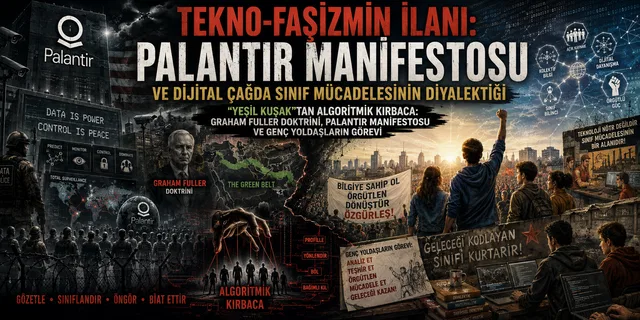
First, the fusing once again of monopoly capitalism with the state. Lenin, in Imperialism, wrote that the monopolies established a "personal union" with the state apparatus: bank directors in the ministries, ministers on the boards. Today this personal union is lived in the form of Musk, for a period, pruning the state institutions at the head of DOGE; of Sacks writing AI policy in the White House; of Palantir supplying the software of the intelligence and migration apparatus. This is not "technofeudalism"; it is monopoly capitalism in its most naked form.
Second, the private ownership of the communications infrastructure has turned into a source of political power. In the twentieth century a newspaper proprietor could affect public opinion. Today the owner of a platform can determine what billions of people will see every day, with whom they will form a tie, and at what speed which lie will spread. This power is not checked by any election.
Third, a United States whose hegemony is shaken. Tariff wars, BRICS Behind the Curtain, the AI race with China… US capital leans on "national champion" technology monopolies in order to hold its position in the world. This means that more privilege is granted to those monopolies at home. The investment of hundreds of billions of dollars that we showed in Bubble or Debt? Meta's 145 Billion Dollars and the Class Character of the AI Bubble is in need of political protection. It is possible to read the AI money in this election as the insurance premium of this investment.
But there is also a line of hope in the table: Brazil and Serbia showed that organised social power can beat the algorithm. In the United States too, the cost of living, the anger at data centres, and the trade-unionist candidates show that material life can seep into the feed.
A Class Assessment: What Should We See?
| The mainstream's narrative | Looked at through the window of class |
|---|---|
| "Democracy against Trump" | A race, among fractions of billionaires, over in whose favour the rules will be written; there are billionaires on both sides |
| "Musk is a mad rich man" | Musk's spending is a rational investment, made for state contracts and for regulatory exemptions |
| "Social media polarises" | Polarisation is not a side effect; it is the product of the business model that maximises engagement, that is, advertising revenue |
| "The problem is false news" | The problem is that the public sphere is in private ownership, and that oversight has been transferred to the unpaid labour of users |
| "A safety debate among AI companies" | A debate over which fraction of capital the regulation will be written into as a competitive advantage; the worker's question (the job, the wage, surveillance) is not on the table |
| "If the Democrats win, the problem is solved" | Taking the House means investigation, a budget veto, and room to breathe; but platform ownership, the super PAC system and monopoly power remain where they are |
Let us complete this assessment with a warning. To make the algorithm the explanation of everything would be another illusion, one that exalts it. What is distancing the US voter from Trump today is not a rival algorithm; it is the supermarket receipt. The algorithm is an accelerator and a giver of direction, working on the ground of material conditions; it is not a magic wand that takes the place of material conditions. The "correlation factory" we spoke of in our essay "Why Do We Deceive Ourselves?" is exactly this: the algorithm offers us false correlations, but life itself, from time to time, breaks those correlations.
Concrete Tasks
- Question your feed. If there is a chronological-feed option on X, on Instagram, on TikTok, use it. But, as the Nature study showed, the real matter is whom you follow. Build your follow list consciously.
- Keep a list of sources. Make it a habit to follow even a distant event, such as the US election, not from the slices the algorithm sets in front of you, but from direct sources (poll compilations, FEC data, research institutions).
- Follow the trail of the money. In Turkey too, make applications for information, and work of compilation, about election spending, advertising budgets and digital campaign companies. "Dark money is not dark for the politicians; it is dark for us."
- Carry the demand for platform transparency onto the trade-union and democratic agenda. The opening of the algorithms to independent researchers, the keeping of complete archives of political advertising, the labelling of AI content: these are not merely an expert debate; they are democratic rights.
- Try federative and open infrastructures, and spread them. Federative networks such as Mastodon, open-source tools, our own servers. As They Walked Past the Algorithm: How the Plenum Beat the Ballot Box in Serbia did, build channels of communication that do not depend on the algorithm.
- Do not underestimate face-to-face organising. The only place the algorithm cannot reach is the meeting that organised people hold in the same room. In Serbia, and in Brazil too, this is what brought the victory.
- Watch election night together, and discuss it. On the night of 3-4 November, watch the results together, and compare the tables in this essay with the results. Which theses held, and which did not? The best way to learn is to set the prediction against practice.
The Ballot Box Once Every Four Years, the Feed Every Day
Dear young comrades,
On 3 November, millions of people in the United States will vote. But what those people think, what they care about, whom they fear, is being shaped long before the ballot box, on the screens they open every morning. The owners of those screens are, at the same time, the largest donors of the election. This is the present state of bourgeois democracy: the ballot box is set up once every four years, the feed every day.
But history tells us one thing more. When the owner of the printing press was the church and the king, proclamations were still printed; when the radio was in the hands of the state, secret broadcasts were still made; when television was in the hands of the monopolies, the squares still filled. Every communications monopoly gave birth to its own counter-network. It is giving birth today too: in the plenums of Serbia, in the neighbourhoods of Brazil, in the farmers' assemblies gathering in the United States against the data centre, in the small donations that rained on Bores.
Our task is to contribute to these counter-networks being bound to one another with a class consciousness. What beats the algorithm is not a better algorithm; it is the organised human being.
After the election results, we shall return to this dossier.
Knowledge belongs to everyone.
Sources
The election and the polls
- Yahoo News: The 2026 midterms are just 7 days away. Which party has a better chance of winning?
- CNBC: 2026 midterms: Prediction markets favor Democratic Congress sweep (27 October 2026)
- Fox News: Democrats poised to take House as generic ballot lead widens
- RealClearPolling: Senate Election Polls 2026
- Wikipedia: 2026 United States elections
Money and super PACs
- Al Jazeera: Tracking the money: The biggest donors in the 2026 US midterm elections (27 October 2026)
- Al Jazeera: Elon Musk spends $366m to bolster Republican Party (12 October 2026)
- CNBC: Elon Musk gives $276 million to Republican groups
- CNBC: Elon Musk's 2026 election spending and SpaceX, Tesla business interests
- Forbes: Elon Musk Gives $77 Million To America PAC
- Public Citizen: Corporate Supremacist Super PACs Drive $500 Million Midterm Spending Surge
- Common Dreams: 172 Billionaire Families Have Spent Record $1.7 Billion
- Futurism: Groups Set Up to Shill AI and Data Centers Are Pouring Huge Sums of Money Into the Midterm Elections
- CNBC: Silicon Valley AI political groups turn on each other in the 2026 election (27 October 2026)
- Gizmodo: AI Super PAC's First Major Target Loses New York Congressional Primary
- Yahoo News: Tech moguls close to Trump see the midterms as a path to long-term power
- Quartz: Meta's next political bet on AI will be at the state level
- Wikipedia: Leading the Future
Trump and techno-capital
- Broadband Breakfast: Midterms Could Change the Politics of AI (15 October 2026)
- Axios: Big Tech elite lavish praise on Trump at White House dinner
- Fortune: Trump says Mark Zuckerberg showed him a Manhattan-sized AI data center
Algorithmic politics
- PsyPost: X's feed algorithm shifts users' political opinions to the right (the Nature study)
- OECD.AI: X's Algorithm Shifts Users Toward Conservative Political Views
- Meta: How Meta Is Preparing for the 2026 US Midterm Elections
- TNW: AI disinformation is outpacing platform moderation before US midterms (27 October 2026)
- NPR: TikTok censorship report (Epstein, ICE)
- Wikipedia: TikTok USDS
- Variety: Bernie Sanders Claims Larry Ellison Will 'Control' TikTok Algorithm
Related Essays from Bilgi Müşterekleri
- Meta in Brazil, Access Bans in Turkey: An Algorithmic History and Technical Anatomy of Elections
- Hope Came from the South: Lula's Victory, Brazil's Hundred Years, and the Road Before the Class
- They Walked Past the Algorithm: How the Plenum Beat the Ballot Box in Serbia
- AfD's 43.8 Percent Is Not a Deviation: It Is the Bill of a Two-Hundred-Year Line and Thirty-Five Years of Dispossession
- From Futurism to Techno-Fascism
- The Declaration of Techno-Fascism: The Palantir Manifesto and the Dialectic of Class Struggle in the Digital Age
- Bubble or Debt? Meta's 145 Billion Dollars and the Class Character of the AI Bubble
- Anthropic's Activist Monitoring System
- BRICS Behind the Curtain
Bilgi Müşterekleri - Knowledge Belongs to Everyone. The figures have been compiled from publicly available sources as of 28 October 2026. After the election results, the dossier will be returned to. CC BY-SA 4.0.