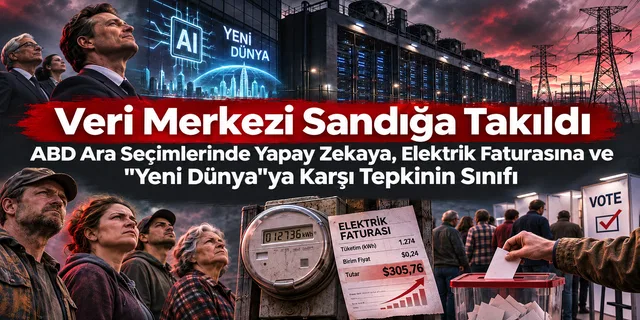
Where Did Two Trillion Dollars Go in a Single Day?
The Ballot Box, the Data Centre and Debt: A Class Reading of the Collapse in Artificial Intelligence Shares

Second piece of the AI bubble file. The first is Bubble or Debt? Meta's 145 Billion Dollars and the Class Character of the AI Bubble. It belongs to the series The US Agenda.
Dear Young Comrades
On Thursday 5 November, a few hours after the New York exchange opened, these figures were moving across the screens: Nvidia lost about 300 billion dollars of value in a single hour. More than 2 trillion dollars was wiped off US shares. The S&P 500 fell, depending on the source, by between 2.7 and 3.4 per cent, and gave back everything it had gained since the midterm results. At the centre of the selling were artificial intelligence chips:
| Company | Fall | Value wiped (approximate) |
|---|---|---|
| Nvidia | 7 per cent | $300 billion |
| Tesla | 9 per cent | $140 billion |
| AMD | 12.5 per cent | $100 billion |
| Micron | 10 per cent | $95 billion |
| Broadcom | 5.5 per cent | $90 billion |
The loss of these five companies alone comes to 725 billion dollars. For comparison: that is roughly half of Turkey's national income for a year. It was wiped off the screen in a few hours.
A day earlier, on 4 November, the same exchange had had its best day in three months. The Dow Jones rose 1,569 points. The Democrats had taken both chambers of Congress, and the market had rejoiced that "a divided government means no hard law gets through". Twenty-four hours later the same results became a cause of fear. What changed?
In Bubble or Debt? we asked, through Meta's accounts: who won while the bubble inflated, who pays if it bursts, who pays if it does not burst? Today a fourth question was added to these: What pricked the bubble? The answer is interesting: the ballot box. More precisely, the voter who said "no" at the ballot box to data centres. We followed that ballot box in The Data Centre Got Stuck at the Ballot Box. Here we look at how the same ballot box wiped two trillion dollars off the exchange.
First the summary, then the detail.
This piece is not investment advice. The figures are intraday data for 5 November 2026. Small differences between sources come from the time of day. The sources are linked in the text and at the end.
First the Summary: What Does This Piece Say?
- The fall has three legs: the ballot box, debt and interest. Candidates opposed to data centres won the election. The cash flow of the big technology companies has turned negative because of investment in artificial intelligence, and the investment continues on debt. The Fed raised interest in September, and another rise is expected in December. The three landed on top of one another on the same day.
- A governor's election in Texas became Wall Street's greatest fear. Democrat Gina Hinojosa became the first Democratic governor of Texas since 1990. Her promise was plain: a moratorium on data centre approvals, a requirement to employ union labour, protection of water, a ban on non-disclosure agreements, no passing of the electricity bill on to the public, and the removal of tax incentives. Texas holds more than a quarter of the data centre capacity planned in the United States through 2030.
- This is not a Texas matter. In 13 states, 28 local votes were held on data centres, and nearly all of them came out on the side of restriction. In Ohio at least 14 municipalities imposed a ban or a limit. According to exit polls, 57 per cent of voters think artificial intelligence will harm society, and only 24 per cent think it will do good.
- The market fears democracy. What analysts call "political risk" is in fact the possibility that the people will have a say in investment decisions. The ability of the people whose electricity, water and land are being used to say "no" is priced on the exchange as "risk".
- The debt chain is stretched. The free cash flow of Alphabet and Amazon has turned negative. Amazon borrowed 48.1 billion dollars in the third quarter. If the data centre slows, the chip order falls; if the chip order falls, the chain of Nvidia, AMD and Micron is shaken. That is what happened on Thursday.
- The fall of Tesla and SpaceX is a separate story. Musk spent close to half a billion dollars on the Republicans in Texas, and lost. The possibility that a Democratic Congress will open investigations into Musk's companies is being priced. This is the failure of an investment made directly in politics by a capitalist.
- Trump Media did not sell the bitcoin. It moved it. Overnight, wallets linked to the company transferred 4,259 bitcoin, about 342 million dollars on CoinDesk's reckoning, to Crypto.com. A sale is not confirmed. The line going round the screens, "he sold because an investigation was ordered", sticks two different clocks together: the bond repayment on 30 November, and the subpoena power that begins in January.
- Who books the loss? Founders and the big funds can manage the swing. The real loss is in the retirement accounts tied to index funds, in the small investor playing with leveraged products, and in the employees who will be laid off tomorrow in the name of "cost cutting". The small saver in Turkey who bought Nvidia through brokerage apps is on this list too.
- A moratorium can strengthen the monopoly. If no new data centre can be built, the giant companies that already hold ready capacity gain in value, and the small players growing on debt are choked. If the people's justified backlash is not tied to a class programme, it can serve the concentration of capital.
- The class position: The question is not whether the data centre is built. It is for whom, under whose control, and on whose bill it is built. The Texas voter asked this question. Our work is to carry the question as far as the question of property.
Now let us go into the detail.
What Happened on Thursday, Hour by Hour?
First let us put the facts in order. The times are New York time.
| Hour / day | Development |
|---|---|
| 3 November (Tuesday) | The US midterms. The Democrats take the House of Representatives and the Senate, and win the governorships of Texas and Georgia. |
| 4 November (Wednesday) | The market opens first in joy: the Dow rises 1,569 points, the best day in three months. But chip and data centre shares split away: Nvidia falls 3.2 per cent, the semiconductor index falls 3 per cent, and Hut 8, which turned from bitcoin mining to data centres, collapses 23 per cent. The cause is Hinojosa's win in Texas (Texas Tribune). |
| 4 November, 21:17 | Wallets linked to Trump Media move 4,259 bitcoin to Crypto.com. CoinDesk puts the sum at about 342 million dollars. The sending addresses are labelled "2028 convertible note collateral". The transfer is not a sale. The company gave no comment on this move (CoinDesk). |
| 5 November, 07:28 | The Bank of England raises interest for the first time in three years (to 4 per cent). Governor Bailey says the main source of inflation is the Iran war and oil (CoinDesk). |
| 07:41 | The pre-open chip selling begins with Qualcomm: the outlook for the smartphone chip is low because of the memory shortage. |
| 09:30-10:00 | The Nasdaq opens down more than 2 per cent. AMD moves into a double-digit fall on a weak fourth-quarter outlook and a gross margin slipping from 56 per cent to 55 per cent (TradingKey). |
| 10:30-11:00 | The Nasdaq enters correction territory with a loss approaching 5 per cent. The S&P 500 is down 3.2 to 3.4 per cent, heading for its worst day since the tariff shock of April 2025. Nvidia falls by as much as 8 per cent, AMD by as much as 16 per cent, CoreWeave by 15 per cent. The fear index, the VIX, jumps by more than 50 per cent. South Korea's Kospi loses 5.3 per cent (Korea Times/AP). |
| During the day | Tesla and SpaceX fall 9 to 11 per cent. Bitcoin drops from 80,000 dollars to below 76,000; Coinbase and Robinhood lose 8 to 10 per cent. Gold rises 1 per cent and the ounce reaches 4,116 dollars. The yield on the 10-year US bond falls to 4.84 per cent; money flees to the safe haven. |
| During the day | According to one analysis site, 930 billion dollars in all is wiped off 12 artificial intelligence shares (Pomegra). The value wiped off the whole US exchange passes 2 trillion dollars. |
There are two things to notice in this table.
First, the fall is not general. It is selective. Two fifths of S&P 500 companies rose on the same day. Health, consumer staples, utilities, finance and pharmaceutical shares either held steady or rose. Energy was the sector that gained the most. So the money did not flee the exchange. It fled the artificial intelligence circuit. This is a sign of the bubble itself: what pulls the index down is the excessive weight of a few giant companies. As AP recalled, a 1 per cent move in Nvidia moves the S&P 500 almost as much as no other company can.
Second, what started the fall was not a set of accounts. It was a ballot box. The falls in October had been started by the bond market and by company accounts. This time the trigger is political: the people voting against data centres.
Texas: Why Did a Governor's Election Matter This Much?
Texas is the heart of artificial intelligence infrastructure in the United States. The former governor, Greg Abbott, had declared the state "the epicentre of artificial intelligence development". Cheap land, loose regulation, the state's own electricity grid and plentiful tax incentives made Texas attractive for data centres. More than a quarter of planned US capacity, and on some reckonings 30 per cent, is in this state.
But Texas is also a state struggling with drought, a state whose grid collapsed in the winter of 2021 and where hundreds of people died of cold or of being left without electricity. The projections of how much electricity data centres will draw from the grid are, as the Texas Tribune reported, of an "almost unbelievable" scale. The need for water is unknown, because the companies run the projects under non-disclosure agreements.
When the people's backlash grew, even Abbott stepped back: in August he paused approvals for review. But the same Abbott had taken about 9 million dollars from donors tied to the data centre industry since July 2025. Hinojosa called this pause an "election-year break" and won with 52.85 per cent of the vote. She became the first Democratic governor of Texas since 1990, and the state's first woman governor of Latin origin (Yahoo Finance).
Hinojosa's programme needs a close look, because what frightens the market is exactly these points:
- A moratorium on all data centre approvals until the legislature meets in January. In her own words: "When I am governor I will put a moratorium, that is a ban, on all data centre approvals."
- A requirement that data centre operators employ union labour.
- Protection of communities' water sources.
- A ban on the non-disclosure agreements that stop the public from watching the projects.
- That Texans not pay a higher electricity bill because of data centres.
- Removal of the incentives that cost the state billions of dollars in tax.
Read this list with a class eye. Union labour, water, transparency, the bill, tax. None of this is hostility to technology. All of it is an answer to the question of who pays the cost of a capital investment. What the market calls "regulatory risk" is the worker, the subscriber and the taxpayer sitting down at the table.
Elon Musk's reaction was instructive too: "Data centres in space look quite attractive now." It was said like a joke, but the content is serious. Capital is looking for a way to flee the society that says "no" to it. On earth there is water, electricity and the vote. In space there is not.
Not Only Texas: A Wave at the Ballot Box
The size of Texas and its symbolic weight carried it to the headline, but the real picture is wider (Yahoo Finance, Texas Tribune):
- Votes on data centres were held in 13 states, from Arkansas to Wisconsin. Nearly all of the 28 restriction measures counted by one monitoring group were passed.
- In Ohio at least 14 municipalities imposed a ban or a restriction. In the same state Sherrod Brown, who campaigned against data centre construction, won the Senate race: "I do not work for the power companies or the data centres."
- 43 per cent of 74 governor candidates in 36 states defended a moratorium or a ban.
- According to the NBC exit poll, 57 per cent of voters think artificial intelligence will harm society, and 24 per cent think it will do good.
- According to the UMass Amherst poll in September, about two thirds of Americans are against data centre construction in their own area; only 11 per cent look on it favourably.
In the October piece we reported the Reuters/Ipsos poll: 77 per cent of voters were worried that data centres would raise the electricity bill. That worry turned into a vote this week.
There is also a preparation at the national level. In March 2026 Bernie Sanders and Alexandria Ocasio-Cortez introduced the "Artificial Intelligence Data Center Moratorium Act". The bill stops the construction of large-scale artificial intelligence data centres, and provides that the moratorium can be lifted only on three conditions: that artificial intelligence products pass public oversight before they come to market; regulations that prevent job losses and share the wealth of artificial intelligence companies with society; that data centres do not raise the electricity bill, do not harm the environment, that communities have a right to refuse, that public incentives are banned, and that union labour is required (Roll Call). The bill had no chance in a Republican Congress. It is hard for it to become law in a Democratic Congress too; but it is now a text that can be debated. The market is pricing this possibility as well.
The Debt Chain: Why Does Everyone Fall If the Data Centre Stops?
Why should one governor's decision wipe 300 billion dollars off Nvidia's value? Because the artificial intelligence economy works like a chain, and each link of the chain depends on the order of the next link.
The chain can be drawn simply like this:
Electricity and land, data centre construction, the cloud company's investment (on debt), the order for chips, memory and network equipment, the revenues of Nvidia, AMD, Micron and Broadcom, the share valuations that rest on these revenues.
If the link at the head of the chain, that is electricity, land and permission, is squeezed, the expectation shrinks at every link after it. And this chain no longer turns on profit. It turns on debt:
- The free cash flow of Alphabet and Amazon has turned negative. That is, the money they earn from their own operations is not enough to meet the investment in artificial intelligence. Amazon borrowed 48.1 billion dollars in the third quarter; capital spending rose to 1.8 times operating cash (FourWeekMBA). In the first piece we told how Meta's cash flow turned negative. Now the same picture is spreading across the giant companies.
- Interest is rising. In September the Fed raised interest for the first time since 2023, and another rise is expected in December. The Iran war is holding oil above 90 dollars; inflation is stubborn. For an investment cycle that turns on debt, this means money that is a little more expensive every month.
- The chip companies themselves are also giving a weak signal. AMD's fourth-quarter outlook came in below the high hopes; its gross margin is falling. Qualcomm said phone chip sales would fall because of the memory shortage. Micron's loss of 10 to 12 per cent reflects the fear that memory prices are now beginning to choke demand. In Whose Is the Memory in Your Computer? we reported that Sam Altman treats the memory in personal computers as idle: when memory flows to the data centres, the ordinary consumer's device becomes expensive, and that lowers demand on the consumer electronics side.
Let us say this in Marx's language. A share is a bill, bought and sold today, on a profit to be taken in the future. Marx calls this fictitious capital. Nvidia's value, past 4 trillion dollars, is not the value of today's profit. It is the expected profit of the 2030s, discounted to today. This expectation rests on a few assumptions: that data centres will go on being built quickly, that electricity will be found, that interest will fall, that the debt can be rolled over, and that in the end artificial intelligence will turn this investment into profit. On Thursday the first of these assumptions, that "data centres will go on being built quickly", was questioned at the ballot box. At the first objection from the real world, fictitious capital shrank by 2 trillion dollars.
Let us underline one thing here. The 2 trillion dollars that was wiped did not vanish, because it had never existed as a factory, a machine or a product. The price of a factory's share can fall by half while the value of the factory does not change. But the fall of this fictitious value has real results: credit collateral shrinks, retirement accounts melt, companies lay off workers in the name of "cost discipline". Fictitious capital, while it inflates, absorbs real labour. While it deflates, it bills real labour.
The Market Fears Democracy
Perhaps the most instructive side of this week is this: in Wall Street's analyst notes, phrases such as "political risk", "regulatory uncertainty" and "public opposition" appear. Let us turn them into plain language:
- "Regulatory risk" = the ability of the representatives the people elected to set a limit on capital's investment decision.
- "Public opposition" = the ability of the people whose electricity, water and land are being used to say "no".
- "Policy uncertainty" = the fact that decisions can be taken at the ballot box, not only in boardrooms.
The limits of bourgeois democracy are very narrow. But even this narrow field is priced as "risk" in the market the moment it threatens the profitability of investment. This is one of the plainest pictures of the tension between capitalism and democracy. For capital, the ideal setting is one in which the decision stays entirely in the field of private property, and the people only pay the bill. Abbott's donors of 9 million dollars were buying this. The half billion dollars Musk spent on Texas was trying to buy it too.
The Musk example is especially plain. Part of the 9 to 11 per cent loss of Tesla and SpaceX on Thursday was the general selling of technology. But part of it was the price of the possibility that a Democratic Congress would open investigations into Musk's companies. So the market openly calculated that a capitalist had invested directly in politics, that this investment had lost, and that this would be reflected in the company's value. In The US Midterms, Techno-Capital and Algorithmic Politics (in Turkish) we said "a money network, a flow network": when the owners of the platforms become a side in the election, the election result also becomes a line in the company accounts. On Thursday this line was written in the negative.
On Thursday morning the account Crypto Sol Hunter wrote that Trump Media, the owner of Truth Social, had sold 343 million dollars of bitcoin, and that the sale came immediately after the Democrats ordered an investigation of Trump's crypto dealings. The chain and the filings do not say this. The wallets Arkham tracks moved 4,259 bitcoin to Crypto.com in two pieces, 2,140.03 and 2,119.31, at 02:17 UTC on 5 November, which is 21:17 in New York on 4 November. CoinDesk writes the sum as about 342 million dollars. The sending addresses were labelled "2028 Convertible Notes Collateral". This is a transfer to an exchange. It is not a sale. In May 2026 the company moved about 2,650 bitcoin to the same platform, and in August about 2,628, and it described both as custody or trading management, not as sales. This time CoinDesk asked for a comment and received none (CoinDesk).
The real date is elsewhere. The company's securities filing of 2 November says holders of the convertible notes can demand repayment in cash on 30 November. If all of them ask, the debt is about 1 billion dollars. The same filing says that if refinancing is not enough, the company may have to sell bitcoin or other digital assets. In the second-quarter file, 4,260.73 bitcoin was collateral for these notes as of 30 June. The amount moved overnight is almost that whole pledged pile. The company has not said the pledge was released.
The Democrats' investigation is not an order issued today either. Robert Garcia, who is expected to take over the House Oversight Committee, answered the Associated Press on election night in two words: "Lawyer up." At the top of the list are the family's World Liberty Financial venture, the investment that came from the United Arab Emirates, and the pardon of Binance founder Changpeng Zhao. The subpoena power begins in January, when the new Congress meets. Reuters had already written that the inquiries could begin around February (Bitcoin Magazine, AP).
The sentence on the screen sticks two clocks together. One is the debt clock of 30 November. The other is the subpoena clock of January. Both are real pressures. Neither is a sale that has already happened. Here, as with Musk, politics is written as a price on a capitalist's treasury. The difference is this: this time the claim of a sale was produced from a transfer that is sitting on the chain.
But let us not fall into an illusion. In US Election Results: A Blue Wave, the Same Shore we set out at length why the Democrats cannot be an alternative for the class. The Democratic Party too stands on the donations of Silicon Valley. It would be naive to think that the first business of the majority in Congress will be a ban on data centres. The distance between Hinojosa's promises and what a Democratic administration will do will be set by the organised pressure of the people who turned the promises into votes. What the market fears is not the Democratic Party. It is the voters' anger that forces the Democratic Party to these promises. In the words of Kathryn Guerra of Public Citizen: "We saw a real anger in the communities."
Who Books the Loss?
The sentence "two trillion dollars was wiped" implies that everyone lost equally. They did not.
Big capital manages the swing. Funds limit the loss with hedges, with options, with sector rotation. On Thursday money moved into health, pharmaceutical, finance and energy shares; gold and the government bond rose. Those who can do this are already the big players. The founders, for their part, have already turned a substantial part of their shares into cash during the rise. In the first piece we reported the 2.3 billion dollar sale by the CoreWeave founders.
The worker in the index fund is hit the most. In the United States a large part of retirement savings sits in funds tied to indexes such as the S&P 500. The first ten companies of the index make up more than 40 per cent of the total value, and most of them are inside the artificial intelligence circuit. So a teacher or a nurse, even if they think they never bought a Nvidia share, is inside this bet through the retirement account. As we showed in October, artificial intelligence debt now makes up about 10 per cent of the bond funds counted as "safe".
The leveraged small investor falls the fastest. One of the things that sped the selling on Thursday was leveraged semiconductor funds such as SOXL. These products triple the daily move. It is the same on the crypto side: Bitcoin lost 5 per cent in a day, and the shares of the crypto exchanges fell 8 to 10 per cent. These are the fields where the small investor, mostly young, mostly a wage earner, stands on the promise of "getting rich quickly".
There are people in Turkey who entered this bet too. In recent years the number of small savers in Turkey investing in US shares through the apps of local brokerages has risen fast. The wage earner trying to protect savings against inflation turned to Nvidia as the most talked-about share. The pattern we saw in Six and a Half Trillion: The Money Wiped Off the Exchange, the Life Missing from the Table holds here too: those with access to information and to hedges exit early; the one who arrives late buys at the top of the wave.
And at the very end, the worker. When the valuation falls, company managements announce "cost discipline" to calm the shareholder. The first item of cost discipline is always the payroll. In this week's restructuring at Canva, which touches 22 per cent of the staff, the cost of artificial intelligence is charged to the worker, as we saw earlier in Forty Percent of the Code, a Quarter of the Staff. A Generous Package, a Silent Table told this cut through Canva. The rule does not change when artificial intelligence shares fall, or when they rise: layoffs in the name of "efficiency with artificial intelligence" on the way up, and in the name of "market conditions" on the way down.
Can a Moratorium Strengthen the Monopoly?
There is a contradiction here that we have to be careful about.
The data centre moratorium is the product of a justified popular backlash. But if it is not tied to a class programme, it can also have an unexpected result: the strengthening of the monopoly. Why?
If no new data centre can be built, the asset of the company that already holds ready capacity gains in value. Giants such as Microsoft, Alphabet, Amazon and Meta can get through this period with their existing data centres, their long-term energy contracts and their own cash. Companies such as CoreWeave, growing on debt and tied to new construction, and the companies that turned from bitcoin mining to artificial intelligence, cannot roll their debt when construction stops. Indeed the sharpest falls on Thursday were these: CoreWeave 15 per cent, the former miner data centres 13 to 17 per cent, Hut 8 28 per cent in two days. Analyst comments also write that "the gap between the giants and the debtors will widen".
This is a pattern we know: a crisis, or a restriction, liquidates the weak capital and concentrates the strong. This is one of the basic theses of Lenin's analysis of monopoly capitalism. The moratorium on its own does not stop this concentration. On the contrary, it makes those who hold the existing capacity "the owners of the scarce resource".
That is why the other points on Hinojosa's list matter more than the moratorium: union labour, the protection of water, the lifting of secrecy, the bill not being passed on to the people, the removal of incentives. The condition in the Sanders and Ocasio-Cortez bill, "sharing the wealth of artificial intelligence companies with society", brings the question close to the plane of property for the first time. But that is not enough either. The real question is this: Whose will this infrastructure be? Saying "stop" to capital's investment is a beginning. Taking the infrastructure under public and social control is the programme.
Seen from Turkey
Three things are visible.
First, the same argument is at the door. In Turkey too, data centre investment, the aim of "becoming an artificial intelligence hub", and the energy projects that go with it are being talked about. But there is no public argument of the kind there is in the United States. Which data centre on which land, which water it will use, who will pay the cost of the electricity, which incentive it will take: none of these questions is being asked openly. We told it in The Class of Three Thousand Kilowatt-Hours: while the EPDK lowers the limit for household subscribers, how the energy cost of the big consumers will be managed is hidden from the public. Texas's question should be Turkey's question too.
Second, in Turkey the ballot box cannot do this job. In Texas the voter could say "no" to the data centre at the ballot box. In Turkey, as we saw at Akbelen, capital's project moves against the villager's olive grove with the gendarmerie alongside it, and a trustee is appointed in place of elected mayors. Even the narrow field of bourgeois democracy in the United States is almost closed in Turkey. That is why, here, the people's "no" has to pass through organisation before it passes through the ballot box.
Third, the bill of a global collapse comes to us too. If the deflation of the artificial intelligence bubble turns into a global financial shock, economies dependent on external finance, such as Turkey, are among the first to be hit by capital outflow and pressure on the exchange rate. The Kospi's fall of 5.3 per cent in a day is a sign of how this chain spreads. It was like this in 2008 too: Wall Street made the crisis, and the workers of the world paid the bill as unemployment and an exchange-rate shock.
The Market's Question, the Class's Question
| What the market asks | What the class should ask |
|---|---|
| How many billions did Nvidia lose in a day? | Where did that value come from, and whose retirement account books the loss? |
| How far does the Texas moratorium lower chip demand? | What will happen to Texans' water, electricity and bill? |
| How should "political risk" be priced? | Why is the people's having a say in the investment decision counted as "risk"? |
| What will a Democratic Congress do to the technology companies? | Where is the organised force that will hold the Democrats to their promises? |
| How exposed are Musk's companies to the risk of investigation? | What kind of democracy is it in which a capitalist can spend half a billion dollars on an election? |
| Did Trump Media sell the bitcoin? | Why was a transfer out of the collateral wallet written up as a sale, and who pays the debt on 30 November? |
| Which company comes out ahead from the moratorium? | If the moratorium strengthens the monopoly, whose will the infrastructure be? |
| Will the Fed raise interest in December? | Whose wage carries the burden of inflation through interest and oil? |
| Is the fall a buying opportunity? | Whose turn is it for the layoff in this cycle? |
So What Should Be Done?
Reading and watching
- Read the accounts together with the ballot box. To understand the value of artificial intelligence companies it is no longer enough to look only at the income statement. Local election results, municipal decisions and opinion polls have to be looked at too. This is something capital confesses to us: social opposition is written into its accounts.
- Watch the weeks ahead. Nvidia's quarterly accounts, the Fed's December decision, and Hinojosa's first steps after she takes office on 19 January 2027 will be decisive. At each of them ask the same three questions: what happened to capital spending, what happened to the debt, what happened to the number of employees?
- Put 30 November on the calendar too. Holders of Trump Media's convertible notes can demand repayment in cash that day. In its 2 November filing the company wrote that if refinancing is not enough, it may have to sell bitcoin. Whether the overnight transfer turns into a sale will be clearer there.
- Update your map of circular finance. To the map of Nvidia, OpenAI, Microsoft, CoreWeave and Oracle that we proposed in the first piece, add two arrows this week: "the Texas voter, the data centre permit" and "the Fed's interest, the cost of debt". You will see for yourselves where the weakest link of the chain is.
Speaking and organising
- Turn the news that "two trillion dollars was wiped" into a question around you: what was that two trillion really, and who pays its loss? There will not be a better occasion to explain the concept of fictitious capital.
- Carry the Texas list to Turkey. Union labour, the protection of water, a ban on non-disclosure agreements, the bill not being passed on to the people, the removal of incentives. These five points are a ready list of questions to be asked, in the chambers, in the city councils and in the unions, about every data centre and every large energy project announced in Turkey.
- Talk with computing workers. When the share falls, a wave of layoffs comes. Read again, in this setting, the organising proposals in The Poverty of the White Collar (in Turkish) and The Computing Worker's Handbook: those who organise before the wave keep their bargaining power in the wave.
- Talk with the young people who put their savings into the exchange. Giving investment advice is not our work. Asking "why is everyone buying Nvidia, and who is selling at the top of the wave?" is our work.
A collective alternative
- Defend a programme that goes beyond the moratorium. "Let the data centre not be built" is not enough, because on its own this can strengthen the monopoly that holds the existing capacity. The demand should be this: let the computing infrastructure be built under public control, with open models, with the consent of the communities, with union labour, and without the bill being charged to the people. As Knowledge Commons, on 13 December 2026, at the conference we describe in An Invitation to Odak 2026 and Our Submission, we will tell exactly this under the heading "From the People's Data to the People's Model".
Dear Young Comrades
Within a few days, two things happened. In the United States the voter said at the ballot box that they did not want to pay the cost of artificial intelligence infrastructure. And this "no" wiped two trillion dollars in a single day from the market value of the world's most valuable companies.
When you put these two side by side, a very important lesson comes out: the value of capital rests on the consent of society. Nvidia's trillions rested on the assumption that the people who would supply the electricity, the water and the land of the data centres would stay silent. When that silence broke, the value was shaken too. However powerful the technology monopolies look, in the last instance they depend on labour, on nature and on social consent. When consent is withdrawn, fictitious capital remembers that it is fictitious.
But if this lesson is left half finished, it is dangerous. If the people's backlash does not turn into a class programme, capital finds a way either to flee to space, or to settle with a Democratic administration, or to use the backlash to liquidate its rivals. The "no" in Texas becoming a real gain depends on that "no" being carried as far as the question "whose will this infrastructure be?"
If one thing is to remain from this piece, let it be this:
The two trillion dollars wiped off the exchange were never a factory, a machine or labour. They were a bill drawn today on the profit of the future. What shook that bill was the people who said at the ballot box, "we will not pay this bill." The machine is new, the chain is old; and the weakest link of the chain is always our consent.
Sources
The market move
- AI chip stocks drag Wall Street toward worst day since Trump's tariff announcements in 2025 - AP / Korea Times, 5 November 2026
- Nasdaq 100 Sinks About 6% as Chip Rout Deepens After Democratic Sweep - The Private Banker, 5 November 2026
- Live updates: Bitcoin plunges as Nasdaq falls in panicky selloff - CoinDesk, 5 November 2026
- AI Stocks Lose $930B as Nasdaq Sinks on Regulation Fears - Pomegra, 5 November 2026
- AMD Moved Down by 13.44% on Nov 5: Drivers Behind the Movement - TradingKey, 5 November 2026
- Semiconductor Stocks Plunge as AI Trade Weakens After US Election Results - Bloomberg, 5 November 2026
- Tech stocks plunge on worries about AI and Democrats' midterm landslide - NBC News, 5 November 2026
- Nvidia Just Dipped Below $200 for the First Time Since August - 24/7 Wall St., 5 November 2026
The election and data centres
- Under Hinojosa, Texas data center approvals could stay paused - Texas Tribune, 4 November 2026
- Democrats' victories in Texas laid bare voter unease over data centers - Yahoo Finance, 5 November 2026
- America got the anti-data-center wave it voted for. Here come the economic consequences - CNN, 5 November 2026
- AI data center stocks and Musk's SpaceX decline as Texas governor result raises risks of a slowdown - CNBC, 4 November 2026
- Data center moratorium pitched as counter to AI impacts - Roll Call, 25 March 2026
- AI Data Center Moratorium Act (bill text) - Sen. Bernie Sanders
Trump Media and bitcoin
- Trump Media moves $342 million in bitcoin to Crypto.com, blockchain data show - CoinDesk, 4 November 2026
- Democrats To Target Trump's Crypto Ventures After Taking Congress - Bitcoin Magazine, November 2026
- Democrats vow to investigate Trump, his family and his administration - AP
Debt and cash flow
- Amazon Borrowed $48.1B as Q3 Capex Ran 1.8x Operating Cash - FourWeekMBA, October 2026
- Alphabet sells $25B in bonds as AI order book tops $115B - AI Weekly, 2026
Theory
- Karl Marx, Capital, Volume III, Part Five (interest-bearing capital and fictitious capital)
- V. I. Lenin, Imperialism, the Highest Stage of Capitalism (1916)
- Rudolf Hilferding, Finance Capital (1910)
Related pieces from Knowledge Commons
- Bubble or Debt? Meta's 145 Billion Dollars and the Class Character of the AI Bubble (first piece of the AI bubble file)
- The Data Centre Got Stuck at the Ballot Box
- Whose Is the Memory in Your Computer?
- The US Midterms, Techno-Capital and Algorithmic Politics (in Turkish)
- US Election Results: A Blue Wave, the Same Shore
- The Class of Three Thousand Kilowatt-Hours
- Six and a Half Trillion: The Money Wiped Off the Exchange, the Life Missing from the Table
- Whose Party Is the Fund Crisis Breaking?
- Forty Percent of the Code, a Quarter of the Staff
- A Generous Package, a Silent Table: What Do the Layoffs at Canva Tell Us?
- The Poverty of the White Collar (in Turkish)
- The Computing Worker's Handbook
- An Invitation to Odak 2026 and Our Submission
This piece is one of the living documents of Knowledge Commons. It is shared under the CC BY-SA 4.0 licence. You may copy, change and share it if you credit the source.