Bargaining over the Climate in Antalya: Fossil Capital Refuses to Leave the Table
A class assessment of COP31: In whose hands, under whose control, and for whose benefit?

Editor's note: This article was prepared on the morning of 22 November 2026, after the latest COP31 draft was released. Its final adoption has not yet been confirmed; the outcome of the negotiations remains to be followed.
Summary: What Happened in Antalya, and What Do We Say?
The facts:
- The conference: COP31 met in Antalya on 9–20 November 2026. Türkiye, with Murat Kurum as president, hosted the conference; Australia's Chris Bowen led the negotiations. Delegations from nearly 200 countries took part.
- Overtime: The scheduled Friday close was overtaken by disputes over fossil fuels and climate finance. Negotiations continued into Sunday morning.
- A thinning text: The first draft on 16 November contained options on moving away from fossil fuels and an annual adaptation-finance target of $120 billion by 2035. The second draft removed the references to fossil fuels, the $120 billion figure and a climate-finance work programme. The third draft still does not name fossil fuels, oil or coal.
- What replaced them: The text includes a target to raise electricity's share of final energy consumption from around 21% to 35% by 2035, a target for capturing and storing one billion tonnes of carbon dioxide, an Antalya-to-Addis Ababa roadmap on adaptation finance and a technical report.
- Who was present: Campaigners identified 103 major polluting organisations at the talks, including fossil-fuel and finance interests. Banks attending the conference provided more than $2.2 trillion in fossil-fuel finance over the previous five years, according to the campaigners' analysis.
- The host's balance sheet: Türkiye announced deals and plans worth over $26 billion, including a preliminary $15 billion renewable-energy agreement with China. It also produces roughly a third of its electricity from coal, has no coal phase-out date and appealed a court ruling blocking expansion at Afşin-Elbistan.
- The streets: Thousands marched in Antalya on 14 November; the People's Climate Summit met on 14–18 November. The host-country agreement included a duty for participants not to interfere in Türkiye's internal affairs.
Our assessment: COP31 negotiated not only the climate but who pays for the climate crisis. Removing the name of fossil fuels is not merely an accident of language: it is connected to the defence of the value of existing wells, power stations, pipelines and the banks financing them. Electrification and carbon capture can displace the question of how energy is produced and for whom with the question of how much electricity is consumed. Responsibility and debt are divided not only between countries but also between classes within them. There can be no climate justice without class justice; a transition is not just if workers cannot organise and sit at the table in their own right.
Dear Young Comrades,
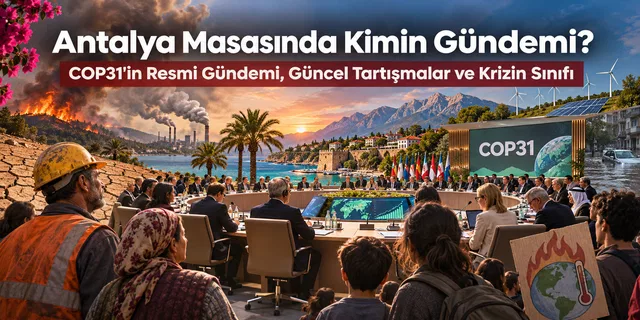
For two weeks, the world's “future” was discussed in Antalya. News bulletins presented a diplomatic sequence of drafts, late-night sessions, extended negotiations and the prospect of a deal. We ask a different question: what was being negotiated, and who sat on either side of the table?
Let us keep three questions in mind throughout: In whose hands? Under whose control? For whose benefit?
1. Two Weeks in Brief
| Date | Development |
|---|---|
| 9 November | COP31 opened; Türkiye assumed the presidency from Brazil. |
| 11–12 November | Leaders' summit; Türkiye promoted its “35 by 35” electrification agenda. |
| 13 November | The Kick Big Polluters Out campaign drew attention to polluting interests at the talks. |
| 14 November | Thousands marched in Antalya; the People's Climate Summit began. |
| 16 November | The first cover-decision draft included competing fossil-fuel formulations, a $120 billion adaptation target, electrification and carbon capture. |
| 19 November | The second draft removed direct references to fossil fuels and the $120 billion target. |
| 20 November | The planned close passed without agreement. A group of countries demanded stronger fossil-fuel and finance provisions. |
| 20–22 November | Negotiations continued past the deadline; some decisions were adopted while other issues remained unresolved. |
| 22 November | A third draft was circulated, with a short period for objections and a planned morning plenary. |
Sources: UN News, Reuters and AP.
2. How the Text Thinned: Three Drafts
A negotiating text is a photograph of power relations. Looking at what disappears tells us whose demands prevail.
| Subject | 16 November: first draft | 19 November: second draft | 22 November: third draft |
|---|---|---|---|
| Fossil fuels | Competing formulations on a transition | Direct references removed | No “fossil”, “oil” or “coal”; a reference to the UAE Consensus remains |
| Adaptation finance | $120 billion annually by 2035 | Figure removed | No amount; a technical report and an Antalya-to-Addis Ababa roadmap |
| Climate-finance work programme | Included | Removed | Not restored |
| Electrification | 35% by 2035 | 35% by 2035 | 35% by 2035, without requiring renewable generation |
| Carbon capture | Bracketed targets | A provisional 2035 capture-capacity target and longer-term range | A target for capturing and storing one billion tonnes |
Sources: UNFCCC first draft, Down To Earth, AP and Reuters.
Reports connected the removal to objections from oil-producing countries, particularly Saudi Arabia, while many countries sought the language's return. President Kurum argued that the latest text addressed fossil-fuel concerns through its reference to the COP28 agreement. In the consensus process, the draft nevertheless omitted the explicit words that many countries sought. Panama's environment minister described the negotiations as being held hostage by an “oil mafia”.
The COP28 agreement in Dubai in 2023 had called for transitioning away from fossil fuels but did not establish a binding production quota or timetable. At COP30 in Belém, a proposed fossil-fuel roadmap did not make it into the final text. In the latest COP31 draft, the explicit expression itself disappeared. The language retreated.
Why does a word matter? Naming coal, oil and gas opens the material basis of production to scrutiny: whose well, whose power station? Speaking only of emissions reduction can leave room to continue production while managing what comes out of the chimney.
3. Who Was at the Table? Lobbies and Banks
According to the Kick Big Polluters Out coalition's analysis, over 100 major polluting companies and industry associations sent delegations. The list included fossil-fuel companies, financial institutions, technology firms and industrial agriculture. Participating banks had provided more than $2.2 trillion in fossil-fuel finance during 2021–2025.
The energy appetite of artificial-intelligence data centres is another reason to ask who benefits from electrification. Rising electricity demand alone does not tell us whether that power comes from coal, gas, wind or sun. The way participants travel to a climate summit also raises questions about unequal emissions and privilege—questions that cannot be reduced to individual choices alone.
4. The Host's Balance Sheet: Investment in Antalya, Coal in Afşin
According to Reuters, Türkiye announced deals and plans worth more than $26 billion during the conference, including a preliminary $15 billion renewable-energy agreement with China and $5.1 billion in development-bank financing.
The other side of the ledger is coal:
- Türkiye has no coal phase-out date. Human Rights Watch reports that the government appealed a June 2026 court decision against two additional units at Afşin-Elbistan A.
- According to the IEA's Türkiye review, coal supplied roughly a quarter of total energy and more than a third of electricity in 2024. Türkiye consumed approximately 120 million tonnes of coal in 2025.
- Ember puts coal's share of 2025 electricity at 34%, with roughly two-thirds of coal-fired electricity relying on imported coal. The insistence on coal cannot simply be explained as “domestic energy”.
- Türkiye's 2025 Climate Law created a basis for an emissions trading system. As TEPAV notes, the 2053 net-zero date is not written into the law. A market's creation does not itself guarantee falling emissions: its cap, coverage and free allowances matter.
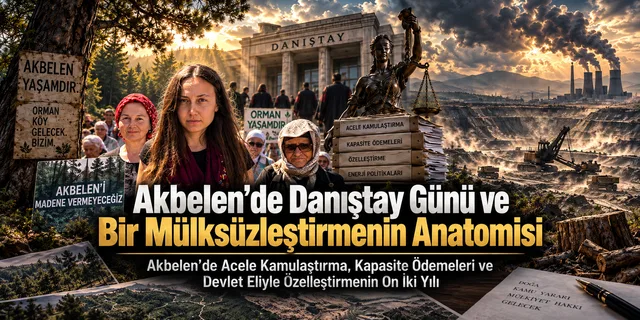
The order that opens olive groves in Akbelen to coal mining is the same order presenting itself as a climate leader in Antalya. We discussed this in our article on Akbelen: nature is opened to capital in the name of the “public interest”.
5. Behind the Word “Electricity”: Whose Electricity?
The “35 by 35” target sounds attractive: vehicles, heating and industry switch to electricity. But the draft does not require that power to come from renewable sources. Electrification powered by coal and gas does not automatically solve the climate crisis.
- In whose hands? Electricity generation in Türkiye is largely privatised. Electrification also creates a new market for private companies.
- Under whose control? Tariffs, grid investments and generation decisions are shaped through institutions and market structures in which workers and consumers lack equivalent power.
- For whose benefit? Our article on fuel prices asked who pays price rises and who receives the profits. The same question applies to electricity.
Electrification is not progressive or reactionary in itself. Under public ownership, social control, renewable generation and protection against energy poverty, it can be a gain. Under private ownership, coal dependence and higher bills, it can become another field of accumulation.
6. Carbon Capture: Solution or Insurance for the Chimney?
The third draft includes a target to capture and store one billion tonnes of carbon dioxide. An earlier draft had discussed at least 500 million tonnes of annual capture capacity by 2035. According to WRI, existing facilities capture roughly one thousandth of global emissions. Campaigners warn that a rapid expansion of these technologies may be used to delay a fossil-fuel transition.
Carbon capture may have a real role in hard-to-abate processes such as cement and steel. Neither rejecting it in every circumstance nor declaring it a universal solution answers the main question: who owns the technology, and who pays the bill?
If public resources extend the economic life of fossil assets while public transport, home insulation and health go underfunded, capture becomes less a climate policy than insurance for fossil capital's value.
7. Fossil Capital, Green Capital, the Same Shareholders
It is misleading to read Antalya as a simple contest between dirty fossil firms and clean green firms. The IEA's World Energy Investment 2026 estimates around $2.2 trillion in clean-energy investment and $1.2 trillion in fossil-fuel investment in 2026. Both facts matter: green investment is growing, but fossil capital still receives enormous new investment.
The Global Carbon Project estimate reported by Carbon Brief projects fossil CO₂ emissions falling around 0.4% to 38.2 billion tonnes in 2026, principally because of the oil shock associated with the Iran conflict. Coal emissions are projected to rise slightly, and total CO₂ emissions including land-use change to reach a record 43.3 billion tonnes. These are estimates, not final measured totals.
Three observations follow:
- The resistance of fixed capital. A coal plant or oil field is built with decades of expected returns. Early closure threatens the value of those investments.
- Competition between fractions of capital is not class struggle. Funds and banks can invest on both sides. A victory for green capital does not automatically mean a victory for workers.
- The metabolic rift. The rupture Marx identified in the relation between human beings and the soil now extends to the atmosphere. The problem is not an undifferentiated “humanity”, but production organised around profit.
8. Finance: Who Owes Whom?
| Concept | Meaning | Appropriate finance |
|---|---|---|
| Mitigation | Clean energy, efficiency and transforming production | Can generate income; may partly involve loans and investment |
| Adaptation | Infrastructure and resilience against floods, drought and heat | Often generates no revenue; grants are needed |
| Loss and damage | Destruction from impacts that cannot be prevented | Grants and compensation are essential |
Financing a solar plant cannot be treated as identical to rehousing a family that has lost its home in a flood.
At COP29 in Baku, developed countries agreed to lead on mobilising at least $300 billion annually by 2035 for developing countries, alongside a broader goal of scaling all sources to $1.3 trillion annually. The two figures must not be conflated.
The UNEP Adaptation Gap Report 2026 estimates developing-country adaptation needs at about $305 billion annually in 2035, against $28.2–31.7 billion in international public adaptation finance in 2024. These are different years, so the comparison illustrates scale, not a same-year gap. Even a tripling of finance would cover only a fraction of need. The first draft's $120 billion target fell short; the later draft removed it, leaving a tripling commitment without specifying its baseline.
This is not an abstract “investment gap”: it means missing early-warning systems, unrepaired water infrastructure and agricultural workers still exposed to extreme heat. The form of finance matters too. Loans must be repaid, potentially through taxes, cuts or service charges borne by working people. Climate finance can thereby become another channel of debt. We discussed related international financial structures in our article on BRICS.
9. Classes Within Countries: One Atmosphere, Unequal Responsibility
The North–South divide is real but incomplete. Responsibility is also divided within countries. Oxfam estimates that the richest 0.1% emit more carbon than the poorest 3.5 billion people; its analysis also attributes about 20% of warming since 1990 to the richest 1%. Such estimates depend on emissions-accounting methods, and consumption-based and investment-based accounts should not simply be added together.
The IMF distinguishes direct fossil-fuel subsidies from implicit subsidies: the latter include health and environmental costs not reflected in prices, not cash paid directly by governments.
A minimum-wage textile worker and an energy holding's shareholder should not be treated as equally responsible merely because they live in the same country. Nor should a carbon tax or sudden removal of energy support be allowed to fall hardest on households that depend on energy for heating and transport. Climate justice must address distribution within states as well as demands between them.
10. A Just Transition: Are Workers Subjects or Costs?
At COP30 in Belém, parties agreed to develop a just transition mechanism. Unions sought a stronger mechanism, and its implementation remained an issue in Antalya. The ITUC's COP31 demands put workers' rights at the centre of climate policy. African union representatives likewise argued that the mechanism must be built with workers.
The ITUC and the international employers' organisation IOE issued a joint statement recognising the importance of a just transition and fundamental labour rights. Agreement on general principles is easier than agreement on money, job security and decision-making power.
We can test a transition with five questions:
- Are incomes and social-security rights protected when workplaces close or change?
- Do unions and local communities participate in investment decisions?
- Does retraining come with real jobs and income guarantees?
- Are costs imposed on low-income households or on high-emission activities and their beneficiaries?
- Are public services, local economies and community life planned for the long term?
In Zonguldak, Soma, Afşin-Elbistan and Yatağan, coal supports household incomes and local economies as well as producing energy. In a country that lost 301 miners at Soma, a miner may hear “coal phase-out” first as unemployment. A climate movement that ignores this fear risks pushing workers towards coal employers.
A strategy written on workers' behalf is not enough. Without the right to organise, strike and bargain collectively, a just transition remains a decision made by others.
11. The Streets and the Duty Not to Interfere
The COP31 host-country agreement included a duty not to interfere in Türkiye's internal affairs. Amnesty International warned that the provision could be used to restrict criticism.
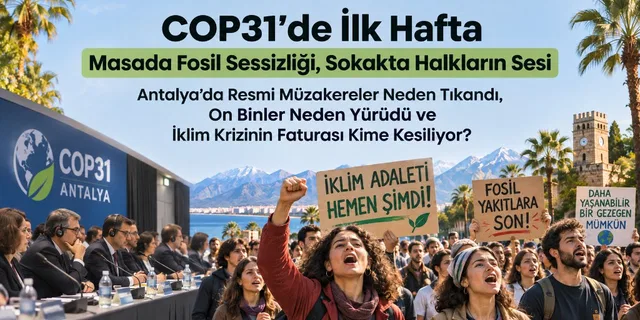
Nevertheless, thousands marched in Antalya on 14 November: environmentalists, trade unionists and human-rights defenders. The parallel People's Climate Summit brought together organisations from Türkiye and abroad. As the demonstrators' message put it, climate justice is won in the streets.
There is a contradiction when a fossil-fuel lobbyist enters the Blue Zone with accreditation while an activist is warned about “internal affairs”. Whose voice counts as participation, and whose as interference?
12. Two Languages, Two Frameworks
| The language of Antalya | The language of class |
|---|---|
| “Emissions reduction” | Whose well and power station will close? |
| “Electrification” | Whose electricity, from which source, at what tariff? |
| “Carbon capture” | Insurance for fossil capital's value? |
| “Mobilising finance” | Grant or loan? Interest for whom, debt for whom? |
| “National responsibility” | Are the richest 1% and minimum-wage workers in the same column? |
| “Just transition” | Who decides for a worker without a union? |
| “Stakeholder participation” | An accredited lobbyist, an activist accused of interference? |
| “Antalya accord” | Agreement between whom, at whose expense? |
13. Our Class Position
It is easy to dismiss Antalya as a failed summit. Our criticism is sharper: COPs can help create the impression that the crisis can be managed without changing property relations. Our position is therefore clear:
- The climate crisis is a problem of a mode of production. The atmosphere is shared, but production decisions are governed by private ownership. Energy must come under social ownership and democratic control.
- Neither fossil capital nor green capital. We defend renewable energy while opposing its transformation into a new field of monopoly profit.
- Climate debt is also a debt between classes. Fossil profits, great wealth and polluting capital must bear the costs first.
- Adaptation and loss-and-damage finance should be grants and compensation, not debt.
- A just transition belongs to organised workers. Miners and climate activists should stand together, not against one another.
- Türkiye's climate policy is tested in the streets and affected communities, from Akbelen to Afşin and Yatağan, not just at a podium.
14. Concrete Tasks
For unions and workers' organisations: Put job and income security, retraining and retirement bridges on collective-bargaining agendas; demand the right to stop work at dangerous heat thresholds; build joint platforms between miners and environmental organisations.
For professional chambers and researchers: Prepare an independent coal phase-out and regional-transition plan with a class assessment of costs; scrutinise emissions-trading rules and disclose who receives free allowances.
For tech workers and the knowledge commons: Monitor data-centre energy consumption and its sources using open data; turn COP texts, national commitments and company claims into openly licensed, comparable datasets.
For young people and the climate movement: Link climate and labour struggles, from picket-line support to solidarity in coal regions; make freedom of expression and assembly part of the climate agenda.
15. Questions After Antalya
Whatever the final text says, five questions remain:
- Timetable: When and where will measurable reductions in coal, oil and gas production be set out?
- Quality of finance: How much will be grants, loans or private investment, and how much will be a real transfer of resources?
- Employment: What guarantees will fossil-sector workers receive, and what will new jobs be like?
- Participation: Will workers, unions and communities share decisions or merely be heard as “stakeholders”?
- Accountability: Who will independently measure and scrutinise national targets, company plans and financing promises?
Conclusion: Removing the Capital That Refuses to Leave
Dear Young Comrades,
Nearly 200 governments discussed the future of a shared atmosphere. In the latest draft, the cause of the crisis was not named directly, a specific amount for those bearing its costs was removed, and carbon capture remained a target. The final agreement still needs to be assessed when its outcome is known.
The lesson is not despair but clarity about where power lies. The climate crisis will not be solved in COP halls alone. Organised workers, communities and climate movements must challenge who owns energy, land and water. When miners and activists, greenhouse workers and tech workers, marchers in Antalya and communities resisting in Afşin can speak together, the word erased from a draft can be written again in the streets.
There is one world, but very few who imagine they own it. The task is to change the relations of ownership.
Sources and Further Reading
- UNFCCC: COP31 first cover-decision draft and presidency consultations.
- Reuters: COP31 talks close to a final deal; deals for the host as diplomacy stalls.
- AP: draft deal leaves out fossil fuels; UN News: countries demand a stronger deal; Down To Earth: draft drops fossil-fuel language.
- Common Dreams: polluter delegations; IEA: World Energy Investment 2026; UNEP: Adaptation Gap Report; Oxfam: Disaster Divide.
- Human Rights Watch: Türkiye and coal expansion; IEA: Türkiye energy review; Ember: Türkiye electricity review.
- Carbon Brief: 2026 fossil CO₂ estimate; WRI: carbon capture explained.
- IndustriALL: COP30 and just transition; ITUC COP31 demands; Climate Home News: host agreement and internal affairs; AFP: Antalya march.
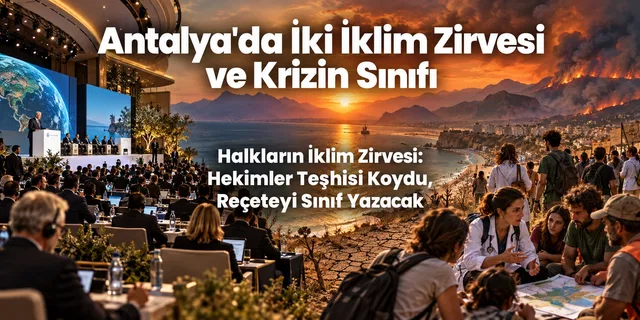
Related articles: Two Climate Summits in Antalya · The People's Climate Summit Declaration · Akbelen · The Class of a Litre of Diesel · BRICS
This text is shared under the CC BY-SA 4.0 licence. It may be reproduced, adapted and distributed with attribution. Version 1.0 · morning of 22 November 2026.