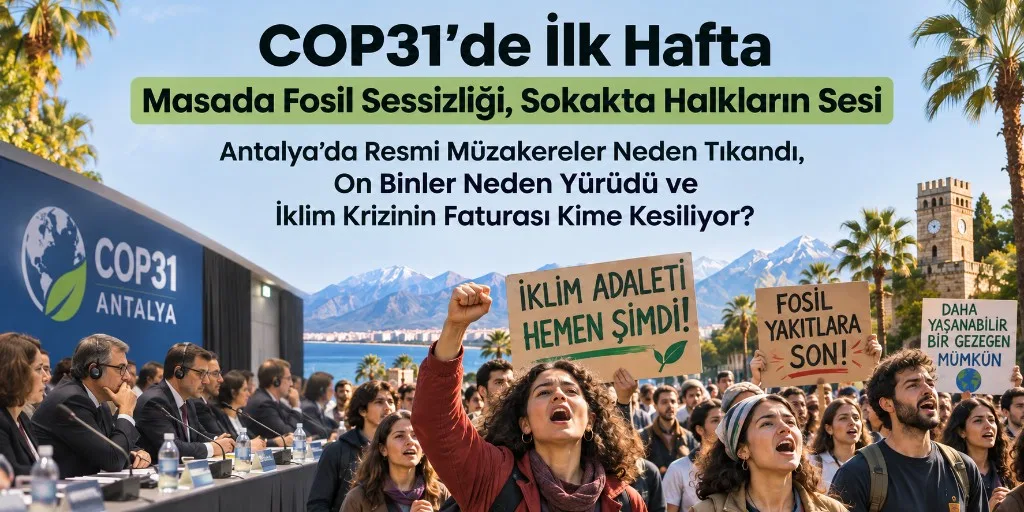
The First Week of COP31: Fossil Silence at the Table, the Peoples' Voice in the Street
Why the Official Talks in Antalya Stalled, Why Tens of Thousands Marched, and Who Is Being Sent the Bill for the Climate Crisis
The first week of COP31 in Antalya is behind us. In the first essay of this series we started from the diagnosis of the Turkish Medical Association and drew the class map of the crisis. In the second we asked in whose interest the official agenda had been set. In this essay we draw up the balance sheet of the first week: what happened at the table, what happened in the street, why people are protesting, and how the findings of the two earlier essays stand up against events.
First a short summary, then the detail.
Summary
- No decision at the table. The first week closed without producing a single binding outcome. In the negotiations run by Australia, a draft text is expected at the start of the second week; the summit ends on 20 November.
- The real fight is over fossil fuels. The big producers and consumers of fossil fuels are resisting any text that contains a binding new target or a commitment to leave oil, gas and coal. The Arab Group, led by Saudi Arabia, objected even to the voluntary roadmap prepared by Brazil being mentioned in the decision texts.
- A retreat across three summits. In Dubai (COP28) the phrase "transitioning away from fossil fuels" entered the text for the first time. In Belém (COP30) the final decision did not mention fossil fuels at all. In Antalya, even the mention of a voluntary document is in dispute.
- The host is stepping back. The COP31 President, Murat Kurum, had earlier called the call to leave fossil fuels "not realistic".
- The gap in electrification. The headline "35x35" target does not require the extra electricity to come from renewable sources.
- Finance at the level of crumbs. Rich countries' adaptation finance in 2024 came to only 28 billion dollars, an increase of 1 billion dollars on the year before.
- The street is strong. About 10,000 people joined the People's Climate March on 14 November. Peasants, opponents of mines and dams, trade unionists, feminists, and anti-war and anti-nuclear campaigners marched in the same procession. The Peoples' Climate Summit continues on 15-18 November.
- The repression began before the summit. On 3 November, officials of İHD, ÇHD and KESK were detained in house raids. Participants were placed under a condition of "non-interference in internal affairs".
- Why protest? Because at the table fossil capital is bargaining over its own future, the host country claims leadership while expanding coal, finance turns disaster into debt, the bill for the crisis is paid by workers, peasants and the poor, and there is an effort to silence those who object.
- Our finding has been borne out. The official table turns within the limits set by fossil capital. Whether the counter-summit lasts depends on how organised labour is.
What Is Happening at the Table?
A Summit With Two Presidents
COP31 runs on an unusual division of labour. The host is Turkey. The COP31 President, the Minister of Environment, Urbanisation and Climate Change Murat Kurum, runs the "Action Agenda". The official negotiations, however, sit with Australia. As Ekonomim reported, preparing the draft texts, consulting the parties and running the negotiating agenda are the responsibility of the Australian Minister for Climate Change and Energy, Chris Bowen.
In our second essay we assessed this structure as an arrangement that produces uncertainty. The first week confirmed it: Turkey runs the shop window, Australia runs the text, and the fossil fuel question is left without an owner between the two presidencies.
The Fossil Fuel Deadlock
At the centre of the first week stood a single question: will fossil fuels get into the text?
According to Reuters, observers say the big producers and consumers of fossil fuels are resisting any agreement that sets a binding new target or envisages leaving oil, gas and coal. On Friday UN Secretary-General Guterres called for "urgent and drastic" cuts in greenhouse gas emissions, but the call did not change the balance at the table.
At the centre of the fight is the voluntary roadmap prepared by Brazil's COP30 presidency. The 182-page document was published on 3 November and put before the parties in Antalya. On the first day of the summit the Saudi-led Arab Group objected to any reference to this roadmap in the COP31 decisions.
This stance needs to be placed on a historical line:
- Dubai, 2023 (COP28): The phrase "transitioning away from fossil fuels" entered UN climate texts for the first time. There was no timetable and no plan, but there was the word.
- Belém, 2025 (COP30): More than 80 countries asked for a roadmap. The oil states resisted, and the final decision did not mention fossil fuels at all. The roadmap was pushed outside the UN process, into a voluntary document.
- Antalya, 2026 (COP31): Now there is an effort to block even the mention of that voluntary document.
If even the word is this hard to accept, a timetabled and binding exit from coal cannot be expected to come out of this table.
The Host's Voice
The host, Turkey, is not the party pushing to break this deadlock. In April Murat Kurum told AFP that telling countries to give up fossil fuels was not realistic, and that every country depends on fossil fuels. Asked whether fossil fuels would get into the final text, he said the issue was not "putting a few words in the text".
In our second essay we wrote that the words "coal", "oil" or "gas" do not appear in Turkey's ten priorities. The first week showed that this silence is no accident.
"35x35": Where Will the Electricity Come From?
One of the headlines the summit has pushed is electrification. The target is to raise electricity's share of final energy consumption to 35 per cent by 2035. Yet according to the Reuters report published in US News, the proposal does not require the growing use of electricity to come from renewable sources.
This gap is not a technical detail. Electrification without a coal plan can raise demand for coal in a country like Turkey, which produces about a third of its electricity from coal. It is also unclear whom the electricity will go to: heating homes, public transport, or the insatiable appetite of artificial intelligence data centres? As we showed in The Class of Three Thousand Kilowatt-Hours, in this country the working people are told to "save energy" while the big consumers of electricity stay untouchable.
Finance: Crumbs and Debt
Finance is the most contested item on the agenda. According to Carbon Pulse, some parties asked for adaptation finance to be tripled and for unilateral climate-related trade measures (such as the EU's carbon border adjustment mechanism) to be put on the agenda. Turkey and Australia kept these items off the main agenda and had the agenda adopted without delay.
The figures show the picture plainly. According to UNEP's Adaptation Gap Report 2026, published on 4 November, rich countries in 2024 provided about 28 billion dollars of public finance for adaptation in developing countries. That is only 1 billion dollars more than the year before.
What is more, most of this money is loans, not grants. That means the countries hit hardest by floods, drought and heatwaves pay for the disaster, and then pay interest on top. Disaster turns into debt, and debt turns into somebody's return.
What Is Expected in the Second Week?
Australia collected written views from countries until Saturday night and aims to produce a draft text at the start of the coming week. The negotiations run until 20 November. In the second week there are three questions to watch:
- Will a fossil fuel phrase, or the Brazilian roadmap, get into the text?
- Will the figure for adaptation finance, and the ratio of grants to loans, become clear?
- Will the just transition mechanism (the Belém-Antalya Mechanism) become operational with class content, or within a capital-friendly framework?
What Is Happening in the Street?
A March of Ten Thousand
On 14 November, the Global Day of Action, about 10,000 people joined the People's Climate March in Antalya. The make-up of the procession that marched to Cumhuriyet Square in spite of the rain was a map of whom the crisis is hitting:
- Peasants defending their land against mining projects,
- Local groups opposing dams on protected rivers,
- Trade unions and labour organisations,
- International organisations such as Greenpeace, 350.org, Fridays for Future and Climate Action Network (CAN),
- Pro-Palestinian, feminist, anti-war and anti-nuclear groups,
- Climate activists from various countries.
Antalya Labour and Democracy Forces, which called the march, organised it under the slogan "Defending Life Against COP31". Mustafa Vakit of the organising committee, at a press conference, described the COP summits to date as a "greenwash" run under corporate sponsorship and an effort by capitalist states to clean their own image.
The Peoples' Climate Summit
The march opened the Peoples' Climate Summit (HİZ). The summit continues on 15-18 November with themed days. The Change the System, Not the Climate Platform announced that the summit is jointly organised by 182 organisations.
As Bianet reported, the process began with a joint statement by the Ecology Union, the Climate Justice Coalition and the Turkey Environment Platform. The summit's main aims are:
- To bring together not governments and companies, but those directly affected by the climate crisis,
- To build not just a declaration, but a lasting organisation at local, national and international level,
- To define climate action as climate justice, built around intergenerational justice and leaving fossil fuels,
- To discuss the plunder of natural resources in the Mediterranean and the responsibility of states and companies,
- To oppose nuclear power, through the Akkuyu plant near the summit area and the plans for Sinop and İğneada,
- To make opposition to war and militarism, and the call for peace, part of the climate agenda.
The summit's organisers also regard Turkey's 2025 Climate Law as essentially a trade law. This finding matches our assessment, in the second essay, that Turkey's climate policy stems from the EU's carbon border adjustment mechanism.
Actions at the Summit Site
Voices were raised inside and around the official area too:
- Two women activists from Greenpeace Turkey took off on paragliders and unfurled a banner reading "Sun and wind are enough for us". The action's message went straight at the "35x35" gap: electrification only makes sense with an exit from fossil fuels.
- On 10 November activists demonstrated at the summit site, demanding fairer climate finance for Africa.
- On the opening day the traditional "Fossil of the Day" action was held, targeting countries blocking the climate negotiations.
Repression: The Detentions Before the Summit
The voice of the street was not raised without cost. Six days before the summit, on the morning of 3 November, homes were raided in Antalya. According to Cumhuriyet, Mehmet Şerif Özdemir, an official of İHD and Emekli-Sen; lawyer Kazım Yiğit, an official of ÇHD Antalya; and İlhan Karakurt, KESK's spokesperson for the term and branch president of Tüm Bel-Sen, were detained. Özdemir and Karakurt were taken by counter-terrorism police. As Medyascope reported, a confidentiality order was placed on the files, and the lawyers could not learn the grounds for the detentions.
On top of this, Climate Home News wrote that participants had been placed under an obligation of "non-interference in Turkey's internal affairs". The same report recalled that rights organisations had documented, over the past year, blanket protest bans across Turkey, unlawful use of force by the police, and the prosecution of journalists, rights defenders and lawyers.
It is no accident that those detained on the eve of a climate summit were a rights defender, a lawyer and a public-sector trade unionist. They represent the social forces that are not wanted in the summit's shop window.
Why the Protests?
We gather the reasons for the protests under five headings.
Fossil Capital Is Bargaining Over Its Own Future at the Table
The Arab Group blocking even the mention of a voluntary document, and the host calling the exit from fossil fuels "not realistic", are two faces of the same fact. Capital tied up in fossil infrastructure does not accept a loss of value. A coal plant, an oil field, a gas pipeline are investments calculated to bring in profit for decades. Leaving fossil fuels means part of this capital being devalued. And states, as apparatuses that protect the competitiveness of their own capital, delay this devaluation.
That is why the problem is not a lack of knowledge. The scientific picture is clear. According to the UNEP figures we cited in our second essay, the 1.5 degree target is all but lost, and on current policies the world is heading for about 2.8 degrees of warming. The problem is who holds the property.
The Host's Own Report Card
Critics point to the gap between Turkey's claim to leadership and its own policy. Özlem Katısöz, Turkey coordinator of CAN Europe, said at the march that Turkey cannot claim climate leadership while keeping up its fossil fuel and coal policies.
The climate expert Ümit Şahin, speaking to NPR, called the "Zero Waste" campaign the government has put in the shop window the number one greenwash. According to Şahin, Turkey is the biggest importer of Europe's plastic waste, and most of that waste is not recycled but burned or dumped. The same report carried activists' allegations about the summit's sponsors: that Limak Holding has expanded coal mines over ancient olive groves, and that Sinpaş GYO has poured concrete inside a national park to build a luxury resort.
The contradiction could be seen even right next to the summit site: according to Bianet, farmland next to the EXPO site was turned into a car park. In the words of Cuma Mercan, Antalya branch president of Tarım Orkam-Sen, what would have suited COP31 was green, not concrete.
In the first essay of the series we showed the same picture through energy: about a third of the electricity comes from coal. While the expansion at Afşin-Elbistan was cancelled by a court ruling, 1,050 MW of additional capacity was announced at Cenal. Organised objection can win individual cases, but the structure of ownership stays in place.
Finance Turns Disaster Into Debt
The 1 billion dollar increase in adaptation finance shows that the North is not paying its historical debt. Most of today's accumulated greenhouse gases are the product of the capital accumulation of the countries that had their industrial revolution two hundred years ago. The cost of that accumulation is paid today by those whose homes are sinking under the sea in the Pacific islands and those whose fields are drying out with drought in Africa.
Giving the money as loans is a second injustice. The country hit by disaster borrows, the debt bears interest, and the interest becomes the profit of finance capital. Carbon markets complete the same logic: the right to pollute is turned into a commodity to be bought and sold, and forests and land into a source of "carbon credits". In the first essay we called this "the enclosure of the sky". The African activists' demand for grant-based finance is a voice raised against this enclosure.
The Bill for the Crisis Is Paid Along Class Lines
Heatstroke, drought and coal smoke do not touch everyone equally. In the first essay, starting from the Turkish Medical Association's diagnosis and the Lancet Countdown figures, we showed this in detail:
- Most of those who die in workplace killings linked to heat and excessive overtime are unorganised workers. As we wrote about the HABAŞ explosion, in this country occupational safety is a regulation that stays on paper.
- The working hours farm workers lose in the heat are part of the surplus value extracted from them.
- The elderly, children and the sick living in badly insulated homes carry the greatest risk in heatwaves.
- Drought hits the food budget of poor households hardest.
- The pollution from coal plants falls on the working communities around them.
The presence of peasants, opponents of mining and trade unionists in the streets of Antalya is the concrete counterpart of this class map.
The Right to Speak Itself
The detention of trade unionists and lawyers before the summit, and the "non-interference in internal affairs" condition, have also turned the climate protest into a question of democracy. In our second essay we linked this condition to the risk of silencing those who object to coal. The detention of the KESK spokesperson shows that the risk has come true.
There is an important connection here: the most effective force against the climate crisis is organised labour, which can stop production and have a say in how society's resources are used. The detention of this force's representatives on the eve of the summit also shows how the rulers want to manage the climate crisis: without the voice of working people, under corporate sponsorship, in front of the shop window.
Two Tables Side by Side
| The Official Table (COP31) | The Peoples' Table (HİZ and the Street) |
|---|---|
| Even the word "fossil fuel" is up for bargaining | A timetabled and binding exit from fossil fuels |
| "35x35" electrification, source unclear | Renewable energy in public ownership, energy democracy |
| Loan-heavy finance, carbon markets | Grant-based finance, cancellation of climate debts |
| Corporate sponsorship, an investment table | Exposing the responsibility of capital and states |
| "Just transition" as an empty framework | A transition planned through the unions, with security for workers |
| An open door for the nuclear lobby | Objection to Akkuyu, Sinop and İğneada |
| A "non-interference in internal affairs" condition | Freedom of assembly and speech |
| Decisions taken by states and companies | Workers, peasants, young people and women demanding a say |
The Link With the Series: Our Findings Against Events
The framework the two essays of the series built together is being borne out by the events of the first week.
The diagnosis in the first essay: COPs have failed for thirty years because they are a bargaining table for states and companies, and fossil fuel lobbyists crowd that table. The first week confirmed this diagnosis through the Arab Group's objection and the host's fossil silence.
The question in the second essay: the answer to "Whose agenda at the Antalya table?" became clear in the first week. The agenda was set within the limits where fossil capital refuses to accept devaluation. Finance stayed at the level of crumbs, and the source for the electrification target was left open.
The warnings in the first essay matter even more now:
- If "just transition" is not filled with class content, capital can hollow it out. That is why how the Belém-Antalya Mechanism works is critical.
- Energy democracy is possible not through renewable energy in the hands of private monopolies, but through public ownership and democratic control.
- Miners must be allies of the exit from coal, not its target. A call for an exit made without job and income security for the coal worker pushes the worker to the boss's side.
- Broad coalitions carry the risk of watering down demands. The independent voice of labour needs to stay clear.
- Lasting change depends on local assemblies and workplace organising carrying on after the summit ends.
The march of ten thousand is a strong start. But the real measure is what is left after 18 November.
Concrete Tasks
- Let us follow the second week. Let us prepare short notes on the fossil fuel wording in the draft text, the grant-to-loan ratio of finance and the content of the just transition mechanism, and share them with those around us.
- Let us take part in the Peoples' Climate Summit. If joining the themed days on 15-18 November is not possible, let us follow the summit's outcomes and hold a report-back meeting in our own city.
- Let us speak out against the detentions. Let us spread the statements made about the detention of the İHD, ÇHD and KESK officials, and ask our unions and professional chambers to take a stand.
- Let us join the local assemblies. Let us join HİZ's local assemblies in the cities, or take the lead in setting one up where we are.
- Let us talk about the climate at work. Let us bring working conditions in the heat, the right to stop work in extreme heat without loss of pay, and occupational safety demands onto the workplace agenda.
- Let us build links with coal workers. Let us contact workers' organisations in the coal regions and discuss together how a just transition can be planned with security for workers.
- Let us expose the greenwash. Let us document and share the mining, coal and construction investments behind the summit's sponsors and the "green" campaigns.
Dear Young Comrades
In Antalya two summits stand side by side. In one, the representatives of capital are looking for ways to manage the crisis without touching their own profits. In the other, those who pay for the crisis want to take the floor and build their future with their own hands.
The first week of the official table taught us nothing new, but it showed us something old again. The climate crisis is not a spontaneous disaster of nature. It is the result of a mode of production. As long as fossil capital refuses to accept devaluation, and as long as states protect the interests of that capital, no summit will solve the crisis. The solution lies in the answer to the question of in whose hands, under whose control and for whose benefit energy, land, water and knowledge are held.
The ten thousand in the street asked this question. The task now is to make sure it goes on being asked in workplaces, neighbourhoods and villages after the summit ends.
The united peoples will win, and life will go on.
Sources
Our essays in this series
- Two Climate Summits in Antalya, and the Class of the Crisis, Knowledge Commons
- Whose Agenda at the Antalya Table?, Knowledge Commons
- Series page: Climate and Class in Antalya
Related essays
- The Class of Three Thousand Kilowatt-Hours, Knowledge Commons
- The Explosion at HABAŞ: This Is Not an Accident, It Is a Mode of Production, Knowledge Commons
The negotiations
- UN chief urges drastic emissions cuts as COP31 talks remain divided over fossil fuels, The Business Standard / Reuters
- UN Chief Urges Drastic Emissions Cuts as COP31 Wrestles With Fossil Fuels, US News / Reuters
- Saudi-Led Arab Group Opposes Brazil Fossil Fuel Roadmap in COP31 Text, House of Saud
- COP31 opens with mounting climate warnings, persistent divisions, To Vima
- COP31: Climate trade measures, adaptation finance left off agenda, Carbon Pulse
- Daily report for 9 November 2026, Earth Negotiations Bulletin
- COP31'e üç ay kala tablo nasıl? (What does the picture look like three months before COP31?), Ekonomim
- Dizer às nações para abandonarem combustíveis fósseis "não é realista", afirma chefe da COP31 (Telling nations to abandon fossil fuels "is not realistic", says COP31 chief), Folha de Pernambuco / AFP
The protests and the counter-summit
- Antalya'da COP31 protestosu: 10 bin kişi sokağa çıktı (COP31 protest in Antalya: 10,000 take to the streets), Gazete Oksijen
- Antalya'da COP31 protestosu: Binlerce kişi iklim adaleti için yürüdü (Thousands march for climate justice), Yeni Alanya
- Antalya Emek ve Demokrasi Güçleri'nden COP31'e Karşı Kitlesel Eylem Çağrısı (Antalya Labour and Democracy Forces call a mass action against COP31), Akdeniz Gerçek
- İklim aktivistlerinden Antalya'da COP31 yürüyüşü (Climate activists march over COP31 in Antalya), DHA
- COP31'in ötesinde Antalya'da Halkların İklim Zirvesi (Beyond COP31: the Peoples' Climate Summit in Antalya), Bianet
- Greenpeace'den COP31'de yamaç paraşütlü eylem (Greenpeace paragliding action at COP31), İlke TV
- COP31 activists demand better climate finance for Africa, Africanews
Criticism and repression
- Turkey hosts world climate summit, but some critics accuse it of greenwashing, NPR
- Agricultural land paved for COP31 parking lot in Antalya, Bianet
- Antalya'da COP31 öncesi sendikalara operasyon (Operation against unions in Antalya before COP31), Cumhuriyet
- COP31 öncesi Antalya'da ev baskınları: İHD, ÇHD ve sendika yöneticileri gözaltında (House raids in Antalya before COP31: İHD, ÇHD and union officials detained), Medyascope
- COP31 attendees told not to interfere in Türkiye's "internal affairs", Climate Home News
This is a living document; it will be updated with the developments of the second week. Published under a CC BY-SA 4.0 licence.