Class Is Back at the Table
The Questions Opened by the Symposium on Classes and Politics in the 21st Century, and Our Organising 2.0 Proposal

On 7 November 2026, on the anniversary of the October Revolution and on the day we remembered İlhan Erdost, a hall full of people at the Izmir Architecture Centre talked about a single question: In a world of labour this scattered, this surveilled, this divided, how does the working class become a political force again?
The symposium "Classes and Politics in the 21st Century", organised together by the Association for Labour Research (Emek-Ar) and the Izmir Branch of the Chamber of Architects, consisted of two sessions and a forum. The first session was titled "The New Period in the Class Struggle: Possibilities and Obstacles", the second "The Unity of the Working Class of Turkey". We too took the floor in the forum, introduced Knowledge Commons, spoke on the comradely exposure of the language of the order, and opened experimental proposals such as Organising 2.0 to criticism.
This piece is not the minutes. We pass on, in their own sections, the notes we took from the talks of Fuat Yücel Filizler, Esra Işık, Başaran Aksu and Mehmet Türkmen. We leave the detail of the other talks to the speakers' own words, when their texts are published. What we do here is to take up, one by one, the questions the programme opened, and to contribute to those questions with the answers this blog has accumulated so far.
Summary: The Symposium and Our Answer in Eleven Points
- The most valuable side of the symposium is that it put class back at the centre of politics, and that it did this by bringing the academic, the writer, the filmmaker, the trade unionist and the defender of the land to the same table.
- The two sessions of the programme were built in the right order: first the question "where did the class go", then the question "how does the class unite".
- Our first thesis is this: The working class is not shrinking. It is widening. The white-collar worker, the student, the courier, the teacher and the programmer are inside the same process of proletarianisation.
- But the widening class is at the same time being fragmented. What is fragmented is not the class itself, but the visibility of the class and the possibilities of its members touching one another. As Fuat Yücel Filizler stressed, the experiences of different regions of the world, and especially of Europe, must be examined carefully if we are to draw lessons from the answers given to this fragmentation.
- Artificial intelligence speeds this fragmentation: it expropriates the general intellect, it divides mental labour inside itself, and it carries surveillance into the workplace.
- Fascist "nationalisation" offers the fragmented class a false unity: the nation instead of the class, the migrant instead of the boss.
- Real unity against this false unity is built when the common interest becomes concrete in a common organisation. For that, new layers have to be added on top of the old model.
- In the second session, three voices from the field reached the same point: Esra Işık stressed that the ecological struggle is a natural part of the class struggle, Başaran Aksu that legality must not be a barrier and that an organisation which demands with its strength is transformative, Mehmet Türkmen that spontaneous action can flow in the right direction only with political organisation.
- In the forum we too pointed to a gap: the language of hegemony is spoken even in the settings that look closest to us. This language has to be exposed in a comradely way, and support has to be offered so that the exposure is understood rightly. We opened our dossiers, our guides and experimental proposals such as Organising 2.0 to criticism for this purpose.
- There was a common question around which the whole day's talks turned: With so many problems and so much concrete lived experience, why can we not come together and organise? This question is the real field in which all of us have to make an effort to find an answer in the period ahead.
- The task ahead is to research this question together, starting from the experience of those who have been able to organise, to bring scattered experiences together in a common working group, and to make the symposium a beginning, not an end.
Now let us go into the detail.
In Izmir on the Seventh of November
The choice of the date may be a coincidence, but its meaning is not. 7 November is the day we remember what the October Revolution gave the world. The eight-hour day, women's right to vote, free education and health, social security: none of these was the favour of the rulers. They were the result of an organised class frightening the world. On the same day we also remember İlhan Erdost: a publisher who paid with his life the cost of standing behind the book and of the organisation of thought.
To ask, on such a day, a question called "classes and politics in the 21st century" is in fact to ask this: How is the organised force that was enough to change the world in 1917 built again in the fragmented world of labour of 2026?
The organisers of the symposium asked this question in two stages too. We will follow the same order.
First Session: The Possibilities and Obstacles of the New Period
The new plane of the working-class movement
Fuat Yücel Filizler's title set the frame of the session. The phrase "new plane" matters, because it refuses an illusion: the illusion that the working class has "ended", has "melted", and has left its place to the "middle class" or to a separate class called the "precariat".
There was an emphasis in Filizler's talk that we especially want to underline: the experiences of different regions of the world must be examined separately and carefully in order to draw lessons, and analyses of developments in Europe are especially valuable from this angle. We agree with this emphasis entirely. Left discussion in Turkey most of the time either closes in on itself or looks at the world only as a geopolitical chessboard. Yet how workers in other geographies answered the same attack of capital is, for us, the richest source of lessons.
Europe is like a laboratory today from this angle. This autumn, the wave of action reaching from Hormuz to the Bastille brought millions into the street against the cost of living, social cuts and budgets flowing into armament. While reading what A. Cihan Soylu wrote on this wave, we had asked the same question: Who will carry the square into a lasting organisation, and how? When we read side by side what Europe's youth wants, the struggle of French school students against Parcoursup, the class of the housing crisis and, on the other side, the rise of the AfD in Germany, two separate ways out of the same crisis become visible: the organised class, or the flow to the right of unorganised anger. A long history is also needed to understand how each of these ways opened. We prepared our dossier A History of the European Working Class for this need.
Regions outside Europe are at least as instructive. Student plenums in Serbia, Lula's victory in Brazil and the tasks before the class, the question of what the Bulgarian elections brought the worker and the struggle news we compiled from nineteen countries are parts of these regional examinations. The condition of drawing a lesson is neither to copy another country's experience nor to push it aside by saying "that place is different", but to ask concretely what worked under which condition and what got stuck.
Our observation is in this direction too. In Turkey, broadly defined unemployment exceeds 30 percent by TÜİK's own figures; 82 percent of university students have to work while studying; the white-collar worker, once counted "privileged", is inside the spiral of dismissal, precarity and surveillance. The class is not shrinking. It is widening. But the plane has changed: the subcontracting chain, the platform, remote work and the "one-person company" have taken the place of the factory gate.
The hardest side of the new plane is that two people doing the same job no longer see each other. While writing the class anatomy of remote work we summed this up as "the machine is new, the chain is old". The chain is the same; but the links of the chain have fallen far from one another.
The last straight of proletarianisation, and a new political possibility
Arif Koşar's title goes one step further: the "last straight" of the process of proletarianisation, and "a new political possibility" born from it. We had taken up Koşar's work on the supervision of labour earlier on this blog in a comradely reading, and we had acknowledged the value of the map of digital supervision reaching from Amazon warehouses to the MHRS.
The word we most want to underline in this title is "possibility". Proletarianisation is a loss: privilege goes, security goes, bargaining power weakens. But it is also a possibility. The meeting, in a common precarity, of sections that see themselves as "outside the class" is the objective ground of a new political subject.
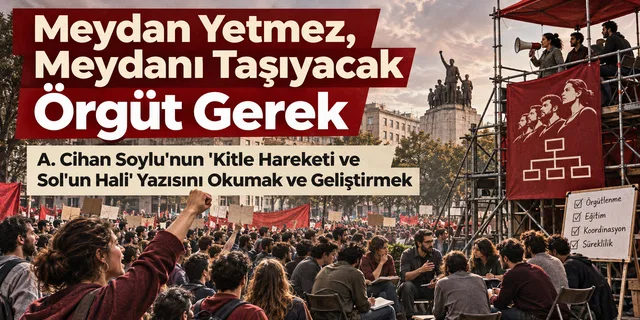
Let us add only a warning: an objective possibility does not turn into politics by itself. Common exploitation does not produce a common organisation. A common organisation is built with conscious labour. The bridge that turns the possibility into reality is the form of organising. We built our contribution in the forum on exactly this bridge.
The contradictions of capitalism in the age of artificial intelligence
Özgür Narin's title touched the field to which we have given the most labour on this blog: the contradictions of capitalism, and class, in the age of artificial intelligence and learning machines.
Let us briefly recall what we have said on this. Large language models were trained by the enclosure, by a few monopolies, of the common knowledge humanity accumulated over centuries, of what Marx called the "general intellect". We call this the expropriation of the general intellect. This expropriation opens a new stage of the Taylorism Braverman described: the division of mental labour inside itself, that is, mental Taylorism. Conception, reasoning and synthesis are carried into the models capital owns; what remains for the human is the role of the supervisor in the loop, that is, a fragmented practice without conception.
The contradiction is exactly here. As capital replaces living labour with the machine, it narrows the source of surplus value. On one side the machine writes forty percent of the code and a quarter of the staff goes; on the other, the bubble inflated by artificial-intelligence investment can evaporate two trillion dollars in a day. The productive forces are socialised, property narrows. This is today's form of the basic contradiction Marx described.
Our proposal is not to content ourselves with diagnosing this contradiction. As we said in the Socialist Artificial Intelligence Manifesto, the question is not "is artificial intelligence good or bad", but these three questions: In whose hands? Under whose control? For whose benefit?
Possibilities of struggle against fascist "nationalisation"
The quotation marks in Aysun Gezen's title are very well placed. "Nationalisation" is the promise of a false unity to the class that capital has fragmented: the nation instead of the class, the migrant instead of the boss, "survival" instead of exploitation.
On this blog we asked why workers vote for the right, we read the AfD's 43.8 percent in Germany as the product of a two-hundred-year line, and we discussed the class function of racism. The conclusion we reached is this: Fascism fills the gap of the unorganised class. When the worker cannot see their own interest in their own organisation, they turn to a false "we".
For this reason the struggle against fascism cannot be only an ideological opposition. The meeting of the migrant worker and the local worker in the same union, in the same neighbourhood committee, under the same list of demands, is the most concrete answer to nationalisation. Internationalism here is not an abstract principle. It is a daily practice of organising.
The class against itself: beyond wage labour
Emre Yeksan's title was the boldest title of the session. The phrase "the class against itself" plays with Marx's distinction between the "class in itself" and the "class for itself", and goes one step beyond: the final aim of the working class is not to remain as the working class, but to abolish the wage-labour relation itself.
Marx says this openly at the end of Wages, Price and Profit: workers should write on their banner "abolition of the wages system" instead of "a fair day's wage for a fair day's work". Today this word gains a new meaning in an age when artificial intelligence can really reduce necessary labour. Abundance is technically possible. The obstacle is the property relation. This is what we meant when we said we will bury capitalism: the bourgeoisie is buying time with technology, but whose that time will be is a question of property.
In Fromm's language, the passage from having to being is not an individual moral choice. It is a matter of social transformation. "To demand what is beyond wage labour" is not to belittle the daily wage struggle. It is to tie it to this horizon.
Second Session: The Unity of the Working Class of Turkey
If the first session asked "where are we", the second asked "what will we do". That most of the people speaking here came from the field, from inside the struggle, made the session especially valuable.
United organised struggle
Haluk Yurtsever's framing presentation set the key concept of the session: united and organised struggle. Both adjectives matter. A movement that is united but unorganised scatters in the first wave; structures that are organised but not united calcify on their own small islands.
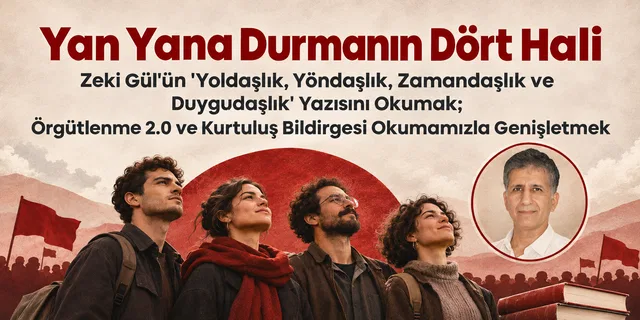
On this blog we discussed this question several times in recent weeks. While reading the TİP's Declaration of Liberation we called on all left parties to common action against groupism. Starting from Zeki Gül's essay we discussed the four ways of standing side by side (sharing a direction, sharing a time, comradeship, sharing a feeling). On A. Cihan Soylu's essay we wrote that the square is not enough, and that an organisation is needed to carry the square. Our common conclusion is this: unity is built not by organisations giving up their own identities, but by their meeting around a common demand and a common calendar.
A concrete programme of struggle
Kamil Kartal's title asked the content of unity: a concrete programme for a new class movement. It is meaningful that an organising specialist speaking from the energy branch asks this, because energy is today one of the fields where the class contradiction appears most nakedly. The lowering of the household electricity threshold to 3,000 kilowatt-hours and one wage in ten months going to inflation are parts of the same table.
Our contribution to the question of a concrete programme is the idea of a "common core of demands". This core, which we proposed in The Computing Worker's Handbook, consists of a few simple demands under which people in different branches, different types of contract and different wage levels can sign the same text: the whole of the wage paid being reflected in social insurance, the right to disconnect outside working hours, and the right to a reason and an objection in algorithmic decisions. The programme can be long; but the unifying core must be short, and clear enough for everyone to understand.
Defending the land and labour together
Esra Işık's title recalled that the class struggle is not limited by factory walls.
In her talk Işık told her own journey: the Akbelen process she was naturally inside suddenly made her part of other actions too, and she found herself in the processes of solidarity inside the class. She also stated plainly the conclusion she drew from this experience: the ecological struggle does not stand in a place separate from the class. It is a natural part of the class struggle.
This testimony is very valuable, because it tells a practice, not a theory. The bond between ecology and class was built in the vigil tent before it was built in books. The peasant defending their land saw, inside the struggle, that their own cause was born from the same property relation as the cause of the miner, the construction worker and the textile worker.
This is also why, on this blog, we called the piece we wrote on Council of State day in Akbelen "the anatomy of a dispossession". The seizure of the peasant's land and the seizure of the worker's labour are two faces of the same logic. The Esra Işık case showed this too: the one who defends nature is tried, the one who plunders nature receives incentives.
Defending land and labour together also stands at the centre of Organising 2.0. In Italy the GKN workers turned the factory they occupied into a social project by making an alliance with the climate movement. Akbelen is the strongest example in Turkey of a similar meeting: peasant, worker, ecologist and lawyer in the same vigil tent.
We can do it
Başaran Aksu's title was a single word, and perhaps the most important word of the day. The experience of the Independent Mine Workers' Union, from the Doruk Madencilik resistance to the miners who walked to Ankara, showed what an organisation built by the worker's own will, outside the big confederations and without waiting for legal thresholds, can do. What the class seven layers underground has taught from Soma to today is also this: we can do it, because we are the ones who do it.
Aksu's talk gathered the lesson of this experience in three points. First, legality must not be a barrier: branch thresholds, authorisation procedures and legal obstacles are not doors to be waited at, but walls to be crossed. Second, actors inside the order, including social-democratic administrations, most of the time affect the workers' own processes negatively. Third, and perhaps most important, an approach that leaves a passive form of organisation and that practises, that demands with its strength, is transformative. Aksu also directed open criticisms at yellow unions and at parties of the order: the existence of these structures, rather than strengthening the class struggle, most of the time harms it.
Each of these emphases overlaps with the ideas of "the minority union that does not wait for the threshold" and "the climbing ladder" that we defended in the Organising 2.0 piece. Legitimacy is born not from the authority the law recognises, but from the organised will of the worker. The law, most of the time, records afterwards the strength that will has reached.
The word "we can do it" also has a philosophical meaning. The greatest weapon of being unorganised is the feeling of helplessness. Small but measurable victories are the strongest tool that breaks that feeling.
The construction of fascism and trade-union decay
Mehmet Türkmen's title contained the sharpest diagnosis of the session: the construction of fascism and the shadow of trade-union decay. We had greeted the independent union experience of BİRTEK-SEN on this blog on the occasion of Türkmen's release.
Türkmen began his talk from his own life. His struggle began in childhood, as a child worker. He said that if he had not been organised he could not have got out of that life, and he could not have been saved from becoming lumpen. The conclusion he reached from here was clear: besides the labour struggle, political organisation is also indispensable. Actions that arise spontaneously are valuable, but they turn into real successes only when they are directed rightly on a political ground. He also stressed separately the value of the workers' own organisations against yellow unionism.
This testimony is the plainest telling of the relation between class and organisation. The relation Lenin set up between spontaneity and consciousness stops being a book discussion here and becomes a life story: the order either crushes the worker left alone or makes them lumpen; organisation makes them a subject of history. This is the living proof of what we call "consciousness is not a precondition, it is a result".
It is also no coincidence that the two concepts, the construction of fascism and trade-union decay, come side by side in the title. When the union bureaucracy stops representing the worker, the worker either moves away from the organisation or turns to the right that promises a false unity. The decaying union prepares the ground for the construction of fascism. The antidote is the union that rests on representatives controlled from the base, transparent, and recallable. This is also why we dedicate the Dispossession dossier we are preparing to the independent unionists in today's union struggle.
Are organising and resisting enough?
Eren Edebali's title was the question closest to our Organising 2.0 proposal: Are organising and resisting enough? What is the relation that has to be built between method and the future?
The struggle of the Private Sector Teachers' Union at the Ankara barricades had shown how a professional group whose base wage was seized, and which was condemned to the minimum wage, could organise from zero.
Our answer to the question is this: organising and resisting are necessary, but they are not enough on their own, because how we organise also determines what kind of future we will build. An organisation in which the decision is taken behind closed doors, in which the representative cannot be recalled, in which the accounts are closed to the member, cannot be a rehearsal of the egalitarian society it wants to build. Method is a small model of the future. For this reason the form of organisation is not a technical detail. It is a political choice.
What We Said in the Forum: The Language of the Order, and Comradely Exposure
In the short time that fell to us in the forum, we first introduced Knowledge Commons, then we underlined a heading we wanted to add to the whole day's discussions: language.
Hegemony is built first in language
The hegemony of the ruling class is built not only with the police, the judiciary or capital, but also with language. When we say "the woman problem" or "the Kurdish problem" we load the source of the problem onto the one who suffers it; this is why we are stopping using these phrases. When we say "employee" we erase the class, when we say "productivity" we neutralise exploitation, when we say "economic realities" we present a property relation like a law of nature.
Perhaps the most uncomfortable sentence we said in the forum was this: this language is not only the language of those opposite us. Even today, in settings that appear beside us, in the circles with which we share the same halls, an important part of the language used is the language of the order. We said this not as an accusation but as a finding. All of us grew up inside this language. Noticing it, and leaving it, both require a collective labour.
Exposure, but comradely
For this reason the language of the order must be explained, and exposed, wherever it appears. But this has two conditions. First, that the exposure be done in a comradely way: the aim is not to condemn the person opposite, but to advance together. Second, that support be offered so that the exposure is perceived rightly: not to say to anyone "you are speaking wrongly" and leave it there, but to offer together the concepts they can put in its place, the texts they can read, and a ground they can discuss.
We spoke of the dossiers and guides we prepared for this purpose: our book of comradely criticism titled For a Left That Does Not Fear Criticism, the Revolutionary Discussion Ethics and Guide to Purging Fallacies, The Computing Worker's Handbook, Event Organizing and Comradeship and the other dossiers on our Guides page. And we made a request to the hall: read these texts, criticise them, support them. All of them are living documents published under the CC BY-SA licence; they are updated with criticisms.
Experimental proposals, a common discussion
Besides these dossiers we also shared the experimental efforts we designed to start the discussion: Organising 2.0 and The Communist Manifesto 2.0. Neither is a recipe. Each is a draft put on the table. They will become meaningful only by being talked about together, criticised together and tested together.
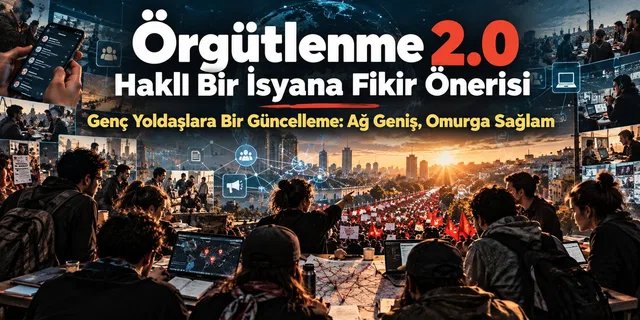
The core of Organising 2.0
Because we could not go into its detail in the forum, let us briefly recall here the core of the Organising 2.0 proposal.
Yesterday's working class met at the factory gate, at the end of the shift, in the same canteen. Our model of organising was built for that: the workplace, the branch, the threshold, the collective agreement. Today two people doing the same job are not even in the same building. The courier thinks they are a "tradesperson", the programmer thinks they are a "professional"; but the same algorithm measures both, the same company dismisses both, the same law leaves both without a union. Exploitation has become common, while the organisation has stayed in its old form. This is plain in a table where the unionisation rate is 13.8 percent.
An important note: 2.0 does not take the place of 1.0. It adds a layer on top of it. The proposal has three feet.
A networked spine. Locally, many small and lasting committees; open assemblies where decisions are taken; a spine that ties the committees to one another and that provides resources and continuity. A network without a spine scatters. A spine without a network calcifies.
A common core of demands. A few simple demands that will bring different contracts and wage levels together under the same text. Every campaign can begin with this core.
A transparent and recallable structure. The person elected must be recallable, the accounts must be open to the member, the duties must rotate. This is the counterpart, in the form of organisation, of the difference Türkmen spoke of between the "own organisation" and the yellow union.
Let us add a warning too: among white-collar workers capital's real weapon is not repression, it is buying. In 2008, when the majority of the workers at IBM Türk joined the union, the company dissolved the organising from inside with a "tactical raise". Commonality must be built wide enough that it cannot be bought. The trials in the world are in this direction too: in Serbia students crossed the algorithm by walking, with a plenum and delegate system, and in Florence the GKN workers are trying to occupy the factory and turn it into a cooperative. But coalitions built only on a wave melt when the wave passes. The new model does not mean a loose model. It means flexible but organised, horizontal but determined.
And the sentence that Türkmen's life story also confirms: a person gains class consciousness while organising. Consciousness is not a precondition. It is a result.
The Day's Common Question: With So Many Problems, Why Can We Not Organise?
The strongest impression that stayed in our minds as we left the symposium belonged not to a single talk but to the whole day. Almost every speaker, and almost every participant who took the floor in the forum, circled by different roads around the same question: With so many problems, in the face of so much concrete lived experience, why can we not come together and organise?
Wages are melting, workplace killings continue, land is plundered, journalists are arrested, young people work while studying, the white-collar worker is dismissed with an email. The list of problems is long, and everyone knows this list. But knowing does not turn into organising. This gap looks like the real field in which all of us have to make an effort to find an answer in the near period.
We will not attempt to give a definite answer to this question in this piece. But, starting from what we have accumulated on this blog so far and from what we heard at the symposium, we can list the fields we think have to be worked on. Each is not an answer, but a heading of research and discussion.
The cost is individual, the gain is collective
The individual pays the cost of organising: dismissal, being blacklisted, custody, a case. The gain is collective, and most of the time it is distant. This is also the most lasting legacy 12 September left: they made the cost of organising so heavy that, for three generations, "don't get yourself into trouble" turned into a piece of family advice. A coup that has not been settled with leaves a fear that has not been settled with. When a life mortgaged by debt is added to this, the risk of losing one's job means, for a family, not only a loss of income but collapse.
The question to be researched: How do we share collectively the individual cost of organising? Solidarity funds, legal support networks and mutual-aid structures that find work for the person dismissed are the first answers given to this question.
Poverty of time
Organisation wants time: the meeting, the vigil, reading, discussion. Yet the scarcest resource of the new working class is time. To say "come to the meeting in the evening" to a person who works two jobs, who works while studying, whose working time reaches home by phone, who leaves their hours on the shuttle road, is most of the time not to see their reality.
The question to be researched: How is an organisation built that a person who has no time can join? Gradual participation, short and regular meetings, an organisation carried inside the workplace and the neighbourhood are possible answers to this question.
The crisis of trust
The criticism of yellow unionism by Mehmet Türkmen and Başaran Aksu points to an important place here. Many people are not unorganised. They have been burned by organisation. Experiences in which the decision was taken at the top, in which the representative could not be recalled, in which the union sat at the table with the boss before the worker, have stained the word "organisation" itself. The voter whom the parties of the order remember from election to election carries the same tiredness.
The question to be researched: How do we build trust again? Our proposal is transparency and recallability: the organisation whose accounts are open, whose elected person can be recalled, whose decision can be followed. But this too is a hypothesis that has to be tested.
The illusion of the individual exit
In Albert Hirschman's distinction, a person who is not content with a structure has two options: voice or exit. Today the exit doors look very bright: another company, freelance work, abroad, setting up one's own business. Capital's strategy of buying among white-collar workers also rests on keeping these doors open. As long as exit looks possible, voice is muted.
The question to be researched: How do we show that the individual exit is a collective illusion, that is, that the door narrows when everyone runs to the same door? Beyaz Yakalının Sefaleti was an introduction to this question. More is needed.
Passivisation and the language of hegemony
What we said in the forum on language is also a part of this question. The engineering of passivisation behind the discourse of social frenzy individualises problems: poverty is presented as personal failure, unemployment as inadequacy, burnout as personal fragility. The person who sees the problem in themselves looks for the solution in themselves too, not in the organisation. When the mechanisms of cognitive surrender and of deceiving ourselves are added on top of this, learned helplessness turns into a way of life.
The question to be researched: How do we turn the problem lived personally into a common problem? The first step of this is to build meeting grounds that let people see others living the same problem.
The break between spontaneous action and lasting organisation
Action is not lacking on this soil. In a mine, in a warehouse, in a school, in a village, people resist every week. But the organisation that will carry the square is most of the time absent; when the action ends, no network remains. The need Türkmen stressed, "the right directing of spontaneity on a political ground", points exactly to this break.
The question to be researched: How is a lasting trace left behind every action, that is, a contact list, a committee, the date of the next meeting?
The left's own fragmentation
Finally we have to look at ourselves. One reason people do not organise may also be that the organisations are not attractive. Long and fruitless meetings, a language in which the newcomer feels outside, groupism, a culture that counts criticism as hostility. The question we asked in the Event Organizing and Comradeship guide holds here too: those who cannot organise among themselves, how will they change the world?
The question to be researched: Are our organisations places where a person who wants to organise, entering the door for the first time, would want to stay?
Asking the question the other way round
Beside all these headings, one thing must not be forgotten: those who have been able to organise also spoke in the same hall. The Independent Mine Workers' Union, BİRTEK-SEN, the Private Sector Teachers' Union, the Akbelen resistance. These are proofs that, despite all the obstacles, people have been able to come together.
For this reason we propose to ask the question "why can we not organise?" the other way round too: Where are we able to organise, and what do we do differently there? The list of failures can lead us to helplessness. A careful analysis of the successes can give a method. One of the fields to which we most want to give labour on this blog in the period ahead will be this: to listen, from their own mouths, to the experience of those who have been able to organise, to draw out the common patterns, and to turn this into open knowledge that everyone can use.
The Old Question, the New Question
When we set the two sessions of the symposium and the discussion in the forum side by side, a transformation of questions appears before us. We prepared the table to make this transformation visible.
| Old question | New question |
|---|---|
| Is the working class shrinking? | Why can the widening class not see itself? |
| Who is the worker? The blue-collar worker? | Why is everyone the algorithm measures, whose contract is uncertain, who carries the fear of losing their job, not a worker? |
| Will artificial intelligence destroy jobs? | Whose property will the time the machine gains be? |
| How do we persuade against nationalism? | How do the migrant worker and the local worker meet under the same list of demands? |
| How is a higher wage won? | How is the wage struggle tied to what is beyond wage labour? |
| Which organisation will be the vanguard? | How do organisations meet on a common calendar while keeping their identities? |
| With so many problems, why can we not organise? | Where are we able to organise, and what do we do differently there? |
| Why does the person who is not a union member not become one? | Why should a person trust an organisation whose decision they cannot take back? |
| Is resisting enough? | Can today's form of organisation be a rehearsal of tomorrow's society? |
| Do we have legal authority? | Are we organised enough to demand with our strength? |
| Ecology, or class? | How do we stand together against the same property relation that seizes the land and the labour? |
| What language are those opposite us speaking? | Among ourselves, what language, whose language, are we speaking? |
Comradely Notes on Sides That Can Be Developed
Organising such a symposium takes great labour. We owe thanks to Emek-Ar and to the Izmir Branch of the Chamber of Architects for spending this labour to open the way of class politics. We write the notes below not as criticism, but as a proposal to strengthen the next meeting even more. As we said in the Event Organizing and Comradeship guide: amateurism is not carelessness.
The new class's own voice. The fastest-growing sections of the new working class, that is, platform workers, couriers, computing workers, call-centre workers and young people who work while studying, were not on the programme as speakers. These sections deserve their own sessions at the next meeting.
Women's labour and care labour. One of the fields where fragmentation is lived most deeply is domestic and care labour. The experience of women workers can be more visible on the programme as a separate heading.
Migrant and Kurdish workers. The most concrete field of the struggle against fascist nationalisation is the organising of migrant and Kurdish workers, from the agricultural worker to the construction worker. The word of those who live this experience directly strengthens the discussion Aysun Gezen opened.
The length and the form of the forum. A forum of an hour and a half at the end of a day with thirteen speakers is not enough to carry the accumulation in the hall. Short question rounds between sessions, a queue-registration system in the forum, or small tables by subject heading can deepen participation.
Turning knowledge into a commons. Publishing the audio and video recordings of the talks, and the presentation texts, under an open licence carries this day's labour also to those who could not be in that hall. As a blog that defends the importance of the knowledge commons, we are ready to give every support we can on this.
Concrete Tasks
The steps we propose, so that the symposium is a beginning and not an end, are these:
- To research together the question "why can we not organise?" To make interviews that compile, in their own telling, the experience of the structures that have been able to organise (miners, textile workers, teachers, Akbelen); to prepare a short survey that asks why those who wanted to organise and gave up gave up; to publish the results as an open dossier.
- A common working group. To set up a small working group with representatives from the different fields that took the floor at the symposium (energy, mining, textile, education, ecology, computing).
- To write the common core of demands together. The first job of this group is to prepare a draft core of five demands that all branches can sign, and to put it forward for discussion as an open text.
- To publish the recordings and the texts. To make the recordings and the texts of the talks accessible under an open licence; to publish on this blog too the texts of speakers who want it.
- A local network meeting. In Izmir, three months after the symposium, to hold a smaller and more practical meeting at which workplace and neighbourhood committees will share their experiences.
- To look at our language together. To hold an open reading workshop in which we discuss how the language of the order seeps into our texts and our talks; to open the Knowledge Commons dossiers and guides to criticism in this workshop, and to update them with the criticisms that come.
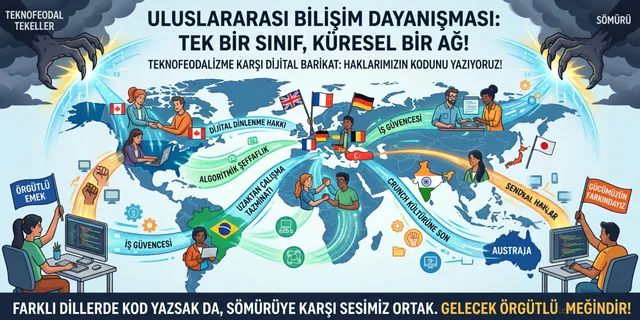
- To keep the digital infrastructure in the hands of the organisation. To base the network's communication not on the monopolies' platforms but on free software under our own control; to keep member and contact data to a minimum.
- To make regional examinations regular. To prepare a series that examines organising experiences in different regions, Europe first, with the questions "what was tried, how did it work, where did it get stuck"; to offer these examinations as an input to the working group's discussions.
- To carry the voice of the new class to the next symposium. To prepare together the own sessions of platform workers, women workers, migrant workers and young people who work while studying.
Dear Young Comrades,
The people sitting side by side in a hall in Izmir today came from different places. One from a mine, one from a classroom, one from a village defending its land, one from a factory, one from in front of a screen. But all of them were asking the same question.
The answer to the question "why can we not organise?" is not found in a book, in a talk or in a symposium. The answer is in what the people in that hall will do tomorrow in their own workplaces, neighbourhoods and schools. The force that changed the world in 1917 did not appear by itself. It was built with a patient, stubborn, careful labour of organising that lasted for years. It will be so today too.
Instead of waiting in front of the old doors, let us open new doors. A fragmented class, on the day it finds itself, is a single class again. And when a class finds itself, it can.
For more beautiful futures, all together.
Sources
- Evrensel, "The 'Classes and Politics in the 21st Century' symposium in Izmir", 2 November 2026.
- Emek-Ar and the Izmir Branch of the Chamber of Architects, Programme of the Symposium on Classes and Politics in the 21st Century, 7 November 2026, Izmir Architecture Centre.
- Karl Marx, Wages, Price and Profit (1865).
- Karl Marx, The Poverty of Philosophy (1847; the distinction between the "class in itself" and the "class for itself").
- Harry Braverman, Labor and Monopoly Capital (1974).
- Erich Fromm, To Have or to Be? (1976).
- V. I. Lenin, What Is to Be Done? (1902; the relation of spontaneity and consciousness).
- Antonio Gramsci, Prison Notebooks (1929-1935; hegemony and language).
- Albert O. Hirschman, Exit, Voice, and Loyalty (1970; the distinction between "voice" and "exit").
The pieces of ours on which this essay is built
- Organising 2.0: An Idea for a Justified Revolt
- The Communist Manifesto 2.0
- For a Left That Does Not Fear Criticism: Our New Book Is Out
- Revolutionary Discussion Ethics and Guide to Purging Fallacies
- Why We Are Done Saying "the Woman Problem" and "the Kurdish Problem"
- "Event Organizing and Comradeship" Guide Is Out
- The Square Is Not Enough: An Organisation Is Needed to Carry It
- Liberation Is in Our Hands, Unity Is in the Hands of the Class
- Four Ways of Standing Side by Side
- The Computing Worker's Handbook
- Beyaz Yakalının Sefaleti
- 12 September: The History, Balance Sheet, and Present of a Class Coup
- Social Frenzy and the Engineering of Passivity
- The Class of Cognitive Surrender
- Neden Kendimizi Aldatırız?
- The Mortgaging of Our Future: A Manifesto for Young Comrades on Financial Bondage and the Credit Card
- The Machine Is New, the Chain Is Old: A Class Anatomy of Remote Work
- An Epistemological View of Arif Koşar's Analysis of Labor Supervision and the Digital Infrastructure of Socialist Planning
- The Expropriation of the General Intellect and the AGI Illusion
- The Human in the Loop
- For the Restitution of the General Intellect: The Socialist AI Manifesto Is Out
- Why Do Workers Vote for the Right?
- The Bourgeoisie Is Buying Time with Technology, and We Will Bury Capitalism
- Council of State Day in Akbelen and the Anatomy of a Dispossession
- Plunder of Nature and Capitalist Domination: From the Esra Işık Trial to Ecosocialist Resistance
- Lightning from Underground to the Capital: The Doruk Madencilik Resistance and the Naked Truth of Class War
- Mehmet Türkmen: In the Ranks of the Class, the Vanguard of an Independent Resistance
- The Future Forged at the Ankara Barricades: The Class Struggle of Private-Sector Teachers
- Europe Took to the Street: The Class of an Autumn from Hormuz to the Bastille
- Dossier: A History of the European Working Class Is Out
- What Does Europe's Youth Want?
- Hope Came from the South: Lula's Victory, Brazil's Hundred Years, and the Road Before the Class
- Algoritmayı Yürüyerek Geçtiler: Sırbistan'da Plenum Sandığı Nasıl Yendi?
- What Did the October Revolution Give the World?
This piece is one of the living documents of Knowledge Commons. It is shared under the CC BY-SA 4.0 licence. You may copy, change and share it if you credit the source.