The Consent of Labour: Why Does the Worker Submit, and When Does the Worker Stand Up?
Reading Nursel Tabel Arslan's "The Consent of Labour: Neoliberal Hegemony and the Working Class", and Developing It in the Conditions of 2026

Dear young comrades,
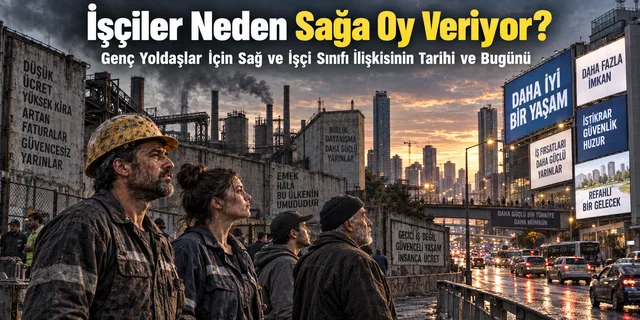
One of the questions we ask most often on this site is this: wages are melting, rent is rising, workplace deaths are increasing, unions are under pressure; so why do millions of workers still vote for this order, still stay silent, still "get by"? There are two easy ways to answer this question wrongly. The first is to belittle the worker: "ignorant, lulled by religion, unaware of their own interest." The second is to tie the whole matter to propaganda alone: "the media determines everything." Both answers turn the worker into a passive object, and both answers take us away from the question of organising.
Dr Nursel Tabel Arslan's book Emeğin Rızası: Neoliberal Hegemonya ve İşçi Sınıfı (The Consent of Labour: Neoliberal Hegemony and the Working Class), published in Kor Kitap's Marxist Research Series, is one of the rare studies that steps outside these two easy paths. The book rests on face-to-face interviews with workers in Ankara's industrial basins, and it tells us this: most workers see what is being done to them, and they know it; yet they submit even while they know. Understanding why they submit is the first step toward understanding how they will stand up.
This essay first summarises the book briefly, then goes into the detail. We then apply the book's concepts to this November's agenda: the explosion at HABAŞ in Aliağa, the strike decision posted in Sincan, the very field of the book, the 2027 minimum wage being discussed below the hunger line, and the 2027 budget, which allocates nearly three times as much to interest as to social assistance. In the final section, taking account of what has changed between 2016–2017, when the fieldwork was done, and today, we set out our comradely proposals for developing the book. The review was prepared using the book together with interviews with the author and published studies; the full list of sources is at the end.
In Brief: The Book in Ten Theses
- Hegemony is not ideology alone. The supremacy of the ruling class is built in minds, and it is also built on the factory floor, on the wage slip, and in the debt note. The book's main move is to rescue Gramsci from "culturalist" readings and to draw attention to the economic foundation of hegemony.
- Hegemony is a combination of coercion and consent. Consent always stands inside a shell of coercion; consent is at its most productive when coercion waits in the shadow, not when it withdraws.
- Consent has two forms. Active consent is to approve; passive consent is to submit. The great majority of the workers in the fieldwork belong to the second group.
- Workers are not deceived. Most of the workers interviewed are aware that the arrangements in working life are against them. The problem is not a lack of knowledge. It is a lack of power.
- Fear is the strongest mortar of consent. Unemployment, debt, precarity, and the threat of dismissal push the worker into the calculation of "saving today".
- Social assistance turns a right into a favour. While rights-based social security has been narrowed, a needs-based network of assistance, presented as the generosity of those in power, has been widened. This network both produces consent and serves capital accumulation.
- Religion is not decisive; nationalism is more effective. The main dynamic that carried the AKP to power was not religion. It was the promise of justice and development. Among workers, nationalist feelings came out as more influential in political choice than religion.
- Some unions are an apparatus for producing consent. Being organised is not, by itself, an antidote. The real question is "what kind of organisation, what kind of union".
- The AKP is the organic response to capital's crisis of hegemony. Bourgeois hegemony, which could not be fully established from 1980 to 2002, was gathered around a single programme with the AKP.
- Hegemony is not fixed. The worker who gives passive consent can move into action at any moment. This is also the book's most hopeful finding.
Let us now open these theses in detail.
The Book and the Author
Emeğin Rızası was published by Kor Kitap in June 2021; it is a study of 290 pages. The book rests on the doctoral thesis the author prepared in the Department of Sociology at the Faculty of Language, History and Geography of Ankara University. The thesis fieldwork was carried out in 2016–2017, through interviews with organised and unorganised workers in the OSTİM, Sincan, and İvedik organised industrial zones in Ankara.
The author had turned to this subject before the book as well. In the 2017 article Türkiye'nin Neoliberalleşme Sürecinde İşçi Sınıfının Siyasal Yönelimi (The Political Orientation of the Working Class in Turkey's Neoliberalisation), published in the Gaziantep University Journal of Labour Research, she discussed the need for the ruling class, if hegemony is to be sustained, to give the dependent classes material concessions that do not touch its own fundamental interests, and the way the control of labour in the production process forces passive consent. The book extends this frame with field data.
After the book was published, two important interviews were held with the author. In Soner Sert's interview in Gazete Duvar, Arslan explained that the 12 September coup was necessary for neoliberalism to take root in Turkey, and that MÜSİAD (the Independent Industrialists' and Businessmen's Association) had an important influence while the AKP was establishing hegemony over workers. In Serpil İlgün's interview in Evrensel before the 2023 elections, she discussed how consent is produced, and the fact that those in power now lean on coercion more than on producing consent. Burak Bağçeci's extensive review in the journal Teori ve Eylem also assessed the book's theoretical ground together with Lenin's understanding of hegemony.
Let us note the link with 12 September in particular, because the main thesis we defended in the 12 September dossier was that the coup was a "class coup" and that today's order was built upon it. Arslan's book can be read as a document from the field of how labour was disciplined on the road that coup opened, and of how that discipline was turned into consent.
What Is Hegemony? From Lenin to Gramsci
The word "hegemony" is used so often in the academy today that it has almost been emptied. For that reason one has to return first to the origin of the concept.
The first person to use the concept systematically inside a revolutionary strategy was Lenin. For Lenin, hegemony is the leadership of the working class, in the revolution, over the other oppressed sections; it is showing that its own class interest contains the liberation of all working people, and bringing society behind it on that basis. Hegemony, in its first form, is a task of the working class.
Gramsci also thought the concept from the other side, in a fascist prison, in the roundabout language he used to get past the censor: why can the bourgeoisie rule not only by coercion but also by consent? His answer was that hegemony is a combination of coercion and consent. The ruling class is hegemonic to the extent that it can present its own particular interest as the general interest of the whole of society.
The problem is that Gramsci was abducted twice in the decades that followed. First, Eurocommunism made him a prop for parliamentary reformism; then the post-Marxists tore him away from the relations of production and confined him to the field of discourse, identity, and culture alone. On these readings, hegemony meant the dependent classes internalising the ruling ideology, and the solution was to be a "cultural struggle".
The theoretical value of Arslan's book is exactly here. The author shows that the importance Gramsci gave to the relations of production has been ignored in the literature, and that treating hegemony only in its ideological dimension opens the door to civil-society and reformist interpretations. In the book's own words, hegemony is established in economic relations as much as in the cultural and political field, and it can be shown concretely. This is a Marxist reading: consciousness is born of being, and consent is born of material conditions.
How Is Consent Produced?
The richest sections of the book are those that show, through the accounts of workers in the field, by which instruments consent is produced. Let us take them one by one.
Social assistance: the right turned into a favour
Under the AKP a silent but deep transformation took place in social policy. The rights of those covered by social security were restricted, a large part of society was pushed outside that coverage, and the social security system was opened to capital accumulation. In the same period the share of social assistance increased; but this assistance began to be distributed not on a rights basis, according to the principle of social citizenship, but on the basis of need.
The difference is very large. A right is nobody's favour; the citizen demands it. Assistance depends on the generosity of the giver; the receiver feels gratitude. As Arslan shows, this assistance was distributed, alongside state institutions, through foundations, religious communities, associations, and local governments, inside an Islamic-conservative form of relation, and it was presented as a favour of those in power. The policy that enlarged poverty and the assistance that "manages" poverty came from the same hand. Poverty was thus both made sustainable and turned into political loyalty.
We discussed this mechanism through family policies in Whose Family Is Safe?. Arslan's book shows the effect of the same mechanism on the working class from the field.
Debt: the mortgaging of the future
The second great mortar of consent is debt. According to the author, a system was built that mortgages the future through indebtedness. This is not peculiar to the AKP alone. It is a general instrument of neoliberalism; but the AKP used it very effectively. For a worker who has credit-card debt, who is paying a housing loan, who gets through the end of the month with a consumer loan, a strike means the risk of dismissal, and dismissal means being unable to pay the debt. Debt chains the worker to the employer and, indirectly, to the order. What is more, because this chain sends interest to finance capital for every lira the worker borrows, it both produces consent and produces accumulation.
Fear: the calculation of saving today
Perhaps the most human finding of the book concerns fear. Workers who give passive consent know that they are wronged and that they do not receive the return on their labour. They also know that if they set out to seek their rights they will be dismissed, blacklisted, and sometimes met with physical violence. There is an army of the unemployed growing at the gate. The worker makes an account, and chooses silence in order to save today.
The author's stance at this point matters. In the Evrensel interview she says of these workers, "I do not think they can be blamed for doing this," and she reminds us that it is easy to theorise from outside and hard to live those conditions. This is a stance we share. A left that blames the worker cannot meet the worker.
Religion and nationalism: changing doses
Contrary to the widespread assumption, the book argues that religion was not the basic dynamic in the dependent classes' support for the AKP. In the first years it came to power, the AKP kept Islamist language in the background; with the promise of justice and development it won the support both of the dependent classes and of the ruling classes. Religious emphases came to the fore in the later years of its rule.
The more interesting finding concerns nationalism. In most of the workers Arslan interviewed, nationalist feelings are more decisive in political choices than religion. Religion addresses a certain section that has already been consolidated; the emphasis on "nativeness and nationalness" can address a much wider section, from the MHP base to the Atatürkists in the CHP. The author reports that even a worker who defines himself as a socialist carries nationalist patterns in his view of the demands of the Kurdish people. This is a fact the left also has to face in its own base.
Unions: antidote, or apparatus?
One of the book's most shaking findings is this: in the fieldwork, being organised did not show the effect that had been expected in breaking consent. Beyond that, some unions play a direct role in the production of consent. The example workers mention most often is Türk Metal. The author sets a few unions, such as Birleşik Metal-İş (the United Metal Workers' Union), in a separate place; but she says the condition of the large confederations and unions is plain to see.
The conclusion the author draws from this is right: the question is not "are you organised or not", but "what kind of organisation, what kind of union". That workers in the Metal Storm of 2015–2016 could impose their own demands on the union shows that the answer to this question is also being sought in the field.
Active Consent, Passive Consent
Let us set side by side the two forms of consent that are the conceptual spine of the book:
| Active consent | Passive consent |
|---|---|
| It is to approve; the worker adopts the order. | It is to submit; the worker does not adopt the order, but endures it. |
| Ideology, religion, and community ties are decisive. | Economic and legal compulsion, and fear, are decisive. |
| Drawing a benefit from the order (assistance, a job, a tender network) is effective. | Debt, unemployment, precarity, and the threat of dismissal are effective. |
| The worker either does not see the wrong done to them, or counts it legitimate. | The worker sees the wrong, but says "now is not the time". |
| Breaking it requires ideological struggle and the exposure of the material interest. | Breaking it requires an organisation that is safe, strong, and trustworthy. |
| A minority in the fieldwork. | A majority in the fieldwork. |
This table can also be read as a map of organising. Telling the worker who gives passive consent to "wake up!" has no meaning; that worker is already awake. What they need is an organisational guarantee with which they can overcome their fear.
The Reality of the Wage: Why "False Consciousness" Is Not Enough
One of the theoretically deepest points of the book is its refusal to explain the worker's consent to the order by ideological manipulation alone. According to the author, in capitalist society the process of creating value is itself alienating. The worker's seeing the wage they receive as the return on their labour is not a lie someone has told them. It is an appearance they live in daily experience, in the flesh. The wage form hides exploitation, because the worker's unpaid labour dissolves, inside the same working day, into their paid labour.
This is the direct continuation of Marx's analysis of commodity fetishism. We discussed this point at length in Why Do We Deceive Ourselves? (in Turkish): social illusions are not an error of the mind. They are the form of appearance of social relations themselves. What Arslan shows from the field is the same. In another observation of the book, the submission of the dependent classes to those in power comes not from their being unaware of their situation, but from their counting submission as prudence inside an order built on surveillance, reward, and punishment.
The worker is not foolish. The worker is cautious. This distinction should change the language of the left at the root.
The Strengths of the Book
Why do we recommend the book to young comrades? There are several reasons.
First, it rests on the field. An important part of what is written on the working class in Turkey starts either from statistics or from theory. Arslan carries into the book the voices of workers in the workshops of OSTİM and the factories of Sincan and İvedik. The contradictory answers of the workers interviewed are the book's most living material.
Second, it gives Gramsci back to class. It rescues the concept of hegemony from culturalist and civil-society readings and ties it to the relations of production.
Third, it does not blame the worker. The book's stance is that the worker is neither a passive victim nor a deceived mass, but a subject who makes rational calculations inside their own conditions.
Fourth, it presents hope as a scientific finding. The book's conclusion is plain: most workers give passive consent in the shadow of compulsion; but it is not possible to speak of a type of worker who has surrendered entirely. In the book's words, those who give passive consent "can pass into a state of action at any time, at any moment." The words of a worker reported toward the end of the book are a living example: that worker says that the source of the problems has to be removed, and that the way to do it passes through a revolution whose vanguard the working class will form.
Looking from November 2026: The Present State of Consent
The best way to introduce a book is to look at today with its concepts. The news that fell onto the agenda in the days we prepared this essay shows, with almost textbook clarity, the forms now taken by what Arslan saw in the field in 2016–2017.
Aliağa: the price of consent is being paid in lives
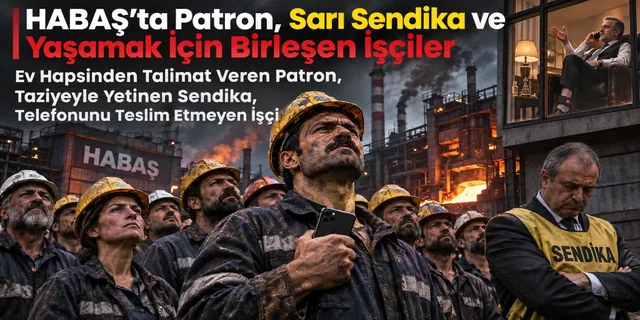
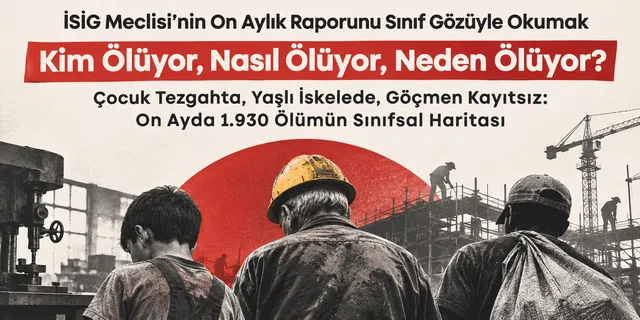
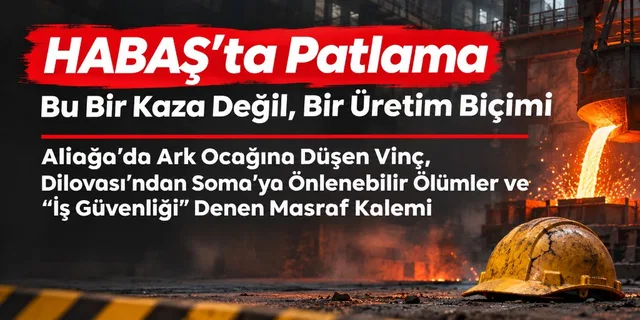
On 9 November, the day this essay was written, an explosion and then a fire broke out in an arc furnace at the HABAŞ iron and steel plant in Aliağa, İzmir. After the cabinet meeting, President Erdoğan announced the death toll as 16 and the injured as 13, of whom 2 were critical. Governor Süleyman Elban had said at 17:43 that 10 workers had died. At 21:48 Health Minister Kemal Memişoğlu said 16: 14 at the scene, 2 in hospital. Sözcü at 22:30 writes that the minister announced the number had risen to 17 because one more of the injured had died. TRT at 22:16 writes 17 dead and 12 injured, of whom 1 is critical. The 17th person is not listed one by one. At 23:11 Evrensel moved the headline to 17. Memişoğlu's message is that one more person who was in a serious condition has died. No name. At 23:16 the death record writes 28 together with the 11 from before today. That is their sum. AA's 10 November opening is 17 dead and 13 injured, 1 of them critical. The body keeps the 16 and the 2 critical cases. The morning pages put the injured at 12, 13 and 14. No names. NTV writes the detentions as 7. The prosecutor's text is 6. No names. At 12:35 the same day the İSİG Meclisi counted at least 1,930 workers dead in the first ten months of 2026: January 155, February 129, March 151, April 190, May 214, June 228, July 216, August 227, September 227, October 193. The 7 October report had September at 226 and the first nine months at 1,736. This post writes September as 227. The HABAŞ deaths of 9 November sit outside these ten months. (İSİG Meclisi) In the afternoon NTV, AA, Yeni Şafak and Evrensel wrote the same 17 names. The same pages also write that DNA continues. Fatih Işık is also on yesterday's injured list. Yücel Memiş and Sonay Tezcan were released. At 16:26 the burial places were written. There is a name outside the list. At 14:49 Tuncay said a detention decision for 11 people. He put the injured at 15, one of them critical. The body that has not been reached is not an 18th death. The names are in our HABAŞ dossier. At the same plant, explosions had also come one after another in the summer of 2018, and workers said then too that no precautions had been taken.
This event is the most painful test of the book's most basic finding. The workers Arslan interviewed stayed silent because they knew they would lose their jobs if they set out to seek their rights. Complaining, in a factory, about an unsafe boiler, an ageing crane, or a speeded-up shift runs into the same account: "if I complain, I will be put out at the gate." Passive consent means consenting not only to a low wage but also to the risk of death. Workplace murders are the heaviest price of passive consent. For that reason the struggle for occupational safety is one of the most concrete doors of the struggle that breaks fear and undoes consent. We took up HABAŞ in a separate essay, as not an accident but a mode of production.
Sincan: a strike decision from the field of the book
From Sincan in Ankara, where Arslan's interviews were held, comes a piece of news that answers the book's question directly. At the Ulusoy Bakır plant, workers have been holding out for years for the right to a collective agreement. According to Evrensel's report of 21 October, the authorisation of Birleşik Metal-İş, affiliated to DİSK (the Confederation of Progressive Trade Unions of Turkey), passed through the local court, the regional court of appeal, and the Court of Cassation, and became final on 23 July 2026. The union announced that if the dismissed workers were not taken back and a collective-agreement table was not set up, it would go on strike on 12 November, and it posted the strike decision on the factory gate.
This news matters for two reasons. First, the union that Arslan set in a separate place in her finding that "being organised is not enough by itself; the real question is what kind of union" is today preparing a strike in the field of the book. Second, the book's most hopeful sentence comes down to the field here: the worker who gives passive consent can move into action at any moment. The Ulusoy Bakır workers did not retreat, despite a legal process lasting years and despite dismissals. When consent breaks, it breaks like this: with patience, with an authorisation case, with a sheet of paper posted on the gate.
It is not only Sincan. In April this year the resistance of mine workers ended in a gain under the lead of an independent union; in August the union's general president said he had been detained four times in six days. In İzmir the Temel Conta workers met detention in a strike that reached its 494th day, and the gendarmerie intervened against the workers on strike at Lezita. This picture is the counterpart, in the field, of the author's 2023 finding of "a shift from consent to coercion": as those in power find it harder to buy consent, they meet the worker with detention; the workers, despite the detentions, carry the resistance on.
A bargain below the hunger line
The minimum wage is the most visible shop window of the "material concessions" mechanism the book speaks of. In 2026 the net minimum wage is being applied at 28,075 lira. According to Evrensel's report of 1 November, a figure between 34,000 and 37,000 lira for 2027 is being discussed in the corridors of those in power; today's hunger line is around 38,000 lira. If this figure is announced, the minimum-wage worker may remain below the hunger line for 45 months without a break.
In the same days TÜİK (the Turkish Statistical Institute) announced October's annual inflation as 29.77 per cent; ENAG (the Inflation Research Group) calculated 45.12 per cent for the same period. This gap, which we described in September Inflation, the TÜİK-ENAG Gap, decides the question of which thermometer the wage bargain will be made with.
Looked at from the book's frame, the situation is this: hegemony requires the ruling class to give concessions that do not touch its own fundamental interests. When the concession falls even below the hunger line, the material basis of consent thins. What remains is fear, debt, and coercion. The minimum-wage table this year will also be the measure of how cheaply consent is being tried for purchase.
The 2027 budget: three for interest, one for assistance
There is no better document than the 2027 budget for testing the book's analysis of social assistance. According to the figures announced, 1 trillion 341 billion lira is foreseen for social assistance and support in 2027, while 3 trillion 975 billion lira is allocated to interest payments. The budget, that is, transfers to finance capital nearly three times what it transfers to social assistance. The 2027 budget of the Ministry of Family and Social Services is also on the discussion calendar of the Plan and Budget Commission; opposition deputies had already argued last year that the rapid rise in the item for the struggle against poverty was an election strategy.
The two-faced mechanism Arslan shows can be read plainly in these figures. On one side, the value labour produces flows to finance capital through borrowing and interest; on the other, the poverty this flow creates is "managed" by assistance distributed in the language of favour. Assistance is presented as a large figure; but beside what the same budget allocates to interest, it stays small. Favour in place of a right, assistance in place of security, debt in place of a wage: this is the summary, in the 2027 budget, of the order the book analysed in 2021.
"Job placement" and the language of fear
Vedat Işıkhan, the Minister of Labour and Social Security, announced that İŞKUR (the Turkish Employment Agency) had mediated 1,298,953 job placements in the first ten months of the year. Announcements of this kind are, in the form the book analyses, part of those in power presenting themselves as the source of work and of bread. The real question is how lasting these jobs are, and at what wage and with what union guarantee they are done. Short-term, minimum-wage, non-union jobs condemn the worker to looking for work again every year, and to being afraid again every year. The material ground of what the book calls passive consent is exactly this: temporary work, permanent fear.
For Developing It: Comradely Proposals from 2016 to 2026
What makes a book valuable is opening it to discussion. The field data of Arslan's study belong to 2016–2017. Much has changed in Turkey and in the world since that day. The proposals below should be read not as the book's shortcoming, but as the directions that have to be walked today on the road it opened.
1. The shift from consent to coercion
After the fieldwork came the 2018 currency shock, the pandemic, the 2023 earthquakes, and a long period of high inflation. As we showed in September Inflation, the TÜİK-ENAG Gap, the gap between official inflation and the inflation the working person lives also melts the consent that social assistance can "buy".
The author herself said, in the 2023 interview, that those in power no longer make much effort to produce consent, and that they lean more on coercion in every sense. In Gramsci's language, as the consent leg of hegemony weakens, the coercion leg comes forward. The journalists imprisoned today, the trade unionists detained, the trustees, and the bans are the signs of this shift. This situation shows, on the one hand, not the strength of those in power but their weakness; on the other hand it enlarges the fear behind passive consent. The book's frame is a strong starting point for understanding this new phase as well. The next step should be to examine from the field how passive consent can be broken in periods of "naked coercion".
2. Algorithmic consent: prudence turned into data
The book shows that the worker counts submission as prudence inside an order built on surveillance, reward, and punishment. In 2026 this order of surveillance is already much more than a foreman's eye. The chipped tracking in the factory that we described in The Card Around Our Necks, the scoring in courier applications, the performance algorithms in warehouses, and the software that watches the screens of white-collar workers take prudence out of the worker's own account and turn it into a rule of conduct the machine imposes.
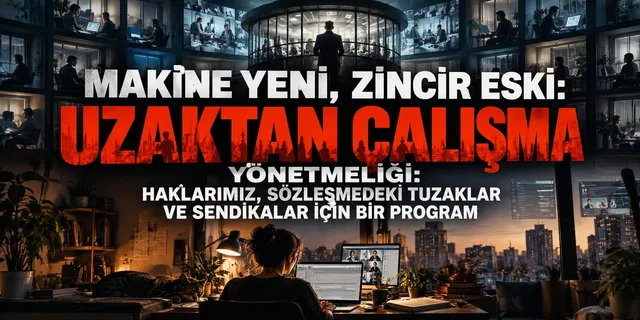
We call this "mental Taylorism" and a "digital panopticon". The essence of the panopticon is this: the person who knows they are watched behaves, even at the moment they are not watched, as if they were. This means the technical production of passive consent. A third layer can be added today to the book's distinction between active and passive consent: consent that is internalised, measured, and scored. In our Gig Economy Dossier, couriers being counted as "tradespeople" and forced to behave as if they were their own bosses is one of the clearest examples of this layer.
3. The "explicit consent" form: the bureaucratic form of consent
Where do we see the word "consent" most often today? In the "explicit consent" texts of the legislation on the protection of personal data. The texts put in front of us when we start a job, download an application, or register at a hospital, and which we approve without reading. A "consent" that has no option of saying no is a legal form of Gramsci's passive consent: approval given inside coercion, in the shadow of coercion.
We discussed a similar point in A Class Analysis of the World of Artificial Intelligence in Light of the Anthropic Survey: the practice by which large technology companies "ask the user" serves, beyond collecting data, to give their decisions an appearance of legitimacy and of consent. These new, digital forms of the production of consent are also waiting to be examined with the book's frame.
4. The consent of the white-collar and information worker
The field of the book was blue-collar industrial workers. But a rapidly growing section of the working class today works in offices, at screens. In this section the strongest form of consent is the thought "I am not a worker". As we showed in The Misery of the White Collar (in Turkish), the promise of the career ladder, performance bonuses, and the identity of "professionalism" are the instruments of the active consent that keeps the white-collar worker from organising. As artificial intelligence pulls away the lower rungs of this ladder, we see this consent beginning to crack as well. Field research done with Arslan's method among white-collar and information workers could shed light on how this new section of the class can be organised.
5. The organisation of counter-hegemony
The book shows that passive consent can turn into action at any moment; but the question of with which organisational form this turn becomes lasting remains beyond the book's scope. This is in fact Lenin's question: how does the working class establish its own hegemony?
Our proposal of a contribution to this question today is the model we discussed in Organising 2.0: secure communication that reduces the worker's fear, small but trustworthy nuclei in the workplace, a rank-and-file organisation that can impose its own demand on the union, and common action that goes beyond factionalism. The book's finding of "millions of workers who do not trust the union" also explains why this model is necessary. Trust can be rebuilt only with an organisation that keeps its word, that is under the worker's own control, and that does not leave the worker alone.
What the book showed, and what has to be added today
| What the book showed from the field (2016–2017) | What has to be added today (2026) |
|---|---|
| Social assistance is the most important leg of consent | Inflation is melting the consent that assistance buys; coercion is coming forward |
| Debt is the mortgaging of the future | Financialisation has deepened; digital credit and instalment consumption have spread |
| Submitting inside an order of surveillance and punishment is prudence | Surveillance has become algorithmic; prudence has turned into a behaviour that is scored |
| Consent is given in active and passive form | With "explicit consent" texts, consent has turned into a bureaucratic form |
| The field: the blue-collar industrial worker | The white-collar and information worker is also inside the spiral of consent and of being unorganised |
| Some unions are an apparatus of consent | Rank-and-file organisation and a digitally secure model of organisation are necessary |
| Passive consent can turn into action at any moment | The organisation of counter-hegemony that will make this turn lasting has to be built |
| The field: workers waiting in silence in Sincan | The strike decision posted on the Ulusoy Bakır gate in Sincan |
| Fear is the reason for consenting to a wrong | In Aliağa the price of fear is being paid in lives. Sözcü at 22:30 writes the death toll as 17. At 23:11 Evrensel moved the headline to 17. The 17th person is not listed one by one |
| Material concessions are the condition of consent | The 2027 minimum wage is being discussed below the hunger line; the budget allocates three times the assistance to interest |
Concrete Tasks
To read a book is to read it in order to do something with it. Here are a few proposals:
- Set up a reading group. Read the book in a group of four or five at your workplace, your school, or your union. After each chapter, talk about this question: how is consent produced in our workplace?
- Examine your own field. You can do, on a small scale, what Arslan did. Talk with five workers around you. Listen to why they stay silent, without passing judgement on whether the consent they give is active or passive. What you hear will show you where organising has to begin.
- Take fear as the target. If the mortar of passive consent is fear, the first work of organising is to reduce fear: legal solidarity, a support fund for those dismissed, secure channels of communication.
- Defend the right as a right. Against the presentation of social assistance in the language of "favour", say insistently that social security is a right. Words matter.
- Make algorithmic surveillance visible. Ask, in your workplace, which data are collected, in whose hands they are, under whose control, and to whose benefit they are used.
- Question your union. Do not abandon it. Ask the question "what kind of union?" inside the union; look for the ways of imposing the rank and file's demand on the leadership.
- Give Sincan a voice. Follow the strike of the Ulusoy Bakır workers, send a message of solidarity, and if you can, visit the strike site. That is where consent is breaking, in the field of the book.
- Do not let Aliağa be forgotten. Follow the case of the workers who died at HABAŞ; record together the gaps in occupational safety at your own workplace. The most concrete way of breaking fear is to make safety of life a common demand.
- Follow the minimum-wage table with your own thermometer. Set the figure to be announced in December beside the hunger line and beside the ENAG–TÜİK gap; open this comparison to discussion in your workplace.
Dear young comrades,
The Consent of Labour tells us something that is both hard and hopeful. The hard part is this: the working class submits not because it has been deceived, but because it is afraid; and this fear is not empty. It rests on real threats. For that reason it is not enough to tell the worker to "wake up". An organisation has to be offered that can put trust in the place of their fear.
The hopeful part is this: consent is not permanent. Hegemony is a relation that has to be reproduced every day, and what has to be reproduced every day can be undone every day. The workers Arslan interviewed knew this. They saw the wrong, and they watched for the time.
This November, two pieces of news stand side by side. In Aliağa, workers paid with their lives the price of a fear that had been silenced. In Sincan, workers who overcame the same fear posted the strike decision on the factory gate. These are the two faces of consent: one ends in death, the other in organisation. What will decide which of them multiplies is what we do today.
Our task, then, is to build that time together. We can do this not only by defending the right ideas, but by standing beside the worker, by sharing their fear, and by organising the ways of overcoming that fear together. As Lenin reminded us, hegemony is a task for the working class: to show that its own liberation is the liberation of all the oppressed, and to bring society behind it on that basis.
Read the book, discuss it, carry it into the field. If consent is produced, counter-consent can be produced too.
Sources
The book
- Nursel Tabel Arslan, Emeğin Rızası: Neoliberal Hegemonya ve İşçi Sınıfı (The Consent of Labour: Neoliberal Hegemony and the Working Class), Kor Kitap (Marxist Research Series), Istanbul, June 2021, 290 pp., ISBN 978-6257392013 — on the publisher's sales site (Ginko Kitap)
The author's other work, and interviews
- Nursel Arslan, "Türkiye'nin Neoliberalleşme Sürecinde İşçi Sınıfının Siyasal Yönelimi" (The Political Orientation of the Working Class in Turkey's Neoliberalisation), Gaziantep University Journal of Labour Research (GEAD), Volume 8, Issue 11, June 2017, pp. 75–98 — PDF
- Serpil İlgün, "Dr. Nursel Tabel Arslan: İşçilerin çoğunluğu politikaların aleyhinde olduğunun farkında" (Dr Nursel Tabel Arslan: Most workers are aware that the policies are against them), Evrensel, 8 April 2023 — link
- Soner Sert, "Nursel Tabel Arslan: 12 Eylül, neoliberalizmin Türkiye'de yerleşebilmesi için gerekliydi" (Nursel Tabel Arslan: 12 September was necessary for neoliberalism to take root in Turkey), Gazete Duvar, 2021 — link
Review
- Burak Bağçeci, "Emeğin Rızası" (The Consent of Labour), Teori ve Eylem, 7 January 2022 — link
Current news (October–November 2026)
- Our HABAŞ dossier: 9 November 2026. Erdoğan said 16 dead and 13 injured, of whom 2 were critical. Memişoğlu at 21:48 said 16: 14 at the scene, 2 in hospital. Sözcü at 22:30 writes that the number rose to 17. TRT at 22:16 writes 17 dead and 12 injured, of whom 1 is critical. At 23:11 Evrensel moved the headline to 17. At 23:16 the death record writes 28 together with the 11. That is their sum. The 17th person is not listed one by one. On 10 November AA's opening is 17 and 13 injured of whom 1 is critical. Across the pages the injured count is 12, 13 and 14. No names. NTV writes the detentions as 7. The prosecutor's text is 6. At 12:35 the İSİG Meclisi counted the first ten months as at least 1,930: 155, 129, 151, 190, 214, 228, 216, 227, 227, 193. The HABAŞ deaths of 9 November sit outside these ten months. In the afternoon 17 names were written. The DNA sentence stays. Memiş and Tezcan were released. At 16:26 the burial places were written. There is a name outside the list. Tuncay announced a detention decision for 11.
- "Aşırı kar hırsıyla üretim işçileri tehdit ediyor: HABAŞ'ta üç işçi ağır yaralandı" (Production driven by an excessive hunger for profit threatens the workers: three workers seriously injured at HABAŞ), soL, 30 August 2018 — link
- "Ulusoy Bakır'da grev kararı asıldı: 12 Kasım'da grev" (The strike decision was posted at Ulusoy Bakır: strike on 12 November), Evrensel, 21 October 2026 — link
- "Asgari ücretliye kesintisiz açlık" (Unbroken hunger for the minimum-wage worker), Evrensel, 1 November 2026 — link
- "Ekim enflasyonu açıklandı: TÜİK yüzde 29,77, ENAG yüzde 45,12 olarak hesapladı" (October inflation announced: TÜİK calculated 29.77 per cent, ENAG 45.12 per cent), 3 November 2026 — link
- "2027 bütçesi açıklandı: 27,3 trilyon liralık harcama, 3,9 trilyon liralık açık" (The 2027 budget announced: 27.3 trillion lira of spending, a 3.9 trillion lira deficit), Dünya — link
- "İktidarın seçim hazırlığı bütçede çıktı" (Those in power's election preparation showed up in the budget), Cumhuriyet — link
- "Bağımsız Maden-İş Genel Başkanı Çakır: 'Patronları da gözaltına alın'" (Çakır, general president of Bağımsız Maden-İş: "Detain the bosses too"), Evrensel, 15 August 2026 — link
- "Maden işçisinden öğreti" (A lesson from the mine worker), Evrensel, 2 May 2026 — link
- "Direnişteki Digel işçilerinden Temel Conta grevine çadır nöbeti desteği" (Tent-watch support from the Digel workers in resistance to the Temel Conta strike), Evrensel, 17 April 2026 — link
Theoretical background
- V. I. Lenin, Two Tactics of Social-Democracy in the Democratic Revolution (1905)
- V. I. Lenin, "Reformism in the Russian Social-Democratic Movement" (1911) — marxists.org
- Antonio Gramsci, Prison Notebooks (1929–1935)
- Karl Marx, Capital, Volume 1, Part One, "The Fetishism of Commodities and the Secret Thereof" (1867)
Related essays from Bilgi Müşterekleri
- 12 September: The History, Balance Sheet, and Present of a Class Coup
- Whose Family Is Safe?
- September Inflation, the TÜİK-ENAG Gap
- Neden Kendimizi Aldatırız? (in Turkish)
- The Card Around Our Necks
- Beyaz Yakalının Sefaleti (in Turkish)
- Gig Economy Dossier
- A Class Analysis of the World of Artificial Intelligence in Light of the Anthropic Survey
- Organising 2.0: An Idea for a Justified Revolt
- For a Left That Does Not Fear Criticism: Our New Book Is Out
- The Explosion at HABAŞ: This Is Not an Accident, It Is a Mode of Production
This essay was prepared by Bilgi Müşterekleri and is shared under the CC BY-SA 4.0 licence. You may reproduce, modify, and publish it, provided you give credit.