The State of the Fund Crisis: The Former Minister Is Inside, the Spouse Who Sold the Shares Is at the Door
The Detained Minister, the Husband under Judicial Supervision, and the Head of Supervision: A Class Map of Justice

This piece belongs to the series The Fund Crisis.
Dear Young Comrades,
It has been seven weeks since the fund crisis broke. On the night of 5 November the crisis crossed a new threshold. Fatma Betül Sayan Kaya, a former deputy chair of the AKP and former Minister of Family and Social Policies, was detained by the criminal judgeship after a statement that lasted about nine hours. Her husband, İlyas Kaya, who bought and sold the same shares in the same period, and İbrahim Ömer Gönül, the former head of the institution responsible for supervising the funds, were released under judicial supervision. The decision was reported by Anadolu Agency, Evrensel and NTV. Detention is not a conviction.
The same week brought other news. The former general manager of Borsa İstanbul was detained on a bribery charge. The former deputy chair of the Capital Markets Board (SPK) and members of the board were taken into custody. The Minister of Justice announced that the investigation had found "a network that had infiltrated the supervision mechanisms". The President said "people you would never have expected have got inside these affairs".
And in the same week, indictments were prepared against journalists who had spoken about the fund swindle. Şaban Sevinç and Mustafa Balcı have been in prison for 28 days. Murat Ağırel, already under house arrest because of the fund reports, was detained in another file and has been inside for 18 days.
In this piece we bring together the picture of the last two weeks and ask this question: In the fund crisis, for whom does the law work, and how?
The investigation details in this piece are at the stage of allegation. Detention is not a conviction, and the presumption of innocence holds for everyone. When these lines were first written (6 November, at 01:50) the judgeship had not yet announced its decision on Fatma Betül Sayan Kaya. Evrensel updated its report at 02:01, and BirGün wrote the same night, that Sayan Kaya had been detained. This piece is not investment advice.
First the Summary: What Does This Piece Say?
For those in a hurry, the whole piece in eight points:
- For the first time a politician has been detained. But this politician is someone her party had already discarded. Her husband and the former chair of the SPK walked out under judicial supervision. The link cut in front of the people can also be a way of protecting the rest of the chain.
- The same share, two different treatments. According to the prosecutor's allegation, the Kaya couple bought the shares together and sold them together. The gain is shared. A signature obligation and a foreign travel ban for the husband and for the former chair of the SPK, who supervised the funds. Detention for the former minister. The legal ground of this distinction was not explained to the public.
- The prosecutor's referral says "inside information". The shares bought in April were disposed of, not on the exchange but by a book transfer, and turned into cash the same day, exactly one day before the decision to liquidate the funds. What we said in Not the Madness of the Crowd, but the Knowledge of Those Inside is now in a prosecutor's document.
- The referees were on the pitch too. The former general manager of Borsa İstanbul was detained for bribery. The former deputy chair of the SPK, a board member, department heads, and a department head at the Banking Regulation and Supervision Agency (BDDK) were taken into custody. The minister says "a bribery order". The institutions that were to supervise the order were part of the order.
- The one who asks is inside. At least six journalists who spoke about the fund swindle met custody, detention, or house arrest. The minister about whom there is an allegation is not a suspect. He is the complainant. The news that a minister put money into a fund counts as "personal data", while the journalist's word counts as "misleading the public".
- Murat Ağırel's two files. Ağırel, placed under house arrest because of the fund reports, was detained on 19 October in another investigation, for a report he did not write. In his own sentence: "By not making the news, and by not even being a member of the organisation, I have aided the organisation."
- Payments have begun, but the bill is again downstairs. On 3 November the Directorate of Communications spoke of 97.3 billion lira. On 5 November Şimşek raised the figure to 130.2 billion and said that 179,449 people had received the whole of their net investment. On the proportion Evrensel draws from the Central Securities Depository's distribution, about half of the small savers who should have received their principal in full are left short. On BirGün's account, what has come back is 9.8 per cent of the gain under examination.
- Not the name, the order. "People you would not have expected" did not wander into this. This grew out of the position those people held. The question is not who went inside. It is why this order, every time, makes the same people rich and the same people victims.
Now to the detail.
What Happened in the Last Two Weeks?
| Date | Development |
|---|---|
| 9 October | Journalists Şaban Sevinç and Sözcü editor Mustafa Balcı are detained on the charge of "publicly spreading misleading information" (Evrensel). |
| 10 October | İsmail Saymaz and Murat Ağırel, who gave statements because of their words on the fund investigation, are first released under judicial supervision. After the chief prosecutor's objection, a house-arrest order is issued (Evrensel). |
| 19 October | Murat Ağırel is detained in a file separate from the fund investigation, on the charge of "aiding a criminal organisation". |
| 22 October | Law 7596, on the liquidation of certain investment funds, is passed in parliament. |
| 27 October | The SPK takes the decision that sets the liquidation and payment procedures. |
| 30 October | The first interim payments begin to reach accounts (Cumhuriyet). |
| 31 October | Borsa İstanbul general manager Korkmaz Enes Ergun is taken into custody (Euronews). |
| 1 November | Diriliş Postası writer Yiğit Uzun is taken into custody after his piece "Tera's Connections Abroad". He is later given four months of house arrest (Karar). |
| 2 November | BirGün: as of 30 October, 18 billion 340 million lira had been collected from 37 people. That is 9.8 per cent of the 187 billion 653 million lira of gain under examination (BirGün). |
| 3 November | Ergun is detained on the charge of "taking a bribe" (NTV). Six people are taken into custody, including former SPK deputy chair Enver Usca, former board member Bülent Murat Haholu, two former SPK department heads, and a BDDK department head (NTV). Justice Minister Gürlek: 433 suspects, 112 detained, 38 fugitives; "a comprehensive criminal structure" (NTV). |
| 4 November | An indictment for Sevinç and Balcı: up to 18 years, 11 months and 15 days for Sevinç, up to 10 years and 10 months for Balcı. Detention continues. The first hearing is on 27 November (Cumhuriyet). An indictment also for Ağırel and Saymaz: from 5 years and 2 months up to 14 years and 10 months for each (Ankara Net Haber). |
| 5 November | Erdoğan, on the plane back from South Korea: "People you would never have expected have got inside these affairs." The Kaya couple and former SPK chair Gönül give statements at Çağlayan as suspects. The couple comes in through the citizens' gate and leaves unanswered the question "where did you get the 163 million lira?" (BirGün). In the afternoon an investigation for "publicly spreading misleading information" is opened against people who wrote that the statements were over and that they had been sent on with a request for judicial supervision (BirGün). Şimşek tells the Plan and Budget Commission that 130.2 billion lira has been paid (Evrensel). At night, a request for detention for Fatma Betül Sayan Kaya. Ağırel's lawyer files for release (12punto). |
| 6 November, 00:46 | The judgeship orders judicial supervision for İlyas Kaya and İbrahim Ömer Gönül, with a foreign travel ban and an obligation to sign in (Milli Gazete). |
| 6 November, 02:01 | Evrensel updates its report: Fatma Betül Sayan Kaya is detained for "membership of an organisation" and "violation of the Capital Markets Law". BirGün also writes that the judgeship detained her. |
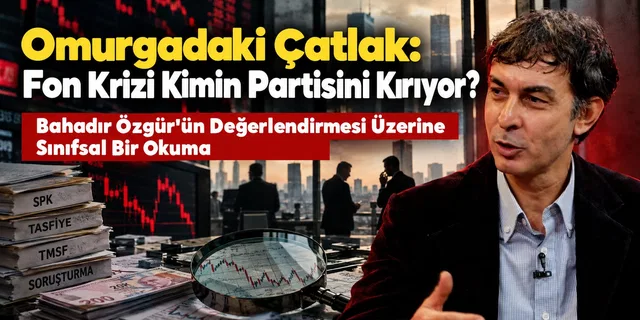
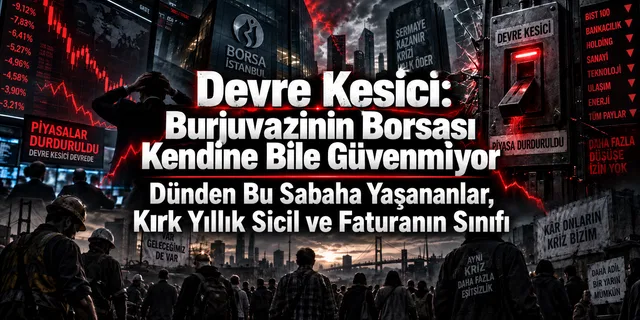
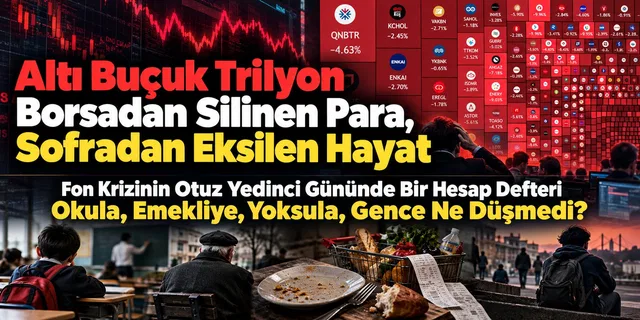
We discussed the first five weeks of the crisis in Whose Party Is the Fund Crisis Breaking?, and the mechanism itself in Circuit Breaker: The Bourgeoisie's Exchange Does Not Even Trust Itself and Six and a Half Trillion: The Money Wiped Off the Exchange, the Life Missing from the Table. The subject of this piece is how the crisis is reflected in the law.
The Former Minister at the Court Door
What does the prosecutor say?
Fatma Betül Sayan Kaya's name came onto the agenda on 26 September, with an allegation by Zeynel Emre, spokesperson of the Yeni Parti, of a gain of about 2 billion lira from Özata Denizcilik shares. She resigned from her party post the same day. A measure was placed on her assets on 29 September. In her first statement, on 7 October, she rejected the charges.
After the second statement on 5 November, the prosecutor asked for detention on two charges: "membership of an organisation established to commit crime" and "violation of the Capital Markets Law." According to the referral that reached the press, the picture the prosecutor built is as follows (Bursa Hayat, Gaste24):
- According to the SPK report, Kaya held information about Özata Denizcilik (OZATD) shares that had not been disclosed to the public and that could affect the price.
- The Tera Group made heavy purchases of OZATD, both through the company and through the funds.
- Kaya has a long acquaintance with Tera executive Erdin Özel. Their meetings grew more frequent in the investment period. She also met Emre Tezmen, chair of Tera's board, and opened an account within Tera.
- The rise in the share began in April 2026, and Kaya bought in that period. The prosecutor stresses that Kaya made high-value transactions even though this was her first stock-exchange investment.
- The SPK decided to liquidate the funds on 17 September. The shares were transferred to Tera Yatırım by book transfer on 16 September, one day earlier, not on the exchange. The ordinary settlement period is two business days, but the price reached the account the same day.
- The ground: suspicion of flight and of destroying evidence, and the view that judicial supervision would not be enough.
According to the figures carried by BirGün, the couple put about 163 million lira into the shares and obtained about 2.17 billion lira from the sales. In April, İlyas Kaya bought about 150,000 lots and Fatma Betül Sayan Kaya about 250,000. According to NTV's chronology, the couple returned about 1.86 billion lira of the gain.
Let us pause. An investment of 163 million lira becomes thirteen times as large in five months. That means money a minimum-wage worker could not earn in a lifetime was gained, in five months, from a single share. In Not the Madness of the Crowd, but the Knowledge of Those Inside we wrote: bubbles are inflated by the madness of the crowd, but the person inside knows when to get out. The prosecutor's referral is that thesis put into legal language.
And look at the book-transfer detail. The shares are moved not on the open market but directly to the brokerage itself, and the next day the door of the funds is locked. On the other side of this transfer, whose money was there, and who lost that money? The prosecutor should ask this question. We will go on asking it too.
Why is the husband not treated the same way?
Now to the real contradiction. According to the prosecutor's allegation, the shares were bought and sold in the same period, at the same brokerage, with the same strategy. The gain is shared, the return is shared, the asset measure is shared. But the result is different:
| Fatma Betül Sayan Kaya | İlyas Kaya | İbrahim Ömer Gönül | |
|---|---|---|---|
| Position | Former minister, former AKP deputy chair | Husband of the former minister, the other buyer of the shares | Former SPK chair, the top of the institution that supervised the funds |
| Lots bought (April 2026) | ~250,000 | ~150,000 | - |
| The prosecutor's request | Detention | Judicial supervision | Judicial supervision |
| Result (night of 6 November) | Detained | Foreign travel ban and signature | Foreign travel ban and signature |
A legal distinction can be made. The prosecutor may think that the "inside information" was with Fatma Betül Sayan Kaya, and that she was the one who built the relationships. But this ground was not explained to the public. And the same logic raises another question. If the flow of information is this clear, why is the former chair of the institution charged with supervising that information free under an obligation to sign in?
Two separate things must not be mixed here. First, it is not our job to applaud anyone's detention. Detention is not a punishment. It is an exceptional measure. This principle holds for the former minister and for the journalist alike. Second, and precisely for that reason, to whom the measure is applied, and by what standard, is a class question. On one side, the partner in a gain of two billion lira and the head of supervision walk out under judicial supervision. On the other, journalists have been in prison for weeks for a social-media post or a question on a television programme. The standard is not the same.
The link that was cut
Let us grant one more thing. Evrensel's headline on 13 October was "The balance sheet of the fund swindle: politicians 0, journalists 5". On the night of 6 November that zero was broken. Evrensel and BirGün wrote that Sayan Kaya had been detained. This is not a development to belittle. It is a result of seven weeks of public pressure.
But which politician? A name whose resignation the AKP accepted on 26 September, and of whom it then said "she is no longer our member". Barış Avşar, writing in Evrensel, also reports that she was said to have been "punished" by being removed from the party's WhatsApp group. In Whose Party Is the Fund Crisis Breaking? we reported Bahadır Özgür's forecast: Erdoğan's anger would stay limited to names, and the structure would not be touched. The detention of a discarded name does not contradict that forecast. It confirms it. One link of the chain is cut in front of the people. The chain itself stays where it is.
BirGün's compilation of 5 November shows that this link does not stand alone. Ertan Aydın, a former AKP Ankara MP and a former adviser to Erdoğan, was detained on 25 October. Mustafa Aksu, a former deputy minister of agriculture and forestry, on 12 October. Özdemir Ataseven, chair of the board of Özata Denizcilik, on 25 September. Erdin Özel, the former chair of Tera Portföy, on 1 October. Emre Tezmen, chair of Tera's board, on 22 September. Also among those detained are Abdülkadir Özkan, a former chief adviser to the prime ministry, Erkan Kilimci, a former deputy governor of the central bank, and Kerem Alkin and Emre Alkin. Taha Çakmak, the former general manager of Türkiye Sigorta and Türkiye Hayat Emeklilik, was first released under judicial supervision and detained on 24 October. Among the grounds written down was that about 100 million lira belonging to the company had been kept in Tera funds. İskender Balcı, a member of Özata's board and the son-in-law of former deputy finance minister Osman Çelik, was detained on 2 October. On the other side, Nihat Zeybekci, an AKP deputy chair, counts himself one of the more than 455,000 victims. Mustafa Yazıcı, the son of former minister Hayati Yazıcı, gave a statement and remained outside under a foreign travel ban. This list is BirGün's compilation. Detention is not a conviction here either.
Where is the rest of the chain? We will look below at the supervision itself.
The Referees Were on the Pitch Too
In the first weeks of the fund crisis the opposition's question was: where were the supervisors? The developments of the last two weeks give the answer: the supervisors were on the pitch.
Korkmaz Enes Ergun, the former general manager of Borsa İstanbul, was detained on 3 November on the charge of taking a bribe. According to the prosecutor's referral, shares in the BIST 50 and BIST 30 indices should normally have been opened to repo transactions at once, but Ergun delayed the opening of Destek Faktoring shares. Other suspects stated that a bribe was paid for this delay.
The custody list the same day was as follows: former SPK deputy chair Enver Usca, former board member Bülent Murat Haholu, former head of the Partnerships Finance Department Kürşat Sait Babuçcu, former head of the Market Surveillance and Supervision Department Ercan Urkan, BDDK Application Department 4 head Mustafa Alper Taş, and a director from Tera Holding.
Justice Minister Akın Gürlek's statement of 3 November describes this picture in his own words: "a network that had infiltrated the senior supervision mechanisms", and the names in the mechanism that controls the money "building a bribery order and making supervision ineffective."
While reading this sentence, watch one word: "infiltrated." Infiltration implies a stranger coming from outside, as if ill-intentioned people had entered a sound structure. The picture tells something else. The person at the head of market surveillance, the deputy chair of the board, the general manager of the exchange, the department head of banking supervision: these are not infiltrators. They are the structure itself. If the person who appoints the referee and the owner of the team the referee is to supervise are inside the same network, the problem is not the referee's morals. It is for whom the match is played.
In the Communist Manifesto, Marx and Engels describe the executive of the modern state as "a committee for managing the common affairs of the whole bourgeoisie." This sentence is often taken for a crude analogy. The fund crisis shows how concrete it is. The institutions that regulate the capital market managed the common affairs of a particular fraction of capital. The crisis broke when the balance inside that fraction came apart.
The One Who Asks Is Inside: The Journalists of the Fund Crisis
In the fund crisis, the justice that worked fastest worked not against those who carried out the swindle, but against those who asked about the swindle.
Şaban Sevinç and Mustafa Balcı: 28 days in prison
On 8 October, Sözcü editor Mustafa Balcı shared a photograph on X. He claimed that the person sitting behind AKP spokesperson Ömer Çelik at a concert in Bodrum on 22 August was Osman Arıkan Nacar, a former Health Ministry bureaucrat named in the fund investigation (Serbestiyet). According to the opposition's allegation, Nacar is someone associated with share transactions of about 20 billion lira and said to have gone abroad. In the social-security records he appears as a minimum-wage official driver. Ömer Çelik left unanswered the question put to him: "Did you holiday together in Bodrum?"
The identity of the person in the photograph was not independently verified, and a photograph by itself does not prove a relationship. Let us say that plainly. But let us also say this: the answer to an unverified allegation is a statement, a correction, or at worst a damages case. It is not a prison.
Balcı and Sevinç were detained on 9 October. In the indictment prepared on 4 November, on the charges of "publicly insulting a public official on account of their duty", "slander", and "publicly spreading misleading information", up to 18 years, 11 months and 15 days is sought for Sevinç and up to 10 years and 10 months for Balcı. The court decided that detention would continue. The first hearing is on 27 November.
Let us put them side by side. The husband of the former minister, who gained two billion lira from the shares, is at home under an obligation to sign in. An editor who shared a photograph is in prison, and is being tried with a prison request of more than ten years.
İsmail Saymaz and Murat Ağırel: the minister's money as "personal data"
Saymaz and Ağırel are being tried because they discussed allegations about the fund investigation on the "Gazeteci Masası" programme on Sözcü TV on 7 October. The complainant is Trade Minister Ömer Bolat. One of the allegations discussed on the programme was Bolat's investment of 37.8 million lira in lease certificates.
The most striking side of the indictment is this. The prosecutor accepts that the information about this investment by the minister falls under "personal data" and "customer secrecy", and also seeks punishment of the journalists for "unlawfully giving or obtaining personal data". For each of the four charges, from 5 years and 2 months up to 14 years and 10 months in prison is requested.
Do not belittle this detail. Whether a public official, a minister of the government that regulates the market, put money into the instruments that are the subject of the crisis is public information. To count this information as "personal data" is to use the personal-data law (KVKK) not to protect the citizen, but to protect the government from supervision. The question we asked in KVKK's "80s Trend" Warning and Privacy in the Digital Age comes back here from the other side. While the citizen's data in the state's hands is sold on query panels, the minister's investment information becomes a shield against the journalist.
In his defence, Ağırel said he had put forward the information he shared not as verified facts but as allegations that needed to be investigated. Saymaz stated that he had made no allegation against Bolat on the programme, and had only asked Ağırel questions. That is exactly the work of journalism: to carry the allegation to the public and call on the person in authority to answer. That a case arrives instead of an answer shows that the question was in the right place.
Murat Ağırel's second file
While Ağırel was under house arrest because of the fund reports, he was detained on 19 October in a separate investigation. Let us make this distinction honestly. This second file is not the fund investigation. It is an investigation the Istanbul Chief Public Prosecutor's Office is running concerning the Sarıgül family. According to the prosecutor, Ağırel passed on to the Sarıgül family the allegations of Sinan Çampınar, who lives in Germany, and this led to threats against the complainants. The charge: "aiding an organisation of which he is not a member."
Ağırel's answer is one sentence: "Do you know what my crime is supposed to be? By not making the news, and by not even being a member of the organisation, I have aided the organisation!" (T24). In his statement he said that, during the research, he did not publish because he could not verify the allegations he held.
His lawyer's release petition of 5 November shows that the photograph cited as the ground for detention had already been shared publicly, on 6 February 2026, months earlier, by a YouTube broadcaster (BirGün, sol). So the chain of causation in the charge breaks against the fact that the information was already in circulation through other channels. No decision on the petition has yet been announced. Ağırel has been in prison for 18 days.
Why do we put the two files side by side? Because the pattern that has appeared for journalists is a method beyond the individual files. First judicial supervision in one file, then house arrest on an objection, then detention in another file. While the journalist is forced to argue about which report put them inside, the real news, the fund swindle, has dropped off the agenda.
Even a loyalist writer
Perhaps the most surprising name on the list is Yiğit Uzun. Uzun is a columnist for Diriliş Postası, a paper close to the government. In the piece he wrote on 1 November, "Tera's Connections Abroad", he examined Tera Group's companies in Germany and Spain and the changes in their management. He had earlier also shared documents on the Kaya family's properties. The same day he was taken into custody at his home by teams of the counter-terror branch, and given four months of house arrest on the charge of "publicly spreading misleading information". Some of his pieces in the paper were removed without an explanation.
This example matters, because it shows something plainly. The problem is not opposition journalism. It is journalism that follows the money. Not who wrote it, but what was written. The question of Tera's connections abroad, that is, of where the money went, is silenced even when it comes from a loyalist pen. Yet in the same days the Minister of Justice himself says that "money taken abroad will be brought back into the economy". When the minister says the money went abroad, it is information. When the journalist asks, it is "misleading information".
Even the step of the news became a crime
The same charge widened by one step on the afternoon of 5 November. While the statements were still going on, the Istanbul Chief Public Prosecutor's Office opened an investigation, again for "publicly spreading misleading information", against people who wrote that the statements were over and that they had been sent to the judgeship with a request for judicial supervision (BirGün, BirGün). BirGün also records that, at the hour it wrote the news of the investigation, the statements were still continuing. The prosecutor's objection, then, is that the news was early and wrong. What is still visible is this: the charge aimed at the journalist who asks about the fund is also aimed at the person who reports a step of the procedure too soon. The step of the investigation becomes something that cannot be written until it is over.
Table: who, for what, received what?
| Person | Position | What they did (allegation / act) | Measure |
|---|---|---|---|
| Fatma Betül Sayan Kaya | Former minister | Buying and selling shares with inside information, a gain of ~2 billion lira (allegation) | Detained (Evrensel 02:01, BirGün) |
| İlyas Kaya | Husband of the former minister | Buying and selling ~150,000 lots of the same shares | Judicial supervision |
| İbrahim Ömer Gönül | Former SPK chair | Misconduct in office (allegation) | Judicial supervision |
| Ömer Bolat | Trade minister | An investment of 37.8 million lira in lease certificates was discussed | Complainant |
| Ömer Çelik | AKP spokesperson | The holiday question about a fugitive suspect went unanswered | None |
| Şaban Sevinç | Journalist | Raised the Çelik-Nacar allegation | Detained for 28 days; up to 18 years and 11 months sought |
| Mustafa Balcı | Sözcü editor | Shared the Bodrum photograph | Detained for 28 days; up to 10 years and 10 months sought |
| Murat Ağırel | Journalist | Discussed the fund allegations on a television programme | House arrest; then detained for 18 days in another file |
| İsmail Saymaz | Journalist | Asked Ağırel questions on the same programme | House arrest; up to 14 years and 10 months sought |
| Yiğit Uzun | Writer on a loyalist paper | Wrote about Tera's companies abroad | Four months of house arrest |
While reading this table, let us not forget a principle. Detention should not be a tool reached for easily, for anyone. Our demand is that the former minister and the journalist be judged by the same standard, and that this standard be freedom. But what we see in the table is the standard working in reverse: as the gain grows, the measure lightens; as the question hardens, the measure grows heavier.
The Payments: What Does "No Public Resource" Mean?
The arm of crisis management that looks positive is the payments. According to the Directorate of Communications' statement of 3 November, since 30 October 97.3 billion lira has been paid to 247,839 investor records in 100 funds (TRT Haber). Of this, 29.3 billion lira is from the Atlas, Pusula and Tera funds in extraordinary liquidation, and 68 billion lira from 93 funds in ordinary liquidation. On a unique count, about 76 billion lira in cash and in kind was paid to 178,537 investors.
Two principles should be granted. Payments are being made from the small holding to the large. Those found to have made an unjust gain were left outside the interim payment. This means the demand we wrote at the start of the crisis, "the small investor first", has been partly met.
But two questions still stand.
First: those who remain. The number of victims had been put at 455,700 in parliament. The methods of counting may differ. But set against the unique figure of 178,537, it is probable that most of the victims are still waiting. The largest losses are also in the funds under extraordinary liquidation. The 29.3 billion lira paid in those funds looks small beside the redemption demands that Tera could not meet and that were reported to exceed 300 billion lira.
Second: "No public resource will be used." On 5 November Erdoğan presented this as a success. The process is being managed without using a public resource, and payments related to the fund will be made after collections. The class meaning of this sentence is this: the loss is limited to the funds' own assets and to what can be recovered from the swindler. Whatever can be taken will be distributed. The difference will stay in the victim's pocket.
Yet the same state, when the crisis began, worked the circuit breakers to stop the exchange, transferred the management of the funds to the Savings Deposit Insurance Fund (TMSF), and for decades made the people pay the debt of the owners of the banks that failed in 2001. A public resource is on the field at every stage of the crisis, for capital. The principle "no public resource" hardens only when the person in question is the small saver.
Let us also recall the allegation we mentioned in Whose Party Is the Fund Crisis Breaking?. According to what was raised in parliament, 3.8 billion lira from the Unemployment Insurance Fund had been placed in these funds. This allegation is still unanswered. If a fund built from the worker's premiums entered these instruments, a public resource had already been used there, and in the worst way, without asking the worker.
Third: Şimşek's new balance sheet. On 5 November Mehmet Şimşek read out a larger picture in the Plan and Budget Commission. As Evrensel reports it, 130.2 billion lira had been paid to 614,874 accounts and 420,031 unique people across 108 funds, and 179,449 people had received the whole of their net investment. Şimşek also said that not a single kuruş of the public budget had been used. This figure does not replace the 97.3 billion of 3 November. Two statements, two dates. A growing figure does not show that the bill has been closed.
Evrensel sets this statement beside the August 2026 distribution of the Central Securities Depository. Of the investors in the market, 88.76 per cent are in the brackets of 1 million lira and below. Apply the same proportion to the 420,031 rights-holders, and the SPK's promise that "savings of up to 1 million lira will be paid in full" would require at least 372,823 people to receive their principal in full. Those who received the full payment stayed at 179,449. Evrensel's proportion is this: one of every two small savers who should have had their principal back to the last kuruş, about 193,000 people, 52 per cent, is left short. This is not a list of names. It is a proportion. It is the proportion that has to be set beside the official sentence "they received the whole of it".
Fourth: what came back is 9.8 per cent of the gain. BirGün's report of 2 November recalls the frame the Minister of Justice had set out earlier. The gain obtained by 141 real persons and 73 companies from the Tera, Pusula and Hedef funds is 187 billion 653 million lira. About 90 billion of it is Tera, 79 billion Pusula, 18 billion Hedef. The 18 billion 340 million lira collected from 37 people as of 30 October is 9.8 per cent of that gain. On 21 October Sayan Kaya told the journalist Nagehan Alçı that she had returned the whole of the sum above her principal, more than 2 billion lira. Evrensel writes that no official collection document was produced for the claim that this money was paid into the voluntary return account known as the "repentance account". BirGün recalls article 107 of Law 6362: for this kind of market fraud, effective remorse requires that twice the unjust benefit be paid to the Treasury. The voluntary accounts opened by the SPK are separate from that mechanism. In the words of Gökhan Günaydın, deputy group chair of the Yeni Parti, "what has to be paid is 4.4 billion lira." Giving the money back does not close the file.
Fifth: the public's insurer wrote the loss down. Against the sentence "there is no public resource", Evrensel sets the balance sheets of two public companies. Türkiye Sigorta stated that it could not collect a receivable of 8 billion 963 million lira left at a brokerage, set aside a provision for the whole of it, and wrote it into the period's expenses. Türkiye Hayat ve Emeklilik likewise treated 3 billion 710 million lira lost to a brokerage as doubtful and booked it entirely as a loss. Among the grounds for the detention of the former general manager Taha Çakmak was that about 100 million lira belonging to Türkiye Hayat Emeklilik had been kept in Tera funds. While the minister says the public resource is not there, it had already become an expense in the company's own books.
The same report has two further ends. After MSCI, S&P Dow Jones placed Turkey on the 2026/2027 country classification watch list. The ground is the concealment of the ultimate beneficiary of share ownership, and transparency. In the December review no new Turkish share will be added to the indices, and the investable weights will be frozen. In the Central Securities Depository's figures the equity portfolio has shrunk by 15.2 per cent since August, from 7 trillion 343 billion lira to 6 trillion 229 billion. The number of investors fell from a July peak of 6 million 897 thousand to 6 million 541 thousand in October. In the last month 151,633 people left. The bracket between 101 lira and 100,000 lira lost 159,345 people, while the 0 to 1 lira bracket, whose balance is in effect zero, rose from 167,830 to 210,601. Small savings were pushed from the upper step to the floor.
"People You Would Not Have Expected", or an Order That Was to Be Expected?
Erdoğan's sentence of 5 November sums up the official narrative of the crisis: "People you would never have expected have got inside these affairs." In the same speech he said "it is not possible for us to make any concession". Barış Avşar writes that the speech was made on the plane returning from South Korea, and that its new part was the sentence that bribery, irregularity and abuse are "being uncovered one by one". For Avşar this is kin to the old sentence "we were deceived". What is said to have come out is still not out where everyone can see it.
The picture Avşar dwells on is this one too. While Erdoğan's words were being published, Sayan Kaya was giving a statement at Çağlayan with her husband. BirGün wrote that the couple came in through Gate C, the gate the citizens use, hand in hand and among security officers; that she did not take off, inside, the sunglasses she had put on in the rain; and that they left unanswered the question "where did you get the 163 million lira?" Fatih Sayan, a former deputy minister of transport and a former chair of the Information and Communication Technologies Authority, came to the courthouse during his sister's statement. Gönül is the son of Vecdi Gönül, who was minister of national defence for three terms. Evrensel reports that, in an earlier statement, he answered the prosecutor's question with "the public may have shown its favour." In the words of the leader of the main opposition, Özgür Özel, as Avşar reports them, there was "more than two billion in the account, enough to buy 3,366 flats", and this was not even "a thousandth of what came out of the dawn raids on the homes of 46 opposition mayors". That is Özel's comparison, not a finding of the court. Avşar's own sentence is this: a government that for 25 years "handed no one over" did not have this photograph taken of its own will. The photograph that was not given while trains were overturning, hotels were burning, and a minister was invoicing his own ministry, was given only under the force of seven weeks of reaction. If it comes out who the 38 people called fugitives are, it will come out by the same force.
This narrative has two functions. First, it reduces the problem to persons: bad people did bad things, and the judiciary is finding them. Second, it places the government in the position not of the one being judged, but of the one cleaning up: we found them, we are punishing them.
Yet the picture of the last two weeks tells something else. A former minister reaches information thanks to an "acquaintance of many years" with a brokerage executive. The general manager of the exchange takes a bribe to delay the opening of a share to repo (allegation). Names at the top of the Capital Markets Board are taken into custody. A minimum-wage official driver is associated with transactions of 20 billion lira. A minister's father puts 470 million into a fund and pulls out 830 million (allegation). None of these are things "you would not have expected". These are things to be expected in an order where bureaucracy, politics and capital have fused.
At this point Marxism says something simple but hard. The law is not a referee above classes. In the words of the Manifesto, the law of the bourgeoisie is nothing but "the will of its class made into a law for everyone." This does not mean that every judge is partial, or that every case is decided in advance. It means this: how fast the law will work for whom, and how hard, is a reflection of the relations of power in society. In the fund crisis this reflection has three layers:
- The victim's loss is being made final: whatever the liquidation price is, that is it; there is no public resource.
- The gain of the person at the top is opened to bargaining: voluntary return, unnamed return, judicial supervision. The discarded name was detained after seven weeks. The partner in the gain and the head of supervision walked out under an obligation to sign in. Only 9.8 per cent of the gain under examination came back.
- The word of the person who asks is criminalised: "misleading the public" for the journalist, a shield of "personal data" for the minister's investment.
For this reason it is not right either to reject the sentence "the judiciary is working" altogether, or to believe it altogether. The judiciary is working. But the question of for whom it works, and by what standard, still stands as the real question of the crisis.
The Official Narrative and the Class Reading Side by Side
| Official narrative | Class reading |
|---|---|
| "People you would not have expected have got into these affairs." | Not persons, positions. In an order where bureaucracy, politics and capital have fused, this result is a result to be expected. |
| "A network that infiltrated the supervision mechanisms." | Not infiltration, the structure itself. Those at the top of the exchange, the SPK and the BDDK did not come from outside. |
| The detention of the former minister: "no concession." | For the first time a politician has been detained. This is a product of public pressure. But it is a discarded link. The husband and the head of supervision are free under judicial supervision. |
| The charge of "misleading the public" against journalists. | The answer to an unverified allegation is a correction and a statement, not a prison. Journalism that follows the money is silenced even when it comes from a loyalist pen. |
| The minister's investment is "personal data and customer secrecy." | A public official's money in the instruments that are the subject of the crisis is public information. The KVKK is being used to protect the government, not the citizen. |
| "Payments are being made without using a public resource." | Şimşek's 130.2 billion also comes from the funds' own assets. On Evrensel's proportion, about half of the small savers did not receive their principal in full. Türkiye Sigorta and Türkiye Hayat wrote the receivable left at a brokerage down as a loss. |
| "The judiciary is doing what is required." | The standard of the measure works in reverse: as the gain grows, the measure lightens; as the question hardens, the measure grows heavier. |
So What Is to Be Done?
Watch, and put it on the record
- Ask for the reasoning of the detention. Evrensel and BirGün wrote, on the night of 6 November, that Sayan Kaya had been detained. The real question is the reasoning. Why was judicial supervision enough for the husband and for the former SPK chair? Do not let the decision pass without reasons. Ask, write, share.
- Keep the table of "who is inside, who is outside" up to date. Take the table above as a beginning. Update it with every new custody, every release, every indictment. The class pattern of justice is most visible in a table like this.
- Ask who was on the other side of the book transfer. On 16 September the shares were transferred to Tera Yatırım by book transfer. From which account, and with whose money, was the payment on the other side of this transfer made? This question should be asked through parliamentary questions and freedom-of-information requests.
Stand together
- Watch the hearing of Sevinç and Balcı on 27 November. Join the calls of journalists' organisations, bar associations and unions to monitor the hearing. A full courtroom is the most legitimate pressure that can be put on the judiciary.
- Keep Murat Ağırel's request for release on the agenda. It has emerged that the photograph cited as the ground for detention was already public months earlier. Spreading this information is the most concrete thing that can be done for Ağırel.
- Read and share the person who wrote the news. Follow archive copies of reports that were blocked, and the new channels of journalists whose accounts were closed. As we said in Questions for Press Workers: Without Organisation There Is No Way Forward: if you are not organised, there is no way forward. The journalist's organisation is the reader's organisation too.
Enlarge the demands
- Demand that the fund accounts of ministers and bureaucrats be disclosed. A public official's investment in the instruments that are the subject of the crisis is not personal data. It is public information. Disclosure of the fund and share transactions of ministers, members of parliament and senior bureaucrats over the last two years is the simplest and most legitimate demand to be drawn from this crisis.
- Turn the principle "no public resource" around. The demand should be this: until the whole of the unjust gain is recovered, the principal of the small saver should be paid first. If a gap remains, it should be completed from the swindler's assets. The account of the Unemployment Insurance Fund's money in these funds should be asked separately.
- Move from the language of morals to the language of structure. To those around you who say "if the former minister goes inside too, justice will have been done", ask this: when one link of the chain is cut, does the chain disappear? What will prevent the next fund crisis is not who was detained. It is whether this order changes.
Dear Comrades
For seven weeks the fund crisis has stood before us like a mirror. In that mirror there are the tears of a former minister, a husband walking out of Çağlayan under judicial supervision, a general manager who delayed a repo decision for a bribe, and an editor being tried with a ten-year prison request for sharing a photograph. And at the very back, hundreds of thousands of people whose faces no one showed: those who entrusted a mother's treatment money, a child's trousseau, a retirement bonus to "the expert".
What this mirror tells us is this. The law does not work in a vacuum. How fast it will work for whom, and how hard, is set by the balance of power in society. Today that balance is in favour of the swindler and against the person who asks. What will change this balance is neither a judge's conscience nor a minister's anger. It is the insistence of an organised society.
If the person who wrote the news and the former minister are inside, and the spouse who sold the same shares is at the door, the problem is not in the individual decisions. It is in the order itself. Not leaving the person who asks alone, pursuing the victim's right, and turning the question "why could it be stolen?" into a programme is our work.
Sources
Fatma Betül Sayan Kaya, İlyas Kaya and İbrahim Ömer Gönül
- Former minister Fatma Betül Sayan Kaya detained in the fund investigation - Anadolu Agency, 6 November 2026
- Fund investigation: Fatma Betül Sayan Kaya detained - NTV, 6 November 2026, 02:03
- Fund swindle investigation: Fatma Betül Sayan Kaya detained - Evrensel, 6 November 2026, 02:01
- Fund swindle investigation: Fatma Betül Sayan Kaya detained - BirGün, 5-6 November 2026
- Fund swindle investigation: a request for detention for Fatma Betül Sayan Kaya - Evrensel, updated 6 November 2026, 02:01
- How did Fatma Betül Sayan Kaya come to the courthouse? - Barış Avşar, Evrensel, 5 November 2026
- In the fund swindle the judiciary invites people to give statements, and the citizens' loss grows - Andaç Aydın Arıduru, Evrensel, 5 November 2026
- In the fund investigation 37 people returned 18.3 billion lira: only 9.8 per cent of the total gain - BirGün, 2 November 2026
- Fund investigations: an investigation against those who wrote "the Kaya couple's statement is over" - BirGün, 5 November 2026
- An investigation was also opened into posts saying "a request for judicial supervision was made" - BirGün, 5 November 2026
- Fatma Betül Sayan Kaya sent to court with a request for detention - Euronews, 5 November 2026
- Fatma Betül Sayan Kaya sent to the judgeship with a request for detention - Bloomberg HT, 5 November 2026
- Fund investigation: Fatma Betül Sayan Kaya and her husband İlyas Kaya at the courthouse to give statements - NTV, 5 November 2026
- A request for detention for Fatma Betül Sayan Kaya. The referral emerges - Bursa Hayat
- Striking details in Kaya's detention referral - Gaste24
- Fatma Betül Sayan Kaya disposed of her shares one day before the liquidation decision - Diken
- Judicial supervision for Sayan Kaya's husband and former SPK chair Gönül - Milli Gazete, 6 November 2026
- Has Fatma Betül Sayan Kaya been detained? - Haberler.com, 6 November 2026
Borsa İstanbul, the SPK, and the general picture of the investigation
- Borsa İstanbul general manager Korkmaz Enes Ergun taken into custody in the fund investigation - Euronews, 1 November 2026
- Former Borsa İstanbul general manager Korkmaz Enes Ergun detained - NTV, 3 November 2026
- Six new custodies in the fund investigation, including the former SPK deputy chair - NTV, 3 November 2026
- Minister Akın Gürlek: a comprehensive criminal structure found in the fund investigation - NTV, 3 November 2026
- President Erdoğan: "People you would not have expected have got inside" - Demokrat Gündem, 5 November 2026
- Critical hours in the fund investigation: five companies transferred to the TMSF - Milliyet, 30 September 2026
Journalists
- Journalists targeted in the fund swindle: Şaban Sevinç and Mustafa Balcı detained - Evrensel, 9 October 2026
- In the fund scandal the bill was sent to the journalists - Serbestiyet, 10 October 2026
- They had been released under judicial supervision: house arrest for İsmail Saymaz and Murat Ağırel - Evrensel, 10 October 2026
- The balance sheet of the fund swindle: politicians 0, journalists 5 - Evrensel, 13 October 2026
- Prison sought for Şaban Sevinç and Mustafa Balcı on three separate charges - Cumhuriyet, 4 November 2026
- Prison sought for two journalists in the fund investigation: indictment for Murat Ağırel and İsmail Saymaz - Ankara Net Haber, 4 November 2026
- Detained journalist Murat Ağırel: do you know what my crime is supposed to be… - T24
- A request for release from Murat Ağırel's lawyer - 12punto, 5 November 2026
- The photograph counted as evidence in Ağırel's detention had been published months earlier - sol
- House arrest for the journalist who followed the fund scandal: taken into custody after writing about Tera's connections abroad - Karar
- AKP spokesperson Ömer Çelik left unanswered the question about a holiday with the fugitive fund figure - Evrensel, 7 October 2026
- The minimum-wage official-driver record of Osman Arıkan Nacar, associated with a swindle of 20 billion lira - Evrensel, 7 October 2026
Payments
- The Directorate of Communications announced the latest on the fund liquidations: those who will not receive an interim payment are now known - Cumhuriyet, 3 November 2026
- 97.3 billion lira deposited into accounts within the fund liquidations - TRT Haber, 3 November 2026
Theory
- Karl Marx and Friedrich Engels, Manifesto of the Communist Party (the executive of the state, and the class character of bourgeois law)
- Karl Marx, The Eighteenth Brumaire of Louis Bonaparte (the apparent independence of the executive)
- Karl Marx, Capital, Volume III, Part Five (fictitious capital and credit)
The Fund Crisis series and our related pieces
- Circuit Breaker: The Bourgeoisie's Exchange Does Not Even Trust Itself
- Whose Party Is the Fund Crisis Breaking?
- Six and a Half Trillion: The Money Wiped Off the Exchange, the Life Missing from the Table
- Not the Madness of the Crowd, but the Knowledge of Those Inside
- We Stand with Journalists on 24 October
- Questions for Press Workers: Without Organisation There Is No Way Forward
- The Eye, the Ear, the Heart of the Class: Bahadır Özgür
- KVKK's "80s Trend" Warning and Privacy in the Digital Age
This piece is one of the living documents of Knowledge Commons. It is shared under the CC BY-SA 4.0 licence. You may copy, change and share it if you credit the source.