Not the Madness of the Crowd, but the Knowledge of Those Inside
Evrim Ağacı's Newton Video, the Hidden Face of the South Sea, and Those Who Got Out Before the Fund Plunder

Dear Young Comrades,
Evrim Ağacı has published a new video. Its subject is Isaac Newton's loss of money in the South Sea Bubble of 1720, and the likeness of that story to the fund crisis in Türkiye. The video is well made, its sources are careful, and the telling is fluent. It recounts Andrew Odlyzko's reconstruction of Newton's investments from the archives, Keynes's beauty-contest analogy, and the profit of Hoare's Bank. At the end it ties the story to a fund crisis that touched half a million people.
The video's main sentence is the famous remark attributed to Newton: "I can calculate the motion of heavenly bodies, but not the madness of people." And the lesson it draws: bubbles are born of the madness of the crowd, the name of that madness is FOMO (fear of missing out), educate yourself, and do not invest in what you do not understand.
In this piece we will argue the opposite. The South Sea Bubble, and the fund plunder of 2026, are explained not by the madness of the crowd, but by the knowledge of those inside. In 1720 there were ministers who took the shares for nothing. In 2026 there are people who got out of the funds days before the collapse, and the list of those people is in the state's hands, but it has not been made public. That is exactly what the video does not tell. And the omission is not an accident. It is an instance of popular science's habit of presenting capitalism as a natural fact.
This is not our first encounter with Evrim Ağacı. In September we replied to the video "Why Can't (Don't) Opposition Parties Win?" under the title "The Class's Answer to Evrim Ağacı's Question". In that video, eternal opposition was explained by thermodynamics, evolutionary biology and game theory, but the word "class" did not appear even once. In October we took up the video "What Will You Do When Artificial General Intelligence Arrives?". There, property relations were held fixed, and the only thing that changed was the technology. Today's video follows the same pattern: a social fact is told as if it were a law of nature, and class drops out of the account. This piece continues those two. We will return to them as we go.
The investigation details in this piece, and the claims directed at named people, are as they stand in the sources we cite. There is no final conviction, and the presumption of innocence holds. Our thesis is not about one person's guilt. It is about the political network inside which this plunder was possible.
First, a Summary: What Does This Piece Say?
For anyone in a hurry, the whole piece in nine theses:
- The South Sea was not a madness. It was a system of bribery. The company handed free shares to members of the government, including the Chancellor of the Exchequer, and to the king's circle. A parliamentary inquiry documented it. The Chancellor was shut in the Tower of London. The video never mentions this.
- The "symmetric nature" of a bubble is not a matter of skill. It is a matter of knowledge and power. The video is right that whoever sells at the top needs a "sucker". But it presents those who got out early as "professionals who knew their business". In 1720, as in 2026, the real source of the early exit was knowledge that came from inside the state.
- The early exit in 2026 is documented. By the Minister of Justice's own statement, 214 people and companies made 187.6 billion lira from three funds. Those who sold out of the funds on 13–16 September, that is, immediately before the collapse, are under examination. The list was given to the TMSF. It was not made public.
- The knowledge was in the state. It reached the press that the prosecutor's office warned the SPK on 19 August, that Minister Şimşek said in November 2025 that they knew of the manipulation, and that Pusula's managers sent millions of dollars abroad weeks before the collapse.
- The colour of the network is plain. Among the names that have surfaced are a former AKP minister, a fund owner who was a former AKP youth-branch official, the son of an AKP group chair, and the son-in-law of a deputy minister. We call this not a list of personal crimes, but a network of power: the plunder became possible where state knowledge, regulatory power and political proximity were gathered in the same hands.
- The video's own account of Türkiye is incomplete for that reason. The video tells the collapse as "the panic of investors frightened by the rule of 28 August", and passes on with "who manipulated the market will become clear in time". The real question is already on the table: who knew in advance?
- Evrim Ağacı naturalises capitalism. To present the market as "the average of our collective thoughts", the collapse as "human psychology", and the solution as "invest in yourself" is to take class, property and the state out of the account. That the sponsor is a school in which a bank has invested, and that the message is "the best investment is the one you make in yourself", is this frame itself.
- Today's task is not individual education. It is organised oversight. No one reaches the knowledge inside the state by learning to read the stock exchange. Publishing the list, taking the money back from those who got out early, and organising the victims happen not by knowledge, but by power.
- The real solution is to make the stock exchange itself unnecessary. A better SPK, a cleaner fund, or a better-informed investor will not end bubbles. What will end them is a society in which production is planned, with scientific reason, according to the needs of all humanity, and not according to the expectation of profit on paper. The name of that society, in which the stock exchange has passed into history, is socialism.
Now to the detail.
What the Video Tells: A Short Account
First let us be fair, and report correctly what the video says.
The video recounts that England, free of debt in 1680, had by 1717, because of wars, fallen into debt equal to 60 per cent of its economy. In 1720 the South Sea Company takes on about 30 million pounds of the state's debt, and in return gives the creditors its own shares. Because the conversion rate is tied not to nominal value but to the market price, the higher the price rises, the more shares the company has left to sell. So the company does everything to push the price up: instalment sales of shares, loans against shares as collateral, four separate public offerings. The share rises from 128 pounds in January to above 1,000 pounds in June, and falls to 200 pounds in October.
Newton's story is here too. Newton is a careful investor: he put less than half his fortune into this share, he had been accumulating slowly since 1712, and in April he sold at 350 pounds and made about 20,000 pounds. But when the price doubled he bought back in June, converted government bonds into shares as well, and kept buying when the fall began. The result: all of his profit goes, and more than a third of his fortune. According to the video, the name of this is FOMO.
The video then moves to Keynes's beauty contest: what sets the price in a market is not the real value of an asset, but what others are willing to pay for it. The planets do not care about our equations. The market, by contrast, is made of the very people who calculate it. So Newton's remark, according to the video, is not a confession that his mathematics fell short. It is an accurate observation about the nature of the market.
And Türkiye: some funds gathered the shares of companies with a low free float, companies tied to themselves even, prices rose, investors who saw the return put money in, and the cycle grew. When the SPK published rules on 28 August that restricted concentration, investors wanted to pull their money out, the funds had to sell, prices collapsed, and on 17 September 131 funds were put into liquidation. The video ends like this: "Who grew rich, who grew poor, and who manipulated the market, and how, will emerge more clearly in time." The advice: educate yourself, do not invest in an instrument you do not understand, do not treat investment as a shortcut to getting rich, and do not invest anywhere that lacks the checks and oversight which protect the small investor from the large.
Let us also grant the video's strengths. It says the company was founded on the slave trade. It says the bubble is symmetric, and that the winner needs the loser. It describes the mechanism in Türkiye correctly as "shares without a foundation" and a "closed loop". It states honestly that the source of Newton's remark is uncertain.
But an account is built by what it does not say as much as by what it says. Now to what is not said.
The Hidden Face of the South Sea: Ministers Who Took Shares for Nothing
When the video tells the South Sea Bubble, it does not tell what happened after the collapse. Yet what happened after the collapse is the part that shows most clearly why the bubble inflated.
In 1721 the English Parliament set up a secret committee. What the committee uncovered was this: in order to get the debt-conversion act through Parliament, the company had given shares without payment to members of the government, to members of Parliament, and to the king's circle. These "shares" were in fact an option. If the price rose, they would take the difference as profit. If it fell, they would lose nothing.
Among the names were these:
- John Aislabie, Chancellor of the Exchequer, that is, the architect of the debt-conversion plan inside the state. He was expelled from Parliament and shut in the Tower of London.
- Charles Stanhope, the second man at the Treasury. He was acquitted by a hair's breadth in the vote.
- James Craggs the elder, Postmaster General. He died while the inquiry was going on. His son, James Craggs, Secretary of State, was among the names as well.
- The Earl of Sunderland, the man at the head of the government. He was acquitted, but had to leave office.
- Courtiers around King George I.
The company's cashier, Robert Knight, fled the country with the ledger that showed who had taken how many shares (it passed into history as the "green book"). The estates of the company's directors were seized.
This picture wholly changes the story the video tells, that "even Newton fell to FOMO". What pushed the price up was not the greed of the crowd. It was the profit expectation of a network inside the state. Because the ministers held a free option, they had a direct interest in the price rising. That is why they passed the act. That is why they stayed silent until the collapse.
The Bubble Act was not a "mistake"
The video tells the Bubble Act (June 1720) as the government's "disastrous mistake": in order to advantage the South Sea, the government made it harder to found new companies, and enlarged the bubble.
But the word "mistake" is wrong. Most historians accept that the act came out at the South Sea Company's own demand and pressure. The company wanted to cut off other companies competing for investors' money, and its shareholders in the government delivered that. A company wiping its rivals off the market by statute is not called a mistake. It is called the protection of a monopoly by the hand of the state.
The slave trade was not a footnote
The video says the company came out of the slave trade, calls it "one of the darkest pages in human history", and moves on. Yet this is not a colour in the story. It is the foundation of the story. The privilege the company held was the asiento, taken from Spain by the Treaty of Utrecht (1713): the monopoly on selling enslaved Africans to Spanish America. The "value" on that paper was written on the bodies of people who had been kidnapped and sold.
Marx tells this in the primitive-accumulation chapter of the first volume of Capital: as capitalism was being born, the public debt, colonial trade and the slave trade worked bound to one another. The paper of the public debt, the slave ship and the stock exchange were parts of the same machine. The South Sea Company is the example that gathers the three into a single company. To reduce this to a footnote and draw the real lesson as "FOMO" is to turn the birth of capitalism into a case of psychology.
Newton too was an "insider", but not inside enough
There is an interesting detail here. The video recounts that Newton was at the head of the Mint, and was counted among the most competent people in England on the subject of money. That is right. Newton was inside the apparatus of the state, and he was in the highest band of income.
But Newton was not inside the government. He was not on the list of those to whom free options were handed out. He was not part of the network that knew why the price was rising, and when it would stop. Even the historians of the "Newton and the Mint" project, which the video itself cites, say that in some documents it is unclear whether Newton was trading in his own name or in the Mint's.
So the lesson of the story is not this: "Even a genius can be swept up in the madness of the crowd." The lesson is this: even a genius loses, if he is outside the room where the knowledge is handed out. Newton's mind was not enough, because the problem was not mind. The problem was the unequal distribution of knowledge, and of access to the rules.
Who Were the "Professionals"?
The video's most striking paragraph is this: not everyone was mad. Hoare's Bank, a long-established bank of London, managed the bubble correctly and closed 1720 with a profit of more than 28,000 pounds. The video goes on: "As in almost every financial bubble, there were in this one too plenty of professionals who knew very well what they were doing, and who made a great deal of money off the backs of amateur investors."
There is a correct observation in that sentence, and a wrong frame.
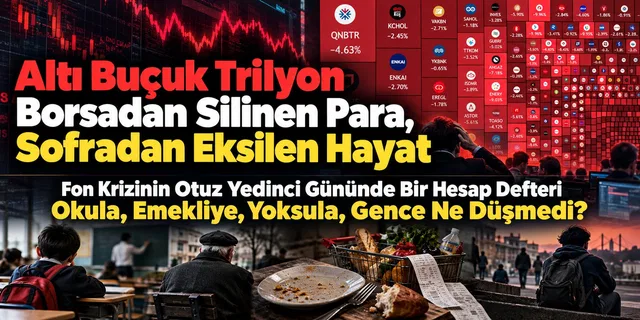
The correct observation: a bubble is symmetric. For someone to sell at the top, someone has to buy at the top. The video says this with the word "sucker". Profit comes out of the loser's pocket. We told this, through Marx's concept of fictitious capital, in Six and a Half Trillion: The Money Wiped Off the Exchange, the Life Missing from the Table: paper does not produce value. The money taken by whoever sells at the top comes out of someone else's savings. A rise in price is not the creation of wealth. It is a transfer.
The wrong frame: to present the winners as "professionals who knew what they were doing" is to tie the gain to skill. This is an account that makes the winner clever and the loser stupid. So who were the real winners of 1720? There were well-managed institutions such as Hoare's Bank, yes. But the most guaranteed winners were those who carried no risk at all, that is, the ministers and courtiers who took the shares without paying for them. Their gain came not from skill, but from position.
The word "professional" erases this distinction. On one side, a bank that reads the market well. On the other, a minister who writes the law and takes a share of the price. To call both "professional" is to present the knowledge and the power inside the state as if they were a skill of the market.
2026: Those Who Got Out in Advance
Now to today. In the video's account of Türkiye, the collapse is told as the panic of the investor frightened by the SPK's decision of 28 August. But this account falls short when it is set beside what has come, over the last six weeks, from official mouths and from the press.
The minister's own figures
The Minister of Justice, Akın Gürlek, made a statement on 9 October. According to the reports in BirGün and sol:
- From the Tera, Pusula and Hedef funds, 141 natural persons and 73 companies made a total of 187 billion 653 million lira.
- The average gain was 714 million per person, and 1 billion 190 million lira per company.
- In Pusula, only 19 natural persons made about 69.7 billion lira. About 3.7 billion lira per person.
- Those who sold out of the funds on 13, 14, 15 and 16 September, that is, immediately before the crisis broke, are under examination.
- The 214 names were reported to the TMSF, the Savings Deposit Insurance Fund. The list was not made public. These names are being notified to deposit money into "voluntary repayment" accounts.
Let us set this figure beside that one. The number of individual victims announced by the SPK, the Capital Markets Board, is 455,758. On one side, 214 names. On the other, 455,000 people. This is the "symmetric nature" of the bubble. But on one side of this symmetry there are not "professionals who knew their business". There is a handful of people who went out of the door before the collapse.
Even Özlem Zengin, Deputy Chair of the AKP parliamentary group, said "I want the whole list published." The list has still not been published.
Where was the knowledge sitting?
An early exit does not happen without knowledge. So where was the knowledge sitting? What reached the press is this:
| Date | What happened | Source |
|---|---|---|
| November 2025 | Minister Mehmet Şimşek says that manipulation was being carried out through the funds, and that they knew who was doing it. | Yetkin Report, citing Bloomberg |
| 18 December 2025 | The SPK raises the qualified-investor threshold from 1 million to 10 million lira. The problem is on the regulator's desk. | Hukukçular Evi timeline |
| December 2025 → September 2026 | According to a column, the number of investors in the funds in question rises from about 48,000 to 111,000. While the warning stood, those going in doubled. | Ekonomim |
| 26 May 2026 | News that Muhammed Yarız, a Pusula manager, bought a luxury yacht for 14.5 million dollars. | Yetkin Report |
| 23 July 2026 | In an announcement, the SPK says that the "fictitious calculation" of certain fund values "has not been permitted". | Hukukçular Evi |
| 3 August 2026 | According to BirGün's report, Emre Tezmen, a Tera manager, is made head of the Central Securities Depository (MKK). The person who manages the fund is at the head of the institution that keeps the records. | Yetkin Report, citing BirGün |
| 19 August 2026 | According to the sources of the journalist İsmail Saymaz, the Istanbul Chief Public Prosecutor's Office writes to the SPK about share rises of up to a hundredfold, and asks whether an investigation has been opened. | Yetkin Report |
| 24 August 2026 | The claim that Serdar Turhan, chair of Pusula Finans Holding, sent about 15 million dollars to Switzerland. | Yetkin Report |
| 28 August 2026 | The SPK makes extensive changes to the guide for investment funds. | SPK bulletin 2026/54 |
| 1 September 2026 | The claim that Yarız sent about 25 million euros. | Yetkin Report |
| 1–16 September 2026 | According to the claim of Gültekin Uysal, leader of the Democrat Party, 440 people who knew of the letter of 19 August sold 401 billion lira of funds in this period. | Evrensel |
| 13–16 September 2026 | The "last exit" window the ministry is examining. | Gürlek's statement |
| 17 September 2026 | 131 funds are put into liquidation. The door closes. | SPK |
Read this table carefully. Each row, on its own, is a claim or a news report. Some have not been confirmed, and we say that plainly. Uysal's figures of 440 people and 401 billion are his claim. The document has not been published. The yacht and the money transfers are press reports too.
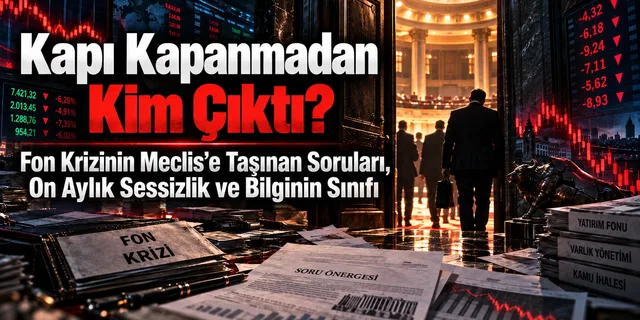
But the whole of the table says something. Knowledge circulated inside the state for months: in the ministry, at the SPK, at the prosecutor's office, at the MKK. In that time the fund managers moved money abroad, and a group of people went out of the door. The door was locked after they had gone, and 455,000 people were left inside.
What the video calls "the panic of investors frightened by the rule of 28 August" is only the last link of the chronology. The panic was the panic of those who went in last. Those who got out first did not panic. They got out because they knew.
The colour of the network
So who are these people? Because the list has not been published, we do not know all of them. But the names that have reached the press show a pattern. We set that pattern out in detail in Whose Party Is the Fund Crisis Breaking?. Let us recall it briefly:
- Fatma Betül Sayan Kaya, a former AKP minister and Deputy Chair of the AKP. According to YENİ Parti's claim, she and her husband made about 2 billion lira from the shares of Özata Denizcilik. Kaya resigned her party posts, denied the accusations, and said they had sent the gain to the account set by the TMSF. She is the only known name to have reached the press, and that was thanks to the opposition.
- Muhammed Yarız, owner of Pusula Portföy. According to BirGün, a former official of the AKP's Istanbul youth branches.
- A ban on leaving the country for Mustafa Yazıcı, son of the AKP group chair Hayati Yazıcı.
- The son-in-law of Osman Çelik, Deputy Minister of Treasury and Finance, was arrested. Çelik retired.
- Reports that names in Tera's management had been appointed to presidential advisory posts and to boards.
Let us speak very plainly here. We are not saying that each of these people is guilty. That is the court's work. What we are saying is this: access to knowledge, appointments to the regulatory institutions, and political proximity had gathered inside the same network. The name of this network is the AKP's network of power. If a network distributes the state's knowledge to its own circle and hides it from the public, if it takes its own circle's money out first and locks the door afterwards, and if it then hides from the people the list of who got out, that is called, politically, a gangster order. We use the phrase not as an insult, but as a description of a way of governing.
And this network knows how to protect itself too. Access blocks were placed on the accounts of journalists who reported the fund plunder, and an investigation was opened against those who shared documents related to the inquiry. In 1720 the cashier fled with the green book. In 2026 the book is in the state's hands. But the journalist who wants to read the book is investigated.
Two Bubbles Side by Side
As the video says, the mechanism has not changed in 300 years. But the mechanism that has not changed is not the madness of the crowd. The mechanism that has not changed is this:
| 1720, the South Sea | 2026, the fund plunder |
|---|---|
| A problem of state debt. The company takes on the debt and gives shares. | The wage–inflation gap. Small savings have nowhere to go. The promise of "20 per cent a month". |
| Shares for ministers and the court, without payment (a free option). | Claims of billion-lira gains, from the funds, by names with political connections. |
| The Bubble Act: the company's rivals are blocked by statute. | A fund manager is appointed head of the record-keeping institution, the MKK. The regulator and the regulated fold into each other. |
| Instalment sales, loans against shares: the company itself pushes the price up. | The fund buys the thinly traded shares of a connected company and inflates its own return. |
| Those inside get out in time. Those who enter later lose. | Those who got out on 13–16 September are under examination. 455,000 people are left inside. |
| The cashier flees with the green book that shows who took what. | The list of 214 people is at the TMSF, and is not made public. A door of "voluntary repayment" is opened. |
| A parliamentary inquiry: the Chancellor of the Exchequer is shut in the Tower. | A parliamentary inquiry commission is rejected. Middle-ranking people are arrested. The list stays secret. |
| The source of the capital is the slave trade. | The source of the loss is the worker's severance pay, the pensioner's bonus, and, according to the claim, even the Unemployment Insurance Fund. |
Look at the row before the last. Even in 1720, that is, when bourgeois democracy was still in its infancy, Parliament set up a secret committee, put the Chancellor of the Exchequer in prison, and seized the directors' estates. In Türkiye in 2026 a parliamentary inquiry commission was not established, and the list of who gained is secret. This is an accountability behind even the England of three hundred years ago.
How Evrim Ağacı Naturalises Capitalism
Now to the real matter. Why does Evrim Ağacı tell this story in this form? Not because it is ill-intentioned. Because it tells it from inside a world view. Let us take that world view apart under a few headings.
Naturalising: "the madness of people"
The video's frame comes from Newton's remark: the sky, and human nature. The sky works by laws. The human being, by contrast, is mad, greedy, prone to FOMO. In this frame the bubble is a result of human nature. Since human nature will not change, there will always be a bubble. The only thing that can be done is to protect oneself.
This is ideology's oldest trick: to present what is historical as natural. It is not the first time we meet it in Evrim Ağacı either. We showed the same method in our piece on the opposition video. There, eternal opposition was reduced to an energy balance, an evolutionary strategy, a payoff matrix. We recalled Engels's criticism of the Darwinian "struggle for life", and we wrote: "Beneath the mechanics there is not thermodynamics but class relations." Today human psychology has taken the place of the planets. The operation is the same. When a social fact is told as a law of nature, the question of who produced it also stops being asked. Bubbles are not born of human nature. They are born of a particular order of property. An order in which paper can be priced independently of production, in which small savings are pushed onto that paper, and in which knowledge and the rules are gathered in the hands of a minority. We said this too in Neden Kendimizi Aldatırız?, the piece in which we discussed why we deceive ourselves: cognitive biases are real, but what decides which error will spread in a society, and whose purpose it will serve, is not the mind. It is the social structure.
FOMO is a real psychological tendency. But 455,000 people falling into FOMO at the same time is not a psychological event. A person whose wage stays below inflation, whose deposit melts, who cannot buy a house, running towards "20 per cent a month" is a rational despair. When the video names this "madness", it makes the loser guilty and the winner clever.
"The average of our collective thoughts"
The video's closing sentence: "The market, on top of economic conditions, is nothing but an average expression of our collective thoughts."
This sentence sounds democratic: the market is all of us. But the market is not a vote. In a vote, everyone has one vote. In the market, everyone has as many votes as their money. According to MKK data, 72 per cent of investors on the exchange have a portfolio under 50,000 lira. 0.56 per cent have a portfolio above 1 million. One person's "thought" weighs thousands of times another person's. And the heaviest "thought" is the thought of whoever holds knowledge that has not yet been made public.
The word "average" abolishes this inequality. Something similar had happened in the opposition video: the working class was removed as a subject, and "voter", "vote" and "customer" were put in its place. In that piece we put it like this: "The absence of class is not a gap; it is a result the frame produces." In today's video too, "investor" takes the worker's place, and "collective thought" takes the place of class. In Keynes's beauty contest, everyone looks at the same photographs. In the real market, some see the photographs before the contest, and some sit at the same table as the jury.
Half of Keynes
The video uses Keynes's beauty-contest analogy. But it does not cite the more famous sentence Keynes wrote in the same chapter (the General Theory, chapter 12): "When the capital development of a country becomes a by-product of the activities of a casino, the job is likely to be ill-done."
Keynes was not a socialist. He was a liberal who wanted to save capitalism. But even he told the beauty contest as a criticism: it is a sickness when investment breaks away from production and turns into a game of guessing what others will think. The video uses the same analogy as a neutral observation, describing the market's natural and unchanging operation. To take half of Keynes and leave the other half is to turn a criticism into a praise.
"The hierarchy of the sciences", and the point that is missed
The video's most interesting idea is this: the planets do not care about our equations, but the market is made of the people who calculate it. The forecast changes the thing forecast. This thought is correct, and it is old in the social sciences. It is known as reflexivity.
But the video draws a wrong conclusion from this correct thought: the market cannot be calculated, so no one can forecast. Yet the market is not uncalculable to an equal degree for everyone. For whoever knows in advance the decision that will affect the price (the SPK's rule, the prosecutor's letter, the fund's buy order), the market is very calculable indeed. What Newton could not calculate was not "the madness of people". What he could not calculate was when the ministers would sell. Today too, what 455,000 people could not calculate was when 214 people would get out.
The unpredictability of the market is not a law of nature. It is the result of the unequal distribution of knowledge. And this inequality is directly about whose hands the state is in.
This is another form of the error we showed in our piece on the artificial general intelligence video. In that video, capitalism's relations of property, market and wages were held fixed, and only the technology was changed. The future was built as an extension of today's order. In today's video too, the market stands fixed, and the only variable left is human psychology. In both cases the question that is not asked is the same: in whose hands is this order? Let us recall here the sentence from that piece: "The future is not a weather forecast; it depends on who makes it." The market is not a weather forecast either.
"Invest in yourself"
The video's sponsor is a technology school among whose investors is Türkiye İş Bankası. The sponsor's message is tied to the video's lesson like this: "As Newton's story will show in a moment, the best investment is the investment a person makes in themselves." And the transition: "Now let us look at what happened to Mr Newton, who did not invest in himself."
This sentence sums up the ideology of the whole video in a single line. Newton was a professor at Trinity College, president of the Royal Society, the inventor of the calculus. If there is someone who did not "invest in himself", it is not Newton. But the function of the sentence is not the joke. It is the lesson: the problem is a lack of knowledge, and the solution is individual education. Educate yourself, take career support, pay your fee once you have a job.
In bourgeois economics the name of this is "human capital": the worker is invited to see their own labour power as a capital, and to "invest" in themselves. A collective problem (the lowness of the wage, unemployment, the pushing of savings into speculation) is thus turned into an individual investment choice. The loser is the person who has not "invested in themselves" enough. This frame is the same frame we discussed, for the white-collar worker, in Beyaz Yakalının Sefaleti.
The video's closing advice comes from the same place: educate yourself, do not invest in an instrument you do not understand, see investment as long-term. None of this advice would have let you know who got out on 13–16 September. No financial education gives access to the letter the prosecutor's office sent to the SPK. Individual knowledge is no protection against a structural inequality of knowledge.
"Do not invest where there are no checks and oversight"
The last piece of advice is the most striking: "Do not invest in any region that lacks strong mechanisms of checks and oversight, at least on paper, protecting the small investor from the large."
This sentence means Türkiye, but it does not name it. And as a solution it says "invest somewhere else". What, then, is the worker who lives in Türkiye, who is paid in Turkish lira, and who cannot take money abroad, supposed to do? This advice diagnoses the problem correctly and addresses it to the wrong person. A mechanism of checks and oversight is not an investment choice. It is a matter of political struggle. It does not come back without a reckoning with whoever destroyed it.
At this point the video describes the result the government created, without naming the government. The caution is understandable. We know what risks a YouTube channel carries in Türkiye. But the result is that the viewer leaves with this thought: the market is like this, people are like this, be careful. The correct lesson was this: a network of power carried out this plunder, and an organised society can stop it.
Consolation: "Newton died rich, do not be sad"
The video closes with this sentence: "If what happened to Newton saddened you, please do not be sad. Because when Newton died in 1727, he left a fortune of 78 million dollars in today's money."
Consolation for whom? For Newton? The viewer's empathy is directed at an aristocrat who lost a third of his fortune and still left millions of dollars. Yet in 1720 there were people who lost their fortune entirely, who fell into debtors' prison, who took their own lives. In 2026 too there are people who lost what they had saved for a mother's treatment, a child's dowry, the money for military service. In Parliament an MP read the message of one of these people. In the video there is not one sentence for them.
What the Video Said, and What It Did Not
| What Evrim Ağacı told | What was not told |
|---|---|
| The madness of the crowd, that is FOMO, inflated the bubble. | The bubble was inflated by ministers and company directors who took a direct share of the price. The madness was the result, not the cause. |
| The Bubble Act was the government's disastrous mistake. | The act was passed to block the company's rivals. It was the protection of a monopoly by the hand of the state. |
| The company came from the slave trade (one sentence). | The source of the capital was enslaved people. The public debt, the colony and the stock exchange were parts of the same machine. |
| Even Newton lost to FOMO. | Newton was outside the room where the knowledge was handed out. Those inside did not lose. |
| Professionals who knew what they were doing won. | The most guaranteed winners were the holders of power, who carried no risk and took free shares. |
| The market is the average of our collective thoughts. | In the market everyone has as many votes as their money and their knowledge. The average hides the inequality. |
| Keynes: the market is a beauty contest. | Keynes: if the development of capital becomes a by-product of a casino, the job is ill-done. |
| In Türkiye, investors took fright at the rule of 28 August and pulled their money out. | Those who got out on 13–16 September, before the collapse, are under examination. Knowledge circulated inside the state for months. |
| Who manipulated the market will become clear in time. | The list of 214 people is in the state's hands. It is not published. |
| Educate yourself, invest in yourself. | No education gives access to the prosecutor's letter. The solution is not individual. It is organised oversight. |
| Do not invest in regions without oversight. | There has to be a reckoning with whoever destroyed the oversight. This is not an investment choice. It is a political task. |
| Newton died rich, do not be sad. | The treatment money, the dowry, the house money of 455,000 victims. Not one sentence for them. |
The Class Character of Popular Science
We do not see this as a problem peculiar to Evrim Ağacı. Popular science is a very valuable work of carrying the method of science to the public, and Evrim Ağacı is an institution that has put labour into this work in Türkiye. Its defence of the theory of evolution against reaction, its carrying of scientific thought to millions, and its care in citing sources should be granted.
But when popular science passes from the natural sciences to the social sciences, it often carries the language of the natural sciences with it. Just as a planet's orbit is a law, the market's bubbles are a law of "human nature". What is lost in this passage is that the social fact is historical and of class. Social facts are things people do. They can be changed. And it can be asked who did them, and for whose benefit.
There is this too: popular-science channels are also businesses. They take sponsors, they worry about views, they calculate risk. It is not surprising that a video sponsored by a school in which a bank has invested does not question the financial system itself. We do not say this as a moral accusation. We say it as an example of how material conditions shape thought. In Marx's words, the ruling ideas are the ideas of the ruling class, even when the person who says them is not of the ruling class.
We assessed this position of Evrim Ağacı on three layers in our piece on artificial general intelligence. The material position: a structure that lives on reader support and advertising income, bound to the rules of the attention economy. The ideological position: the stance that "our personal view does not matter; what matters is what science says". This stance lets the ruling view, on social questions, appear not to be a side. The class position: an audience that is educated, urban, mostly white-collar, and does not see itself as a class. In that piece we showed that this stance lets the declarations of artificial-intelligence companies pass as "data". Today the same stance lets the financial system's advice to "invest in yourself" pass as a scientific lesson. In the opposition piece too, we gave this reply to the channel's claim that "we do not look with a partisan eye": "This claim is not neutral." The claim of neutrality is the form in which whoever rules appears not to be a side.
But let us repeat here what we underlined in both pieces: this is not a fate. We see the channel not as an enemy, but as an interlocutor. Carrying knowledge to the people is in itself an act of class. It is possible to put the question of class inside that act as well.
At the end of our piece on artificial general intelligence we addressed Çağrı Mert Bakırcı and the Evrim Ağacı team with an open letter calling them to a common humanity and a common work. Today we repeat the same call: when you apply the scientific method to society, ask about the structure of society too. Who gained, who lost, in whose hands was the knowledge of what? These questions are not far from science. They are science itself. The last sentence of that piece fits here too: "Our final stop is not acceptance but organisation."
The Real Solution: A World in Which the Stock Exchange Has Passed into History
Let us gather what we have said so far, without leaving a door open to a misunderstanding. We want the list published, those who got out on inside knowledge tried, and the victim protected. These are today's urgent demands, and they should not be withdrawn. But even if every one of these demands were met, this question would still stand: when is the next bubble?
Because the problem is not only the rottenness of this network. The problem is the order itself, in which production can be turned into a paper and bought and sold, in which the price of that paper can inflate by breaking away from production, and in which taking a share of that inflation is the privilege of those who hold knowledge and power. The same thing happened in London in 1720, in New York in 1929, in Silicon Valley in 2000, across the whole world in 2008, and in Istanbul in 2026. Countries, laws, regulators and governments changed. The bubble did not. This repetition is not a coincidence. It is a law: as long as the means of production remain in private property, and as long as production is carried on for profit, a part of savings will always flow not into production but into speculation, and every speculation will one day go out by being transferred from some people's pockets into others'.
Better oversight does not abolish this law. It only softens it. A better-informed investor does not abolish it. They only change who the loser will be. Formulas such as "responsible capitalism", "people's capitalism" and "the capitalisation of savings", far from abolishing the law, draw the wage earner deeper into it.
Let us recall the historical function of the stock exchange: to gather scattered capital together, and to direct it to wherever the expectation of profit is highest. That is, the expectation of profit decides where society's labour and resources will go. This is why, in a country, investment goes into a luxury residence while there is a need for housing, into cosmetics while there is a need for medicine, into coal while clean energy is required. The same thing happened in the fund plunder: hundreds of billions of lira flowed not into producing in a dairy, but into inflating the paper of a company that had stopped producing.
Yet there is another way to direct society's resources, and the knowledge, the technique and the reason required for it are already in our hands. Needs can be measured, production planned and resources distributed today without looking at the price of paper. The world's largest companies already do exactly this inside themselves: they run their supply chains not by the market, but by plan, by data, by algorithm. The problem is not that planning is impossible. It is whom the plan is made for. Today the plan is made for profit, in the name of a minority. Tomorrow the same reason, the same technique and the same data can be used for the needs of all humanity, under the producers' own democratic control. This is what we discussed in For the Restitution of the General Intellect: The Socialist AI Manifesto Is Out.
In such a society there is no need left for a stock exchange. Because the means of production are not divided into paper and bought and sold. They are society's common property. What decides which factory will be built, and which need will be met first, is not "the investor's expectation". It is society's need, and scientific calculation. No one gains from someone else's loss, because the only way to gain is to produce together. There is no such thing as inside knowledge, because knowledge is not a minority's privilege. It is everyone's commons. And a worker does not have to entrust their savings, that is, the money for treatment, the money for a dowry, the security of retirement, to a fund promising "20 per cent a month", because health, housing, education and security in old age are already met socially.
Look once more, with this eye, at Newton's story. The reason that calculated the sky could not calculate society. But the cause was not that society is by nature uncalculable. The cause was that society had been organised according to the profit hunger of a handful of people. When production is planned for all humanity, and with scientific reason, the reason Newton applied to the sky can be applied to the earth as well. A great part of what is presented as people's "madness" is the name of the insecurity and the despair this order creates. Remove the insecurity, and the "madness" largely disappears too.
This is not a dream. It is the real choice in front of humanity. And the road to that choice passes through today's struggles, one by one: through the publishing of the list, through the organising of the victim, through calling to account those who opened the worker's contribution to speculation. Each is a crack in the world of capital, and a step in ours.
So What Is to Be Done?
Knowing, and showing
-
Ask for the list. The list of 214 people is in the state's hands. Even a deputy chair of the AKP group asked for it to be published. A freedom-of-information request, a parliamentary question, a statement by a union and a professional organisation: the opening of this list to the public should be demanded by every road. Without it being known whose money was taken back and whose was not, "voluntary repayment" turns into a settlement, and a settlement into a laundering.
-
Keep the chronology. Extend the table above yourselves. When who held the knowledge, and when, is set beside who got out, and when, it becomes visible what the "panic" account is hiding. When knowledge is a commons, it becomes a weapon.
-
Watch popular-science content with the question of class. If a video explains a social event by "human nature" or "psychology", ask three questions: in whose hands? under whose control? for whose benefit? Write these questions under the video. Discuss the frame, not the channel.
Organising
-
Do not leave the victims alone. As long as 455,000 people stand scattered, they are reconciled to the liquidation price. The victims of the funds need to come together on a common platform, to retain their lawyers together, and to state their demands together. Point the victims you know towards such efforts.
-
Ask for the account of the Unemployment Insurance Fund. According to the claim raised in Parliament, billions of lira from this fund were invested in these funds. This money is the worker's contribution. It is the unions' subject directly.
-
Defend the person who writes the news. While the plunderer's list is hidden, the account of the person who writes the plunder is closed. Subscribe to independent journalism, and share the news that is blocked.
Demands
-
Take it back from those who got out early. The gain of those found to have got out, in the window before the collapse, on knowledge that had not been made public, should be taken back not "voluntarily" but compulsorily, and the small victim should be given priority.
-
An account from whoever gave the knowledge, too. The public official who leaked that knowledge should be investigated as much as the person who traded on inside knowledge. Who passed the prosecutor's letter of 19 August, and to whom?
-
A parliamentary inquiry commission. The secret committee that was set up even in the England of 1720 was rejected in the Türkiye of 2026. This demand should not be withdrawn.
-
Collective forms of small savings. The cooperative, the solidarity chest, the mutual-aid fund. These do not promise 20 per cent a month. But nor is there a door through which those who got out from the inside will leave you inside.
The horizon
- Tie every demand to the larger aim. When you talk with a victim of the funds, talk about the list, the repayment, the trial. But do not stop there. Tell them also that, in an order where health, housing, education and old age are tied to social security, and where production is planned for need and not for profit, no one will have to entrust their savings to a fund. The urgent demand and the larger aim are not opposites of each other. They are the two ends of the same road.
Dear Young Comrades,
The remark attributed to Newton has been circulating for three hundred years, because it sounds deep: the sky can be calculated, the human being cannot. But this remark, whether Newton said it or it was invented later, hides something. In 1720 too there was someone whose account could be made: the minister who took the shares for nothing. In 2026 too there is someone whose account can be made: the person who knew in advance the prosecutor's letter, the SPK's decision, the fund's order, and who got out before 13 September.
The madness was not the crowd's. The crowd decided, outside a room that was kept closed to it, with the only knowledge it had in its hand, that is, with the price. Those inside the room decided with the knowledge behind the price. One lost, the other gained. This is not called "symmetry". This is called class.
If one thing is to remain from this piece, let it be this:
The madness of the market is the reason of those who hold the knowledge. To tell the others "educate yourselves" while some are going out of the door is to fail to ask whose hands the door is in. Today we ask: where is the list, who opened the door, who locked the door? Tomorrow we will build a world in which that door does not exist, in which the stock exchange has passed into history, and in which production is planned, with scientific reason, for all humanity.
The planets do not care about us. That is right. But the market is our work. People made it, and people can change it. To apply to the earth, to the organising of production and of distribution, the reason Newton applied to the sky, that is, to change this order, is our work. To the extent that we are organised.
Sources
The video
- Evrim Ağacı, the video on Newton and the South Sea Bubble (November 2026)
The fund plunder: official statements and news
- Akın Gürlek's statement on the fund plunder: 214 people and companies made 187.6 billion lira from three funds — BirGün, 9 October 2026
- Akın Gürlek's statement on the fund plunder, to a partisan: 214 people had made 187.6 billion lira — Cumhuriyet
- 214 names had put 187 billion lira in their tills: who are the fund plunderers, and why are the names being hidden? — sol, 9 October 2026
- The stock-exchange scandal: was unregistered money also taken abroad on that yacht? — Murat Yetkin, Yetkin Report, 22 September 2026
- The 19 August claim in the fund plunder: those who knew of the confidential letter sold 401 billion lira of funds — Evrensel, 12 October 2026
- Did the SPK know the fund crisis in advance? A timeline — Hukukçular Evi
- There is one group that is not accused in the fund plunder — Ekonomim
- The 800-billion-lira fund plunder: how it began, how it happened, what could have been done — Medyascope, 1 October 2026
- An investigation was opened against those who shared "confidential" documents in the fund inquiry — Medyascope, 12 October 2026
- The fund-crisis inquiry: the assets of 42 people were frozen — Euronews, 26 September 2026
- The disease has spread through the whole body — BirGün, 21 October 2026
- AKP's Güler announced: no parliamentary inquiry commission will be set up for the fund plunder — BirGün, 7 October 2026
The South Sea Bubble and Newton
- Andrew Odlyzko, "Newton's financial misadventures in the South Sea Bubble", Notes and Records of the Royal Society, 2019
- Peter Temin and Hans-Joachim Voth, "Riding the South Sea Bubble", American Economic Review, 2004 (the transactions of Hoare's Bank)
- John Carswell, The South Sea Bubble (the parliamentary secret committee, Aislabie, Knight and the "green book")
- Richard Dale, The First Crash: Lessons from the South Sea Bubble, Princeton University Press, 2004
Theory
- Karl Marx, Capital, Volume I, chapter 31 (the public debt, the colonial system and primitive accumulation) and Volume III, Part Five (fictitious capital)
- Karl Marx and Friedrich Engels, The German Ideology (the ruling ideas)
- John Maynard Keynes, The General Theory of Employment, Interest and Money, chapter 12 (the beauty contest and the casino)
Our related pieces
The stock-exchange dossier
- Six and a Half Trillion: The Money Wiped Off the Exchange, the Life Missing from the Table
- Whose Party Is the Fund Crisis Breaking?
- Bubble or Debt? Meta's 145 Billion Dollars and the Class Character of the AI Bubble
Pieces on Evrim Ağacı
The alternative
The class character of error
The investigation details in this piece, and the claims directed at named people, are as they are reported in the sources. There is no final conviction, and the presumption of innocence holds. The video's statements are taken from the transcript. This piece is not investment advice.
This piece is published under the CC BY-SA 4.0 licence.