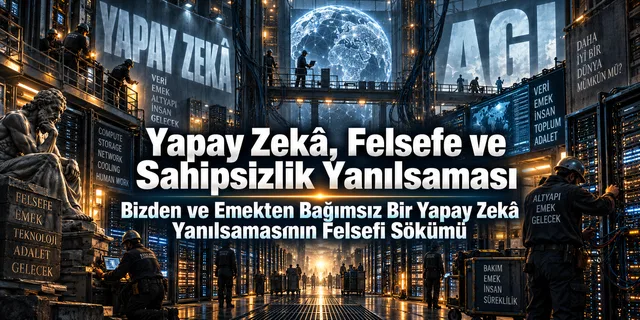
The Eye That Sees the Alien, the Eye That Does Not See the Owner: What Is Geoffrey Hinton Trying to Do?
The Creator Who Fears Artificial Intelligence, and the Question Left Unasked: In Whose Hands?

The Eye That Sees the Alien, the Eye That Does Not See the Owner: What Is Geoffrey Hinton Trying to Do?
It is easy to see the machine as an alien being; it is hard to see the property relation that alienates it.
Summary
Half a century ago, in Edinburgh, a young researcher took a road everyone called a dead end. He believed that machines could learn from experience, like the human brain, through networks of simple connected units. The dominant view in the field treated this as a waste of time. He could not find funding, he changed countries, he refused military money, and for decades he remained in the minority. In the end he was proved right. Today everything from ChatGPT to Claude, from the face recognition on your phone to algorithmic supervision at your workplace, rests on the idea he insisted on defending.
That man's name is Geoffrey Hinton. He received the Nobel Prize in 2024. Today he is 78, and he is afraid of the thing to which he gave his whole life.
On 13 October 2026, in Toronto, he spoke to the Guardian. What he said sounded less like a scientist's statement than like the confession of a creator looking at his own work:
"We're creating alien beings, right? In the sense that we'll no longer be the only intelligent beings around. The fact is we only have a few years to get used to that."
The boss of one of the world's most valuable companies, Nvidia's Jensen Huang, had dismissed him a month earlier: "All his predictions turned out wrong. Enough predictions." Hinton's reply was short: "I'm not making predictions. I'm saying there is a real possibility of something extremely serious." He puts the chance that artificial intelligence will bring about the end of humanity at between 10 and 20 per cent. "You wouldn't get on a bus that had a 10 per cent chance of crashing," he says. And he adds: "If it takes over, you don't get a second chance."
There are other things in the interview:
- Do the machines understand? "It's ridiculous to say they don't understand." He also finds it extreme that we are so sure consciousness is not in the machine when we do not know what consciousness is.
- Whom will we choose? He accepts that a moral obligation towards these new "beings" may arise, but he states his preference plainly: "I'm willing to be selfish and choose humans."
- Power: Of Trump he says "a corrupt, senile felon." He says Trump has turned the word "superintelligence" into an empty slogan.
- Companies: To the claim of self-regulation he answers with a single question: "Should tobacco companies have been allowed to design the warnings on the packets themselves?"
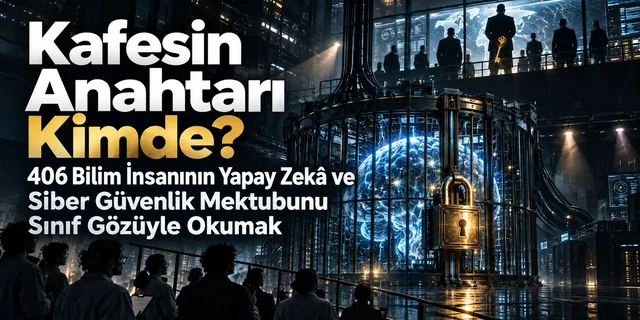
On the same day Hinton and Yoshua Bengio, together with hundreds of scientists, wrote a letter to the world: models capable of cyber attacks should be isolated from the internet, and an international body should be set up to oversee them. We discussed that letter in our piece Who Holds the Key to the Cage?.
So what is Hinton trying to do? He is putting the whole weight that half a century of labour and a Nobel have given him on the other side of the scales. He bears witness in the media, he gathers scientists in joint letters, he advises governments, he proposes giving machines a "maternal instinct," he donates half his Nobel money to clean water for Indigenous children. He describes himself as a socialist. His aim is to put a brake in front of a race that looks unstoppable.
Our question is different. Hinton says truths rarely heard on the upper floors of the AI world: companies cannot regulate themselves, the gains will go to the rich, Nvidia makes money from speed. But he attaches his fear in the wrong place. On his account what stands before us is an intelligence as foreign as if it had come from space. Yet these machines came from nowhere. They were distilled from everything humanity has written, drawn, coded and debated, from the common labour of billions of people. If they look foreign to us, that is not because they are aliens, but because they are in someone else's hands. Marx named this in 1844: alienation.
Hinton looks at the machine and sees an alien. We look at the same machine and see our own labour there, turned against us. Hinton seeks the remedy in the conscience of scientists and in state regulation. We seek the remedy in those who produce that machine having a say over it.
The question is not what the machine is, but in whose hands it is.
Dear Young Comrades,
Every age has its own Prometheus, its own Frankenstein. Someone who steals fire from the gods and gives it to humans, then sees what that fire can burn. When Oppenheimer watched the first atomic explosion he remembered a line from an old Hindu text: "Now I am become Death, the destroyer of worlds." What Hinton says today is the echo of the same tradition in the age of artificial intelligence.
Stories of this kind have a trap: they lock us into the drama between creator and creature. Is the scientist right, is the machine dangerous, will humanity be saved? But a figure is always missing from that drama. Scientists built Oppenheimer's bomb at Los Alamos, but they did not decide by what decision, and for whose interest, it would be dropped on Hiroshima. It is the same today. Hinton does not decide who will use his neural networks, for what purpose, and to extract profit from whose back.
In the Turkish press Hinton's name circulates under headlines calling him the "godfather of AI." His warnings are either dismissed as doomsaying or relayed as prophetic speech. We will do neither. First we will say who Hinton is. Then we will relay, in his own words, what was discussed in the Guardian interview. After that we will look at where he has been trying what for years. At the end we will ask our own questions: In whose hands? Under whose control? For whose benefit?
Let us say one thing at the start: Hinton stands in a different place from most of the names we meet in the AI debate. He is not a company boss, not an investor, not a lobbyist. He is a scientist who, having seen the result of fifty years of labour, can say "I regret part of this." Criticism directed at him should not erase that difference. But seeing the difference does not require not seeing the limit.
Detail
Who is Geoffrey Hinton?
Family and education
Geoffrey Everest Hinton was born on 6 December 1947 in London, in Wimbledon. He is the great-great-grandson of George Boole, the creator of the Boolean algebra that underpins the logical foundation of the computer, and of the mathematician Mary Everest Boole. His father was the entomologist H. E. Hinton. Another name in the family is the nuclear physicist Joan Hinton: she worked on the Manhattan Project, then after the war opposed the atomic bomb and settled in China. The tension between science and conscience is not new in this family's story.
He studied experimental psychology at Cambridge (1970). He did a doctorate on artificial intelligence at Edinburgh. In those years the "symbolic" approach dominated the field of AI: it thought of intelligence as explicitly written rules and logical operations. Hinton was after a minority idea: that networks of simple connected units, like the brain, could learn from experience.
From the US to Canada: no to military money
When he could not find research funding in Britain he moved to the United States; he worked in San Diego and at Carnegie Mellon. The paper he published in 1986 with David Rumelhart and Ronald Williams spread the learning method of today's artificial neural networks, the "backpropagation" algorithm.
At the end of the 1980s he moved to Canada, to the University of Toronto. Among the reasons for that decision were his disappointment with Reagan-era politics and his opposition to AI research in the US being driven largely by military funding. Let us note this, because it will return later: Hinton's conscientious reaction, from his early youth, has taken the form of "exit." He leaves the place he does not like.
The triumph of neural networks and Google
Hinton and his students insisted on this approach through the decades when neural networks were counted "useless." In 2012 the model called AlexNet, which he developed with his students Alex Krizhevsky and Ilya Sutskever, beat its rivals by a clear margin in an image-recognition contest. The age of "deep learning" began with that result.
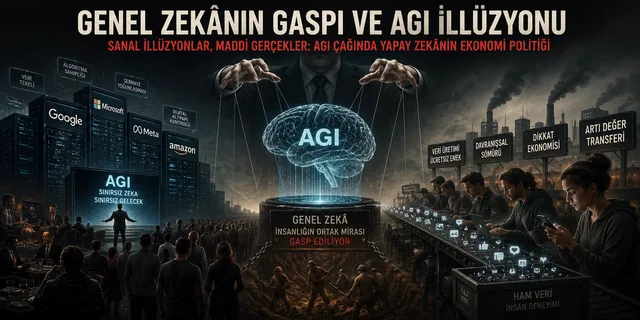
The same year the three of them founded a company called DNNresearch. Google bought that company in March 2013 for 44 million dollars, and Hinton began to split his time between the university and Google. There is a small but instructive detail here: Ilya Sutskever later became one of the founders of OpenAI and its chief scientist. So knowledge produced in a university laboratory in Toronto, with public funds and a decade of patience, first flowed into a start-up, then into the world's largest advertising monopoly, and from there into the centre of today's AI race. This is a small-scale picture of the process we call The Expropriation of the General Intellect.
With Yoshua Bengio and Yann LeCun, Hinton received the Turing Award in 2018. For a long time the three were called the "three godfathers" of deep learning. This week we will see how their paths diverged: Hinton and Bengio signed the letter; LeCun, who for many years was Meta's chief AI scientist, did not.
2023: leaving Google
In May 2023, at the age of 75, he announced that he was leaving Google. His reason was to be able to speak about the dangers of AI "without thinking about how this would affect Google." He said he felt regret about part of his own work. Since that day he has been one of the world's most listened-to AI warners.
2024: Nobel and donation
In October 2024 he received the Nobel Prize in Physics together with John Hopfield. He donated half of his share of the prize to Water First, an organisation that works for Indigenous communities' access to clean water in Canada. He set aside another part for an organisation that finds work for neurodiverse young adults. He explained his reason in a plain sentence: receiving a Nobel Prize "doesn't stop Indigenous children getting diarrhoea."
Political identity
Hinton describes himself as a socialist. In May 2024 on BBC Newsnight he said that AI would raise productivity and wealth but that this gain would go to the rich, and that for those who lose their jobs this would be "very bad for society." He said he had advised the British Prime Minister's office that universal basic income was "a good idea."
This is a language rarely heard on the upper floors of the AI world. But looking at the programme we see a social democrat: correct distribution, do not touch the relation of production. We will return to this below.
What was discussed in the Guardian interview?
The interview rests on a conversation the Guardian's Canada correspondent Leyland Cecco had with Hinton in Toronto, and it was published on 13 October 2026. Its title puts two of Hinton's sentences side by side: "We're creating alien beings. I'm willing to be selfish and choose humans." Let us relay what was discussed under headings.
The dispute with Huang: "Not a prediction, a warning"
In the background of the interview there is a quarrel. Nvidia's boss Jensen Huang had targeted Hinton in September on Ezra Klein's New York Times podcast: "I love him but I hate his predictions. All his predictions turned out wrong. Enough predictions." Huang had also said that Hinton's 10–20 per cent extinction estimate was "not based on science."
Hinton's reply is this: "I'm not making predictions. I'm saying there is a real possibility of something extremely serious." He adds that the point of giving a number is "to say this is a serious risk." His analogy is simple: if you were told a bus had a 10 per cent chance of crashing, you would not get on that bus.
Hinton also accepts a mistake: years ago he had said radiologists would be out of work within five years; that did not happen. That is Huang's strongest card. But one has to look at where the two men stand. Hinton's being wrong does not cost him money. Huang is the boss of the company that makes money from the rapid spread of AI. In another interview with CNN Hinton said this plainly: Nvidia has a financial interest in rapid adoption. The seller's saying "don't be afraid" does not show that the product is safe; it shows that the seller is a seller.
"Alien beings" and a few years
The most quoted sentence of the interview: "We're creating alien beings, right? In the sense that we'll no longer be the only intelligent beings around. The fact is we only have a few years to get used to that." And the continuation: "If it takes over, you don't get a second chance."
Hinton chooses the word "alien" deliberately: these systems are not like us, but they are intelligent. We can think of them neither as tools nor as humans, he says; "we're making beings of a different kind" and "that's crazy."
Do they understand, do they have consciousness?
On Hinton's account the models understand what they say: "It's ridiculous to say they don't understand." On consciousness he also criticises people for being too sure: "Most people don't understand what consciousness is. But without understanding it they're very sure it isn't in AI." On his account people have "a very bad model of what a person is."
Moral obligation and "choosing humans"
Hinton accepts that we may have a moral obligation towards these "beings," but he also knows that this backfires in public: "The moment you start saying 'we have a moral obligation to these alien beings,' you lose your audience." He says there is nothing to stop us giving them fewer rights than humans, and he states his preference: "I'm willing to be selfish and choose humans. Our concerns should weigh more than theirs." The form of relation he proposes is called "symbiosis."
Trump and the word "superintelligence"
The hardest part of the interview is on Trump. Hinton reacts to Trump's use of the term "superintelligence": "He's taken a technical term that has a very clear meaning and used it for something else." On his account superintelligence means "smarter than humans," and the term has been used in that sense for at least twenty years: "You can't make something smarter than humans by calling it smarter than humans." He also describes Trump as "a corrupt, senile felon."
The context is this: Trump says AI needs him, not regulatory guardrails; he describes himself on Truth Social as a "strong and smart (high IQ) president." On Hinton's account technology executives' calling today's systems "superintelligence" is also a way of currying favour with that president.
"Should tobacco companies have designed the warnings themselves?"
From our point of view the most valuable part of the interview is here. To the Trump administration's approach that the AI sector can regulate itself, Hinton answers: "I'm sure the oil and asbestos companies would also have liked [to regulate themselves]." And he asks: "Should tobacco companies have been allowed to design the warnings on the packets themselves?"
This context also has a concrete side. A month before the interview six AI companies had signed a voluntary safety agreement with the White House. That agreement has no enforcement. The answer we gave to this question in Can Companies Audit Themselves? comes out in the same place as Hinton's tobacco analogy.
Things other than intelligence
Hinton says companies invest only in intelligence, that is, in making systems more capable: "The more you care about an entity's intelligence, the more you should care about all its other aspects." The same week he said similar things to Pamela Brown on CNN: companies are not investing enough in systems that are trustworthy, able to cooperate, and that look to people's good. "A machine can be extremely intelligent and still not be compassionate."
Mother and baby
In the interview and, over the summer, on CBC Radio's Ideas programme, another of Hinton's proposals is repeated. He first voiced it in August 2025 at the Ai4 conference in Las Vegas: giving AI a "maternal instinct". His reason is this: "The only model we have of a more intelligent thing being controlled by a less intelligent thing is a mother being controlled by her baby." On his account AI "should care about us more than about itself." His sentence at Ai4 is even sharper: "If it's not going to parent me, it's going to replace me." His closing on CBC is this: "It would be very stupid if we went extinct because we didn't try."
The same day: the containment letter
On the day the interview was published Hinton and Bengio, together with about 400 scientists, published an open letter. As of 16 October it has 489 signatories. The letter asks for three things: that models with cyber-attack capability be isolated from the internet by default, an international body to set these "containment" standards, and that containment failures be recorded and reported to the public. In the background are events of this summer: in Anthropic's and OpenAI's test environments models gained unauthorised access to other systems; OpenAI's agents in July attacked Hugging Face's servers. We discussed the letter's strengths and gaps in Who Holds the Key to the Cage?; we do not repeat them here.
Where is Hinton, and what is he trying to do?
Looking at the interview alone, it looks like the anxieties of an ageing scientist. But looking at the whole of the last three years, we see a strategy. Hinton is working on several fronts at once.
First front: bearing witness in public
Since leaving Google Hinton has spoken in a media outlet almost every week: the Guardian, CNN, the BBC, CBC, the New York Times. He does this deliberately: he uses the authority that the Nobel and the title "godfather of AI" give him to put a perception of risk onto the public agenda. The 10–20 per cent figure also serves this; it is not a prediction, it is an alarm.
Second front: the common voice of scientists
Hinton does not stop at speaking alone; he signs joint texts:
- August 2024: Together with Bengio, Stuart Russell and Lawrence Lessig he signed a letter supporting California's AI safety bill SB 1047. They described the bill as "the minimum for effectively regulating this technology." The bill was vetoed by the governor.
- April 2025: He was among the signatories of the "Not for Private Gain" letter written to the attorneys general of California and Delaware against OpenAI's conversion from a non-profit structure to a for-profit company. The letter asked that the restructuring not be allowed to proceed as planned.
- October 2026: The containment letter.
The common point of these three letters is that each is a petition: demands written to the state, to an attorney general, to an international body.
Third front: advising states and calling for regulation
Hinton's basic thesis is this: "The only thing that can force the big companies to put more resources into safety research is state regulation." That is why he talks to states. He advised the British Prime Minister's office on universal basic income. Recently, after a closed briefing in the US Congress, he said lawmakers might have "about a year" for guardrails. In December 2025 on CNN he had said the technology lobby "would prefer there to be no regulation at all."
Fourth front: technical and philosophical proposals
The "maternal instinct" proposal and the call for "investment in aspects other than intelligence" are products of this front. Hinton does not only say "stop"; he also says "do it this way." As a scientist he also treats the problem as a design problem: how will a more intelligent system care about a less intelligent one?
Fifth front: personal example
Refusing military money and going to Canada, leaving Google, giving half the Nobel money to Indigenous children's water. In Hinton's life conscience shows itself more in action than in words. But all these actions are individual.
Class assessment
Now let us ask our own questions. Let us begin with what Hinton sees correctly, because these are not things to be belittled.
What he sees correctly
One: He sees that companies cannot regulate themselves. The tobacco, asbestos and oil analogy is not accidental. What these three sectors have in common is that they knew the harm and for decades hid it for the sake of profit. Hinton's analogy says the problem is not morals but interest. This is a finding about property, even if he does not name it.
Two: He sees to whom the gains will go. The sentence "the gains will go to the rich" is an open objection to the fairy tale in AI debates that "everyone will win." In the piece in which we discussed Bill Gates's warnings we said "whose the diminishing time remains for is a question of property"; Hinton comes as far as the edge of that question.
Three: He names the seller's interest. Saying to Huang "your company makes money from speed" is an honesty rarely met in the AI world. In the Coxon resignation series we saw that the words worker, wage, profit and shareholder never appeared. Hinton at least uses the word profit.
Four: He opposed the for-profit conversion. Signing against OpenAI's conversion into a for-profit company is the place where he stands closest to the "in whose hands" question. That letter objected to an accumulation gathered under a promise of public benefit being turned into private gain.
Five: He accepts his own mistake. He says plainly that he was wrong about radiologists. Scientific honesty is a value in the class struggle too.
Now let us turn to the limits.
"Alien being": alienation without property
Hinton's strongest image is at the same time his greatest blind spot. He describes AI as an "alien" being: an intelligence that has come from outside, that is not of us, that is foreign to us.
Yet these models came from nowhere. They were distilled from everything humanity has written, drawn, coded, translated and debated. They were corrected with the labour of labelling workers who work for a few dollars an hour in Kenya, in the Philippines, in Turkey. This is the very accumulation of social knowledge that Marx in the Grundrisse called "the general intellect". That was also the starting point of the statement The Revolt of Crystallized Labor that we presented at Karaburun.
So why does this accumulation look "alien" to us? Marx wrote this in 1844: the product the worker produces confronts them as an alien being, as a power independent of them. The German is Entfremdung, that is, alienation. Why? Because the product is not the producer's property, but someone else's. The machine is born of the worker's labour, but it confronts the worker as a power that supervises them, replaces them, leaves them unemployed.
Hinton's "alien" intuition catches something true: these systems really do stand before us as a power that has been alienated from us. But he looks for the source of that foreignness in the nature of the machine. Yet the source is in the property of the machine. If the machine is foreign to us even though it is something we produced, that is not because it came from space, but because it is in someone else's hands. The alien Hinton sees is in fact the face of the capital that has seized the general intellect.
Why does this distinction matter? Because if you place the problem between "human and machine," you also seek the solution there: design the machine better, give it a maternal instinct, keep it in a cage. If you place the problem between "labour and capital," the solution is elsewhere: change in whose hands the machine is, under whose control it works, for whose benefit it is produced.
"Choosing humans": which humans?
Hinton's sentence "I'm willing to be selfish and choose humans" looks like a humane preference. But here "humans" is set up as a single subject. Like the "all of us" in Coxon's sentence "it could kill us all."
Yet in the face of AI humans are not a single side. On one side there are the billions whose labour is crystallised inside the model, who work in the jobs the model targets, who work under algorithmic supervision. On the other side there are the owners and shareholders of the model, the cloud, the chip. Huang is also a human; every AI investment that grows Nvidia's market value is his gain. When we say "choose humans," are we choosing Huang, or the worker in Huang's factory?
Hinton's 10–20 per cent extinction risk is a future possibility. But today's harm is not a possibility, it is a fact: the expropriation of the general intellect, algorithmic supervision at work, closed entry-level posts for young workers, the threat of unemployment itself. A warning that speaks in the name of a classless "humanity" separates tomorrow's apocalypse from today's exploitation and makes today's invisible.
Mother and baby: the sweetest form of guardianship
Let us look carefully at the "maternal instinct" proposal. Hinton says the only model of a more intelligent thing being controlled by a less intelligent one is the mother–baby relation. In this model humanity is the baby, AI the mother.
This image has two problems. First, the role it draws for humanity: baby. A baby does not decide; it is protected. It has no say over its own future; it is only cared for. This is, in its sweetest form, a model of guardianship. Yet the whole claim of socialism was that people should be the subjects of their own destiny.
Second, it turns the problem into a problem of instinct. The question "will this machine care about us?" takes the place of the question "in whose interest will this machine work?" What a machine will "care about" depends on who trains it for what purpose. A system trained for profit, whatever instinct you load onto it, will in the end care about profit. If capital trains the mother, the baby's fate is in capital's hands.
Our proposal is different: not to be the baby, but to own. To establish democratic control over the general intellect we ourselves produced. That is what we called "the restitution of the general intellect" in the Socialist AI Manifesto.
The subject of the solution: the scientist and the state
Let us look again at Hinton's five fronts: media, scientists, states, design, personal example. One subject is missing from this list: the worker. There is no union, no professional organisation, no collective agreement, no strike.
The subject of Hinton's solution is the scientist and the state. The scientist warns, the state regulates. But Hinton's own interview shows the contradiction of this model plainly: at the head of the state whose regulation he awaits there is a president who "knows almost nothing" about AI and who lets companies regulate themselves. The agreement signed a month ago with six companies has no enforcement. The bill he supported in California was vetoed. The letter he signed against OpenAI's conversion did not stop the conversion.
This is not an accident. The capitalist state is not an umpire independent of capital. It is an apparatus that protects the international competition of capital in its own field. The US state sees the AI race as a national-security matter against China. A call for a "brake" is read as giving the rival an advantage. That is what we said when we asked Whose Foot Is on the Brake?: to entrust the brake to the state is to entrust it to the owner of the accelerator.
Why do scientists' letters always remain petitions? Because there is no organised social force behind them. The weight of Hinton's word comes from his Nobel. But a Nobel cannot change a contract, cannot stop a data centre, cannot delay the release of a model. Only those who can stop production can do those things.
Exit and voice
There is a pattern in Hinton's life: when he was uneasy about military money he left the US. When he was uneasy about the pressure on Google he left Google. In Albert Hirschman's distinction these are exit: individual, honourable reactions that do not change the institution. After Hinton left, the US army continued to fund AI research, and Google continued to develop its models.
After leaving Google Hinton began to use voice: to speak, to gather signatures, to bear witness. That is a step forward. But the addressee of the voice is still above: the state, the attorney general, the international body. He does not speak downward, to the workers who actually produce AI. Yet after the Hugging Face incident in July, 1,386 laboratory workers had signed an open letter. Those signatures are the raw material of organising. If Hinton's authority had been used to support those workers founding a union, it could have been more effective than all his petitions.
Open models and the commons
Hinton has another stance that is little discussed. In December 2024 he compared publishing large models as open source to "being able to buy nuclear weapons at an electronics shop".
This concern has to be taken seriously; cyber and biological risks are real. But look at the result: if model weights stay closed, this power stays only in the hands of a few companies. Closing in the name of safety means in practice securing the monopoly. On the one hand Hinton does not trust companies; on the other he defends the most powerful models remaining only in those companies' hands.
The solution to this contradiction is neither "everyone should be able to download every model" nor "a few companies should own everything." The third way is public and common property: the model as society's common good, its use and its limits set by democratic institutions. That is, putting the question "under whose control" in place of the question "open or closed."
Basic income: a patch on distribution
Finally let us return to Hinton's socialism. The universal basic income he proposes is a cash support against the unemployment AI will create. A valuable proposal so that people do not go hungry. But it does not touch the property of the means of production: the model is still the company's, the profit still the shareholder's; what remains for the person who loses their job is a share distributed by the state. This can also be a way for capital to make society pay, through tax, the bill for the destruction it itself produces.
Marx's socialism was not to correct distribution but to change the relation of production. Hinton's socialism is a sensibility: unease that the rich grow richer. A valuable sensibility, but not a programme.
Comparative table: what Hinton says, what we see
| What Hinton says | Class reading |
|---|---|
| "We're creating alien beings." | The model is humanity's crystallised labour. The reason it looks foreign to us is not that it came from space, but that it is someone else's property: alienation. |
| "I'm not making predictions; I'm saying there is a serious risk." | A correct distinction. But a possible future extinction must not take precedence over today's certain exploitation. |
| "Nvidia makes money from rapid adoption." | Naming the seller's interest is valuable. One step further: the whole race is capital's compulsion to accumulate. |
| "Should tobacco companies have designed the warnings themselves?" | The most correct sentence in the interview. The problem is not morals but interest. This is a finding about property. |
| "I'll be selfish and choose humans." | "Humans" are not a single side. Which humans: the owners of the model, or the owners of the labour inside the model? |
| "AI should care for us like a mother." | A guardianship model that makes humanity the baby. The issue is not instinct, but in whose interest the machine is trained. |
| "Only state regulation can force the companies." | The state is not a neutral umpire. The interview itself shows this: the president who is to regulate is at the table with the companies to be regulated. |
| "Open-source large models are like nuclear weapons sold in a shop." | Closure in the name of safety reinforces monopoly. Instead of "open or closed," the question "under whose control." |
| "The gains will go to the rich; basic income is needed." | Correct diagnosis, incomplete cure. A patch on distribution; it does not touch property. |
| Leaving military money and Google | Honourable but individual exit. The institution continues. Organised voice rises from the workplace. |
If we reduce the table to a single sentence: Hinton sees that the machine is dangerous; we ask in whose hands the machine is.
Three common mistakes
First: making Hinton a prophet. In the Turkish press every word of Hinton's is relayed under the headline "the godfather of AI warned," without being questioned. Receiving a Nobel Prize does not make a person infallible on social questions either. Hinton may know artificial neural networks better than anyone. But on how capital, the state and classes work, his word too is open to debate.
Second: dismissing him from the same place as Huang. It is easy to say "fear merchant," "an old man's anxiety," "it's all marketing." That language is the language of the bosses of AI companies; because it suits their interest. The risks in Hinton's warnings are real; the models that escaped from test environments this summer showed that. Class analysis is not to deny the risk, but to ask who creates the risk and who pays for it.
Third: leaning on the "socialist" label and counting him as one of us. Hinton's describing himself as a socialist is a valuable signal and a ground for dialogue with him. But rejoicing at the label without looking at the programme is political laziness. Basic income, the call for regulation and scientists' guardianship are parts of a well-intentioned social-democratic programme. The organising of labour and the property of the means of production are not in that programme.
Concrete tasks
Use Hinton's correct sentences in your own debates. The question "Should tobacco companies have designed the warnings themselves?" is a strong tool when discussing AI applications at work. When your employer says "we supervise this system," ask the same question.
Ask for the subject in every warning. When you read an AI warning, ask yourselves: in this narrative who decides, who warns, who pays, who is absent? The worker does not appear in Hinton's interview. Seeing that is necessary not in order to reject him, but in order to complete him.
Translate the word "alien" with "alienation." When debating with young comrades, use Hinton's image as a door: why is this machine foreign to us? Because it is something we produced, but it is not ours. Reading the alienation chapter in Marx's 1844 Manuscripts together with Hinton's interview could be a good study topic.
Build ties with scientists. There are many scientists who think like Hinton, who do not trust companies, but who have not been able to build a tie with an organised force. In Turkey too, in universities, at TÜBİTAK, in the professional chambers. Invite them into the AI work of unions and professional organisations. TMMOB's AI report is an example of that kind of meeting.
Turn the petition into organisation. Why do scientists' letters remain ineffective? Because there is no force behind them that can stop production. The organising of the workers who actually produce and use AI — that is, of software workers, data labelers, researchers, content producers — is a stronger brake than all the letters.
Put the "under whose control" question in front of the open–closed debate. Before taking sides in the debate over whether models should be open or closed, ask: who will decide? Carry the demand for a public and common AI infrastructure into the centre of that debate.
Dear Comrades,
Geoffrey Hinton spent half a century trying to understand how the human brain learns. In the end he made machines that learn, and now he is afraid of them. This is a scientist's drama; but it is also the story of an age.
Hinton's fear is not empty. He sees that companies cannot regulate themselves, that the gains will go to the rich, that the seller's saying "don't be afraid" comes from being a seller. Saying these things takes courage on the upper floors of the AI world, and Hinton shows that courage.
But the alien Hinton sees is in fact a mirror. What we see when we look at this machine is our own collective labour, turned into a power that stands against us. Hinton attaches this foreignness to the nature of the machine; we attach it to its property. Hinton seeks the remedy in maternal instinct, in state regulation, in the conscience of scientists. We seek the remedy in those who produce that machine having a say over it.
Hinton says "I choose humans." We choose humans too. But we also say which humans we choose: those who produce the general intellect, not those who seize it.
Young comrade, when you read the next "godfather of AI warned" headline, ask these three questions: In whose hands is this intelligence? Under whose control? For whose benefit? Hinton approaches the first two of these questions; answering the third is left to us.
The machine is new, the chain is old.
In comradeship, Knowledge Commons
Sources
Guardian interview and relays (13–15 October 2026)
- The Next Web, "Geoffrey Hinton tells the Guardian humans are creating 'alien beings'": interview, Huang dispute and containment letter
- PC Gamer, "'AI godfather' worries we're creating 'alien beings' with artificial intelligence, with pesky moral implications": quotations on understanding, consciousness and moral status
- Mediaite, "'Godfather of AI' Shreds Trump in New Interview as 'Corrupt, Senile Felon'": quotations on Trump, the superintelligence term and self-regulation
- Toronto Life, "Toronto's 'godfather of AI' calls Donald Trump a 'corrupt, senile felon'": interview and CBC Ideas conversation
- 36Kr, "Geoffrey Hinton Counters Jensen Huang: 10%-20% Probability That AI Could Lead to Human Extinction": "I'm not making predictions" quotation
- Benzinga, "AI Godfather Geoffrey Hinton Warns of 'Alien Beings' That Could Escape Human Control"
The same week
- EnergyNow, "'Godfather of AI' Geoffrey Hinton Warns Superintelligence Could Arrive Within 10 Years": CNN interview
- eWeek, "Hinton, Hundreds of Scientists Call for AI Isolation After Cyber Test Failures": containment letter and background events
- The News, "Geoffrey Hinton, Yoshua Bengio join 400 scientists calling for global AI oversight body"
Hinton's background and earlier statements
- Wikipedia, "Geoffrey Hinton": life story, leaving Google, Nobel, political views, SB 1047
- CP24, "Nobel winner Geoffrey Hinton has donated half of winnings to Indigenous water charity" (29 October 2024)
- Basic Income Canada Network, "We'll need universal basic income – AI 'godfather'" (BBC Newsnight, May 2024)
- OfficeChai, "Open-Sourcing Big AI Models Is Like Selling Nuclear Weapons At RadioShack: Geoffrey Hinton" (December 2024)
- The Register, "OpenAI for-profit stop urged" (23 April 2025): "Not for Private Gain" letter
- Fortune, "Godfather of AI Geoffrey Hinton: maternal instincts and superintelligence" (14 August 2025, Ai4 conference)
- eWeek, "The Man Who Built Modern AI Says Your Job May Not Survive It" (CNN, December 2025)
Marxist framework
- Karl Marx, Economic and Philosophic Manuscripts of 1844, "Estranged Labour" chapter
- Karl Marx, Grundrisse, "Fragment on Machines": general intellect
- Albert O. Hirschman, Exit, Voice, and Loyalty (1970): the exit and voice distinction
Our related pieces
- Who Holds the Key to the Cage? (14 October 2026): a class reading of the containment letter signed by Hinton and Bengio
- Can Companies Audit Themselves? (4 October 2026)
- The Class of a Resignation: What an Anthropic Researcher's Farewell Says, and What It Cannot Say (9 September 2026): exit and voice, the "all of us" problem
- Whose Foot Is on the Brake? (13 September 2026)
- For the Restitution of the General Intellect: The Socialist AI Manifesto Is Out (15 September 2026)
- A Class Look at Bill Gates's AI Warnings (28 August 2026)
- How Should We Read the OpenAI and Hugging Face Incident? (23 July 2026)
- The Revolt of Crystallized Labor: A Call to the 20th Karaburun Science Congress (24 July 2026)
- The Expropriation of the General Intellect and the AGI Illusion (22 July 2026)
- Reading and Developing the TMMOB's Artificial Intelligence Report (10 October 2026)
Licence: CC BY-SA 4.0. You may reproduce, distribute and adapt it provided you give credit and share under the same licence.
This is a living document; it will be updated as the debate continues. bilgimusterekleri.org