A Class Seven Layers Underground
A Hundred-and-Fifty-Year Account, from Zonguldak to Soma

The East-5 Face: Five Miners in Soma, a Hundred-and-Fifty-Year Account
Summary
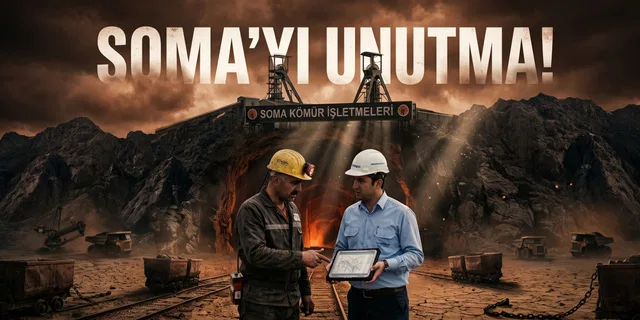
Thursday 1 October 2026, at 16.06. In the Soma district of Manisa, at the East-5 face of the underground coal mine belonging to İmbat Mining, there was a collapse. Seven workers were left under the collapse. Süleyman Şakrak and İbrahim Çimen were rescued injured. Ramazan İnce, Halit Ersay, Kerim Ören, Ömer Karakaya and İsa Olcay lost their lives. All five were members of Bağımsız Maden-İş; Ramazan İnce was 26, and he was an official of the union's Aegean Branch No. 1.
This piece says three things:
- The event is not a single one. At İmbat, since 2017, at least seven more workers have died. In Turkey, between 2013 and 2025, 1,267 mine workers died; 350 of them in Manisa. Forty percent of the deaths were from collapse and crushing.
- The history is not a single one. The line that runs from forced labour in Zonguldak (1867, 1940) to Armutçuk (1983), to Kozlu (1992), to Soma (2014), to Ermenek, to Şirvan, to Amasra, to İliç is the same line: coal is cheap, and life is cheaper.
- The failure to take precautions is not a negligence, it is an account. A precaution is a cost for the boss; death is an item written into someone else's ledger, its penalty bargained down. Rödovans, subcontracting, wage pressure and impunity are the four components of this account. The only force that can break the account is the organised worker who has a say in the workplace.
The detail is below.
Dear Young Comrades,
As this piece was being written, Ramazan İnce's funeral was being laid in the earth at Taşdibi neighbourhood, in İvrindi, Balıkesir. He was twenty-six. He was unmarried. He worked underground, and when the shift ended he served as an official at the union branch, seeking his friends' rights. When, in February, three thousand workers at İmbat stopped production for the inflation differential, he was there too. Eight months later, in the same workplace, at one face of the same mine, the earth collapsed on top of him.
I am not going to tell you of an accident. I am going to tell you of an order. Because the word "accident" makes death look like something that could not be seen beforehand, something in no one's hands. Yet that there will be a collapse in a mine in Soma is something every miner in Soma, every engineer, every inspector, every boss knows. If no precaution is taken against a thing that is known, what is there is not an accident, it is a decision. Our question is this: Who makes that decision, and why?
What happened: 1–2 October 2026
The facts, with what we know today, are these:
- Place: Soma, Manisa, the underground lignite mine belonging to İmbat Mining, the East-5 face (sol.org.tr; İSİG Assembly).
- Time: 1 October 2026, 16.06 (dokuz8HABER).
- Left under the collapse: Seven workers. Two workers were brought out alive in the first hours; the search and rescue went on through the night, and the bodies of the remaining five workers were reached on 2 October (Medyascope).
- Those who lost their lives: Ramazan İnce, Halit Ersay, Kerim Ören, Ömer Karakaya, İsa Olcay (Kısa Dalga).
- The injured: Süleyman Şakrak and İbrahim Çimen (Medyascope).
- The union: All five were members of Bağımsız Maden-İş; Ramazan İnce was an official of the union's Aegean Branch No. 1 (İSİG Assembly; Gazete Merhaba).
- The investigation: The Soma Chief Public Prosecutor's Office assigned three prosecutors; nine people, the company's general manager among them, were taken into custody. The Social Security Institution appointed a chief inspector (Haber Kıbrıs; İz Gazete).
- The rescue: 756 personnel and 76 vehicles; AFAD, the fire service, the gendarmerie, the police, health teams, underground imaging devices (Kısa Dalga).
The technical cause of the collapse has not yet been announced. The face's support, the roof control, the gas and pressure measurements, the production target on that shift, whether the face had given a warning before: all of these will be the subject of the expert report. But the subject of this piece is the place the expert will not look: why, every year, in the same basin, deaths of the same kind happen.
Reactions: three unions, three sentences
The union statements that came in the first hours of the deaths put the matter far more plainly than the ministry announcements.
The İSİG Assembly announced the five names together with their union identity: "Ramazan İnce, official of Bağımsız Maden-İş Aegean Branch No. 1, and the union's members…" (İSİG Assembly). This is an important choice, one that takes the dead out of being a number of "workers" and shows them as organised people.
BİRTEK-SEN (the United Textile, Weaving and Leather Workers' Union), while the search was still going on, spread the matter across the geography: "Soma, İliç, Amasra, Şirvan… All over Turkey the mine fields are being watered with the workers' blood." The statement stressed that İmbat is among Turkey's largest companies, that despite record profits no precaution was taken, and that impunity makes workers from "7 to 70" the victims of workplace killings; and it closed with a single slogan: "Organise to live!" (BİRTEK-SEN).
DGD-SEN (the Revolutionary General Warehouse Workers' Union) counted the cause in three words: "lack of inspection, subcontracting, and the lust for profit." And it added: "This is not an accident, it is a murder… Condolences to the whole of the working class" (DGD-SEN).
That a textile union and a warehouse workers' union took the floor in the first hours for the mine workers is not a small detail. The sentence "condolences to the whole of the working class" takes death out of being one branch's affair and makes it the class's common affair. This is the starting point of this piece too.
On the official side, the familiar language did its work: the ministry said "we are following the process closely", appointed a chief inspector, and offered condolences (İz Gazete). TÜRK-İŞ, together with an explosion the same day at a metal factory in Torbalı, wrote that "no economic ground is more important than the labourer's safety of life" (Manşetiz). A correct sentence. But, as we will see in this piece, the order is built precisely on an account that counts the economic ground as more important than life.
İmbat Mining: the company's record
İmbat is one of the large private companies producing underground lignite in the Soma basin. It is on the Istanbul Chamber of Industry's list of the 500 largest industrial establishments; the chair of the board is Gökalp Büyükyıldız (sol.org.tr). It employs thousands of workers: about three thousand workers, on two shifts, joined the stoppage of work in February 2026 (Aydınlık).
Earlier deaths
The workers whose deaths at this workplace before 1 October reached the public (sol.org.tr; UİD-DER):
| Year | Worker | How |
|---|---|---|
| 2017 | İsmail Kahraman | A work machine overturning |
| 2019 | Emin Karaçam, Selahattin Göktepe | A work accident |
| 2020 | Ersin Özdoğan, Salih Ayber, Erdinç Karaveli | Collapse |
| 2022 | Durmuş Şahan | Being caught under a machine |
| 2026 | Ramazan İnce, Halit Ersay, Kerim Ören, Ömer Karakaya, İsa Olcay | Collapse |
Some compilations give the number of deaths at the company since 2013 as sixteen (Yeni Yaşam); we write the twelve whose names we could reach. Notice: in 2020 a collapse, three dead. In 2026 a collapse, five dead. The same workplace, the same kind of death, six years apart. What changed after the first collapse? The answer to this question is the subject of the rest of the piece.
The wage front: a second war in the same workplace
At İmbat the workers are struggling not only with the earth, but with the payroll:
- 2021: About 1,500 workers stopped production because rights arising from the collective agreement were not paid, and because of the working conditions (sol.org.tr).
- February 2026: About three thousand workers, on two shifts, stopped production because of an unpaid inflation differential and breaches of the collective agreement. In the same period there was a wave in which İmbat and Demirexport moved together in imposing "zero rise" at the collective bargaining, in which two thousand workers at Yeni Anadolu Mining also stopped production on the evening shift, in which 1,243 workers at Polyak Eynez walked 16 kilometres to Kınık, and in which officials of Bağımsız Maden-İş were taken into custody (Aydınlık; El Yazmaları).
- The main complaints the workers voiced: pressure through the supervisors, a high pace of work, the restriction of toilet and meal times, arbitrary cuts to the daily wage, the blocking of union rights (sol.org.tr).
These two fronts are not separate from each other. When the pressure to "meet the production target" is put on a worker who cannot get his wage, whose rise is set at zero, whose daily wage is cut, that worker's power to say "this face's roof is speaking, I am not going in" diminishes. Wage pressure and the neglect of safety are two cogs of the same machine.
A hundred-and-fifty-year account: a short history of mining in Turkey
To understand Soma one has to begin from Zonguldak. Because in Turkey the miner's history is, from the first day, a history of force.
The two ages of forced labour (1867 and 1940)
In the Ereğli coal basin, coal began to be worked in the middle of the nineteenth century, for the fuel needs of the Ottoman navy and of Istanbul. The Dilaver Pasha Regulation, issued in 1867, obliged the men of the villages in the basin to work in the mine in turn, on set days. The worker was not a party to a contract; he was the object of an obligation resembling military service. Wage labour did not yet exist, but exploitation did: the coal to the state, the death to the village.
In the first years of the Republic, the Law No. 151 on the Rights of the Mine Workers of the Ereğli Coal Basin, issued in 1921, brought the miners an eight-hour working day and some protections; it is counted as Turkey's first labour law. But the protection on paper did not last long: in the years of the Second World War, with the National Protection Law (1940), labour conscription was brought back to Zonguldak. From 1940 to 1947 the peasants of the basin were again sent down into the coal mines by force. Those who fled were brought back by the gendarmerie.
The lesson of these two ages is this: when the state needed coal, it supplied labour power either by force or by poverty. When forced labour was lifted, poverty took its place. What brings the miner to Soma today is not the gendarmerie either; it is the dissolving village economy of Balıkesir, of Manisa, of Kütahya.
Public mining, and the rise of the class (1950–1991)
From the 1950s the mines were worked largely by public establishments: in Zonguldak the Ereğli Coal Works, then the Turkish Hard Coal Enterprise (TTK), founded in 1983; in lignite, the Turkish Coal Enterprises (TKİ). Public mining was not a paradise; death was here too:
- 7 March 1983, Armutçuk (Zonguldak): a firedamp explosion, 103 dead.
- 7 February 1990, Yeni Çeltek (Amasya): a firedamp explosion, 68 dead.
- 3 March 1992, Kozlu (Zonguldak): a firedamp explosion, 263 dead.
But public mining was also a ground on which the miner could organise. The greatest example of this is the Great Miners' Strike of Zonguldak in 1990–91, and the march on Ankara in January 1991: tens of thousands of miners, together with their families, marched to the capital on snowy roads. This strike was the greatest mass outbreak of the Turkish working class after 12 September, and it showed one thing: the organised miner can change not only the wage, but the country's agenda.
The age of rödovans (the 2000s)
With the 2000s, public mining was not liquidated; a more refined path was chosen. Rödovans: The state keeps the ownership of the field, and gives its operation to a private company in return for a rent. The company extracts the coal, pays the state a price per tonne, or sells the coal to the state at a set price. The Soma basin became the centre of this model. TKİ's fields were handed over, one after another, to private companies.
The class meaning of rödovans was explained by Alp Gürkan himself, the boss of Soma Coal Works, the company of the 2014 disaster, two years before the disaster: he told, boasting, that the coal TKİ extracted at 130 to 140 dollars a tonne, he himself extracted at 23.80 dollars (Bianet; Wikipedia). The cost falling to a fifth was not a miracle of productivity. The difference came from the low wage, from the subcontracting chain, from the intensified shift, and from the precautions not taken.
Rödovans has another function too: the evaporation of responsibility. The field is the state's, the operation the company's, the inspection again the state's. When there is a death, the state says "the operating company", the company says "the project the state approved". Another Soma event, lived in the summer of 2026, showed this uncertainty naked: TKİ cancelled its rödovans contract with Yeni Anadolu Mining; the company, giving this as its ground, dismissed 1,361 workers. Another company took the field with a new tender (BirGün). The contract changed hands, the coal stayed where it was; the one left unemployed was the worker.
13 May 2014: Soma
On 13 May 2014, in the fire that broke out at the Eynez mine of Soma Coal Works, 301 miners lost their lives. It was the greatest mine disaster in the history of the Republic. A sentence said that day was engraved on our memories: "This is in the nature of the work." This sentence, which says that death is in the nature of coal mining, was in fact the shortest summary of a class ideology: death is from nature, and the precaution is a luxury.
What followed is the textbook of impunity:
- In the case that began in 2015, the boss Can Gürkan received a sentence of 15 years in 2018.
- With the reversal by the Court of Cassation the process lengthened; at the last stage Gürkan's sentence became 20 years. But because of the time spent in detention, all of the defendants had been released by the beginning of 2021 (T24). By the press's reckoning, the time the boss served for each miner who died came to a few days (Onedio).
- The case against the public officials could be opened in December 2023; in 2025 the regional court of appeal ruled that, on the charges of negligent killing, the statute of limitations had run (T24). Those who inspected were acquitted without ever being tried.
A mother has been saying this often from that day to this: "People are still dying in the mines. The 301 deaths changed nothing."
From 2014 to today: the list lengthens
- 28 October 2014, Ermenek (Karaman): a flood of water, 18 dead.
- 17 November 2016, Şirvan (Siirt): a landslide on a copper field, 16 dead.
- 14 October 2022, Amasra (Bartın): a firedamp explosion at a TTK mine, 43 dead.
- 13 February 2024, İliç (Erzincan): a landslide on a cyanide heap-leach field, 9 dead.
- 1 October 2026, Soma (Manisa): a collapse at İmbat, 5 dead.
After Soma the law changed too: with the omnibus Law No. 6552, issued in the autumn of 2014, the working time of underground miners was shortened and a floor of twice the minimum wage was brought in; in 2015 Turkey ratified the ILO's Convention No. 176 on Safety and Health in Mines. The paper changed. But the İSİG Assembly's figures for 2013–2025 show what the paper did not change (İSİG Assembly):
| Indicator | 2013–2025 |
|---|---|
| Workers who died in the mining branch | 1,267 |
| The highest year | 2014 (386) |
| The lowest year | 2023 (51) |
| Collapse and crushing | 507 deaths (40%) |
| Poisoning and suffocation | 363 deaths (29%) |
| Explosion and fire | 97 deaths |
| Manisa | 350 deaths (28%) — in first place |
| Zonguldak | 140 deaths (11%) |
| Non-union worker | 68.2% |
Even in the "best" year, in 2023, one worker a week died in the mining branch. In the twelve years after Soma, the number of miners who died in Manisa alone passed the number of the 2014 disaster. By the İSİG's reckoning, Turkey lives through several "Somas" every year; not all at once, but in instalments.
Why is no precaution taken? The class answer
Now let us come to the real question. A collapse in a mine is something that can be prevented. How the roof will be supported, how fast the face will be advanced, how the pressure will be measured, how many workers will be at a face at the same time, how the escape way will be kept open: these are known subjects of engineering. The knowledge is there. The technology is there. The law is there. What is missing?
Marx gave the answer a hundred and fifty years ago, for the English coal mines. In the third volume of Capital, under the heading "economy in the use of constant capital", he writes that one of the ways the capitalist increases his profit is economy on the worker's conditions of life and health: narrow, airless, dangerous workplaces; safety measures not taken; workers left unprotected in the mines. In this section Marx recounts, one by one, the mine deaths in the English parliamentary reports, and says that this economy is "a waste of human material". Engels, earlier, in The Condition of the Working Class in England, had given these deaths a name: social murder. A murder in which no one pulled the trigger, but everyone knew the result.
The logic at work in Soma today is this. It has four components.
The first component: the precaution is a cost, death is an externality
From the boss's point of view, an element of support, an extra gas sensor, fewer workers at a face, slower advance, more frequent maintenance: all of these are items visible on the balance sheet. Death is not visible on the balance sheet. Even if it is visible, it appears as compensation, insurance, lawyers' costs and a few days' loss of production, as an item far smaller than the total cost of the precaution.
The competition of rödovans on the cost per tonne sharpens this account. Whoever offers TKİ the coal most cheaply wins. A cheap offer means cutting from the cost. The place in the cost most easily cut is the place whose result is not visible today: safety. The rödovans tender is, in effect, a competition in "the least precaution".
The second component: production pressure, and the wage regime
In the mine it is not the engineer who first notices the danger, it is the worker. The worker inside the face hears the roof "speaking", the coal "sweating". But hearing is not enough; one has to stop. To be able to stop, two things are needed: that there is no fear of being dismissed, and that the wage is not tied to the production target.
The picture the İmbat workers tell is the opposite of this: a high pace, pressure from the supervisors, an arbitrary cut to the daily wage, the imposition of zero rise. The Occupational Health and Safety Law No. 6331, on paper, grants the worker the right to refrain from working: if there is a serious and close danger, the worker can refuse to work. But for this right to be usable, the worker who uses it has to be sure he will be in his job the next day. In Soma this guarantee does not exist. Because in Soma the unemployed miner has no other job to go to. A sentence from one of the 1,361 Yeni Anadolu workers dismissed in the summer of 2026 sums this up: "A miner cannot do any job but the mine" (BirGün).
The third component: the reserve army, and the dissolving village
What brings the miner to the Soma basin? Soma and its surroundings were once a region of tobacco and olive. In the 2000s, with the liquidation of tobacco farming, the privatisation of Tekel, and the dissolution of the small producer, the villages turned into pools that send workers to the mine. The field studies done after the Soma disaster documented that the greater part of the miners were first-generation workers, that they kept their tie to the village, and that they entered the mine because they had no other choice (Boğaziçi Soma Research Group). Ramazan İnce coming from İvrindi in Balıkesir, and İbrahim Çimen, who was rescued, coming from Dursunbey, is the map of this geography.
Marx names this the industrial reserve army: a mass of the unemployed and the half-employed, which capital can call at the moment it needs, and cast aside when it does not. The more crowded the reserve army, the more the worker in the mine loses the power to say "no". The risk of death is, in part, a function of the unemployment rate.
The fourth component: the two faces of the state, and impunity
In the rödovans order the state is three things at once: the owner of the field (TKİ), the buyer of the coal (the thermal power plants and the public distribution) and the inspector (the labour inspectors of the Ministry of Labour, the mine inspection of the Ministry of Energy). An institution that is both a partner and a customer of a company cannot be expected to inspect that same company strictly. Cheaper coal serves the state's own budget account too.
Impunity is the insurance of this order. If, in a case where 301 miners died, the boss is released within a few years, and the inspectors are saved by the statute of limitations, this note is entered in another boss's account: even in the worst scenario, the price to be paid is lower than the cost of the precaution. The claim of criminal law to deter is weighed like this on the scales of class justice. The custody news that comes after every disaster is, for this reason, not a beginning, but most of the time a ritual. We will watch how the nine custodies of 2 October end; but the record of 2014 is in the open.
A note: all five were union members
In the İSİG figures, 68 percent of the miners who died were non-union. All five of the workers who died on 1 October were union members; one was a union official. Does this mean "the union is of no use"?
No. It shows that union membership on its own does not change the relation of power in the workplace. A union can have power at the wage table; the stoppages of work in February are the proof of this. But if it has no say over the face's support, the shift plan, the production target, the decision "today we do not go into this face", the membership card does not hold the roof. The problem is the distance between being a union member and having the authority of inspection in the workplace. Ramazan İnce's death is the price of this distance.
Two readings side by side
| The official account | The class reading |
|---|---|
| "A mine accident." | A precaution not taken against a known danger; not an accident, a decision. |
| "It is in the nature of the work." | What is in the nature is not death, it is profit; death is the item struck off profit's cost account. |
| "We are following the process closely." | The state is the owner of the field, the buyer of the coal, and the inspector; the one who follows and the partner are the same institution. |
| "Those responsible will give an account." | In 2014 the boss was released in a few years, and the public officials were acquitted by the statute of limitations. |
| "Rödovans increased productivity." | The cost per tonne fell to a fifth; the difference came out by cutting from the wage, from subcontracting, and from safety. |
| "The law changed, ILO 176 was ratified." | In the twelve years after 2014, 350 more miners died in Manisa. The paper changed, the relation of power did not. |
| "Fate." | A collapse in the same workplace in 2020, a collapse in 2026. Fate does not repeat; an order repeats. |
For the young comrades: how should these deaths be read?
When you read the news of a workplace killing, ask three questions.
The first: from whose cost was the saving made? Behind every death there is, somewhere, a table in which an item was cut. Finding that item is the expert's work; showing why that item was cut is ours.
The second: could the worker have stopped? Did the worker who saw the danger have the power to stop working? If not, why not: fear of unemployment, wage pressure, or a supervisor's threat? This question turns work safety from a technical matter into a matter of power.
The third: who will be tried, and who will not? Are the shift supervisor taken into custody, and the board of directors that set that shift's production target, being weighed on the same scales? Are the inspector who did not inspect, and the institution that gave the rödovans, in the file?
When you ask these three questions, the word "accident" falls away of itself. In its place comes a harder but a truer word: class.
Do not forget one thing more. Ramazan İnce was twenty-six; he was your age. He both went down underground and organised his friends. The joining of these two works in the same person is, in this country, the heaviest and the most honourable condition of being a worker. The best way to remember him is to carry on the work he did.
Concrete tasks
- Follow the case. Follow what becomes of the nine custodies of 2 October, whom the indictment covers, and when and how the expert report is written. Publish the announcements of Bağımsız Maden-İş, of the İSİG Assembly and of the families' lawyers; call for attendance at the hearings.
- Put the board of directors into the file. Build a public pressure so that the investigation does not stay limited to the shift and the face officials, and so that it also covers those who set the production target and the budget.
- Question the rödovans. Ask, by right-to-information applications, for the ownership and operating relation of İmbat's field, for the conditions of its contract with TKİ if there is one, and for the inspection reports. If no answer comes, write that it did not come.
- Demand workers' inspection. An order in which the workers' representatives are the majority on the occupational health and safety boards, in which the authority to stop the work is given to the workers' representative, and in which the stoppage does not lead to a loss of wages, should be the first article of a union programme.
- Teach the right to refrain from working. Tell of this right, which Law No. 6331 grants, in every workplace you are in, in every workers' association, in every student collective. A right, if it is not known, does not exist; if it is not used, it does not exist either.
- Talk of bringing the mines into public ownership. Discuss the demand that the mines be taken from the bosses and worked publicly, on the basis of the public benefit, of the workers' health and of workers' inspection (sol.org.tr), not only as a slogan, but as a programme set against the experience of rödovans.
- Build a bridge between the branches. The statements of BİRTEK-SEN and DGD-SEN in the first hours are an example. A network of solidarity in which the textile worker, the warehouse worker, the courier, the computing worker makes the same sentence as the mine worker should not have to be built again after every workplace killing; it should be lasting.
- Keep your own list. Follow the monthly reports of the İSİG Assembly; record, with their names, the workplace killings in the province you are in. A death without a name is a death that is forgotten.
Dear Comrades,
The East-5 face is a small line on a map. But that line comes to today by way of the peasant sent down into the mine by the gendarmerie from the villages of Zonguldak in 1867, the miner overcome by firedamp at Kozlu in 1992, the 301 people left in the smoke at Eynez in 2014. What changes is the name of the law, the title of the company, the kind of the contract. What does not change is the account itself: if the coal is to be cheap, someone's life will be cheap.
What will break this account is not a ministry circular or an expert report. It is the worker organised enough to say, on the day the roof speaks, "today we do not go into this face", and not to lose his job for having said it. Ramazan İnce was working for this.
To those who ask the price of the coal, we ask the price of the miner's life. What sets that price is not the market, it is the lack of organisation.
We remember Ramazan İnce, Halit Ersay, Kerim Ören, Ömer Karakaya and İsa Olcay with respect. We offer our condolences to their families, to their shift-mates, to their comrades in Bağımsız Maden-İş. Condolences to the whole of the working class.
Related pieces
- Why Do Workers Vote for the Right? — the political reading of Soma 2014 and after
- 12 September: The History, Balance Sheet, and Present of a Class Coup — the roots of the liquidation of union rights
- TÜİK: Two Figures, One Country: 8.1% and 30.6% — the industrial reserve army, and unemployment
- Gig Economy Dossier — another face of the insecurity of work
Sources
The event and the statements
- İSİG Assembly, post on X, 2 October 2026
- BİRTEK-SEN, post on X, 2 October 2026
- DGD-SEN, post on X, 2 October 2026
- Medyascope: a mine collapse in Soma, 5 miners lost their lives
- Kısa Dalga: the number of workers who lost their lives rose to 5
- dokuz8HABER: a mine accident again, the place again Soma
- Haber Kıbrıs: nine people taken into custody
- Gazete Merhaba: who is Ramazan İnce?
- İz Gazete: Minister Işıkhan's statement
- Manşetiz: TÜRK-İŞ's statement on Soma and Torbalı
İmbat Mining and the 2026 mine actions
- sol.org.tr: a Soma statement from Patronların Ensesindeyiz
- UİD-DER: a workers' massacre at İmbat Mining
- Aydınlık: the private mining companies united against the worker
- El Yazmaları: the torch of the class struggle is with the mine workers
- BirGün: in Soma 1,361 labourers were pushed into unemployment
Figures and history
- İSİG Assembly: in the mining branch in 2013–2025, 1,267 workers lost their lives
- İSİG Assembly: reports of workplace killings
- Yeni Yaşam: the fate imposed on Soma
- T24: the twelfth year of the Soma disaster, did those responsible receive a sentence?
- Onedio: the decision in the Soma case
- Bianet: coal has been extracted in Soma for 101 years
- TMMOB report on the Soma mine disaster, September 2014
- Boğaziçi Soma Research Group: field observation report
- Wikipedia: Soma mine disaster
The theoretical frame
- Karl Marx, Capital, Volume III, Part One, Chapter Five: "Economy in the Use of Constant Capital"
- Karl Marx, Capital, Volume I, Chapter Twenty-Three: "The General Law of Capitalist Accumulation" (the industrial reserve army)
- Friedrich Engels, The Condition of the Working Class in England (1845)
The technical cause of the collapse had not been announced when this piece was written; the information on the event in the piece is as of the evening of 2 October 2026. For the earlier deaths at İmbat, the names that reached the public have been taken as the basis; in other compilations the number is higher.