The Rifle at the School Gate
From Turgutlu to Young Comrades: On Violence, Poverty and Echo Chambers

The Rifle at the School Gate
Dear Young Comrades,
This morning at 07.59, in the Turgutlu district of Manisa, a shotgun was fired at your friends as they tried to make it to class in front of a vocational high school. Eleven students were wounded; two of them seriously. The person who pulled the trigger was someone your age: a fifteen-year-old child.
I am writing this piece while the event is still hot. So let me say two things at the outset. First: we do not know today why the child who pulled the trigger in Turgutlu did this, and it is not our job to behave as if we did. The investigation is ongoing; every piece of information released may change. Second: not knowing the cause of an event does not mean we do not know the soil in which it grew. Siverek in April, then Kahramanmaraş, now Turgutlu. Each event is different from the others; but events that follow one another form a pattern, and a pattern speaks about the system.
In this piece I will first set out, as facts, what happened in Turgutlu. Then together we will ask a harder question: what kind of society makes it possible for a child to walk to the school gate with a shotgun in hand? Asking that question, we will look at school attacks in the United States, at the debate that says "games turn children into killers," at echo chambers in the digital world, at the spiral of poverty and futurelessness that lies under all of them, and at the İSİG report released the same day, documenting child-worker deaths from MESEM to the fields.
A note before we begin: in this piece I deliberately do not name the attackers. You will see why below, when we come to the echo chambers.
What Happened in Turgutlu?
As of the evening of 22 September 2026, the official statements and what the news agencies have relayed are as follows:
| Time / Stage | Fact |
|---|---|
| 07.59 | A report of an armed attack is received near İnci Üzmez Vocational and Technical Anatolian High School in Albayrak Neighbourhood, Turgutlu. |
| The attack | According to security-camera footage, the attacker arrives on foot with a shotgun in hand; opens fire on the students in front of the school building, then runs away. |
| The first hours | First 4, then 8, finally 11 wounded are announced; two of them seriously. In the first hours a piece of information that "a student has lost their life" spreads from the mouth of a local official; official statements do not confirm this. |
| The arrest | The Manisa Governor's Office announces that the 15-year-old suspect has been caught by the security forces and taken into custody. The reason for the event appears in the governor's statement as "a reason not yet determined." |
| The family | Minister of Justice Akın Gürlek announces that the suspect's mother, father and grandfather — determined to have been involved in the use of the weapon used in the attack — have also been taken into custody. The investigation has been assigned to two prosecutors; the headings being examined: how the weapon came into the child's hands, the conditions in which it was stored, the parents' duty of supervision, and claims of peer bullying before the event. |
| The state | Interior Minister Mustafa Çiftçi and National Education Minister Yusuf Tekin go to Manisa; education at the school is suspended, three inspectors are assigned, psychosocial support teams go into the field. |
| RTÜK | RTÜK (the Radio and Television Supreme Council) warns broadcasters not to share images of violence or unverified information, and to have regard for children's mental health. |
Sources: Cumhuriyet, TRT Haber, Yeni Birlik / Governor's statement, BirGün, bianet, Sözcü.
I want to underline three details in this table.
The first detail: the school is a vocational high school. In Turkey vocational high schools are, in the great majority, the schools to which the children of workers and poor labouring families go. They are the schools of those whose LGS (High School Entrance Exam) scores are not enough, those for whom course fees cannot be paid, those pushed into work at an early age. Turgutlu too is a district that lives by agriculture and industry, dense with a labouring population. We have no information about the attacker's social background and I will not speculate on that; but who the wounded are is clear: working-class children waiting at the school gate at eight in the morning.
The second detail: the weapon from the house, from the grandfather. It was not bought from some dark arms trafficker, nor ordered on the internet. The shotgun at home. We will come back to this below.
The third detail: the claim of peer bullying. The minister himself says that claims of bullying before the event are being examined. If this claim is confirmed, we will be facing not only the story of "a perpetrator," but also of a child who for a long time was unseen, unheard, left alone. This in no way justifies what was done. But it is a necessary part of understanding why.
Before the Protocol's Ink Had Dried
Now let me give you the most striking, perhaps the most bitter, fact of this event.
One day before the attack, on 21 September 2026, a "School Safety Protocol" was signed in Ankara at a ceremony attended by the Interior Minister and the National Education Minister. The protocol had been prepared after the Siverek and Kahramanmaraş attacks in April. Its contents are as follows (Türkiye Gazetesi):
- Employment for the first time of 31,000 "school-yard officers,"
- A standing police presence at high-risk schools,
- Regular inspections around schools by narcotics and juvenile-branch teams,
- A mandatory parent-appointment system, a school-bus tracking system,
- "Perception of violence" surveys in schools, risk maps,
- A "peer courtesy" approach and digital-literacy lessons,
- The continuation of mobile-phone restrictions in school buildings.
Add to this the law passed in the Grand National Assembly in April that bans the provision of social-media services to those under 15 and brings in a duty of age verification (Bloomberg HT).
So the state did everything it calls a "measure": police, watchmen, cameras, bans, surveys, parent appointments. And the morning after the day the protocol was signed, a child walked to the school gate with his grandfather's shotgun.
I am not drawing from this the conclusion that "no measure works." Someone at a school's door, a weapon kept in a locked cupboard, warning signs noticed, can save lives. But this picture shows us this: the public-order mind tries to meet the problem at the gate. Whereas the problem grows long before it arrives at the gate — at home, in the street, on the screen, at the table, in the classroom.
From April to September: A Pattern Taking Shape
We cannot understand Turgutlu on its own. Let us look at the recent past.
14 April 2026, Siverek. A 19-year-old former student who had been forced to leave school on grounds of absenteeism and failure attacked Ahmet Koyuncu Vocational and Technical Anatolian High School with a pump-action shotgun. 10 students, 4 teachers, a canteen worker and a police officer were wounded; the attacker took his own life. Days earlier he had written on the school's social-media account that there would be an attack, and on Facebook he had shared a photograph of the Columbine attackers in the United States. A month earlier he had taken a psychiatry appointment. (AA, Euronews)
15 April 2026, Kahramanmaraş. About 28 hours after Siverek, a 13-year-old eighth-grade student opened fire at Ayser Çalık Secondary School in Onikişubat. A teacher, Ayla Kara, and nine students lost their lives; 15 students were wounded. The deadliest school attack in Turkey's history. The five pistols used belonged to his father, a police chief superintendent, and stood unlocked in the house. According to the indictment prepared in July, the attacker had planned the attack for months, researched school attacks in different countries, announced the attack in advance on Discord, and the same morning had recorded the news footage of the Siverek attack on his phone. Two psychologists had recommended psychiatric support, but this recommendation was not followed up. (AA, indictment, ANKA)
22 September 2026, Turgutlu. The second week of the new school year. A vocational high school. A fifteen-year-old child. The shotgun at home.
When we set these three events side by side, the common points appear of themselves:
- In all three the weapon is in the house or easily reachable.
- In at least two there are open warning signs before the event: a psychiatry appointment, a psychologist's warning, an announcement on social media.
- In at least two the attackers had taken as models school attackers in the United States and had fed on their images.
- In all three the school is a place from which both the attacker and the targets have become "alienated."
These are not coincidences. Now let us open these common points one by one.
The Rifle at Home: An Armed Society
According to the Umut Foundation's "Turkey Armed Violence Map 2025" report, Turkey is estimated to have some 4 million licensed weapons against 30 million unlicensed ones. Armed violence takes the lives of an average of 10 people every day, about 2,500 a year. In armed-violence incidents reported since 2014, more than 26,000 people have been killed, more than 38,000 wounded. In 96 percent of murders committed with a weapon, an unlicensed weapon is used (report on the Umut Foundation report, Umut Foundation).
What do thirty million weapons mean in a country of eighty-six million? They mean a society in which the bullet fired into the air at a wedding, the pistol drawn from the belt in a traffic quarrel, the murder committed in the name of "honour" (namus), the blood spilled in the street in a dispute over a debt, are part of everyday life. In this society the weapon is not only a tool; it is a form of social relation: the embodied form of power, masculinity, prestige and the culture of "take your right yourself."
Here I want to point to a class contradiction. The state does not hesitate for a moment to count a leaflet in the pocket of a young person chanting slogans in a square as evidence of terror; but in a country where millions of unlicensed weapons circulate it does not pursue a determined policy against individual armament. What is more, this armament is constantly exalted both in the language of politics and in television series, with the images of the "tough guy" (kabadayı), the "boss" (reis), the "lad" (delikanlı). That the weapons used in the Kahramanmaraş attack came from the house of a police superintendent is the bitterest form of this irony: the state's own weapon stood unlocked in the state's own house.
That the mother, the father, the grandfather are taken into custody today is a legally intelligible step; how the weapon was stored must of course be asked. But notice: the moment responsibility is unloaded onto the family, the social dimension of the problem also evaporates. As if the only problem were the lock on that cupboard in that house. Whereas the problem is the society in which that cupboard stands.
The US Mirror: A Country Showing Us Our Future?
When school attacks are mentioned, the first country that comes to mind is the United States. And that a significant part of the attackers in Turkey take their images from there is not a coincidence.
A few figures:
- According to the K-12 School Shooting Database, 233 school shooting incidents took place in the United States in 2025. This is the lowest level since the record of 352 in 2023; but it still means four or five incidents a week (K-12 Dive).
- In the United States, since 2020, firearms are the number-one cause of death for children and young people. They have left traffic accidents and cancer behind. In 2021 the rate of firearm death among children aged 1—17 was 3.7 per 100,000; this rate is nine and a half times Canada's. Although the United States makes up 46 percent of the total population of rich OECD countries, 97 percent of child firearm deaths in these countries take place in the United States (KFF).
How is this condition of the United States explained? The liberal explanation says "gun laws"; the conservative explanation says "mental health" and "the collapse of the family." Both touch a piece of the truth but cannot see the whole.
The whole is this: the United States is the developed capitalist country in which the gun circulates most freely as a commodity, in which the gun industry (and its lobby, the NRA) most directly buys politics, in which the social-security net is weakest, in which competition is exalted as the most merciless of ideologies. Even the products sold there after every school attack are interesting: bulletproof school bags, barricade locks for classroom doors, face-recognition cameras, AI gun-detection systems. Capitalism markets the fear it itself produces. School safety is today a sector of billions of dollars in the United States.
The 2019 report of the US Secret Service's National Threat Assessment Center (NTAC), which examined 41 school attacks between 2008 and 2017, offers us a concrete picture beyond liberal or conservative explanations (Secret Service, ASIS summary):
- About three-quarters of the attackers had been subjected to verbal bullying, 40 percent to physical bullying.
- Almost all came from unstable home environments: divorce, addiction, domestic violence.
- All had concerning behaviours before the event; most had told someone of their intention in advance.
- Most of the weapons had been taken from the house, from a family member.
- There was no single "attacker profile."
Now compare this list with Siverek, Kahramanmaraş and Turgutlu. The claim of bullying, the weapon at home, the intention announced in advance, the warning signs that went unseen. Turkey is standing at the entrance of the tunnel the United States entered twenty years ago.
Are Games to Blame? Making Pixels the Scapegoat
After every school attack the same sentence is formed: "These children grew up with computer games." After Kahramanmaraş the same thing happened; a YouTube channel was blocked, mafia series were taken off the air, a social-media ban passed rapidly through the Assembly.
I discussed this subject in detail in May, in my piece Pixel Violence as Scapegoat: Social Decay, the Family, and the Political Economy of the Digital World. I want to recall the basic thesis there today in the light of Turgutlu:
Violence is not a virus born in the digital world and seeping into the physical world; on the contrary, it is the hyper-realistic reflection, in the digital mirror, of the structural savagery produced by capitalist relations of production.
The scientific picture also supports this thesis. The American Psychological Association (APA), in the resolution it updated in 2020, stated clearly that there is not enough evidence to establish a causal link between violent video games and violent behaviour (that is, doing serious harm to another person), and stressed that tying violence to games is not scientifically sound and draws attention away from the real risk factors (APA press release, APA resolution). There are findings that games may increase short-term feelings of aggression; but between a feeling of aggression and opening fire on someone with a shotgun there is a world of difference.
Let us make a simple comparison: young people in South Korea and Japan are among those who spend the most time on video games in the world. In these countries school attacks are almost nonexistent. The same games, the same screens, the same graphics cards. What changes? Access to weapons, social structure, the place of violence in everyday life.
So are games innocent? No, but their crimes lie elsewhere. As I described in the May piece, the games industry works as a dopamine economy: reward loops designed to create addiction, loot boxes that accustom children to gambling, algorithms engineered into a marvel to keep the player on the screen. The problem with the game is not that it contains violence, but that it has been commodified. The child's attention, time and pocket are the raw material of companies.
Notice one more detail: it was said that the Kahramanmaraş attacker played "Columbine-themed" games on Roblox. But these "games" on Roblox are not violence games designed by a company; they are maps made by users themselves, re-enacting real attacks. So the problem here is not "the game," but the community that makes, shares and exalts those maps. That brings us to the real matter: the echo chambers.
Echo Chambers: The Fandom of Notoriety
The Siverek attacker had shared a photograph of the Columbine attackers. On the Kahramanmaraş attacker's WhatsApp profile there was a photograph of a US mass killer; he announced his attack on Discord and the same morning recorded the footage from Siverek on his phone. These children were not alone. But those at their side were not friends who would stop them; they were an "audience" that would incite them.
Researchers give this crowd a name: the "True Crime Community" (TCC). The name looks innocent; it should not be confused with the millions of ordinary people who watch true-crime documentaries. What is at issue here is a small but dangerous subculture clustered inside that wider interest, turning school attackers and mass killers into a "fandom" object — that is, into idols to be admired. It circulates on Tumblr, Discord, Telegram, X and TikTok. Its members draw pictures of the attackers, dress like them, quote their words, commemorate their attacks on "anniversaries."
According to research by the Institute for Strategic Dialogue (ISD), seven school attacks and nine prevented plans linked to this community have been identified since the beginning of 2024. These attacks were more lethal than all attackers combined in the same period who were attached to openly ideologically motivated extremist movements (for example racist or jihadist) (ISD, CTC West Point, ADL).
Researchers call this violence "memetic violence": the attacker does not only imitate the previous one, but "reinterprets" them in their own way, adds their own signature, and pursues fame inside the community. Every new attacker adds a new name to the community's "pantheon"; the next attacker makes a reference to them. A chain.
This is why I do not name the attackers in this piece. There is a principle known in the world as "No Notoriety": not to put the attacker's name, face, "manifesto" into circulation; to turn the focus to those who were lost and to the causes. Because that is exactly what those children were looking for: to be seen. Not to give them this is the simplest way of making the next attack harder.
How does an echo chamber work?
An echo chamber is a closed digital space in which a person hears only the echo of their own thought, and different voices cannot enter. But what matters here is this: echo chambers do not form of themselves. The platforms' business model produces them.
The value a social-media company produces is your attention. Your attention is sold to the advertiser. The longer attention stays on the screen, the more the company earns. Algorithms are built accordingly: they bring in front of you the content that holds you most. And the content that holds a person most is content that contains anger, fear, humiliation and shock. When a lonely, angry, excluded young person clicks once on a dark piece of content, the algorithm begins to offer them "similar" ones. A few weeks later that young person's screen is full of voices saying "you are superior, they are worthless, take revenge, your name will go down in history."
That the Kahramanmaraş attacker defined himself in his "manifesto" as "a superior human being" is therefore not surprising. Exclusion is turned in the echo chamber into a fantasy of superiority. The humiliated begins to believe they are chosen.
Here it is instructive to recall Erich Fromm's concept of social character: every society produces a type of human being suited to its own functioning. A society that sanctifies competition, individual success, the distinction between "winners and losers," produces in a part of those who remain on the losing side a deep feeling of worthlessness and the destructiveness that is that feeling turned inside out. Fromm describes this destructiveness as "the result of unlived life." The echo chamber is the digital stage of that unlived life.
Why is a ban not a solution?
The state's answer to this was a social-media ban under the age of 15. Seeing the problem, but taking hold of it from the wrong place.
First, you all know how bans are circumvented by children: a fake age, a VPN, a parent's account, another platform. Second, the ban does not touch the platforms' business model; it targets the child, not the algorithm. Third, a duty of age verification means an internet with identity for everyone; that means the expansion of surveillance. As we have seen in our KVKK piece and in the piece in which we described the wave of censorship, every infrastructure of control built in the name of "protecting children" expands in a short time so as to cover the opposition, unions, journalists as well. We examined in detail how the discourse of "the protection of the child" works class-wise in the piece Whose Family Is Safe?.
A real solution requires that algorithmic design be opened to public oversight, that content flows which reward violence and notoriety be regulated according to the health of society, not the profit of the platforms. And that is a property question: in whose hands are these infrastructures, in whose interest do they work?
The Real Soil: Poverty, Futurelessness, No Way Out
Now let us go down to the most basic layer. The weapon is a tool, the echo chamber an accelerator. But what is the ground that makes it possible for a child to take that tool in hand, to give themselves over to that accelerator?
The figures:
- According to TÜİK (Turkish Statistical Institute) data, 36.8 percent of children aged 0—17 in Turkey are at risk of poverty or social exclusion. That is, one in every three children.
- 23.3 percent of young people aged 15—24 are neither in education nor in employment. Among young women this rate is 30.9 percent. Youth unemployment by the official figure is 15.3 percent (summary of TÜİK Youth in Statistics 2025).
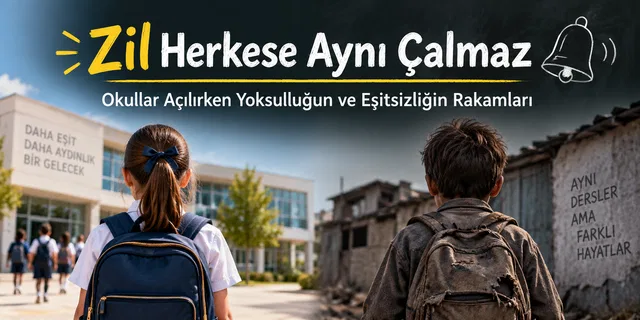
- As we showed in our piece The Bell Does Not Ring the Same for Everyone, even the cheapest scenario for preparing a high-school student for school comes to one net minimum wage, education inflation runs well above general inflation, more than a million children remain outside school, and a significant part of vocational high schools are being turned, through MESEM, into a source of child labour.
Behind these figures there is a feeling: no way out. Let us look at the world through a young person's eyes. They know that even if they succeed at school they will not find work. Their family works two jobs, comes home tired, tense, in debt. There is no one to talk to at home, because everyone is trying to stay alive. In the street there is no youth centre, sports hall, library where they can hang out in safety, or it is unreachable. At school a single guidance counsellor falls to hundreds of students, in some places more than a thousand. Classes are crowded, teachers are on contract, without security, burnt out. They turn to the screen; the screen teaches them the lives of the rich, the "ones who succeed," and also how to be angry at everything.
In the May piece I described the family under capitalist siege: parents' labour is exploited so intensely that it becomes almost impossible for them to spend "quality time" with their children; the internet turns into the "digital babysitter" of exhausted families. Today, looking at the mother and father taken into custody in Turgutlu, we should remember this picture too. Let their responsibility be investigated; but it is not a single family that left its child alone, it is a working regime that tears families from their children.
This is what we call the spiral:
- Poverty and insecurity exhaust the family;
- The exhausted family leaves the child alone;
- The child left alone is not seen at school either, is bullied or turns into a bully;
- Public support (guidance, psychological counselling, social services) is insufficient, and what there is sits where the poor cannot reach it;
- The child turns to the screen, the algorithm draws them into the dark;
- There is a weapon in the house, because society is armed;
- And one morning everything explodes at the school gate.
- Then the state increases the police and the ban; it does not touch poverty, insecurity, the weapon; the spiral begins again.
No single link of this spiral by itself explains an attack. The overwhelming majority of poor children harm no one; on the contrary, they are the ones who suffer violence most. But the spiral as a whole explains a society's capacity to produce violence. To look for the cause not in the individual but in the relation is the first step of dialectical thought.
The Same Day, Unseen Violence: 95 Child Workers
On the day the gunshots were heard in Turgutlu, that is on 22 September 2026, the Workers' Health and Safety Assembly (İSİG Meclisi) published a report. The title of this report did not find as much space on television screens as Turgutlu:
"To the Struggle against Child Labour… In the 2025—2026 school year at least 95 child workers lost their lives." (İSİG Assembly)
Dear Young Comrades, I want you to linger on this figure for a while. In the last school year, at least 95 children your age and younger died not at school but at the workplace, in the field, on the building site, in the workshop. When ten children die in a school attack the country is rightly shaken. But every school year nine times as many children die while working, and this is not named "school violence," ministers do not go to the scene, no protocol is signed.
What does the report say?
| Heading | 2025—2026 school year |
|---|---|
| Child workers who lost their lives | At least 95 (72 the previous year, 66 the year before that; a 32 percent increase in one year) |
| Age | 28 children aged 5—14, 67 children aged 15—17 |
| Sex | 81 boys, 14 girls |
| Migrant children | 14 (11 Syrian, 2 Afghan, 1 Iraqi) |
| Branch of work | Agriculture 37 (39 percent), industry 27, construction 18, services 13 |
| Provinces | Antalya 9, Şanlıurfa 6, Mersin 5; 4 children each in Diyarbakır, Hatay, Istanbul, Izmir, Kahramanmaraş and Kocaeli |
I relay some of the names in the agriculture column from the report itself, because figures remain invisible as long as they remain nameless: Yunus Emre, Ersin, Halil İbrahim, Mehmet, Zerda, Gülseren and Okan, who drowned in a stream or an irrigation canal. Muhammed, whose arm was caught in a feed-mixing machine. İsa, struck by a tractor in the field. Nursefa, struck by a combine harvester. Miraç, who fell from eighty metres into a ravine in forestry work.
According to the long-period report İSİG released in April, at least 852 child workers have lost their lives while working since 2013; while the yearly average was 63—64, this number has been rising rapidly in recent years. The same report estimates that there are about 3 million child workers in Turkey, of whom about 2 million are students "working while studying" in MESEM and vocational high schools (sendika.org).
The violence in this table is not as loud as the rifle at the school gate. But it is more systematic, more predictable and more lethal. In the Marxist literature this is called structural violence: violence in which no one pulls a trigger, but the order kills people by its own ordinary functioning. What sends a child to the field, the building site, the workshop is not the anger of a perpetrator, but the family's poverty and capital's need for cheap labour.
MESEM: A workshop in the guise of a school
I said above that the school in Turgutlu is a Vocational and Technical Anatolian High School. Without understanding what vocational education has become in Turkey today, we cannot understand the world of the children who go to these schools either.
MESEM, that is the Vocational Training Centre programme (Mesleki Eğitim Merkezi), was rapidly expanded by legal arrangements made in 2021—2022. In the then National Education Minister's own words, before the arrangement there were 159,000 apprentices and journeymen in Turkey; by November 2022 this number had risen to 1 million 33 thousand, and this was celebrated as reaching a year-end target set by the President a month early (MEB). That the success of an education programme is measured by "how many children were sent to a workplace" says with its own mouth what this programme really is.
The İSİG report describes MESEM's functioning as follows:
- The child goes one day a week to school, four days to the workplace.
- Not on paper but in practice the working week runs to 5—6 days, 10—12 hours a day; on average 50—60 hours a week. There are workplaces where children are made to work until 23.00.
- The wage paid to the children is between one third and one half of the minimum wage (9—14 thousand lira). This wage too does not come from the boss's pocket but from the Unemployment Insurance Fund, that is from workers' own contributions. At most a meal or pocket money comes out of the boss's pocket.
- The children who go to MESEM are in large part the children of families in a bad material situation.
İSİG gives this order a name: "child labour for free." According to the report, child labour was integrated more deeply into the education system together with the 4+4+4 system; in this order children's working became "a necessity rather than a choice."
Manisa is not outside this picture. One of the names İSİG counted among the nine students who died while working under MESEM in the 2023—2024 school year was 17-year-old Alperen Enes Ural, who fell from a height while laying a natural-gas pipe in Manisa (İSİG, interview with Kansu Yıldırım). On the same list were 16-year-old Zekai Dikici, who fell from the fifth floor, and 16-year-old Eren Dağ, electrocuted in Konya.
What does this table have to do with school violence?
Let me say this clearly: we have no information that the child in Turgutlu had any link with MESEM or with child labour, and I am not drawing such a link. The link I am drawing is another: the same society, on the same day, produces two different forms of violence and sees only one of them as "violence."
When a child opens fire on another child, this is rightly a scandal; the family is taken into custody, ministers come, RTÜK warns, a protocol is signed. But when on average two children a week die in a field, on a building site, in a workshop, the boss is not taken into custody, the minister does not go to the scene; at most it is called a "workplace accident," the file is closed. Dominant ideology presents individual violence as crime, structural violence as fate.
The second link is about how young people experience the world. A young person who goes to a vocational high school or to MESEM learns at fourteen to be shouted at in a workplace, to be humiliated, to be driven to dangerous work, not to receive the return of their labour. The school promises them not a future but becoming cheap labour. This is the concrete address of the feeling of futurelessness I described above. When a society gives its children every day the message "you are cheap, you are expendable," one should not be surprised that a part of those children come to see life, including their own, as cheap.
The third link is seen in the İSİG report's own demands. The report describes the struggle not only against child labour but also "against virtual addiction, drugs, gambling, violence and gangs," and proposes that "our living spaces" be cleaned of gangsterisation, that for this we organise and build "an alternative life." That is, workers' health organisations working in the field also see the same spiral: poverty, child labour, screen addiction, gangsterisation and violence are intertwined in the same neighbourhoods, in the same children's lives.
Two Narratives: The Dominant Answer and the Class Answer
| What does the dominant narrative say? | What is the class answer? |
|---|---|
| "This is a monster, a deviant, an exception." | Events that follow one another are not an exception but a pattern; the pattern shows the social structure. |
| "The family is to blame, they did not look after the child." | The family is an institution whose labour has been seized, whose time has been taken from its hands. Responsibility is not individual but social. |
| "Games and series are to blame." | The scientific evidence does not support this. The problem is not violent content but commodification built on attention and addiction. |
| "Social media is to blame, let us ban it." | Echo chambers are produced by the platforms' profit model. It is the algorithm that must be overseen, not the child; a ban grows surveillance. |
| "Police, cameras, watchmen in schools." | Public order meets the problem at the gate; the problem grows before it arrives at the gate. What schools need is not police but a guidance counsellor, a social worker, a psychologist. |
| "A mental-health problem." | Mental health is not independent of social conditions; poverty, exclusion and futurelessness damage mental health. Treatment too must be reachable not by those who have money but by everyone. |
| "The media should not talk, RTÜK should warn." | Not circulating the images and the attacker's name is right; but forbidding talk of the causes guarantees that the spiral will continue. |
| "MESEM gives young people a trade and a job." | MESEM turns child labour into cheap labour-power subsidised by the Unemployment Insurance Fund; in one school year at least 95 child workers died. |
| "Child-worker deaths are workplace accidents." | Preventable and predictable deaths are not accidents, they are structural violence; they should be on the agenda as much as individual violence, perhaps more. |
| "The weapon is an ancestral heirloom, a man's honour." | Thirty million unlicensed weapons are the material basis of a culture that is patriarchal and that exalts violence; individual disarmament is a social task. |
Eğitim Sen's (the Education and Science Workers' Union) statement in April overlaps with the right-hand column of this table: violence in schools should be solved "not with an approach focused on public order and control, but with a pedagogical and democratic approach"; AI monitoring systems turn schools into centres of surveillance; the real need is qualified guidance counsellors, social workers, the elimination of crowded classes and of poverty, and democratic school administration in which teachers, parents and student representatives take part (İlkses).
To Young Comrades: What Can We Do from Today to Tomorrow?
So far I have drawn you a picture. Now let us talk about where, in this picture, your place and ours is. Because this piece is not a piece of lament; it is a call to consciousness and to organisation.
At the individual and friendship level
- Do not share the attacker's name, photograph, video. What inspires the next attacker is the "fame" the previous one gained. Do not reward them. Talk about the wounded, those we have lost, the causes.
- Do not share images, do not spread unverified information. You saw how in the first hours the information that "there is a death" spread. Panic too is a form of violence; it hits families most.
- See the friend who is left alone. When you notice someone who always sits alone in class, who is mocked, who has gone silent, who says things like "they will all see," who has begun to share dark content, do not stay silent. This is not snitching, it is comradeship. First approach them, then tell a teacher or a guidance counsellor you trust.
- Do not stand by as a spectator to bullying. Bullying grows with the silence of the class. Standing beside the friend who is being bullied can save them from being met by the echo chamber.
- Question your own screen. Pay attention to where the algorithm is taking you. A feed nourished by anger consumes you too.
At the school level
- Make student assemblies and representatives real. The school's safety should not be talked about without your say. Ask not for cameras and police, but for a guidance counsellor, a psychologist, a social worker, sports and arts workshops, a midday meal.
- Form peer solidarity groups. Small groups that welcome newcomers, call the lonely to the table, stand together against bullying. The reality of what the state calls "peer courtesy" is solidarity woven from below, not imposed from above.
- Form an alliance with your teachers. They too are without security, in crowded classes, tired. The trade-union struggle of education workers is the same struggle as your demand for a safe school.
At the social and political level
- Own the demand for individual disarmament. A determined struggle against unlicensed weapons, the tightening of individual weapon licences, making the locked storage of weapons at home obligatory and inspectable, a campaign against the language and images that exalt the weapon.
- Raise the demand for a sufficient guidance counsellor, psychologist and social worker in every school. This should be the real axis of the "school safety" debate.
- Free school meals, free transport, free mental-health services. Wiping the traces of poverty from the school is to break one link of the spiral.
- Demand the prohibition of child labour and the closure of MESEMs. As İSİG proposes, vocational education should be rebuilt as school-centred, suited to the child's development, and with public rules; education at every stage should be free of charge, the 4+4+4 system should be abandoned, the education budget increased, the education of the children of seasonal agricultural-worker families secured.
- Stand beside your friends in MESEM and in vocational high school. Build a solidarity network in which they can tell of the rights violations they live at the workplace, the overtime, the dangerous work; form a bond with unions and workers' health organisations. Make child-worker deaths as visible as school attacks: share their names, ask who is responsible.
- Ask for public oversight of algorithms, not the surveillance of children. The platforms' designs that reward violence and notoriety must answer; oppose everyone's being watched with an identity under the pretext of age verification.
- Demand public space in the neighbourhood. Youth centres, libraries, sports pitches, free courses. A neighbourhood in which the screen is not the only shelter.
The Rifle at the Gate, the Anger at the Table
Dear Young Comrades,
Today in Turgutlu eleven of your friends were wounded. Two are still in danger of their lives. I wish a speedy recovery to them, to their families, to the teachers of that school, and to everyone who lived the fear at the school gate this morning. I hope they recover.
But wishing a speedy recovery is not enough. What I have tried to show you throughout this piece is this: the rifle at the school gate is not the product of a single moment exploding in a child's hands, but of a long process. That process is woven at the tables of poor houses, in the silence of tired mothers and fathers, in the blindness of crowded classes, in the dark corridors of algorithms, and in the streets where thirty million weapons circulate.
And let us not forget: a report released the same day says that in the last school year at least 95 children died not at school but at the workplace. A "protect the children" policy that talks of the rifle at the school gate without talking of the combine harvester in the field, the scaffolding on the building site, the machine in the MESEM workshop, protects not children but the order.
The dominant want to ignore every stage of this process and talk only of the last moment: the perpetrator, the family, the game, the screen. Because to talk of the process as a whole is to talk of their own order. It is to talk of the companies that sell your attention for profit, of the working regime that exploits your labour, of the policies that turn education into a commodity, of the culture that exalts the weapon.
We, though, will talk of exactly this. Because the antidote to the feeling that nothing can be solved is knowing that the solution is collective. If it is loneliness that pushes a child to the rifle, what we will set against it is solidarity. If it is the attention economy that shuts them into the echo chamber, what we will set against it is the demand for a public, free, human digital world. If it is poverty that leaves them without a future, what we will set against it is the struggle of organised labour.
The school gate should be the gate of the future, not of the rifle. We will open that gate together.
Comradely, Knowledge Commons
Reproduce it.
Update
Update: 22 September 2026, 16.51 (Türkiye time)
About nine hours have passed since the attack. In the light of official statements and what has appeared in the press, the latest situation is as follows:
- The wounded: A total of 11 students were wounded by shotgun pellets. According to Interior Minister Mustafa Çiftçi's afternoon statement, three students are in critical condition; three students were taken into surgery, three are in intensive care. The students in critical condition were transferred to Manisa Celal Bayar University Hospital; the other wounded are being treated at Turgutlu State Hospital and other hospitals in the district. One of the wounded has been discharged. Health Minister Kemal Memişoğlu announced that the wounded are being closely monitored.
- The death claim: In the morning hours, information that "a student has lost their life," attributed to the Mayor of Turgutlu, spread, and on some sites it still stands as a headline. But there is no confirmed death from the governor's office, the ministries or the Ministry of Health; the ministers' afternoon statements do not speak of a death. I ask you not to share this information until official confirmation comes.
- "First-degree risk school": This is the most important piece of information of the day. Minister Çiftçi announced that the school where the attack took place was on the list of "first-degree risk" schools (birinci derece riskli). According to the protocol signed one day earlier, police were to be stationed at first- and second-degree risk schools. According to the information given by the ministers, at the moment of the attack there were one security officer and one yard officer at the school; the school had passed a security assessment by seven ministries before it opened. The attack took place not at the school gate but about 100 metres away, against students waiting for a school bus. In Çiftçi's own words: "School safety is not something that can be formed by physical measures alone." This sentence confirms, this time from the minister's mouth, what we described above as "the public-order mind tries to meet the problem at the gate."
- The suspect: According to information that has appeared in the press, the suspect is a 9th-grade student at the school where the attack took place. I do not name them or give their initials here, for the reason I set out above. According to what the neighbourhood mukhtar told Euronews, they had withdrawn into themselves of late; the family makes its living from agriculture. The weapon is reported to be a shotgun (in some reports a pump-action shotgun).
- The reason: There is no official statement. Minister of Justice Akın Gürlek had said that "claims of peer bullying" before the event were being examined. Some newspapers write that the suspect, the day before, had been in a fight at the school entrance over a girl student; this information has not been officially confirmed. If it is confirmed it does not change the main thesis of this piece; on the contrary, it shows once more the social climate in which an ordinary fight can turn into a shotgun overnight — that is, the rifle at home, the culture of masculinity, and the anger no one noticed.
- The investigation: Four people are in custody: the suspect, their mother, their father, and the grandfather determined to have been involved in the use of the weapon; the investigation is being conducted by the Turgutlu Chief Public Prosecutor's Office. By the legal arrangement made after April, adults who store a weapon in a way a child can reach it face 1—3 years in prison. The ministers said "all administrative dimensions will be investigated, those who were negligent will be identified"; three inspectors were assigned.
- The state: National Education Minister Yusuf Tekin cancelled his Trabzon and Gümüşhane programmes and went to Manisa; together with Interior Minister Çiftçi he made a joint statement in Turgutlu. Manisa Governor Vahdettin Özkan visited the scene and the hospital. Education at the school was suspended; 20 psychosocial support specialists from the Ministry of National Education are working with students, teachers and families.
- Unions and organisations: Eğitim-İş (the Education Workers' Union) addressed the Ministry saying "When our students became the target of violence we cried out, we warned, you did not listen"; it asked for a comprehensive action plan to prevent violence, sufficient guidance counsellors, strengthened psychosocial support, tighter access to weapons, and social policies that protect children from violence. One sentence in the statement summarises the spirit of this piece: "Schools can be made safe without being turned into prisons." KESK (the Confederation of Public Employees' Unions), VELİ-DER (the Parents' Association), SOL Parti (SOL Party) and TİP (the Workers' Party of Turkey) rejected the approach that presents the violence as an individual crime; they held marketisation in education, inequality and the tarikat–cemaat (religious-order and congregation) structures responsible, and called for the resignation of National Education Minister Yusuf Tekin. As of this hour there is no announced place or time for an action.
We hope your wounded friends recover as soon as possible. This section will be updated regularly as developments in the investigation and in the condition of the wounded come in; the date and time will be renewed with each update.
Sources for the update: Manisa Flash Haber, joint statement by the two ministers, Cumhuriyet, Çiftçi's statement, TRT Haber, Euronews Türkçe, Yeni Şafak, Manşetiz, bianet, Habere Güven / Eğitim-İş, Cumhuriyet, statements by left parties and unions.
Sources
The Turgutlu attack
- Cumhuriyet: Armed attack on a school in Manisa (22 September 2026)
- Cumhuriyet: Akın Gürlek announced: The attacker's mother, father and grandfather in custody
- TRT Haber: Armed attack on a school in Manisa
- Yeni Birlik: First statement from the Manisa Governor's Office
- BirGün: 11 wounded, 2 seriously; the attacker and their family taken into custody
- bianet: Armed attack near a high school in Turgutlu
- Sözcü: This is how the attacker arrived at the school
- NTV: Armed attack in front of a high school in Turgutlu
- soL Haber: Armed attack in front of a high school in Manisa, Turgutlu
Previous attacks and the state's response
- AA: 16 people wounded in the armed attack on a school in Siverek
- Euronews: Armed attack on a school in Şanlıurfa
- AA: The indictment in the Kahramanmaraş school attack
- ANKA: The indictment, announced the attack in advance on Discord
- Türkiye Gazetesi: School safety protocol (21 September 2026)
- Bloomberg HT: Passed in the Assembly: social-media ban under 15
- İlkses: Eğitim Sen: Violence in schools should be solved with a pedagogical approach
Child labour and MESEM
- İSİG Assembly: To the Struggle against Child Labour… In the 2025—2026 school year at least 95 child workers lost their lives (22 September 2026)
- sendika.org: In 13 years at least 852 child workers lost their lives while working (İSİG, April 2026)
- İSİG Assembly: This year 9 student workers employed under MESEM died (interview with Kansu Yıldırım)
- MEB: The number of students in vocational training centres has passed 1 million (15 November 2022)
Armament and social data
- Umut Foundation: Individual Armed Violence in Turkey and Proposals for a Solution
- News on the Umut Foundation "Turkey Armed Violence Map 2025" report
- Summary of TÜİK Youth in Statistics 2025 (Rapor Bülteni)
The United States, games and echo chambers
- K-12 Dive: School shootings dropped in 2025
- K-12 School Shooting Database
- KFF: Child and Teen Firearm Mortality in the U.S. and Peer Countries
- U.S. Secret Service: Protecting America's Schools (2019)
- APA: Violent video games and violent behavior (2020)
- APA Resolution on Violent Video Games (2020 revision)
- ISD: Memetic violence: How the True Crime Community generates its own killers
- CTC West Point: True Crime Community
- ADL: The True Crime Community (TCC)
Related pieces from Knowledge Commons
- Pixel Violence as Scapegoat: Social Decay, the Family, and the Political Economy of the Digital World (16 May 2026)
- The Bell Does Not Ring the Same for Everyone
- From Having to Being: Reading Erich Fromm with Class
- Whose Family Is Safe?
- KVKK's "80s Trend" Warning and Privacy in the Digital Age
- From Obscenity to National Security: The Anatomy of a Forty-Eight-Hour Wave of Censorship