The Bell Does Not Ring the Same for Everyone
The Figures of Poverty and Inequality as Schools Open

The Bell Does Not Ring the Same for Everyone
The figures of poverty as schools open, and notes for young comrades
Dear Young Comrades,
Tomorrow morning, Monday 14 September 2026, the bell will ring in Turkey for more than seventeen million children and 1.2 million teachers. The papers will run this as a story of "excitement": new bags, first-day photographs, the minister's opening speech.
We will do something else. We will read that same morning in figures — and then we will talk about what those figures mean for you.
Because the bell rings at the same moment but it does not say the same thing to everyone. To one child it says "today you begin to learn"; to another "get by again this year"; to a third it never arrives, because that child is not at school but in a workshop.
And the reason for these three different sentences is not in the children's heads. It is in the household's income.
The Education Dossier we published in August discussed, in 217 chapters, why the school is a class institution. This piece is its current supplement, and it has two parts: in the first part we document, with official statistics, union research and Hacer Foggo's field, the material conditions in which the 2026-2027 school year is opening; in the second part we talk about where the young comrade stands in the face of this table, and what they can do.
We will proceed by a single methodological principle: beneath every claim a figure, beneath every figure a source.
Part One — The figures
1. The first figure: education, champion of inflation
Let us look at the August 2026 data TÜİK released on 3 September 2026.
| Expenditure group | Annual increase |
|---|---|
| CPI (general) | 31.51 percent |
| Education | 53.44 percent |
| — higher education (sub-item) | 102.69 percent |
| Health | 43.46 percent |
| Housing, water, electricity, gas | 39.77 percent |
| Transport | 35.08 percent |
| Food and non-alcoholic beverages | 33.79 percent |
(Source: TÜİK August 2026 CPI; bianet report, 3 September 2026)
Education is the item with the highest annual increase among the twelve main expenditure groups. 1.7 times general inflation. Higher education is 3.3 times general inflation — in a single year prices have doubled.
Comrade, do not miss the first lesson here:
Inflation is not a "general" phenomenon. Every household does not carry the same basket, and therefore does not live the same inflation.
And a household with a school-age child, in this month of the year, is facing precisely the item in which inflation is running fastest.
The sentence "inflation is 31 percent" is not true for the parent enrolling a child in school.
2. The bill at the school gate
Let the figure not remain abstract. The price survey Eğitim-İş released on 7 September 2026 gives, item by item, the cost of starting a child at school.
Items
| Item | Amount |
|---|---|
| Stationery — primary | 6,363 TL |
| Stationery — lower secondary | 7,666 TL |
| Stationery — upper secondary | 10,328 TL |
| Clothing (two sets of smock/uniform + shoes + coat) | 15,900 TL |
| School bus — short distance (seasonal) | 42,194 TL |
| School bus — long distance (seasonal) | 55,296 TL |
| Student bus pass (seasonal) | 5,850 TL |
Total start-of-year cost
| Stage | With long-distance school bus | With short-distance school bus | With bus pass |
|---|---|---|---|
| Primary | 77,559 TL | 64,457 TL | 28,113 TL |
| Lower secondary | 78,862 TL | 65,760 TL | 29,416 TL |
| Upper secondary | 81,524 TL | 68,422 TL | 32,078 TL |
(Source: Eğitim-İş 2026-2027 school-expenses survey, 7 September 2026)
Stationery has gone up 27–32 percent in a year, the school bus 25.49 percent, the student pass 44.44 percent.
Now let us set this table beside a single number.
2026 net minimum wage: 28,075.50 TL.
- The cost of starting an upper-secondary pupil at school with a school bus is 2.9 times the net minimum wage.
- The cheapest option — no school bus, the child goes by public bus, primary — is 28,113 TL. That is 37.50 lira more than the whole of the net minimum wage.
Let us put the sentence exactly as it is:
A worker on the minimum wage, if they handed over their entire monthly pay, could start only one child at school — and only on the cheapest terms.
They can start them — they cannot keep them going. Because this figure is only September's bill. When October comes, food and transport will have to be paid again.
Eğitim Sen's statement of 11 September 2026 — titled "Schools Are Opening Not with the Lesson Bell but with Deadlock" — gives, excluding the school bus and food, a three-year series for basic-need items alone:
| Stage | 2024-25 | 2025-26 | 2026-27 | Increase |
|---|---|---|---|---|
| Primary | 1,800–2,400 TL | 2,800–3,800 TL | 4,200–5,800 TL | about 51 percent |
| Lower secondary | 2,500–3,500 TL | 4,000–5,800 TL | 5,800–8,200 TL | about 43 percent |
| Upper secondary | 2,800–4,000 TL | 4,000–5,800 TL | 6,500–9,500 TL | about 63 percent |
The two unions' methods and baskets differ; the result looks in the same direction. Education is becoming unaffordable for wage-earners.
3. Whose household budget are we talking about?
Let us look at the table of the household that is to pay this bill.
Subsistence thresholds
TÜRK-İŞ's August 2026 calculation, for a family of four:
| Indicator | Amount |
|---|---|
| Hunger threshold (food only) | 37,388.30 TL |
| Poverty threshold | 121,786.00 TL |
| Monthly living cost for a single worker | 48,305.38 TL |
| Kitchen inflation (12-month) | 37.90 percent |
(Source: TÜRK-İŞ August 2026 Hunger and Poverty Threshold)
The net minimum wage is 28,075.50 TL, 75 percent of the hunger threshold. That is, a minimum-wage household cannot even meet the food need of four people. Its ratio to the poverty threshold: 23 percent.
And this is not the exception; it is the norm. According to DİSK-AR's June 2026 report, 35 percent of workers are in the minimum-wage and +5 percent band, 42 percent are below the minimum wage +20 percent; 15 percent work even below the minimum wage. (DİSK-AR, The Working Class's Cost-of-Living Crisis, June 2026)
A historical figure from the same report: the ratio of the minimum wage to national income per head was 80.6 percent in 1974 and 45.7 percent in 2026. In half a century labour's share of national income has fallen by nearly half.
The official measure of inequality
TÜİK's income-distribution statistics released on 26 December 2025 (income reference year 2024):
| Indicator | Value |
|---|---|
| Gini coefficient | 0.410 |
| Share of the richest 20 percent of income | 48.0 percent |
| Share of the poorest 20 percent of income | 6.4 percent |
| P80/P20 ratio | 7.5 times |
| P90/P10 ratio | 12.9 times |
| Richest region / poorest region income | 2.6 times |
(Source: TÜİK Income Distribution Statistics 2025; bianet report)
The Gini has fallen by 0.003 points from the previous year. This is a fluctuation that remains within the margin of measurement error; for the headline to read "inequality has fallen" is an interpretation, not a finding. The structure stands where it was: one fifth of the population takes half the income.
And the children
From TÜİK's Poverty and Living Conditions bulletin of 30 December 2025, the risk of poverty or social exclusion by age group:
| Age group | Rate |
|---|---|
| 0–17 | 36.8 percent |
| 18–64 | 25.1 percent |
| 65+ | 22.8 percent |
| Turkey overall | 27.9 percent |
TÜİK Children in Statistics 2025 adds this: 21,375,930 children live in Turkey (24.8 percent of the population) and 25.5 percent of the 15–17 age group are in the labour force — among boys this rate is 36.5 percent.
Comrade, these three tables must be read side by side:
In this country poverty is concentrated most among children. That is, in the part of the population that is supposed to go to school.
And this is not an accident. The child is the household member who brings no income but does bring expense. Under capitalism, as a household's number of children rises, income per head falls; when the state does not close that gap, poverty accumulates automatically among children.
In Turkey the state is not closing that gap. That is what the figure is as well.
4. Below the threshold of the statistic: Hacer Foggo's field
Up to here we have spoken with official statistics. But a statistic shows the average; it does not show those below the average. When TÜİK says "at risk of poverty" it draws a threshold. Far below that threshold there is a layer the survey never walks through the door of: households with no regular job, no address, sometimes not even an identity document.
The person who has documented that layer most persistently in Turkey is Hacer Foggo. A researcher who has done labour and human-rights reporting since 1989, who has followed urban poverty in the field since the early 2000s — from Sulukule to Kâğıthane — who founded Çimenev in 2016 for children remaining outside school, and who founded Derin Yoksulluk Ağı (Deep Poverty Network) in March 2020. Her book Askıda Hayatlar: Yoksulluk Günlükleri (2022) and the network's briefing notes are among the few regular fields that go below the official threshold.
She defines the concept herself as follows:
"Deep poverty is a condition of being unable to reach. It is not only deprivation of income; it is being denied the right to a life worthy of a human being — from food to clean water, from housing to education, from health to culture." (17 October 2025)
And the temporal dimension: once poverty lasts more than five years it becomes "persistent poverty" and lasts three generations.
The field's findings on school
| Finding | Source |
|---|---|
| Of 108 households followed, 91 struggle to put food in their child's bag every morning; 16 cannot do so on any day of the week. Food insecurity in 97 households; 22 children left formal education. | DYA, 17 October 2025 |
| In a follow-up of 141 households, in 108 families 27 children left school in two years — 16 of them in order to work. 61 households could not pay the rent at least twice; 66 households went into debt for medicine. | DYA, August 2026 |
| 90 households, 234 children: 1 child in 10 cannot reach new clothing; 1 in 2 does not have enough underwear; 3 in 4 do not have suitable shoes. 18.7 percent cannot take part in school activities because of inadequate clothing. | DYA Clothing Insecurity Briefing Note, April 2025 |
| Child Poverty Briefing Note: 7.9 million children are at risk of poverty/social exclusion; 75.8 percent do not have a book appropriate to their age; only 34 percent have a room of their own; 10 percent cannot eat fresh fruit and vegetables every day. | DYA, July 2026 |
| A child's daily school food is about 150 TL, 3,000 TL a month. Most of the families they stand in solidarity with live by street vending, paper-collecting or day labour. | Foggo, X, 12 September 2026 |
| Some children go to school with a carrier bag because they have no schoolbag; a child with no spare uniform has to go without a uniform in winter because the clothes have not dried. | DYA, 25 August 2026 |
And from last year's school opening, a post dated 7 September 2025:
"Attention, attention: schools open tomorrow. There are tens of thousands of children who will not be able to go to school tomorrow because they could not get a uniform — I am not exaggerating. Today alone I spoke with the mothers of nine children. The children will not go to school tomorrow because they have not been able to get uniforms."
Three scenes
Among the things Foggo tells, there are three scenes no statistic can give. All three take place at the school gate.
The banana. "Some families develop strategies among themselves in front of the school. They say, 'Please don't put a banana in; let's all put the same things.'" (Medyascope, September 2023) — Parents agree among themselves so that the difference between their children will not show at snack time. Equality is established not by the state but by poor mothers among themselves.
The pencil. "Children who have no packed lunch have to swap their best pencil, their best hair clip, for a classmate's sandwich." (the same interview) — An eight-year-old child's first experience of the market: turning the one thing they have into a meal.
Ali. What she said to a child on the point of leaving school: "Please don't leave school, all right? Ali, please don't leave." (Medyascope, April 2026) — The moment a researcher, when she has no other instrument left in her hand, begs a child. The moment itself is a record of where the social state is not.
The facts she keeps reminding us of
There are a few sentences Foggo has repeated for years. These are not slogans; they are theses drawn from the field:
- "Hunger and education are bound together. Concentration, the capacity to learn — these are all bound up with nutrition." — School food is not a social-assistance item; it is the precondition of learning.
- "When you prevent child poverty, you prevent poverty in that country as well." — If poverty accumulates in the child, intervention must begin there too.
- "Continuous aid means a process heading toward continuous poverty and permanent poverty." — When aid takes the place of a right, it does not end poverty; it manages it.
- "There are plenty of politicians who say we will end poverty, but none who say we will prevent it."
- "Fight poverty, not the poor."
- "It is not the stunted children who fail to grow who should be tightening their belts; it is the handful of the rich who deepen inequality in the world."
- "An unhealthy generation is coming; it will affect the whole of their lives when they become adults. A generation is being lost."
Comrade, bind Foggo's field to our table like this:
The sentence "75.8 percent do not have a book appropriate to their age; only 34 percent have a room of their own" is the field counterpart of the thesis we set out in the Education Dossier: talent is the sum of the activities a child can enter. The activities a child without a book and without a room cannot enter are measured, on exam day, as a "lack of talent."
Foggo's frame is rights-based: she names poverty as a human-rights violation. We add a question to that frame: who is violating the right, and who gains from the violation? This is not a correction; it is a completion. Where she says "a handful of the rich," we name the property relation; where she says "prevention," we ask about the class distribution of the budget.
And the common point is this: Poverty spoken of without going into the field is a statistical category. Once you go into the field, it is a child's pencil.
5. During the day: the canteen, the school bus, the dining hall
The start-of-year cost is once only. The real burden is what is repeated every day.
The canteen. The 2026-2027 tariff of the Turkish Federation of Canteen Operators, in force from 14 September:
| Product | Price |
|---|---|
| Water (bottle) | 15 TL |
| Ayran | 30 TL |
| Poğaça | 30 TL |
| Açma | 35 TL |
| Soup | 80 TL |
| Cheese/sucuk toastie | 100 TL |
| Mixed toastie | 120 TL |
| Sandwich | 100–125 TL |
(Source: Turkish Federation of Canteen Operators 2026-2027 tariff, 10 September 2026)
One toastie and one ayran: 130 TL. Twenty school days a month: 2,600 TL. For a single child, the canteen alone. This is 9.3 percent of the net minimum wage.
Inside the school. According to CHP's statement of 8 September 2026, of Turkey's state schools only 15,000 have a canteen. (source) In MEB's 2024/2025 statistics the official number of schools is 59,336. That is, in about three quarters of state schools there is not even a place where a child can buy something — and a place that serves a free meal is far rarer still.
The most recent free-meal figure MEB has released to the public belongs to the 2023-2024 period: 1,029,250 pupils. In a student body of about 18 million this is around 6 percent. No up-to-date coverage figure has been published for 2026-2027 — and that itself is information.
The school bus. 2026-2027 tariffs:
| City | Annual starting price | Annual ceiling | Increase |
|---|---|---|---|
| Istanbul | 39,970 TL | 93,610 TL | 10 percent |
| Ankara | 27,331 TL | 40,432 TL | 25.49 percent |
| Izmir | 32,850 TL | 83,250 TL | 35 percent |
(Source: 2026-2027 school-bus fees)
And let us mark a contradiction:
According to TÜİK's 2025 Household Consumption Expenditure survey, the share of the household budget allocated to education is only 1.8 percent. Housing 29.3 percent, transport 20.5 percent, food 17.3 percent.
This does not mean "education is cheap." It says the opposite: after two thirds of household income has gone on housing, transport and food, education does not get a turn. That the price of education has risen 53 percent while the share remains at 1.8 percent is a sign not of spending but of giving up.
What appears in the statistics as a "low share" appears in life as "taking the child out of school."
6. The exam industry: where inequality is measured and legitimised
The number of children and young people who applied for the exams in 2026:
- 2026 LGS: 1,274,629 pupils in year 8, 1,022,658 applying for the central exam (80.2 percent)
- 2026 YKS: total applications 2,425,560, sitting for the first time 921,225
The prices of the preparation market standing opposite these three and a half million children and young people:
| Service | Price |
|---|---|
| LGS course (Istanbul, starting) | 150,000 TL |
| LGS boutique institution | 250,000–350,000 TL |
| YKS course (standard) | 250,000–350,000 TL |
| YKS "VIP" class | 600,000–750,000 TL |
| YKS elite preparation centre | 900,000–1,000,000 TL |
| Private lesson (mathematics, per hour) | 2,000–2,500 TL |
| Private lesson (Istanbul, popular tutor, per hour) | 4,000–7,000 TL |
| Five-book test set | 1,500–1,800 TL (70–100 percent increase in one year) |
(Source: 2026 LGS and YKS preparation-cost compilation)
A one-hour private lesson — 2,000 TL — is about two days' earnings for a minimum-wage worker. The lower bound of a standard YKS course (250,000 TL) is about nine months' net minimum wage.
Comrade, see the function of the exam system here.
The exam, by "asking everyone the same question," produces the appearance of equality. But while the question is the same, the condition of preparation is not.
One child is preparing in a 1,000,000 TL preparation centre, another in a crowded classroom entered by an hourly-paid teacher, a third after the job they work in the evening. All three are ranked on the same scale.
And the name of that ranking becomes "talent."
We wrote it in the Education Dossier; let us repeat it here: "Talent" is not a substance found in the child's head. It is the sum of the activities they can enter. And a child does not choose which activities they can enter — class chooses in their place.
The exam system does not measure inequality; it absolves it. That is its function.
7. Two schools in the same country
Private-school fees for 2026-2027:
In Milliyet/Uzmanpara's 2026-2027 survey, private-school annual fees are in the range 450,000 TL to 2,751,000 TL. Food, school bus, uniform, books and course items raise the total burden by a further 30–40 percent; the food item alone is 150,000–220,000 TL on some campuses. In other compilations there are those who report over 4 million lira for the top end; here we will speak with the upper bound of the survey data, 2,751,000 TL.
The ceiling increase rates MEB has set for this year complete the table as well: 30.74 percent in intermediate years, 43.92 percent at the start of a stage (nursery, years 1, 5 and 9).
(Sources: Milliyet/Uzmanpara, Year-1 fees, Pervin Kaplan, MEB ceiling increase rates)
The annual fee at the top end of a private school — 2,751,000 TL — is equal to 98 net minimum wages.
And in the same country, on the same morning, the start-of-year cost of a primary-school child going to school on a bus pass is 28,113 TL, that is, one net minimum wage.
The course of the share
The share of private education in the total was 1.9 percent in 2002 and is 8 percent today (Eğitim Sen, 2025-26 Year-End Report, 25 June 2026). In MEB's 2024/2025 statistics there are 1,539,579 pupils and 14,700 schools in the private sector.
From 2002 to 2025:
| Indicator | Change |
|---|---|
| Private-school pupil numbers | 560 percent increase |
| Number of private schools (2,395 → 14,700) | 513 percent increase |
| State-school pupil numbers (13.67 → 15.33 million) | 12.15 percent increase |
| Number of state schools | 37 percent increase |
| Village schools closed | more than 24,000 |
(Source: soL Haber, based on figures from CHP Deputy Chair Yıldırım Kaya)
The real information in this table is not in the ratios, but in the ratios moving together:
While private schools grow fivefold, the village school is closing. These are not two separate phenomena; they are two ends of a single process. Wherever the public school withdraws, the market opens a door; and there is a price for passing through the door the market opens.
8. The teacher: poverty inside the school
Inequality does not stand only in front of the desks; it stands in front of the blackboard as well.
Pay
A comparison of teacher salaries after the July 2026 rise with that same month's TÜRK-İŞ poverty threshold (120,325 TL):
| Grade | Salary | Below the poverty threshold | Ratio to the threshold |
|---|---|---|---|
| 9/1 (newly appointed) | 72,578 TL | −47,747 TL | 60.3 percent |
| 4/1 | 77,404 TL | −42,921 TL | 64.3 percent |
| Specialist teacher | 91,775 TL | −28,550 TL | 76.3 percent |
| Head teacher (highest) | 97,871 TL | −22,454 TL | 81.3 percent |
(Salary source: MEB Personel, 30 July 2026; amounts are given as relayed in the source; the net/gross distinction is not specified. The ratio calculations are ours.)
There is not a single row in the table above the poverty threshold. Even Turkey's most senior teacher, on the highest career step, is 22,454 lira below the poverty threshold.
And there is a category that remains outside the table: the hourly-paid teacher. According to Eğitim Sen's June 2026 data their monthly income is about 24,000 TL — that is, even below the hunger threshold (37,388 TL).
Staffing
Türk Eğitim-Sen's survey of 4 August 2026, compiled from the governorships:
- 71,757 hourly-paid teachers in 62 provinces
- 80,449 established-post vacancies in 55 provinces
- Istanbul alone 21,947 hourly-paid teachers
- Of the hourly-paid teachers, 35,359 hold a bachelor's degree from outside a faculty of education, 5,862 an associate degree
- Of the 20,979 hourly-paid teachers working in special education, 2,205 hold an associate degree
(Source: Türk Eğitim-Sen, 4 August 2026)
Note: this count does not cover all 81 provinces. The true total is higher. In Eğitim Sen's staffing breakdown, beside 945,162 tenured teachers there are 64,509 contracted teachers.
Comrade, make the connection here:
Hourly-paid teaching is not a "temporary solution"; it is a cost strategy. It is the way of having the same lesson taught for one third of a tenured teacher's salary.
And both sides pay the price: the teacher by living below the hunger threshold, the child by meeting a different teacher every year.
Class inequality does not enter the school only through the parent's wallet. It also enters through the teacher's payslip.
9. Children who are not at school
The Education Reform Initiative's Education Monitoring Report 2025, based on 2024-25 data:
| Category | Number |
|---|---|
| Total children outside formal education | 1,470,694 |
| — of compulsory-school age, outside formal education | 804,250 |
| — of whom Turkish citizens | 611,612 |
| — of whom foreign nationals | 192,638 |
| In open high school | 273,557 |
| In MESEM | 392,887 |
(Source: ERG Education Monitoring Report 2025; bianet report)
And work instead of school
MESEM — the Vocational Training Centre — is the sharpest place in this table. Pupil numbers are 421,930 in MEB's 2024/2025 formal-education statistics and 392,887 in ERG's compilation for the same period (the two counts use different coverage). In the same period the number of pupils in vocational and technical high schools has fallen from 2,269,651 in 2012-13 to 1,259,170. That is, vocational education in the form of a school is shrinking, while vocational education in the form of a workplace is growing.
The price:
- According to the figure MEB has released, in the last two years there have been 9,950 workplace accidents and 37 pupil deaths in MESEMs. Note this: in another statement by the Ministry in June 2026, a total of 3,080 accidents and 13 deaths since 2016 had been reported. The two-year figure is three times the nine-year figure. The same institution's two declarations do not match; which is a measurement and which is a declaration is unclear. (BirGün analysis)
- According to the İSİG Assembly's count, at least 94 child workers lost their lives in 2025; 6 of them in MESEM, 7 during internships. In 2024 this number was 71 — a 32.4 percent increase in one year. (İSİG Assembly, 31 January 2026)
- In August 2026 alone 15 child workers died; four of them aged 14 and under. The same month's total worker deaths were 226; the January–August 2026 total is at least 1,509. (İSİG Assembly August 2026 report)
- According to the İSİG Assembly's count, at least 862 child workers have died while working since 2013: 292 of them aged 5–14, 570 aged 15–17.
There is a method to not seeing as well
Let us put a note here, because it matters methodologically:
TÜİK's last Child Labour Force Survey belongs to 2019. It was published on 31 March 2020 and has not been repeated since. In that survey the number of working children was measured as 720,000. In the seven years that have passed, no up-to-date official measurement of the number of working children in Turkey has been made.
Comrade, do not take this for a neglect.
Producing statistics is a budget item, and it is a choice. If a state can measure the inflation basket every month, it is not that it has been unable to count working children for seven years — it has chosen not to count them.
A problem that is not measured cannot be debated. A problem that is not debated cannot become a matter of policy.
The absence of data is also a datum.
10. University: the student who cannot find housing
For the young person who has passed the exam the table is as follows:
- Against about 4 million higher-education students there are 993,258 KYK beds (30 June 2026). That is, roughly three in every four students cannot get a place in a state dormitory.
- Capacity did not rise; it fell: the number of beds, which was 1,003,259 in November 2025, fell to 993,258 in mid-2026. While new beds were added, structurally unsound blocks were closed and the net change turned negative.
- Private-dormitory annual fees (10 months): Istanbul 110,000–700,000 TL, Ankara 160,000–800,000 TL.
- Student rent in Istanbul is in the 30,000–80,000 TL/month band. The cost of moving in (first month's rent + two deposits + estate agent) is 100,000–200,000 TL — that is, three and a half to seven times the net minimum wage.
- The KYK undergraduate grant/loan is 4,000 TL/month. This is only 13 percent even of the lower end of the Istanbul rent band.
(Sources: Kısa Dalga, the housing crisis; BirGün, 20 August 2026)
And the result: according to the official reply MEB gave to a parliamentary question by CHP MP Bekir Başevirgen, in 2025 alone 57,437 students froze their enrolment; between 2020 and 2025 a total of 453,852 students.
Look at this number once more. Four hundred and fifty-three thousand. People who had passed the exam, completed their enrolment, and then could not continue. In a year when higher-education inflation is 102.69 percent, one does not need pedagogy to explain why this number has grown.
(Source: MEB's reply to the parliamentary question, 13 February 2026)
11. The budget: "there is no money" is not a finding; it is a choice
Now let us come to the single centre of the problem: where is the money going?
| Indicator | Value |
|---|---|
| MEB 2026 budget | 1 trillion 943.97 billion TL |
| Total education budget (MEB + YÖK + universities) | 2 trillion 905.04 billion TL — 15.33 percent of the central budget |
| MEB appropriation in the 2027 MTP | 2 trillion 458 billion TL — 9.89 percent of the central budget |
(The bases of the two rows are different: the second covers MEB alone, the first the whole of education spending including higher education. What is comparable is the course of MEB's share on its own.)
(Sources: MEB 2026 budget presentation, 20 November 2025; MTP 2027-2029, 6 September 2026)
The course of MEB's share of the central budget: 12.8 percent in 2014 → 13.1 percent in 2017 → 9.8 percent in 2027. Three points below the 12 percent threshold accepted in international criteria. (BirGün analysis)
The investment share has moved in the same direction: 17.18 percent in 2002 → 9.17 percent in 2024. On Eğitim Sen's calculation, 83 percent of the MEB budget goes on obligatory expenditure — so the share left for building schools, equipping them, opening dining halls is extremely narrow.
Where is the distribution looking?
MEB's Institutional Financial Situation and Expectations Report of 1 August 2026 gives actual expenditure in the first six months of 2026:
| Item | January–June 2026 expenditure |
|---|---|
| Total MEB expenditure | 941.76 billion TL |
| Imam-hatip schools | 72.8 billion TL |
| General secondary education (Anatolian, science and social-sciences high schools) | 108.4 billion TL |
| Vocational and technical education | 109.6 billion TL |
| Transfers to foundations (Maarif + Yunus Emre) | 2.12 billion TL |
(Sources: Cumhuriyet, BirGün)
A careful reading is needed here. In the press these three items are often added up as "religious and vocational education" and compared with general high schools. We will not make that addition: vocational education is a field to be defended in its own right — our problem is not that resources are allocated to vocational education, but that those resources are used to send the child into the workplace.
The meaningful comparison is this: a single school type — imam-hatips — spent 72.8 billion lira in the first six months, while Anatolian, science and social-sciences high schools together spent 108.4 billion lira.
And the item we treated in detail in our Education Dossier still stands where it was: the budget of the Directorate General of Religious Education grew in four years from 11.9 billion TL to 109.8 billion TL — a 9.2-fold increase in nominal terms. Even after subtracting the cumulative inflation of those same four years the real growth is several-fold; no other directorate general grew at this speed.
Comrade, a budget is not an accounting document. It is a political declaration.
The answer given to the demand for "one free meal a day in every school" is "there is no money." But in the same budget religious education can grow ninefold in four years, and 2.12 billion lira can be transferred to foundations in the first six months.
So there is money. There is a choice about where the money will go.
And that choice is being made in our place, without our being asked. That is the name of the problem.
12. The same morning, two children
Let us bring all the figures down to a single table. Both will hear the same bell tomorrow morning.
| A: The child of a minimum-wage household | B: The child of a private-school parent | |
|---|---|---|
| Household monthly income | 28,075.50 TL (net minimum wage) | — |
| Start-of-year school cost | 28,113 TL (by bus, primary) — an entire month's pay | 450,000–2,751,000 TL annual fee |
| Transport | 5,850 TL seasonal pass, a crowded bus | School bus, included in the fee |
| Morning packed lunch | In deep poverty 91 of 108 households struggle to provide it; mothers agree "let's not put a banana in" | Not a problem |
| Midday meal | Canteen: toastie + ayran 130 TL/day → 2,600 TL/month; or something from home | Campus dining hall (150,000–220,000 TL a year, included in the package) |
| Condition for studying | Only 34 percent of poor children have a room of their own; 24 percent have a book appropriate to their age | Their own room, their library, a coach if needed |
| Class size | 30–40 pupils, more in crowded districts | Limited size, a published ratio |
| Teacher | On some lessons an hourly-paid teacher (~24,000 TL/month, below the hunger threshold) | Tenured, paid on the private-school scale |
| Exam preparation | School + textbook; a course is beyond the budget | 150,000–1,000,000 TL course / private lessons at 2,000–7,000 TL an hour |
| In the exam | The same question booklet | The same question booklet |
| The name of the result | "Did not work hard enough" | "Talented" |
| Housing at university | The KYK queue (no place for 3 in every 4 students), 43,000 TL rent / 4,000 TL grant | Family support or abroad |
| Risky fork in the road | MESEM / open high school / leaving school | None |
And the single row of the table is the knot of the whole argument:
"In the exam: the same question booklet."
The dominant narrative gathers its equality from this single row. "Look, they sit the same exam."
Whereas equality is established, or is not established, not at the moment of the exam but in the twelve years that pass until the exam. The whole of those twelve years is written in the table above.
To race people on the same line is not to start them from the same point.
Part Two — Notes for young comrades
Up to here we have spoken in figures. Now I turn to you.
I am writing this part to everyone who will hear the sound of that bell: to the one who will sit at a desk tomorrow, to the one who will stand in front of the blackboard, to the one who will leave a sibling at the school gate and go to work. The figures are above; here we will talk about what they mean for you. Around a single thesis: the name of what you will live tomorrow morning is not fate; it is class.
First, a question
Let me ask you a question; do not answer it in haste.
Tomorrow, at the same hour, two children will sit at a desk. Both are eight years old. Both have a notebook, a pencil, a smock. The same teacher will teach both of them the same lesson. Eight years later both will sit the same exam; the same question booklet will be set in front of them.
Are these two children equal?
The dominant answer is "yes." And the whole support of that answer is in the last sentence: the same question booklet. "Look, they sit the same exam."
Our answer is this: To race people on the same line is not to start them from the same point. Equality is not established at the moment of the exam; it is established, or is not established, in the twelve years that pass until the exam. And every day of those twelve years is paid for at a price.
You have seen above what the price is. Now let us look at how that price is made invisible.
The thing called "talent"
Now let us go back to the beginning. Those two children sat the exam eight years later. One passed; the other did not. The system gives this result a name: talent.
But remember what happened in the eight years in between. One ate from the canteen, the other from the bread they had brought from home. One's teacher stayed the same for four years; the other's changed every year. One went to a 150-thousand-lira course for the LGS — this starts at 250 thousand lira on a standard YKS course and rises to a million at "elite" centres — the other worked in a shop after school. A one-hour private lesson is 2,000 lira; two days' labour of a minimum-wage worker.
A million children sat the LGS this summer, two and a half million young people the YKS. All of them were ranked on the same scale.
It has appeared twice in this piece; let us say it a third time, because this is the thesis itself:
"Talent" is not a substance found in the child's head. It is the sum of the activities they can enter. And a child does not choose which activities they can enter — class chooses in their place.
The exam system does not measure inequality. It absolves it. Its function is this: to present a class difference as an individual fault. The child who loses says "I did not work hard enough"; they say it to themselves. The system's greatest success is to turn its victim into their own prosecutor.
What is the discourse of "equality of opportunity" for?
Young comrade, the dominant discourse that looks at these figures makes three moves. Learn to recognise all three.
The first move: individualisation. "Very successful children come out of state schools too." That is true. But the existence of an exception does not refute the rule — it hides the rule. That one child in a thousand makes the leap does not change the fact that nine hundred and ninety-nine could not; it only loads the fault of those who could not leap onto themselves.
The second move: turning it into charity. Stationery campaigns, "one bag one hope," grant organisations. These are not bad; solidarity is valuable. But when they take the place of a right they change function: free education ceases to be a citizenship right and becomes the favour of kind-hearted people. A right is demanded; a favour is waited for.
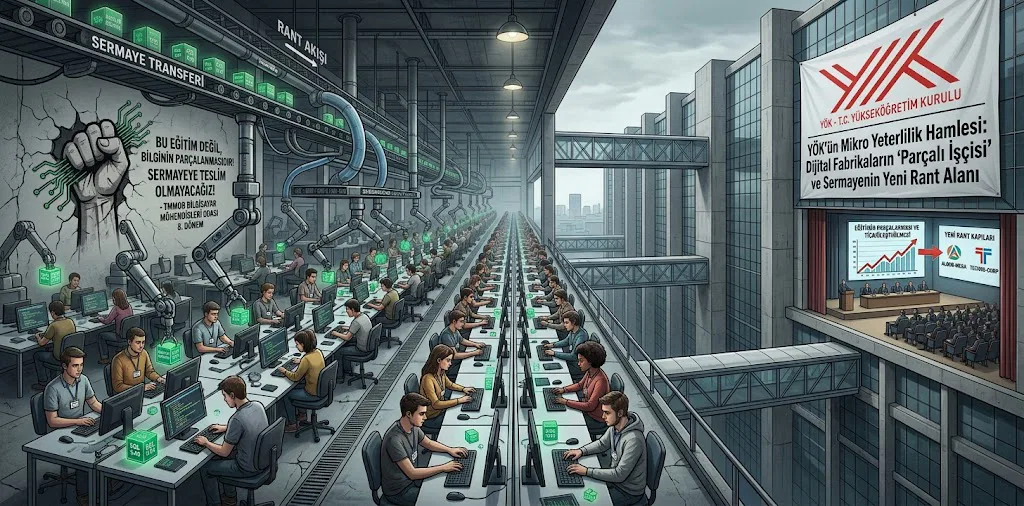
The third move: technicalisation. "The curriculum will be updated," "digital transformation," "AI-supported personalised learning." The education debate is reduced to a pedagogical technical problem; and a technical problem is solved by experts, not by parents. In the Education Dossier we had named this: the turning of the public school into a test environment for EdTech.
The common side of the three moves is this: none of them asks about property and the distribution of resources.
And because they do not ask, all of them leave the table where it is.
The difference of Marxist criticism is not a difference of anger; it is a difference of question. We do not ask "why did the child fail." We ask "who produces these conditions, how, and for whose benefit."
So where are you in this table?
Many of you reading this piece were one of those two children. Perhaps you sat in a classroom entered by an hourly-paid teacher, perhaps you were the child who could not afford the canteen, perhaps you prepared for the exam in a district that had no course. Or perhaps you were on the lucky side — and if you are reading this piece, you have noticed that that luck was luck.
I want to say two things to you.
The first: If you did not pass, the fault was not yours. I am not saying this as a consolation; I am saying it as a diagnosis. The figures above tell not of your inadequacy but of the working of the system.
The second: If you did pass, the matter is not over. Because to pass is for the system to exhibit you as an "exception" — to be the material of the first move above. Your leap will be used to weigh more heavily the fault of the nine hundred and ninety-nine who could not leap. The only way not to permit this is to tell your own story not as a success story but as an exception report: "I got through; the conditions were these; under the same conditions, who could not get through."
In both cases the work to be done is the same: to reread your personal story as a class story. And then not to leave that reading alone.
What can you do?
A diagnosis is not a programme. Let us be concrete. First what we want, then what you can do.
Our demands — they can be written into a budget; their cost can be calculated
- One free, decent, daily meal in every school. Today the number of pupils given a free meal is about one million; the total number of pupils is nearly eighteen million. This is the cheapest and most effective demand on the list: its cost can be calculated, its effect can be measured.
- Free and public school transport. The school-bus fee (27,331–93,610 TL a year) should cease to be taken from the family and should be met by the municipalities and MEB.
- Stationery and clothing to be met from the central budget. If the textbook is free, why are the notebook, the pencil and the smock not?
- The school's running costs (cleaning, security, bills, maintenance) to be met directly from the central budget. What is called a "donation" is the state transferring its own expense onto the parent; a headteacher who is not given the resource is forced to ask for donations. The problem is not personal; it is structural.
- Teachers' pay to be raised above the poverty threshold and hourly-paid teaching to be abolished and replaced by tenured appointment. On one side there are 80,449 established-post vacancies and 71,757 hourly-paid teachers; on the other, hundreds of thousands of graduates waiting for appointment. This is not a problem that cannot be solved — it is a problem that is not budgeted.
- An end to the regime of putting people to work in MESEM, full OHS protection and independent inspection for every student working in workplaces; child-worker deaths to be reported separately and regularly.
- TÜİK's Child Labour Force Survey to be carried out again, annually. What is not measured cannot be debated.
- Housing in higher education to be counted as a public right: dormitory capacity to be planned according to student numbers, the grant amount to be indexed to the cost of housing.
- MEB's share of the central budget to be raised to at least 12 percent and the investment share to be returned to the 2002 level (17 percent).
What you can do
Go into the field. This is Foggo's method: to enter houses, to ask, to write. From a distance poverty is a statistical category; from close up it is a child's pencil. See that pencil in your own neighbourhood, in your own school. But with a warning: go into the field not to distribute aid, but to demand a right. Foggo herself says it: "Continuous aid means a process heading toward continuous poverty and permanent poverty."
Localise it. The numbers in this piece are national averages; in your school they look different. Write down your own school's class size, how many lessons are run by an hourly-paid teacher, canteen prices, the school-bus fee, whether there is a dining hall. A localised figure does more work than a general figure, because it cannot be denied.
Ask questions. School-parent associations are in most places today an apparatus for collecting donations; they can be turned into an apparatus for calling to account. If the donation is "voluntary," why is there a list? Who won the canteen tender? Why is the parent paying the school's electricity bill? These questions are not destructive; they are constitutive.
Unite. The teacher's pay and the child's meal are not separate agendas; both are the result of the same budget choice. To defend these two demands at separate tables is the surest way to lose both. Until the parent, the student and the education worker sit at the same table, the table is not set.
Become the subject. You are the ones who know canteen prices, the school-bus fee, dormitory conditions best. Student councils, clubs, associations — every ground on which you will speak in your own name is a demand. Do not permit yourselves to be spoken for.
Organise. For a demand to find an addressee there must be an organised force behind it; otherwise the demand remains a wish. The union, the association, the council — whichever is to hand. We wrote it too when we discussed the unemployment figures: unorganised knowledge is not knowledge; it is melancholy.
And learn. You can see how hard this system is trying to put you off school. The most stubborn answer to that is not to give up reading — but not in the form they want. Win the diploma not as a prize in a race but as a tool your class needs. Marx's polytechnic school, Gramsci's unitary school, the Village Institutes: all of them are proof that school could be founded otherwise, in this country and in the world. And an apparatus does not dismantle its own part; the state that founded the Village Institutes closed them in 1954 as the same state. Fields are won; they are not given of themselves.
Dear Comrades,
When the bell rings tomorrow morning, more than seventeen million children will sit at a desk. How many will have a full stomach, how many a new smock, how many a teacher who will be the same person next year, how many will still be at school in June — none of these is a question about the child. All of them are questions about us, about the size of our organised force.
The bell does not ring the same for everyone. But bells can be changed.
This piece is not a lament; it is a call. I did not give you the figures above so that you might complain; I gave them to you as a weapon. Use them.
The answer to the question of whose school it is remains open. And open questions can be won.
See you tomorrow — at the desk, at the blackboard or at the door.
Comradely,
Knowledge belongs to everyone.
Related posts
- Our Education Dossier Is Out: Whose School Is It? (29 August 2026)
- TÜİK: Two Figures, One Country: 8.1% and 30.6%
- What Is This Thing Called Racism?
- Reading the İHD 2025 Report Through a Class Lens
- Gig Economy Dossier
Sources
Inflation and income
- TÜİK August 2026 CPI — education inflation 53.44 percent, higher education 102.69 percent (bianet, 3 September 2026)
- TÜİK, Income Distribution Statistics 2025 (26 December 2025) — bianet report, BirGün report
- TÜİK, Poverty and Living Conditions Statistics 2025 (30 December 2025) — report
- TÜİK, Children in Statistics 2025 (PDF)
- TÜRK-İŞ August 2026 Hunger and Poverty Threshold
- DİSK-AR, The Working Class's Cost-of-Living Crisis, June 2026 (PDF)
- DİSK-AR, The Appearance of Unemployment — July 2026 data (bianet, 31 August 2026)
The cost of education
- Eğitim-İş, 2026-2027 school-expenses survey (7 September 2026)
- Eğitim Sen, "Schools Are Opening Not with the Lesson Bell but with Deadlock" (11 September 2026)
- Eğitim Sen, The State of Education at the End of the 2025-26 School Year (25 June 2026, PDF)
- CHP, statement on the cost of starting school (8 September 2026)
- Turkish Federation of Canteen Operators 2026-2027 canteen tariff (10 September 2026)
- 2026-2027 school-bus fees — Istanbul, Ankara, Izmir
- 2026 LGS and YKS preparation-cost compilation
- Private-school fees 2026-2027 (Milliyet/Uzmanpara) · Year-1 fees (Pervin Kaplan)
School, teachers, budget
- MEB, 2024-2025 Formal Education Statistics (30 September 2025)
- MEB, 2026-2027 School Year Calendar
- MEB 2026 budget presentation (20 November 2025)
- Medium-Term Programme 2027-2029 (6 September 2026)
- MEB's resource distribution: religious and vocational education (Cumhuriyet) · BirGün
- The course of MEB's budget share: 12.8 percent in 2014 → 9.8 percent in 2027 (BirGün)
- Türk Eğitim-Sen, 71,757 hourly-paid teachers in 62 provinces, 80,449 vacancies in 55 provinces (4 August 2026)
- Teacher salaries and the poverty threshold (30 July 2026)
- Private-school pupil numbers rose 560 percent; more than 24,000 village schools closed (soL Haber)
Hacer Foggo and Derin Yoksulluk Ağı (Deep Poverty Network)
- Derin Yoksulluk Ağı — 17 October 2025 International Day for the Eradication of Poverty statement, 108-household study · T24 report
- Derin Yoksulluk Ağı — Clothing Insecurity 1st Briefing Note (April 2025)
- Derin Yoksulluk Ağı — Child Poverty Briefing Note (July 2026; bianet report)
- Derin Yoksulluk Ağı — 141-household follow-up and Stationery Solidarity (August 2026) · Children going to school with a carrier bag (25 August 2026)
- Hacer Foggo — "Children cannot go to school because of education costs" (Medyascope, 4 September 2023)
- Hacer Foggo — "Children lost inside poverty" (Medyascope, 10 September 2024)
- Hacer Foggo — "Education is no longer a priority" (Cumhuriyet, 5 August 2024)
- Hacer Foggo — Equality Monitoring Centre interview, "The lunch bags are empty" (October 2024)
- Hacer Foggo — "2025 was not good for children" (Cumhuriyet, 31 December 2025)
- Hacer Foggo — "You cannot erase poverty" (BirGün, 25 February 2026)
- Hacer Foggo — Medyascope interview (6 April 2026)
- Hacer Foggo — "A generation is being lost" (Diken, 17 April 2022)
- Hacer Foggo, Askıda Hayatlar: Yoksulluk Günlükleri, Doğan Kitap, 2022
- Derin Yoksulluk Ağı, Hikâyenin Yok Hali, 2021
Children outside school, child labour, housing
- ERG Education Monitoring Report 2025 — 1,470,694 children outside formal education (bianet)
- İSİG Assembly — at least 94 child workers died in 2025 (31 January 2026)
- İSİG Assembly August 2026 report — 226 workplace murders, 15 of them child workers (bianet)
- 9,950 workplace accidents and 37 deaths in MESEMs (BirGün)
- TÜİK, Child Labour Force Survey 2019 (31 March 2020) — the last official measurement published in this field; it has not been repeated since
- University students' housing crisis (Kısa Dalga)
- The first lesson in higher education: the housing crisis (BirGün, 20 August 2026)
- 2026 LGS application numbers (MEB) · 2026 YKS application numbers (ÖSYM/AA)
Theoretical background
- Karl Marx, Critique of the Gotha Programme (1875), section on education and the state
- Karl Marx, Capital, Volume I, "The Working Day" and "Machinery and Large-Scale Industry" (child labour and factory education) chapters
- Antonio Gramsci, Prison Notebooks, notes on the "unitary school"
- Knowledge Commons, Whose School Is It? Taking the School Back from the Market, Religious Communities, and the Algorithm (Education Dossier, 2026)