Thirty-One Points: The Freedom on the Net 2026 Report and the Screen Tied to Identity
Freedom House again counts Türkiye as "Not Free"; the e-Devlet verification that begins on 1 November opens a door the report only sees from the edge

In short: what happened, and what we say
On 22 October 2026 Freedom House published Freedom on the Net 2026. The report covers June 2025 to May 2026 and scores 38 countries on a scale of 100.
The result for Türkiye:
- A total score of 31 out of 100. The same as last year. The category is again "Not Free".
- The subscores: obstacles to access, 14 out of 25; limits on content, 10 out of 35; violations of user rights, 7 out of 40.
- Last in Europe. 35 points behind Serbia (66), the country just ahead of it; the European average excluding Türkiye is 75.
- Why did the score stay still? Connectivity in the earthquake region was repaired, and the infrastructure score rose by 1; attacks on journalists increased, and the "intimidation and violence" score fell by 1. One cancelled the other.
- The report's most striking sentence for Türkiye: the regulation that bans social media for those under 15 ties social-media accounts in practice to a real identity, by doing age verification only through e-Devlet. Freedom House compares this to the real-name requirement China introduced in the language of "protecting the child".
We have three theses:
- The real news of thirty-one points is not the stillness, but the composition. The cable is improving, and user rights are at the bottom. Technical access and political control are growing together. This is not a contradiction; it is the two faces of the same process: the more widespread the network, the more profitable the control.
- When you look at whom censorship targets, class appears. Those blocked are journalists, women's organisations, unions, economists. That is, the people who record the crisis, the exploitation and the violence.
- In four days, on 1 November, the e-Devlet verification that begins carries censorship from the stage of "blocking content" to the stage of "recording identity". The problem is no longer only what is said, but that who said it is permanently in the hands of the state.
Below we open these out in detail. First we read the report, then what remains outside the report, then the class reading, and at the end the work to be done.
Dear Young Comrades,
Do not read this piece as a score table, but as a map of the device you hold in your hand every day: in whose hands it works, under whose control, and for whose benefit. Thirty-one points is the score of your screen.
What the report says
The anatomy of the score
Freedom House measures countries under three main headings, with 21 indicators in total. Türkiye's table is as follows:
| Heading | Türkiye | Maximum | Rate |
|---|---|---|---|
| Obstacles to access (infrastructure, throttling, market structure, regulatory independence) | 14 | 25 | 56% |
| Limits on content (blocking, removal, self-censorship, disinformation) | 10 | 35 | 29% |
| Violations of user rights (legal framework, prosecution, surveillance, attacks) | 7 | 40 | 17.5% |
| Total | 31 | 100 |
The rates say a great deal on their own: in Türkiye there is a cable, and there is no speech. While more than half the score is kept under the access heading, not even a fifth of the score remains under user rights. This is the lowest user-rights score in Europe.
Why did the score not move?
This year two indicators changed, and they balanced each other:
- The infrastructure indicator rose from 5 to 6. The connectivity that collapsed in the earthquakes of 6 February 2023 was largely repaired.
- The indicator of intimidation against journalists fell from 2 to 1. The report gives two events as examples: an armed attack on the journalist Nafiz Koca in Elazığ in October 2025, and a physical attack on the journalist Hakkı Sağlam in Eskişehir in January 2026 (ANKA).
A base station was put back up, that is, and a journalist was knocked to the ground. The table says "nothing changed"; life changed in both directions at once.
The main events the report lists
- Throttling. During opposition actions, social media was slowed. The most concrete example of the period is 7–8 September 2025: after the police siege of the Istanbul provincial headquarters of the CHP and the party's call for a rally, access to X, Instagram, YouTube, TikTok, Facebook and WhatsApp was restricted on more than one network (Evrensel, Medyascope).
- Blocking and removal. Access blocks and content-removal orders were issued for a large number of websites.
- Prosecution for a post. Journalists, activists and ordinary users were investigated and tried because of online posts. The report's main text speaks plainly: in Türkiye people are "routinely" detained and imprisoned for online expression, especially for criticising the President (FOTN 2026, p. 9).
- Disinformation. Lies favourable to the government continued to be spread by organised troll networks.
The world picture: a decline for the 16th year in a row
- Of 38 countries, the situation worsened in 16 and improved in 8. Global internet freedom declined for the 16th year in a row.
- The year's largest fall was in Iran: a nationwide shutdown lasting about 88 days, the longest in the report's history.
- At the bottom, China, Myanmar and Iran (9 points each); at the top, Estonia (91).
- One of the report's main headings is age verification: as of June 2026, in 10 of the 38 countries a law on age verification for social media or similar content had been proposed, adopted or put into force. Australia and Indonesia banned social media for those under 16 (press release).
On the list of 38 countries, Türkiye sits between Nicaragua (36) and Ethiopia (30), one of 13 "Not Free" countries.
After the report's period closed: the "digital state of siege" of September 2026
The report closes on 31 May 2026. The real leap came afterwards. According to the figures of the Freedom of Expression Association (İFÖD) (soL):
- In 1–30 September 2026 alone, at least 1,270 X accounts were closed to access from Türkiye. The number of accounts blocked in the whole of 2025 under Article 8/A of Law No. 5651 was 995. One month passed one year.
- 941 of those blocked came in the second half of the month.
- The 1,227 accounts whose follower figures could be reached have more than 35 million followers in total; 70 accounts have more than 100,000 followers, and 10 have more than 500,000.
- About 90 per cent of the blocks were made "invisible from Türkiye" by X itself.
- On the first day of October, EngelliWeb's own X account, which was recording these blocks, was also closed to access (Evrensel, Medyascope). The counter that counted the censorship was censored too.
It is enough to look at the names on İFÖD's list: journalists (Erk Acarer, Naz Yavuzarslan, Canan Kaya, Meral Danyıldız, İrem Afşin and others), outlets (Kısa Dalga, soL Haber, Mezopotamya Ajansı, JinNews, Kaos GL Haber), economists (Veysel Ulusoy, İnan Mutlu, Emre Şirin), organisations (Amnesty International Türkiye, MLSA, the Academics for Peace, the We Will Stop Femicide Platform, the Federation of Women's Associations of Türkiye, the Psychiatric Association of Türkiye), a union (Umut-Sen) and defenders of workers' rights.
We had followed the beginning of this wave in From Obscenity to National Security: The Anatomy of a Forty-Eight-Hour Wave of Censorship. The 31 points in the report do not yet contain this picture; next year's report will probably arrive with a lower number.
The door the report only sees from the edge: 1 November and e-Devlet
The calendar
- April 2026: Parliament adopted the regulation banning social media for those under 15. In the same omnibus law, maternity leave rises from 16 weeks to 24, and paternity leave from 5 days to 10 (NTV). Criticising the ban can thus be made to look like criticising maternity leave.
- 10 October 2026: The regulation setting out the details of implementation was published in the Official Gazette.
- 1 November 2026: The regulation comes into force. New accounts will be verified through e-Devlet.
- 31 March 2027: Platforms must verify existing unverified accounts at least once. Accounts found to belong to those under 15 will be closed (Foreks, Politikam).
How will it work?
Under the regulation the user is directed to the e-Devlet gate, a verification "token" is produced there, and with this token the platform receives only the information "over 15, or not". The official discourse is this: no other personal data is transferred.
Let us open the side of this design that looks reasonable on paper and is missed technically:
- The platform learns little; the state learns a great deal. The token may say "yes/no" to the platform. But the side that produces the token, that is e-Devlet, sees which identity number, on which date, asked for verification for which platform. If this information is recorded, the state holds the list of who opened an account on which social network. In the summaries of the regulation there is no clear provision on whether these records are kept, or for how long they are stored.
- The bond between the token and the account. If the token is used when the account is opened, the information that the account was "verified with e-Devlet" remains on the platform's side. In an investigation, when the platform is asked for "this account's verification token" and it is matched with the e-Devlet record, anonymity ends. This is Freedom House's finding that "it ties accounts in practice to a real name".
- Existing accounts are in scope too. The matter is not children opening new accounts. Until 31 March 2027, unverified accounts will also be verified at least once. Platforms also have the authority to ask for verification again in case of "suspicion". In practice everyone can be forced to verify.
- The sanction is tied to Law No. 5651. A heavy fine and throttling for a platform that does not comply. The users of a platform that does not comply are the ones who are punished.
How is it going in the world?
Two figures Freedom House compiled break the habit:
- After the under-16 ban in Australia, about 5 million accounts were deleted, but 85 per cent of the children under 16 who took part in a survey said they continued to use social media.
- In a leak in October 2025 at one of Discord's age-verification suppliers, it was reported that about 70,000 identity photographs may have been exposed (Solidarity with Others).
Age verification fails at protecting the child, and succeeds at collecting the adult's data. We spoke about how personal data is protected in Türkiye when we wrote KVKK's "80s Trend" Warning and Privacy in the Digital Age: in a country where information leaking from state databases is sold on query panels, passing every social-media account through e-Devlet is not protecting data, it is centralising it.
A class reading
One: whose child does "protecting the child" protect?
According to the figures of the İSİG Assembly, at least 95 children lost their lives in workplace killings in 2025–2026. In the MESEM scheme, children of 14 are at the workplace four days a week. The same state does not send an inspector to the factory to protect these children, but it puts e-Devlet on their screen. Let us repeat what we said in Whose Family Is Safe?: moral panic is the cheapest way of making class problems invisible. Children's real danger is not only the algorithm; it is poverty, child labour and the absence of a future. None of these is solved by age verification.
This does not mean social media is harmless for children. Infinite scroll designed for addiction, personalised advertising and recommendation engines optimised for profit are real problems. But their source is the business model of the platform monopolies. The solution too is an intervention in the business model: a ban on advertising and profiling, public control of the algorithm, a limit on data collection. The regulation's restriction of personalised advertising and infinite scroll for ages 15–18 is a step in the right direction; but why is this step not applied to everyone? Because touching only the user's identity, without touching the platforms' profit, suits both sides.
Two: who applies the censorship? The state and the monopoly at the same table
X itself hid 90 per cent of the 1,270 accounts in September. This detail matters. Censorship in Türkiye is no longer only the BTK's "access block" order; it is a job the platform monopoly does with its own hand, at the state's request. Most of the time there is no traceable court order: according to İFÖD's finding, the legal basis of only 115 of the 1,270 blocks can be seen. The orders are not published, and they are not notified to the person blocked.
This is a division of labour:
| What the state wants | What the platform monopoly wants |
|---|---|
| The opposition voice to fall silent | Not to be removed from the market |
| No legal trace of the block to remain | Advertising revenue to continue |
| To know who wrote what | To know who wrote what |
| An account tied to identity | An account tied to identity (a more valuable advertising profile) |
| The threat of throttling to work | Compliance in four hours, costless obedience |
The last three rows of the table are not a coincidence. A user base tied to identity, with real names, is more valuable both for the state and for the advertising market. It is therefore not surprising that the platform owners who use the discourse of "free expression" at the highest volume close 90 per cent of the accounts with their own hand at the first serious demand. We had seen this too when we wrote on the Palantir manifesto and Anthropic's activist-monitoring report: in monopoly capitalism, surveillance is the common infrastructure of the state and of capital.
Three: whom are they silencing?
Let us look again at the list of those blocked: economists, women's organisations, a union, journalists, rights organisations. These perform a common function: they keep the record of the crisis, the exploitation and the violence. The economist who calculates the real figure of inflation, the platform that counts femicides, the union that defends the worker's right, the reporter who records the event on the spot.
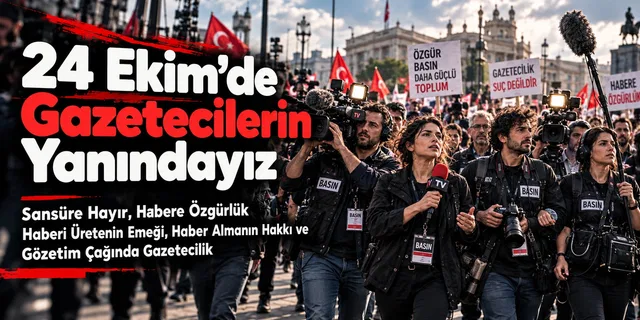
Censorship looks "political" at first glance, but when you look at whose record is erased, its class content comes out. What is silenced is the knowledge that lets the worker know their own condition. What we said for press workers in We Stand with Journalists on 24 October holds for everyone on the internet: the lack of organisation of the person who produces the news is the precondition of the news disappearing.
Four: throttling, the censorship that cannot be decided
Throttling has a special function: behind it there is no published order, no office to appeal to, no ban of a definite duration. The user thinks "the internet is slow"; the image of the action cannot be uploaded, the live broadcast drops, the call cannot spread. This is what happened in Istanbul on 8 September 2025. The most efficient form of censorship is the one that cannot even be proved to be censorship.
Let us underline one point here: those who apply throttling in practice are the network engineers and technicians who work at the service providers. That computing workers are unorganised in the face of these orders reduces the technical cost of censorship to zero. As we wrote in The Computing Worker's Handbook, so long as the hands that run the network have no organised voice, the network always remains the instrument of whoever controls the network.
Five: pay attention to the scale itself
We use Freedom House's data, because the numbers show something true. But we also have to question the scale itself.
- Freedom House is an institution that has historically received a significant part of its funds from the United States government. The funds of the United States' internet-freedom programmes were largely cut in 2025 (Benton). It is therefore not surprising that one of the report's recommendations is that the United States finance the Open Technology Fund.
- In the same report the United States is in the "Free" category with 73 points. Yet the previous report had recorded non-US citizens detained and deported because of online posts.
- The scale defines "freedom" essentially through the state's intervention. The algorithmic control of the platform monopolies, the private ownership of data, advertising surveillance and the exploitation of digital labour hardly appear on this scale.
The report, in short, measures well what the state does to the internet, but largely does not see what capital does to the internet. Because in Türkiye the two sit at the same table today, this gap is especially important for understanding Türkiye.
In whose hands, under whose control, for whose benefit?
| Question | Today's answer | Our answer |
|---|---|---|
| In whose hands? | Infrastructure in a few operators, social networks in a few global monopolies, identity in e-Devlet | Public infrastructure, platforms that can work together, and a commons |
| Under whose control? | The BTK, decisions under 5651/8-A, the platforms' hidden compliance teams | Decisions that are published, that can be appealed, and that are under independent judicial control |
| For whose benefit? | Political power and advertising capital | The worker who reaches knowledge, produces the news and organises |
| Who decides? | Behind closed doors, with a four-hour deadline | Open processes in which users, workers and professional organisations take part |
What is to be done? Concrete tasks
Personal security, a collective habit:
- Learn tools such as a VPN and Tor against throttling and blocking, and teach them to those around you. For the user in Türkiye these are lawful tools.
- In correspondence inside an organisation, prefer end-to-end encrypted, open-source messaging applications.
- Do not entrust important content to a single platform; archive it, and keep it in more than one place.
Our own networks:
- So as not to depend on a single company's "invisible from Türkiye" button, establish a presence on federated, decentralised networks (such as Mastodon) and on our own sites. The federated account networks and the face-to-face networks that the youth movement in Serbia built against the algorithm are a good example.
- The email bulletins and RSS feeds of organisations, unions and outlets are still among the most durable tools.
Legal and institutional objection:
- Against the e-Devlet verification regulation, bar associations, professional organisations and associations can ask questions through an annulment case and a KVKK application: are the verification records kept? For how long are they stored? To whom are they opened?
- Support structures such as İFÖD/EngelliWeb and MLSA, which record the blocks and give legal support; report blocked accounts to them.
Organising:
- Computing workers: we are the technical executors of throttling and blocking orders. Let us carry the transparency and the lawfulness of these orders onto the agenda in our workplaces, our professional organisations and our unions.
- Press workers: the journalist whose account is closed is not alone. Solidarity does not go beyond a momentary feeling without organisation.
- Parents and teachers: if we want to protect children, our demand should not be an identity record, but a ban on advertising and profiling, control of the algorithm, digital literacy at school, and a real ban on child labour.
Conclusion: not the cable, the word
Thirty-one points looks like a stillness, but a transformation is hidden inside it. In Türkiye the internet is becoming more widespread, faster and more controlled. From 1 November it also becomes more identified.
The name of this transformation is not "digitalisation"; it is the digitalisation of class control. On one side platform monopolies built for profit, on the other a government afraid of opposition; both want to recognise the user, to classify them, and to silence them when needed.
Our answer is neither the fatalism of "the internet can never be free anyway" nor pinning our hopes on a report score. Our answer is this: knowledge is a commons, and the network must be a commons. Only organised workers can secure that: those who build the network, those who write the news, those who teach the child at school, and the millions of users at the other end of the screen.
The machine is new, the chain is old. The way to break the chain is old too: to organise.
Sources
- Freedom House, New Report: Authoritarian Internet Controls Drive 16th Consecutive Year of Decline in Global Internet Freedom, 22 October 2026
- Freedom House, Freedom on the Net 2026: Seismic Shifts on the Global Internet (PDF)
- ANKA, Freedom House's 2026 internet freedom report: Türkiye again in the "not free" category with 31 points
- Son Dakika, In the Freedom House 2026 report, Türkiye's internet freedom score stayed at 31
- Artı Gerçek, Freedom House: the internet in Türkiye is "not free"
- Solidarity with Others, Freedom House scores Turkey 7 out of 40 on user rights
- soL Haber, Censorship without precedent: access blocks on 1,270 accounts in one month
- Evrensel, The X account of EngelliWeb, which tracks access blocks, was also blocked
- Medyascope, EngelliWeb's X account was blocked: which accounts have been blocked so far?
- Evrensel, Social media throttled after the police siege of the CHP provincial headquarters, 8 September 2025
- Medyascope, During the police siege of the CHP in Istanbul: the social-media restriction continues
- NTV, The social-media ban for those under 15 came into force
- Foreks, An under-15 ban and an age-verification obligation for social-media platforms
- Politikam, The social-media ban for those under 15 begins on 1 November
- Benton Institute, US funding for global internet freedom 'effectively gutted'
Related pieces from Bilgi Müşterekleri
- From Obscenity to National Security: The Anatomy of a Forty-Eight-Hour Wave of Censorship
- KVKK's "80s Trend" Warning and Privacy in the Digital Age
- Whose Family Is Safe?
- We Stand with Journalists on 24 October
- The Declaration of Techno-Fascism: The Palantir Manifesto and the Dialectic of Class Struggle in the Digital Age
- Anthropic's Activist Monitoring System
- The Computing Worker's Handbook
- They Walked Past the Algorithm (Serbia)
Bilgi Müşterekleri — Knowledge Belongs to Everyone. CC BY-SA 4.0.