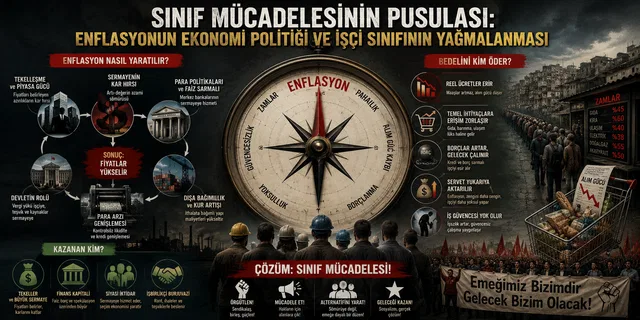
One Wage in Ten Months
Prices Are Updated Every Day, the Wage Once a Year: The Class Calendar of Inflation

This morning TÜİK announced the October inflation figures: 2.58% in the month, 29.77% over the year. The same day ENAG reported annual inflation of 45.12%. The fall in the annual figure that had lasted four months has stopped; the monthly rise came in above every economist's expectation. A month ago, in September Inflation, the TÜİK-ENAG Gap, we said this was "not a thermometer, but a question of distribution". This piece builds on that thesis, and takes the real question further: the minimum wage has not risen by a single kuruş since January. What has happened to it inside this movement of prices, and why is that not an accident but an order?
First, the Summary: Ten Theses
- The figure. On TÜİK's account, prices in October rose by 2.58% in the month and 29.77% over the year. The rise since the start of the year is 27.52%. On ENAG's account, the monthly figure is 2.68% and the annual figure 45.12%. The gap between the two institutions is 15.35 points.
- The direction. The four-month run of falling annual inflation is over. Food rose by 3.50% in the month, and clothing, with the change of season, by 12.58%. The monthly pace contradicted the Central Bank's story that "the underlying trend is falling" more openly than at any point so far.
- The melting of the minimum wage. The net minimum wage of 28,075.50 lira is worth about 22,019 lira today, at December 2025 prices. The loss of purchasing power is 21.6%. Between January and October a minimum-wage worker lost about 39,000 lira to inflation, more than a month's wage.
- The hunger line. According to Türk-İş, the hunger line for a family of four is 38,024 lira, the poverty line is 123,857 lira, and the cost of living for a single worker is 49,124 lira. The minimum wage is 74% of the hunger line and 57% of a single worker's cost of living.
- The bare arithmetic of the 2027 bargain. Merely to reach today's hunger line, the minimum wage would have to rise by 35.4%. Even the highest scenario being discussed, a 35% rise, would in January still sit below October's hunger line.
- The indexation hierarchy. The rent-increase ceiling, at 31.23%, is tied to the twelve-month average. The policy rate, at 36%, sits 4.8 points above inflation. Civil servants and pensioners are updated every six months, and late. The minimum wage is tied to no index at all. Whoever's income is tied to what, that is their place in the class.
- The theoretical core. The wage is the price of labour-power. In periods of inflation, when prices are updated every day and wages once a year, the difference flows to capital and to rent as a deduction from the wage that nobody signed. Marx's distinction between the nominal, the real and the relative wage is still the sharpest tool we have for reading today.
- The myth that "a wage rise creates inflation". The answer Marx gave Weston in 1865 still holds: prices are not set by wages, but by capital's power to set prices and by the struggle over distribution. In October the wage did not rise, and prices rose anyway.
- Disinflation, and on whose back. The phrase "weak domestic demand" in the Central Bank's interest-rate text is the technical name for what is missing from the worker household's plate. The programme uses the wage as an anchor.
- What we want. Wages indexed to inflation automatically and often, at least once every three months; a legal guarantee that the minimum wage cannot fall below a single worker's cost of living; an independent measurement of prices based on the worker household's basket; and, as the only way to win any of these, organisation.
The Figures: What Was Announced in October?
TÜİK's table
According to TÜİK, consumer prices rose by 2.58% in October. In September the figure was 1.84%. Annual inflation went from 29.73% to 29.77%, so the fall that had lasted four months has stopped. Economists in the AA Finans survey expected 2.20% for the month; the Bloomberg HT median was 2.42%. The outcome came in above every forecast (Forbes Türkiye).
The rise in prices since the start of the year is 27.52%, and the twelve-month average is 31.23%. Core inflation (the B index) is 28.46% over the year and 2.00% in the month. Of 174 sub-items, 134 rose.
| Month (2026) | Monthly (%) | Annual (%) |
|---|---|---|
| January | 4.84 | 30.65 |
| February | 2.96 | 31.53 |
| March | 1.94 | 30.87 |
| April | 4.18 | 32.37 |
| May | 1.71 | 32.61 |
| June | 0.99 | 32.11 |
| July | 1.78 | 31.75 |
| August | 1.84 | 31.51 |
| September | 1.84 | 29.73 |
| October | 2.58 | 29.77 |
Source: compiled from TÜİK figures by İstanbul Ticaret Gazetesi.
The annual rise by expenditure group
| Expenditure group | Monthly (%) | Annual (%) |
|---|---|---|
| Education | 0.24 | 48.86 |
| Health | 0.50 | 43.29 |
| Housing, water, electricity, gas | 2.84 | 40.24 |
| Transport | 2.02 | 36.39 |
| Insurance and financial services | 0.59 | 31.41 |
| Alcoholic beverages and tobacco | 0.18 | 28.73 |
| Restaurants and hotels | 0.47 | 28.42 |
| Food and non-alcoholic beverages | 3.50 | 27.73 |
| Information and communication | 1.15 | 27.33 |
| Recreation and culture | 0.33 | 23.21 |
| Furniture and household goods | 0.82 | 23.00 |
| Miscellaneous goods and services | 0.32 | 20.86 |
| Clothing and footwear | 12.58 | 13.38 |
| Overall CPI | 2.58 | 29.77 |
Source: TÜİK, as reported by ABC Gazetesi.
Look at the table once more. The four groups above the overall index are education, health, housing and transport. These are the expenditures a worker household cannot postpone. The groups pulling the overall index down are led by clothing, furniture, recreation and culture: the items a poor household cuts first. This is exactly what we meant in the September piece when we said there is no such thing as average inflation.
ENAG and the other thermometers
ENAG put October inflation at 2.68% in the month and 45.12% over the year. In September those figures were 2.10% and 46.61% (Milli Gazete). The annual gap between the two institutions was 16.88 points in September and fell to 15.35 points in October. The gap is narrowing, but it is still large enough to decide a minimum-wage earner's entire annual rise.
On Türk-İş's October calculation, the hunger line for a family of four in Ankara is 38,024.03 lira, the poverty line is 123,856.80 lira, and the monthly cost of living for a single worker is 49,124.30 lira (Forbes Türkiye).
Monetary policy
On 22 October the Central Bank cut the policy rate from 37% to 36%. The statement puts the stress on "the fall in the underlying trend", "weak domestic demand" and "the limited pass-through of supply shocks to prices" (Capital). Recall that in August the Bank pulled its year-end forecast down to 28%. By October the rise since the start of the year had reached 27.52%. November and December are still ahead of us.
Ten Months of the Minimum Wage: The Deduction Nobody Signed
The calculation
The 2026 minimum wage is 28,075.50 lira net and 33,030 lira gross. It has not changed since January (Cumhuriyet). Using TÜİK's own monthly figures, we calculated the real value of this wage month by month, at December 2025 prices:
| Month | Price level (December 2025 = 1) | Real value of the minimum wage (lira) |
|---|---|---|
| January | 1.048 | 26,779 |
| February | 1.079 | 26,009 |
| March | 1.100 | 25,515 |
| April | 1.146 | 24,491 |
| May | 1.166 | 24,079 |
| June | 1.178 | 23,843 |
| July | 1.199 | 23,426 |
| August | 1.221 | 23,003 |
| September | 1.243 | 22,587 |
| October | 1.275 | 22,019 |
In October the purchasing power of the minimum wage is 21.6% below where it stood at the start of the year. Adding up, across ten months, the gap between the nominal wage and the real wage, the sum a minimum-wage worker has lost to inflation is about 39,000 lira. That is 11,000 lira more than one month's wage. Put another way, the worker worked for ten months and was paid for nine.
In making this calculation we used TÜİK's figure, which is the most optimistic scenario. A calculation with ENAG's figure, or with Türk-İş's kitchen inflation, produces a much heavier picture. The loss DİSK-AR calculated for September alone is 6,828 lira (DİSK-AR Inflation Bulletin).
Comparison with the hunger line
| Measure | Amount (lira) | Share covered by the minimum wage |
|---|---|---|
| Hunger line, family of four | 38,024 | 74% |
| Cost of living, single worker | 49,124 | 57% |
| Poverty line, family of four | 123,857 | 23% |
What this table says is simple. In Turkey the legally set lowest wage does not cover the living costs of even a worker who lives alone. The minimum wage operates here not as a "floor" but as a reference price that holds the price of labour-power down. We open this theoretically below.
The bare arithmetic of the 2027 bargain
The Minimum Wage Determination Commission is expected to meet in December. The press is discussing scenarios of 20%, 25%, 30% and 35%:
| Rise scenario | New net minimum wage (lira) | Against the October 2026 hunger line |
|---|---|---|
| 20% | 33,691 | 4,333 lira below |
| 25% | 35,094 | 2,930 lira below |
| 30% | 36,498 | 1,526 lira below |
| 35% | 37,902 | 122 lira below |
Merely to recover the purchasing power lost in 2026, the minimum wage would have to be 35,798 lira today. Reaching the hunger line takes a rise of 35.4%. And when January comes, the hunger line will not have stood still. In short, even the highest scenario does not carry the worker as far as this October's hunger line.
The Indexation Hierarchy: Whose Income Is Tied to What?
Look at whose income in a society is protected against inflation, and you have drawn the map of class relations. In Turkey today that map looks like this:
| Kind of income | Whose is it? | How it is tied to inflation | As of October 2026 |
|---|---|---|---|
| Interest (deposits, bonds) | Money capital, the saver | The policy rate sits above inflation | 36%, a real +4.8% |
| Rent | The landlord, the rentier | The legal ceiling is tied to the twelve-month average | A right to raise rent by up to 31.23% |
| Profit | Industrial and commercial capital | The price can be updated every day | In proportion to pricing power |
| Civil service pay | The public employee | Collective agreement plus a six-month inflation difference, paid late | July–October price rise 8.28%, contract rate 7% |
| Pension | The pensioner | Six-month inflation, paid late | To be updated in January; the loss in between is never paid back |
| Minimum wage | The worker | Tied to no index, set once a year by a political decision | 0% since January |
The theoretical meaning of this table is plain. The different sections of capital protect their income against inflation either in advance (interest), at the same time (profit, pricing power), or by a legal index (rent). The public employee and the pensioner are protected late. The minimum-wage worker is protected not at all. They try to take back, as a "rise" at the new year, the difference that has piled up over a year, but the loss of the eleven months in between is never paid back.
The landlord has a legal right to raise the rent by 31.23%, while the income of the minimum-wage tenant living in that flat rose by zero over the same period. In Capitalism's Rent Is Taking Its Revenge we said that this gap between rent and the wage is the real engine of the housing crisis. The October figure widened the gap once more: the housing group, at 40.24% over the year, sits 10 points above the overall index.
The Theoretical Ground: Why Inflation Is a Class Question
This section is a little long. We need the ground, though, if the minimum-wage debate is to stop drowning every year in the same place, in the question "a rise of what percent?"
What is the wage the price of?
Let us begin with one of Marx's most basic distinctions. The worker sells capital not their labour but their labour-power, the capacity to work for a given time. The wage is the market price of this commodity. The value of labour-power is set by the value of the means of subsistence the worker needs in order to reproduce themselves and their family: food, shelter, heating, transport, health, the children's education.
In the first volume of Capital, Marx draws attention to an important feature of this value. Unlike the value of other commodities, the value of labour-power contains "a historical and moral element". The boundary of what counts as "a human life" in a society is set not biologically, but by that society's level of development and by the point the struggle between the classes has reached. The eight-hour day, paid leave, the right to a pension, free education: none of these came from nature. They were added to the value of labour-power by struggle. We told the history of these gains in What Did the October Revolution Give the World?.
The conclusion is this. Türk-İş's hunger-line calculation is a measure close to the biological lower limit of the value of labour-power. That the minimum wage falls even below this means labour-power is being paid below its value. Marx describes this as capital turning the worker's "necessary consumption fund" directly into a fund of capital accumulation. The worker is deprived of a part of what they need in order to reproduce themselves, and that deprivation is written into capital's account.
The nominal, the real and the relative wage
In Wage Labour and Capital, published in 1849, Marx proposes reading the wage in three layers:
- The nominal wage: the sum of money that enters the pocket. 28,075.50 lira.
- The real wage: the quantity of goods and services that money can buy. In October, 22,019 lira at December prices.
- The relative wage: the ratio of the worker's share to the share capital takes. Who gets how much of the value that has been created.
The official debate always runs on the first layer: "A rise of what percent for the minimum wage?" A slightly more conscious debate descends to the second: "Did it fall short of inflation?" The third layer is the one Marx actually points to. Even if the real wage stands still, if the productivity of labour is rising, the worker's share of the social product falls. This is exactly what has happened in Turkey in recent years: labour's share of national income has retreated while the shares of profit and interest have grown. Inflation is the quietest instrument of the transfer on this third layer.
The asymmetry of time: the wage once a year, the price every day
To grasp how inflation works as a class mechanism, this simple asymmetry is enough:
- Capital can change the price of its product every day. The label on the supermarket shelf, the figure on the fuel pump, the increase clause in the rental contract are updated all the time.
- The price of the only commodity the worker sells, labour-power, is set once a year and then stays fixed for a year.
This asymmetry turns inflation, of itself, into a machine of distribution. As prices rise, the same nominal wage buys fewer goods each month. The difference does not evaporate. It is written into the account of the side that raised the price: into profit, rent and interest. The 39,000 lira we calculated above is exactly this: a deduction from the wage that appears on no employer's payroll as a "deduction", and that has nevertheless taken place.
The Polish Marxist economist Michał Kalecki showed that, in monopolistic markets, firms set the price by adding a profit margin on top of cost. The greater the pricing power, the more easily the firm passes a rise in costs into the price, and even takes the opportunity to widen its margin. In 1977 the British economist Bob Rowthorn developed this with the concept of "conflict inflation": inflation is the monetary expression of the conflict between the mutually incompatible claims of workers and capitalists on the total product. Whichever side can update its price more often and more strongly wins the conflict.
In Turkey one side of this conflict can update its price every day. The other side can sit at the table only once a year, and sits there unorganised. The result is decided in advance.
The myth that "a wage rise fuels inflation"
Every December we hear the same sentence: "A high rise in the minimum wage will fuel inflation." This sentence is older than Marx. In 1865, at the General Council of the International Workingmen's Association, a member named John Weston argued that wage rises were useless, because the capitalists would take them back by raising prices. Marx's reply was later published as Wages, Price and Profit.
The core of Marx's argument is this. If wages rise in general, that does not raise prices in general; it lowers the rate of profit. The wage and profit are two parts of the same new value; the growth of one is the shrinking of the other. The claim "if the wage rises, the price rises" is the polite form of saying "if the wage rises, profit falls, and we will not allow that".
The October 2026 figures also give this debate an empirical answer: since January the minimum wage has risen by zero, and prices have risen by 27.52%. If wages were frozen, where did the inflation come from? From energy prices, from the pass-through of the exchange rate, from the rise in rents and in rentier income, from indirect taxes, from the intermediary monopolies in food, and from the pricing behaviour of firms. The wage sits on this list not as the cause, but as the item that pays the bill.
The share of the minimum wage in total costs also limits the myth. How far a minimum-wage rise passes into prices varies from sector to sector. But in an economy where the wage rise is made once a year while prices rise all year long, to look for the main source of inflation in this once-a-year correction is to run the account backwards.
The wage anchor: the hidden accounts of the disinflation programme
Two sentences sit in the Central Bank's interest-rate text: "weak domestic demand" and "the disinflation process". Let us translate both into the language of class.
That demand is weak means the purchasing power of wage earners, the largest body of consumers, is being held down. In order to bring prices down, the programme first holds wages behind prices. In the language of economics this is called a "wage anchor": wages are set according to the inflation target, realised inflation comes out above the target, and the difference is taken off the worker's purchasing power. In the September piece we summed up this mechanism as "the target is a bargaining instrument". At the start of 2026 the minimum wage was raised by about 27%, and that rise was treated as "enough" for the whole year; the Central Bank's year-end interim target was 24%. Prices rose by 27.5% in only ten months, so the January rise had, by October, melted away entirely. With November and December the worker will close the year below the purchasing power they had at the new year.
In "The Political Aspects of Full Employment", written in 1943, Kalecki explains why capital likes unemployment as an instrument of discipline: if the fear of unemployment disappears, the worker bargains more boldly over wages and working conditions. In Turkey today this discipline is built through inflation as well as through unemployment. In TÜİK: Two Figures, One Country: 8.1% and 30.6% we showed that while official unemployment was 8.1%, the broadly defined idle labour force was 30.6%. This mass, which Marx called "the reserve army of labour", suppresses the wage demand of the worker inside, because others are waiting at the gate. Inflation melts the wage, and unemployment breaks the resistance to that melting. Together they produce "weak domestic demand".
Household adjustment: how does a wage below the value of labour-power stay standing?
If the minimum wage is 74% of the hunger line, how do millions of households get by? The answer matters theoretically, because it shows where the cost is paid when capital buys labour-power below its value:
- The number of people working in the household rises. A second and a third wage earner come into play. In Eighty-Two Out of a Hundred Students we wrote that 82% of university students in Istanbul have to work. This is not a preference. It is the result of the wage being shared out inside the household.
- Working time gets longer. Overtime, a second job, weekend courier work. What Marx called "absolute surplus value", the lengthening of the working day, comes back.
- The burden of debt grows. The credit card and the consumer loan become the means of buying today the means of subsistence the wage does not cover, and of paying for them out of tomorrow's wage. This also transfers a part of the wage to finance capital as interest.
- Unpaid labour inside the home grows. The services that can no longer be bought outside (care, cooking, cleaning, childcare) are produced at home, mostly by the unpaid labour of women.
- The postponement of consumption turns into permanent deprivation. One reason the clothing, furniture, culture and holiday items show the lowest rises in inflation is that demand has collapsed. The poor household cut these items long ago.
So capital does not pay the full value of labour-power, and yet the working class goes on reproducing itself. It does this by working more hours, by sending more members of the family out to work, by going into debt, and by cutting back on itself. In The Poverty of the White Collar (in Turkish) we showed that this pressure is now pulling white-collar sections down towards the minimum wage as well. The minimum wage is increasingly becoming the "average wage".
Why is the minimum wage not a floor but an anchor?
Let us make clear the minimum wage's own particular function. On paper the minimum wage is a floor beneath which employers cannot go. In this respect it is a historical gain of the working class. But when the floor is set below the value of labour-power, and when a very large part of those in work are paid exactly at this floor, its function changes. The floor turns into a ceiling, or more precisely into an anchor to which the whole wage structure is tied:
- In non-union workplaces the rule "the minimum wage plus a little" settles in.
- On the employers' side of collective agreements, the minimum-wage rise is brought to the table as the reference.
- Public spending, social assistance, and even some fines are calculated from the minimum wage.
The decision given in the minimum-wage commission thus sets the one-year income path not only of minimum-wage earners but of the great majority of wage earners. The structure of the commission does not reflect this. Government and employer representatives always meet on common ground, and the workers' side's vote does not change the result. The minimum wage is not determined. It is announced.
Rent and interest: inflation's other winners
Alongside the conflict between industrial capital and the worker, inflation is also a channel of transfer for incomes of rent and interest. A policy rate of 36% against annual inflation of 29.77% means the owners of money capital gain about 4.8% in real terms. Over the same period the wage earner loses in real terms. The disinflation programme does not only suppress the wage. It also protects the owners of deposits and bonds.
In Six and a Half Trillion we showed how the bill for the fund crisis was again sent to the worker. Inflation works by the same logic. The owner of assets protects the asset with an index, with interest, with foreign currency and with gold. The person who has no asset, who sells only their labour-power, is left unprotected. Inflation is a mechanism that grows wealth inequality faster than it grows income inequality.
Class Inflation: The Worker Household's Thermometer
Working backwards from the annual contributions of the groups in October to the weights in TÜİK's index gives this picture: the weight of food is about 24.6%, of transport 16.8%, and of housing only 11.7%.
For a minimum-wage household renting in Istanbul, Ankara or Izmir, rent alone takes a third of income, and often half. We showed this at the scale of the city in A Poor City, Ankara. That housing weighs 11.7% in the average household's index is the result of an average that also includes home-owning households and those who pay no rent. The average does not see the tenant worker.
As an illustration, we built the spending structure of a worker household that pays rent, on a rough assumption: food 30%, housing 25%, transport 14%, education 4%, health 3%, clothing 5%, communication 4%, eating out 5%, other 10%. Weighing October's group inflation rates with these weights, this household's annual inflation comes out around 32%. This is not an exact measurement. It is a demonstration of a method. What we actually want to say is this: whoever measures inflation is also deciding which household to accept as "average". The working class needs its own thermometer.
The items that heat this thermometer are clear too. Inside the housing group's rise of 40.24% there is also electricity and natural gas. In The Class of Three Thousand Kilowatt-Hours we described how the energy regulator's lowering of the household electricity threshold will set a bill trap in 2027. Winter is coming, and the worker household's inflation will diverge from the average household's once again.
Civil Servants and Pensioners: Delayed Protection, a Loss That Is Never Paid Back
Civil servants and pensioners look as if they are a step ahead of the minimum-wage earner, because their pay is updated against inflation every six months. This protection has two structural gaps.
The first is the delay. Between July and October prices rose by 8.28%. This rise will be reflected in pay in January. The purchasing power lost across the six months from July to January will not be paid back. The inflation difference closes the gap in the rate. It does not close the loss.
The second is bargaining through the target. The collective-agreement rise for civil servants in the second half of 2026 is 7%. The rise in prices over four months has already passed that rate. In the calculations being discussed for January 2027, the 5% coming from the collective agreement and the inflation difference are added together, and a rate of around 6–7% is foreseen. These rates depend on the official inflation outturns and will change with the November and December figures.
The lowest pension, on the calculations reported in the press, stands at 23,552 lira (Milli Gazete). This sum is below even the minimum wage, and a separate legal arrangement is required before the lowest pension automatically benefits from the inflation rise. The poorest pensioner is left outside indexation.
In Whose Family Is Safe? we wrote that the talk of "the family" covers over the reality of class. In the household of a worker who looks after a retired mother, pays a student child's rent, and themselves works for the minimum wage, these three different indexation regimes meet in the same kitchen. None of them covers a living on its own.
The Official Narrative and a Class Reading
| What does the official narrative say? | What does a class reading see? |
|---|---|
| "The October rise is seasonal; the underlying trend is falling." | The monthly pace beat every forecast; food rose by 3.5%. Seasonality does not fill the worker's plate. |
| "Annual inflation is below 30%." | 27.52% since the start of the year; the minimum wage, 0%. For the wage earner the annual figure is not what matters. The accumulated loss is. |
| "The disinflation process continues with determination." | The process continues by melting the wage in real terms. "Weak domestic demand" is the technical name of poverty. |
| "A high rise in the minimum wage fuels inflation." | For ten months the wage did not rise, and prices did. The wage is not the cause of inflation. It is what pays the bill. |
| "The rent rise was limited by a legal ceiling." | The ceiling is 31.23%, the wage rise is 0%. The law tied rent to an index. It did not tie the wage. |
| "Civil servants and pensioners are given an inflation difference." | The difference is late, and it does not make good the loss in arrears. The lowest pension sits outside the index. |
| "TÜİK's figures conform to international standards." | The item price list has not been published since 2022. The gap with ENAG is 15 points. The average household does not see the tenant worker. |
| "The interest-rate cut will relieve the economy." | The real rate is still +4.8%. What is relieved is the owner of deposits and bonds. |
A Lesson from the World: The Sliding Scale
Tying wages to inflation automatically is not a new demand, and it is not a fanciful one. The world has concrete examples that lasted a long time:
- The scala mobile (sliding scale) in Italy. It was established in 1945 by an agreement between workers' organisations and employers. Wages were tied to a price index and updated automatically at set intervals. During the high inflation of the 1970s the system became the basic instrument for protecting the working class's purchasing power. It was restricted in 1984 and abolished in 1992. In the period that followed, real wages in Italy stood still for a long time.
- Automatic indexation in Belgium. Wages and social benefits are still updated automatically against a health index. Employers and the European institutions criticise the system regularly, but the resistance of the trade unions has protected it to this day.
In Turkey, DİSK has for years demanded that the minimum wage be updated at least twice a year until inflation falls to single digits. The calculations in this piece show that even twice a year is not enough: under monthly inflation of 2.5%, the real wage melts by about 14% in a six-month period. Quarterly or monthly indexation is no longer a luxury. It is the condition on which the lowest-paid worker stays alive.
Indexation also has a limit, and we should say so plainly. Indexation protects the wage. It does not raise it. Even if the real wage stays the same, as productivity rises the worker's share of the social product falls. The sliding scale is not where the struggle over distribution ends. It is the ground on which it begins. The real struggle is over the relative wage, over labour's share of national income.
Dear Young Comrades,
When an inflation figure is announced, the news bulletins say a single number: 29.77%. When you hear that number, ask yourself four questions:
- Whose basket? According to which household's spending was this figure calculated? How much room do the rent, the bill and the fare of my own home take inside this basket?
- Which calendar? While prices change every day, when is my income updated? Who pays for the months lost in between?
- Whose income is protected? The landlord's rent, the interest on the deposit at the bank, the company's price are tied to inflation. Why is my wage not?
- Who decides? Who sits at the table that sets my income for the year, who votes, and how is my voice heard at that table?
None of these questions requires a degree in economics. All of them require a class consciousness. Inflation is told to you as "prices rising for everyone". In inflation there are losers and there are winners. Knowing who the losers are is the first step to seeing who the winners are.
In The Bourgeoisie Is Buying Time with Technology, and We Will Bury Capitalism we said that capital uses every crisis to buy time. Inflation too is an instrument for buying time: every month the wage stays frozen is a month won for capital. The way to take that time back is not, individually, to "find a better job". It is to change the wage's calendar as a class.
Concrete Tasks
For your own household:
- Write your home's monthly spending in twelve items, weigh them with TÜİK's group inflation rates, and calculate your own household inflation. Compare the result with your workmates.
- Using the method of the table above, calculate how far your wage has melted in real terms since January. Ask, at the workplace, "how many months' wages have I lost in ten months?"
At the workplace and in the union:
- Before the minimum-wage commission meets, make visible at your workplace the sum lost in 2026 (about 39,000 lira for a minimum-wage earner) and the threshold for winning it back (35,798 lira).
- If you have a union, put on the agenda of collective agreements a clause for a quarterly inflation difference and for making good the loss in arrears. If you have no union, discuss why this demand cannot even be spoken in an unorganised workplace.
- Work so that unions, professional chambers and neighbourhood solidarity networks produce a worker-household price index as a shared data commons. Collecting prices does not require a large institution. It requires an effort that is regular, open in its method, and collective.
As demands:
- The minimum wage must not be allowed to fall below a single worker's cost of living (49,124 lira today), and this must be guaranteed in law.
- The minimum wage and all wages must be updated automatically against official inflation at least once every three months. A wage rise should be a matter of bargaining added on top of this protection.
- The minimum wage must stay outside tax, and the structure of the commission must be changed so that workers' organisations have a real say.
- The inflation difference for civil servants and pensioners must be paid month by month and in arrears. The lowest pension must be brought inside automatic indexation.
- The rent-increase ceiling must not operate independently of the rise in wages. The legal basis for rent rising in a period when the wage does not rise should be called into question.
- TÜİK must publish the item price list and the methodological documents again, as open data. Public statistics are a knowledge commons.
None of these demands is won by a column, by a social-media post, or by a single action. The organising in the form of a network that we proposed in Organising 2.0, and the unity of the class that we called for in Liberation Is in Our Hands, Unity Is in the Hands of the Class, can be built precisely around demands of this kind: concrete, measurable, and touching everyone's pocket.
Changing the Wage's Calendar
Inflation is always told to us as if it were a natural event: prices "rise", purchasing power "melts", rises "arrive". In this language there is no subject. Behind October's figures, though, stands a very concrete relation. One side can update its price every day, can tie its rent to an index, can place its money in interest above inflation. The other side is called, once a year, unorganised, to a table whose result is already decided.
One wage lost in ten months is this year's balance sheet of that relation. Next year's balance sheet will be written not in the commission in December, but before that, in the workplaces, in the unions and in the street.
We will go on arguing about the brand of the thermometer. The real question has not changed: who is paying the bill, and when will we refuse the payment together?
Sources
Data:
- TÜİK, Consumer Price Index, October 2026 (3 November 2026), as reported by Forbes Türkiye, ABC Gazetesi, İstanbul Ticaret Gazetesi, Timeturk
- ENAG, October 2026 inflation, as reported by Milli Gazete, Euronews Türkçe
- Türk-İş, October 2026 Hunger and Poverty Line, as reported by Forbes Türkiye
- DİSK-AR, Inflation Bulletin, October 2026
- CBRT Monetary Policy Committee decision, 22 October 2026, as reported by Capital
- The 2026 minimum wage and the 2027 commission calendar: Cumhuriyet
- Pension and civil-service calculations: Milli Gazete
Calculations: The real value of the minimum wage, the cumulative loss, the hunger-line ratios, the rise scenarios, the group weights and the sample worker-household inflation were calculated by Knowledge Commons from the official figures in the sources above. The sample household weights are an assumption, and they are there to demonstrate a method.
Theory:
- Karl Marx, Wage Labour and Capital (1849)
- Karl Marx, Wages, Price and Profit (1865)
- Karl Marx, Capital, Volume I, Chapter 6 ("The Buying and Selling of Labour-Power") and Chapter 24
- Michał Kalecki, "Political Aspects of Full Employment", Political Quarterly (1943)
- Bob Rowthorn, "Conflict, Inflation and Money", Cambridge Journal of Economics (1977)
Related pieces on Knowledge Commons:
- September Inflation, the TÜİK-ENAG Gap: Two Thermometers, One Fever
- Two Figures, One Country: 8.1% and 30.6%
- Capitalism's Rent Is Taking Its Revenge
- The Class of Three Thousand Kilowatt-Hours
- A Poor City, Ankara
- Eighty-Two Out of a Hundred Students
- The Poverty of the White Collar (in Turkish)
- Six and a Half Trillion
- Whose Family Is Safe?
- What Did the October Revolution Give the World?
- The Bourgeoisie Is Buying Time with Technology, and We Will Bury Capitalism
- Organising 2.0
- Liberation Is in Our Hands, Unity Is in the Hands of the Class
This piece is one of the living documents of Knowledge Commons. It is shared under the CC BY-SA 4.0 licence.