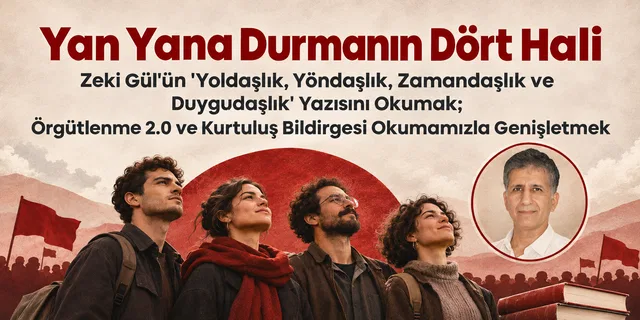
Liberation Is in Our Hands, Unity Is in the Hands of the Class
Reading and Developing TİP's Liberation Declaration, and Calling Every Left Force to Act Together on the Class Line

Summary
- On 30 October 2026 the Workers' Party of Turkey (TİP) published its Liberation Declaration (Kurtuluş Bildirgesi), and presented it to the public on 2 November with a speech by Erkan Baş. The meeting was to have been held a week earlier. It was postponed because two TİP students were detained for unfurling a banner that said "resign". The setting in which the declaration was born is the trouble it describes.
- The declaration has two parts: a letter addressed to the citizen, and the text itself, which lists the demands, those who are wronged, and the road of organising. Free education and health care, nurseries and care for the elderly, taking housing out of the business of accumulating wealth, security of work and of the union, the closure of MESEM, an end to discrimination, no amnesty for the killers of women, children and workers, no to dependence on the United States, and peace are the principal demands.
- We find the declaration important as a call to carry the struggle out of the rostrum and off the screen, into the places where people live. In a period when politics has been squeezed into the corridors of parliament, the television studio and the electoral calculation, it points again to the neighbourhood, the workplace, the school and the square as the real place of the struggle.
- Its most valuable side is that it is a call to organise, not a call to morale. It proposes meeting in the neighbourhood, the workplace and the school, electing representatives, and writing the "Liberation programme" together. Beating the government in the field first, and treating the ballot as the registration of that, rather than waiting for the election, is the right orientation.
- We offer seven proposals for developing the text. Name the enemy through the relation of capital, not only through rent and corruption. Open the question of property and planning. Bind the language of citizenship to organising in the workplace. Take an open stand for a democratic solution of the Kurdish question. Give the assemblies concrete material work. Take technology and platform labour into the programme. Set ecology inside the frame of the commons.
- Our real call goes beyond the declaration: liberation is not in the hands of a single party. It is in the hands of the class. The unity of the class comes before the growth of any organisation.
- We call every left and socialist party, the unions, the professional organisations, and the youth and women's organisations to a unity of action, far from factionalism and based on common class policies. Our proposal is concrete: a common list of minimum demands, a common calendar, common local assemblies, and common solidarity for every comrade who is detained.
- We rest our proposal for how the common struggle is to be built on our model of Organising 2.0: common cells between organisations at the bottom, common assemblies of elected and recallable delegates in the middle, and parties and unions as a spine that carries the network rather than running it. The common calendar should be built as a ladder of escalation, and every common action as a test of the structure.
- The street is not a place for a spectacle. It is the place where the relation of forces changes. The plenums of Serbia, the unions of Brazil, our Gezi and our Saraçhane say the same thing: unorganised anger disperses, organised anger transforms.
What Does the Declaration Say?
A letter to the citizen
The text begins by describing the life the reader deserves: secure work, a dwelling one can live in, free and decent education, a humane retirement, health care where no one asks about money. It then says why this life cannot be lived. The country's resources are transferred to a handful of people through rent-seekers, patronage, tenders and fraud, and the media is tied to this order. The text treats neither the government nor "the right that is set before us as the opposition" as a solution, and invites the reader into a nameless "Liberation movement".
The declaration itself
The declaration announces that citizens who live by their labour have come together to save the country from "rotten politics". It leaves outside, in plain words, those under the sway of the Palace, the right-wing politics that races with the regime, and the politicians who chase personal advancement.
It also lists, one by one, in whose name it speaks: the worker on a low wage, the pensioner who cannot heat their home, the child sent to a bench instead of to school, the woman subjected to violence, the peasant whose land is opened to mining, the tenant crushed under rent and debt.
The demands are set out as follows:
- Free, decent and scientific education, and the closure of MESEM
- Free health care
- Public nurseries and care for the elderly
- Taking shelter out of the business of accumulating wealth
- Security of work and security of the union
- An end to ethnic and religious discrimination
- No amnesty for the killers of women, children and workers
- Refusal of dependence on the United States, and peace
The proposal for organising is the spine of the declaration: to meet in the cities, the towns, the neighbourhoods, the workplaces and the schools, to elect representatives, and to write the "Liberation programme" together. The stance is plain: "If you say our trouble is not bargaining with this regime but struggling against it, we are here." It closes with two slogans: "Liberation is in our hands" and "Either all of us together, or none of us."
The speech of Erkan Baş
In his speech of 2 November, Baş placed the declaration as an answer to the Turkish leg of the counter-revolutionary wave in the world. He recalled the figures on the concentration of wealth: in the world the richest ten per cent hold three quarters of the wealth; in Turkey the richest one per cent holds more than a third of the wealth, while the bottom half makes do with two and a half per cent. Two of his sentences sum up the spirit of the declaration: "We are not making a call to morale, we are making a call to organise" and "This government will be beaten, and after that the elections can be the places where this is registered." (Cumhuriyet, GazeteKalem)
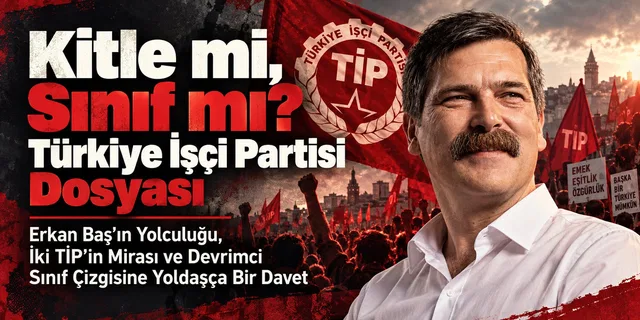
This piece can be read as a continuation of Mass or Class? A Dossier on the Workers' Party of Turkey, which we published a month ago. In that dossier we took up, in a comradely language, the road Erkan Baş has travelled, the inheritance of the TİP of 1961–1980 and of the TİP after 2017, the party's value for Turkey, and the fields in which it needs to grow stronger. The first assessment of the discourse of a "movement of the nameless" and of the concept of an "international counter-revolution" was there too. There we pointed to the risk that this concept misses the crisis of imperialist redivision. It is worth keeping the same question in mind while reading the declaration.
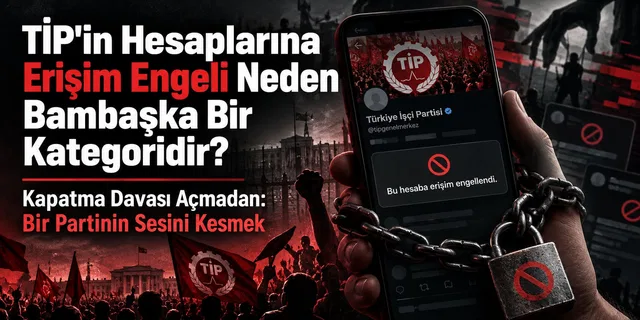
Let us not forget why the meeting was postponed. Nehir Dizdar and Nevin Tekin were detained for unfurling a banner that called on Minister Yusuf Tekin to resign. We took this up in detail in our piece on Nehir and Nevin, and we assessed the access block placed on TİP's accounts in a separate piece. That a declaration is announced while the young people of those who wrote it are in prison tells, of itself, why the text says "not bargaining, but struggle".
Where Is the Value of the Declaration?
A call that carries the struggle into the field
This is why, before anything else, we find the declaration important. In recent years opposition politics has narrowed: the parliamentary rostrum, the television programme, the social-media post and the opinion poll. The people became the spectator of this politics, not its subject. There was anger, but nowhere for it to go. It was either consumed on the screen or postponed to election day.
The Liberation Declaration points again, against this narrowing, to the real place of the struggle: the neighbourhood where the rent is paid, the workplace where the wage is set, the school of the child sent to MESEM, the square of the village opened to a mine. The call to meet in the cities, the towns, the neighbourhoods, the workplaces and the schools is a call to carry politics back to the place where people live their lives, that is, into the field. To say this in a period when repression is thickening and young people are detained for a banner takes courage. We claim this orientation, and we think it has to be strengthened.
Going into the field is a common need of every left force, not of one party alone. In the field no one is strong enough on their own. We also know from our own experience that standing side by side in the field is much easier than agreeing around a table. For this reason the declaration's emphasis on the field is also the starting point of the line of common struggle we propose below.
The demand to take reproduction out of the market
The demands have a common direction. Education, health, care and housing are the fields in which labour power is reproduced every day. Capitalism either turns these fields into commodities or loads them onto the unpaid labour of the family, and above all of the woman. That nurseries and care for the elderly enter the programme matters for this reason. It makes invisible labour visible, and defines it as a public right.
An opposition that does not race with the right
The declaration does not count as a solution an opposition that races with the government only in tone, and that slides onto its nationalist and conservative ground. This is the first condition of class politics. The left cannot win a match played on the ground of the right. The ground has to be changed.
An objection to a politics that waits for the ballot
The understanding of "let us be patient until the elections" postponed social anger, every time, to election day, and consumed it there. The declaration objects to this cycle. It does not treat the election as unimportant, but it places it as the result of the struggle, not in its place. This is today's counterpart of Lenin's stance of using parliament as a "rostrum" without looking for power in the rostrum.
The proposal for organising
Writing the programme together, electing representatives, meeting in the neighbourhood and the workplace, turns the text from a communiqué into a plan of organising. A programme written from below, rather than a programme distributed from above, is the only way to make the people, in Baş's words, "the subject of politics".
Sides That Can Be Developed
The proposals below are not a list of criticisms. They are a reply to the declaration's own call. If the programme is to be written together, we too have things to say.
Name the enemy through the relation of capital
The text says that resources are transferred through rent, patronage, tenders and fraud. The finding is true, and it is incomplete. Plunder is the specific form that the accumulation of capital takes in Turkey. It is not accumulation itself. The surplus value seized every day in the factory, and the wage seized through rent, are not "corruption". They are the ordinary working of the order. If the enemy is defined only as a "rotten" section, the impression arises that a clean capitalism is possible. The warning we made about left populism in the TİP dossier holds here too: when the duality of "the people" and "the Palace" is set up on its own, it can make capital, the contradictions inside the class, and the need to organise invisible. In the same dossier we also noted that the diagnosis was a class diagnosis while the prescription remained, in the main, legal and institutional. The declaration is a good chance to close this gap. Our proposal is that the figures on the concentration of wealth in Baş's speech be carried into the language of the declaration, and that the problem be named plainly: the problem is not a handful of plunderers. It is the relation in which capital seizes the product of labour.
Open the question of property and planning
The demands draw a strong programme of a social state. But in whose hands will energy, mining, banking, transport and the digital platforms remain? How will free health care be sustained while the production of medicines and medical devices is in private monopolies? How will housing be taken out of the business of wealth without the expropriation of land and of urban rent? If these questions are not answered, the demands remain a promise of welfare. We propose that a heading be added to the declaration: public property in the strategic sectors, workers' and people's control, and democratic planning. In the language of the classics: transitional demands are needed, demands that carry the minimum demands to the limit of the system.
Bind the language of citizenship to organising in the workplace
The word "citizen" makes it easier to reach wide sections, and we do not belittle that. But the relation of exploitation is established not in the neighbourhood but in the workplace, and the real source of power is there too: the ability to stop production. How the neighbourhood assemblies will join with workplace committees, with union organising, and with the defence of the right to strike is a question the declaration still owes an answer. Our proposal is that every assembly take it as its task to build a workers' leg in the workplaces of its area. In the TİP dossier we recalled the manual-worker quota in the 1966 rules, and proposed rules that secure the representation of workers in the party bodies, and workplace units. The Liberation assemblies can be a natural ground for this proposal to come to life: a share, in the representatives of the assemblies, reserved for workers who come from the workplace is the most concrete guarantee of a class character.
An open stand on the Kurdish question
The declaration stops at the demand that "ethnic and religious discrimination come to an end". The unity of the working class in Turkey cannot be built without openly claiming the equal political rights of Kurdish workers and the democratic content of peace. The demand for peace must not stay limited to foreign policy. It must also include the peace inside the country, education in the mother tongue, respect for the will of those who were elected, and an end to the practice of appointed trustees.
Give the assemblies material work
The Gezi forums were founded with a great hope, and they dispersed within a few months. In the world too, the local assemblies of movement-party experiences turned into a ritual of meetings when they did not take on a concrete function. Assemblies live only when they do work that touches people's daily life: tenant solidarity and a watch against eviction, legal support against workplace deaths and wage theft, a neighbourhood nursery, a food and energy cooperative, a network of student housing, advice on bills and debt. The students' plenums in Serbia stayed on their feet for this reason. Every decision had someone responsible, and every task had a calendar. We told this, in its technical detail, in our piece on Serbia (in Turkish). The independence of the assemblies, and their relation to the parties, also has to be defined plainly from the start. The assembly belongs to the movement. It is not the periphery of a single organisation.
Take technology and platform labour into the programme
At the centre of insecurity today there are algorithms: the systems that measure the courier's route, the warehouse worker's pace, the call-centre worker's minute, the programmer's line of code. Among the workers the declaration lists, the courier, the platform worker and the computing worker are missing. As we told in The Card Around Our Necks, When AI Becomes the Boss's Eye and The Poverty of the White Collar (in Turkish), the banning of digital surveillance in the workplace, the right to object to algorithmic decisions, the public and social ownership of data, and the counting of platform workers as workers must be part of the programme.
Set ecology inside the frame of the commons
The peasant affected by mining is named in the declaration. But whose are the water, the land, the forest and the air? The resistances from Akbelen to the Kaz Mountains defend the idea that nature is a commons and cannot be sold. Our proposal is that ecology enter the programme as a heading of its own, in the frame of the public protection of the commons and of a public transformation in energy.
A summary table
| What is in the declaration | Our proposal for developing it |
|---|---|
| A critique of plunder through rent, patronage and tenders | Name the problem as the relation of capital and labour, and carry the figures on the concentration of wealth into the text |
| Free education, health, care and housing | Public property in the strategic sectors, workers' control and democratic planning |
| The citizen who lives by their labour | Join the neighbourhood assemblies with workplace committees and with union organising |
| An end to ethnic and religious discrimination | Equal political rights on the Kurdish question, and the democratic content of the peace inside the country |
| Meetings in the neighbourhood, the workplace and the school | Give the assemblies concrete material tasks, such as solidarity, cooperatives and legal support |
| The low-wage worker, the pensioner, the child worker | The courier, the platform worker and the computing worker; a ban on algorithmic surveillance |
| The peasant threatened by mining | Count water, land and forest as commons; a public transformation in energy |
| A nameless "Liberation movement" | Build the movement as the common ground of every left force, not of a single party |
The Unity of the Class Comes First
The last row of the table is the real subject of this piece. The declaration calls everyone "to walk side by side", but to take this call out of being one party's invitation and to make it the common work of the class is the task of all of us, not of TİP alone.
The lesson of the classics
The Communist Manifesto says that the communists pursue no separate interest against the other workers' parties, and that they have no interests separate from those of the proletariat as a whole. What distinguishes the communists is that, at every stage of the movement, they bring the interest of the whole to the front. This principle means that an organisation cannot put its own growth in front of the unity of the class.
At the beginning of the 1920s, as the wave of revolution receded, the workers' movement paid the price of division and developed the policy of the united front: the unity in action, around common demands, of organisations that have different programmes. In the 1930s, in the face of the rise of fascism, this policy was carried onto a still wider ground. The lesson was bitter, and it was plain: fascism advanced while the workers' organisations fought one another; it was stopped where they united. The difference between Germany in 1933 and France in 1936 is, in large part, this. We read today's wave of reaction in Europe together with this history in our piece on the AfD.
The lesson of Turkey
Our own history says the same thing. On 15–16 June 1970 the workers went into the street without regard to which organisation they belonged to, and in practice defeated the regulation that restricted union freedoms. At the end of the 1970s the left, at the peak of its strength, was weakened by the divisions inside itself, and 12 September used that weakness without mercy. In Gezi, millions became a crowd that no organisation could have called on its own; but because a common organisational ground could not be built, that energy dispersed. The youth that rose in Saraçhane and in the universities in March 2025 faced the same question: there is anger, where is the common organisation?
The Labour and Freedom Alliance, founded in 2022, was an important experience of different left parties searching for a common ground. The tensions lived around the electoral lists also taught us something: when an alliance is built only on electoral arithmetic, it cracks at the first squeeze. Unity has to be woven in the street, the workplace and the neighbourhood before election day. In the TİP dossier we wrote that the self-criticism of the stance in the 2023 elections had not yet been made. This self-criticism is a debt not of TİP alone but of every organisation that took part in that process, and it can be the firmest beginning of a common table. In the same dossier we also noted a positive example: the municipality won in Samandağ by cooperation inside the left shows that a unity built locally can get a result.
The cost of factionalism
Factionalism is each organisation counting its own flag more important than the common flag of the class, turning every action into its own field of propaganda, not going to an action that someone else has called, and not standing by someone else's detained youth. The organisations never pay the price of this. The working class pays it. Five separate little contingents, walking unaware of one another at the minimum-wage table, at a tenant's eviction, and at the press statement after a workplace death, are the scene the boss and the government love most.
Staying far from factionalism does not mean ignoring differences of view. Every organisation keeps its own programme, its own history, its own criticism. Unity is being able to act together on the common interest while setting these differences aside. An old slogan tells this very well: freedom in discussion, unity in action. This principle is also the core of the understanding of democratic centralism that we proposed, in the TİP dossier, for the opening of channels of discussion inside the party. The principle that holds inside one party holds between parties too: different views are discussed openly, but the common decision that is taken is applied together in the field.
Transformation in the Street
Why does the street matter?
The street is not a place for a spectacle or for a photograph. It is the place where the relation of forces changes in the concrete. A right is won not because it is declared, but because enough people come together to take it. The eight-hour day, the right to a union, and free education were won in this way. As we told in What Did the October Revolution Give the World?, the bourgeoisie in every part of the world had to recognise these rights in the face of the organised pressure of the working class.
But the street on its own is not enough. Anger that bursts out spontaneously goes home the next day. What makes the street transformative is the organisation behind it: who takes the decision, who takes on the task, what will be done the next day? We discussed these questions, together with the tools of the digital age, in Organising 2.0. We also saw it in our piece on Brazil: even a victory at the ballot cannot stay on its feet without the unions, the movement of the landless peasants, and the neighbourhood organisations that made it possible.
The forms of action today
Today the street does not mean only a march. The strike, the stoppage, the watch in front of the workplace, the solidarity at the door against an eviction, the front of the court, the front of the prison, the front of the school, the campus forum, the watch against a mine in the village square, and the common campaign in the digital field are all forms of action. Their common point is that people organise together, for the same aim, and in a lasting way.
How Is a Common Struggle Built?
It is easy to make a call for unity. What is hard is to find the road that will make unity lasting. The common declarations, the common platforms and the electoral alliances of the Turkish left were mostly signed between general headquarters and dispersed without finding a counterpart in the field. Knowing the reasons for this is our greatest guarantee while building a new experience.
Why do we disperse?
- Unity is built at the top, and it does not live at the bottom. Texts signed between general headquarters cannot be brought to life with members who do not know one another in the neighbourhood and the workplace.
- Unity is tied only to the calendar. When the election, May Day or a great attack has passed, the common table disperses too. Because there is no continuous work, trust does not accumulate.
- The rules of decision are unclear. Because who decides what, and what will be done when there is a disagreement, is not talked through at the start, the first tension turns into a break.
- The race for visibility. The common action is turned into a field for showing which organisation is more crowded and more visible. The number of flags gets in front of the unity.
- The fear of the small organisations that they will be swallowed. The fear that the large organisation will swallow the common structure keeps the small organisations at a distance from the start.
A road map for the common struggle
As an answer to these problems, we propose a unity built from below and from above at the same time. This was also the most important lesson of the united-front debate of the 1920s: unity lasts when it is built not only between the leaderships of organisations, but among people who do work together at the base, in the workplace and in the neighbourhood.
- Begin with a common map of troubles. In every district, comrades from different organisations come together and name the three most burning problems of that area: a wave of evictions, a theft of wages in a factory, a school being turned into a MESEM, a mining licence.
- Build trust with the smallest common task. Instead of great programmes, begin with a small and concrete piece of work that everyone can join: going to a hearing together, stopping an eviction together, carrying provisions together to a strike tent. Trust accumulates not by a declaration, but by work done together.
- Write the rules at the start. How the common structure will decide, what will happen in a disagreement, how the spokespeople will be chosen, and what the order of flags and slogans will be in a common action, is talked through at the first meeting and put in writing.
- Build the common calendar as a ladder of escalation. Instead of one-off great actions, a calendar announced in advance and growing step by step: first a press statement, then a district march, then a stoppage, then a city rally.
- Assess every action together. A common assessment meeting after every action: how many people came, which sections did we reach, where did we fall short? A failure is nobody's fault. It is a measured datum.
- Recognise the separation. The common structure recognises the right of every organisation to carry on its own programme, its own publication and its own criticism. An organisation may not take part in an action whose common decision it did not join. But it does not sabotage the common action, and it does not smear an action that someone else has called.
The Line of Common Struggle with Organising 2.0
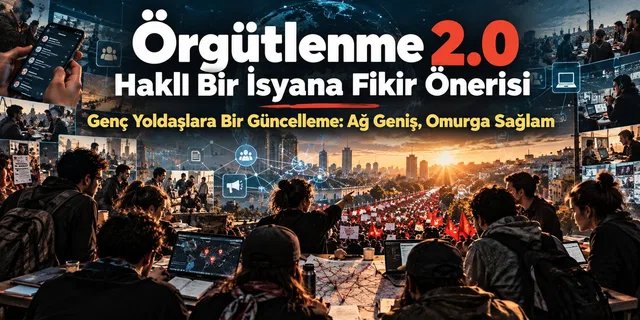
In Organising 2.0: An Idea for a Justified Revolt we proposed a layered model that joins a century of the workers' movement's experience with the conditions of today. The basic formula of that piece was this: "A network without a spine falls apart, a spine without a network calcifies." We think this model also offers a usable frame for building a line of common struggle among different left organisations. Because the model proposes not merging the organisations, or tying one to another, but building a common network in which all of them can take part.
The cell: a common committee between organisations
The basic unit of the model is a small committee, of between five and thirty people, lasting, and with a concrete piece of work. On the line of common struggle these committees are built between organisations. In a tenants' committee in a neighbourhood, a member of TİP, of EMEP, of the SOL Party, of the DEM Party, an unorganised pensioner and a student can stand side by side. The members of the committee go on being members of their own organisations. But in the committee they represent not their organisations, but the tenants of that neighbourhood.
The strength of the cell comes from people who do the same work together every day coming to know one another. The trust that cannot be built for years between general headquarters can be built in a few weeks between the members of two different organisations who keep a watch at the same eviction door.
The assembly: delegates who are elected and can be recalled
The committees come together, on common questions, in district and city assemblies. The critical principle here is this: the delegates to the assembly are elected not by the general headquarters of the organisations, but by the committees. The delegates account to the committee that elected them, and they can be recalled when needed. In this way no organisation can capture the assembly with its own membership numbers. The strength of the assembly comes from the real organisation in the field.
This is also an answer to the fear that the large organisation will swallow the small one. What determines weight in the assembly is not how many flags an organisation brought, but in how many committees it did work. The spokesperson rotates. The same face does not stand in front of the cameras all the time. The principle of "electing a representative" that the Liberation Declaration proposes can take a concrete form with this structure.
The spine: parties and unions carry the network, they do not run it
Parties, unions, confederations and professional organisations are the spine of the model. The spine provides legal support, sends lawyers, manages the strike fund, gives education, opens its publishing strength to the common campaign, and builds the national and international connections. The second formula of Organising 2.0 is decisive here: "The spine does not run the network; it carries the network."
This principle is the key to the common struggle among the left parties. Every party keeps its own spine, defends its own programme, and determines its own electoral strategy. But it does not try to turn the common network in the field into its own periphery. It feeds it with its resources. The value of a party is measured by how many lawyers, how much of a solidarity fund, how much education, and how much labour it carries to the common network.
The bridge: solidarity across the border
While capital is organised across nations, the organisation facing it cannot stay inside national borders. The line of common struggle builds bridges with the migrant workers' organisations in Europe, with the plenums of Serbia, with the unions of Brazil, and with the left movements in every part of the world. An international solidarity campaign for every comrade who is detained can be the first function of these bridges.
The principles of the common line
We adapt the seven principles of Organising 2.0 to the line of common struggle as follows:
- Shrink the unit, grow the number: Dozens of small committees between organisations in every district, instead of one great platform.
- Open the decision, spread the face: Open assemblies, rotating spokespeople. In the common action, the face of the field, not the face of a single organisation.
- Measure first, then escalate: Every common action is a test of the structure. The results are assessed together, and the calendar is grown accordingly.
- Do not wait for the threshold: Begin today to do work together in the field, without waiting for a protocol to be signed between general headquarters.
- Ask about property: Let the common struggle not stay only on the defensive. Let it also aim to build together forms of common property, such as the cooperative, the public nursery, the neighbourhood energy union.
- Organise life: The common structure lives by networks of solidarity that answer the troubles of daily life. Care, mutual aid and comradeship are the mortar of unity.
- Cross the border: The line of common struggle grows stronger with international solidarity.
Digital discipline and a common infrastructure
The digital infrastructure of the common struggle must also be common, but not uncontrolled. The communication of the committees between organisations is done on encrypted channels, membership and contact details are kept to the minimum, and they are stored not on any company's server but on the common structure's own infrastructure. Against access blocks, common mirrors, a common bulletin and RSS feeds are set up. Computing workers can take on the digital security of the common structure and the flow of information on days of blackout. The common calendar and the common distribution of tasks are kept in an environment that everyone can see and that is closed to the outside.
The layers and their counterparts
| Layer of Organising 2.0 | Its counterpart on the line of common struggle |
|---|---|
| Cell (a lasting committee of 5–30 people) | A common committee, in the neighbourhood, the workplace and the campus, of people from different organisations and of unorganised workers |
| Assembly (an open meeting, an elected and recallable delegate) | District and city labour and democracy assemblies, gathered with delegates the committees elect |
| Spine (union, party, professional organisation) | The left parties, DİSK, KESK, TMMOB, the Turkish Medical Association and the bar associations: legal support, funds, education, publishing strength |
| Bridge (a bond across the border) | Common solidarity campaigns with migrant workers' organisations and with the left movements of the world |
| Ladder of escalation | A common calendar of action, announced in advance and growing step by step |
| Test of the structure | The common assessment and measurement made after every common action |
| Digital discipline | Encrypted communication, data that stays in the organisation, common mirrors and bulletins |
The first tests of the structure
The common line is built not with one great meeting, but with a few concrete tests. The first trials we propose for the weeks ahead are these:
- Common solidarity for the detained youth: the common participation of every left organisation in the hearings of Nehir Dizdar and Nevin Tekin. Can we stand by a young person without looking at which organisation they are from?
- The minimum-wage process: common statements district by district, actions in front of workplaces, and a common city action for the minimum wage that will be set in December.
- Rent and eviction: at least one tenants' committee between organisations in every district.
- Preparation for a common May Day: plan May Day not as a day of spectacle, but as the result of a year's common organising.
If these tests are passed, the common line grows of itself. If they are not passed, we will have a ground on which to talk together about why they were not passed.
Our Call to Every Left Force
From TİP to EMEP, from the SOL Party to the TKP, from the DEM Party to the socialist organisations, from DİSK to KESK, from TMMOB to the Turkish Medical Association, from the women's and youth organisations to the ecology movements, we address every force of labour and democracy whose name we can list and whose name we cannot:
Liberation is not in the hands of a single organisation. It is in the hands of the class. The Liberation Declaration was written by a party, but the demands inside it are the demands of all of us. Let us answer this call by looking not at who wrote it, but at what it says. In the same way, we expect TİP too to take its call out of being one party's invitation and to turn it into a common table.
Our proposal is not to merge the programmes, but to build a unity of action on a common minimum ground:
- Common minimum demands: taking the minimum wage out of tax and raising it to the poverty line, security of work and of the union, free education and health care, public nurseries and care, a limit on rent increases and protection against evictions, an end to impunity in workplace deaths.
- Common demands of democracy: the release of detained youth, journalists and elected representatives, an end to the practice of appointed trustees, an end to access blocks and to censorship, the guarantee of the right to assemble and to demonstrate.
- A common calendar: local actions held on the same day, with the same slogans, at the same scale; a common intervention in the processes of the minimum wage, the budget and May Day.
- Common local assemblies: in every district, labour and democracy assemblies that are open, elected and accountable, without regard to organisation.
- Common solidarity: a common standing-by for every comrade who is detained, dismissed from work, or attacked, whichever organisation they are from.
- A common principle: no organisation turns the common action into its own propaganda, no organisation leaves someone else's youth alone, the discussion goes on, but the unity in action is not broken.
Concrete Tasks
- Read the declaration, and hold a reading meeting together in your workplace, your school and your neighbourhood. Put the proposals in this piece on the table too.
- In the district where you are, call a common meeting with at least three friends from different left organisations. Let the first item on the agenda be a common map of troubles and a common network of solidarity.
- At the first meeting, write the rules of the common structure: how decisions will be taken, what will be done in a disagreement, how the spokespeople will rotate, what the order of flags will be in a common action.
- Build your first committee between organisations on the model of Organising 2.0, and set the first test of the structure. Write the common assessment meeting, after the test, into the calendar now.
- Take the first step of a workers' committee in the workplace where you are: a contact list, a listing of the common troubles, a link with the union.
- Turn a concrete trouble in your neighbourhood, for example an eviction, a problem with a bill, or a matter of a school bus, into a common task of solidarity.
- Speak out for the detained students Nehir Dizdar and Nevin Tekin, whichever organisation you are from. Share the messages of solidarity, the calendar of hearings, the petition campaigns.
- Invite couriers, warehouse workers, call-centre workers and computing workers into the local assemblies. Have the demands against algorithmic surveillance written into the programme.
- Open a plain discussion, inside your organisation, against factionalism: why did we join the last common action, or why did we not?
Dear Young Comrades
What we need most today is not a new text. It is a common will that will bring the texts to life. The Liberation Declaration opens a door of that will. How many people, which organisations, and with which flags will pass through that door is in our hands.
What we ask of you is that you look not at who is calling, but at what they are calling to. When a comrade is detained, be at their door without asking which organisation they are from. While building a committee in a workplace, while organising the tenants in a neighbourhood, while opening a forum on a campus, keep in front not your own flag but the common interest of the class.
History has shown us one thing again and again: when we were divided we lost, when we united we won. When the workers, the youth and the women of this country walk side by side, no palace can stand in the way of that walk.
Liberation is in our hands. Unity is in the hands of the class. Either all of us together, or none of us.
Sources
- Workers' Party of Turkey, Liberation Declaration (Kurtuluş Bildirgesi), 30 October 2026
- Cumhuriyet / ANKA, The TİP Liberation Declaration was announced... A warning from Erkan Baş to the opposition: "The elections will be a result", 2 November 2026 (in Turkish)
- GazeteKalem, The TİP Liberation Declaration was announced... Erkan Baş: "We aim to bring into the field a social force that will not surrender to the government", 2 November 2026 (in Turkish)
- ANKA, TİP: We call everyone whose priority is not their own political advancement, but to struggle against this regime for the people, to walk side by side, 30 October 2026 (in Turkish)
- dokuz8HABER, TİP made a call to the citizen under the heading "Liberation Declaration" (in Turkish)
- Medyascope, Erkan Baş: "The understanding of 'let us be patient until the elections' is not right", 2 November 2026 (in Turkish)
- Marx, K. and Engels, F., Communist Manifesto, 1848, Chapter II: "Proletarians and Communists"
- Communist International, Theses on the United Front of the Workers, December 1921
- Dimitrov, G., The United Front Against Fascism, report to the Seventh Congress of the Comintern, 1935
Related pieces from Knowledge Commons
- Mass or Class? A Dossier on the Workers' Party of Turkey
- Why Saying "If We Have No Future, You Will Have No Peace" Is Not a Crime
- Why Is the Access Block on TİP's Accounts an Entirely Different Category?
- They Walked Past the Algorithm: How the Plenum Beat the Ballot in Serbia (in Turkish)
- Hope Came from the South
- Organising 2.0: An Idea for a Justified Revolt
- What Did the October Revolution Give the World?
- The Bourgeoisie Is Buying Time with Technology, and We Will Bury Capitalism
- The Card Around Our Necks
- The Poverty of the White Collar (in Turkish)
- The Republic Again, But Whose Republic?
This piece is one of the living documents of Knowledge Commons. It is shared under the CC BY-SA 4.0 licence.