Turkey's Place as the Mecca Alliance Turns to the Front
Yemen Again, a Hundred Years Later

Yemen Again, a Hundred Years Later: Turkey's Place as the Mecca Alliance Turns to the Front
Summary: What Happened, and Why It Matters
Dear Young Comrades,
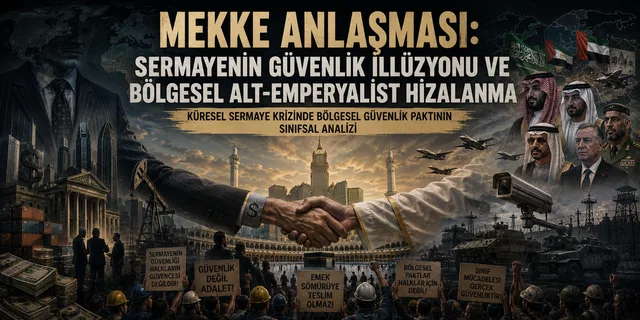
Two months ago, on 11 August, we published a piece on the Mecca Agreement. In that piece we said that the Mecca Joint Defence Agreement, signed on 7 August 2026 by Turkey, Saudi Arabia and Pakistan, was not a document of "peace" or of "ummah solidarity", but an alignment meant to protect capital's energy corridors and trade routes. We named Bab el-Mandeb, the Red Sea and the Strait of Hormuz. We also added that agreements of this kind are written down as "defence" on paper and, at the first crisis, turn into a front.
Two months later, that front has a name: Yemen.
What has happened, in brief:
- Since July, the Houthi movement in Yemen (Ansar Allah) has been attacking cities in southern Saudi Arabia, Aramco facilities and ships in the Red Sea with missiles and drones. In mid-September the Houthis took control of both shores of the Bab el-Mandeb Strait and the whole of Yemen's Red Sea coast.
- On 21 September, Trump, who had instructed the Pentagon to prepare after Crown Prince Mohammed bin Salman's request for air strikes against the Houthis, stepped back from the decision; the United States announced that, for now, it would not bomb the Houthis.
- Two weeks later, on 5 October in Riyadh, the Mecca Alliance's Strategic Political and Defence Committee met in extraordinary session. Turkey was represented by Foreign Minister Hakan Fidan, Minister of National Defence Yaşar Güler and Chief of the General Staff Selçuk Bayraktaroğlu. The joint statement announced a decision "to provide Saudi Arabia with the agreed military forces and capabilities, and to deploy them rapidly".
- On 6 October, that is, today, the Yemeni government backed by Saudi Arabia launched a broad ground operation against the Houthis under the name "Yemen Dawn"; the Saudi-led coalition is providing air support.
- While all of this was happening, the agreement still has not come before the Grand National Assembly. Article 90 of the Constitution requires international agreements to enter into force with the Assembly's approval, and Article 92 requires the Assembly's permission before the Turkish Armed Forces can be sent abroad. The agreement was not ratified, and no authorisation motion (tezkere) arrived; yet a decision to "deploy" was taken.
- Seyit Aslan, General President of the Labour Party (EMEP), described the decision as "outside the law" and said that the children of workers and working people cannot be driven to the front for the interests of the imperialists. Özgür Özel, General President of the YENİ Party, said "we do not accept being Trump's orderlies".
The thesis of this piece, in a single sentence, is this: Turkey and Pakistan are being driven into a war the United States hesitates to enter, through an alliance built with Gulf money; the profit of this war will go to the defence companies and Gulf capital, and the bill will be paid by the children of working people in the two countries, and by the people of Yemen.
Below I tell, first, of Yemen; then of how the alliance works; then of Turkey's position; and, at the end, of what we can do.
Telling Yemen as If We Did Not Know It at All
The poorest country in the Arab world
Yemen is a country of about 35 to 40 million people at the south-western tip of the Arabian Peninsula. To its north stands Saudi Arabia, one of the richest oil states in the world; Yemen itself is the poorest country in the Arab world. This neighbourhood is the contradiction that has shaped the whole of Yemen's modern history: on one side a kingdom swollen with oil rent, on the other a people who have sent cheap labour to that kingdom and whose borders have been drawn by that kingdom again and again.
The figures in the Humanitarian Needs and Response Plan announced by the United Nations in March 2026 are these:
- 22.3 million people in need of humanitarian aid,
- 18.3 million people in acute food insecurity,
- 2.2 million children under five acutely malnourished; more than 500,000 of them severe cases,
- 5.2 million people displaced inside their own country.
These figures are the picture from before the latest fighting began. According to the International Organization for Migration, more than 82,000 people since the beginning of September alone have left their homes because of the new fighting. The World Food Programme, for its part, was forced in January 2026 to stop working in areas under Houthi control.
The place Turkey is turning towards in the name of "the responsibility of alliance" is, then, a country where a new operation is being launched upon a people already struggling with hunger.
From 2014 to today: the internationalisation of a civil war
A short chronology is enough to understand today:
- 2011: The Arab Spring wave reached Yemen too. After thirty-three years, the rule of Ali Abdullah Saleh gave way, through the mediation of the Gulf states, to his deputy Abdurabbu Mansur Hadi. The people's demands — work, bread, an end to corruption — were taken under Riyadh's supervision under the name of a "transition process".
- September 2014: The Houthi movement, of Zaydi origin and coming from the north, took the capital, Sana'a.
- March 2015: A coalition led by Saudi Arabia began bombing Yemen under the name "Operation Decisive Storm". The United States and Britain provided intelligence, aerial refuelling and weapons. In those days Turkey declared political and logistical support for the operation.
- 2015–2022: Hospitals, weddings, funerals and school buses were bombed. A cholera epidemic, blockades, famine. In the UN's words, "the world's largest humanitarian crisis".
- 2022: A ceasefire through the UN; it did not end officially, but in practice it held.
- 2023–2024: During the Israeli attacks on Gaza, the Houthis attacked ships in the Red Sea that they regarded as linked to Israel; the United States and Britain bombed the Houthis.
- December 2025 – January 2026: In the south, fighting broke out between the Southern Transitional Council, backed by the UAE, and the Saudi-backed government; the Saudi side prevailed, and the Yemeni government cancelled its defence agreement with the UAE. The "coalition" itself, in other words, split.
- 28 February 2026: The 2026 Iran war, begun with the attack by the United States and Israel on Iran. The Houthis joined the war on 28 March. In April a ceasefire was declared through Pakistani mediation, but the Hormuz question and mutual violations continued.
- July – September 2026: The Houthis intensified attacks on Saudi territory and on Saudi ships in the Red Sea; in missile and drone attacks on 8 September against Abha, Jizan, Najran and Khamis Mushait, 73 people were wounded. On 11 September they took Perim Island and the Hanish Islands and seized control of Bab el-Mandeb.
The first lesson of this chronology is this: the war in Yemen was never only a war "among Yemenis". At every stage Riyadh, Abu Dhabi, Tehran, Washington and London were parties to this war. Ankara and Islamabad are now being added to that list.
Who are the Houthis? Without falling into romance or demonisation
A warning is needed here, because on this subject there are two easy roads, and both are wrong.
The first easy road is to see the Houthis as "Iran's terrorist proxy" and to count the Saudi bombs as legitimate defence. This is the language of Riyadh and of Washington; it acquits those responsible for the destruction Yemen has lived through for ten years.
The second easy road is to romanticise the Houthis as a "resistance" that supports Palestine. Ansar Allah, though, is a religious and authoritarian administration which, in the territory it controls, detains journalists, trade unionists, women activists, religious minorities such as the Baha'is, and staff of the UN and of aid organisations. Its attacks on ships in the Red Sea have also killed Filipino, Indian and Ukrainian seafarers working on those ships: in an attack on 11 August on a cargo ship at Bab el-Mandeb, six crew members lost their lives.
A Marxist view chooses neither of these. The question to be asked is this: In this war, who represents the interest of Yemen's worker, peasant, fisher, and child struggling with hunger? The answer: no armed party. Not Riyadh's bombs, not Tehran's missiles, not Ankara's drones.
From Mecca to Riyadh: How the Alliance Turned into a Front
The agreement itself
The Mecca Joint Defence Agreement was signed on 7 August 2026 at the Safa Palace in Mecca by President Erdoğan, Crown Prince Mohammed bin Salman and Pakistan's Prime Minister Shehbaz Sharif. Its basic provision, in a form similar to Article 5 of NATO, is that an armed attack on one of the parties is deemed to have been made on all of them. The agreement's predecessor was the strategic mutual defence agreement signed in September 2025 between Saudi Arabia and Pakistan; Turkey was added to that pair as the third leg. Foreign Minister Fidan said the preparations had lasted "2 years and 8 months".
The first committee meeting was held on 31 August in Istanbul, at Çırağan Palace. The agenda: "defence cooperation, joint production, and the fight against terrorism." In those days Erdoğan was saying that the agreement "targets no country".
The text shared with the public, as Medyascope also recalled, consists of a joint statement of one page. Neither the Assembly nor the people have seen the full text of the agreement.
The test arrives
The first serious test came in September. After the Houthis' missile and drone attacks on Riyadh on 19 September, Fidan, according to Kısa Dalga, said that the agreement laid a "responsibility of alliance" on Turkey and that support would be given within the scope of "technical needs". The words "technical support" are wide enough to cover everything from radar data to the delivery of missiles.
On the Pakistani side the language was plainer. As soL Haber compiled, Pakistan's Defence Minister said that if the fighting in Yemen spilled onto Saudi territory, the alliance would "certainly" come into play. The American Republican Senator Joe Wilson, for his part, openly called on the three countries to "eliminate the Houthis".
The Houthi side also made its threat plain: Mohammed al-Bukhaiti, one of the movement's leaders, said that if Turkey and Pakistan entered the war they would be answered "with an iron fist".
The Riyadh decision of 5 October
According to T24, three decisions stood out at the extraordinary meeting on 5 October:
- Providing Saudi Arabia, "within national legal frameworks", with the agreed military forces and capabilities, and deploying them rapidly,
- Appointing retired Pakistani Lieutenant General Numan Mahmud as the alliance's first secretary-general, for three years,
- Condemning attempts to target Mecca and Medina, and attacks on Saudi cities.
Note this: the emphasis on the holy cities is not an accident. The oldest way of making a people accept a war is to turn it into a matter of faith. The Saudi religious authorities' calls for "action together" do the same work. Yet the places the Houthis have targeted are Aramco refineries, airports and military bases; that is, oil and the state. The talk of Mecca and Medina turns the protection of Aramco into a matter of the pilgrimage.
Which force, how many soldiers, when?
We do not know. As Halk TV listed, it was not announced which Turkish units would go, how many personnel there would be, when they would go, what duty they would take on, and under whose command they would be.
Pakistan's picture is clear. According to reports published in June, Pakistan has, since April, deployed to Saudi Arabia about 8,000 soldiers, around 16 JF-17 fighter jets, two drone fleets, and Chinese-made HQ-9 air defence systems. Saudi Arabia meets the whole cost. It is written that the agreement allows deployment of up to 80,000 Pakistani soldiers.
This detail tells a great deal: a foreign army financed with Saudi money. In the old language, that was called a mercenary.
Washington Stepped Back, the Subcontractor Stepped In
Trump's step back
The link in this story that is most often missed is the role of the United States.
According to Anadolu Agency, drawing on the New York Times, Trump, after his meeting with Mohammed bin Salman, instructed the Pentagon to prepare air strikes against the Houthis; but on 21 September he stepped back from that decision. For now, the United States would not bomb the Houthis.
Why? Because the United States has been inside a war with Iran since February; it is running a campaign at Hormuz, and by June the direct cost of this war had passed 113 billion dollars. Domestic public opinion is weary of a new Middle East war. The Trump administration does not want to open a second front in the Red Sea.
Two weeks later came the Mecca Alliance's decision to deploy.
No conspiracy theory is needed to read this sequence. It is already the division of labour that the imperialist system has built in the region for years: the centre hands the cost and the risk of the war to regional partners; it itself sells weapons, gives intelligence, and provides diplomatic cover. That is why an American senator's call to "eliminate the Houthis" is addressed to Turkey and Pakistan. That is why the visits of the US Ambassador Tom Barrack matter.
What does "sub-imperialism" mean?
The Brazilian Marxist Ruy Mauro Marini, while studying the Brazilian military dictatorship in the 1960s, developed a concept: sub-imperialism. A dependent capitalist country taking on an expansionist role in its own region while remaining in alliance with the imperialist centre. This country both exploits and is exploited; it seeks markets and spheres of influence for its own capital, and it conducts that search inside the limits the centre approves.
In our piece of two months ago we defined the Mecca Agreement as a "regional sub-imperialist alignment". Today that definition has been filled in:
- Saudi Arabia owns the oil rent; with its money it buys security.
- Pakistan owns a large and cheap army; it rents out its soldiers, and in return it receives Gulf credit and oil.
- Turkey owns a developing arms industry; it offers technology, drones, air defence and command experience, and in return it hopes for Gulf investment, contracts and markets.
- The United States appears to stand outside this triangle, and stands above it.
The Israel paradox
Let us also note a contradiction. The Turkish government uses a harsh discourse against Israel on Gaza. The Houthis, too, have presented themselves since 2023 as a force fighting Israel, and in 2026 they continue to fire missiles at Israel. Turkey is now deploying against the Houthis, alongside Saudi Arabia, which has sat at the table of normalisation with Israel.
This paradox shows the point in Ankara's foreign policy where discourse and interest part company. In the discourse, the "ummah" and "Palestine"; in the interest, Gulf capital and the arms market. For the working person, the right question is not who waves which flag, but who gets what in their pocket.
Turkey's Position: Who Gains, Who Pays?
Those who gain
The defence industry. Turkey's defence and aerospace exports, at 7.4 billion dollars in the first eleven months of 2025 alone, passed all previous annual records. Saudi Arabia is one of the most important markets of this growth. In 2023 Baykar signed, with the Saudi Ministry of Defence, the agreement announced as "Turkey's largest defence and aerospace export contract" for the Bayraktar Akıncı; afterwards Baykar, ASELSAN and Roketsan made agreements with Saudi companies for local production and technology transfer. Every war means these products being sold into new markets with the label "tested in the field". Remember that defence shares on the stock exchange rise with every tension.
Big capital that does business with Gulf capital. Construction companies, contractors, holdings waiting for funds from Gulf sources. As Turkey's need for foreign currency grows, the Gulf's "hot money" and direct investment turn into a political lever. This, too, is one face of the Mecca Agreement: capital in exchange for security.
The government. A "survival" front abroad is the known way of overshadowing the economic crisis, inflation, unemployment and censorship at home. War is the easiest ground for accusing the opposition of "standing with the enemy".
Those who pay
The children of working people who become soldiers. We said this also in The Rich Want War, Students Want a Future: war is always to the loss of the class, and the class goes to the front first. The great majority of contracted privates, specialist sergeants and non-commissioned officers are the children of working families from poor provinces and districts, who entered the army to escape unemployment. A radar technician who will go to Yemen for "technical support", and a private on a base who will be the target of a Houthi missile, are both of this class. The Houthis' "iron fist" threat is aimed not at the ministers in Ankara, but at them.
The seafarers on the merchant ships. As retired Rear Admiral Yankı Bağcıoğlu warned, Turkey becoming a direct party can also turn merchant ships flying the Turkish flag, or belonging to Turkish companies, that pass through the Red Sea into targets. The seafarers who work on the ships were not asked at any stage of this decision.
Everyone at the fuel pump. Bab el-Mandeb is a strait through which about 10 per cent of world trade and 5 to 7 per cent of oil shipping passes. Brent oil passed 108 dollars a barrel on 14 September. Turkey is a country that imports a very large part of its energy; every dollar of oil is reflected in fuel, transport, food and rent. The bill of the war also comes out of the pocket of the minimum-wage worker who will never go to the front.
The people of Yemen. They are paying, and will pay, the heaviest bill. On the first day of the "Yemen Dawn" operation that began on 6 October, according to the government statement, about 100 Houthi militants were killed and about 150 people were wounded; the coalition announced that 324 targets had been struck. Nobody will know, before the first week is out, how many civilians are inside these figures. If the ten-year war in Yemen has taught us one thing, it is that wedding halls, school buses and water facilities have also gone inside the word "target".
Where Is the Law? Where Is Parliament?
What does the Constitution say?
Two articles of the Constitution are plain on this:
- Article 90: The ratification of treaties to be made with foreign states in the name of Turkey depends on the Grand National Assembly's finding the ratification appropriate by a law.
- Article 92: The authority to permit the Turkish Armed Forces to be sent to foreign countries, or foreign armed forces to be present in Turkey, belongs to the Grand National Assembly.
The Mecca Agreement has been signed for two months, but it has not come before Parliament. In spite of that, the alliance's secretary-general was appointed, its committee met twice, and now a decision to deploy has been taken. The phrase "within national legal frameworks" in the Riyadh statement stands like a footnote put there to cover this gap. Yet the legal framework is not a formality to be invented after the decision has been taken; it is the precondition of the decision.
In Parliament Is Opening, but What Is It For? we told how Parliament has ceased to be a legislative organ and has turned into the executive's mechanism of approval. The Mecca process is the most concrete example of this: the decision of war and peace, that is, the decision of whether a people's children will be sent to their deaths, is taken first in Riyadh, and perhaps afterwards reported to Ankara.
Two precedents: 1 March 2003 and Pakistan 2015
In this geography there are also moments when the people were able to say "no" to war, and these have to be remembered.
1 March 2003: The Grand National Assembly rejected the authorisation motion that would have allowed American soldiers to use Turkish territory to invade Iraq. This rejection was the product of a period in which hundreds of thousands marched in the squares and the unions, the professional chambers and the left parties built a common anti-war front. The government was sure the motion would pass; it did not.
10 April 2015: When Saudi Arabia asked Pakistan for aircraft, ships and ground forces for Operation Decisive Storm, the Parliament of Pakistan decided unanimously to remain neutral in the Yemen war. Riyadh was very angry at this decision, but the Pakistani soldier did not go to that war.
Today the same Pakistan has sent thousands of its soldiers to the Gulf with Saudi money; and Turkey is signing under a deployment decision without ever stopping at parliament. What has changed in eleven years is not the peoples' desire for peace; it is the weakening of the organised force that could carry that desire into Parliament.
The Memory of the Yemen Song
"There is no cloud in the sky, what smoke is this / There is no death in the neighbourhood, what lament is this / How harsh these lands of Yemen are."
Yemen lives in Turkey's popular memory as a folk song. From the middle of the nineteenth century to the end of the First World War, the Ottomans sent tens of thousands of young men from the villages of Anatolia there in order to keep Yemen in their hands. Most of those who went did not return; they died of the heat, of epidemics, of rebellions that did not end. To go to Yemen came to mean, in the villages, "the road with no return". The mourning of the song is the mourning of an empire's strategic calculations being paid by the children of the peasantry.
When Özgür Özel says that, a hundred years later, they do not accept an adventure that would drive Mehmetçik to Yemen again, he is speaking to this memory, while the Labour Party's statement brings forward the class content of the same memory: the one who goes down this road has always been the child of the working person.
This memory must not be turned into a nationalist lament either. The Ottoman presence in Yemen was also an occupation and a tax regime; the rebellions of the Yemeni people were also their own justified struggle. The real lesson of the song is this: the geopolitical calculation of an empire, or of an alliance, sets the poor of two peoples to breaking each other. That day, the Anatolian peasant and the Yemeni peasant; today, Anatolia's contracted private and Yemen's hungry child.
What Is Said, and What Is Actually Happening
| What the government and the alliance say | What is actually happening |
|---|---|
| The agreement "targets no country" and is wholly for defence | Within two months a decision was taken to deploy as a party to a civil war in Yemen |
| "Holy lands" and the "ummah" are being defended | What is targeted and protected are the Aramco facilities, the oil routes and the Bab el-Mandeb trade |
| Turkey's independent regional leadership | Entering, in its place, the war the United States avoids entering |
| The countries of the region providing their own security themselves | The hiring of the Pakistani and Turkish armies with Saudi money |
| Decisions "within national legal frameworks" | The agreement did not come before Parliament, there is no authorisation motion, the decision was taken in Riyadh |
| "Technical support", "the responsibility of alliance" | A gradual slide from radar to drone, from personnel to combat |
| The success of the defence industry is "the nation's success" | The profit is the companies' and the shareholders', the risk is the soldier's and the seafarer's |
| We stand with Palestine and with the oppressed | Deploying alongside the Saudi administration that sits at the table of normalisation with Israel |
Our Stance
We ended our piece of two months ago with Karl Liebknecht's sentence: "The main enemy is at home." Today I want to repeat the same sentence, opening it a little.
First: This war is not the war of the people of Yemen; it is not the war of the people of Turkey at all. It is a war of influence among Riyadh, Tehran, Washington and their partners in the region. To take a side in this war means standing on the side of a fraction of capital, not of the working person.
Second: Opposing the Houthis is not the same thing as supporting the Saudi bombs; opposing the Saudi bombs is not the same thing as supporting the Houthis. The internationalist stance defends the right of the people of Yemen to determine their own fate, without external intervention, through their own democratic and social struggle.
Third: Turkey's inclusion in this war in any form — soldier, personnel, radar, drone, munitions, intelligence — is a decision that tramples the Constitution, is hidden from the people, and will be paid for by working people. Opposing this decision is the place where defending the law and defending the class interest meet.
Fourth: The demand for peace must not remain an abstract declaration of good will. Peace is effective when it appears as an organised force. That is also what made 1 March 2003 possible.
Concrete Tasks
Dear Young Comrades, it is not enough to read this piece and pass on. The following are things each of us can do where we are:
- Watch the parliamentary calendar. When the agreement or an authorisation motion comes before the Grand National Assembly, write to the deputies of your own province, send email, telephone them. Ask plainly how they will vote. Share the answers with the public.
- Make it an agenda in your union, your chamber, your association. An anti-war decision, a statement, a signature text. The unions were the backbone of the anti-war front in 2003; they can be today as well.
- Talk at the workplace. With simple sentences tied to everyday life, such as "not soldiers to Yemen, no rise on the bread". Tell the link between the fuel rise and Bab el-Mandeb.
- Talk with your friends and siblings of military age. Young people who are thinking of becoming contracted soldiers need to know what this decision can turn into. Raise the demand that the right of conscientious objection be recognised in law, together with the anti-war agenda.
- Verify the information, and do not fall for disinformation. Periods of war are periods of fake images and invented news of "martyrs" and "victories". Share no content whose source is not clear; rely on the data of the UN, of humanitarian aid organisations, and of independent journalists.
- Make Yemen visible. Share the data that tell of the hunger in Yemen, the displacement, the situation of the children. The first step in stopping a war is to make its cost visible.
- Build international links. Open channels of communication with labour organisations and socialists who stand against the war in Pakistan, in the Gulf and in the Yemeni diaspora; propose joint statements and joint days of action.
- Keep the anti-war unity wide. On this matter the Labour Party, the YENİ Party, the unions, the peace associations, and the chambers of doctors and of engineers arrive at the same point for different reasons. While continuing to discuss the differences of reason, it is possible and necessary to stand side by side on the common ground of "no to a war decision that does not pass through Parliament".
The Yemen Road Is Long Again
A hundred years ago, when the child of the Anatolian peasant was sent to Yemen, the palace that took the decision did not even know their name. Today the decision is taken in a palace in Riyadh, with a one-page statement to the public, without ever stopping at Parliament. What changes is the address of the palace; what does not change is the class of the one who will walk the road.
We want this road not to be walked again. Let the children of Anatolia not die in Yemen, and let the children of Yemen not die under a drone produced in Anatolia. Those who produce the wealth carried by the ships that pass Bab el-Mandeb do not have to kill one another in that strait.
To say no to war is not to wish for peace; it is to organise it.
Not soldiers to Yemen, but peace to Yemen. The children of working people not to the front, but to the future.
Sources
- Knowledge Commons, The Mecca Agreement: Capital’s Security Illusion and Regional Sub-Imperialist Alignment, 11 August 2026
- Knowledge Commons, The Rich Want War, Students Want a Future, 26 September 2026
- Knowledge Commons, Parliament Is Opening, but What Is It For?, 1 October 2026
- Knowledge Commons, A Class Balance Sheet of a Week in Washington, 26 September 2026
- Evrensel, EMEP'ten Suudi Arabistan'a asker gönderme kararına tepki: İşçi ve emekçi çocukları emperyalistlerin çıkarları için cepheye sürülemez!, 6 October 2026
- 12punto, EMEP Genel Başkanı Seyit Aslan'dan Suudi Arabistan'a asker gönderme kararına tepki, 6 October 2026
- Son Dakika, Özgür Özel, Yemen'e asker gönderimine "Trump'ın emir askerliği" diyerek karşı çıktı, 6 October 2026
- Gazete Oksijen, Özgür Özel'den Mekke İttifakı tepkisi, 6 October 2026
- Medyascope, Mekke Anlaşması neden tartışılıyor, ne zaman Meclis'e gelecek?, 6 October 2026
- T24, Türkiye, Pakistan ve Suudi Arabistan'dan "Mekke İttifakı" hamlesi, 5 October 2026
- Halk TV, Türkiye Suudi Arabistan'a asker mi gönderiyor? Mekke İttifakı'nda gözler Meclis'te
- Net Haberler, Yemen Şafağı Operasyonu ve Babülmendep Gerilimi, 6 October 2026
- Kısa Dalga, Mekke İttifakı, Türkiye'yi Yemen savaşına çeker mi?
- Gazete Oksijen, Al Jazeera analizi: Türkiye ve Pakistan Husilerle savaşa yaklaşıyor, 26 September 2026
- Gazete Oksijen, 8 bin asker ve Çin savaş uçakları: Pakistan'dan Suudi Arabistan'a dev askerî konuşlandırma, 17 June 2026
- soL Haber, ABD bastırıyor, Pakistan istekli: AKP iktidarı Türkiye'yi Yemen'de savaşa sürüklüyor
- Sözcü, Gündemdeki tartışma: Yemen'e asker gönderilecek mi?, 26 September 2026
- Foreks / AA, Trump'ın, Suudi Arabistan'ın Husilere karşı askerî destek talebiyle ilgili kararını ertelediği iddia edildi, 21 September 2026
- Küre Ansiklopedi, Mekke Ortak Savunma Anlaşması
- ReliefWeb / OCHA, Yemen humanitarian crisis deepens: aid agencies appeal for US$2.16 billion, 18 March 2026
- Wikipedia, 2026 in Yemen
- Wikipedia, Bab al-Mandab Strait crisis
- Wikipedia, 2026 Iran war and 2026 Iran war ceasefire
- Capital, Türkiye, savunma ve havacılık ihracatında tarihi rekor
- Paratic, Baykar, ASELSAN ve Roketsan'dan Suudilerle yeni anlaşmalar
- Emek Partisi, X paylaşımı, 6 October 2026
- Ruy Mauro Marini, Subdesarrollo y revolución (1969) — for the concept of sub-imperialism