The Price of Wanting Peace: The Tenth Year on 1 September
Academics for Peace, Dismissed on World Peace Day, Are Still Waiting at the Door Ten Years Later

Academics for Peace, dismissed on World Peace Day, are still waiting at the door ten years later. A door closed to those who said "let the guns fall silent," and opened to those who laid down their arms — whose peace is that the door of?
Dear Young Comrades,
Today is 1 September. World Peace Day.
Last night a post of Aziz Çelik's dropped into the timeline. This is what he said: "Ten years ago, on 1 September 2016, you began dismissing from the universities, by an unlawful decree-law, the academics who had signed the Peace Petition, among them my teachers, my friends, and my colleagues. The first dismissal decree-law was published on 1 September 2016. Today is the tenth year of that cruelty."
Look carefully at the date in that sentence. It may be a coincidence, but history's coincidences also tell us something: those who wanted peace were put out of their jobs on World Peace Day.
Ten years have passed. The Constitutional Court upheld their rights. The criminal courts acquitted them. And even so, of 406 academics only 18 have been able to return to the university for good. That is four per cent.
In this piece we will talk about three things: where 1 September comes from, why wanting peace in this country has always been counted a crime, and what it means to look at peace with a class eye. At the end we will also ask this: how is it that a "peace" regulation that settles the legal status of those who laid down their arms leaves outside its scope those who, ten years ago, signed their names to "let the guns fall silent"?
Part One: Where Did 1 September Come From?
Not a day of victory, a day of catastrophe
1 September 1939. Nazi Germany invaded Poland. The Second World War began. Six years later what remained were 70–80 million dead, cities razed, the camps, and two atomic bombs.
Now pay attention, because this detail matters a great deal: when the world peace movement declared a day of peace, it chose not the day the war was won, but the day the war began.
This is a conscious choice. Victory days are the armies' days; flags are waved, parades are held, war itself is glorified. The day the war began is the day of the catastrophe. To mark it is not to say "we won"; it is to say "never again." 1 September is not a celebration; it is a warning.
The day was first observed in 1946. Then, through the Cold War, it spread in the socialist countries, in the labour movement, in the unions, and in the world peace movement. The World Peace Council, founded in 1949, became the centre of this tradition; with the 1950 Stockholm Appeal, hundreds of millions of signatures were gathered worldwide for the prohibition of nuclear weapons.
A note: the United Nations' official day of peace is not 1 September, but 21 September. The difference between them is political. 21 September is the calendar of states; 1 September is the calendar of peoples and labourers. That is why in Turkey it is the unions, the professional organisations, the left and the labour movement that claim 1 September. This is not a matter of preference; it is a matter of tradition.
So why do wars break out?
That is the real question for making sense of Peace Day. And the answer is not the answer the rulers give.
We are taught that wars break out because of "bad leaders," "old enmities," "religious differences," "the aggression in human nature." All of these are the form of war, not its cause.
For Marxists, war has a material ground. Remember Clausewitz's famous sentence: war is the continuation of politics by other means. Lenin adds: and whose politics is that politics? In the age of imperialism, war is the armed form of the struggle among monopolies to share markets, raw materials, cheap labour-power, and spheres of influence. Oil, pipelines, mines, trade routes, ports.
Look at today: which war in the world is being waged without a struggle over a resource, a corridor, or a market underneath it? And two things are certain in every war: those who die are the children of labourers; those who win are the shareholders.
In 1914, when the great parties of the Second International voted for their own governments' war budgets, Karl Liebknecht said "no" alone in the German parliament and coined that famous sentence: "The main enemy is at home."
That sentence is the summary of a class view of peace. The worker's enemy is not the worker on the other side of the border. The enemy of both is those who set them to slaughter one another.
Part Two: Wanting Peace in This Country
Now let us come to our own history. And we will see that the demand for peace has been counted a crime in Turkey for three generations — and always by the same method: by declaring the person who wants peace "affiliated" (iltisaklı) with the other side of the war.
1950: Those who opposed sending troops to Korea
On 25 July 1950 Turkey decided to send troops to Korea. Without asking the Assembly, as the price of entering NATO.
The Turkish Peace-Lovers Association, founded that year, opposed this and distributed a statement: let young people from Turkey not die in a war thousands of kilometres away that does not concern us.
The result: the Association's president, Behice Boran, and her comrades were arrested and each sentenced to fifteen months in prison. Their crime was to say no to war.
And history proved them right: about 750 soldiers from Turkey died in Korea. No one today can say what that war gained Turkey. Apart from NATO membership.
1977–1991: The Peace Association
In 1977 in Istanbul, under the presidency of the retired ambassador Mahmut Dikerdem, the Peace Association of Turkey was founded. Intellectuals, writers, lawyers, artists — Tarık Akan among them. Their demands were simple: nuclear disarmament, distance from NATO, standing against war in the region.
After the coup of 12 September 1980 the association was shut down. On 27 February 1982, 44 of its officers were arrested. The indictment claimed that the association was "pro-Soviet" and aimed to put Turkey onto a Marxist order. The articles they were tried under were the period's notorious TPC 141 and 142.
The trial lasted nine years. The Military Court of Cassation repeatedly quashed the judgments on grounds of "incomplete investigation." The defendants were nominated for the Nobel Peace Prize in 1984. And on 21 April 1991 they were all acquitted.
Nine years. Nine years for an acquittal. This is the delayed price of wanting peace in this country: in the end you are proved right, but you cannot take back nine years of your life.
2016: Academics for Peace
And the third generation.
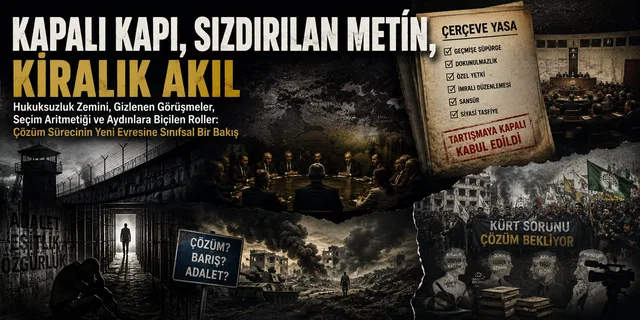
10–11 January 2016. Against what was being lived in the Kurdish provinces under curfews, 1,128 academics signed a petition: "We will not be a party to this crime." The number of signatories soon rose to 2,212.
What did the petition ask for? That the fighting stop, that civilians be protected, that a negotiating table be set up. That is, exactly the thing that ten years later has become official policy today.
What happened?
- They were targeted at the level of the President.
- Detentions and house raids began. Investigations were opened against 822 academics; 722 of them were put on trial.
- 204 academics were given prison sentences of from 1 year and 3 months to 3 years for "propaganda for a terrorist organisation."
- The first person to enter prison was Prof. Dr Füsun Üstel.
- 406 academics were dismissed from the universities by state-of-emergency decree-laws (KHK). The first dismissal decree-law: 1 September 2016.
- The passports of those dismissed were cancelled. They were banned for life from working in the public service. They could not leave the country; they could not find work inside it.
Then, on 26 July 2019, the Constitutional Court gave its ruling: to punish people for signing the petition is a violation of freedom of expression. The criminal courts began issuing acquittals on the strength of that ruling.
But it is precisely here that Turkey's legal aberration kicked in.
The criminal courts cleared them; the administration did not reinstate them.
The dismissals had been carried out by decree-law; the "State of Emergency Commission" that was to review decree-law dismissals was an appointed board. The Commission rejected the Academics for Peace's applications on boilerplate grounds. According to the figure Aziz Çelik gives, the applications of 385 of the 406 dismissed were rejected.
The point we have reached today: in ten years only 18 academics have been able to return to their posts for good.
This past July, Hülya Kendir and Cengiz Erçin of Kocaeli University were reinstated by a ruling of the Ankara 15th Regional Administrative Court. Their dates of dismissal were 1 September 2016; their dates of reinstatement, 26 July 2026. Between them there are exactly ten years.
What does ten years mean? As Aziz Çelik asks: what does it mean to go ten years without income, ten years without social security, ten years waiting at the door with a document that says "I was cleared"? In that time there were those who took their own lives, those who died of grief, those forced to leave the country. Doctoral students were left without supervisors, departments were scattered, a generation of academics could not be trained.
And one more detail, which is the bitterest place in the story: some of the rectors who prepared those dismissal lists are today members of parliament, some of them members of YÖK.
Part Three: The Name of the Hypocrisy — The Framework Law
Now let us come to today, because this is what really completes the picture.
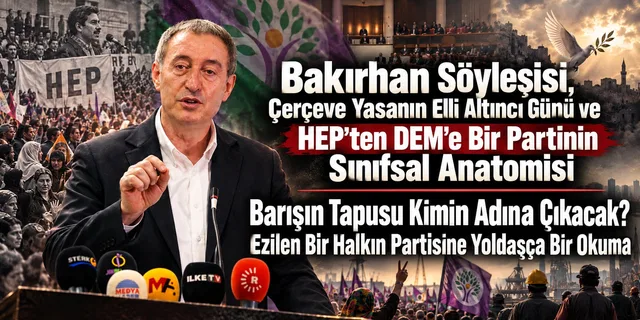
Turkey has been living through a "resolution/peace process" since the end of 2024. On 5 August 2026 the framework law, officially titled the "Law on Strengthening National Solidarity and Social Integration," was submitted to the TBMM with the signatures of 360 deputies, among them the Speaker of the Assembly, the chair of the MHP, the co-chairs of the DEM Party, and representatives of the AKP. It passed the General Assembly on 11 August 2026.
What does the law do? Roughly: it provides that if the organisation is deemed dissolved, the offence of membership of the organisation shall lapse; that investigation and prosecution in certain offences shall be deferred for 5–10 years; that enforcement of sentences shall be deferred. Intentional homicide and life sentences preceding a certain date are outside its scope.
Let us say this at the outset, and plainly: the silencing of the guns is good. Peace is good. After more than forty years of conflict, tens of thousands of dead, emptied villages, unsolved murders, mothers weeping in their mother tongue, the silencing of the guns is an undisputed gain. To stand against it is to enlist in the war party. We are not there.
But it is precisely because we defend peace that we ask.
The contradiction born of the law's own logic
Suppose we accept it: political prisoners from other organisations were left outside the scope because they were not parties to the process. That is debatable in itself, but it at least rests on a "procedural logic": the law regulates those who are parties to the laying-down of arms.
And the Academics for Peace?
They are not the process's other side. They are the process's forerunners. Ten years ago they were dismissed for saying in a petition the thing 360 deputies have now signed — "let the guns fall silent, let a negotiating table be set up."
And here the logic collapses altogether. Pay attention:
What was the ground of the Academics for Peace's dismissal? Being "affiliated" (iltisaklı) with a terrorist organisation. That is, not a conviction, not membership, not an act — that vague, extra-legal formula called "connection and affiliation" (irtibat ve iltisak).
What is happening now? The same state is negotiating with the organisation they were counted "affiliated" with, accepting its dissolution, and making a law that takes membership of it out of the category of crime.
That is: The ground on which the claim of affiliation rested is disappearing as a matter of law, but the punishment for affiliation remains.
Membership of an organisation is no longer prosecuted; the academic dismissed for being counted "affiliated" with that organisation still cannot enter the university. The legal status of those who carried a weapon is being settled; that of those who put a signature is not.
That is not the name of law. That is, in the name Aziz Çelik gave it, hypocrisy.
And the job is a two-line amendment
There is no need to invent a new law for these people. What is more:
- The Constitutional Court found them in the right.
- The criminal courts acquitted them.
- That is, the legal system has already said "not guilty."
All that remains is the quashing of an administrative act. That is, the implementation of the Constitutional Court's rulings, and a two-line statutory amendment. In an Assembly where 360 signatures were gathered, signatures cannot be found for two lines that would send 400 people who signed for peace back to the university.
And YÖK, faced with this picture, wants "scientific studies to be conducted" on the framework-law process. Who is to do that study? Those dismissed from the university for writing on the subject ten years ago are waiting at the door.
If a peace process is closed to those who wanted peace, then there is a problem there.
Part Four: Looking at Peace with a Class Eye
Now let us come to the heart of the matter. Because the injustice we have told so far may look like a legal problem on its own. It is not.
Peace is not a feeling; it is a social relation
The rulers' definition of peace is simple: the silencing of the guns. The absence of conflict. Stability.
This definition is dangerous not because it is incomplete, but because it is inadequate. Because an order in which the guns have fallen silent but exploitation, poverty, and repression continue can also be called "peace." In the literature this is called negative peace: the absence of war. But peace is not the absence of war; it is the presence of justice.
If a worker dies in a workplace murder; if a child dies in the back of a tractor as a seasonal agricultural labourer; if a woman is killed; if a family is put out of its home because it cannot pay the rent — there may be no gun going off there, but there is no peace there either. There is a war being continued by other means.
War is used against class at home
We must understand this well: war is not only against the outside. The state of war and the discourse of war are the most effective instrument for suppressing class struggle at home.
We know how it works:
- The call for "national unity" declares the strike to be separatism. In Turkey strikes have for years been postponed on grounds of "national security" — that is, banned in practice.
- The discourse of "survival" (beka) makes a demand for a raise into ingratitude.
- A state of emergency is declared in the name of the fight against terror; but among those dismissed by decree-law are unionists, teachers, academics, journalists.
- And the person who wants peace is put out of their job by being declared a "traitor."
The story of the Academics for Peace is exactly this. They were dismissed not only because they said something on the Kurdish question, but in order to destroy the university's capacity for critical thought. A dismissal of 406 people was at the same time a message given to the tens of thousands of academics left behind: if you speak, this is what happens.
That is, the war was waged not only in the Kurdish provinces, but over the whole field of freedom of the country's labourers. That is why the demand for peace is not a "Kurdish demand"; it is the demand of the class.
War has a ledger, and so does peace
Let us look at the figures as well, because a class view is a concrete view.
The cost of forty years of conflict is spoken of, by different reckonings, as hundreds of billions of dollars. Thousands of villages emptied, millions of people displaced, a regional economy wrecked. Where did this money not go? To schools, hospitals, housing, wages.
But let us also ask: where exactly did this money go? To defence-industry companies, to contractors, to security tenders. That is, the cost of war was written to society, its profit to capital. War is a mechanism of redistribution — from below upward.
That is exactly why peace too must have a class ledger. If the guns fall silent, where will that resource go? Again to the same companies, as new "regional development" tenders? Or to the labourer's wage, to the region's school, to its hospital?
The class content of peace is knotted in this question.
Which peace is ours?
| Capital's peace | Labour's peace | |
|---|---|---|
| Definition | The silencing of the guns, "stability" | The end of exploitation and repression |
| Aim | The investment climate, the risk premium, a secure border | A life fit for human beings, equal citizenship, freedom |
| At whose demand? | From above, behind closed doors, by bargain | From below, by the organised will of the people |
| What does it give the Kurdish labourer? | To work at the same job, at the same wage, but now "without trouble" | Mother tongue, equal rights, secure work, freedom of organisation |
| What does it give the Turkish labourer? | His son may come home from the army alive; the rest is the same | The war budget returning to the public, the field of freedom widening |
| Its measure | The number in the conflict reports falling to zero | Reinstatement of the dismissed, the right to strike, freedom of expression, the lessening of poverty |
| The dismissals | Off the subject, "another matter" | Peace's first and cheapest test |
| Its durability | Conjunctural; it ends when the balances change | Social; the gain is institutionalised |
This table is not for rejecting the process; it is for measuring it. So that we have a ruler in our hands.
And the first notch on that ruler is this: Can 406 academics return to the university?
Because this is a step that costs the state almost nothing economically, that is already settled as a matter of law, and that politically requires only will. If a peace process cannot take the step of justice that will cost it the least, it cannot take the expensive ones at all.
Without forgetting 10 October
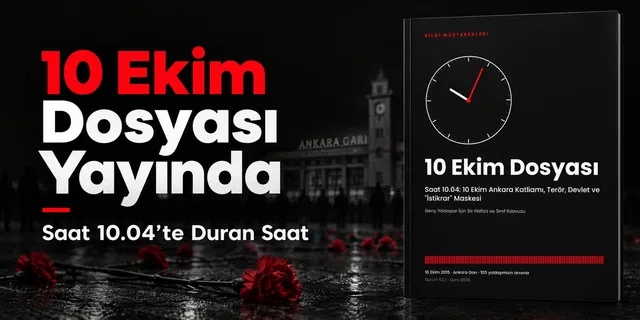
Let us not pass without recalling one more thing. On 10 October 2015, in front of Ankara Station, bombs went off over those gathered for the "Labour, Peace, Democracy" rally. 103 people died. Unionists, teachers, young people, labourers.
Turkey's greatest massacre took place at a peace rally.
Why am I recalling this? Because in this country those who have paid the price of the demand for peace have always been the same people: the academic who signed, the worker who hired a bus to the rally, the teacher who carried a banner. Peace never came as a gift from above; it was always wanted from below, by paying the price.
That is why, however much from above the peace process is conducted, the true owners of that demand are those below. They may not be at the table today; but ten years ago it was they who wanted that table.
Concrete Tasks
- Keep the reinstatement of the Academics for Peace on the agenda not as a "matter of the past," but as the test of today's process. Let the Constitutional Court's rulings be implemented, let the dismissed be reinstated, let the KHK stain be lifted.
- While defending "the silencing of the guns," do not allow the content of peace to be emptied. It is not enough to say peace is good; we have to ask whose peace, at what price, and what it will gain whom. To ask is not to oppose; it is to claim.
- Mark 1 September in your union, your chamber, your association. This day is not the states' day; it is the labourers' day; do not hand it over to the official language of 21 September.
- Learn the history of the demand for peace, and teach it. The Peace-Lovers of 1950, the Peace Association of 1977, the Academics for Peace of 2016 — these three generations are links in the same chain. There is a continuity between Behice Boran's fifteen months and today's ten years.
- Make a bond with dismissed academics. Hold a talk, listen to their lecture, publish their writing, read their book. You can put a person out of their chair, but you cannot put them out of their knowledge — so long as there is someone to listen.
- Follow where the war budget goes. Peace means the displacement of resources. If that displacement is not happening, peace is still only half.
Dear Young Comrades,
On 1 September 1939 a war began, and humanity, by declaring that day a day of peace, made a banner out of the wreckage.
On 1 September 2016, in this country, those who wanted peace were put out of their jobs. And they have been waiting at the door for a full ten years.
Behice Boran went to prison for opposing the sending of troops to Korea; then history proved her right. The officers of the Peace Association were tried for nine years; then they were acquitted. The Academics for Peace were declared "terrorists"; ten years later the state is saying what they said ten years ago.
In this country those who wanted peace were always proved right. But they were always proved right late. And the price of that delay was paid each time by them — not by the state, not by the rectors who prepared the lists, but by those who put their names down.
What is asked today is not a great thing. Not compensation, not revenge, not a settling of accounts. Only to return to class. To stand at the blackboard, to meet their students, to teach.
Peace begins with the silencing of the guns, but it does not end there. Peace begins on the day the dismissed person returns to their job, the exile to their country, the silenced person to their word.
A country cannot make peace by keeping those who wanted peace waiting at the door.
Let the Academics for Peace return to the university. Ten years is enough.
And let us not forget: peace is not a gift that will be given to us; it is an order we will build with our organised will. Every generation that wanted it paid a price; but every generation carried it a little further.
It is our turn.
Sources
- Aziz Çelik's post of 31 August 2026 — @Emegin_Halleri
- Academics for Peace
- Fourth Anniversary of the Peace Petition: Acquittal Yes; Reinstatement No — bianet
- Two Academics for Peace returned to their posts — BirGün
- Here Is the Text and Justification of the "Terror-Free Turkey" Framework Law Submitted to the Assembly — Yetkin Report
- The framework law passed the Assembly — bianet
- 'Terror-Free Turkey' process: What provisions are in the framework law? — Euronews Turkish
- 1 September World Peace Day: How did the date a war began turn into a day of peace? — Medyascope
- 27 February 1982: 44 officers of the Peace Association arrested — marksist.org
- The Korean War and an Anti-War Organisation in Turkey: The Turkish Peace-Lovers Association — ÇTTAD
- Judicial Harassment of Academics for Peace — Front Line Defenders