Closed Door, Leaked Text, Hired Mind
The Ground of Lawlessness, Concealed Talks, Electoral Arithmetic, and the Roles Assigned to Intellectuals: A Class Perspective on the New Phase of the Resolution Process

The Framework Law dossier, of which this article is a part, is also available as a brochure — free PDF, EPUB and Markdown on our Guides page.
Dear young comrades,
In our Framework Law series, we discussed the class character of bourgeois law, the mechanism of passive revolution, and why rejecting the "yes/no" playing field constructed by the ruling class is a revolutionary necessity. In the three weeks that have passed, the process has entered a new phase. The law was enacted; but at the very moment it was enacted, it became visible that what it rests upon is not a legal text, but a regime of uncertainty.
Today the country’s political agenda turns on two axes: First, the leaking, circulation, and subsequent denial of speeches and meeting notes attributed to İmralı—that is, the content of the process being kept from the public while being served piece by piece, without oversight, and in deniable form. Second, the debate over "why are intellectuals not giving support?"—that is, the attempt to close the process’s deficit of intellectual legitimacy by assigning roles to intellectuals.
These two axes are not independent of each other. They are two sides of the same coin: a process conducted outside the masses searching for a caste that will speak in the name of the masses.
But neither can be understood when torn from the ground on which they rest.
That ground is this: Not a single step has been taken in the name of democratization.
Those dismissed by decree-law (KHK) are still not back at their posts. A nurse was detained for protesting an attack on a Kurdish woman whose hair was cut in Syria, and though she was acquitted, she was dismissed from public service. An elected deputy has been in prison for years despite Constitutional Court rulings of rights violations. The ECtHR has issued a third finding of violation against Turkey concerning Osman Kavala; the Palace’s chief adviser answered with "Let the ECtHR know its place," and moreover announced that accession to the Convention could be reviewed. And all of this is taking place in the days when the monitoring board of what is called the "peace process" is being established.
On top of this there is an external front: the spiral of war and agreement along the US–Iran axis, balances redrawn in Iraq and Syria, the roles assigned to Kurds and to Turkey. The fate of peoples circulates as a bargaining chip on tables they never see.
And there is a third segment: those who say "This is a beginning; thousands of prisoners will be released, mothers will reunite with their children; for now let us make do with what is given and continue the struggle later." Those who set aside both the health of the ground and the content of the closed-door bargain and arrive at the point of "for now, just approve."
And the most decisive question stands beneath all of these: What is all this haste for? When constitutional amendment efforts, the arithmetic of re-candidacy, and simultaneous liquidations underway in the region are set side by side, the tableau that emerges is far too consistent to be explained under the heading of "peace."
In this article we will address them all at once—the ground of lawlessness, the regime of secrecy, the calculation behind the process, the role assigned to intellectuals, and the politics of "for now, make do"—from a class perspective.
First, the Facts: An August 2026 Chronology
Before we move to evaluation, let us set the material ground of the debate before us as it is. The Marxist method first wants the fact; interpretation comes afterward.
| Date | Fact |
|---|---|
| 5 August 2025 | The National Solidarity, Brotherhood and Democracy Commission is established in the TBMM. |
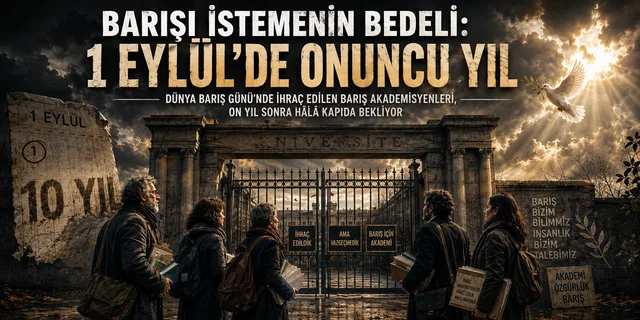
| January 2026 | The 10th anniversary of the Academics for Peace declaration. Of more than 2,200 signatories, over 400 had been dismissed by KHK; in ten years the Council of State has resolved only 13 files. |
| 26 January 2026 | Nurse İkra Avcı is detained and suspended from duty for joining a "hair-braiding" campaign begun in solidarity with a Kurdish woman whose hair was cut in Syria. |
| February 2026 | The commission report is adopted by majority vote in the General Assembly; DEM Party files a dissenting opinion. In the same period, an outlet named Rastî publishes the first notes claimed to belong to the İmralı talks. |
| 15–21 May 2026 | Avcı is first served a penalty of "Dismissal from Public Service" (15 May); six days later the court issues an acquittal in the criminal case opened over the same post (21 May). |
| 7–17 June 2026 | First a memorandum of understanding between the US and Iran, then a 14-article agreement. Pressure and operations in Kurdish geographies of the region intensify in its wake. |
| 5 August 2026 | The Framework Law bill is submitted to the Assembly with the signatures of the AKP, MHP, DEM Party, and CHP. |
| 10 August 2026 | The "Law on Strengthening National Solidarity and Social Integration" is adopted in a session with 561 votes cast—467 in favor, 87 against, 7 abstentions. Its entry into force is tied to the MGK’s "determination and confirmation" of the dissolution of the PKK/KCK and the laying down of arms. |
| 17 August 2026 | İmralı meeting notes claimed to be dated 2 August re-enter circulation; then the publication chain expands. |
| 19 August 2026 | DEM Party spokespersons state at a press conference that they "saw the text of the law only on the morning of the day it would be passed." The same day İkra Avcı announces that she has been dismissed from public service. |
| 23 August 2026 | The DEM Party İmralı Delegation warns against treating unverified texts as if they were genuine. |
| 24 August 2026 | The debate "Why are intellectuals not supporting the process?" grows; Academics for Peace come onto the agenda. |
| 25 August 2026 | In Damascus it is announced that the SDF will be dissolved and integrated into the Syrian army; US officials own this with the formula "one army, one government, one state." |
| 25 August 2026 | The Monitoring and Evaluation Board chaired by the Vice President convenes for the first time; four sub-commissions are established. The same day a handwritten message attributed to Öcalan is published: the "statements, meetings, names, documents, meeting notes" attributed to him are declared false, characterized as "provocative moves by opponents of the process." |
| 26 August 2026 | The DEM Party delegation (Mithat Sancar, Gültan Kışanak, Çetin Arkaş) meets journalists: assessments are made that no meeting with a Qandil delegation took place on İmralı, that Öcalan remains "in his old place," that he is expected to serve on a sub-board, and that "Kurds will join the government in Damascus." |
| 26 August 2026 | The ECtHR Grand Chamber convicts Turkey of violating five separate articles of the Convention in the Osman Kavala file and awards 70 thousand euros in compensation; this is the third ECtHR ruling concerning Kavala. Presidential Chief Adviser Mehmet Uçum declares the ruling a "political project," says "Let the ECtHR and Amor know their place," and writes that Turkey "could review" its accession to the ECHR and the right of individual application. |
| 26 August 2026 | Assessments examining the form of the text’s circulation find that the "meeting note" was relabeled first as a "minutes," then as a "confession," with the degree of provenness artificially raised at each stage. |
The first thing this table tells us is this: Turkey’s most strategic political process is being debated not through official documents, but through texts of uncertain provenance and their denials.
As communists, we are not in a position to pass judgment on whether the leaked texts are authentic, and that is not our job either. Proving a document’s originality is the obligation of those who publish it. Our job is different: to ask how such a regime is possible and whom it serves.
The Process’s Material Test: Not a Single Step in the Name of Democratization
The sincerity of a "peace process" is measured not by its statements, but by the change it creates in ordinary people’s lives. So let us ask: Has this process restored even a single person’s rights in this country?
The Acquitted Are Dismissed: The İkra Avcı Example
A nurse joins a solidarity campaign begun against the cutting of a Kurdish woman’s hair in Syria; she braids her hair, shares it. On 26 January 2026 she is detained; the same day she is suspended from duty. On 15 May the Ministry of Health High Disciplinary Board serves a penalty of "Dismissal from Public Service." Six days later, on 21 May, she is acquitted in the criminal case opened over the same post. And on 19 August, right in the middle of the process debates, she announces that she has been dismissed from her profession.
Comrades, read this tableau carefully. The same act is not a crime in criminal adjudication; in administration it is grounds for dismissal from the profession. This is not a "difference of legal jurisprudence." This is discretion taking the place of law. If the state can remove from her job a laborer whom its own court has acquitted, without needing the court at all, there is no law there; there is the administration’s unbounded arbitrariness.
And take note: What stands before us here is not an "intellectual," a politician, or an opinion leader; it is a health laborer. A woman worker who lives on her wage, who lives by selling her labor power. The place where the regime is most brazen is the place where we are most defenseless: work, bread, livelihood. Political repression here is not an abstract problem of "freedom of expression"; it is dispossession.
A Ten-Year Debt: Those Dismissed by KHK and Academics for Peace
Of more than 2,200 academics who signed the peace declaration, over 400 were dismissed by decree. Ten years have passed. In that time the Council of State has been able to resolve only thirteen files. A handful of people have been able to return to their posts; the rest have lived with unemployment, passport seizure, migration, and mobbing.
Now the same state says "we are making peace." So how many of those dismissed by KHK have returned to their jobs in this process? Zero. In which of the Framework Law’s 12 articles does the right of those dismissed by KHK appear? In none.
Here there is a critical truth: In 2016 these people were punished because they wanted peace. In 2026 they are criticized because they do not support peace enough. In both cases the measure is the same: not peace, but conformity to the state’s line of the day. The measure of loyalty has never been principle; the measure is the conjuncture of those in power. Yesterday supporting the conflict was loyalty; today supporting "the process" is counted as loyalty. What has changed is not conscience, but the instruction.
Hostage Politics: Can Atalay, Kavala, Demirtaş, and the Prisoners
Let us recall the concept we used in the first article of the series: hostage politics.
- Can Atalay: An elected deputy. Despite Constitutional Court rulings of rights violations, he was not released, his parliamentary mandate was stripped, and he has been in prison for years.
- Osman Kavala: The ECtHR has issued a third finding of violation. The response was not to implement the ruling, but to tell the court that issued it to "know its place" and to open discussion of withdrawal from the Convention.
- Selahattin Demirtaş and thousands of political prisoners: Their release is debated not as a question of rights, but as a question of a calendar. Corridor news circulates such as "they may get out in September," "four thousand people may fall within the scope." That is, freedom is the subject of bargaining, not of the court.
If a person’s freedom is the subject of a calendar rather than of law, that person is not a detainee but a hostage. Hostage politics is not a malfunction of the resolution process; it is its operating system: The side that holds hostages is always advantaged at the table, and it releases hostages not all at once, but drop by drop, taking its price.
The Same Week, Two News Items
On 25 August the monitoring board of the "peace process" convened for the first time. On 26 August the Palace’s chief adviser opened discussion of withdrawal from the European Convention on Human Rights; he said "there is no bindingness in substance at any stage in ECtHR rulings," "the authority to comply or not comply with findings of violation belongs to the relevant national courts."
These are not two contradictory news items. They are two articles of the same program.
We communists do not see bourgeois courts, the ECtHR, or the Constitutional Court as saviors; these are not institutions that will bring freedom to laborers. But we must establish this: The "peace" claim of a state that does not even recognize its own law, that threatens to "review" the convention it itself signed, is not a legal claim but an entirely political and unilateral one. Every "solution" resting on the word of such a state is nothing more than a permission that the giver can withdraw whenever it wishes.
This is what we mean when we say "not a single step has been taken in the name of democratization." While journalists are in prison, municipalities are under trustees, union rights are suspended, strikes are banned under the name of postponement; while not a single right has been restored; while only a calendar of liquidation and integration is running—this is not called peace. This is called a domination reorganized under conditions of non-conflict.
Secrecy Is Not an Accident; It Is a Mode of Governance
Liberal criticism looks at this tableau and says "communication accident," "lack of transparency," "bad governance." As if transparency were a technical detail the conductors of the process had forgotten.
Yet secrecy here is not a deficiency; it is the constitutive principle of the process.
Let us think: A country’s bloodiest problem of decades is being put on the table. A negotiation that will directly determine the lives of millions of people is underway. A commission in the Assembly works for a year. And one of the parties that signed the law that commission produced sees the text of that law "on the morning it would be passed." The people never see the content of the negotiation at any stage. The only thing they can see is leaks of uncertain provenance and their denials.
This is not a defect of democracy; it is the mode of operation of authoritarian etatism. In the form Poulantzas described: Decision-making authority is drawn from the legislature to the executive, from the executive to the core of the administrative-security apparatus; representative institutions are formally preserved, but the real decision is taken in an unsupervised core. The structure established on 25 August is concrete proof of this: Monitoring of the process has been tied not to the Assembly, but to a board chaired by the Vice President and to its four sub-commissions. Even the entry into force of the law has been left not to parliament, but to the National Security Council’s "determination and confirmation."
The meaning of this is clear: Here there is no law; there is discretion. There is no right; there is favor. And where there is favor, the one who stands before the bestower of favor is never a rights-holder, but always a petitioner.
That is why the demand for transparency is not a liberal ornament. It is the right of laborers to oversee decisions taken in their name. The clearest example of this in the history of socialism is that one of the first acts of Soviet power in 1917 was to abolish secret diplomacy and publish the Tsarist secret treaties as they were. This was not a gesture of "good governance," but a class stance: Nothing concerning the fate of peoples can be decided outside the knowledge of peoples.
Today in Turkey there is no political focus that defends this principle. Those "in favor of the process" see secrecy as necessary for the process’s safety; the "anti-process" nationalist wing uses secrecy only as fuel for its own conspiracy theories. Neither stance defends laborers’ right to know. This vacuum is the vacuum that an independent class line must fill.
Three Functions of the Leak–Denial Spiral
The cycle of putting texts of uncertain provenance into circulation and then denying them is not random chaos. This cycle is, from the rulers’ point of view, an extremely functional technique of governance. Let us distinguish its three functions.
Deniable Communication: The Trial Balloon
In a negotiation, parties cannot announce through official channels every proposal whose base reaction they wish to measure. If they announce it, they are bound. But if they leak it, they both measure and remain unbound. If the text holds, it is said "it was already like this"; if it does not, it is called "provocation."
This technique is among the oldest tools in the history of diplomacy, and it is asymmetric: The side that measures is the state; the side measured is the people. The mass is not the subject of an experiment conducted about its own future, but the test subject.
Shifting Debate from Content to Loyalty
The second and perhaps most destructive effect of the spiral is this. The moment the question "What did the leader say?" occupies the agenda, the question "What must be done?" disappears.
Take note: What has been debated for the last ten days is not what the Framework Law’s 12 articles bring to laborers. What is debated is whether a text is authentic. A political movement’s program has been reduced to the notarization of a document. This is the transformation of politics into theology: Debate built upon the authenticity of a text is inevitably a debate of faith and doubt; it is not a debate of program, interest, and class.
And the natural result of theological debate is the strengthening of the leadership cult. Because the only authority that can decide authenticity is the leader himself. The mass has no independent means of verification in its hands; and because it does not, it has no capacity to use its own reason either. A structure in which a movement’s base can learn what its own movement has said only through the leader’s denial is a structure that has been politically disarmed.
The Criminalization of Criticism
The third function: the expansion of the category of "provocation."
It is true that anti-process chauvinist-nationalist foci do indeed produce provocation; to ignore this would be naivety. But once the concept of "provocation" becomes a political shield, it turns into a category that swallows not only conspiracy, but every kind of criticism. The one who asks "What does this law give the laborer?" and the one who asks "Why is the content of the negotiation secret?" are thrown into the same sack.
What the ruling class loves most is this: that the critic must defend their intention before defending their criticism. Thus debate shifts from the truth of the argument to the interrogation of the critic’s record.
Our stance is clear: We expose provocation, but we accept no framework that counts criticism as provocation. Criticism conducted from a class line is written into the account of neither the state nor any bourgeois-nationalist focus.
Text Fetishism: Reducing a Class Relation to a Document Problem
In Volume One of Capital, Marx describes commodity fetishism thus: Under capitalism, the social relation between people appears in the form of a relation between things. The exploitation of labor power appears as the dance of prices among themselves.
Today we face a political counterpart of this: text fetishism.
The real relation between Turkish and Kurdish laborers—shared exploitation, shared impoverishment, division through chauvinism, regional uneven development—has been reduced to the problem of a document’s authenticity. As if if that text turns out authentic the Kurdish worker’s unemployment will be solved, and if it turns out false the Turkish worker’s starvation wage will rise.
Let us ask concretely:
- Has the trustee regime been lifted? No.
- Has the right to education in the mother tongue been recognized? No.
- Have those dismissed by KHK returned to their jobs? No.
- Have strike bans been lifted? No.
- Has the minimum wage risen above the hunger threshold? No.
- Have unemployment in the region, the slavish conditions of seasonal agricultural labor, and child labor been debated? No.
The Framework Law has 12 articles, and in none of them is there a worker. The architecture built under the heading of "social integration" is not class integration, but a national-identitarian integration that will cover over class fragmentation. What the state needs from the standpoint of capital accumulation is a "non-conflict" investment climate—that is, a legal-security environment in which mining, energy, agri-food monopolies, and construction capital can enter the region without risk. What is meant by "peace" is this: the clearing of political obstacles before labor power and natural resources.
That is why there is a direct link between keeping the content of the process secret and laborers’ demands never entering the agenda. Secrecy is monopoly over setting the agenda. Whoever sets the agenda also determines what will not be spoken of.
The International Dimension: This Process Is Not Being Built in Turkey Alone
To skip one point traps the analysis in localism. The "resolution process" in Turkey is part of a regional restructuring, and the calendar of that restructuring is set not in Ankara, but at much larger tables.
Let us recall what took place in the first half of 2026: the escalation of war along the US–Israel–Iran axis, then the memorandum of understanding reached on 7 June and the fourteen-article US–Iran agreement signed on 17 June. What followed immediately afterward in Kurdish geographies of the region is instructive: Iran’s attacks on Rojhilat and Iraqi Kurdistan intensified, the US put the integration of Peshmerga forces into the Iraqi central army on the agenda, and while a new equation was being established in Syria the Turkish army massed forces along the border.
The tableau is clear: When imperialist centers and regional bourgeoisies sit at the table, Kurds are on the table. Now as a pressure card, now as a buffer, now as an "element of stability." The equation taking shape after the regime change in Syria, capital alliances built through energy and transport corridors in Iraq, the integration of armed structures with central states—all of these are arranged not by the will of peoples, but by calculations of profit and influence. The Turkish bourgeoisie seeks a position for itself in this arrangement and constructs "internal peace" as a precondition of its external moves. What is going on behind the scenes, what commitments were given, what "internal step" will be taken in return for what regional role—the people know none of this. That they do not know is no accident either; the real function of the regime of secrecy may lie precisely here.
The conclusion that follows is this: This process is determined not by the will of peoples, but by capital’s regional needs. And precisely for that reason, to expect freedom for peoples from any wing of imperialism or from regional bourgeois foci is, to put it mildly, political blindness. No imperialist center, no regional capital group, will bring equality to the Kurdish laborer; the only thing it can bring is a status drawn within the frame of its own interests and withdrawn when those interests change. Recent history is full of countless examples of this: Those declared "allies" today are spent in tomorrow’s bargain.
In the redivision of the Middle East the role assigned to peoples is always the same: to die and to consent. The only way to reject this role is to defend the internationalist unity of the region’s working class against this entire table of redivision that uses peoples against one another.
The internationalist stance unites the unconditional defense of nations’ right to self-determination with opposition to that right’s being turned into a bargaining object of bourgeois classes. The Kurdish people’s demand for equality is legitimate and must be defended. But the bearer of that demand must be not a political apparatus that has compromised with its own bourgeoisie, but the common struggle of Turkish and Kurdish laborers.
So What Does the AKP Want? What Do International Powers Want?
Up to this point we have analyzed the form of the process: secrecy, leakage, denial, the role assigned to the intellectual. Now let us come to the real question: What is all of this being done for?
Let us begin with a methodological note. What follows are not proven facts, but political claims inferred from the arrangement of the facts. We do not read intentions; we read the direction of class interests. And every claim must be testable; at the end of this section we propose a concrete criterion of testing.
The Regime’s First Need: To Be Able to Be Re-elected
Turkey’s political arithmetic is plain, and that arithmetic leads to a single place.
There are two paths for the President to be able to run again: either constitutional amendment (directly with 400 votes in the Assembly, or by referendum with 360 votes), or a decision by the Assembly to renew elections (again 360 votes). The People’s Alliance totals in the low 320s. The CHP, İYİ Party, and Yeni Yol are in opposition. The gap is around thirty to forty votes.
The only bloc that can close that gap is DEM Party’s fifty-six deputies.
The claim is that plain: The calendar of the "resolution process" and the calendar of re-election are the same calendar. Whoever wants to understand why the process is accelerating now, why after a year of commission work the law was passed in days, why the content is kept secret, should look first at this arithmetic.
To this is added a constitutional package. As reflected in the press, the package includes such headings as changing the conditions of the president’s re-candidacy and lowering the election threshold from "50 percent plus 1" to "40 percent plus 1"; against this there is no return to the parliamentary system, no strong parliament, and the first four articles are preserved as they are. The function of the "equal citizenship" and "democratic rights" emphasis sprinkled into the package is clear: packaging prepared to obtain the support of Kurdish politics.
Comrades, the character of a constitution is measured not by the fine words in its opening sentences, but by which class’s property order it secures. Writing "we are equal citizens" into the text does not raise by a kuruş the daily wage of the child who goes to seasonal work in Cizre; it does not insure the woman working without security in Diyarbakır; a text whose first four articles are preserved, whose unbounded executive power is left outside discussion, cannot by definition be a democratic constitution.
The Regime’s Second Need: A Field Without Opposition
The second claim: The process is at the same time an operation of splitting the opposition.
On the one hand the main opposition is encircled by the judiciary; on the other, Kurdish politics is drawn to the table and severed from the main opposition. Thus those in power prevent the meeting of two blocs that could unite against them. The discourse of "peace" here functions not as a unifier, but as a splitter.
The Regime’s Third Need: Making Laborers Pay for the Crisis
The third and class-wise most decisive claim: In a conjuncture in which capital accumulation is blocked, in which inflation and the cost of rolling over debt squeeze, "non-conflict" is an economic program.
The fall of the risk premium, the return of hot money, the safe opening of the region to mining, energy, agri-food, and construction capital—all of these require non-conflict. And all of them concern not the laborer’s wage, but capital’s profit.
Moreover, concepts such as "national solidarity" and "social integration" are the oldest ideological covers over class contradiction. The strike ban is also imposed in the name of "national interest," and the starvation wage is also imposed in the name of "national sacrifice." That the law is named "National Solidarity and Social Integration" is not an accident; it is a program.
What Do International Powers Want?
Now let us look at the external front; because the calendar of this process is not kept in Ankara alone.
On the evening of 25 August 2026 in Damascus, it was announced that the SDF would be dissolved and integrated into the Syrian army. US officials’ owning this with the formula "one army, one government, one state" reveals the character of the matter. The same week in Turkey the monitoring board of the "Framework Law" was being established.
These two developments do not fall side by side by chance; they are two legs of the same plan. The transfer of armed structures in the region to central states means costless stability for the US: In the new order established after the agreement with Iran, reducing the number of armed actors is required for the security of corridors, energy lines, and trade routes. The disarmament of Kurds stands in this equation not as a step of "peace," but as an operation of simplification.
What is wanted on the European front is not democracy either. What the EU expects from Turkey can be listed: holding migration flows, cooperation in the defense industry and security architecture, the stability of energy routes. The clearest proof of this is the following: The Palace’s response to the ECtHR’s Kavala ruling was "know its place," a signal of withdrawal from the Convention was given—and in return no serious price has been paid. Democracy for the West is not a principle, but a bargaining chip.
What international finance capital wants can be summarized in a single word: predictability. Capital does not want the rule of law; it wants the security of its contract. It has no problem with a municipality under a trustee, with a dismissed nurse, or with a deputy in prison—a country in which the strike is postponed, the wage is suppressed, and profit can be transferred is enough for it.
So What Is Kurdish Politics Getting?
Let us be honest: A card is being held at the table, and that card is "constitutional and electoral support." The hoped-for return is Öcalan’s field of political movement, the freedom of prisoners, constitutional status, and "politics under conditions of full democracy."
But the card has two weaknesses. First: Once the card is used, its value is zeroed. The support given cannot be taken back; the rights promised can at any moment be postponed, tied to MGK confirmation, or met with "conditions have not matured." Second: The moment those in power run the formula of "election by Assembly decision without touching the constitution at all," they can render that card entirely void.
And this costs the Kurdish laborer most of all. Because this is a calculation of representation; the laborer’s demands—work, wage, mother tongue, municipality without trustee, secure employment—are held hostage to someone else’s electoral arithmetic.
If We Sum Up the Tableau
There are three bourgeois subjects at the table: the Turkish bourgeoisie and its state; imperialist centers and regional capital; and Kurdish bourgeois politics. Each has a concrete, calculable interest.
The only thing not at the table: laborers. Neither the Turkish worker, nor the Kurdish worker, nor the seasonal agricultural worker, nor the insecure woman laborer. No one asks them what they want; everyone says what they want in their name.
And a Criterion of Testing
We said all of this is "claim." So let us test the claim. We propose a simple criterion:
If this process is truly a process of democratization, steps that can be taken today, without return, entirely independent of election and constitutional bargaining, are taken.
No bargaining is needed for the reinstatement of those dismissed by KHK. No negotiation is needed for the removal of trustees. No accord is needed for the implementation of court rulings. A single signature is enough for the acquitted nurse to return to her job. No MGK determination is needed for the lifting of strike bans.
If these are not being done, while the calendar advances together with electoral arithmetic—the claim has been confirmed.
The criterion is this; the rest is talk.
The Intellectual Debate: Is "Support" Wanted, or "Approval"?
Now let us come to the second axis.
In mid-August, when one of the members of the İmralı Delegation said that the process was receiving "little intellectual support" in a manner rarely seen in the world, a broad debate began. Replies were not late in coming.
As reflected in the press, the lines of the debate were drawn thus: On one side, the finding that the process’s theoretical-conceptual framework remained weak, that intellectuals had not contributed. On the other, objections pointing to the situation of academics who were dismissed, prosecuted, and forced to migrate abroad for signing the "We Will Not Be a Party to This Crime" declaration: Of roughly two thousand signatories, 406 had been dismissed by KHK, and lawsuits had been opened against 822. The contradiction of asking, ten years later, "why are you not speaking?" of a segment that had received the message "this is what happens to those who speak" in its hardest form was rightly emphasized. Another objection touched the essence of the matter: "Is support expected, or unconditional approval?"
This question is the right question. But we must take it one step further.
The Intellectual Is Not a Category Outside Class
The entire debate assumes "intellectuals" as a homogeneous, supra-class subject whose will is self-sufficient. From a Marxist standpoint, no such subject exists.
Gramsci’s finding is clear: Every social class creates its own organic intellectuals; it also seeks to make itself accepted by the "traditional intellectuals"—the academic, the jurist, the man of letters, the cleric—left over from previous periods. The most distinctive feature of the traditional intellectual is that he imagines himself above classes. This illusion is not a sign of his impartiality, but of his inability to see under which class’s hegemony he works.
Let us think of the material position of the layer we call "intellectual" in Turkey: the research assistant working on insecure contracts at the university; the translator living on royalties; the PhD teaching without a cadre post; the journalist on the payroll of capital groups’ media organs; the NGO worker become dependent on the project and fund economy. The overwhelming majority of these are wage laborers who own no means of production and live by selling their labor power. Intellectual labor is also labor; and it too has been made insecure, subcontracted, and bound to algorithmic and administrative control.
KHK dismissals are the most naked expression of this truth. What took place in 2016 was not merely "pressure on ideas"; it was the severing of intellectual laborers from their means of production and their livelihood by a decree. That is, it was dispossession. Today’s telling the same segment "come, give support" is the dispossessor begging consent from the dispossessed.
What Is Wanted Is Not Knowledge, but Legitimacy
So why does this demand come now?
Because a process conducted behind closed doors has a legitimacy deficit. A negotiation that proceeds without the participation of the masses, without its content being known, needs social approval, and because that approval cannot be taken from the mass, it is sought from a caste that can speak in the name of the mass. What is wanted from intellectuals is not an analysis; it is a signature.
Gramsci defines intellectuals as the "functionaries" of hegemony: the layer that organizes the consent of the ruling class, that turns its world-view into common sense. The role assigned to intellectuals today is precisely this. The sentence "the theoretical framework is lacking" sounds like a modest invitation; but in practice its meaning is this: You produce the conceptual polish that will legitimize the work we have done.
Critical reason is invited to the extent that it serves those in power; the moment it does not, it is included in "provocation." This is not a place given to the intellectual, but a service contract assigned to the intellectual.
The Silence of Intellectuals Cannot Be Explained by Fear Alone
But comrades, the coin has another side, and we must not ignore that either.
The silence of a portion of intellectuals is truly from fear; no one has the right to belittle the caution of people who have paid a price. But the silence of another portion is from having nothing to say.
Liberal peace discourse in Turkey has for decades constructed the matter with concepts such as "recognition of identity," "democratization," "EU standards," "transitional justice," and never asked the class question. This discourse now freezes when it sees a process constructed with its own concepts operating in authoritarian fashion. Because it has in its hands no theory with which to criticize in the name of peace what is done in the name of "peace." Every theory that casts class outside analysis sooner or later falls mute at the point where its own concepts are used by the rulers.
This is not a personality weakness of the intellectual layer; it is a theoretical bankruptcy; and the source of the bankruptcy is class.
From Invitation to Threat: Targeting Those Who Ask
And now the debate has entered a new stage. Those who ask intellectuals for support have begun to be disturbed by intellectuals who have questions.
The mechanism is simple and familiar. First the invitation: "Come, contribute, let us build the theoretical framework together." Then, when the contribution that comes is not approval but a question, the tone changes: "Why are you obstructing? Whose mill are you carrying water to? This stance is opposition to the process."
Thus the invitation turns into a loyalty test. The person who asks "What does this law give the laborer?", who asks "Why is the content of the negotiation secret?", who asks "Where in this process is the right of the person dismissed by KHK who has not returned to their job for ten years?" is no longer an interlocutor, but a suspect. The content of the question is not debated; the intention of the asker is debated.
Let us name this: This is a reactionary reflex that equates criticism with betrayal, and it is reactionary no matter whom it comes from. When it comes from the state it is called "separatism," when it comes from process spokespersons "opposition to the process," when it comes from the nationalist wing "treason"; its function in all of them is the same: to raise the price of thinking.
Moreover this reflex is especially shameful because of the ground on which it rests. In a country that has people who have not returned to their jobs for ten years, a nurse dismissed from her profession though acquitted, a deputy whose mandate was stripped though elected, a detainee about whom a third finding of violation has been issued—that is, while there is nothing at all that can be called a right—people are asked for "trust" and "support." Trust is not a feeling; it is a balance sheet. Instead of telling people to trust, one must show a performance that can be trusted.
Our attitude is clear: Asking questions is the most basic revolutionary right. If a process cannot bear the questions directed at it, the problem is not in the questions, but in the process.
The False Dichotomy Before Us Again
The mechanism we have pointed to from the beginning of the series is at work here as well. The debate is constructed around two options:
- Unconditional support for the process: Suspend criticism, be silent to clear the way for "peace."
- Nationalist rejection: Declare the entire process "surrender to separatism."
Both options are played on the ruling class’s playing field. The first provides a progressive cover for an authoritarian program of liquidation and integration. The second feeds chauvinism by declaring even the most basic democratic demands of the Kurdish people the enemy, and deepens the division of laborers.
There is a third stance, and this is not "critical support," but an independent program: to defend unconditionally the Kurdish people’s right to equality and self-determination; to see the silencing of arms as a development in the interest of peoples; but to say that this right will be won not by the favor of the bourgeois state, but by the united struggle of laborers; to expose the liquidating-authoritarian architecture of the process; and while doing all of this, to struggle in the hardest way against chauvinism.
"This Is a Beginning": Mothers, Prisoners, and the Politics of "For Now, Make Do"
Now we come to the hardest heading, the one that most requires sincerity.
A segment says: "This is a beginning. Thousands of political prisoners will be released. Mothers will reunite with their children. Sick prisoners will get out before they die. For now let us make do with what is given; we will continue the struggle later."
The great majority of those who form this sentence are sincere; they are people who have paid a price, whose child is inside, who have buried the dead. No stance that belittles their joy, that spends their pain as "tactics," can be revolutionary. Our objection is not to the people, but to the political logic of that sentence.
And let us say from the start: The freedom of prisoners is our demand as well—moreover our unconditional demand. The debate is not a debate over whether prisoners should get out or not. The debate is this: What is being given in return, who is giving it, and can what is given be taken back?
The Two Hidden Assumptions of "Not Enough, But Yes"
This stance was named years ago: "not enough, but yes." Today we face a new application of the same logic; indeed writers who have drawn this analogy have also appeared. DEM Party officials’ formula "we neither sanctify this text with closed eyes nor reject it as incomplete," though it looks like indecision, has in practice meant only one thing: approval.
The sentence "Let us accept now, continue later" rests on two assumptions, and both are false:
First assumption: What is given is permanent. It is not. The law’s entry into force is tied to the MGK’s "determination and confirmation." The regime established is not an amnesty regime, but a regime of deferral: investigation is deferred, prosecution is deferred, enforcement is deferred. A deferred sentence is not an erased sentence; it is a sword hanging over the person’s head. The person who gets out is not free, but conditionally outside—and the side that sets the condition is at the same time the side that will decide the condition has been violated.
The political meaning of this is very clear: Release does not merely free the prisoner; it disciplines him and his family, an entire milieu. The threat "if you raise your voice you return" stands there as an article everyone knows even if it is written nowhere. This is the most refined form of hostage politics: releasing the hostage while keeping the end of the chain in one’s hand.
Second assumption: Our power to struggle later remains the same. It does not. While saying "we will continue later," it is never asked with what power one will go to that "later." Arms will have been laid down, organizational structure dissolved, political support given, the election and constitution card played. What will remain in hand?
After bargaining power is exhausted, the name of asking for rights is not struggle; it is petition. And history has not recorded a single example of a right won by petition.
We Have Seen This Before: 2015
The strongest proof in this debate is not talk, but history.
In the 2013–2015 process too it was said "this is a beginning." Negotiation proceeded, the accord text was read before cameras—and shortly afterward those in power announced they did not recognize that accord. The monitoring delegation was not accepted. After the 7 June 2015 election the process closed overnight. Then what happened? Cities were destroyed, hundreds of people died under curfews, trustees were appointed to municipalities, elected co-mayors were arrested. Gültan Kışanak, who today explains the process to journalists, was herself among those who spent years in that detention.
That is, the sentence "for now make do, continue later" has been formed in this country before. We all saw together what came afterward. To be able to form the same sentence a second time, one must forget what happened the first time.
To Say "The Ground Does Not Matter" Is to Accept the Outcome in Advance
This segment’s second defense is this: "Leave aside the health of the ground, the details of the bargain; look at the outcome."
Yet comrades, a right lives in the form in which it is won. A right wrenched by struggle is defended by the same struggle when it is sought to be taken back. A right given as favor is taken back as favor—and when it is taken back, no organized force is found to defend it, because that force has already been dispersed with "there is no longer need."
The ground is the outcome itself. Those dismissed by KHK too were once told "we will sort it out later"; ten years have passed, the Council of State has resolved thirteen files. One need not be a soothsayer to know what "later" means in this country.
Do Not Sign a Contract You Have Not Read
The third defense is the most brazen: "The detail of what is discussed behind closed doors does not matter; for now, just approve."
Let us translate this into a worker’s language, because its real meaning appears there.
Imagine a union leadership. It sits at the collective bargaining table with the boss, negotiates for days, and turns to its member and says: "You cannot see the text, but sign. This is a beginning; we will sort out the rest later."
What is such a union called? What is such a contract called?
This is called the usurpation of the base’s will, and it is the lesson the working class has learned at the highest price: Do not sign a contract you have not read. Because the provisions under the signature—whether you read them or not—the boss applies.
For a people’s future the rule is the same. The one who says "detail does not matter" is in fact saying "you do not decide; it has been decided in your name."
Let Us Look at the Concrete Tableau: What Is Being Given, What Is Being Taken?
Recent days’ statements lay the equation bare.
On 26 August the DEM Party delegation met journalists. Mithat Sancar said that no meeting took place between Öcalan and a Qandil delegation on İmralı, that the circulating notes were not genuine; yet he noted that "when needed, messages are conveyed to their addressees." He also said this regarding Öcalan’s conditions: "Yes, we hold our meetings in a different, larger hall, but Mr. Öcalan continues to remain in his old place." And he conveyed the delegation’s expectation: Öcalan’s serving on the Disarmament and Strategic Coordination Sub-Board established under the Framework Law—but the one who will decide this is again the Monitoring and Evaluation Board, that is, the state.
Let us read this tableau in class terms. There is no change in the legal status of a person held for more than thirty years; the hall has widened, the cell remains in place. Against this, what is expected is not freedom, but assignment: a role in the conduct of the liquidation process. That is, interlocutorship is not recognized as a right; it is given as an administrative act, by the state’s discretion. What can be given can be taken back.
At the same meeting Gültan Kışanak, assessing the development in Syria, said this: "DSG (SDF) has been dissolved. We face a new situation. Kurds will join the government in Damascus. The conditions for this must be created." She also emphasized that the boards "must be open to the participation of civil society and individuals."
These two sentences are the summary of the entire strategy: Dissolution → integration → joining the government. The return for the movement that laid down arms in Syria is joining the government in Damascus; in Turkey too, representation on boards in return for dissolution.
So what does this change for the Kurdish laborer?
Whichever government is established in Damascus, the daily wage of the worker in the field in Qamishli is determined by that government’s class character. Whoever sits on whichever board in Ankara, nothing changes so long as the woman working without security in Diyarbakır is not insured. Joining the state apparatus does not change that apparatus’s class character; it changes the one who joins. The transformation of the struggle against national oppression into a struggle for a place in the ruling class’s mechanism of governance—this is precisely what Marxist literature calls "the class limit of bourgeois nationalism."
And Kışanak’s demand that "boards must be open to civil participation" is, without her realizing it, a confession: They are not open now. If one of the names at the very center of a process complains of the process’s closedness, the defense that "details do not matter" collapses there.
Our Stance
Let us clarify, because blur on this matter is unforgivable:
- We defend the freedom of prisoners unconditionally. We demand the immediate release of sick prisoners. We accept the payment of no political price for this.
- But the moment freedom is made a subject of bargaining, its name changes. A release for which political support is demanded in return is not liberation, but the collection of ransom. The hostage freed by ransom does not become free; only the end of the chain changes hands.
- We say neither "yes" nor "no." As we have said from the beginning of the series: This dichotomy is one constructed by the ruler. We reject the table itself and say this: A people’s political future cannot be mortgaged so that a mother may reunite with her child. These two things cannot be placed on the pans of the same scale; the moment they are, people become hostages and rights become a means of payment.
- And our criticism is not of the people who will be released. Their joy is legitimate, sacred, and must be defended. Our criticism is of the calculation that turns that joy into political capital, that tries to silence everything else by saying "look, we gave."
The silencing of arms is good; no one says otherwise. But a country in which arms fall silent but society is also silenced is not called peace. Non-conflict is not peace. Peace is equality.
Comparison of Ideological Presentation and Material Reality
| Ideological Presentation | Material Reality |
|---|---|
| "A historic peace process is being conducted" | A discretionary liquidation calendar whose entry into force is tied to the MGK’s "determination and confirmation" |
| "The will of the Assembly has manifested" | One of the parties that signed the law sees the text on the morning it would be passed; monitoring authority is transferred from the Assembly to the core of the executive |
| "The process is proceeding transparently" | The sole source of content is leaks of uncertain provenance and their denials |
| "The leaks are the work of opponents of the process" | May be true; but the same category is being expanded so as to swallow class criticism as well |
| "Social integration" | Deepening of class fragmentation under the discourse of identitarian integration; the thorn-clearing of the investment climate |
| "Intellectuals should contribute to the process" | Not contribution, but approval; not analysis, but signature; not critical reason, but a demand for conceptual polish |
| "A law of brotherhood is being built" | Mother tongue, trustee, KHK, unemployment, strike ban have not a speck of counterpart in the law |
| "Arms are falling silent, peace is coming" | Disarmament is unilateral; the state’s apparatus of force, private security architecture, and armor of impunity remain in place |
| "Steps of democratization are being taken" | Not a single person dismissed by KHK has returned to their job; the acquitted nurse was dismissed from her profession; despite Constitutional Court rulings the deputy is inside |
| "We are a state of law" | The response to the ECtHR’s third finding of violation: "know its place" and a signal of withdrawal from the Convention |
| "Prisoners will be released" | Freedom is not a right, but the subject of corridor calendars and bargaining: hostage politics |
| "A wind of peace is blowing in the region" | Operations intensifying in Kurdish geographies after the US–Iran agreement, military massing on the border |
| "We await the contribution of intellectuals" | When contribution comes in the form of a question, the asker is targeted; the invitation turns into a loyalty test |
| "We will make a new and civilian constitution" | The first four articles are preserved, no return to the parliamentary system; the real headings are conditions of re-candidacy and the election threshold |
| "The process belongs to everyone" | The process advances at the intersection of a 360-vote arithmetic and a regional simplification plan |
| "Thousands of prisoners will be free" | Not amnesty but a deferral regime: conditional, revocable freedom that can be reactivated at any moment |
| "This is a beginning, the rest will come" | It was said thus in 2015 too; the accord was not recognized, the process closed overnight, then came trustees and arrests |
| "Öcalan is being given a role" | No change in legal status; what is expected is not freedom, but assignment in liquidation—the state again decides |
So What Is to Be Done? Concrete Tasks of the Independent Class Line
Criticism that does not show an alternative line is complaint. We propose the following tasks:
1. Turning laborers’ right to know into a demand. "No to secret negotiation; every text concerning the people’s fate is the property of public opinion." This demand differs from liberal transparency-ism: The aim is not good governance, but laborers’ overseeing decisions taken in their name. Raising this demand is the antidote both to the leak–denial spiral and to text fetishism.
2. Testing the process with class demands. Placing the same question before every step: What does this give the worker? Concrete demands: Removal of trustees; the right to education in the mother tongue; unconditional reinstatement and compensation of those dismissed by KHK; freedom of political prisoners; an end to strike bans and the deferral regime; removal of union thresholds; humane working conditions for seasonal agricultural workers and insecure labor in the region; the return to the people of the region of the wealth created in the region.
3. Raising the slogan "Rights first, debate afterward." The sincerity of a process is measured only by the rights it restores. There are steps that can be taken today at once, that need no negotiation, no MGK confirmation, no calendar: reinstatement of those dismissed by KHK, cancellation of arbitrary dismissals such as İkra Avcı’s, implementation of court rulings, removal of trustees, freedom of prisoners, lifting of strike bans. Every step taken while none of these is done is not a right but a showcase. We do not see bourgeois courts as saviors; but we insistently expose that a state that does not even recognize its own law has no guarantee for any word it gives.
4. Counting the struggle against chauvinism as the priority task of Turkish laborers, and the struggle against class collaboration as the priority task of Kurdish laborers. This is the concrete meaning of internationalism. No workers’ movement that does not struggle against its own bourgeoisie’s nationalism can fraternize with another people.
5. Rejecting the debate "intellectuals should do this"; organizing intellectual labor. Every debate that substitutes a caste for the subjectivity of the masses is reactionary. What we propose is not assigning roles to intellectuals; it is the working class’s creating its own organic intellectuals. The concrete counterpart of this: the training of the workplace representative, the union educator, the youth who founds the neighborhood library, the worker who learns the political economy of their own branch. And the organization of laborers in academia, media, culture-arts, software-informatics in their own unions—because the intellectual laborer is free as an intellectual only when organized as a laborer.
6. Strengthening our own independent means of publication, education, and research. The strongest defense against the circulation of unverified texts is independent knowledge production. The way to break the rulers’ monopoly on the agenda is not to wait for denial, but to build our own agenda.
7. Weaving united action. Turk, Kurd, Arab, Laz, Circassian; woman, youth, migrant—the unity of the exploited is established at no negotiation table; it is established on the strike, in the resistance tent, in neighborhood solidarity.
Conclusion
Dear young comrades,
The tableau before us today is this: a ground on which not a single step has been taken in the name of democratization, where arbitrariness and lawlessness are knee-deep; a process whose content is concealed, managed by leaks, disciplined by denials; roles assigned to peoples on regional tables of redivision; and tasks distributed to intellectuals to close the legitimacy deficit of all this—tasks that turn into threat when not accepted.
The "peace" word of a power that removes the acquitted nurse from her job, that keeps the person dismissed by KHK waiting at the door for ten years, that holds the elected deputy inside, that tells the convention it itself signed to "know its place," has no material counterpart. The only thing that has a counterpart is that power’s strengthening of its own hand: on one side a thirty-to-forty-vote electoral arithmetic, on the other a regional simplification plan.
And our criterion stands: If steps that can be taken today independent of bargaining are not being taken, the matter is not peace.
We do not know whether the leaked texts are authentic, and we are not a party to that debate. What we know is this: If a people’s future is decided through texts that people cannot see, there is neither peace nor democracy there. There is only an arrangement the rulers have established among themselves.
And the role assigned to intellectuals is not independent of this either. A politics that keeps the masses outside the process seeks a caste that will speak in the name of the masses. What is expected of the intellectual is not that they use their mind, but that they lend it.
Our stance is clear:
- We defend unconditionally the Kurdish people’s right to equality; but we reject leaving this right to the discretion of the bourgeois state.
- We see the silencing of arms as in the interest of peoples; but we expose the presentation of unilateral disarmament as "peace" while the state’s apparatus of force and armor of impunity remain in place.
- We struggle in the hardest way against chauvinism; but we do not do this by ignoring the class collaboration of Kurdish bourgeois politics.
- We reject politics that assigns roles to intellectuals, and defend the merging of intellectual labor with the class; we stand against every reflex that targets those who ask questions.
- We regard as legitimate no table that imperialist centers set over the fate of the region’s peoples.
The ruling class again shows us a table with two chairs: Either approve or reject. We say a third thing: We will set the table, and laborers will sit at that table.
History remembers not those who read denials, but those who write their own text.
Knowledge is a commons; the future belongs to the laborers. Rights are ours, the future is ours!