The Lantern and the Road: Celebrating Philosophy on World Philosophy Day
Philosophy as a Guide That Can Change Our Lives, Philosophy as the Thinking Behind Changing Life Together

Today, 19 November 2026, is World Philosophy Day. UNESCO celebrates it on the third Thursday of November each year. This year's theme asks “How can we coexist in a world in crises?”, with an emphasis on migration, climate, artificial intelligence and health. The title of the plenary session in Paris is “Thinking and acting: Philosophy to inhabit a world with multiple stakes”.
This evening at 18:00, the Marmaris Philosophy Community, MARFET, marks the day at Daima Cafe & Bar in İçmeler with a discussion entitled “Understanding Philosophy as a Guide That Can Change Our Lives.” A lantern lighting the way along a dark road is also the companion of this essay.
Let's meet today: Join us to talk philosophy together on Thursday, 19 November at 18:00 at Daima Cafe & Bar, İçmeler, Marmaris. The conversation will continue after the discussion. See Daima's Instagram announcement.
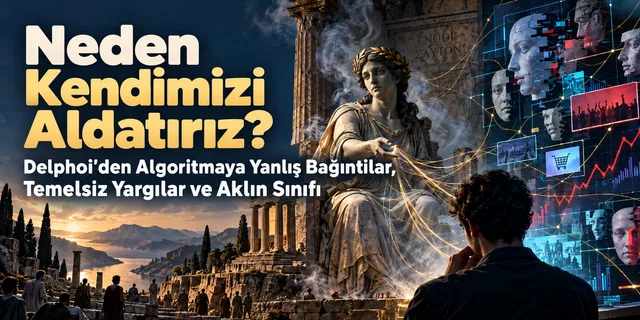
MARFET gatherings have become a tradition for us. In September we wrote about philosophy for young comrades on the occasion of a discussion of Nietzsche. At the end of October, we addressed “Why Do We Deceive Ourselves?” on a journey from Delphi to the algorithm. Today we want to do something more fundamental: celebrate philosophy itself and discuss why it remains, perhaps more than ever, a guide.
First, a Summary: Ten Theses
- Before it is a field of expertise, philosophy is a human activity. Everyone lives with an implicit worldview. The question is not whether we philosophise, but whether we do so consciously or unconsciously, critically or by accepting what we have inherited.
- A guide does not walk the road for us. The lantern lights the way, but we are the ones who walk. Philosophy is not a manual dispensing ready-made answers; it is a light that teaches us to ask questions.
- The market's “guide” is not the same as philosophical guidance. The self-help industry places the problem on the individual and advises adaptation; philosophy questions the conditions that produce the problem.
- Since Socrates, a first lesson of philosophy has been that an unexamined life is not worthy of a human being. This is not just a call to individual virtue, but an attitude that troubles power. Socrates' death by hemlock is evidence of that.
- Enlightenment is a matter of courage. In Kant's formulation, it means having the courage to use one's reason without another's direction. Today that “other” may be an authority or an algorithm.
- Marx did not end philosophy; he brought it down to earth. “The philosophers have only interpreted the world, in various ways; the point, however, is to change it.” This thesis is not against philosophy, but about its fulfilment.
- Changing our lives and changing the world cannot be separated. Conditions change people, and people change conditions; practice is where the two meet.
- “Living together” in an age of crises is not an abstract wish. Crisis does not place the same burden on everyone. A philosophy of coexistence cannot be built without asking whose shoulders bear that burden.
- In the age of artificial intelligence, philosophy is not a luxury but a form of self-defence. To the extent that we hand over thinking to a machine, we need to know whose thinking we are accepting.
- Philosophy is not done alone. From the agora to Epicurus' Garden, from reading in coffeehouses to today's MARFET table, philosophy has been a practice of thinking together, a commons.
Let us explore these theses in turn.
Why Is Philosophy a Guide Rather Than a Prescription?
The word “guide” in the discussion's title deserves attention. It can mean two things: a manual telling us what to do step by step, or a light that helps us see the road in the dark. Philosophy guides us in the second sense.
Today some of the most crowded shelves in bookshops are filled with titles about how to be happy, successful or more productive. Some of these books look for the problem entirely inside the individual. If you are tired, you have failed to manage your time; if you are poor, your mindset is wrong; if you are anxious, you are not thinking “positively” enough. Such books may look like guides, but they can become manuals for adaptation: accept the world as it is and fit yourself to it.
Philosophy asks us to do the opposite. It moves from the individual to the conditions and then back again. Instead of asking only “How can I be less tired?”, it asks: “What working arrangements produce this exhaustion?” As we saw in our earlier discussion of Erich Fromm's distinction between having and being, alienation from oneself is not an individual weakness but the result of a social relationship.
Philosophical guidance therefore awakens rather than comforts. When the lantern lights the road, we see that it is uneven, full of potholes and slopes, and that sometimes we are going in the wrong direction. The first effect of light is discomfort. But only then can we walk the road.
The Lantern's Light: A Short Journey Through the History of Philosophy
To understand how philosophy can serve as a guide, we should briefly look at how humanity has carried oil to this lantern.
Miletus, sixth century BCE. Thales and his companions tried to explain the world through nature's own principles rather than the whims of gods. This was a great act of courage: refusing to accept “because the gods wanted it” as a sufficient answer. We should also consider the material conditions of this thinking: Miletus was a trading city where people encountered the knowledge and beliefs of different peoples.
Athens, 399 BCE. In his defence before the court, Socrates spoke the famous words that an unexamined life is not worth living for a human being. He was accused of “corrupting” the young and failing to acknowledge the city's gods; he was tried and sentenced to death. His questioning attitude and the political and social tensions in Athens provide important context for understanding the trial.
Epicurus' Garden, fourth century BCE. Epicurus established a community that also welcomed women and enslaved people into philosophy. For him, philosophy aimed to free people from fear, especially fear of the gods and of death. It is no coincidence that Marx compared the natural philosophies of Democritus and Epicurus in his doctoral thesis. We followed this thread in detail in our essay on comradeship from the Garden to the barricades.
Baghdad and Córdoba, ninth to twelfth centuries. Al-Kindi, Al-Farabi, Ibn Sina and Ibn Rushd both preserved and developed the legacy of ancient Greek thought. Ibn Rushd's approach to the relationship between reasoning and the interpretation of religious texts was debated for centuries in Europe under the name “Averroism”. Philosophy was one of humanity's great commons, crossing the boundaries of geography and religion.
Amsterdam, seventeenth century. Spinoza was excommunicated from his community and earned a living polishing lenses. He summarised his principle for understanding human action as neither laughing, weeping nor hating, but understanding. This did not mean belittling anger; it meant turning it into knowledge.
Königsberg, 1784. In answering the question “What is Enlightenment?”, Kant defined it as humanity's emergence from self-incurred immaturity and gave it a motto: Sapere aude! Dare to use your own reason. For Kant, what kept people in immaturity was not a lack of intelligence but laziness and fear. An easy way to remain there was to find a guardian: a book to think for us, a priest to have a conscience for us, or a doctor to decide what we should eat.
Brussels, 1845. The young Marx wrote the last of his theses on Feuerbach: philosophers have only interpreted the world in various ways; the point is to change it. This sentence is often read as an attack on philosophy. It is not. Marx brought philosophy down from the heavens and began to think about it through relations of labour, property and class. Philosophy would now ask not only what the world is, but what it is for whom and how it could be otherwise.
Turi Prison, 1930s. In notebooks written in a fascist prison, Gramsci said that all people are philosophers. Everyone carries an implicit philosophy in their language, common sense and beliefs. The task is to turn this scattered worldview, often inherited from the ruling classes, into a critical and coherent consciousness. This provides a theoretical basis for philosophy to leave the academy and enter the neighbourhood, the factory and the café.
These moments have something in common: philosophy advanced in the hands of those who refused to treat what exists as “natural” and “unchangeable”. Sometimes that questioning carried a heavy price: poison, excommunication, exile or imprisonment.
Should I Change My Life or Change the World?
The discussion's title speaks of something “that can change our lives”. We want to add this: truly changing our lives is impossible without changing the world that shapes them. But changing the world is also impossible without changing ourselves.
In his third thesis on Feuerbach, Marx approaches this contradiction. Some thinkers say people are products of conditions and education; therefore, to change people, conditions must be changed. But Marx asks: are people not also the ones who change conditions? Must the educator not also be educated? The answer lies where the two meet: the coincidence of changing circumstances and human activity, or self-change, can be understood as revolutionary practice.
Let us put this in everyday language. Imagine a young person at work. A self-help book tells them to get up earlier, work harder, get along with the boss and “know your value”. Philosophy invites different questions: Why do I work from seven in the morning until eight in the evening? How much of the value I produce comes back to me? Is the person beside me experiencing the same thing? What can we do together?
The second set of questions can change that young person's life. It breaks their isolation, frees them from seeing their problem as a personal failure and opens a path to acting with others. In our essay on Kierkegaard and responsibility we discussed the individual's anxiety about choice; Marxist philosophy does not belittle that anxiety, but shows that it cannot be resolved solely in the individual's inner world.
This is where philosophy's power to change life lies: it moves us from a passive story of “things that happen to us” to an active one of “what we can do together”.
Living Together in an Age of Crises: A Class Answer to UNESCO's Question
UNESCO's question this year matters: how can we coexist in a world full of crises? Migration, climate, artificial intelligence, health. We want to take this question seriously, but we must also take it a step further.
Crises do not affect everyone in the same way. In the climate crisis, someone whose home is lost in a flood and someone who arrives at a climate summit by private jet do not experience the same crisis. In the migration crisis, the person who drowns at sea and the company awarded a contract for a border wall are not in the same position. In the AI “revolution”, a call-centre worker who loses their job and a technology monopoly whose share price rises are not looking at the same future. We explored this in detail in our articles on the COP31 process in Antalya.
A philosophically honest answer to “how do we live together?” must therefore begin with three questions:
- In whose hands? Who owns the means of production, land, data and capital implicated in the crisis?
- Under whose control? Who makes decisions about the crisis, and who is excluded from them?
- For whose benefit? Whose gains do proposed solutions protect, and who is asked to pay the price?
A call for coexistence that does not ask these questions risks leaving inequality intact and asking everyone to tolerate it. Philosophy teaches us not merely to tolerate, but to understand and change. The real ground of living together is the rebuilding of what we hold in common: the commons.
Philosophy in the Age of AI: Not a Luxury but Self-Defence
When Kant described the convenience that keeps people in immaturity, he gave the example of “a book that thinks for us”. Today AI systems can answer any question fluently in seconds. They can make knowledge more accessible and lighten work; we do not deny that. But Kant's warning remains urgent: the moment we hand over thinking entirely, we must ask whose thinking we are accepting.
Many AI models are trained on data containing the labour of millions of people: books, articles, forums and dictionaries. A significant share of large, widely used models is controlled by a small number of companies, although open models and other ways of developing them also exist. The selection of data, training methods and rules for use affect which perspectives models foreground or overlook. What “thinks for us” is therefore not just a tool, but a tool situated within particular relations of ownership.
Philosophy serves as self-defence in two ways. First, it helps us distinguish a fluent answer from a correct one, correlation from causation, and what “everyone says” from truth. In our essay on self-deception we explored how algorithms can act as a “correlation factory”. Second, it teaches us to notice who asks a question and how it is framed. How a question is asked is half the answer. We traced this in language in our essay on escaping the language of hegemony.
We need philosophy not to compete with the machine, but to ask who controls it and what it serves.
Whose Philosophy?
The history of philosophy is often told as the history of great names. That account misleads. For Socrates to speak in the agora, someone had to work in the fields. The philosophy of ancient Athens' citizens, who possessed leisure (skhole, the root of the English school and French école), rested on the labour of enslaved people. Aristotle regarded slavery as natural. The history of philosophy is also the history of who was allowed to philosophise and who was not.
So when we celebrate philosophy, we celebrate it not only as the activity of books and lecterns, but also as the activity of millions of unnamed people asking “Why is it like this?” in fields, factories and kitchens. The worker who says at a meeting “this cannot go on”, the mother who does not forbid her child to ask “why”, the pensioner discussing the newspaper in a café: all are philosophers in Gramsci's sense.
Philosophy's liberating power emerges when we make it a commons accessible to everyone. In our essay on Ioanna Kuçuradi we discussed the distinction between morality and ethics and knowledge of values, alongside her contribution to keeping philosophy alive as a public endeavour in Turkey. The people gathering today in a café in İçmeler, Marmaris, to talk about philosophy are a concrete example of that public life. When philosophy leaves the lectern and sits down at the table, it truly belongs to everyone.
Two Understandings of Philosophy: A Comparison
| “Philosophy” as a manual for adaptation | Philosophy as an emancipatory guide |
|---|---|
| Locates the problem within the individual | Looks at the relationship between the individual and their conditions |
| Says “You cannot change the world; change yourself” | Says “Change yourself as you change the world, and the world as you change yourself” |
| Offers ready-made answers and prescriptions | Teaches us to ask questions and test answers |
| Comforts and numbs | First unsettles, then awakens |
| Measures success through individual competition | Considers each person's development alongside that of others |
| Is read and applied alone | Is thought through and tested together |
| Treats crisis as fate and counsels endurance | Asks in whose hands and for whose benefit the crisis is produced |
| Hands thinking to a guardian for convenience | Sapere aude: dares to use its own reason |
| Is a product sold on the market | Is humanity's shared accumulation, a commons |
Concrete Tasks: Walking by the Lantern's Light
The best way to celebrate philosophy is to bring it into life. A few suggestions for young comrades:
- Keep a question notebook. Write down each thing that makes you ask “why?” during the day. Return to the questions once a week; try to distinguish the personal from the social. You will find that most are both.
- Read a classic, but not alone. Plato's Apology, Kant's What Is Enlightenment? and Marx's Theses on Feuerbach are short texts. Read and discuss one with a friend.
- Join a local philosophy gathering, or start one. Communities like MARFET bring philosophy into public life. If there is no such table where you live, begin a reading group with three people.
- Question the questions you ask AI. When you receive an answer, ask: What assumptions does it rely on? Which perspective is missing? Who trained this model, and whose data did they use?
- Make “in whose hands, under whose control, for whose benefit?” a habit. Ask all three when evaluating a news story, policy or technology.
- Bring philosophy to work, school and the neighbourhood. Talk to a colleague about why you are tired or a classmate about whom education serves. Philosophy can change things where it is least expected.
- Share what you learn. Knowledge is a wealth that grows when shared. Summarise what you read, publish your notes under an open licence and help others think.
Dear Young Comrades,
We cannot forget that little lantern. It lights a dark, winding road. It does not illuminate the whole road, only a few steps ahead. But that is enough to walk.
Philosophy is like that. It does not give us a map of the future, but helps us see the next step. It does not tell us what to think, but teaches us how. It does not say “this is how the world is”; it invites us to ask, “Why is the world like this, and how could it be otherwise?”
And remember: no one person carried the oil for that lantern. From the sailors of Miletus to the agora of Athens, from the translators of Baghdad to the lens polisher of Amsterdam, from prison notebooks in Turi to the people gathering today in İçmeler, thousands of years of shared work have kept its light burning. Philosophy is one of humanity's oldest and most precious commons.
Today, on World Philosophy Day, we celebrate philosophy. We celebrate the courage to ask questions. We celebrate thinking together and changing things together. And we greet everyone meeting around that table this evening as fellow travellers on this ancient journey.
The lantern is lit. The road lies before us. We are the ones who walk.
Together, for better futures.
Sources
World Philosophy Day and the gathering
- Daily Nous, “Reminder: World Philosophy Day Coming Up Next Month”, 26 October 2026 (UNESCO's 2026 theme)
- UNESCO, World Philosophy Day 2026 programme, 19 November 2026
- UNESCO UK, World Philosophy Day
- MARFET – Marmaris Philosophy Community, “Understanding Philosophy as a Guide That Can Change Our Lives”, 19 November 2026, 18:00, Daima Cafe & Bar, İçmeler: Daima's Instagram announcement
Classical texts
- Plato, Apology
- Epicurus, Letter to Menoeceus
- Spinoza, Political Treatise (Tractatus Politicus), chapter I
- Immanuel Kant, “An Answer to the Question: What Is Enlightenment?” (1784)
- Karl Marx, Theses on Feuerbach (1845)
- Antonio Gramsci, Prison Notebooks
- Erich Fromm, To Have or To Be?
Related Knowledge Commons articles
- Why Do We Deceive Ourselves? From Delphi to the Algorithm
- From Having to Being: Fromm
- Kierkegaard and Responsibility
- Ioanna Kuçuradi
- From the Garden to the Barricades: The Epistemology of Comradeship from Epicurus to Marx
- On Escaping the Language of Hegemony
This article is published by Knowledge Commons under the CC BY-SA 4.0 licence. You may share, reproduce and adapt it as long as you credit the source and share under the same licence.