How a CEO's Private Life Became a Matter of "National Security"
What Does the Investigation at NVIDIA Tell Us about Monopoly Capitalism?
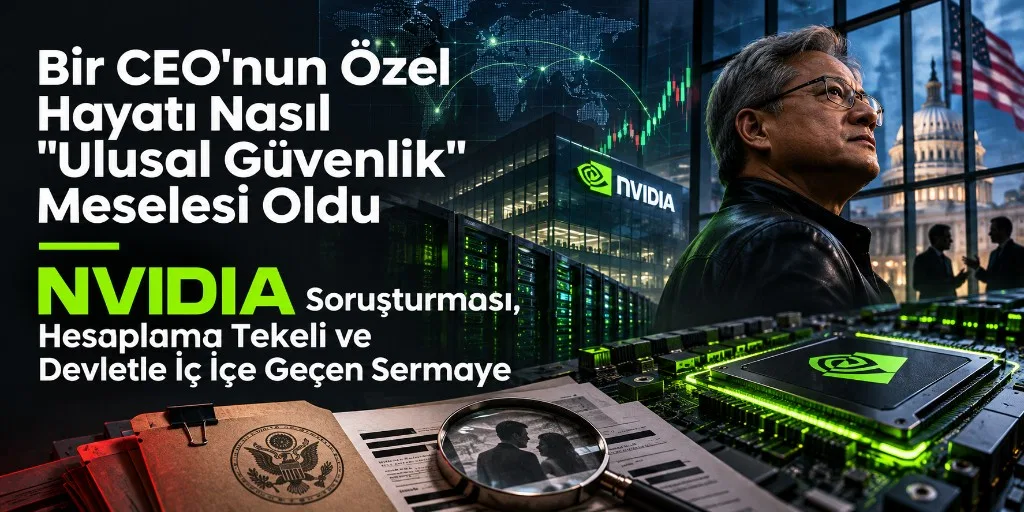
On Sunday 8 November 2026 the Nvidia board announced that it had opened an independent investigation into CEO Jensen Huang. What set the investigation off was the report the New York Times published on 29 October. According to the report, US intelligence counts Alice Huang (Huang Le), an executive of the Singaporean company Megaspeed, as an asset of China's Ministry of State Security, and Alice Huang had formed a close relationship with Jensen Huang. In an email to employees Huang admitted that he had been unfaithful to his wife, apologised, and said he would give the investigation his full support. The board announced that there was "no reason to believe that national security or Nvidia's secrets have been put at risk". So for now there is no finding of a security breach, but the investigation has also only just begun.
The magazine face of the news is a confession of infidelity. Its class face is much larger.
Summary
- The private life of a single person shakes hundreds of billions of dollars. After the reports, Nvidia shares lost hundreds of billions of dollars of value in a single day. This shows how few hands the computing infrastructure of the age of artificial intelligence is gathered in.
- "National security" is here the name of the security of capital. Chip export controls are the legal dress of the monopoly race of two blocs of capital (the United States and China) over computing power.
- The state and the monopoly are intertwined. The Department of Commerce's smuggling investigation into Megaspeed stopped after Nvidia's chief legal officer made contact with the agents. The Trump administration received the information a year earlier, but it did not act. The same administration takes a 15 per cent share of Nvidia's sales to China.
- The "independent" investigation is capital auditing itself. The real client of the investigation is not the public. It is the shareholder.
- Watch the spy-woman narrative and the language of the "yellow peril". The allegations have not yet been proved. The nationalist wave against China can be an instrument for lining workers up behind their own capitals.
- Our question does not change: In whose hands? Under whose audit? For whose benefit? So long as computing power is held in a form of property as fragile as one man's bedroom, crises of this kind will recur.
Let us now go into the detail.
What Happened? A Short Chronology
| Date | Development |
|---|---|
| 2024–2025 | Alice Huang is seen with Jensen Huang at Computex events. Megaspeed becomes one of Nvidia's largest customers in Southeast Asia; it buys about 4.8 billion dollars of equipment. |
| August 2025 | The Trump administration announces that it will take a 15 per cent share of certain chip sales Nvidia will make to China. The same month Nvidia's chief legal officer, Tim Teter, emails Department of Commerce agents who are examining Megaspeed. |
| October 2025 | US officials inform Trump of the Jensen Huang–Alice Huang relationship. The administration does not act. |
| Early 2026 | The United States permits the sale of H200 chips to China; this time China's regulators block the imports. |
| 29 October 2026 | The New York Times writes that US intelligence counts Alice Huang as a Chinese intelligence asset and that she formed a close relationship with Jensen Huang. |
| 8 November 2026 | Huang confesses the infidelity; the board opens an investigation with a committee of independent directors and outside lawyers. Huang remains in his post. |
| 9 November 2026 | Nvidia shares fall by as much as 8.8 per cent during the day; the New York Times writes that the Department of Commerce investigation was halted after Nvidia's contact. |
| 18 November 2026 | The date of the closed session that House committee chairs have asked of Huang. Nvidia's third-quarter results will be announced the day before. |
The figures differ slightly among the sources: CBS News reports the board's statement, Al Jazeera gives the previous week's one-day loss of 450 billion dollars, and The Next Web, relying on Bloomberg, gives a loss that at one point on Monday approached 400 billion dollars. CNBC writes that the share closed the day down 4 per cent. Whatever the exact figure, the order of magnitude is the same: hundreds of billions of dollars.
Let us also note what is not known. The allegations about Alice Huang rest on unnamed sources. Megaspeed denies the smuggling. China's Ministry of Foreign Affairs describes the allegations as "baseless smears". Nvidia says that the allegations of steering towards Megaspeed were examined last year and refuted. The board's saying "we see no reason" is not a finding. It is a statement. We are not declaring here who is guilty. We are looking at what the event lays bare.
The Question the Magazine Covers Over
The bourgeois press cast this news in two moulds. The first is moral: "The boss of the world's most valuable company was unfaithful to his wife." The second is a spy novel: "A beautiful Chinese agent infiltrated the heart of the American technology giant." Both moulds do the same work: they reduce the matter to the character of an individual.
The question that has to be asked is this: Why is one man's private life decisive enough to shake the world's artificial-intelligence infrastructure?
The answer is in Nvidia's place in the market. The overwhelming majority of the accelerators on which large language models are trained come out of this company; on the software side the CUDA ecosystem serves as a lock. As we set out in our essay Bubble or Debt? Meta's 145 Billion Dollars and the Class Character of the AI Bubble, a large part of artificial-intelligence investment ends up flowing into one till, Nvidia's till. In a monopoly of this scale the company is identified with the personality of its founder: the leather jacket, the stage shows, the legend of the "founder CEO". In the language of finance the name of this is "key-person risk". We give it a plainer name: the personification of property.
When Marx said that commodities make social relations appear as relations between things, he was speaking of fetishism. Here there is a second layer of fetishism. The value produced by the common labour of the foundry worker in Taiwan, the data-centre technician in Malaysia, the engineer in Santa Clara, and of humanity, the real owner of the data that trains the models, that is, of millions of workers, appears on the exchange as bound to one man's fidelity. Value is produced in labour; but the fluctuation of the valuation is read from a bedroom.
Whose Security Is "National Security"?
In the background of the investigation are the United States' chip export controls directed at China. The examination that began with unopened Nvidia equipment being found in Megaspeed's data centre in Malaysia extends to the allegation that the company rents computing to Chinese firms such as Alibaba. Today the file is in the Department of Justice's National Security Division.
What has to be seen here is the race of two blocs of capital. The United States wants to hold computing power in its hand as a monopoly. China wants to break that monopoly, either by buying it, or by illicit routes, or by developing its own chips. The same United States also wants to take a 15 per cent share of its own company's sales to China. So the matter is not "chips must not be sold to China". It is on what condition, under whose audit, and with a commission into whose till they will be sold, if they are sold.
In our essay Learning from Everyone Is Permitted, Learning from the Monopoly Is a Crime we had seen the same contradiction on the plane of the model: learning from everyone's labour was counted as "fair use", and learning from the monopoly's output was counted as "theft". The same logic works on the plane of the chip: the computing monopoly of US capital is "national security", and the rival that tries to reach it is "espionage". This does not mean that espionage does not exist; states of course watch one another. But the language of "national security" is an instrument for presenting a company's market share as if it were a question of the existence of an entire people.
We do not line up behind either of the two blocs. Neither Washington's protection of the monopoly nor Beijing's move to break the monopoly is in the worker's interest. Both want computing power for the accumulation of their own capital.
The Fusion of the State and the Monopoly
When Lenin examined imperialism, he wrote that monopoly capital and the state apparatus increasingly fuse, and that personal ties and mutual interests are woven between ministries and boards of directors. The Nvidia affair is like a textbook example of this:
- The company's contact with the investigation. According to the New York Times report relayed by The Next Web, Nvidia's chief legal officer made contact in August 2025 with Department of Commerce agents who were examining Megaspeed, and wrote that he did this with the approval of a ministry official. The agents refused the meeting; but some officials thought the contact had tainted the case, and the file passed to the Department of Justice.
- Intelligence that was known but not used. The relationship was reported to Trump in October 2025. According to the reports, the administration did not act, so as not to disrupt Nvidia's sales and not to increase the commercial tension with China. Huang was not given a "defence briefing" either.
- The state's share of the sale. The administration takes a 15 per cent share of Nvidia's sales to China.
- The president's portfolio. Al Jazeera reports that Trump has bought and sold Nvidia shares.
- The president's shield. Trump defended Huang as "a person of very high qualification", and said he would take him on the coming trip to China. Secretary of State Rubio counted the affair as "an internal company matter".
In this table the state is not a neutral referee standing above the monopoly. It is the monopoly's partner, its customer, and its protector, and, when necessary, its disciplinarian. In the essay US Midterm Elections, Techno-Capital and Algorithmic Politics we had seen that the owners of the platforms are a party to the election. Here we see the chip leg of the same relation.
The "Independent" Investigation: Independent of Whom?
The board's statement is worth reading carefully. A "committee of independent directors" will conduct the investigation with outside lawyers. Huang will remain in his post. The board maintains "its confidence in Jensen and the management team".
In the language of corporate governance, "independent director" means independent of the management. It does not mean independent of capital. The duty of these directors is to protect shareholder value. So the investigation's real question is not "was the public harmed?" It is "how much will the share value be harmed, and how do we limit that?" That "we see no reason" is said while there is still no finding is, for this reason, a market message more than a finding: Stay calm, the ship is on course.
We know this from Turkey too. As we saw in the essays Whose Party Is the Fund Crisis Breaking? and Six and a Half Trillion: The Money Wiped Off the Exchange, the Life Missing from the Table, when capital audits itself, the audit turns into a public-relations stage of rebuilding confidence. When the referee is also on the field, the result of the game is settled from the start.
The missing subject here, once again, is the worker. The tens of thousands of Nvidia employees who read Huang's apology email have no say in this investigation, and they have no right to a say about which country the company will sell chips to, on what condition, and for what purpose. The decisions that determine the company's fate are taken outside those whose labour makes that company exist.
Staying Awake against the Spy-Woman Narrative and the Language of the "Yellow Peril"
We have to be careful on two points.
The first is the mould of "the foreign woman who seduces". This mould has been in the propaganda repertoire of wartime since Mata Hari. It shows the woman as both immoral and dangerous, and it presents the man as a victim overcome by his weakness. Yet what is there is two adult human beings, and a many-layered commercial and personal relationship formed with one of a company's most important customers. The allegations about Alice Huang rest for now on unnamed sources, and they have not been proved. We leave both the accusation and the exoneration not to a court, but to the facts.
The second is the suspicion of "loyalty" directed at Asian Americans. Jensen Huang is an American citizen born in Taiwan; Alice Huang is a Chinese citizen. In the history of the United States, cases of this kind have turned into waves that declare scientists and engineers of Asian origin suspect as a whole. The known example of this is the physicist Wen Ho Lee at Los Alamos in 1999, charged with espionage and held in a cell for months, after which a large part of the charges fell and the judge apologised on behalf of the government. As the discourse of the "China threat" grows, the cost is paid not by the owners of the companies, but by students, researchers and workers of Asian origin.
The nationalist wave is the oldest instrument for lining workers up behind their own capitals. The opposition set up between "our monopoly" and "their spies" covers the real opposition, the one between labour and capital.
Two Readings Side by Side
| What does the bourgeois press say? | What is visible from the window of class? |
|---|---|
| A famous CEO was unfaithful to his wife; this is a matter of morals and reputation. | That one person's private life shakes hundreds of billions of dollars shows that property is concentrated to an extreme. |
| A Chinese agent tried to infiltrate American technology. | Two blocs of capital are racing for the computing monopoly; "national security" is the legal dress of this race. |
| The board opened an independent investigation; corporate governance is working. | Capital is auditing itself; the client of the investigation is the shareholder, not the public. |
| The president trusts Huang; the state is watching the affair closely. | The state is the monopoly's partner (a 15 per cent share), its protector, and, when necessary, its disciplinarian. |
| The share fell, investors are uneasy. | The value the workers produce is shown on the exchange as bound to one man's fidelity: the second layer of fetishism. |
| The matter is whether Huang will remain in his post. | The matter is in whose hands computing power is, under whose audit, and for whose benefit. |
What Does It Tell Us?
Let us gather the lesson that comes out of this event in three questions.
In whose hands? Computing power, one of the basic means of production of the age of artificial intelligence, is in the hands of a handful of companies, and within them in the hands of founder-managers. This concentration has gone so far that one man's private relationship can turn into an international security file, a session of Congress, and a stock-exchange wave of hundreds of billions of dollars.
Under whose audit? The audit is shared among the company's own board, an executive power in a partnership of interest with the company, and the intelligence apparatuses of states that are in competition. In no link of this chain of audit are there the workers, the users, or society.
For whose benefit? The investigation protects shareholder confidence, the export controls protect the bloc of capital's monopoly, and the president's shield protects the partnership between the state and the monopoly. None of them aims at turning computing power towards humanity's common problems, towards health, the climate, and education.
As we defended in the essay For the Restitution of the General Intellect: The Socialist AI Manifesto Is Out, so long as computing infrastructure is not a commons under public and democratic audit, crises of this kind will be the rule, not the exception. Today a confession of infidelity, tomorrow a fight over management, the day after an export ban. Each time the world's information infrastructure will remain hostage to the fragility of a few people.
Concrete Tasks
- To read the news without personalising it. When this event is talked about around us, to carry the question from morals to property: "Why is one person's life this decisive?"
- To question the language of "national security". In technology news, to show which interest of which capital this expression protects; to refuse to take the side of either bloc.
- To stand against racist and sexist moulds. To oppose the narratives of the "spy woman" and the "China threat" making workers of Asian origin, and women, into targets.
- To put the computing workers' right to a say on the agenda. To discuss, as a trade-union demand, that those who work in technology companies have a say in the company's decisions on sales, cooperation, and use.
- To defend the commons of computing. To support initiatives working for public computing infrastructure, open hardware designs, and free-software ecosystems, and to grow this discussion at gatherings such as Odak 2026.
- To watch the calendar. To read again, with the three questions in this essay, what is said in the results on 17 November and in the session of Congress on 18 November.
Dear young comrades,
This news will be forgotten in a week. The board will in all likelihood say "no serious breach was found", the share will recover, and perhaps on the stage of a new launch the same leather jacket will be applauded again. But this short crisis showed, for a moment, something that is normally not visible: behind the bright shop window of artificial intelligence there stands a structure of property gathered in the hands of a few people and intertwined with states.
However strong that structure looks, it is fragile. An email, a newspaper report, a confession is enough to shake it. Our work is to turn that fragility into an opportunity: to tell that knowledge, computing, and the labour that produces them can be common property, and that they ought to be, and to organise for this.
The machine is new, the chain is old. Breaking the chain, too, will be all together.
Sources
Reports
- CBS News, "Nvidia investigates CEO Jensen Huang amid allegations he was target of Chinese intelligence effort": link
- Al Jazeera, "US chipmaker Nvidia investigates CEO Jensen Huang over affair" (8 November 2026): link
- The Next Web, "Commerce halted its Megaspeed probe after Nvidia stepped in, NYT reports" (9 November 2026): link
- Implicator.ai, "US officials believe Megaspeed executive Alice Huang…" (a summary of the New York Times report, 29 October 2026): link
- CNBC, "Nvidia investigates CEO Jensen Huang's relationship with alleged Chinese spy" (8 November 2026): link
- CNBC, "Nvidia stock falls 4% as scrutiny turns to Jensen Huang's affair with alleged Chinese spy" (9 November 2026): link
- Bloomberg, "Nvidia Board to Probe Spying Case After CEO Jensen Huang Admits Infidelity" (8 November 2026): link
Books
- V. I. Lenin, Imperialism, the Highest Stage of Capitalism (1916)
- K. Marx, Capital, Volume I, Chapter 1, "The Fetishism of Commodities and the Secret Thereof"
Related Essays from Bilgi Müşterekleri
- Bubble or Debt? Meta's 145 Billion Dollars and the Class Character of the AI Bubble (24 October 2026)
- Learning from Everyone Is Permitted, Learning from the Monopoly Is a Crime (9 September 2026)
- US Midterm Elections, Techno-Capital and Algorithmic Politics (28 October 2026)
- Whose Party Is the Fund Crisis Breaking? (21 October 2026)
- Six and a Half Trillion: The Money Wiped Off the Exchange, the Life Missing from the Table (23 October 2026)
- For the Restitution of the General Intellect: The Socialist AI Manifesto Is Out (15 September 2026)
This essay is published under the CC BY-SA 4.0 licence. It is a living document. It is updated with criticism and contributions.