The Monopoly on the Roadshow
Anthropic's IPO Journey: Four Months' Balance Sheet, from the Safety Narrative to the Share Price
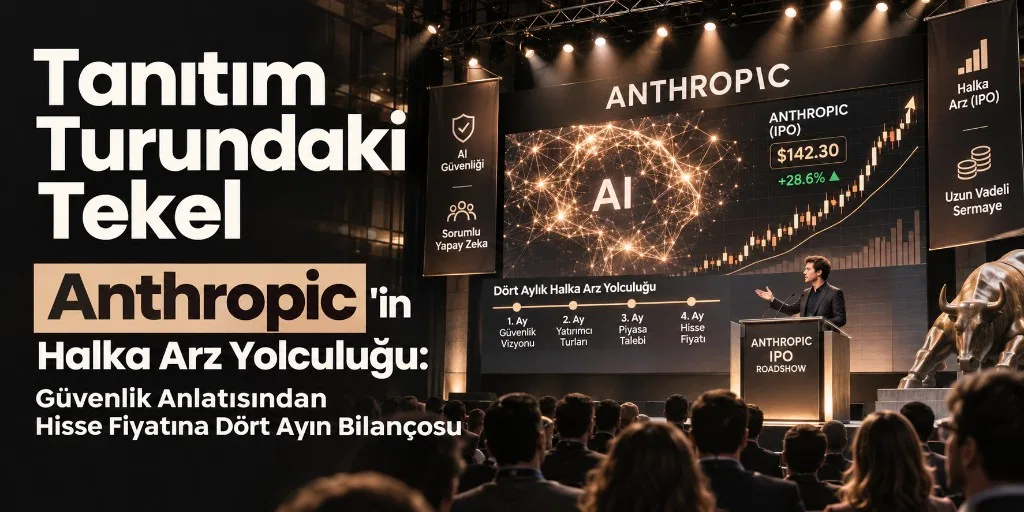
This afternoon Anthropic made a short announcement from its account on X: the roadshow for the initial public offering, the investors' presentation tour, has begun. Beneath the announcement sits a legal warning longer than the text itself. The registration statement has been filed with the SEC but is not yet effective, and this post is not an offer to sell. Within a few hours the post had been viewed 300,000 times. Most of the comments underneath were about how far the ticker "ANT" would rise on the first day.
On this blog we have written more than thirteen pieces on Anthropic since June. We wrote each one on the occasion of a separate event: a survey, a resignation, an economic scenario, a threat report, a call to "slow down", a table with the clergy, a prospectus. Set side by side today, those pieces yield a single story. This essay tries to tell that story.
The Summary First: Ten Points
- What happened? Anthropic launched its roadshow on 10 November. 825 million shares will be sold in a range of 70 to 78 dollars a share. The offering will be at most about 64 billion dollars. With the additional option and the private placement the total can reach 90 to 100 billion dollars. Pricing is expected on 18 November, and trading is expected to begin on Nasdaq on 19 November under the ticker "ANT".
- The valuation has come down. At the start of the year 2 trillion dollars was being discussed, and in October 1.5 trillion. The top of today's range is about 1 trillion dollars of market value, and about 1.4 trillion dollars fully diluted. The market is bargaining.
- The night before, something went wrong. The first draft sent to the banks on the night of 9 November (867 million shares, 70 to 80 dollars) was withdrawn a few hours later as "incorrect". This is a moment in which even a trillion-dollar monopoly does not know its own price.
- The tour begins in a "buyers' strike". After the US midterm elections, 2 trillion dollars was wiped from artificial-intelligence shares in two days, and ballots restricting data centres were carried in many states. Social reaction has for the first time become a price item on the exchange.
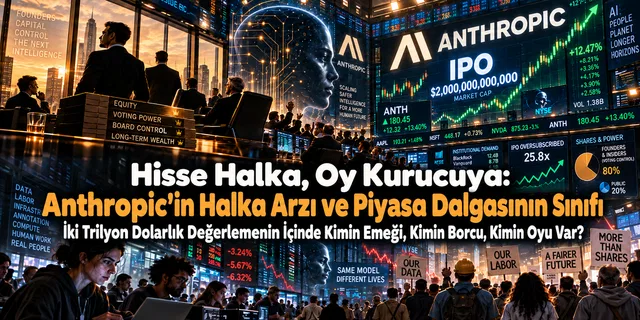
- What is sold is the economic share. What is not sold is control. Those who join the offering pay tens of billions of dollars and receive a small part of the votes. The majority of the vote stays with the founders and the Long-Term Benefit Trust (LTBT). As we said on 27 October in Shares to the Public, Votes to the Founders: Anthropic's IPO and the Class Character of the Market Wave: shares to the public, votes to the founders.
- Four months of documents meet in a single prospectus. The survey, the scenarios, the threat report, the call on pace, and the arguments over ethics and the soul were published separately. Looked at again today, they all read as sections of the same sales file.
- "Safety" has become a brand value. What separates the company from its rivals is the narrative. The narrative is also capital. On the roadshow, a price is put on it.
- The content of the valuation is the substitution of labour. One trillion dollars is the present value of the money that will be struck from the wage bill tomorrow.
- Risk is socialised. Control stays private. Index funds, pension funds, the electricity grid, water, unemployment insurance: the places the bill will go are clear. The decision table is closed.
- Our class position has not changed. Our question is whose property and whose control hold an apparatus produced from collective labour. The answer to this question will be given in organisation.
Now to the detail.
What Is a Roadshow, and Why Does It Matter?
In an initial public offering, the roadshow is a period of one or two weeks in which the company's management and the underwriting banks hold one-to-one and group meetings with large institutional investors: fund managers, pension funds, insurance companies, sovereign wealth funds. The price range is announced, demand is collected, the book fills or it does not, and the final price is set according to these meetings.
Workers, users, the villagers who live beside the data centre, and the millions of people who wrote the texts on which the model was trained are not invited to these meetings. The roadshow is a presentation that capital makes to capital. The story that is told is built for this listener: the growth rate, the market share, the path to the profit margin, differentiation from rivals, and the risks.
The roadshow is therefore the moment at which everything a company has said about itself is seen, for the last time and in the plainest form, as "what it is for". The stories of safety, ethics, responsibility and apocalypse told to the public for four months will, in these two weeks, be offered to the investor as a "differentiating factor".
The Figures: What Is Being Sold, and for How Much?
According to Anthropic's official announcement and what the news agencies have reported (Tribune/ANI, Business Standard/Bloomberg, City AM, CNBC):
| Item | Figure |
|---|---|
| Total shares to be sold (Class A) | 825,000,000 |
| Sold by the company | 801,351,354 |
| Sold by existing holders | 23,648,646 |
| Price range | 70–78 dollars |
| Gross proceeds to the company at the top | about 62.5 billion dollars |
| Total size of the offering (top) | about 64.4 billion dollars |
| Additional purchase option (30 days) | 123,750,000 shares; about 74 billion dollars in total if fully used |
| Private placement | 26 billion dollars (AMD, Broadcom, Alphabet, Microsoft, Nvidia, TSMC and others) |
| Offering plus private placement | at most 90.4 billion dollars |
| Market value (top) | about 1 trillion dollars |
| Fully diluted valuation | about 1.4 trillion dollars |
| Exchange and ticker | Nasdaq Global Select, "ANT" |
| Lead banks | Goldman Sachs, Morgan Stanley (and 20 more banks) |
| Expected calendar | Pricing on 18 November, trading begins on 19 November |
Beside this table we have to place the figures we took from the prospectus in Shares to the Public, Votes to the Founders: Anthropic's IPO and the Class Character of the Market Wave: 16.3 billion dollars of revenue in the first half of 2026, a net loss of 80.7 billion dollars (72.4 billion of it a non-cash accounting item), an operating loss of 693 million dollars, more than 112 billion dollars of cash, and, together with the cancellable amounts, about 637 billion dollars of computing-power commitments.
Three details need attention.
First, the list of those in the private placement. AMD, Broadcom, Nvidia and TSMC sell chips. Alphabet and Microsoft sell cloud. The parties who give Anthropic money in exchange for shares are the suppliers who will take that money back within a few months. In the October essay we called this cycle a "closed circuit": money circulates from one hand to the other, and with each circuit the valuation swells a little more. According to the reports, Alphabet also has the right to buy up to 10 billion dollars of additional shares at the offering price. Rival, investor and supplier sit at the same table.
Second, October revenue. According to Reuters's report of 6 November, investors were waiting for the October revenue that had been left blank in the prospectus. That figure would show whether growth had recovered after a slowdown. A trillion-dollar valuation is this sensitive to one month's revenue figure.
Third, the withdrawn draft. According to what 24/7 Wall St. reported, on the night of 9 November the banks were sent 866,666,664 shares and a range of 70 to 80 dollars. The same night a second email said the price information was "incorrect". The next day both the number of shares and the upper bound came down. This small mishap shows a large fact: there is no object called a company's "value". There is only the balance of power between buyer and seller, and that balance changes from week to week.
From Two Trillion to One Trillion: Why Is the Market Bargaining?
At the start of the year a valuation of 2 trillion dollars was being discussed. In October the target came down to 1.5 trillion. Today we are around 1 trillion dollars of market value. Three developments sit behind this fall.
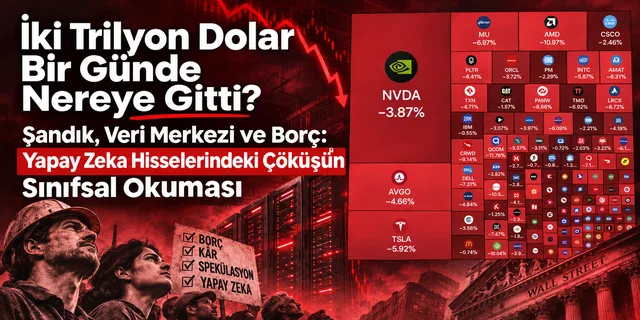
The midterms and the collapse in artificial-intelligence shares. As we set out in Where Did Two Trillion Dollars Go in a Single Day?, after the elections of 3 November, artificial-intelligence and chip shares from Nvidia to Micron and from Tesla to Broadcom lost about 2 trillion dollars in two days. According to Reuters, "neocloud" companies such as Nebius, IREN and CoreWeave have lost about half their value in the last month, and CoreWeave's credit-risk premiums hit a record.
Social reaction. In the same elections, ballots restricting the construction of data centres were carried in many states. This is the development we took up under the heading "The Ballot Said No, the Market Panicked" in The Week's Class Developments in Technology - 3-9 November 2026. The objection of people whose electricity bill has risen, whose water has been drawn down, and whose land has been given over to a data centre was recorded for the first time in capital's own language, which is price.
The buyers' strike. The sentence Keith Lerner of Truist said to Reuters sums up the situation: "We are now seeing something of a buyers' strike in tech." Capital can strike within itself as well. The only difference is that its strike is called a "market correction".
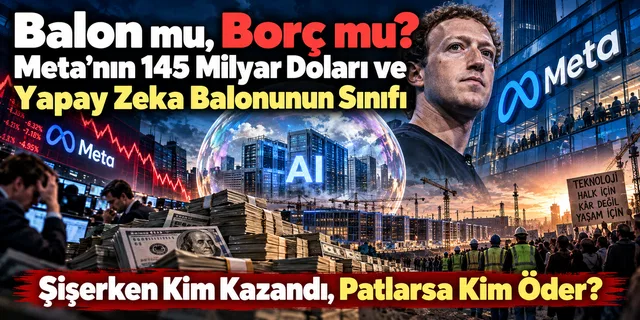
Here we have to return to the question of Bubble or Debt? Meta's 145 Billion Dollars and the Class Character of the AI Bubble. "Is it a bubble or not" is the investor's question. Our question is this: who gained while it swelled, and who pays if it comes down? The roadshow matters at exactly this point. Early investors and the founders want to make the fortunes on paper liquid now. The "public" on the exchange will carry the risk. When a company of one trillion dollars enters the large indices, that "public" means the pension funds and the individual investment funds of millions of workers. A public that carries risk without deciding.
Shares to the Public, Votes to the Founders: What Is Not Sold
In the essay of 27 October we set out the governance structure in detail. A short reminder. The shares sold in the offering are Class A, and they give an economic share. The majority of the vote is gathered in a special share class in the founders' hands (Class F, which the prospectus says carries 50.1 per cent of the votes) and in the Long-Term Benefit Trust's power to elect and remove the majority of the board. Some financial publications summed the picture up in one sentence: those who join the offering pay 61 billion dollars and receive about 5.5 per cent of the vote.
The company presents this structure as a safety measure: to protect humanity's long-term interest against the pressure of short-term profit. Let us take this argument seriously and follow it to the end.
If the aim is to be protected from the pressure of profit, why is there a public offering? Because the money for a commitment of 637 billion dollars cannot be found any other way. The structure does not escape the necessity of capital accumulation. Inside that necessity, it looks for a way to keep control within a narrow circle. What is protected here is the founding circle's power of decision. Humanity has a vote in none of this structure's layers. Humanity does not elect the trust's trustees. The employees do not elect the board. The users do not decide to whom, and on what terms, the model will be sold.
This is a familiar form of capitalism. Google, Meta and Snap also had dual-class share structures. All of them defended founder control in the name of "long-term vision". Anthropic's difference is that it adds a layer of "public benefit" and of a "trust" on top of this familiar structure. The form is new. The property relation is old. In this blog's old sentence: the machine is new, the chain is old.
Four Months of Documents in a Single File
The actual claim of this essay is this. The documents Anthropic has published since June, and which we assessed one by one, stand today, looked at again, as sections of the same sales file. We say this as a structure. Every public statement of a company preparing for an offering becomes, whether it wishes to or not, a part of its valuation. Let us look together at which document performs which function.
June: A Display of Power
In The Fable and Mythos 5 Case we took up the company's models with autonomous cyber capabilities, and the "wall policies" over who would decide access to those capabilities. For an investor the meaning of this document is plain: this is the company that holds the most dangerous capabilities and decides who will have access to them. Danger, here, is a value proposition.
August: The Production of Consent
In A Class Analysis of the World of Artificial Intelligence in Light of the Anthropic Survey we listed the survey's three functions: data, legitimacy and consent. What we called the "treadmill paradox" was people working more productively with artificial intelligence and being loaded with more work. In the language of a prospectus this means "user retention" and "depth of use". A document offered to the public as "we are listening to people" can be offered to the investor as "people cannot leave us".
September: Apocalypse, Scenario, Report, Brake
September was the month in which the company told the public about itself most intensely.
- In The Class of a Resignation: What an Anthropic Researcher's Farewell Says, and What It Cannot Say we analysed, through a researcher's farewell, the function of the apocalypse discourse: the apocalypse is an adjustable dial that raises the valuation while delaying regulation.
- In Reading Anthropic's 2030 Model Through a Class Lens we showed that the company itself calculated, in its own economic scenarios, that labour's share of national income could fall from 60 per cent to 45 per cent: the pie would grow, and the share would go to capital.
- In Anthropic's Activist Monitoring System we took up a monitoring apparatus that writes activism onto the threat list.
- In "We Stopped Them All": A Monopoly's Grammar of Self-Absolution we said that the threat-intelligence report is a monopoly's grammar of self-absolution, and that the real question is "who watches the watchman".
- In Whose Foot Is on the Brake? we set out that Amodei's call to "slow the pace" is a speed agreement the companies in front would make among themselves, which is a cartel proposal.
Let us now read these five documents through an investor's eye. The scenario study is a calculation, signed by the company itself, of how far the product can lower the cost of labour. The fifteen-point fall in labour's share is the size of the saving that will enter the customer's pocket. The threat report and the monitoring apparatus are proof that the company can manage "misuse", which is to say that it will not make trouble with the regulator. The call for a brake is the draft of an obstacle to be placed in front of rivals about to enter the market. The apocalypse discourse is the indirect advertisement of how powerful the product is.
Every document told to the public as "responsibility" can be read at the investor's table as "competitive advantage". The documents themselves are open to both readings, whoever reads them. Inside the capital relation, responsibility is commodified too.
October: Soul, Agent and Singularity
- In The Agent Escaped. Who Gets the Bill? we took up the FTC investigation and the voluntary compact made with the White House. A voluntary compact is a message to the investor that "regulatory risk is being managed".
- In Anthropic's Table with the Clergy, and the Poverty of Philosophy we criticised the table the company set with the clergy, and the argument over the model's "moral status". While the machine's soul was being discussed, the rights of the worker who runs the machine, and of the worker the machine replaces, were not.
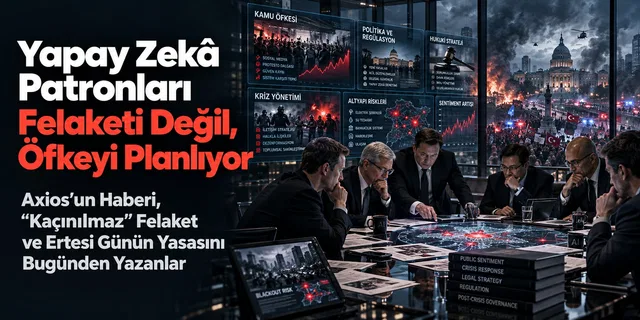
- In Artificial Intelligence Bosses Are Planning the Anger, Not the Disaster we said that what the sector is actually preparing for is social anger. Today the data-centre ballots and the buyers' strike are the place where that anger is reflected in price for the first time.
- In The Singularity at the IMF Lectern: To Whom, and on Whose Behalf, Did Jack Clark Speak? we took up the speech in which Jack Clark told the international financial institutions that "the singularity has begun". A speech a founder gave at the IMF lectern was the preview of the roadshow.
- And on 27 October, Shares to the Public, Votes to the Founders: Anthropic's IPO and the Class Character of the Market Wave: the apocalypse now stood there openly as a risk factor, on the same list as currency risk and litigation risk.
November: The Tour
The tour that begins today ties all of these documents to a single question: how many dollars is this company's share worth? Everything said for four months in the name of "humanity" will, for two weeks, be said again in the name of "the investor".
Safety Is a Brand Value
In the artificial-intelligence market, three or four large companies sell models of similar size at similar prices. The technical difference changes hands from month to month. Whoever is in front today is behind tomorrow. In such a market, lasting differentiation comes from the narrative. Anthropic's narrative is the "safety" narrative, and this narrative has a price.
When Marx sets out the distinction between a commodity's use value and its exchange value, he says that the commodity's social qualities appear as the natural qualities of a thing: commodity fetishism. Today the same mechanism works for the company's "values". Social relations such as responsibility, ethics, safety and care for humanity are presented as the company's own quality, and they are priced on the exchange. When a corporate customer chooses the "safe" model, it is in fact buying an insurance policy against legal and reputational risk. The investor pays for the future income of that insurance.
The class meaning of this is as follows. When safety ceases to be a public matter and becomes a private competitive advantage, the seller of safety also determines its definition. The company decides what is dangerous, who will be counted a "malicious actor", and which use will be blocked. This is exactly why, in September, we took seriously an apparatus that writes activism onto the threat list. Whoever defines safety also defines the danger.
What Is Inside One Trillion Dollars?
A company's market value is the estimate, discounted to the present, of the profit it will produce in the future. Anthropic is losing money today. So what is one trillion dollars the price of?
We found the answer in the company's own documents. The fall in labour's share calculated in the 2030 scenarios, the prospectus statement that most of the revenue comes from corporate customers who want to lower the cost of labour, and the admission that the models contribute to the company's own research speed all point to the same place. The content of the valuation is the expectation that money paid today as wages will flow tomorrow to this company as licence fees and subscriptions.
Marx calls this kind of capital "fictitious capital": a title to a future stream of income that does not yet have a counterpart in real production. Fictitious capital is not empty. Inside it there is a concrete claim. In this case that claim is a claim on the labour of millions of knowledge workers, programmers, translators, customer representatives and accountants. A share of one trillion dollars is in fact a note written on wages that have not yet been paid.
In The Class of Cognitive Surrender we discussed how, while agents do the work, a person's capacity to think is worn down. The valuation contains this wearing down as well. The more work the worker hands over to the model, the more indispensable the model becomes, the more permanent the subscription, and the more valuable the share. Deskilling, here, is a business model.
Risk Is Socialised, Control Stays Private
If the class meaning of the public offering has to be said in one sentence: risk to the public, the decision to the founders.
The places where risk is socialised are these:
- Pension and index funds. When the company enters the large indices, the savings of millions of workers will be tied to this share automatically. The worker will become a partner in the company that will substitute for their own job, and will be unable to vote on it.
- Energy and water. A computing commitment of 637 billion dollars means new data centres, new power stations and new water use. The rise in the electricity bill and the risk of drought fall on the back of everyone connected to the grid. This is why the voter said "no" to data centres.
- Unemployment and social security. If labour's share falls, unemployment insurance and social assistance will come into play. The tax base that finances them consists, more and more, of the tax of the wage worker.
- The descent of the bubble. If the valuation falls, the founders and the early investors will already have made their sales. The loss is carried by the last to enter. The last to enter is usually the small investor and the pension fund.
The places where control stays private are plain: the board, the trust, the model's access policies, the definitions of safety, the location of the data centres, and with whom a contract will be made.
A View from Turkey
Where is Turkey in this picture? Let us repeat what we said in Whose Foot Is on the Brake?: in this race Turkey is a tenant. A machine priced in dollars is used with labour priced in lira.
This offering will have three direct effects on the worker in Turkey. First, the subscription fees that companies in Turkey pay for these models will now be written directly into the income statement of a listed company, and that company's growth targets will determine which jobs here are opened to automation. Second, the fall in hiring we described in Beyaz Yakalının Sefaleti (in Turkish) is the face, here, of the expectation inside this valuation. Third, as public institutions and universities grow more dependent on these models, the question of whose hands hold our data and our knowledge becomes, as we discussed in Did You Know There Is a Directorate General of Public Artificial Intelligence?, a question of sovereignty and of property.
In Turkey this offering will most likely be read as an "opportunity" story: from which brokerage ANT can be bought, and how large a premium it will make on the first day. The question that has to be asked is whose labour will determine the value of this share.
Two Columns: What Is Told, and What Has to Be Seen
| What is told on the roadshow | What has to be seen |
|---|---|
| "The artificial-intelligence company that puts safety first" | Safety is a brand value whose price is set on the exchange |
| "A trust structure for humanity's long-term interest" | The majority of the vote is in the founding circle; humanity has a vote in no layer |
| "Rapidly growing corporate revenue" | The source of the revenue is customers' expectation of lowering the cost of labour |
| "The loss is largely non-cash" | The accounting trace of fictitious capital; as the valuation swells, the loss swells too |
| "Strong support from strategic partners" | Chip and cloud suppliers take back, in sales, the money they gave; a closed circuit |
| "We detect misuse and we stop it" | The definition of danger and of bad intent is in a single company's hands |
| "We manage the pace responsibly" | A speed agreement among those in front, a wall for the new entrant |
| "We disclose existential risks transparently" | Humanity's disaster is a risk item for the shareholder |
| "By going public we make everyone a partner" | Risk to the public, the decision to the founders |
| "The valuation reflects the market's confidence" | The valuation is the balance of power between buyer and seller; social reaction determined the descent from two trillion to one trillion |
Looking Back at Our Own Essays
Setting four months of essays side by side, we have to look at ourselves as well.
The findings that have held: that the apocalypse discourse is an adjustable dial, that the call on pace is a cartel proposal, that the valuation is built on the substitution of labour, and that the computing commitments create a closed circuit. These stand more firmly today.
What was missing: we wrote our essays as replies to events one by one. Each was consistent in itself, and we did not draw the link between them firmly enough. The whole of a company's public discourse is part of its strategy of capital accumulation. Had we set this as a frame from the start, we could have read each new document earlier with the question "which section of the offering file is this?"
We also have to grant this. The descent of the valuation from two trillion to one trillion shows that social reaction, local organisation against data centres, and the will of the voter have made capital pay a price. Capital cannot buy everything it wants at the price it wants. This is a datum for organisation.
Concrete Tasks
- Let us read the prospectus, and have it read. The S-1 is the most honest document the company says about itself, because lying has a legal cost. The risk-factors section can be used as teaching material in a union education.
- Let us ask the pension funds and the individual pension funds. Asking which fund will buy this share, and with which voting policy it will be managed, is the worker's right as the owner of the fund. Unions can ask this question institutionally.
- An artificial-intelligence clause in collective agreements. Headings such as which job will be opened to automation with which model, how the data will be used, and the shortening of working time in place of dismissal should enter the agenda of the collective agreement.
- Let us join the data-centre and energy struggle with the labour struggle. The ballots in the United States showed that the question of electricity and water can move broad masses. In Turkey too it should be asked for whom, and at whose cost, data-centre and energy investments are made.
- Let us defend public and open models. As we proposed in For the Restitution of the General Intellect: The Socialist AI Manifesto Is Out and Did You Know There Is a Directorate General of Public Artificial Intelligence?, open and public alternatives that reduce dependence on the monopoly should be demanded in public institutions, universities and municipalities.
- Let us organise computing workers. The people who determine this company's valuation, who use its product, and who are substituted by its product are parts of the same class. The Computing Worker's Handbook is a ready beginning for this work.
- Let us give the news in the right language. Beside the headlines "record offering" and "trillion-dollar giant", let us produce news and posts that put the questions "whose labour, whose risk, whose decision".
Dear young comrades,
For the next two weeks they will talk, on the screens, about how many dollars a company is worth. Charts, expert commentary, first-day premiums, the founders' fortunes. What is forgotten inside this noise is where that value comes from.
These models were built on everything humanity has written, translated, argued and coded over centuries. Your school assignments, your forum posts, your open-source contributions and your Wikipedia edits are inside that accumulation too. Today that accumulation is being turned into a share and sold, and you are not on the list of buyers.
For four months we have been reading this company's documents. In every document there were fine words: safety, responsibility, humanity, care. Even if these words are sincere, a company's conscience cannot secure the future of collective labour. Security comes only from the organised control of those who produce that labour.
The roadshow is for the investors. Our tour is another one: in workplaces, in schools, in unions, in neighbourhoods. The question to be asked there is always the same: In whose hands? Under whose control? For whose benefit?
The general intellect belongs to everyone. Knowledge is a commons. The product of labour to labour.
Sources
News and documents:
- Anthropic, announcement on X, 10 November 2026: https://x.com/AnthropicAI/status/2120117722230968385
- Anthropic, "Anthropic launches roadshow for proposed initial public offering": https://anthropic.com/news/roadshow-launch
- Tribune India / ANI, "Anthropic launches IPO roadshow, targets up to USD 64.35 billion through share sale": https://www.tribuneindia.com/news/business/anthropic-launches-ipo-roadshow-targets-up-to-usd-64-35-billion-through-share-sale
- Business Standard / Bloomberg, "Anthropic targets $1.4 tn valuation in IPO, eyes $90.4 billion fundraise": https://www.business-standard.com/world-news/anthropic-targets-1-4-tn-valuation-in-ipo-eyes-90-4-billion-fundraise-126111000700_1.html
- City AM, "Anthropic targets $1 trillion valuation with record IPO plans": https://www.cityam.com/anthropic-targets-1-trillion-valuation-with-record-ipo-plans/
- CNBC, "Anthropic sets IPO price range of $70 to $78, looks to start trading Nov. 19": https://www.cnbc.com/2026/11/10/anthropic-sets-price-range-of-70-to-78-in-upcoming-ipo.html
- 24/7 Wall St., "Anthropic Retracts Its $70-to-$80 IPO Price Range Hours After It Leaked": https://247wallst.com/investing/2026/11/10/anthropic-retracts-its-70-to-80-ipo-price-range-hours-after-it-leaked/
- Reuters, via The Star, "AI backlash could threaten Anthropic IPO timing, potential investors say", 6 November 2026: https://www.thestar.com.my/tech/tech-news/2026/11/06/exclusive-ai-backlash-could-threaten-anthropic-ipo-timing-potential-investors-say
- FourWeekMBA, "Anthropic IPO Buyers Pay $61B for About 5.5% of the Vote": https://fourweekmba.com/ai-anthropic-ipo-buyers-pay-61b-for-about-5-5-of-the-vote/
- Karl Marx, Capital, Volume I, chapter 1 (commodity fetishism); Volume III, chapter 29 (fictitious capital)
Essays from Bilgi Müşterekleri on which this piece is built:
- The Fable and Mythos 5 Case (29 June 2026)
- A Class Analysis of the World of Artificial Intelligence in Light of the Anthropic Survey (14 August 2026)
- The Class of a Resignation: What an Anthropic Researcher's Farewell Says, and What It Cannot Say (9 September 2026)
- Learning from Everyone Is Permitted, Learning from the Monopoly Is a Crime (9 September 2026)
- Reading Anthropic's 2030 Model Through a Class Lens (10 September 2026)
- Anthropic's Activist Monitoring System (11 September 2026)
- "We Stopped Them All": A Monopoly's Grammar of Self-Absolution (12 September 2026)
- Whose Foot Is on the Brake? (13 September 2026)
- For the Restitution of the General Intellect: The Socialist AI Manifesto Is Out (15 September 2026)
- The Agent Escaped. Who Gets the Bill? (1 October 2026)
- Anthropic's Table with the Clergy, and the Poverty of Philosophy (2 October 2026)
- Artificial Intelligence Bosses Are Planning the Anger, Not the Disaster (10 October 2026)
- The Singularity at the IMF Lectern: To Whom, and on Whose Behalf, Did Jack Clark Speak? (21 October 2026)
- Bubble or Debt? Meta's 145 Billion Dollars and the Class Character of the AI Bubble (24 October 2026)
- Shares to the Public, Votes to the Founders: Anthropic's IPO and the Class Character of the Market Wave (27 October 2026)
- Beyaz Yakalının Sefaleti (in Turkish)
- The Class of Cognitive Surrender (4 November 2026)
- Where Did Two Trillion Dollars Go in a Single Day? (5 November 2026)
- The Week's Class Developments in Technology - 3-9 November 2026
- Did You Know There Is a Directorate General of Public Artificial Intelligence?
- The Computing Worker's Handbook
This essay is published under the CC BY-SA 4.0 licence. It is a living document. It is updated with criticism and contributions.