The Square Is Not Enough: An Organisation Is Needed to Carry It
Reading and Developing A. Cihan Soylu's "The Mass Movement and the State of the 'Left'"

Dear Young Comrades
A wave of action is running from Europe to North Africa, from the Balkans to South Asia. The cost of living, low wages, social cuts, the impoverishment of schools and budgets flowing into armament have brought millions into the street. How should we read this wave? Without exaggerating it, without belittling it, and above all by asking "what is to be done now".
A. Cihan Soylu's piece in Evrensel, The mass movement and the state of the "left" (II) (in Turkish), asks exactly this question. In this piece we will first summarise what Soylu says, then open and deepen the points we find right, and add our own contribution where the piece can be developed.
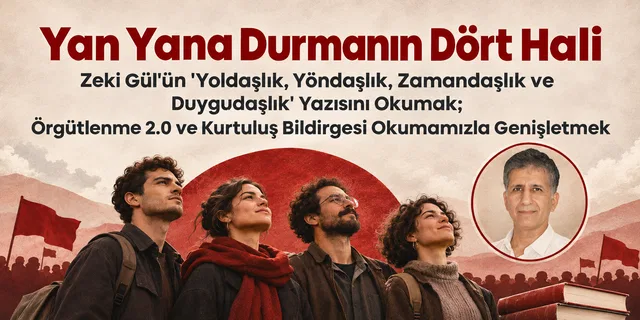
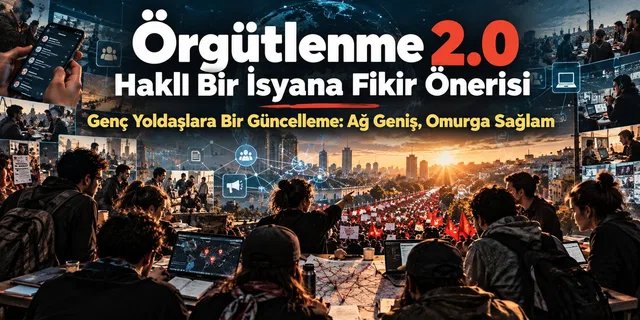
In doing this we will draw on two frames we have built on this blog in recent weeks. The first is the "network with a spine" in Organising 2.0: An Idea for a Justified Revolt, which we wrote on the occasion of the press workers' actions. The second is shared direction, shared time, comradeship and fellow-feeling in Four Ways of Standing Side by Side, which set out from Zeki Gül's piece. Soylu's piece can be read as a case in which these two frames are tested on a European scale. Our aim is not a polemic with a column. It is to carry forward, together, the thought of a comrade who stands on the same side.
Summary: The Piece and Our Reply in Nine Sentences
What does Soylu say?
- The actions in France, Spain, Portugal, Italy, Germany, Belgium, Tunisia, Albania and Bangladesh are a real and important mass movement, aimed at beating back the attack of the monopolies and the states.
- The rulers (Macron, Merz, Lecornu, Trump) smear the actions as "marginal groups of the far left", "criminals" and "migrant looting". But "to obscure is not to prove".
- Unorganised anger is open to provocation. Where there is no disciplined leadership, the real target is overshadowed.
- It is wrong to present this wave as "a new '68", "the days of the Commune" or "the spectre of communism haunting Europe". The world of 1968 was different. Today's conditions are heavier.
- The way out is to build organised unities in the factory, the workplace, the school and the neighbourhood, and to rest the square on this force.
What do we add?
- Soylu's main thesis is half of the formula we set down in Organising 2.0: a network without a spine falls apart. The other half of the formula is at least as important: a spine without a network calcifies. An organisation that belittles the square is not enough either.
- In the square people are looking in the same direction. They share a direction. But looking in the same direction is not walking the same road. The name of turning shared direction into comradeship is organisation.
- The piece can be developed at seven points: the frame of the defence of migrants (not fellow-feeling but a shared class position), the dialectic between spontaneity and organisation, today's own possibilities (from the visibility action to the cost action, and especially positional power in logistics), concrete forms of organisation (cell, assembly, spine, bridge), binding war and austerity into a single demand, the algorithmic regime of the image, and the link with Turkey.
- In short: a wide network, a strong spine. The organisation must be a structure that learns from the square and makes the square lasting.
What Does the Piece Tell?
The Map of the Wave
Soylu begins with the geography of the wave of action. The demands change from country to country, but there is a common ground: the problems of education, the cost of living, low wages, cuts in social rights, poverty, repression, and budgets transferred to war policies. According to the author, two classes look at this wave with two different eyes. The bourgeoisie sees it as a threat to the order. The workers see it as the echo of their own voice.
The Language of the Rulers
One of the strongest parts of the piece is where it exposes the rulers' strategy of speech. The names in power in Europe describe the actions as "provocateurs from marginal groups of the far left, and a large number of criminals who joined them". Trump proposes that France close its borders. Images of violence are spread especially through the figure of the "Muslim migrant", and so the demands of wages, rent and school are wiped from the screen.
Soylu's reply is short and in the right place: "To obscure is not to prove." The rulers assert, but they do not prove. Against this the author sets concrete facts: the general strike in Italy, the stoppages against war and armament in 133 ports in 22 countries, and the actions of French and German youth.
The Cost of Being Unorganised
Soylu also sees that provocation is not only a game of the police. It is a gap that the lack of organisation opens. Where disciplined revolutionary organisations do not give a direction, anger can burst in forms that overshadow the real target. When the shop window is broken, the camera turns to the window. The demand leaves the frame.
Against Historical Exaggeration
The second great axis of the piece is a criticism of the enthusiastic comparisons in one part of the left. Some greet the wave as a "movement of the earth", "the days of the Commune" or "a new '68". For Soylu this is to tell the desire, not the reality. In 1968 the Soviet Union was standing. The effect of the revolutions in China, Cuba and Albania was continuing. National liberation movements were rising from Latin America to Africa. Today these supports are gone. The conditions are heavier. It is early to give a definite judgment on how lasting the movement will be, which organisations it will be the ground of, and whether it will gain an international character.
The Way Proposed
The conclusion Soylu reaches is plain: to build organised unities wherever one is, in the factory, the workplace, the school and the neighbourhood, and to rest the "struggles of the square" on this organised force. The task that falls to socialists and revolutionary democrats is to be both organisers and educators in the places where they live and work. Only with such labour can structures arise that will lead the masses.
What Is Right, and What Has to Be Deepened
We agree with Soylu's two basic theses. The first: to romanticise the mass movement is another form of not understanding it. The second: lasting power accumulates not in the square, but in the everyday organisation behind the square.
These two theses overlap with the diagnosis we reached in Organising 2.0. There we had said: the problem is not in the method. It is in the subject. In the 1960s organised workers carried the action. Today the crowds do not give a sense of power, because there is no lasting structure behind them. One-off actions, cut off and forgotten the next day, do not produce a lasting power. What Soylu says for Europe is this too.
The sentence "to obscure is not to prove" is worth keeping as a measure not only for this wave, but for the whole speech of the rulers. The question we asked in Who Audits the Proof? was exactly this: who keeps the record of the truth?
A Network without a Spine, a Spine without a Network
The formula at the centre of Organising 2.0 was this: "A network without a spine falls apart, a spine without a network calcifies."
A network without a spine is like the European squares today: a crowd that is wide, alive and fast, but has no lasting memory, no strike fund, no legal protection and no structure of education. In that piece we had given Hong Kong 2019 as the example of this weakness: a movement that brought millions into the street, that boasted of having no centre, but that left no lasting structure behind when repression came. Soylu's warning is against this weakness, and it is right.
But there is the other half of the formula. A spine without a network is the organisation that has lost its bond with the base, and that repeats its own congress, its own declaration and its own calendar. When the mass movement comes, it either does not see it, or sees it only as a material "to be disciplined". Soylu's piece does not contain a warning of the same clarity against this second danger. What we want to add is exactly this balance: a wide network, a strong spine.
From Shared Direction to Comradeship
When we opened Zeki Gül's concepts in Four Ways of Standing Side by Side, we had written this: "Looking in the same direction does not mean walking the same road."
The squares of Europe are a living laboratory of this distinction. The student in Paris, the docker in Genoa, the teacher in Brussels and the unemployed young person in Tunis are looking in the same direction: against the cost of living, against the cuts, against the war budget. This is a shared direction, and it is valuable. But shared direction is only the first step of the passage from the "class in itself" to the "class for itself". When, the next morning, everyone returns to their own job, their own school, their own rent, the shared direction falls apart.
The name of turning shared direction into comradeship, that is, into a relation that takes responsibility for a common aim, shares the cost, and keeps the right to criticise and accountability, is organisation. We can say Soylu's call for "an organised unity everywhere" again in this language: to turn the shared direction built in the square into comradeship in the workplace, the school and the neighbourhood.
On this firm ground we want to carry the piece forward at seven points.
Sides That Can Be Developed
The Frame of the Defence of Migrants: Not Fellow-Feeling, a Shared Class Position
Soylu refuses the rulers' claim that "the activists are migrants", and stresses that the great majority of the activists are not migrants. As a fact, this may be right. But this defence, without noticing, accepts the frame the other side has built: as if, had the activists been migrants, the smear would have been justified.
The question that has to be asked is this: What would change if they were migrants? Migrant workers do Europe's cleaning, care, construction, logistics and agricultural work. They carry the heaviest load of rents, wages and social cuts. The migrant worker is not a risk standing at the edge of this movement. As the layer in which exploitation is lived most intensely, they are one of its subjects.
Here two theses in Four Ways of Standing Side by Side show the way. The first: "Fellow-feeling cannot take the place of justice." To understand the migrant's pain, to pity them, to "defend" them, is valuable, but it is not enough. The second: under the four ways there is a fifth ground, which we call a shared class position, that is, a common material position. What joins the migrant worker and the local worker is not a feeling. It is a common position against the same employer, the same landlord, the same budget cut.
Class unity is built not by saying "they did not do it", but by saying "we are the same class". We discussed the class function of racism in detail in What Is This Thing Called Racism? and AfD's 43.8 Percent Is Not a Deviation: hostility to migrants is the instrument of pulling wages down together, by dividing the working class into local and foreign. The strongest reply to this is to see the migrant worker not as the one who is defended, but as the one who is organised together with.
The Dialectic between Spontaneity and Organisation
In the piece the organisation stands as the side that brings discipline, and the masses as the side to be disciplined. The phrase "structures that will lead the masses and discipline them" is right as an intention, but it describes a one-way relation.
The most fruitful discussion of this subject in the Marxist tradition was exactly about going beyond this one-way relation. With What Is to Be Done? (1902) Lenin showed the limits of spontaneous consciousness. Rosa Luxemburg, with The Mass Strike, the Political Party and the Trade Unions (1906), set down the lesson she drew from the Russian Revolution of 1905: the mass strike is not "declared" by a party's decision. It is born from the movement of the class struggle itself. Lenin himself, when he met the soviets in 1905, quickly grasped the importance of this form, which the party had not invented. The soviet was not something the organisation gave to the masses. It was something the masses taught the organisation.
On discipline, too, another principle of Lenin's has to be remembered: "Freedom in discussion, unity in action." As we stressed in Four Ways of Standing Side by Side, comradeship is a responsibility among equals, and "keeping silent and obeying in the name of comradeship produces a new inequality." Discipline is that those who have taken a decision together abide by that decision together. It is not the application, below, of an instruction that comes from above.
The lesson that comes out of this is this: the organisation must be open not only to leading the movement and disciplining it, but also to learning from the movement. The forms born spontaneously in the square (plenums, neighbourhood assemblies, strike committees, digital networks of coordination) are the raw material of the organisation. The organisation that belittles them as "a lack of discipline" belittles its own future too. The calcification of the spine without a network is exactly this.
The Comparison with '68: Not Only Losses, but New Possibilities
Soylu's warning that "this is not '68" is in the right place. But its ground is one-way: it counts only what today has lost (the socialist camp, the wave of national liberation). Yet every period carries its own possibilities as much as its own weaknesses.
The question of shared time. In Four Ways of Standing Side by Side we had recalled Ernst Bloch's concept of "the simultaneity of the non-simultaneous": different generations and different social layers who live in the same year are in fact living different times. This holds for this wave too. The garment worker in Bangladesh, the unemployed university graduate in Tunisia and the industrial worker in Germany stand side by side in 2026, but each speaks from inside a different historical time. Shared time is not merely living in the same period. It is taking on the responsibility of the historical moment. This requires two things at once: not to take today for a repetition of 1968 or of 1871, but also to see today's own possibilities.
From the visibility action to the cost action. The most important of these possibilities is hidden in the piece's own example: a stoppage in 133 ports in 22 countries. This figure is used in the piece as a proof against the rulers' propaganda, but its real importance is strategic. In Organising 2.0 we had separated two kinds of action: the visibility action shows something, the cost action stops something. A march in the square is a visibility action. A container that is not loaded in the port is a cost action. In the same piece we had also made another warning: "A reaction whose cost is known in advance is not a deterrent." The rulers can calculate the cost of a march in advance. They have trouble calculating the cost of a port that has stopped.
Today's capitalism rests on global logistics chains that work "just in time" and are tightly bound. An hour stopped in a port, a transfer warehouse, a data centre or an energy line spreads to the whole of the chain. The sociologist Beverly Silver, in Forces of Labor (2003), divides workers' power in two: associational power (union, party, association) and structural power. "Positional power", a form of structural power, is the power of the worker who stands at a critical point of the chain of production to create a great effect with a small action. Dockers, drivers, warehouse workers, and the workers of energy and infrastructure are exactly in this position today.
The students of '68 occupied the university. Today's dockers can stop the container that is to be loaded onto a warship. This shows that the conditions are not only "heavier", but that a different strategic map has also opened. Soylu's principle of "organising everywhere" is right, but to mark the priority positions inside this map is also a task of organisation.
| The world of 1968 | The world of 2026 |
|---|---|
| A socialist camp standing, and rising national liberation movements | No socialist camp; the wave of national liberation has faded |
| The Fordist factory, large and concentrated masses of workers | Scattered workplaces, subcontracting, platform and insecure labour |
| The centre of the struggle is the university and the big factory | The critical nodes of the struggle are the port, the warehouse, energy and data infrastructure |
| News spreads late, through newspaper and television | The image spreads at once, but algorithms choose what will be seen |
| International solidarity was built through parties and states | International solidarity can be built through union networks and the direct coordination of workers |
Concrete Forms of Organisation: Cell, Assembly, Spine, Bridge
"An organised unity wherever one is" is right as a direction. But the piece leaves open the question of in which form. This gap carries the risk that the call turns into a wish. A young comrade who reads this piece should know what they will do tomorrow morning. As we said in the last thesis of Four Ways of Standing Side by Side: "Tightening the ranks is not a call. It is a plan of work."
In Organising 2.0 we had proposed a four-layer model for this plan of work. The places Soylu lists (factory, workplace, school, neighbourhood) sit easily inside this model:
- The cell: a lasting, face-to-face committee of between 5 and 30 people, built in the workplace, the school, the neighbourhood or the campus. In a unionised workplace it is the union's eye and ear at the base. In a non-union workplace it is the seed of the union. In the neighbourhood it organises problems of reproduction such as rent, bills, transport and childcare. The insecure worker, the migrant and the domestic worker who cannot organise in the workplace find a place here. In the school it sets out from the fact that the student is both studying and working (let us recall the figure in Eighty-Two Out of a Hundred Students).
- The assembly: the open meeting where the cells take common decisions. Direct vote, delegates who can be recalled, rotating spokespeople. It is the lasting form of the forums born spontaneously in the square.
- The spine: the union, the confederation, the professional organisation or the political organisation. It provides legal protection, a strike fund, education and a long memory. As we underlined in Organising 2.0, it does not run the network. It carries it. Turning the existing unions from inside, with organisation at the base, instead of condemning them from outside as "yellow", is also a way of making the spine firm.
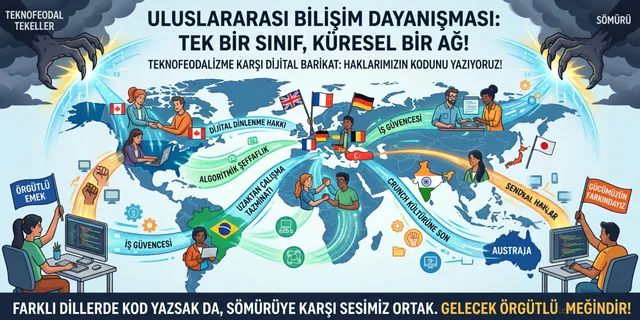
- The bridge: solidarity across the border. Because capital is transnational, the organisation too has to be transnational. The place where Soylu says "it is uncertain whether the movement will gain an international character" depends exactly on whether this layer is built. The simultaneous action in 133 ports shows that the bridge can be built spontaneously. The task is to make it lasting.
The most striking application of this model in recent history was the youth movement in Serbia (in Turkish). With plenum, delegate and veto mechanisms, a spontaneous movement turned into a lasting organisation. As we also discussed in that piece, the content of this form can stay liberal, but the form itself shows how the bridge between spontaneity and organisation can be built.
There is also the question of how the action itself is to be built. In Organising 2.0 we had distinguished the duty action from the campaign action. The duty action is a one-day ritual. It is done and forgotten. The campaign action is an escalation ladder with a timetable, every step of it measured by participation. Every action is a structure test: how many people came, how many new cells were built, how many people passed to the next step? Even failure is a measured datum. What will decide whether the wave in Europe is lasting is whether the energy in the squares turns into such a ladder.
The War Budget and the Social Cut: A Single Demand
Soylu counts war policies and social cuts side by side among the causes of the actions. But he does not turn the bond between the two into a unifying demand.
Yet this bond is the strongest instrument that can gather scattered demands on a single political axis: Every lira that goes to armament is a lira cut from the wage, the school, the hospital and the pensioner's pocket. The rising defence spending in Europe and the raising of the retirement age, the cutting of school budgets, are two columns of the same budget table.
The dockers have already built this bond spontaneously. The worker who does not load the ship that carries weapons stands both against the war and against the order that will make them pay for that war out of their own wage. The task that falls to the organisation is to turn this bond, which the workers have built in practice, into a conscious programme. The same question holds in the budget debate in Turkey: in whose favour does the gap open between interest, guarantee payments and security spending, and the minimum wage and the pension?
The Algorithmic Regime of the Image
Soylu rightly identifies how provocation and the media obscure the actions. But today this obscuring does not work only through newspaper headlines and the editing of television. The real editing desk is now the recommendation algorithms of the platforms.
Hundreds of images come out of an action: the peaceful march of thousands, the common meal in the strike tent, the workers on the quay with their arms folded, and also a burning rubbish container. An algorithm that measures interaction decides which of them will reach millions. Because anger and fear are the feelings that bring the most interaction, the burning container always passes in front of the march. Bourgeois propaganda therefore no longer even has to "tell a lie". Selective visibility is enough.
We had taken this subject up from different angles in When AI Becomes the Boss's Eye and The Card Around Our Necks. The principle of "transparent content, faceless representation" that we proposed in Organising 2.0 binds here too: not binding the word of the movement to a single face, to the image of a single leader, both protects against repression and wastes the algorithm's game of personalisation. The task that comes out of this is plain. The movement needs its own infrastructure of recording, verification and publication. Soylu's task of "being an educator" should today also cover this:
- Keep an independent and verified record of the actions (date, place, participation, demand).
- Quickly verify, or refute, images of provocation.
- Build a network of communication that puts the demands in front of the image, and that has its own channels of distribution.
- Rest all of this not on closed platforms, but on knowledge commons in common ownership.
The Link with Turkey
The piece tells Europe and ends with a general conclusion. Yet the real question in the reader's mind is this: what do we learn from this wave for Turkey?
The same mechanisms are at work in Turkey too. As we showed in One Wage in Ten Months, wages are melting against inflation. The new limit on the electricity bill forces the poor household not to save but to go cold. Hostility to the migrant worker is used in every part of politics as an easy source of votes.
Turkey also has its own experience of a mass movement: June 2013. Gezi is the most striking proof of Soylu's warning. An anger that poured millions into the street fell apart to the extent that it could not turn into a lasting organisation in the workplace and the neighbourhood. The forums built in the parks were an early example of the plenums in Serbia, but they faded because they could not build a bond with the workplace. Gezi is the experience of a network without a spine in our own history.
But the history of Turkey does not carry only this weakness. There are also the experiences we named as "seeds" from Turkey in Organising 2.0: the Spring Actions of 1989, in which public workers whose hands were bound by the laws of 12 September invented new forms of action such as the canteen boycott, collectively growing beards and the slowdown, and the 1997 action "One Minute of Darkness for Constant Light", which millions joined from home by turning their lights off at the same minute. The first shows that an organised spine can produce creative forms from the base even under conditions of prohibition. The second shows that even the most scattered mass can move at the same time with a common calendar and a simple form of action.
The complaint we hear most often for Turkey is the feeling that "there is nothing we can do". In Organising 2.0 we had described this as the feeling of being trapped: at the scale of the individual the wall looks insurmountable, at the scale of the organisation doors appear. To watch the wave in Europe and say "it is happening there, it will not happen here", and to wait for "Europe to do something", are both parts of the same trap. As we said in that piece: "Those who wait do not win; they are kept waiting."
Finally, the relation between organisations. In Four Ways of Standing Side by Side we had written that the four ways are necessary not only inside the organisation but also between organisations, and that factionalism is the greatest obstacle to this. The general strikes and the port actions in Europe gained strength where different unions and political currents could meet around a common calendar of action. As we also stressed in the piece we wrote on the Liberation Declaration, to carry the struggle into the fields, and to build a ground of common action among left parties that goes beyond factionalism, is the core of the lesson to be drawn from this wave in Turkey.
Looking with Tables
The Square and the Organisation
| The approach that trusts the square (a network without a spine) | The approach that rests on the organisation (a network with a spine) |
|---|---|
| Declares the mass movement a historical break | Sees the mass movement as a possibility for organising |
| Is content with the visibility action | Binds the visibility action to the cost action |
| Does a duty action, and falls apart the next day | Builds an escalation ladder with the campaign action |
| Is defenceless against provocation and smears | Keeps its own record, and puts forward its own spokespeople |
| Sees the migrant as a subject to be defended | Organises the migrant worker together, as sharing a class position |
| Romanticises spontaneity, or belittles it | Learns from spontaneity, and gives it a form |
The Four Ways in the Square and in the Organisation
| Way | In the square | In the organisation |
|---|---|---|
| Shared direction | Looking at the same slogan, the same target | Meeting in a common programme |
| Shared time | Being in the same street on the same day | Taking on the responsibility of the historical moment, without exaggerating and without belittling |
| Comradeship | Protecting one another in a police attack | Sharing the cost, taking the decision together, applying it together |
| Fellow-feeling | Sharing someone else's anger and pain | Turning this feeling into a demand for justice and a solidarity fund |
| A shared class position (the ground) | Standing side by side without noticing | Turning the common material position into a conscious unity |
Concrete Tasks
- Build your cell. In the place where you work, study or live, form a group that meets regularly with three or five people and puts a common problem (overtime, the wage, the canteen, the rent) on the agenda. The first principle of Organising 2.0: shrink the unit, grow the number.
- Bind it to a spine. Bind your cell to a union, a professional organisation or a political organisation. Do not wait for the threshold: if there is no legal status, begin with intermediate structures such as an association, a minority union or a solidarity network.
- Build a shared class position with the migrant worker. Come side by side, in your own workplace and neighbourhood, with migrant workers, through common problems. Language is the first field of the struggle against racism.
- Learn your position. Where is the critical link of the chain in the sector you are in? Beside the visibility action, which cost action is possible? Look for ways of building a bond with the workers in logistics, energy, the data centre or the information infrastructure.
- First measure, then climb. After every action you join, ask: how many people came, how many new bonds were built, what is the next step?
- Record, verify, publish. Keep an independent record of the actions you join. When you see an image of provocation, first verify it. Put the demands in front of the image.
- Tell the bond between war and the budget. Around you, tell with figures the relation between armament spending and wages, schools and hospitals.
- Build the bridge. Draw the lessons that can be shared with workers in Turkey from the port strikes and general strikes in Europe. Follow the cross-border union networks, and share them.
- Go beyond factionalism. Join the actions of other organisations. Do not turn the common action into your own propaganda. Build a ground of common work at the base.
Dear Comrades
A. Cihan Soylu's piece makes a cool-headed warning at a moment when enthusiasm easily turns into exaggeration: the square is important, but the square is not enough. We agree with this warning from the heart, and we want to carry it one step forward. A network without a spine falls apart, but a spine without a network calcifies too. What we need is an organisation that learns from the square, that knows the migrant worker as sharing its class position, that recognises the critical link of the chain, that keeps the record of its own truth, and that knows how to stay in the workplace, the neighbourhood and the school when the wave recedes.
In the squares of Europe millions are looking in the same direction. What falls to us is to turn this shared direction into comradeship. A wide network, a strong spine. The machine is new, the chain is old. But what will break the chain, as always, is organised labour.
Sources
- A. Cihan Soylu, The mass movement and the state of the "left" (II) (in Turkish), Evrensel, 5 November 2026.
- V. I. Lenin, What Is to Be Done?, 1902.
- Rosa Luxemburg, The Mass Strike, the Political Party and the Trade Unions, 1906.
- Beverly J. Silver, Forces of Labor: Workers' Movements and Globalization since 1870, Cambridge University Press, 2003.
- Ernst Bloch, Erbschaft dieser Zeit (Heritage of Our Times), 1935.
Related pieces from Knowledge Commons
- Organising 2.0: An Idea for a Justified Revolt
- Four Ways of Standing Side by Side
- Liberation Is in Our Hands, Unity Is in the Hands of the Class
- They Walked Past the Algorithm: How the Plenum Beat the Ballot Box in Serbia (in Turkish)
- Questions for Press Workers: Without Organisation There Is No Way Forward
- What Is This Thing Called Racism?
- AfD's 43.8 Percent Is Not a Deviation
- Who Audits the Proof?
- When AI Becomes the Boss's Eye
- The Card Around Our Necks
- Eighty-Two Out of a Hundred Students
- One Wage in Ten Months
- The Class of Three Thousand Kilowatt-Hours
This piece is one of the living documents of Knowledge Commons. It is shared under the CC BY-SA 4.0 licence. You may copy, change and share it if you credit the source.