Factory for Sale by Owner
In Whose Name Is the Crisis Being Billed?
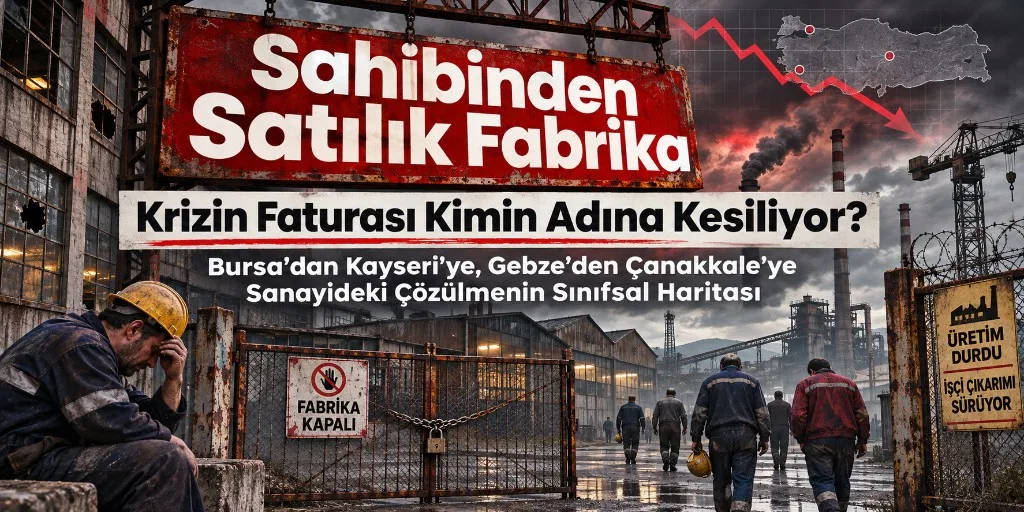
On the classifieds sites the label "sahibinden satılık", for sale by owner, no longer sits only under second-hand cars, household goods and flats. In the middle of October 2026, 2,368 factories across Turkey were on the for-sale list. In the same weeks a weaving factory of 73 years closed its doors in Kayseri, a textile giant based in İzmir locked 7 of its 13 factories, the large firms of the automotive supply industry in Bursa began to dismiss workers or to cut wages, an air-conditioning factory in Gebze notified the exchange of its decision to close, and a food giant in Çanakkale could not pay even the minimum wage on time.
In this essay we have gathered what has happened in industry over the last three months, sector by sector and factory by factory; we have set it against the aggregate figures; and we have tried to read all of it through three questions: In whose hands? Under whose control? To whose benefit?
Summary: Ten Theses
- The crisis is not in a single sector; it is in the backbone of industry. The automotive supply industry (Bosch, Döktaş, Bekaert), white goods and air conditioning (Arçelik, Alarko Carrier), textiles (TYH, Orta Anadolu, Politet) and food (Dardanel) are shrinking, closing, or unable to pay wages at the same time.
- The loss is measured in the thousands. According to Evrensel's compilation, since the start of the year at least 7,241 workers have lost their jobs in only 15 workplaces. Five thousand of them are from a single textile company, TYH.
- Industry's share of employment is at a historic low. The share of manufacturing in registered wage employment fell to 23.8 per cent in August 2026; this is the lowest rate since 2009.
- The concordat has become ordinary. In the first 10 months of 2026, 4,936 concordat decisions were given, and 249 companies went bankrupt. Three years ago this number was 1,516 a year. A concordat is a court composition with creditors.
- Dismissal is being done in a targeted way. First in line are the EYT workers, those caught by the retirement-age rule, the senior workers, those on a high daily rate, and the union members. The crisis is being turned into an opportunity to cheapen the workforce and to break up the organisation.
- The one that makes a profit and the one that makes a loss do the same thing. Arçelik, which has declared a loss, dismisses workers; Döktaş, which makes a profit, wants to cut wages; Renault, which is working at full capacity, opens a "voluntary departure" programme. The ground changes; the result does not.
- The name of the crisis is the "disinflation programme". The programme, which proceeds by high interest, tight credit and a suppressed wage, bills first the worker and then small and medium capital; the fund plunder also dries up the cash of the real sector.
- Capital migrates; the worker cannot. Production is moved to Egypt, to the Balkans, or to a cheaper province inside the country; what remains for the worker is a bargain over compensation.
- A factory for sale is at the same time land for sale. Capital that withdraws from production turns towards land and construction; the crisis turns into a period of centralisation in which big capital swallows the small.
- The way out is organised. A ban on dismissals, a ban on dismissals for a company that receives an incentive, open books, the opening of a closed factory to workers' control: these are put on the table only by an organised force. That the women workers of Dardanel beat back the imposition of a 12-hour day by stopping work shows that this is possible.
Let us now go into the detail.
From the Ground: A Factory-by-Factory Map of the Crisis
Automotive and the Supply Industry: Bursa's Wheels
Bursa is the heart of Turkey's automotive industry. What has happened in this heart over the last three months shows all the forms of the industrial crisis together.
Bosch. In September 2026 it was announced that Bosch would dismiss 1,400 workers at its Bursa factories. The ground was presented as a "contraction of production" and the transition to electric vehicles. On 9 November the dismissals began: in the first stage the jobs of nearly 300 workers who are within the EYT and whose hourly wage is high were ended; it is stated that the total may reach 1,200. In the interviews in October the mood of the workers gathered in a single question: "Am I next?" According to what EMEP Bursa reported, Bosch had closed 2025 on a global scale with a turnover of about 91 billion euro and an operating profit of 1.8 billion euro.
Döktaş. Döktaş Dökümcülük, part of Güriş Holding, is 199th on the İSO 500 list, the Istanbul Chamber of Industry's top 500; in 2025 it declared 13.96 billion lira of net sales and 1.54 billion lira of EBITDA with 2,672 employees. At the beginning of November it was claimed that workers were being asked to sign a document stating that they accepted a 20 per cent wage cut, and that those who did not sign were threatened with a transfer and with dismissal. The report also says that the company has not paid corporation tax for the last three years. A company that makes a profit is in pursuit of a wage cut.
Oyak Renault. While the factory is working at full capacity and with overtime, a voluntary departure programme with six months of extra pay was opened to the workers from 2 November. The workers read this as a move of wage pressure: the polite form of the message "if you do not like it, go".
Bekaert. On the night of 29 September, 128 workers on the 4–12 shift were dismissed at the Kocaeli factories of Bekaert, Belgian capital, which produces steel cord for vehicle tyres; they were taken out of the factory before the shift ended, and they were not even allowed to say goodbye to their friends. Since June the number of those who have lost their jobs has passed 250. The dismissals came immediately after the strike that lasted 29 days in April and May and ended with a 62 per cent rise. The company points to a fall in production; the workers say that this is a pretext, and that the real aim is to settle the account of the strike.
White Goods and Air Conditioning: The Brands Stay, the Worker Goes
Arçelik. The white-goods giant of Koç Holding declared a net loss of 6.2 billion lira in the third quarter. According to the local press, at the Bolu factory 40 EYT workers were dismissed in the first stage at the end of October; it is claimed that the factory will be shrunk by 30 per cent and that dismissals of up to 700 people may be made by the end of the year, and it is written that part of the production has been shifted to Manisa. There is no official statement from the company.
Alarko Carrier. With a statement made to KAP, the Public Disclosure Platform, on 6 November, it was announced that the Gebze factory will close. Production will stop on 28 February 2027, and the contracts of 183 employees will be terminated (119 of them on 31 December, 64 of them by the end of February). The ground is the end of the Carrier and Toshiba partnership and the falling volume of sales. According to the company's statement, Gebze accounted for about 55 per cent of total production costs while bringing only 13 per cent of 2025 net sales. Production under the Alarko brand will continue in Eskişehir. According to the Gebze branch of Türk Metal, the metalworkers' union, some of the workers will be able to go to Eskişehir, and some will be dismissed at the end of the year. It was written in the press that the total compensation burden is 293 million lira.
Textiles: The Heaviest Blow
Textiles and ready-made clothing carry the deepest wound of the crisis.
TYH Tekstil. The company, based in İzmir and also producing in Manisa, Kırklareli and Edirne, announced in October 2026 that it had closed 7 of its 13 factories. The number of employees fell from about 6,900 to 1,900: 5,000 workers are outside the door. The chair of the board says that the company is in a concordat process. This is one of the largest slaughters of industrial workers to take place in a single stroke in recent years.
Orta Anadolu. Orta Anadolu, 73 years old, which produces denim fabric for brands such as Levi's, Mavi and Wrangler, stopped production in Kayseri on 11 September, and the plants closed on 12 October. The company gave as its ground the weakening of global demand and rising operating and financing expenses. The number of workers who lost their jobs at the factory where TEKSİF, the textile workers' union, is organised is close to one thousand five hundred. EMEP Kayseri, on the basis of information it received from the workers, claimed that production had been moved to Egypt for cheap labour; there is no reply from the company to this claim.
Politet. At Politet Tekstil in Yıldırım, Bursa, the workers recount that unpaid leave, the showing of leave as if it had been used, and a wage deduction have been imposed, and that the part of the wage up to the minimum wage is paid into the bank and the rest in cash. According to the workers, the aim is to force them to resign and so to escape the compensation. The company rejects the claims. This method is the quiet way of wearing the worker down without openly announcing a closure.
The picture in textiles goes beyond the companies one by one: according to the figures of TEPAV, the Economic Policy Research Foundation of Turkey, ready-made clothing alone lost more than 31,000 registered jobs in one year; according to Evrensel's compilation, in the last year 51,000 women fell out of employment in textiles.
Food: The Minimum Wage, and Not Even on Time
Dardanel. Çanakkale's food giant, which is on the İSO 500 list and whose net sales in 2025 were above 6 billion lira, did not pay the workers' wages for the last month in October. One worker's words sum up the situation: "They already pay the minimum wage, and they do not pay even that on time." The workers dismissed in March 2026 had also taken action for their compensation; as İskender Bayhan, the Labour Party (EMEP) member of parliament, stressed, what was at issue was a company that receives incentives in the billions and does not pay compensation. But Dardanel is at the same time an example that gives hope; we will return to it at the end of the essay.
The Crisis Map at a Glance
| Company | Place | Sector | What happened? |
|---|---|---|---|
| TYH Tekstil | İzmir, Manisa, Thrace | Textiles | 7 of 13 factories closed, about 5,000 workers dismissed, concordat |
| Orta Anadolu | Kayseri | Textiles (denim) | A factory of 73 years closed, close to one thousand five hundred workers unemployed |
| Bosch | Bursa | Automotive supply | A plan for 1,400 people, nearly 300 EYT workers in the first wave |
| Arçelik | Bolu | White goods | A loss of 6.2 billion TL in the quarter, the first 40 workers dismissed, a claim of a 30 per cent shrinkage |
| Alarko Carrier | Gebze | Air conditioning | The factory is closing, 183 contracts will be terminated |
| Bekaert | Kocaeli | Steel cord | 128 workers at midnight, more than 250 dismissals since June |
| Döktaş | Bursa | Casting | A claim that a signature for a 20 per cent wage cut was imposed |
| Oyak Renault | Bursa | Automotive | A "voluntary departure" programme at full capacity |
| Politet | Bursa | Textiles | A claim of unpaid leave, a wage deduction, and pressure to resign |
| Dardanel | Çanakkale | Food | Wages are not paid on time, compensation receivables |
The Larger Picture: What Do the Figures Say?
Thousands of workers, dozens of workplaces. According to the compilation of the Evrensel reporters Barış Salık and Sevim Saylam, since the start of the year at least 7,241 workers at 15 workplaces have lost their jobs. According to the same compilation, the dismissals made after union organising reached 380 workers, and resistance continues in at least 9 workplaces.
Manufacturing's share is at a historic low. According to TEPAV's calculation based on the figures of the Social Security Institution (SGK), the share of manufacturing industry in registered wage employment fell to 23.8 per cent in August 2026. This is the lowest rate since 2009, when the series began; in March 2022 the share was 27.4 per cent. According to the wage-employee statistics of TÜİK, manufacturing employment fell by more than 325,000 people from its post-pandemic peak to January 2026.
The concordat has become ordinary. According to the figures of Concordat Tracking, in the first 10 months of 2026 the courts gave 4,936 concordat decisions: 1,656 temporary stays, 1,597 rejections, 249 bankruptcies. In 2023, 1,516 decisions were given, in 2024 3,497, and in 2025 6,361; fourfold in three years. The most records are in construction, textiles, metal products, food and furniture.
A quarter of the machines are idle. According to the figures of the Central Bank of the Republic of Turkey (TCMB), the capacity utilisation rate in manufacturing industry was 74.5 per cent in October 2026.
Factories for sale. In the middle of October there were 2,368 factories for sale on the classifieds sites; according to the estate agent Mustafa Dönmez, the number of factories put up for sale in the first 10 months of the year rose by 60 per cent compared with the same period of the previous year. The distribution shows the industrial basins:
| Province | Factory-for-sale listings |
|---|---|
| İstanbul | 253 |
| Bursa | 149 |
| Kocaeli (last 30 days) | 99 (45 of them in Gebze) |
| Sakarya | 57 |
| Denizli | 49 |
| Balıkesir | 25 |
These figures are not an official statistic; they are a count of listings; the same plant can appear in more than one listing. But the tendency coincides with the other figures. İlker Önel, president of the Istanbul Merchants' Club Association, also says that the real effect of the crisis will be seen in November and December, and that some firms have reached the point of being unable to pay even wages. It is not a workers' organisation that says this; it is an employers' organisation.
Unemployment is growing. According to the calculation of DİSK-AR, the research unit of the Confederation of Progressive Trade Unions, the broadly defined number of unemployed reached 12.8 million in September, and the rate 31.2 per cent; TÜİK's narrowly defined rate is 8.4 per cent. As we recounted in TÜİK: Two Figures, One Country: 8.1% and 30.6%, the worker thrown out of the factory often reappears in the statistic not as "unemployed", but by turning into a courier, a security guard, a worker in an unregistered workshop.
Why Now? The Class Mechanics of the Crisis
The Bill for Disinflation
The official account is this: a tight monetary policy is required for the fight against inflation; high interest and limited credit will cause a little pain, but in the end everyone will gain. What actually happens is this: high interest and restricted credit choke the enterprises that turn on debt; a currency that appreciates in real terms lowers the competitiveness of the exporter, and of textiles in particular; wages are held below inflation and domestic demand is suppressed.
As we have recounted in our inflation essays, the first of them being September Inflation, the TÜİK-ENAG Gap, the real anchor of the programme is the wage. The rise in prices is slowed by lowering the worker's purchasing power. This is not a side effect of the programme; it is the design itself. The dismissals in the factories are the second act of this design: when demand contracts, production contracts, and when production contracts the workforce is seen as "surplus".
The Fund Crisis and the Cash Squeeze
The representatives of industry themselves count the investment-fund crisis and the cash squeeze among the grounds of the factories put up for sale. The crisis we recounted in Six and a Half Trillion: The Money Wiped Off the Exchange, the Life Missing from the Table and Whose Party Is the Fund Crisis Breaking? did not only burn the savings of the small investor; through the financial channel it also cut the credit and the cash flow of the real sector. The money lost in the casino is paid back as the worker's wage in the factory.
The Same Result in Profit and in Loss
Look at the map once more. Arçelik declares a loss and dismisses workers. Döktaş makes a profit and wants to cut wages. While Bosch has declared a profit of billions of euro on a global scale, it dismisses workers in Bursa. While Renault is working at full capacity, it opens a departure programme. Bekaert shrinks the workforce immediately after the rise won by the strike.
The one that makes a loss, the one that makes a profit, and the one that works at full capacity do the same thing: shrink the workforce, work those who remain more intensely, pull the wage down. So the real ground of the dismissal is not "the company's difficult position"; it is capital's compulsion to protect or to raise the rate of profit. The crisis provides this compulsion only with a cover and an opportunity.
Targeted Dismissal: First the Senior, First the Organised
Pay attention to whom the dismissals begin with. At Bosch and at Arçelik alike, the first wave is the EYT workers and those on a high daily rate. When the senior workforce is cleared out and a younger, cheaper, more precarious labour force is taken in its place, the crisis turns into an instrument for pulling the wage structure down.
The other target is the organisation. At Bekaert the dismissals came immediately after the strike. In the small workplaces in Evrensel's compilation the pattern is even clearer: at Domino Tekstil in Bolu, 60 workers, 25 of them union members, were dismissed on the ground of "economic contraction"; at Volvac in Tuzla, Istanbul, the leading workers were dismissed after the union's authorisation; at Smart Solar in Aliağa, at Bursagaz in Bursa, and at BBCA in Ergene, the workers who unionised were put outside the door. According to the same compilation, the unions win 95 per cent of the cases objecting to authorisation, but a collective agreement can be signed at only 10 per cent of the workplaces. The word "contraction" is also the legal cover for breaking up the organisation.
Capital Migrates, the Worker Cannot
The tendency that has gone on for years in textiles is to move production to countries where cheaper labour is found (Egypt, Morocco, Uzbekistan, the Balkans). In the Orta Anadolu example this claim is stated openly. In the Alarko example the move is inside the country: from Gebze to Eskişehir. At Arçelik it is written that production has been shifted from Bolu to Manisa. But for a worker in Gebze whose child goes to school there, whose spouse works there, whose rent is there, the offer "come to Eskişehir" is often not a real option. For capital, place is an item of cost; for the worker it is life itself.
Centralisation: The Big Fish Swallows the Small
In the first volume of Capital, Marx separates two movements of capital from each other: growth through accumulation (concentration) and the swallowing of existing capitals by one another (centralisation). Crises are the periods in which the second movement accelerates. Who will the buyers of the 2,368 factories for sale be? The large groups that have cash in hand and access to cheap credit and to state incentives. The customers of the supplier that enters a concordat, the machines of the workshop that goes bankrupt, the land of the plant that closes, will have gathered in fewer and larger hands when the crisis ends. For this reason, to say "industry is collapsing" is an incomplete finding: industry concentrates while it shrinks. What collapses is the meaning of industry for the worker and for the small producer.
The Title Deed Turns While the Wheel Stops
Part of the factories for sale will be bought not for production again, but for the value of the land. For years we have been watching old industrial areas that have remained inside the city turn into housing and shopping-centre projects; in some reports it is written that the value of these areas has risen by 200 per cent. The mechanism we recounted in A Building Does Not Collapse by Itself works here too: capital that withdraws from production turns towards land and construction. For the worker the factory is a livelihood; for capital it is an asset item to be sold when required.
The Incentive from the Public, the Profit Private, the Bill to the Worker
That Dardanel receives incentives in the billions and does not pay compensation is not a single example; it is the summary of a model. Investment incentives, SGK premium supports and tax reductions are transferred from the common resource of society to capital; the claim in the Döktaş report that "corporation tax has not been paid for three years" is also a part of this picture. The employment guarantee that ought to be the counterpart of the incentive is in no contract. When the crisis comes, the incentive stays in the company, and the worker goes out of the door.
The Reserve Army of Labour Grows
The common result of all these processes is the growth of the mass of the unemployed and the semi-unemployed that Marx called the "industrial reserve army". This army is a constant instrument of pressure on those who are working: "If you do not like it, there are many waiting at the door." The fear of the Bosch worker, "am I next", the fact that the Dardanel worker cannot find the courage to slow the work even when the wage is late, the paper of a wage cut put in front of the Döktaş worker: these are the everyday face of this pressure. Unemployment is a mechanism that lowers the bargaining power not only of the one who loses the job, but also of those who keep it.
And Where Are Technology and Artificial Intelligence?
In this picture it would be a shortcut to tie everything to artificial intelligence or to robots. The main cause of today's closures is monetary policy, the contraction of demand, the financial crisis, and the restructuring of capital. But two connections must not be missed.
The first is the ground, in the Bosch example, of the transition to electric vehicles. The technological transformation is real; but the question of why the bill is charged to the worker is not a technical question; it is a political one. The passage from the diesel injection system to the electric drivetrain can also be made by retraining the worker, by shortening working hours, by a planned transformation of production. What determines this is not the technology; it is the property relation.
The second is that the pattern we saw in The Poverty of the White Collar and A Generous Package, a Silent Table: What Do the Layoffs at Canva Tell Us? is at work on the blue collar too: once the workforce is shrunk in a period of crisis, it is not returned to the old number when the recovery comes; the gap is filled with automation, intensified work, and subcontracting. The saying "the machine is new, the chain is old" holds here too.
Two Accounts: The Language of Capital, the Language of the Class
| The account of capital and of the government | The reality of the class |
|---|---|
| "The global conjuncture; everyone is in a difficult position." | The crisis is not distributed equally: the company that makes a profit also dismisses workers, and big capital swallows the small. |
| "The fight against inflation will cause a little pain." | It is the wage earner who suffers the pain; the anchor of the programme is the suppressed wage. |
| "Costs are high; we cannot compete." | In Gebze the cost is "high", in Eskişehir or in Egypt it is "suitable": the matter is the cheapening of the worker. |
| "Termination on account of economic contraction." | At the head of those dismissed are the union members and those who struck; contraction is the cover for breaking up the organisation. |
| "A voluntary departure programme; whoever wishes may go." | Voluntariness is an imposition in an atmosphere of fear and debt; an instrument of wage pressure. |
| "The EYT worker is already retired, and will not be wronged." | The senior, high-wage workforce is being cleared out; a precarious young worker comes in its place. |
| "The incentive is given in order to create employment." | The company that receives the incentive does not pay compensation and delays the wage; the incentive is a transfer from the public to capital. |
| "A factory for sale is the natural movement of the market." | Capital that withdraws from production is looking for rent; the factory's land turns into a housing project. |
| "Patience; the recovery will come." | When the recovery comes, the workforce does not return to the old number; the loss becomes permanent. |
What Do We Want? Concrete Demands
There is no way out of the crisis that is "fair for everyone"; every way out works to someone's detriment. The question is this: who will pay the bill? The class's answer takes shape in the following demands:
- Let dismissals be banned. This ban was in force in the pandemic; so it is possible. Dismissing a worker on the ground of the crisis should be banned, and if necessary working time should be shortened without a loss of wages.
- The one that receives an incentive cannot dismiss. For every company that receives a public incentive, an investment allowance, or an SGK premium support, a ban on dismissals should be brought in, and a condition that the incentives be taken back otherwise.
- Let the books be opened. The books of a company that says "we are making a loss" should be opened to the inspection of workers' representatives, unions and the professional chambers. The profits transferred to the holding, the bonuses paid to the managers, the dividends that go abroad should be laid out.
- The closed factory to the workers' control. Plants that are closed or abandoned should be able to continue production on the model of a workers' cooperative or a public enterprise. Argentina's experience of the "recovered factories" is the historical example of this.
- Let the union guarantee be real. A legal change should be made that makes reinstatement compulsory for a dismissal on union grounds, and that removes the order which leaves organising suspended for years by an objection to authorisation.
- Let severance pay not be touched, and let the unpaid receivable be under the state's guarantee. The Wage Guarantee Fund should be widened so that it pays delayed wages and compensation promptly.
- Let industrial land not be opened to rent. The conversion, by a change of zoning, of the sites of closed factories into housing should be stopped; these sites should be protected for production and for public use.
- Wages cannot be held below inflation. The minimum wage and all wages should be set on real inflation, at least twice a year.
What We Can Do This Week
- Map your own locality. Gather the workplaces in your own province and in the organised industrial zone that are closing, shrinking, delaying wages, and dismissing unionised workers. Put the factory-for-sale listings, the concordat announcements, the KAP statements and the local news into one table. This is the knowledge commons.
- Share it with its source. When you share news of the crisis, add the source, and separate the claim from the information that has been confirmed. Our accuracy is the strength of our propaganda.
- Go to the factory gate. Talk with the workers in front of the workplaces where a dismissal has taken place and where the resistance continues. Hear from them what is being said and what is being hidden.
- Organise the legal support. Bring together, with labour lawyers, the professional chambers and the unions, the workers who have been dismissed, whose compensation has not been paid, who have been forced onto unpaid leave. The loss of a right often arises from not knowing.
- Spread the demands. Voice the demands "let dismissals be banned" and "the one that receives an incentive cannot dismiss" in every setting you are in (the school, the workplace, the neighbourhood, social media).
- Question the union, and stand by the union. Does the union in the factory protect the worker, or does it come to terms with the management? Asking the question is the first step in strengthening the union; being without a union is the weakest state.
Dear young comrades,
Most of us who read this news ask, with an anxiety: "Where is this course going?" This anxiety is right, but by itself it changes nothing. The anxiety has to be turned into knowledge, and the knowledge into organisation.
We want to remind you of the women workers of Dardanel. In a factory on the minimum wage, where even the wage is not paid on time, when they heard in August the imposition of a 12-hour working day, they said "we all put the knife down". And they won. The Bekaert workers too won a 62 per cent rise by striking for 29 days; now they have to resist together again against the boss's revenge. Solidarity built on one line, on one shift, can make even the worker who looks the weakest strong in front of the boss; but for that solidarity to last, organisation is required.
It is in our hands to change the question of the worker at Bosch who asks "am I next": to be able to say not "Who is next?", but "You cannot dismiss any of us". We discussed the way of this in Organising 2.0: An Idea for a Justified Revolt: a model that brings together, in the same network, the different sections of a fragmented working class, the factory worker, the courier, the white collar, the student-worker, and that organises both in the factory and in the neighbourhood and in the digital field.
Every factory that closes is not a defeat; if we can expose the real cause of the closure, it is a lesson. Every dismissal is not an end; if we meet it with solidarity, it is a beginning. Capitalism is trying to make the worker pay for its crisis; our task is to send the bill back to its real owner.
Related Essays
- Six and a Half Trillion: The Money Wiped Off the Exchange, the Life Missing from the Table
- Whose Party Is the Fund Crisis Breaking?
- September Inflation, the TÜİK-ENAG Gap
- TÜİK: Two Figures, One Country: 8.1% and 30.6%
- The Poverty of the White Collar
- A Generous Package, a Silent Table: What Do the Layoffs at Canva Tell Us?
- A Building Does Not Collapse by Itself
- Organising 2.0: An Idea for a Justified Revolt
Sources
Automotive and the supply industry
- 1,400 workers to be dismissed at Bosch: a call from EMEP that dismissals be banned — Evrensel, 12 September 2026
- Workers at Bosch in the shadow of debt and the fear of dismissal: am I next? — Evrensel, 15 October 2026
- Dismissals began at Bosch: the jobs of nearly 300 workers were ended — Evrensel, 9 November 2026
- Pressure for a wage cut at Döktaş Dökümcülük — Evrensel, 3 November 2026
- Whoever does not sign is threatened with exile and with dismissal — Evrensel, 3 November 2026
- From Renault, which is breaking records, the bluff of "departures are free" to the workers — Evrensel, 9 November 2026
- 128 workers dismissed at midnight at Bekaert — Evrensel, 29 September 2026
White goods and air conditioning
- Dismissals began at the Bolu Arçelik factory — TV Bolu, 24 October 2026
- A net loss of 6.2 billion TL from Arçelik in the third quarter — YatırımX
- A critical process for 183 workers: Alarko Carrier is closing its Gebze factory — Evrensel, 6 November 2026
- The giant company is closing its Gebze factory: 183 people will be dismissed, 293 million TL of compensation will be paid — Dünya
Textiles
- Economic difficulties hit TYH Tekstil too: 7 of its factories closed — Textilegence, 22 October 2026
- Turkey's long-established textile factory stopped production — Bursada Bugün
- The Labour Party's question on Orta Anadolu: 1,500 workers were left unemployed; was a plant opened in Egypt for cheap labour? — Evrensel, 12 September 2026
- A claim of unpaid leave and a wage deduction from the workers of Politet Tekstil — Evrensel, 28 October 2026
- In the last year 51,000 women fell out of employment in textiles — Evrensel, 6 September 2026
- At Umut Oran's factory, Domino Tekstil, 60 workers, 25 of them union members, were dismissed — Evrensel, 30 October 2026
Food
- Dardanel did not pay the workers' wages — Evrensel, 23 October 2026
- It dismissed them and did not pay their rights: the Dardanel workers took action for their receivables — Evrensel, 4 March 2026
- İskender Bayhan: Dardanel, which receives incentives in the billions, does not pay compensation — Evrensel, 11 March 2026
- The women workers won at Dardanel: when we heard of the 12 hours, we all put the knife down — Evrensel, 26 August 2026
Aggregate figures
- Since the start of the year at least 7,200 workers at 15 workplaces were put outside the door — Evrensel, 30 October 2026
- 7,241 workers were dismissed at 15 workplaces, and workers who unionised are also losing their jobs — bianet, 30 October 2026
- 35 workers were dismissed at Volvac after the union organising — bianet
- Manufacturing industry's share of employment fell to its lowest level since 2009 — Foreks / TEPAV, 6 November 2026
- Manufacturing industry employment fell by 325,000 people — Ekonomim
- A bankruptcy decision was given for 249 companies in the first 10 months of 2026 — CNBC-e, 3 November 2026
- The capacity utilisation rate in manufacturing industry was 74.5 in October — Capital, 21 October 2026
- The wheels stopped, the factory is being sold — Sözcü, 13 October 2026
- The fund crisis and the cost spiral in industry: 2,368 factories were put up for sale — YatırımX, 13 October 2026
- Factory sites turned into luxury housing projects, their values rose by 200 per cent — CNN Türk
Theoretical background
- Karl Marx, Capital, Volume I, Chapter 25: "The General Law of Capitalist Accumulation" (concentration, centralisation, and the industrial reserve army).
This essay is published under the CC BY-SA 4.0 licence. It is a living document. It is updated with criticism and contributions.