Enough of the Lesser Evil
A Reply to the Call for Unity: We Want Our Own Strength, Not What Is Imposed on Us

Dear young comrades,
On 22 November 2026, Yakup Kepenek published a column in BirGün entitled “Time to Come Together”. Kepenek is a teacher who has taught generations about Turkey's economy; we fully respect his work and knowledge. This is a respectful reply, but one written from the perspective of class.
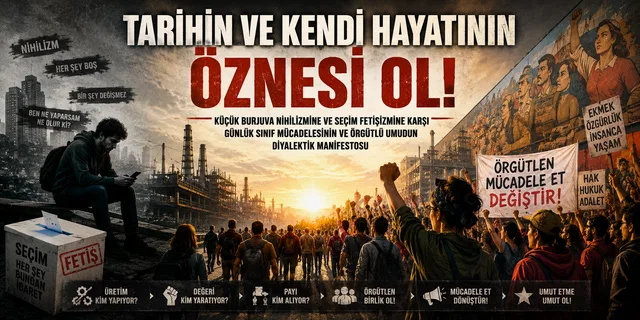
“Time to come together”, “time to unite”, “no time for excuses”: we hear these words often these days. We have heard them before, in 2014, 2018 and 2023. Each time we were shown a candidate and a ballot box; each time we were asked to postpone our own agenda. This article is a call to break that habit.
First, the Summary
- Kepenek's diagnosis is partly correct. He calls the disease of Turkish politics “cadre politics”: an elite politics built from above and detached from the people. The observation is right, but the explanation is incomplete. Cadres became detached not simply because they failed, but because of the class interests they served.
- His proposed remedy concerns procedure. Neighbourhood assemblies, primaries and members' votes are steps forward compared with domination by delegates. But procedure cannot replace substance. What people vote for matters as much as who votes.
- The word “people” obscures class. Workers and shopkeepers, employees and pensioners all become “the people” in the same sentence. Bringing bosses and workers together in a neighbourhood assembly does not resolve their contradiction; it merely makes it invisible.
- We have heard this call before. Similar calls for unity were made around Ekmeleddin İhsanoğlu in 2014 and Kemal Kılıçdaroğlu in 2023. Both lost. More importantly, what would have changed in workers' lives if they had won was rarely made the decisive question.
- The lesser evil is not a strategy but a postponement. For twelve years the task of building the class's own organisation has been deferred with the words “let this election pass first”. Elections pass; organisation remains deferred.
- Our call is clear. We will not pledge unconditional allegiance. Yes to common action and common struggle; no to abandoning our programme and organisation to dissolve into someone else's party.
What Does Kepenek Say?
The argument runs as follows: YENİ Parti's founding congress of 14–15 November is a turning point. Turkish politics has suffered from a “cadre” disease since the Committee of Union and Progress. From the Kadro journal to the Democrat Party, and from Ecevit through Özal to Baykal, the story is one of failed elite movements detached from the people. Kepenek also attributes the arrival of one-man rule to the betrayal of intellectuals. Although YENİ Parti's 160-member Party Council may at first look like another cadre project, Kepenek argues that the people are building the party with everything they have. The leaders' first task, therefore, is to unite with the people. Neighbourhood assemblies are the means; selecting all candidates by members' votes is the result.
There are points in the article that deserve acknowledgment. Kepenek openly criticises the “not enough, but yes” position and those who contributed to the Abant meetings. He describes loyalty to a leader taking precedence over knowledge and ethics as a form of decay. He wants candidates chosen from below rather than imposed from above. We do not object to any of these points. In our article on union elections, we too criticised the delegate system and block lists and argued for proportional representation.
Kepenek's article is not itself a call to vote for a presidential candidate. Our objection concerns the class questions left unanswered by his proposal to unite around the party.
Why Do Cadres Become Detached from the People?
Kepenek explains the failure of cadres largely in moral terms: intellectuals lack backbone, elites do not go among the people, leaders cannot agree. Yet a class reading of the same history gives us a different picture.
In our reading, the Democrat Party's rule cannot be explained simply by disagreements among its founders: it also represented large landowners and the commercial bourgeoisie. Özal's cadre was not a failure from capital's point of view; it consolidated the 24 January economic programme and the labour regime of the 12 September coup. The CHP under Baykal and Kılıçdaroğlu sought a path to power without mobilising the working class and failed to find one. As we argued in our reply to Evrim Ağacı, an opposition that does not challenge ownership and the labour regime leaves the question of accumulation to be settled among competing sections of the propertied classes.
A cadre does not become detached merely because it forgets to go among the people. It becomes detached when the interests of the class it represents conflict with those of the majority. A neighbourhood meeting alone cannot eliminate that contradiction.
Democratic Procedure, Class Content
YENİ Parti's use of a members' vote is a noteworthy innovation. But let us look at the congress:
- There was one candidate in the leadership primary, and he received all valid votes.
- The Party Council was chosen by delegates rather than members, using a block list; everyone on the leader's list won.
- Of the 160 members, 80 came from the legislative quota, 40 from the organisation quota and 40 from the “policy development” quota. Economists, academics and diplomats were among the prominent names.
Open the list and count: how many workers? How many union representatives, couriers, textile workers or minimum-wage earners? Asking that question is a concrete way to criticise cadre politics, and it is absent from Kepenek's article.
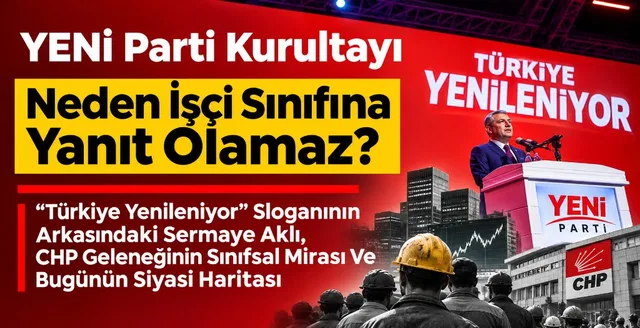
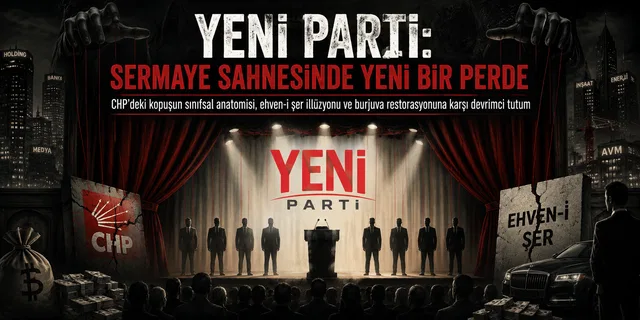
As for the programme, the congress declaration promises to increase labour's share and shift taxation towards wealth. These are not insignificant. But the same declaration places public leadership, the creativity of private enterprise and the strength of organised labour side by side in harmony. We do not see binding commitments to end strike bans, abolish industry-level union thresholds, eliminate subcontracting or reverse privatisations: issues that would put the party in conflict with capital. We discussed this in detail in our article on the congress: the sign is new, the class is old.
| The “coming together” framework | The class framework | |
|---|---|---|
| Problem | Cadre politics, elites detached from the people | Parties' dependence on the capitalist class |
| Subject | People, members, voters | The working class and its allies among working people |
| Solution | Primaries, neighbourhood assemblies, members' votes | Independent class organisation and programme |
| Unity | Party leadership and people coming together | Unity in action at work, in unions and in the streets |
| Measure | How was the candidate chosen? | Whose interests do the candidate and programme defend? |
| Worker's role | Voting and attending meetings | Deciding, writing the programme and holding leaders accountable |
| After the election | Hoping elected representatives stay connected | Right of recall, a worker's wage and accountability |
We Have Seen This Film Before
2014. The CHP and MHP made Ekmeleddin İhsanoğlu, former secretary-general of the Organisation of Islamic Cooperation, their joint presidential candidate. The message to the left was: no excuses, hold your nose and vote. İhsanoğlu received 38.44 per cent, and Erdoğan was elected in the first round. A year later, the joint candidate became an MHP MP.
2018. Again we were told, “first let's get rid of them”. We did not.
2023. The Table of Six was formed. Some socialist parties and organisations also called for votes for Kılıçdaroğlu. Thirty-nine candidates from six other parties, including parties of the right, entered parliament on CHP lists. Between the two rounds, the campaign leaned on anti-migrant rhetoric and a protocol with the Victory Party. Kılıçdaroğlu received 47.82 per cent in the second round and lost.
Now let us return to Kepenek's article. Kılıçdaroğlu, whom some urged us to support in 2023 in the name of unity, is now associated in Kepenek's column with a cadre structure detached from the people. What was presented yesterday as the lesser evil is today treated as the very embodiment of the problem. So we are entitled to ask: what will be written five years from now about the cadre we are asked to unite with today?
The main lesson is not simply the defeats. In each of these elections, the question “what will workers gain if we win?” was not given the weight it deserved. Opposition parties won municipalities in 2024; the following year, municipal workers on strike in İzmir faced a CHP-led municipal administration. Even when the lesser evil wins, the class does not necessarily win.
Why Is the Lesser Evil a Trap?
This is not a question of individuals' good intentions; it is a trap with a mechanism.
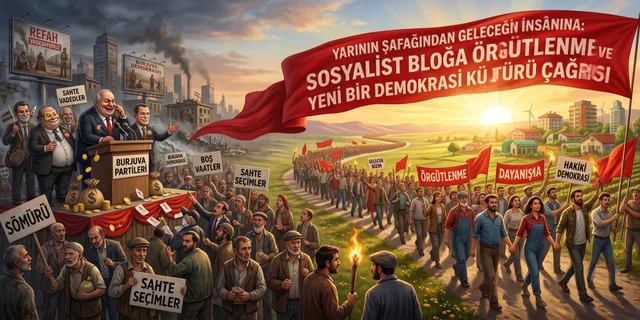
First, it eliminates bargaining power. If your vote is unconditional, they have no obligation to offer anything in return. A party that says “they have no choice but to support us” can move to the right in search of other votes.
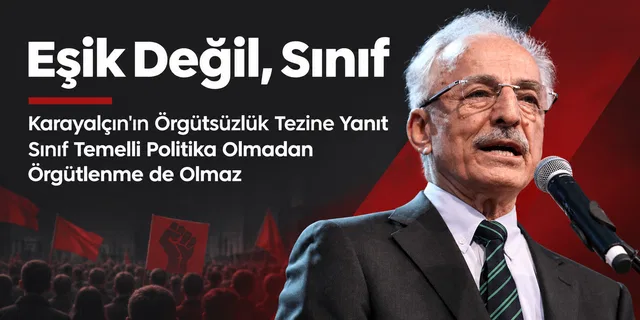
Second, it postpones organisation. Every election is declared the “last election”. Unionisation, workplace committees and independent politics are pushed into the next period. Twelve years have passed this way. This postponement also prepares the ground for presenting the lack of organisation as a kind of fate. As we argued in Not a Threshold, but Class, the failure to turn popular anger into organisation is not an inherent trait of the people but a product of a regime of law and coercion stretching from strike bans to the appointment of trustees; and if the threshold cannot be defined, it is class that defines it.
Third, disappointment can benefit the right. A worker without a party of their own who loses hope in what they call the opposition may turn not to socialism but to nationalism or withdrawal from politics. We discussed this cycle in the case of the Democratic Party in our article on US elections.
In their March 1850 address to the Communist League, Marx and Engels argued in the context of the revolutionary developments they expected in Germany that workers should field their own candidates even where they had no prospect of winning, preserve their independence and measure their strength. They should not be misled by democrats' complaints that they were splitting the vote. Those words, written 176 years ago, still speak to today's calls to “come together”.
“But What About One-Man Rule?”
This is the strongest objection and must be taken seriously: we face a regime that imprisons elected mayors and changes control of parties through court decisions. Is standing apart a luxury in such a period?
Our answer has two parts.
First, we are not opposed to common struggle. Against appointed trustees, arrests and strike bans, we stand alongside whoever is needed. That is the united-front tradition against fascism: march separately, strike together. But in that tradition the working class enters the front with its own organisation and demands; it does not dissolve into someone else's party.
Second, twelve years of experience show the limits of relying on the lesser evil at the ballot box. The force capable of pushing the regime back is organised labour, able to halt production and fill the streets. As the youth plenums in Serbia and university students here in the spring of 2025 showed, grassroots organisation can shake the established order. Without building it, “coming together” risks making the class a reserve force for someone else's project.
What Is to Be Done?
- End the era of unconditional votes. Whoever asks for your vote should give written, binding answers: will strike bans end? Will the industry-level union threshold be abolished? Will subcontracting end? Will the minimum wage be tied to the poverty line?
- If you go to a neighbourhood assembly, bring your demands. Go not merely as a listener, but to have the concrete demands of your workplace and neighbourhood entered into the record.
- Build your own organisation. A union, a workplace committee, neighbourhood solidarity, a student assembly. The model in our article Organising 2.0 is there for this purpose.
- Push for unity on the left. If we are to come together, let us first come together among ourselves. The basis for common action proposed in Class Is Back on the Table and Four Ways of Standing Side by Side is a task for every party on the side of the working class.
- Test every candidate with three questions. In whose hands? Under whose control? For whose benefit?
Dear comrades,
We agree with Professor Kepenek on one point: yes, it is time to come together. But with whom?
With the person on your shift. With the person working in the same warehouse, call centre or construction site, or behind the same screen. With the neighbour who cannot pay the rent, the fellow student made to work for free in the name of an internship. It is the class that must come together; the name for that coming together is organisation.
For twelve years we have been shown the lesser evil, and many of us have gone and voted. We do not say this to blame anyone; we have all stood before that ballot box. But the record is clear. By pledging allegiance to the lesser evil, we have neither escaped the regime nor built our own strength.
Enough. Our votes will not be held hostage, our organisation postponed, our demands put off until “later”. We will pledge allegiance to no one. We will speak in our own name, with our own programme and our own organisation. We will be present in every square where we can stand side by side, but we will go there under our own banner, not trailing behind someone else's.
A unity without a class basis will take us no further than the next disappointment. The road we must take is the road of the working class.
Sources
The article answered
YENİ Parti congress
- Euronews: YENİ Parti elects its 160-member Party Council, 16 November 2026
- Euronews: Özgür Özel re-elected party leader, 14 November 2026
- Karar: preparations for YENİ Parti's founding congress
- bianet: Özgür Özel's congress speech
Elections and labour
- Anadolu Agency: the election authority's final 2014 presidential results
- Directorate of Communications: final results of the 2023 presidential run-off
- bianet: the İzmir municipal workers' strike, 2 June 2025
Classics
- Karl Marx and Friedrich Engels, “Address of the Central Committee to the Communist League”, March 1850
- Karl Marx, The Eighteenth Brumaire of Louis Bonaparte, 1852
From Bilgi Müşterekleri
- A New Sign, the Same Class: Why YENİ Parti's Congress Cannot Answer the Working Class
- Not a Threshold, but Class
- Does the Winner Really Win?
- The Class's Reply to Evrim Ağacı
- US Election Results: A Blue Wave, the Same Shore
- Organising 2.0
- Class Is Back on the Table
- Four Ways of Standing Side by Side
This text is licensed under CC BY-SA 4.0. Knowledge belongs to everyone.