New Sign, Old Class: Why the YENİ Parti Congress Cannot Be an Answer for the Working Class
The Logic of Capital Behind the Slogan "Turkey Is Renewing", the Class Legacy of the CHP Tradition, and Today's Political Map
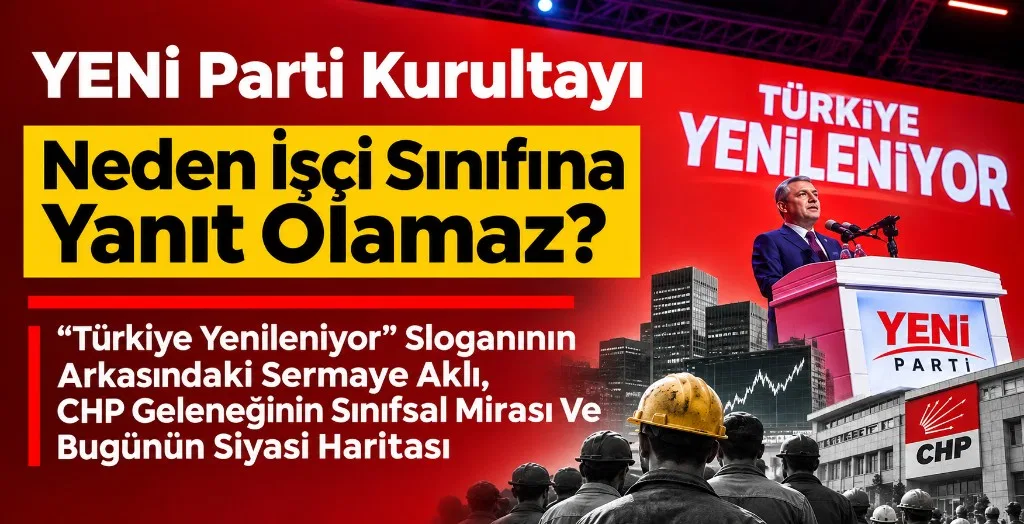
YENİ Parti (the New Party) held its 1st Ordinary Congress at the Ankara Arena on 14-15 November under the slogan "Turkey Is Renewing". In a hall with 1,202 registered delegates, the sole candidate, Özgür Özel, was elected party chair with every one of the 1,154 valid votes out of 1,157 cast. The Founding Congress Declaration was adopted unanimously, and it was decided that the elections for the Party Assembly and the High Disciplinary Board would be held by block list (ANKA).
This essay reads the congress not through the question "who won, who lost", but through our usual four questions: Whose party is it? What does it promise? Who is sent the bill? What does it do to the class's own organisation?
Summary: Ten Theses
- The congress is not a renewal but a transfer. The CHP's main body, programme, cadre and class compass were moved under a new sign. Even the programme's sections on public ownership and the social state were largely carried over word for word from the old CHP text.
- Standing against the absolute nullity ruling is a democratic duty, but it does not make this party the party of the class. Opposing the shaping of the opposition by the courts does not contradict criticising the class content of that opposition. On the contrary, if the two are not done together, both remain incomplete.
- The most instructive sentence of the speech was about the minimum wage. Raise the minimum wage above the hunger line, but cover it "without loading this increase onto the employer, with state support". This formula makes the wage increase payable not from capital's profit, but from the public budget, that is, once again from working people's taxes.
- The speech has no strikes, no subcontracting, no severance pay, no privatisation and no IMF. Labour is present in the roll call of "working people, pensioners, farmers", as a category of voters. It is absent as an organised class.
- The phrase "the new party of the Turkish nation" is a choice. There is an inclusiveness that lists identities one by one, but the common denominator is the nation, not the class. Every politics that dissolves the class into the nation ends up serving the ruling class within that nation.
- The axis of foreign policy is the West. Full EU membership, awareness of being "part of the Western alliance" and the emphasis on the defence industry propose not changing Turkey's place in the imperialist system after the AKP, but correcting it.
- The "new politics" is participatory in form and plebiscitary in substance. Members' direct votes and neighbourhood assemblies are well-meant tools. But a single-candidate, hundred-per-cent, block-list congress with songs and poems builds a membership that approves the leader rather than chooses them.
- The class history of the CHP tradition explains the present. From the single-party era that created a bourgeoisie through the state, to the 1978 IMF programme, to the 5 April 1994 decisions of the SHP-DYP coalition, this tradition always stood, in moments of crisis, on the side that loaded capital's burden onto working people. Murat Karayalçın, who chaired the congress presidium, was himself deputy prime minister in that coalition.
- YENİ Parti is the bourgeoisie's reserve option for government. The fact that the lawlessness, unpredictability and plunder created by the AKP have become costly for a section of capital too opens space for the promise of "qualified cadres, law, the EU, institutions". This is a bourgeois proposal for a way out of the regime crisis.
- Our answer should be neither indifference nor tailism. In the struggle for democratic rights we stand side by side. But the independent political organisation of the working class cannot be postponed for someone else's election campaign. The question is not only what YENİ Parti is, but what socialists will do.
Now to the detail.
What Happened at the Congress?
Timeline and Figures
YENİ Parti was founded after the Ankara Regional Court of Appeal, on 21 May 2026, annulled the CHP's 38th Ordinary Congress, at which Özel had been elected. When demands for an extraordinary congress were not met, Özel and 90 MPs resigned from the CHP on 24 July and formed the new party's Founders' Board (Rudaw, NTV).
A rapid organising process followed:
| Date | Development |
|---|---|
| 24 July 2026 | Founded with 91 MPs, Özel unanimously made chair |
| 31 August 2026 | Özel: a budget of 539 million lira from donations, more than 600,000 members (Evrensel) |
| September-October 2026 | Neighbourhood ballots, primaries for district and provincial chairs, official congresses |
| 5 November 2026 | A 17-item "Founding Congress Work Programme" (Evrensel) |
| 8 November 2026 | Primary for party chair: 639,454 members voted at 2,502 ballot boxes (Evrensel) |
| 9 November 2026 | Statute change: the Party Assembly enlarged from 80 to 150 members for one term, an Ethics Board set up (Medyascope) |
| 14-15 November 2026 | 1st Ordinary Congress, Ankara Arena |
With this congress the party will become eligible to stand in elections as of 15 May 2027 (Medyascope).
The Scene in the Hall
On the wall facing the stage were photographs of Özel with former CHP chairs Altan Öymen, Murat Karayalçın and Hikmet Çetin. The Youth Branch had hung a banner with photographs of İmamoğlu and Özel. Songs such as "Thanks to My Auntie", "The Dark Order Is Ending" and "We Will March to Power" were composed for the congress (ANKA). After the national anthem, the delegates chanted "We are the soldiers of Mustafa Kemal" (Koza24). Murat Karayalçın took the chair of the presidium (BirGün).
The political surprise of the first day was that seven jailed Istanbul district mayors joined the party with a joint letter. İmamoğlu sent a video message produced with artificial intelligence. Stefan Löfven of the Party of European Socialists sent a video message, and Pedro Sánchez a letter on behalf of the Socialist International (ANKA).
The guest list is a map in itself: representatives of the DEM Party, the Victory Party (Zafer), Yeni Yol, Saadet, Yeniden Refah, EMEP, the SOL Party, HKP, DİSK, KESK and Eğitim-İş were in the hall. The AKP and MHP did not attend, and the CHP was not invited (ANKA). This range, stretching from DEM to Zafer, shows both the breadth of the "Turkey Alliance" idea in practice and its emptiness: a roof under which everyone can fit is a roof tied to no class choice.
As this essay was being written, the second day of the congress, that is, the block-list election of the 150-member Party Assembly, was still under way. Once the make-up of the list is settled, the profile of the economic advisers deserves separate attention.
First, a Distinction: Opposing the Nullity Ruling and Criticising the Party
Let us make the tone of this essay clear from the start. Removing a party's chair through the courts, besieging an opposition with jailed mayors, and jailing journalists and students are open usurpations of democratic rights. Standing against them, whoever is targeted, is the duty of every socialist. We held to this line when we wrote about the İBB case and the trustee at Halk TV.
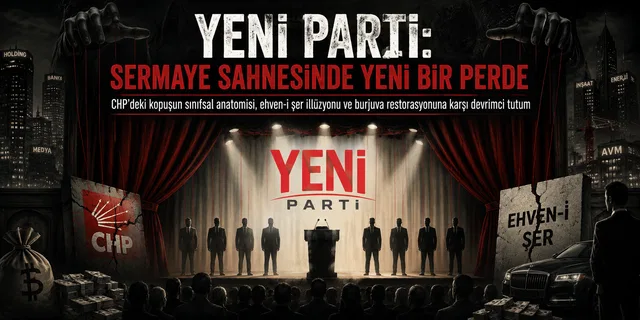
But standing side by side in the struggle for democratic rights does not require refraining from debating the class content of the party carrying that struggle's banner. On the contrary, it is exactly at such moments that the debate is needed. Because repression creates an aura of "unquestionable" immunity around a party: every question put to it is met as "playing into the government's hands". Surrendering to this aura means postponing the working class's own agenda once again until the next election. When we examined the party's birth in July in The New Party: A New Curtain on Capital's Stage, we argued for independent class politics against the illusion of "as long as the AKP goes". The congress confirms that assessment.
The EMEP and SOL Party representatives at the congress, and DİSK and KESK too, ought to hold this dual position: solidarity against lawlessness, independence in class politics.
A Class Reading of the Speech: What Is In It, What Is Not?
Özel's congress speech showed once again that he is a good orator. The speech exposed the AKP's plunder with concrete examples: the fund swindle, the foundations, the line "they told the fairy tale of the Century of Turkey and pulled off the Swindle of the Century" (Cumhuriyet). Most of these exposures are accurate, and we too have written about the fund crisis in detail on these pages.
The problem is where the exposure stops. The speech frames the plunder as a problem of morality and management: bad cadres, lack of merit, favouritism. The solution fits this: "Turkey's best economic cadres", "qualified cadres", "reforms that will get the institutions back on their feet". The idea that plunder is a regime of accumulation, that is, a way in which a particular section of capital enriches itself through the state apparatus, is absent from the speech. Yet plunder is the product not of individuals, but of a particular phase of capital accumulation. Any administration that changes the cadre but keeps the model of accumulation carries on the same plunder with a cleaner invoice.
The Minimum Wage Sentence
The most instructive point of the speech in class terms was this: YENİ Parti will raise the minimum wage above the hunger line, but will cover it "without loading this increase onto the employer, with state support" (full text of the speech, 10Haber).
This sentence also matches the bill the party submitted to parliament in August: raising the net minimum wage to 45,800 lira and having the Treasury cover part of the employer's share of social insurance contributions (BirGün).
Let us spell out what this means, because it is a good example for young comrades learning to read bourgeois social policy:
- The wage is the price of labour power. The difference between the wage and the new value the worker produces is surplus value. When wages rise, the rate of surplus value falls. This is the economic core of the class struggle.
- Saying "let the state cover the increase without loading it onto the employer" means asking for the wage increase to be paid not out of surplus value, but out of the public budget. In other words, the boss's rate of profit is protected and the difference is socialised.
- The revenue structure of the public budget is well known. As Özel himself recalled in his speech, 62 of every 100 lira of tax are collected from indirect taxes, that is, from the shopping basket. Even if indirect taxes are cut, wage earners will go on carrying the main burden of the budget.
- The result: the worker pays a large part of their own wage increase themselves, as tax. Capital, meanwhile, gets a state subsidy on top of cheap labour.
This method is not new. The AKP too has used the same mechanism for years, under the names of employer contribution incentives, employment support and minimum wage support. As we have shown in our pieces on the budget, part of the incentives going to capital consists of exactly these items; and in our piece on inflation and wages we described how wages melt away under this order. YENİ Parti's proposal is a generous version of the AKP's wage policy, but the logic is the same: managing distribution between the classes through the budget, without touching capital.
We are not questioning good intentions here. Raising the minimum wage above the hunger line, and raising pensions to the level of a minimum wage, would make a real difference in millions of people's lives. But class politics asks: Who pays for this difference? If the answer is not "the boss's profit" but "all our taxes", then what we have is not redistribution but a shifting of the burden.
Basic Citizen's Income
At the congress Özel said, "Those who promised a Basic Citizen's Income to those with no income are the members of YENİ Parti" (Cumhuriyet). The party's "7 promises" text also includes a guaranteed minimum income for every household and social insurance and pension rights for housewives (Halk TV).
Making domestic labour visible is an important step. But we need to look at whose mouths the idea of basic income circulates in around the world: Silicon Valley's techno-capitalists also champion basic income, to make the unemployment that artificial intelligence will create "manageable". We discussed this in what we wrote on the techno-capitalists' talk of a "useless class". Basic income can be a tool for keeping the reserve army of labour alive without touching property relations, that is, for keeping those pushed out of the system tied to it. Unemployment is not "fate"; it is a need of capital. The real answer to it, as much as income support, is shortening working hours, public planning of employment and social control over the means of production.
What Is Missing from the Speech
When we read a text we look at what it does not say as much as what it says. The full text of the speech does not contain:
- The right to strike. The programme contains the sentence "free trade unionism, collective bargaining and the right to strike will be guaranteed" (Halk TV). But lifting strike bans and the postponements justified by "national security" and "public health" did not reach the congress podium.
- Subcontracting. There is no abolition of the subcontracting system in the public or private sector.
- Severance pay. There is no guarantee on severance pay, which capital has wanted to transfer to a fund for years.
- Privatisation. In a speech in Edirne, a promise was made to bring motorways and bridges back into public ownership (İstiklal). But there is no general principle against privatisation, no programme of nationalisation, and no cancellation of the guarantees in public-private partnerships.
- The IMF and debt. There is nothing on foreign debt, interest payments or relations with international financial institutions.
- The market. The word does not even appear. This is not a coincidence; it is a compromise.
Workplace killings, on the other hand, do appear: the mines, the factory disaster in Aliağa, and a promise to put international occupational health and safety measures in writing. Let us repeat what we said when writing about the HABAŞ explosion: the problem is not that the measures are not in writing, but that inspection and sanctions are subordinated to capital's profit calculations. Occupational safety legislation is already in writing in Turkey. What is not in writing is the worker's ability to actually exercise the right to stop dangerous work, and organised workers' oversight in the workplace.
The Sentence "There Are No Wealthy Backers Behind Us"
In his speech Özel said, "There are no powerful wealthy backers behind us." In terms of the party's donation budget this sentence may have some truth. But the class character of a party is measured not by whom it takes donations from, but by which property order it protects. An analysis published in soL argues that what the names who stand out as the party's economic advisers have in common is that they are "capital- and market-friendly", and that although the programme uses the concepts of "planned economy" and "statism", it stays entirely within the limits of the capitalist order (soL). This finding will need to be tested against the 150-member Party Assembly list.
"The New Party of the Turkish Nation"
One of the central sentences of the speech was: "We seek not the AK Party's artificial peace, but the sincere peace of the nation... YENİ Parti is the new party of the Turkish nation" (Artı Gerçek). Straight after comes a roll call: "the new party of all Turkey", with its Kurds, its Arabs, its Zazas, its Laz, its Alevis, its Sunnis, its Roma, its Bosniaks (10Haber).
This pair of sentences shows well where bourgeois politics in Turkey is squeezed. On the one hand, in a hall where the Victory Party also sat, the common denominator of "the Turkish nation" is preserved; on the other, a message of inclusiveness is sent to Kurdish voters. The word "process", however, never appears. In other words, instead of a concrete programme for a democratic solution in response to the settlement process being run by the People's Alliance, a formula such as "the peace of the nation" is put forward, onto which every group can load its own meaning.
In class terms the real problem is this: counting society by identities takes the place of counting it by classes. The Kurdish worker and the Kurdish landlord, the Alevi worker and the Alevi contractor, the Turkish worker and the Turkish industrialist are made equal within the same roll call of "the nation". As we said in The Class of Words, hegemony is built above all with such "all-embracing" words. In Turkey the concept of "the nation" has been the official language for suppressing class conflict since the 1920s. That is what has not changed since the formula "a classless, privilege-free, fused mass".
The delegates' chant "We are the soldiers of Mustafa Kemal" fits this frame too. As we discussed in detail in our basic guide to the Republic and our reply to Kongar, defending the progressive gains of the Republic is one thing, and presenting Kemalism as an ideology above classes is another. The Republic was a bourgeois revolution. Claiming its legacy also requires seeing the class limits of that legacy.
Foreign Policy: Inside the West, Not in Spite of It
In the "7 promises" text, full EU membership is defined as a goal to be achieved in the first term in government. Investment in the defence industry and "peace in the Middle East" sit under the same heading (Halk TV). NATO is not mentioned by name in the congress speech, but a government "aware that Turkey is part of the Western alliance" is promised. The AKP, meanwhile, is criticised for failing to obtain the engines for the KAAN fighter jet.
This is not a criticism of the AKP's foreign policy for its relationship with imperialism; it is a criticism of that relationship not being managed more efficiently. At a time when NATO's pressure to arm is growing, the emphasis on the defence industry proposes not debating the share of the budget given to weapons, but managing it better.
On EU membership, let us also offer a reminder. As we showed in our piece on Bulgaria, what the EU means for its peripheral countries is often not democracy, but becoming a reservoir of cheap labour, deindustrialisation and the emigration of young people to the West. The EU is a union of capital as much as a legal norm. Turkey's integration into the EU is the deepening of the Turkish bourgeoisie's articulation with European capital. For the working class, the price of this, as thirty years of the Customs Union have shown, is competition based on cheap labour.
"New Politics": Participatory Form, Plebiscitary Substance
The innovation YENİ Parti most emphasises is its organising model. As early as its first group meeting in August, Özel announced that being a delegate would remain "a technical role" and that every member would directly elect the district chair, the provincial chair and the party chair (Diken). At the congress, too, it was said that neighbourhood, district and provincial assemblies would be set up (Canlı Gaste).
Let us not belittle this. It is well known how the delegate system in Turkey has turned party apparatuses into closed oligarchies, and more than 600,000 members going to the ballot box is a sign of the political energy in society. As Barış Avşar wrote in Evrensel, this model can be seen as an opportunity against the mindset of "politics without the people" (Evrensel).
But from a class point of view, the question needs to be asked: What does the member decide?
- The primary for party chair had a single candidate.
- At the congress, the chair received every valid vote.
- The Party Assembly is elected by block list, and that list is drawn up by the chair.
- The programme came not from debate at the congress but from party headquarters, and it is largely a summary of the old CHP programme (Sözcü).
In other words, the member approves the leaders but does not set policy. If there is no arena in which debate and alternative programmes compete, the direct vote enlarges not democracy but the plebiscite. And the plebiscite gathers politics into the person of the leader: songs, a poem, "Özgür (Free) is coming" banners are the aesthetics of this personalisation.
Here let us recall the plenum model of the student movement in Serbia and our proposal in Organising 2.0. Real participation is measured not by casting a vote, but by owning the decision-making process: the recallability of delegates, an agenda built from below, a programme written through debate and, most importantly, lasting organisation in the workplace, the neighbourhood and the school. A "neighbourhood assembly" that opens and closes with the election season is not the class's own assembly.
The Weight of the Past: A Short Class History of the CHP Tradition
Even though YENİ Parti carries the name "new", the congress hall was full of a claim to continuity: the photographs of former chairs, Karayalçın in the chair of the presidium, the tribute to Altan Öymen. Tracing this continuity with a class eye is the shortest way to understand the limits of today's promises.
1923-1946: A Bourgeoisie Made by the State
In the single-party era the CHP saw creating a national bourgeoisie as the task of the state. Statism meant the state investing in areas where private capital fell short, and over time transferring this accumulation into private hands. The 1936 Labour Law banned strikes. The 1942 Wealth Tax became the tool for dispossessing the non-Muslim bourgeoisie and transferring wealth to the Muslim-Turkish bourgeoisie. Progressive experiments such as the Village Institutes were also products of this era, but they were among the first to be sacrificed in the transition to multi-party politics. We described this period in detail in our basic guide to the Republic.
The 1960s and 1970s: "Left of Centre" and the Hope in Ecevit
In 1965 the "left of centre" discourse was a response to the rising workers' movement and the entry of the TİP into parliament: holding with social democracy the base that might drift towards socialism. In the 1970s, with the slogan "the land to those who till it, the water to those who use it", Ecevit became the hope of millions of working people, and in 1977 the CHP won 41 per cent of the vote. But the Ecevit government formed in 1978, as the crisis deepened, went to the IMF for a stand-by agreement and implemented austerity packages. In the moment of crisis, the side social democracy chose was capital's stabilisation programme. Then came the 24 January decisions, and 12 September, which came to implement them. The 12 September Dossier tells this chain of events.
The 1990s: Coalition and 5 April
After 12 September, the social democratic tradition gathered under the roof of the SHP. The DYP-SHP coalition formed in 1991 implemented the 5 April decisions in the 1994 crisis: devaluation, wage freezes, accelerated privatisation, layoffs in the public sector. The SHP chair and deputy prime minister at the time was Murat Karayalçın. The man chairing the YENİ Parti congress today is the same person.
We do not say this as a personal accusation. What we are saying is this: at every historical moment when it had to respond to capital's crisis, this tradition implemented programmes that made working people pay the cost of the crisis. Because for a politics that stays within the capitalist order, there is no other way in a crisis.
The 2000s to 2026: From the Nation Alliance to the Turkey Alliance
In the Kılıçdaroğlu era the CHP put an opening to the centre-right at the heart of its strategy, and in 2023 it went into the election with the Table of Six. The Özel era brought success in the 2024 local elections. But in the wage and collective bargaining disputes in CHP-run municipalities, the stance of these municipalities as employers also showed how social democracy behaves when it is the "employer". As another analysis in soL stresses, the YENİ Parti programme carries the traces of the Table of Six consensus more than of the old CHP documents (soL).
That the party's advisers said, already at the founding stage, that the party would position itself not on the "left" but on the line of a "Turkey Alliance" is the natural continuation of this history (soL).
Today's Map: The Bourgeoisie's Two Projects
To understand YENİ Parti, the regime crisis in Turkey needs to be read in class terms.
The first project is the People's Alliance project. A government that gathers the judiciary, the media and public resources in a single centre, enriches a section of capital through state tenders, guarantees in public-private partnerships and fund schemes, and shapes the opposition through the courts. The fund crisis showed how this model profits from insider information.
The second project is the post-AKP restoration project. The predictability of law, institutions working again, the EU anchor, "qualified" economic management. This is the need of the section of capital that is harmed by the AKP's arbitrariness and wants to deepen its articulation with international capital. YENİ Parti is the strongest carrier of this project today.
The conflict between the two projects is real and matters for democratic rights. But neither asks the same question: Whose is the wealth that is produced? Both try to answer the question of distribution without touching capital's rate of profit. The first does it by managing poverty through networks of handouts, the second through social transfers via the budget.
When assessing the US election results, we explained why the Democrats cannot be an alternative. A similar logic is at work here: a liberal and social democratic front formed against a fascistic right, once in power, often reproduces the very conditions that gave birth to that right, that is, insecurity, pressure on wages and the free movement of capital. Then the anger flows back to the right. The way out of this cycle is not a better centre, but organised class politics.
Why It Cannot Be an Answer for the Class
Let us gather what we have said so far under five headings:
1. It does not ask the question of property. The programme contains the concepts of "public interest" and "planned economy", but there is no proposal on the ownership of the means of production, on capital's monopoly over investment decisions, or on control of the financial sector. A "public ownership" that does not touch property keeps the public in the service of capital.
2. It refers distribution to the budget. The minimum wage increase covered "with state support", pensions, basic income: all of it is to be financed from the public budget. Taxing capital, raising corporation tax, a wealth tax and abolishing incentives did not clearly feature at the congress podium. In that case the bill for social transfers once again lands on wage earners.
3. It organises the class as voters, not as a class. The party calls on workers to vote and to become members. But there is no call to organise in the workplace, to unionise, or to actually exercise the right to strike. This is a mobilisation that strengthens not the working class's own organisations, but the party's election machine.
4. It builds the common denominator as the nation. The formula "the new party of the Turkish nation" dissolves class antagonisms within national unity. This feeds the illusion that working people stand on the same side as "their own" bosses.
5. On the international axis, it articulates itself into the imperialist system. The emphasis on EU membership, the Western alliance and the defence industry does not question Turkey's place in world capitalism; it looks for a better position.
Comparison: What YENİ Parti Proposes and What the Class Needs
| What stood out at the YENİ Parti congress | The independent agenda of the working class |
|---|---|
| Raise the minimum wage above the hunger line, cover the increase with state support | Set the minimum wage with workers' organisations, cover the increase from capital's profit, a tax-free minimum wage |
| Cut indirect taxes, raise the first tax bracket | A wealth tax, higher corporation tax, abolition of incentives for capital |
| Basic Citizen's Income | Shorter working hours with no loss of pay, public employment, secure jobs |
| A sentence on the right to strike in the programme | Lifting strike bans and postponements, the right to general and solidarity strikes |
| Absent from the podium | Abolition of subcontracting, no touching of severance pay |
| Put occupational safety measures in writing | The worker's right to stop dangerous work, organised workers' oversight, employer liability for workplace killings |
| Bring motorways back into public ownership | Cancel the guarantees in public-private partnerships, take strategic sectors into social ownership |
| "Qualified cadres" | Open public administration to the oversight of working people |
| Members' direct vote, block list | Recallable delegates, an agenda built from below, workplace organisation |
| "The new party of the Turkish nation" | The equality of peoples, class fraternity |
| Full EU membership, the Western alliance, the defence industry | Independence from imperialist blocs, social spending instead of armament |
So What Is to Be Done? Concrete Tasks
Criticism is incomplete if it does not define our own tasks. That YENİ Parti cannot be an answer for the class does not have to mean that the class will be left without an answer. If we do not produce the answer, nobody will.
- Principled solidarity in the struggle for democratic rights. Stand side by side with every section of the opposition against the nullity ruling, trustees, arrests and censorship; but do so together with class demands, and under our own banner.
- Build the minimum wage debate on a class axis. In the minimum wage process heading into December, put the question "who pays for the increase?" at the centre. Explain in workplaces that the state support formula is a subsidy for capital.
- Common ground for joint action among the left parties. Left parties, from the EMEP and SOL Party, which sent representatives to the congress, to the TİP, should come together around a common class programme that overcomes sectarianism, as we proposed in the debate on the Liberation Declaration. The question we asked in the TİP Dossier, "mass or class", applies to the whole left today.
- Work to the organisation's calendar, not the election calendar. As we said in The Square Is Not Enough, if a mass movement does not turn into lasting organisation, it is written into someone else's column at the next election. Workplace committees, neighbourhood solidarity networks, unionisation campaigns.
- Talk to the working people in YENİ Parti's base. Most of its 600,000 members are workers, pensioners and unemployed young people. Not belittling them as "deceived", but seeing together the distance between their own demands and the party's programme. Sample questions: Who will pay for the minimum wage increase? Will subcontracting be abolished? Will strike postponements end?
- Watch the Party Assembly list and the first actions. Who the economic advisers are, how YENİ Parti municipalities behave in collective bargaining, and the stance taken in the budget debates are more instructive than words.
- Bring the technology and labour agenda into politics. Artificial intelligence, platform labour, algorithmic management and digital surveillance appear in no bourgeois party's programme as class issues. As in our gig economy dossier and our piece on digital surveillance in the factory, we must put this field on the agenda of class politics.
Dear Young Comrades
Do not belittle the enthusiasm at the Ankara Arena. In that hall and outside it was the hope of millions of people who are worn out by more than twenty years of AKP rule, who cannot see a future for their children, who cannot pay their rent. That hope is real and deserves respect.
But hope does not replace a programme. History has shown us time and again that every hope that does not touch the capitalist order, once in power, makes the same people pay the bill at the first crisis. That is how it was in 1978, and in 1994. Saying this is not pessimism; it is learning.
Our job is not to belittle that hope, but to give it a class foundation. It is to explain the difference between voting for a party and a class taking its fate into its own hands. Unless we build our own organisation in the factory, the office, the warehouse, the campus and the neighbourhood, every "new" sign will keep us inside the old.
What needs renewing is not a party, but politics itself. And that renewal will come not from the podium, but from the organised working people's own assembly.
For a better future, organised and stubborn.
Sources
Reports on the congress
- ANKA: YENİ Parti 1. Olağan Kurultayı başladı (YENİ Parti's 1st Ordinary Congress begins)
- ANKA: Kurultayda ilk gün, Özel genel başkan seçildi, tutuklu belediye başkanları partiye katıldı (First day of the congress: Özel elected chair, jailed mayors join the party)
- BirGün: Özgür Özel'den iktidar mesajı (Özgür Özel's message on taking power)
- Cumhuriyet: Özel'in kurultay konuşması (Özel's congress speech)
- 10Haber: Konuşmanın tam metni (Full text of the speech)
- Artı Gerçek: Özel'den süreç ve barış mesajı (Özel's message on the process and peace)
- Canlı Gaste: Adaletin dört kolonu ve mahalle meclisleri (The four pillars of justice and neighbourhood assemblies)
- Koza24: Kurultay günü (Congress day)
The founding process and the programme
- Rudaw: Kurucular Kurulu ve butlan kararı (The Founders' Board and the nullity ruling)
- NTV: Özel'in A Takımı (Özel's A Team)
- Diken: Üyeler genel başkanı doğrudan seçecek (Members will elect the chair directly)
- Evrensel: 539 milyon liralık bütçe, 600 bin üye (A 539 million lira budget, 600,000 members)
- Evrensel: 17 maddelik çalışma programı (The 17-item work programme)
- Evrensel: Parti Meclisi 150 üyeye çıkarıldı, ön seçim katılımı (Party Assembly enlarged to 150, primary turnout)
- Medyascope: Tüzük değişikliği (Statute change)
- Medyascope: Kuruluş kurultayı ve seçime girme yeterliliği (The founding congress and eligibility to stand in elections)
- Halk TV: 7 söz, 7 görev (7 promises, 7 tasks)
- Halk TV: Tüzük ve programda sosyal demokrat vurgusu (Social democratic emphasis in the statute and programme)
- Sözcü: Parti tüzüğü ve programı (Party statute and programme)
- BirGün: Asgari ücret kanun teklifi (The minimum wage bill)
- İstiklal: Otoyolların kamuya kazandırılması (Bringing motorways back into public ownership)
Assessments
- Evrensel, Barış Avşar: Yeni Parti modelinde saklı fırsat (The opportunity hidden in the Yeni Parti model)
- soL: Yeni Parti'nin piyasacı ekonomi kurmayları (Yeni Parti's pro-market economic advisers)
- soL: Yeni Parti programı bize ne anlatıyor? (What does the Yeni Parti programme tell us?)
- soL: Özel sol değil, ittifak partisi kuracak (Özel will found not a left party but an alliance party)
Related essays from Knowledge Commons
- The New Party: A New Curtain on Capital's Stage
- Mass or Class? A Dossier on the Workers' Party of Turkey
- Liberation Is in Our Hands, Unity Is in the Hands of the Class
- Organising 2.0: An Idea for a Justified Revolt
- The Square Is Not Enough: An Organisation Is Needed to Carry It
- US Election Results: A Blue Wave, the Same Shore
- Why Is the Republic a Bourgeois Revolution?
- Whose Republic? A Basic Guide in Its 103rd Year
- 12 September: The History, Balance Sheet, and Present of a Class Coup
- One Wage in Ten Months
- Gig Economy Dossier and The Card Around Our Necks
- The Explosion at HABAŞ: This Is Not an Accident, It Is a Mode of Production
- Whose Party Is the Fund Crisis Breaking? and Six and a Half Trillion: The Money Wiped Off the Exchange, the Life Missing from the Table
- They Walked Past the Algorithm: How the Plenum Beat the Ballot Box in Serbia
- The Bulgarian Elections: Yotova Won, but What Did the Bulgarian Worker Win?
- On Getting Free from the Language of Hegemony
- Whose Case Is Being Heard in Silivri? and Who Blacked Out the Screen?
- The Class's Answer to Evrim Ağacı's Question
This essay is published under a CC BY-SA 4.0 licence.