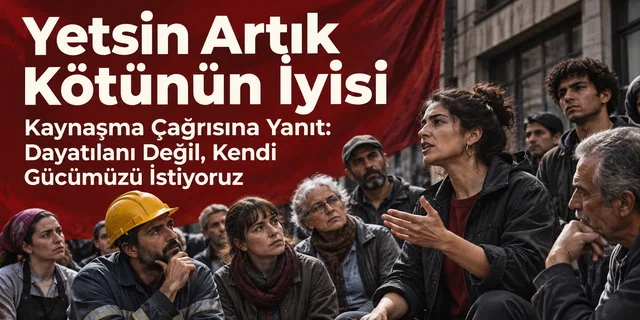
Not a Threshold, but Class
A Reply to Karayalçın on the Lack of Organisation: Without Class Politics, There Can Be No Lasting Organisation

Summary
Dear young comrades,
On 21 November 2026, Murat Karayalçın gave a presentation entitled “Participation and Partnership in Local Government” at the Akın Atauz Conference in Ankara, organised by Gazete Solfasol and the Fikri Sönmez Foundation. His central argument was that people in Turkey can react powerfully when a threshold is crossed, but cannot turn that reaction into organisation.
The observation is right. The explanation is incomplete. Our reply fits into six points:
- A lack of organisation is not a characteristic of the people; it is a produced outcome. It is the result of laws and coercion stretching from the 12 September coup and industry-level union thresholds to strike bans and the appointment of trustees to municipalities.
- The “undefined threshold” is a class threshold. It is the line of wages, rent, debt and dispossession. Without the concept of class, the threshold remains difficult to define.
- Karayalçın's own theory supports the class argument. He says people participate when they see concrete gains. Concrete gains are material interests, and material interests have a class character.
- A project's social base is not a class organisation. A “fixed social base” may be assembled around a project and dissipate when that project is over. Property owners may remain, but not necessarily an organisation.
- Participation called into being by a municipality is vulnerable when control of that municipality changes. The Ankara Congress ended after 1994; later phases of Dikmen Valley saw demolition teams replace cooperation. Participatory institutions can be dismantled by appointed trustees. Independent class organisation offers a more durable basis.
- The evidence is in Karayalçın's own example. The newly founded Tenants' Union held its first meeting in a metalworkers' union hall. In Spain, tenants and labour unions came together in a general strike.
In short: class helps define the threshold, and class-based politics can turn reaction into organisation. Without it, neither participation nor organisation can be made durable.
We begin with Karayalçın's reported remarks, then respond to each argument.
What Did Karayalçın Say?
The full text of the speech has not been published. We have Solfasol's conference report, ANKA's report, and other sites carrying the latter's account, including Son Dakika and Haber Erk. From these accounts, his arguments can be summarised as follows:
- Turkey has a strong state and strong local governments. In places, municipalities performed better than central government during the pandemic and after the 2023 earthquake.
- Associations of people from the same hometown may be the clearest example of civil organisation. In his words, “The people are not socially organised.”
- Once a threshold that he himself cannot define is crossed, people can react strongly but cannot turn the reaction into lasting organisation.
- The Gezi resistance was one of the most advanced examples in Turkey's political history, producing remarkable solidarity, but it did not continue as an organisation.
- Tenants in Spain and Portugal are organised and have achieved results. A newly founded tenants' organisation in Turkey, he said, has a limited impact so far.
- People participate consistently when they expect concrete gains. A project with people who claim ownership of it is more likely to succeed.
- Residents should participate in a city's plans, budget and projects. From 1989 to 1994 the Ankara Congress discussed plans and budgets with delegates for a week.
- Projects with identifiable users have a “fixed social base”: Batıkent's planned 55,000 homes and Dikmen Valley's five cooperatives were his examples. Projects such as a metro or sewerage system have a broader, less identifiable user base. In the first kind, partnership in decisions is possible.
- In the question-and-answer session he said that rent extraction is theft and should not be accepted.
- He questioned the credibility of COP31's leadership, pointing to housing permitted for the Kanal İstanbul project at Sazlıdere while a different message was delivered in Antalya.
First, let us give credit where it is due. Karayalçın's municipal record includes tens of thousands of cooperative homes and processes that brought residents of informal settlements to the decision-making table. It matters that he raised the lack of organisation in a room where a letter from a detained urban official was read. Our criticism is not of the person but of where the explanation stops.
Replies to the Arguments
“The people are not organised”: Disorganisation is produced
“The people react but cannot organise” risks making disorganisation sound like a popular trait. In Turkey it has a history and a legal framework.
After 12 September 1980 the military authorities suspended DİSK's activities, prosecuted its leaders and banned strikes. Elements of that legal order persist under different names. According to the Labour Ministry's July 2026 statistics, 2,432,789 of 17,630,475 registered workers were union members: 13.8 per cent. The contrast among registered workers is striking: 76.29 per cent in the public sector and 6.48 per cent in the private sector. Of 246 unions, only 60 pass the industry threshold. DİSK-AR estimates collective-agreement coverage at around 10 per cent, using its own measure.
The fact that approximately 93.5 per cent of registered private-sector workers are not union members is not simply a cultural matter. Thresholds, employer objections that delay bargaining, dismissals and strike postponements all matter. We examined the industry structure in Industry No. 10 Is Not an Accident, but a Design. When workers risk losing their jobs for organising, disorganisation is not merely a preference; it can be a sanction.
Another point matters. Karayalçın did not appear only as a former mayor. A week earlier, on 14–15 November, he chaired the YENİ Parti congress presidium. He was also deputy prime minister from 1993 to 1995; the government of which he was part adopted the 5 April 1994 economic decisions. To the extent that social democracy participated in programmes weakening labour's organised power, it also weakened its own base.
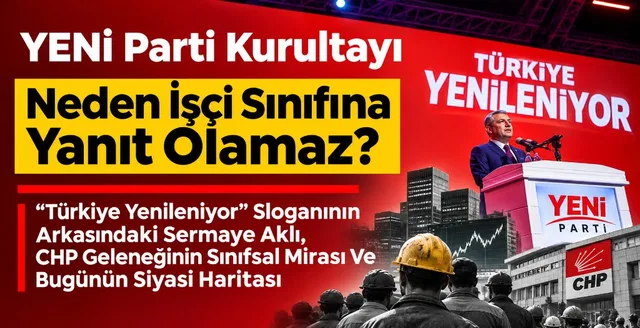
In New Sign, Old Class we argued that the congress speech addressed labour as an electoral category rather than as an organised class. Workers were invited to vote, not to organise at work or join unions; no commitment was made to end strike bans and postponements. A tradition that laments the lack of organisation must also account for its own contribution to that condition.
“A threshold I cannot define”: The threshold has a class character
Karayalçın openly says he cannot define the threshold. That is an instructive admission. “The people” includes employer and worker, landlord and tenant. Their interests do not share one simple threshold.
Through class, we can identify concrete pressures: wages that no longer cover rent, unmanageable debt, enclosure of common land, or votes overridden by appointed trustees. At the Tenants' Union meeting, a speaker recalled the words of a HABAŞ worker who described long working hours and wages that did not cover rent (TR Haberleri). The same person is a worker at the factory and a tenant at home. Life does not separate those two struggles; our institutions often do. We wrote about the HABAŞ workers in Before the Turnstile.
“The only civil organisation is based on hometown”: Horizontal organisation is overlooked
Hometown associations can be powerful. They bring together employers and workers, contractors and tenants who share a place of origin; they can also organise access to work, housing and political networks. They may cross class lines rather than confront class conflict.
But identifying them as the only example overlooks unions, professional chambers, the women's movement, grassroots unions, courier and warehouse workers' organisations and neighbourhood assemblies in Kurdish provinces. They exist, often under pressure.
The proposition of strong local government was tested in the same conference hall. Çankaya's acting mayor spoke for its detained elected mayor; a letter came from another detained urban official; Diyarbakır's co-mayor described the damage done during trustee rule. An organised public cannot by itself eliminate legal or political pressure, but without independent support a municipality is especially vulnerable to it.
“Gezi did not become an organisation”: Why not?
It is not true that nothing remained of Gezi: park forums, neighbourhood solidarity and urban and environmental campaigns emerged from it. But no single durable mass organisation carried the whole movement forward. Why?
The first reason is coercion: deaths, injuries and years of prosecutions followed the protests. A second concerns organisation at the point of production. Gezi was strong in the squares but weaker in workplaces. Trade-union solidarity strikes were limited; many wage earners returned to workplaces where they were not organised. When the squares emptied, there was no common structure capable of carrying the whole response.
Organisation is not the automatic residue of protest. It is the product of deliberate work linking a response to a continuing struggle over interests where people live and work. Gezi's lesson should not be “people cannot organise”, but that a response not connected to sustained organisation is hard to preserve. We explored this in The Square Is Not Enough.
“Tenants are organised in Europe, but not here”: The example challenges the argument
A correction first. Karayalçın referred to an “association” and recalled the venue tentatively. The newly established group calls itself the Tenants' Union. Its first meeting, on 15 November, was held at Birleşik Metal-İş's conference hall in Bostancı, Istanbul. Its founders explained their preference for the language of a union over an association: they wanted the strength to sit at the bargaining table.
This distinction matters. The new tenants' organisation began in solidarity with a workers' union and adopted the language of collective bargaining. It links the workplace to housing rather than treating them as separate worlds.
Spain illustrates the connection on a larger scale. Tenants' unions joined housing demands to questions of wages and prices. In Madrid on 3 October, 70,000 people marched according to the government delegation, 500,000 according to the tenants' union, and called for a general strike. On 11 November, labour federations and tenants' unions came together for a general strike over wages, housing and prices. El País reported that participation varied by sector. The example shows the potential of connecting housing and labour organising.
“People participate when there is a concrete gain”: Let us follow the argument through
This is Karayalçın's strongest point. People come not merely for an abstract invitation to participate but for a concrete gain that changes their lives. Marxism has long insisted that consciousness is connected to material conditions.
But whose gain? A rent cap benefits a tenant and reduces a landlord's expected income. A pay rise is a worker's gain and an employer's cost. A title deed for a resident of an informal settlement closes off an opportunity for a land speculator. Once a gain is defined, interests are identified. There is no purely classless “gain for the people”.
YENİ Parti's minimum-wage proposal provides a current example. As we argued in our congress article, financing the increase through state support shifts the burden from employers to the public budget, including the taxes paid by working people. A gain looks different when we ask who pays. As we wrote when the party was founded, the offer can become a fairer form of exploitation.
The argument thus points back to politics: people need a programme that offers them concrete gains as a class and is prepared to confront the interests opposed to those gains.
“A fixed social base”: A project partner is not a class organisation
Batıkent was a significant achievement, and the social organisation behind it deserves attention. Kent-Koop was founded on 17 October 1979, led by the municipality and involving unions, tradespeople's organisations and professional chambers. The social base behind the planned 55,000 homes did not appear from nowhere. Organised groups made the project possible. The difficulty of reproducing a project on that scale after 12 September also calls for historical explanation.
The “fixed social base” concept has two limits:
- The base consists of prospective property owners. Members share the aim of obtaining housing. When that aim is fulfilled, continuation depends on new common needs and members' choices. A class organisation can instead be rooted in an ongoing relationship: wages, work or rent.
- The model leaves out projects affecting very large populations. Karayalçın says a metro or sewerage system lacks a fixed base of known users. But working people use the metro every day. Their unions and neighbourhood organisations can represent their interests even when individual passengers cannot be identified in advance.
Dikmen Valley exposed the problem. In the early stages, five cooperatives and the municipality made decisions together through a project decision board. Under a later administration, residents of the fourth and fifth stages faced police. A demolition attempt took place in the early hours of 1 February 2007. In August 2008, unidentified people set fire to the Housing Rights Office residents had built. The valley was defended by residents' independent organising and resistance, not simply by a municipal board.
“Congress and participation”: What happens when the inviting authority leaves?
The Ankara Congress was an important participatory practice. But its form matters: the municipality invited delegates, they debated for a week, their conclusions went to the municipal council, and the council decided. That is consultation, not necessarily a sharing of power. The congress ended after the administration changed in 1994.
The experiences presented at the conference are valuable: Varto's neighbourhood-based participatory budgeting, Fındıklı's people's assembly and Diyarbakır's reopened women's institutions. Yet institutions dependent on a municipality can be weakened or dismantled by a change of administration or an appointed trustee. Ulaş Bayraktar's point about Fatsa was important: organised society, not individual heroism alone, was decisive. According to the Fikri Sönmez Foundation, committees established before the election were transformed into people's committees after Sönmez became mayor.
The same question applies to neighbourhood assemblies proposed in YENİ Parti's organisational model. We welcomed direct member voting and the idea of neighbourhood assemblies, but structures that open and close around election campaigns cannot substitute for the class's own organisations. A body established by a party or municipality can also be closed by it.
Participation mechanisms cannot replace independent organisation. The relationship should run the other way: an organised public should press for participation and help protect it.
“Rent is theft”: A question of property, not just morality
We agree with the phrase, with one addition: rent is not simply a dishonest individual's failing. It is connected to private ownership of land and housing. Society creates urban value through roads, metro lines, schools and parks; a title holder can appropriate a resulting increase in value. What appears as theft can be perfectly legal in the market.
The answer therefore requires changing property relations: public rental housing, rent limits, public use of vacant homes, user cooperatives rather than contractors in urban renewal, and publicly owned land. Participatory redevelopment projects can still distribute increases in land value rather than eliminate the underlying rent relationship. Sharing the rent adds a seat at the table; it does not abolish the table.
The COP31 criticism
We share Karayalçın's scepticism about the Antalya summit. As we argued in Bargaining over the Climate in Antalya, when the same accumulation model rewards climate promises in one place and concrete construction in another, the problem is larger than one person's credibility.
Two Approaches Side by Side
| Question | Karayalçın's framework | A class-based framework |
|---|---|---|
| Subject | The people, fellow residents | Workers and working-class tenants |
| Lack of organisation | Reaction fails to become organisation | Thresholds, bans, dismissals, trusteeship and a lack of class politics |
| Threshold | Not defined | Wages, rent, debt and dispossession |
| Source of organisation | Municipal participation mechanisms | Independent workplace and neighbourhood organisation |
| Base | A project's users | Class groups with continuing common interests |
| Continuity | Vulnerable when a project or administration ends | Built around an ongoing relationship of interests |
| Concrete gain | Home ownership | Wages, rent limits, public housing and collective agreements |
| Rent | Theft that should not be accepted | A result of property relations requiring structural change |
| Role of municipality | A centre organising participation | An institution organised people can scrutinise and defend |
What Is to Be Done?
- Connect tenants' and workers' unions. Workplace representatives can put rents on the union agenda; tenant organisations can build links in industrial districts.
- Demand the right to organise, not only an invitation to participate. Defend municipal workers' freedom to choose their union, an end to subcontracting, and space and resources for neighbourhood assemblies governed by residents. See Does the Winner Win? on union democracy.
- Develop cooperatives beyond individual property acquisition. Consider housing cooperatives based on use rights, publicly owned land and safeguards against resale. Continuing organisation requires more than the distribution of deeds.
- Make participatory budgeting more resilient to trusteeship. Neighbourhood assemblies can seek independent legal standing, their own dues and their own archives, so their work does not depend entirely on one municipality.
- Plan for the day after every protest. Build a contact list, a meeting schedule and a concrete demand, while protecting members' privacy and security.
- Watch YENİ Parti municipalities at the bargaining table. Judge participation alongside wages, subcontracting and workers' freedom to choose a union.
- Frame demands in the language of class. Specify limits on rent relative to income, free transport and protection against water cut-offs, rather than stopping at the abstract phrase “a liveable city”.
Dear comrades,
Karayalçın sees the lack of organisation but stops short of accounting for the forces that produce it. He recognises concrete gains but does not ask which class benefits. He defends participation but does not fully describe the independent power needed to sustain it.
A threshold can be defined through class. Without politics that names it and builds organisation, protests can rise and fade, squares can fill and empty, and congresses can gather and disperse. With such politics, tenants can meet in a metalworkers' hall, housing demands can connect with a general strike and a municipality can be supported by organised residents.
People are not simply unable to organise, dear comrades. Too often they are not called upon as a class. We will not wait for someone else to make that call. The words we wrote when YENİ Parti was founded still apply: “Organise where you are today!”
Related Articles
On YENİ Parti (tag page)
- New Sign, Old Class: Why the YENİ Parti Congress Cannot Be an Answer for the Working Class (15 November 2026)
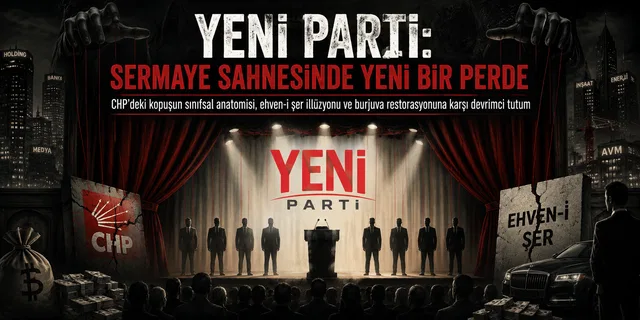
- New Party: A New Curtain on Capital's Stage (24 July 2026)
- Be the Subject of History and Your Own Life! (25 July 2026)
- The Class of the Budget: Who Pays and Who Receives in 2027? (5 November 2026)
On organising and unions
- Does the Winner Win? (21 November 2026)
- Industry No. 10 Is Not an Accident, but a Design (19 November 2026)
- Before the Turnstile: The Boss, the Company Union and Workers United to Live at HABAŞ (13 November 2026)
- The Square Is Not Enough: We Need an Organisation to Carry It Forward (5 November 2026)
On climate and the city
- Bargaining over the Climate in Antalya (22 November 2026)
Sources
- Akın Atauz Conference: local democracy under the shadow of trusteeship — Solfasol, November 2026.
- Murat Karayalçın on social reaction and organisation — ANKA, 21 November 2026.
- Karayalçın on social reaction — Son Dakika; Haber Erk, 22 November 2026.
- July 2026 union statistics — Ministry of Labour and Social Security; Wage and Union Statistics Bulletin, October 2026.
- Unionisation falls to 13.79 per cent — Cumhuriyet; DİSK-AR report — soL Haber.
- Tenants' Union founded — BirGün; first meeting and aims — Yeni Yaşam; meeting in Bostancı — TR Haberleri; first meeting — Yeniçağ/ANKA.
- Housing march in Madrid — Ara, 3 October 2026; Spain's general strike — El País, 12 November 2026.
- Fikri Sönmez and the Fatsa committees — Fikri Sönmez Foundation; Kent-Koop — Mimarizm; Karayalçın on urban renewal — Şantiye Dergisi.
- Dikmen Valley residents' Housing Rights Office set on fire — bianet; İrem Yılmaz, “Gecekondu Direnişi: Dikmen Vadisi Örneği” — Mülkiye Dergisi, 2015.
Licence: CC BY-SA 4.0 — you may reproduce, distribute and adapt this article with attribution and under the same licence.
This is a living document; it will be updated when the full recording of the speech is published. bilgimusterekleri.org