Open Weights, the Free Model, and the Question of Property
Reading and Developing İzlem Gözükeleş's Essay "The Illusion of Openness"

Dear young comrades,
In the essay Open Weights: The Illusion of Openness in Artificial Intelligence, published today (31 October 2026) in Yarımada, İzlem Gözükeleş lays on the table the word most used, and least questioned, of the last two years: open. He asks what the models presented as "open", from Llama to Qwen and from DeepSeek to Kimi, actually open, and what they keep closed, and he answers by the criteria of the free-software tradition.
This essay first seeks to summarise his text faithfully, and then to develop it with the accumulation of the discussions Bilgi Müşterekleri has been conducting for several months (Learning from Everyone Is Permitted, Learning from the Monopoly Is a Crime, on distillation; What Does Mark Zuckerberg Actually Want?; What Is International Open Access Week, and Why Does It Matter?; A Common Product Is Not Common Without Common Ownership, a reply to Cengizhan Kaptan). Our aim is not to correct, but to take one step further in the same direction. Because İzlem's essay was published under a CC BY-ND licence, we do not reproduce the text here; we suggest that you read it in full on its own page.
Summary
For comrades in a hurry, we first give the whole discussion together; the reasons and the sources come after.
Seven points İzlem emphasises
- The shift in terms. Free software's "freedom to study, to modify, to share" was, together with open source, gradually reduced to "the code's being visible". In artificial intelligence this shift went one step further: what is now counted as "open" is not even the code, but only the sharing of the training output.
- Open weights are not open source. The weights are the result of training; so long as the training data, the training code and the intermediate checkpoints are not shared, the model cannot be reproduced.
- There are real gains for the user. Running it on one's own infrastructure, fine-tuning, the data not going to the provider, and getting free of the API fee and of the provider's arbitrary changes.
- But inadequate in four areas. Reproducibility, data transparency, regulatory compliance and community contribution; contribution mostly remains limited to fine-tuning.
- The OSI and FSF criteria. The OSI's definition requires that data information, code and parameters be opened together; the FSF is stricter: if the training data, too, is not in conformity with the four freedoms, the application is not free. "Ethical" licences (RAIL) narrow freedom by restrictions on use.
- Economy and geopolitics. Open weights are cheap only for those who have the hardware and the qualified workforce; monopolisation is shifting from the model provider to the owner of the ecosystem (with reference to Cecilia Rikap). The Kimi K3 licence sets a separate contractual condition for large commercial users; the "open ecosystem" declaration of US companies is in fact a demand for policy intervention.
- Conclusion. Freedom cannot be the favour of companies; it must rest on a legal guarantee such as copyleft. Today there is no legal basis compelling the giants to publish a fully open model.
Our contribution: seven steps further
- The weight is a compiled binary. Open weights are the "freeware" of artificial intelligence: you can use it, but you cannot know how it was made, and you cannot make it again.
- The weight is crystallised general intellect. Inside it are the writings, the code and the questions of millions of people. "Open weights" are the giving back of a part of this expropriated commons, on conditions set by its owner; not a restitution, but a rented restitution.
- Openness is not a principle, it is a tactic. Monopolies distribute open weights by the strategy of "commoditise the complement"; the proof is Meta's turn, from the 2024 manifesto "open source is the path forward", to a closed vault with Muse in 2026.
- The real enclosure is computing. Even a fully open model is a formal freedom for the person who does not possess the GPU, the energy and the memory with which to reproduce it. If the four freedoms have no material condition, legal equality covers over real inequality.
- Copyleft is necessary, but it is not enough. The GPL rests on copyright law; whether the weights are a subject of copyright is uncertain, and in provision as a service there is a gap of distribution. The legal guarantee has to be completed by the question of property and labour.
- Data transparency does not take the place of data justice. Explaining the source of the data does not mean giving a say and a share to those who produced that data.
- The way out: a public model, common infrastructure, organised labour. Fully open models (OLMo, Pythia, BLOOM, Apertus) show that the path is possible; what is missing is public computing, data commons, and a computing union that will organise this labour.
The philosophical layer: From the Garden to the network
The history of sharing is far older than artificial intelligence. There is a line that runs from Epicurus's Garden in Athens (306 BC) to Lucretius's poem, which survived thanks to a single copy; from the common forests of the Middle Ages to Jefferson's words, "one who lights his candle from mine does not leave me in the dark"; from Marx's general intellect to Ostrom's commons; from Stallman's GNU to Wikipedia. From this line we draw three lessons:
- Sharing is not a quality of a thing, but a relation among people. In the Garden, knowledge was shared within friendship (philia); today the weights are distributed in the market. To take the adjective "open" for a property of the model is a new form of the illusion Marx called commodity fetishism: the fetishism of openness.
- Every age of sharing has an enclosure. The enclosure of the forest was the wire fence; the enclosure of the book was copyright; the enclosure of software was closed code; the enclosure of the model is computing power.
- Who can enter through the gate is decisive. Women and slaves could enter Epicurus's garden; at the gate of today's garden stands the GPU bill.
In one sentence: İzlem rightly says that "open weights are not open source"; we go one step further and say that "even fully open source is not freedom if the means of production are not public".
I. What Does İzlem Say?
A short history of the shift in terms
İzlem begins his essay with the announcement of the GNU project 43 years ago. The free-software movement was from the start a movement of the user's freedom: to run the program for any purpose, to study it, to modify it and to distribute it. In 1998 the term "open source" emerged in order to translate this idea to the business world. İzlem's finding is clear: in time, the freedom of production was replaced by the source code's being visible.
In artificial intelligence the shift went still further. Meta presented Llama as "open source"; yet neither the data nor the training code was open, and the licence besides set a separate permission condition for companies above a certain number of users. The more the word was emptied of its content, the more useful it became in marketing.
What is the weight, and what does it open?
When a language model is trained, what emerges is a set of parameters made up of billions of numbers: the weights. These are the numerical trace of everything the model "knows", but they cannot be read by a human being. İzlem lists, correctly, the gains that open weights provide:
- Running the model on one's own infrastructure; the data not going outside in sensitive fields such as health, law and finance,
- The possibility of fine-tuning and of reduction (distillation, quantisation),
- Getting free of the per-token API fee,
- Protection from risks such as the provider's raising the price, shutting off access, or silently changing the model's behaviour.
There is a cost too: the requirement of hardware and expertise, a performance that most of the time remains behind closed models, the passing to the user of responsibility for security and updates, and licence conditions that change from model to model.
What should open-source artificial intelligence be?
İzlem recalls that, according to the OSI's Open Source AI Definition, three components are required for a system to provide the four freedoms:
| Component | Content |
|---|---|
| Data information | The source of the training data, the methods of processing and filtering, the list of third-party data |
| Code | The whole of the code for training, data processing, testing, the tokeniser, inference and architecture |
| Parameters | The weights, the configuration settings, and intermediate checkpoints where necessary |
Open weights give only the third of these. For this reason İzlem counts four lacks: the model cannot be reproduced, and the source of bias and of the security vulnerability cannot be found; the selection of data cannot be audited; the transparency requirements of fields such as the public sector and finance cannot be met; the community can only fine-tune on top of the ready model, and cannot contribute to the model itself.
The FSF's strict line
One of the most valuable parts of the essay is its carrying, to the Turkish reader, of the FSF's work on machine learning and of the FOSDEM 2025 presentation. According to the FSF, freedom does not belong to software alone; the training data, the parameters and the software must be free together. Even in sensitive fields such as medical data, an exception is not granted. İzlem sums up this line with the following principle of the FSF: "Software is either free or it is not; there is no middle!" The FSF also counts RAIL-type "responsible artificial intelligence" licences as licences that are not free, because they set restrictions on use.
Economy and geopolitics
This is the part that takes İzlem's essay out of a technical debate about terms:
- Cost: Open weights are attractive for institutions that do not want to remain dependent on an API, but only for those who have the hardware and the qualified workforce.
- The shift of responsibility: Once the weights enter circulation, the provider's control diminishes; responsibility passes to the one who runs the model.
- The ecosystem monopoly: Dominance shifts from the API provider to the platform ecosystem; the examples of Android, iOS, AWS, Azure and Google Cloud. With reference to Rikap's study The Rulers, it is stressed that network effects create lasting barriers.
- Geopolitics: In the face of the US restrictions on chip exports, the Chinese company Moonshot's publication of the Kimi K3 weights, and the licence's setting of a separate contractual condition for "model as a service" businesses that earn more than 20 million dollars of revenue in 12 months. Lawfare's "open-weight diplomacy" analysis and NVIDIA's report are the two faces of this front.
Conclusion and note
İzlem ends with three findings: open weights will spread in the short term as a tool for lowering costs, but only to those who have the resources; monopolisation will shift from model providers to the owners of ecosystems; freedom must be the product of legal guarantees such as copyleft, not the favour of companies. A detail in the notes of the essay is, we think, very important: he writes explicitly that when he says "user" he means not individuals, but the public institutions and the companies that will be able to reproduce these systems. We shall enlarge this note below.
II. The Strengths of the Essay
- The right balance. Without being taken in by the marketing value of the word "open", he weighs it against the four freedoms of free software.
- Technical accuracy. He sets up the distinction of weight, data, code and checkpoint with a clarity a young reader can follow.
- Balanced. He does not belittle the real benefits of open weights; data privacy, and getting free of dependence on the provider, are concrete gains for public institutions.
- It opens onto political economy. By bringing the ecosystem monopoly in with Rikap, and geopolitics in with Kimi K3, he takes the subject out of a debate about licences.
- A principled ending. The emphasis on "not a favour but a guarantee" carries into artificial intelligence the soundest inheritance of the free-software tradition.
III. Our Contributions: Seven Steps Further
1. The weight is a compiled binary
We can put İzlem's distinction in the everyday language of the software developer as follows: the weight is a compiled binary (binary). The training data and the training code are the source code. None of us calls it "open source" to distribute, free of charge, only the .exe file of a program; we call it "freeware". Open weights are the freeware of artificial intelligence.
The analogy also has a limit, and that limit makes the matter heavier still: a compiled program you can, by reverse engineering, read to some extent; the weights, even those who trained the model cannot fully read. So in open weights "closedness" is not merely a choice, but is in the structure itself. In that case, being able to reproduce (data + code + computing) becomes the only way of studying. For this reason we count İzlem's criticism of "reproducibility" as the heaviest criticism.
2. The weight is crystallised general intellect
The thesis we have defended since Karaburun at Twenty: The Map of Labor, the Algorithm of Capital is this: large language models are the turning into private property of the social accumulation of knowledge which Marx, in the Grundrisse, called the "general intellect". Inside the weights are the text written by millions of people, the bug report they opened, the forum question they answered, the article they translated, the evenings they spent on Wikipedia.
Looked at from this angle, "open weights" are not a gift; they are the giving back of a part of an expropriated commons, on the conditions of the one who expropriated it. We call this not a restitution, but a rented restitution: the company writes the licence, the company sets the threshold, the company decides whether it will open the next version.
In our essay on distillation, Learning from Everyone Is Permitted, Learning from the Monopoly Is a Crime, we had shown this double standard: learning from everyone's labour is "fair use", learning from the monopoly's output is "theft". The debate on open weights is the other face of the same coin: the monopoly keeps closed what it took from the commons, and decides for itself when, and on what condition, it will "open" its own output.
3. Openness is not a principle, it is a tactic
Why does a company distribute, free of charge, the product of a training that cost billions of dollars? The known answer of the software world is: commoditise your complement (Joel Spolsky, "Strategy Letter V"). As the thing that complements your product grows cheaper, demand for your product grows.
- For NVIDIA, the model is the complement of the chip; the more widespread open-weight models are, the more GPUs are sold. NVIDIA's report on open weights, and the warning of Nvidia, Microsoft and Meta against "premature restrictions", are both the language of this interest.
- For Meta, the model was the complement of the advertising and platform ecosystem. In 2024 Zuckerberg wrote "open-source artificial intelligence is the path forward"; it suited Meta's business to render worthless the rivals' sale of models. In 2026, when the company passed to building its own layer with the personal agent Muse, the best model went into the closed vault. In What Does Mark Zuckerberg Actually Want? we had described this turn as "from open weights to the closed vault"; while small models such as Glimmer, which İzlem also mentions, remained open, the capability at the frontier was not opened.
- For Moonshot and the Chinese companies, open weights are a weapon of spread and of standard-setting against the chip embargo. The 20-million-dollar threshold of the Kimi K3 licence shows this tactic very clearly: open to the mass, closed to rival capital. The small user enlarges the ecosystem; the large user pays a share into the vault.
So we must read openness not as a principle, but as a valve that opens and closes according to the need of capital accumulation at that moment. The question of who stands at the head of the valve comes before the question of whether it is open or closed. Let us answer it with our old three questions: In whose hands are the weights? Everyone's. Under whose control is the next model? The company's. To whose benefit does the ecosystem grow? The platform owner's.
4. The real enclosure is computing
İzlem's note is perhaps the deepest sentence of the essay: the "user" he means is not the individual, but the institutions and companies that can reproduce the system. Let us take this to the end.
Let us imagine for a moment: tomorrow a monopoly publishes a model that conforms to the letter of the OSI definition. The data list, the training code, the checkpoints, all of it is there. Who can reproduce it? The training of a model at the frontier means computing worth hundreds of millions of dollars, tens of thousands of GPUs, the electricity of a small city. A considerable part of the world's DRAM production today is tied to a few data-centre projects; for this reason, in our essay on memory, Whose Is the Memory in Your Computer?, we had discussed Sam Altman's words counting the RAM in personal computers as "waste".
In that case the four freedoms are a formal freedom that has no material condition. Let us recall the distinction Marx makes in On the Jewish Question: equality before the law can cover over inequality in property. Everyone has the "right" to train a model; there are five companies that have the power to do it.
This does not mean that openness is worthless. On the contrary: when full openness is joined with a public computing infrastructure, it turns into a real freedom. We can pass the monopoly's enclosure not by the licence alone, but by the data centre. That is why, in For the Restitution of the General Intellect: The Socialist AI Manifesto Is Out, we had written the bringing of computing infrastructure into public ownership as a separate demand.
5. Copyleft is necessary, but it is not enough
We agree entirely with İzlem's principle of "not a favour but a guarantee". But we must also see the three obstacles copyleft meets in artificial intelligence:
- The ground of copyright is uncertain. The GPL rests on copyright; copyleft cannot be applied to something that has no copyright. Whether numerical parameters produced by a machine are a subject of copyright is disputed in many legal orders. The lever of copyleft can be lost right here.
- The service gap. The GPL is tied to distribution; one who does not distribute the model, and only offers it as a service, escapes the obligation to open the source. The free-software movement had answered this gap with the AGPL; a similar "network clause" is not yet established in artificial intelligence.
- Labour remains invisible. Copyleft protects the freedom of the code, not the livelihood of the person who writes the code. As we recalled in our reply to Cengizhan Kaptan, A Common Product Is Not Common Without Common Ownership, while the value of open source on the demand side is calculated as trillions of dollars, a large part of the maintainers work unpaid or on low pay. The monopolies use the commons, and make voluntary labour pay the price.
The legal guarantee therefore has to be completed by the question of property and labour. Let us repeat the title of that essay here as well: a common product is not common without common ownership.
6. Data transparency does not take the place of data justice
İzlem and the OSI want data transparency; that is right. But we need to take one step further: knowing where the data came from does not mean giving a say and a share to those who produced that data.
As we showed in What Is International Open Access Week, and Why Does It Matter?, the large publishers license article archives to artificial-intelligence companies without the authors' consent and without a share. Anthropic's settlement of 1.5 billion dollars with authors, and the NYT–OpenAI case, both show that the problem cannot be solved by individual copyright lawsuits; because a large part of the data is the labour of ordinary people who do not even hold a copyright.
Even a wholly open data set, if it remains outside the control of those who produced it, is not a commons but an open mine. For this reason we place three demands beside data transparency: a collective say for data contributors (data trusts, data cooperatives), the transfer to a public fund of the rent obtained from training data, and the use of data produced by public institutions only in public models.
7. "Use for any purpose" and the tension with RAIL
We agree with the FSF's criticism of RAIL: if the "ethical" restriction is written, interpreted and applied by the company's legal department, this is not ethics but control. But there is a tension here that we have to speak of openly: the freedom of "use for any purpose" also covers use for surveillance and for war. The apparatuses we showed in The Declaration of Techno-Fascism: The Palantir Manifesto and the Dialectic of Class Struggle in the Digital Age can also be built with open models.
Our answer is this: the solution of this problem lies not in the licence clause, but in social control. What determines in whose hands a code will turn into a weapon is not the text of the licence, but the relations of power in that society. To impose ethics by a licence is to hand ethics over to the company; the right path is to limit use through democratic institutions, workers' organisations and public oversight.
IV. From the Garden to the Network: A Philosophical History of Sharing
İzlem's essay begins from the 43-year history of free software. We want to take this history a little further back, twenty-three centuries back. Because the question "who shares knowledge, with whom, and on what condition?" was born not from the computer, but from philosophy itself. We can see what the question is only on this long road.
Epicurus's Garden: Knowledge shared within friendship
In 306 BC Epicurus bought a small garden outside the walls of Athens and founded his school there. The name of the school came from this too: Kepos, that is, the Garden. According to Seneca's account, a notice greeted the guests at the gate in this sense: stranger, here you will spend your time well; here the highest good is pleasure (Seneca, Letters to Lucilius, 21.10).
Three features that set the Garden apart from the other schools of its age are, for our discussion today, surprisingly current:
- The gate was open to everyone. Plato's Academy and Aristotle's Lyceum were schools of free male citizens. Women and slaves could also join the Garden; Diogenes Laertius reports that Epicurus's slave Mys also occupied himself with philosophy (Diogenes Laertius, Lives of Eminent Philosophers, Book X). Access to knowledge was not tied to birth and to property.
- Sharing was a relation of friendship. For Epicurus, the greatest security of a happy life was friendship (philia). An interesting detail: according to Diogenes Laertius, Epicurus did not adopt, as an obligatory rule, the Pythagoreans' principle that "the possessions of friends are common". His reason was this: if sharing is imposed, it means that people do not trust one another. In the Garden, sharing was to be not a rule, but the spontaneous result of trust.
- Knowledge was deliverance from fear. Epicurus's atomist physics existed in order to be delivered from the fear of the gods and of death. The aim was ataraxia, that is, the tranquillity of the soul. To understand nature was to break the power of the things that frighten the human being.
When Epicurus died, he left the garden by will to his student Hermarchus and to "those who will do philosophy together with him"; Diogenes Laertius transmits the text of the will. Said in today's language, this is one of the first institutional guarantees of the knowledge commons: a property is devoted to a community's common work.
Marx and Epicurus: The freedom of the swerve
This garden has a direct bond with us. The young Marx's doctoral dissertation of 1841 was precisely on this subject: the difference between the natural philosophies of Democritus and Epicurus. Marx stresses that the atoms of Democritus fall in the void, of necessity, in a straight line, whereas Epicurus adds to the atoms a small swerve (in Lucretius's phrase, clinamen). If this swerve did not exist, the atoms would never collide, and nothing would come into being. Marx sees in this swerve the philosophical ground of freedom inside mechanical necessity. Later, in The German Ideology too, he recalls Epicurus as the true radical Enlightener of antiquity.
This image is instructive for today as well. The logic of monopoly capitalism resembles the straight-line fall of the atoms: everything appears to flow in the necessary orbit of accumulation. The free-software movement, Wikipedia and open access are each a swerve in this orbit of history. They are small, but they open the possibility of new combinations, of new collisions. The swerve by itself does not change the world; but without the swerve, nothing new comes into being.
The journey of Lucretius: Knowledge that lives by being copied
Of Epicurus's hundreds of works, almost none reached today whole. The text that carries his thought best was the long poem of the Roman poet Lucretius, On the Nature of Things (De Rerum Natura). This poem too was lost for centuries; in 1417 the Italian humanist Poggio Bracciolini found a copy in the library of a German monastery and had it copied. Materialist thought, running from the Renaissance to the Enlightenment, is to some extent indebted to the multiplication of that single copy.
From this comes a simple but deep lesson: knowledge lives to the extent that it is copied. Every order that forbids copying puts knowledge at the risk of vanishing. We must not forget that the act of copying, accused today under the name "pirate", is the act that keeps humanity's inheritance of thought standing.
The story also has a continuation that reaches today. The library of the Villa of the Papyri at Herculaneum, carbonised by the eruption of Vesuvius in AD 79, consisted in large part of the texts of the Epicurean philosopher Philodemus. These rolls, too fragile to be opened, were in 2023–2024 "opened virtually" by machine learning within the Vesuvius Challenge, an open competition, and the Greek lines inside them were read for the first time. The code and the data of the competition were shared openly; students from every part of the world contributed. The words remaining from Epicurus's garden could, twenty centuries later, be read again by open science and common labour. It is hard to think of a finer example of what artificial intelligence can be used for.
Aristotle's objection and the "tragedy of the commons"
The philosophical history of sharing is not without objection. Plato, in the Republic, had proposed common property for the class of guardians. Aristotle objected to this in Book II of the Politics: the thing that belongs to the most people is shown the least care, and everyone attends more to what belongs to himself.
This objection appeared again, twenty-three centuries later, in Garrett Hardin's famous article of 1968, "The Tragedy of the Commons": everyone uses the common pasture without limit, and the pasture is exhausted; the solution is either private property or state control. This article became one of the texts to which neoliberal privatisation policies had most recourse.
The answer was given empirically by Elinor Ostrom. By examining hundreds of local commons across the world (irrigation associations, common pastures, fishing communities), she showed that, when communities set and enforce their own rules, the commons can be sustained for centuries, and in 2009 she received the Nobel Prize in Economics. Together with Charlotte Hess she carried this frame to knowledge as well: Understanding Knowledge as a Commons (2007). In our essay A Glossary of the Knowledge Commons: The Conceptual Tools of Liberation in the Digital Age we had discussed these concepts in detail.
There is a further addition for the knowledge commons: knowledge is not exhausted like a pasture. My using an idea does not diminish your use. In the economists' language, knowledge is a "non-rival" good. The real tragedy in knowledge is not overuse, but enclosure.
The common forest, enclosure, and "the sheep eating the people"
In medieval Europe the life of the peasants depended on the commons: wood from the common forest, grass from the common pasture, fish from the common waters. In 1217, in England, beside Magna Carta, a less known document was proclaimed: the Forest Charter (Charter of the Forest). It secured ordinary people's rights to benefit from the forest.
In the centuries that followed, these commons were enclosed. Thomas More, in Utopia in 1516, told, with an unforgettable image, of the fields being enclosed for the wool trade and the peasants being driven out: the sheep are eating the people. In 1649 Gerrard Winstanley and the Diggers (Diggers) set about working the common lands again, and declared that the land was "everyone's common treasury". Marx, in the chapter on primitive accumulation of Capital, analysed enclosure as the birth pang of capitalism: to separate the producer from the means of production was the precondition of turning him into a wage worker.
What we are living today is the repetition of this process in the field of knowledge. The common forest of the internet age (the open web, the forums, Wikipedia, the open-source repositories) is being gathered as training data, processed, and turned into weights. This time, in the place of the sheep, there are models. In our essay on the digital commons, Digital Commons in the Age of Algorithmic Enclosure: Artificial Intelligence and the Liberation of Knowledge Labor, we called this algorithmic enclosure.
The Islamic world and Anatolia: Translation, the library, the waqf
To tell the history of sharing only through Europe would be incomplete. The translation movement carried on in the 8th to 10th centuries around the House of Wisdom (Bayt al-Hikma) in Baghdad preserved and developed Greek philosophy and science by carrying them into Arabic; Aristotle returned to Europe in large part by this road. This is one of the greatest examples of one civilisation's accumulation of knowledge being taken up by another civilisation as a common heritage.
In Anatolia, the waqf tradition was the institutional form of property's being devoted, permanently, to a definite public purpose: libraries, madrasas, soup kitchens, fountains. Of course the waqfs were not independent of the property and power relations of the period; most of the time they also became a means for the ruling class to protect its wealth. But the idea that a good can be devoted to the community in a form in which it cannot be bought and sold belongs to the same family as Epicurus's will, and offers a local root to today's discussion of the knowledge commons.
The printing press, copyright, and Jefferson's candle
The printing press made the multiplication of knowledge cheap; at the same moment a new enclosure was born. The Act of Anne (Statute of Anne), issued in England in 1710, is counted as the first modern copyright law. In appearance it protected the author; in practice it was a new legal dress for the publishers' monopoly privileges. The root of the academic-publishing rent we told of in What Is International Open Access Week, and Why Does It Matter? reaches here.
The Enlighteners of the same period were saying something else about the nature of knowledge. The Encyclopédie of Diderot and d'Alembert (1751–1772) was a project of compiling human knowledge in a form everyone could reach, and it came out struggling with censorship. Thomas Jefferson, in the letter he wrote to Isaac McPherson in 1813, told the non-rival nature of knowledge with perhaps the finest image: one who takes an idea from me takes it without diminishing mine; one who lights his candle from mine receives light without leaving me in the dark. The conclusion that came from Jefferson was also clear: ideas are, by their nature, not fit to be an object of property.
What is ironic is this: Jefferson's candle is today coming about, exactly, with weight files. Copying a model's weights does not diminish the owner's copy. But while the light of the candle multiplies without diminishing anyone, the wax required to cast the candle itself (data, computing, energy) stands in the depot of a few companies.
Marx, Kropotkin and the general intellect
In the 19th century the question of sharing settled, for the first time, at the centre of a systematic social theory. Marx, in the "Fragment on Machines" of the Grundrisse, foresaw that social knowledge would turn into an immediate productive force, and he named this the general intellect (general intellect). This knowledge was not something anyone produced alone, but the common accumulation of society; yet the moment it was sunk into machines, it turned into the property of capital. The weight file is the most concrete form, to this day, of this foresight.
In the same period Pyotr Kropotkin, with Mutual Aid (1902), objected to Social Darwinism: in the survival of species and of communities, solidarity was as decisive as competition, and even more so. Against the artificial-intelligence competition legitimised today by the discourse of the "race", Kropotkin's question is still valid: did humanity arrive at this point by competition, or by sharing?
From the hacker ethic to Wikipedia
In the second half of the 20th century, sharing was born again on a new technical ground. The hacker culture that emerged at MIT in the 1960s saw code as a common product of craft: a program was something everyone could work on and develop. When, at the end of the 1970s, software was commoditised and closed, Richard Stallman objected: in 1983 he announced the GNU project, in 1985 he wrote the GNU Manifesto, and he founded the Free Software Foundation. Copyleft was an inversion that struck copyright law with its own weapon: a licence whose freedom no one would be able to close.
Those who came after widened this line: Linux in 1991; Wikipedia in 2001, the largest voluntary knowledge commons in history; in 2001–2002, under the lead of Lawrence Lessig, Creative Commons, free licences for content. In 2008 Aaron Swartz wrote the Guerilla Open Access Manifesto and defined the rescue of knowledge from closed archives as a moral duty; for this cause he met a heavy prosecution, and in 2013 he lost his life. This history has both its victories and its costs.
Today: Open weights and the fetishism of sharing
Looked at from this long road, what sets the period of open weights apart from those before it becomes distinct. In the Garden, in the library, in the waqf, in GNU, in Wikipedia, sharing was a relation of community: people took part in a common work, and completed one another's labour. In open weights, sharing appears for the first time on a large scale as the strategy of its owner. The community does not share; the monopoly distributes. The community consumes what is distributed, and at most fine-tunes it.
Marx, in the first chapter of Capital, describes commodity fetishism: the social relation among people appears as a relation among things, as a quality of the things themselves. The expression "open model" produces precisely such an illusion. Openness is as if a property of the model: this model is open, that model is closed. Yet openness is a social relation: it is the name of who gives what to whom, on what condition, for how long, and while reserving the right to take it back. We call this the fetishism of openness. This, we think, is the philosophical name of what İzlem called "the illusion of openness".
Let us recall what Epicurus said about friendship: if sharing is imposed, there is no trust. We can read today's situation from the other side: if sharing can be given one-sidedly and taken back, what is there is not a community but a dependence.
Sharing and the enclosure across the ages
| Age | Form of sharing | Enclosure | Who could not enter through the gate? |
|---|---|---|---|
| Epicurus's Garden (4th–3rd centuries BC) | Common learning within friendship | The citizenship limits of the polis (the Garden went beyond this) | In the Garden, comparatively no one; in the other schools, women and slaves |
| The medieval village | Common forest, pasture, water | Enclosure, landed property | The landless peasant |
| The translation movement and the waqfs | Knowledge as a common heritage, property devoted to a public purpose | Literacy, religious and class hierarchy | The majority who could not read and write |
| The printing press and the Enlightenment | The Encyclopédie, the public library | Copyright law, censorship | Those who could not buy a book, and those who could not read |
| Industrial capitalism | The general intellect, workers' solidarity | The private property of the machine | The worker separated from the means of production |
| The hacker age | Free software, copyleft, Wikipedia | Closed code, the software patent | Those without a computer and a connection |
| The age of artificial intelligence | Open weights (distribution), fully open models (sharing) | Computing power, the data monopoly, licence thresholds | Those without a GPU, energy, or a data centre |
Three lessons from the Garden to today
- Knowledge delivers from fear; the black box frightens. Epicurus had counted the understanding of nature as the path of deliverance from fear. Today the apocalyptic discourse around artificial intelligence is fed by a black box that people do not understand and cannot control. A model that can be reproduced, that can be studied, that is fully open, is a part of the road towards the ataraxia of our age: it puts understanding in the place of fear.
- The swerve is small, but it is necessary. Free software, open access and fully open models are each a clinamen in the orbit of the monopoly. By themselves they do not change the order; but when they meet an organised movement, they open the possibility of a new combination.
- The Garden is an institution, it is a will. Epicurus tied his garden not to personal good will, but to a will, that is, to a lasting institutional guarantee. This is the philosophical counterpart of İzlem's conclusion, "not a favour but a guarantee". Our addition is this: the guarantee must be not only the text of the licence, but also common property and an organised community.
V. A Note for Turkey
For public institutions and companies in Turkey, open weights are genuinely attractive from the point of view of the gains İzlem counts: the data does not go abroad, and an API bill denominated in foreign currency is not paid. But two risks have to be seen:
- The "domestic model" label. Making a Turkish-language fine-tuning of a foreign monopoly's open-weight model is valuable work; but to call this a "sovereign" or "national" model while the foundation, the data and the next version are in someone else's hands is to continue the dependence under a new name.
- The flowing of public data into a private model. If the linguistic, legal and medical data in the hands of public institutions is processed by private contracts without a transparent public frame, the "paying three times" order we have lived through in open access is set up again in artificial intelligence.
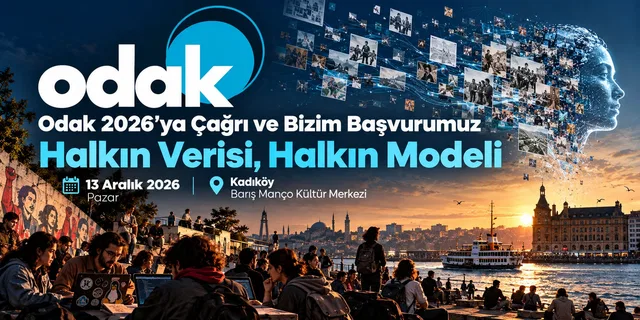
This is why we think the theme of this year's Odak conference of the Free Software Association (ÖYD) is exactly right: Odak 2026, "Free Artificial Intelligence - The People's Data, the People's Model". In An Invitation to Odak 2026 and Our Submission we had proposed to discuss these questions with their technical layers; İzlem's essay offers that discussion a very valuable ground.
Two Opennesses: A Comparison
| Liberal openness (open weights) | Commons openness (the free model) |
|---|---|
| The output is shared, the production process is closed | Data, code, parameters and process are open together |
| The company determines the licence and the threshold | Copyleft and the guarantee of public law |
| Openness opens and closes according to capital's need | Openness is established as a right that cannot be taken back |
| The power of reproduction is in a few companies | Public computing infrastructure is open to everyone |
| The data source is secret, or merely listed | A collective say and a share for data contributors |
| The community fine-tunes, and cannot touch the base model | The community develops the model itself together |
| Maintainer and data labour is invisible and unpaid | Maintenance labour is waged and organised |
| "Ethics" is the company's licence clause | The limit of use is drawn by social control |
| To the benefit of the owner of the ecosystem | To the benefit of those who live by the wage, and of the public |
VI. Signs of What Is Possible
There are examples showing that the fully open model is not a fantasy. These are not on the same scale as the monopolies at the frontier, but they prove that the path can be walked:
- OLMo (Allen Institute for Artificial Intelligence): published together with the data, the training code, the intermediate checkpoints and the evaluation tools.
- Pythia (EleutherAI): a family of models designed for reproducibility research, with all the training steps shared.
- BLOOM (BigScience): a multilingual model that hundreds of researchers trained together, over a year, on a public supercomputer.
- Apertus (Switzerland, EPFL and ETH Zurich): a national model trained on public computing infrastructure, with its data and its process open.
The common denominator of these examples is striking: in all of them there is either public computing or not-for-profit collective labour. That is, full openness becomes possible only when the means of production themselves have in part turned into a commons. The proof of our thesis in contribution 4 is precisely this.
VII. Concrete Tasks
For computing workers
- Before recommending a model as "open", let us check the three components of the OSI definition; let us not call open weights "open source".
- When choosing a model in our institutions, let us report in writing the user thresholds in the licence, the restrictions on use, and the conditions of revocability.
- Let us prepare openly licensed evaluation sets that measure the Turkish-language performance of fully open models (OLMo, Apertus and others).
- Let us build Turkish-language data sets under a free licence, with the contributors' consent and with a record.
For free-software communities
- Let us set up a Turkish-language legal working group on the adaptation of copyleft to artificial intelligence (the network clause, the legal status of the weights).
- Let us keep an open table that exposes the "washing of openness" (open-washing) and that scores the models.
For the public and for democratic organisations
- Let us demand a principle that gives priority to the fully open model in the artificial-intelligence purchases of public institutions.
- Let us put on the agenda a public computing infrastructure among universities, and its democratic governance.
- Let us ask that the contracts by which public data is transferred to private models be transparent.
For organising
- Let us enlarge the discussion that will bring together, under the roof of the same computing union, the labour of open-source maintainers, of data labellers and of model developers.
- Let us meet on 13 December at Odak 2026; let us discuss these questions there together.
Dear young comrades,
İzlem's essay reminds us of something very important: words, too, are enclosed. "Free" turned first into "open", "open" then into "visible", and at the end into "downloadable". At each step the word grew a little more polite, and the freedom inside it a little less.
The only thing we can add is this: taking the word back is not enough; the thing the word points to must also be taken back. The labour inside the training data is ours; the machines that process that labour are also the product of our common accumulation. In a world where the weight is open and the vault is closed, the question to be asked is not "which model is more open?", but "who produces the model, for whom, and under whose control?"
The gate of Epicurus's garden was, in its own age, open to women and to slaves. Our task is to open the gate of today's garden to everyone as well: not only the weights, but the data, the code, the computing, and the say over these. To make the Garden not a company's shop window, but a community's will.
We owe thanks to everyone who asks this question, who researches it, who carries it into Turkish. To İzlem, too, for this essay. Let us enlarge the discussion together; let us defend freedom not as a favour, but as a right built by our organised labour.
The machine is new, the chain is old. But the commons is ours too.
Sources
The essay we read
- İzlem Gözükeleş, Open Weights: The Illusion of Openness in Artificial Intelligence, Yarımada, 31 October 2026 (CC BY-ND 4.0).
Sources in İzlem's essay
- The New York Times, Zuckerberg interview, 28 July 2026.
- The New York Times, Meta and open source, 10 August 2026.
- NVIDIA, Open Weights and American AI Leadership.
- OSI, The Open Source AI Definition.
- OSI, Open Weights.
- FSF, FSF is working on freedom in machine learning applications.
- FSF, RAIL licences are not free and are not ethical.
- FOSDEM 2025, FSF's criteria for free machine learning applications.
- Lawfare, Open-Weight Diplomacy.
- Moonshot AI, Kimi K3 licence text, Hugging Face.
- Cecilia Rikap, The Rulers: Corporate Power in the Age of AI and the Cloud, Verso, 2026.
Sources we added
- Meta, Open Source AI Is the Path Forward, 23 July 2024.
- CNBC, Nvidia, Microsoft, Meta warn against 'premature restrictions' of open-weight models, 24 July 2026.
- Joel Spolsky, Strategy Letter V, 2002.
- GNU, What is free software? and Copyleft.
- GNU, AGPLv3.
- Hoffmann, Nagle, Zhou, The Value of Open Source Software, SSRN.
- Harvard Business School, Open Source Software: The Nine Trillion Resource Companies Take for Granted.
- The Register, Open-source maintainers are low-paid, 2024.
- The Register, On open-washing, 2024.
- NPR, Anthropic pays authors $1.5 billion to settle copyright infringement, 2025.
- Wikipedia, The New York Times v. Microsoft and OpenAI.
- Allen Institute for AI, OLMo.
- EleutherAI, Pythia.
- BigScience, BLOOM.
- Swiss AI Initiative, Apertus.
- Free Software Association, Odak 2026.
- Karl Marx, Grundrisse, "Fragment on Machines".
- Karl Marx, On the Jewish Question, 1843.
Sources for the section on philosophical history
- Diogenes Laertius, Lives of Eminent Philosophers, Book X (Epicurus).
- Seneca, Letters to Lucilius, letter 21.
- Karl Marx, The Difference Between the Natural Philosophies of Democritus and Epicurus, doctoral dissertation, 1841.
- Lucretius, On the Nature of Things (De Rerum Natura).
- Vesuvius Challenge, The reading of the Herculaneum papyri by machine learning.
- Plato, Republic; Aristotle, Politics, Book II.
- Garrett Hardin, "The Tragedy of the Commons", Science, 1968.
- Elinor Ostrom, 2009 Nobel Prize in Economics; Charlotte Hess and Elinor Ostrom (eds.), Understanding Knowledge as a Commons, MIT Press, 2007.
- Charter of the Forest, 1217.
- Thomas More, Utopia, 1516; Gerrard Winstanley, The True Levellers Standard Advanced, 1649.
- Karl Marx, Capital, Volume I, Chapter 27: The expulsion of the agricultural population from the land.
- Karl Marx, Capital, Volume I, Chapter 1: The fetish-character of the commodity.
- Statute of Anne, 1710.
- Thomas Jefferson, Letter to Isaac McPherson, 13 August 1813.
- Pyotr Kropotkin, Mutual Aid, 1902.
- Richard Stallman, The GNU Manifesto, 1985.
- About Creative Commons.
- Aaron Swartz, Guerilla Open Access Manifesto, 2008.
Related essays from Bilgi Müşterekleri
- Learning from Everyone Is Permitted, Learning from the Monopoly Is a Crime (distillation)
- What Does Mark Zuckerberg Actually Want? (from open weights to the closed vault)
- A Common Product Is Not Common Without Common Ownership (a reply to Cengizhan Kaptan)
- What Is International Open Access Week, and Why Does It Matter?
- Whose Is the Memory in Your Computer? (the RAM crisis)
- For the Restitution of the General Intellect: The Socialist AI Manifesto Is Out
- An Invitation to Odak 2026 and Our Submission
- How Should We Read the OpenAI and Hugging Face Incident?
- OpenAI's 722 Mathematics Papers and the Closed Laboratory of the General Intellect
- The Commons of Code and Art: Software and Content Licenses 101
- A Glossary of the Knowledge Commons: The Conceptual Tools of Liberation in the Digital Age
- A New Generation’s Struggle for Freedom: The Procyberian Systems Distribution (PSD) Community Growing from Turkey
- Albatros Computing Cooperative and Software Cooperativism 101
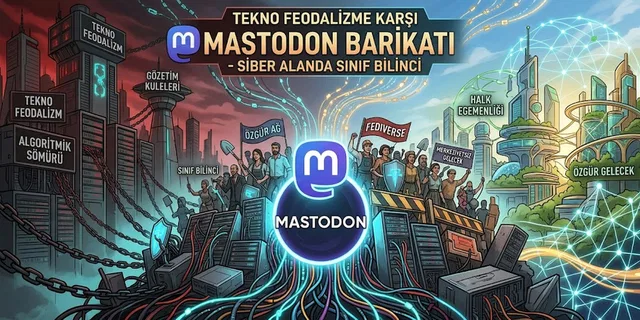
- The Mastodon Barricade Against Technofeudalism - Class Consciousness in Cyberspace
- From Platform Capitalism to Digital Commons: The Socialization of the Means of Production in Publishing
- Whose Hand Is on the Shutdown Button?
- Digital Commons in the Age of Algorithmic Enclosure: Artificial Intelligence and the Liberation of Knowledge Labor
This essay is published under the CC BY-SA 4.0 licence.