Same Block, Separate Floors
Reading the Second Season of Bir Başkadır through the Lens of Class
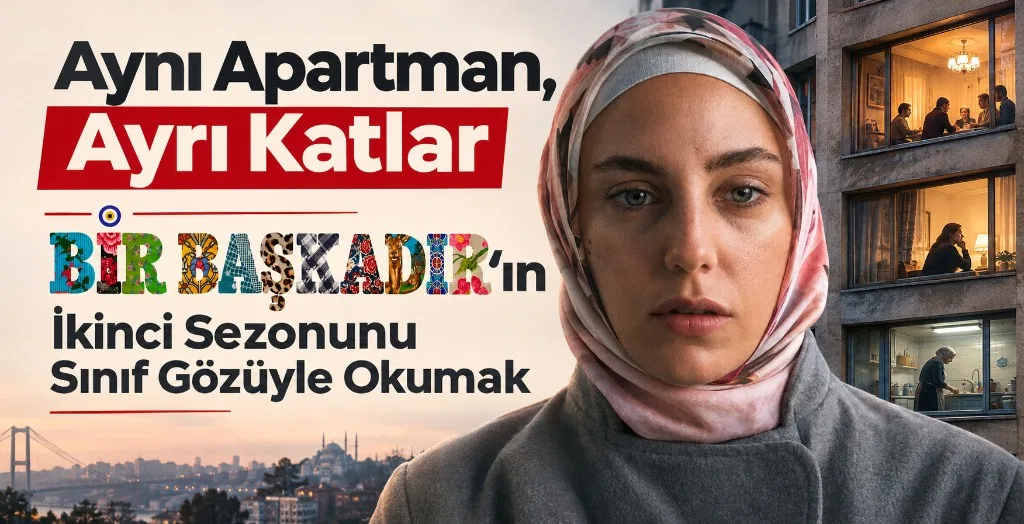
Berkun Oya's Bir Başkadır (known abroad as Ethos) returned on 12 November 2026, a full six years after its first season, with a second season of four episodes, and within a few hours became the most watched production in Turkey. Six years earlier the series had sat Turkey down in a therapy room and opened a debate on identity polarisation through the encounter of a "headscarved cleaner and a secular psychiatrist". Today another story is being told in the same therapy room: how fear, surveillance and power seep into everyday life.
In this essay we will try to read the new season not as television criticism, but as a social document. Our question is simple: What do these four episodes tell us about Turkey's class structure, and what do they leave unsaid?
Spoiler warning: This essay contains details of the plot of the second season of Bir Başkadır. If you have not watched the season yet, we suggest you watch it first and read this afterwards.
First, a Summary: Ten Theses
- Six years ago the divide ran along identity; today it runs along insecurity. The thick line the first season drew between the secular middle class and the conservative poor has thinned; in its place has come a shared unease that surrounds everyone. This is the real divide beneath the identity divide — the relation of property and power — becoming visible.
- The lie that "we are all in the same boat" is collapsing. The characters live in the same block, but not on the same floor. Those who live upstairs can determine the fate of those downstairs.
- Chief Inspector Muzaffer is the human face of the state's repressive apparatus. This man who mourns, weeps and cannot sleep at home can, on duty, have an imam locked up over a few videos. Personal grief neither softens nor explains social oppression.
- Conscience has been privatised. Muzaffer can feel sorrow only for his own loss. This is the morality of an individualist society: pain is real only when it happens to oneself.
- Speech is now evidence of a crime. An imam's live streams, a journalist's words in a taxi, even the money spent on stuffed vine leaves and sausage, enter a "terror" file. Surveillance works not only from above, but also from beside us.
- A society of informers splits the class. The taxi driver who secretly records the journalist's words is a small but sharp picture of an order in which the labourer is positioned against the labourer.
- Woman's voice is silenced twice over. Meryem finds no room for her own speech between the scolding voice of the state on one side and her husband's endless talk on the other; Muzaffer's late wife stayed silent for a lifetime.
- "Terrorist" has entered children's games. Hegemony becomes lasting above all when it is reproduced in the mouths of children.
- People are tired of shouting politics and look at the price of beans. This is not apoliticism; it is a justified distrust that appears in the absence of class politics.
- The therapy room is not a way out. The series squeezes a social wound into a room for two and offers no prescription. We know the prescription: not an individual shelter, but organised solidarity.
What Changed in Six Years?
The first season was released in November 2020, in the middle of the pandemic. Turkey was then passing through a period in which the narrative of "two Turkeys" was spoken of most intensely: the headscarf, lifestyle, neighbourhood pressure, "White Turks" and "Blacks". The series handled this divide cleverly, but often left class in the shadow of culture. Meryem's poverty looked like a "background", Peri's wealth like a matter of "taste".
In the second season that balance shifts. The cast has narrowed, the side stories have been cut back; the stories of the Hodja, of Hayrünnisa and of Gülbin are gone, and Ruhiye is now only someone who stands beside Meryem. The narrative concentrates around a single event: the detention and arrest of Meryem's imam husband, Hilmi.
Whether this narrowing is an artistic choice or a demand of production conditions, we do not know. But that form matches content is clear. The country's mood has narrowed as well. People are closer to one another than before, and more cramped. The middle class has melted, the cost of living has knocked at every door, polarisation has turned into enmity, and suspicion has worked its way into the fabric of everyday relations.
In the first season Peri looked at Meryem's headscarf and wrestled with her own prejudice. In the second season Peri's husband Bahadır walks out through the police station door, and in the finale is called back to the same door, this time to give a statement. The secular middle class's confidence that "it will not touch me" is also finished. This is not the place where the first season's cultural opposition ends; it is the place where it becomes clear that that opposition was never the real determinant.
From a Marxist point of view there is nothing new here. Identity conflicts are real, but they are not autonomous. As the ruling class divides society along cultural lines, it makes the line of property and power invisible. When the crisis deepens and repression becomes general, that invisible line asserts itself. The headscarved woman and the secular woman begin to live the same fear at different ends of the same mechanism. The "equalising" of Peri and Meryem in the finale is exactly this: what draws them near is not culture, but the repression to which they are exposed.
The Floor Plan of the Block: Who Lives Where?
The season's strongest spatial image is the apartment block. Meryem and Hilmi live in a new, carefully furnished flat that has not yet aged. Upstairs is Chief Inspector Muzaffer's home: the children have grown and gone, and what remains are the belongings of a lifetime and armchairs in which no one sits any longer.
This floor plan is a class cross-section of society. To live in the same building is not to live under the same conditions. Every political discourse that begins with "we are all in the same boat" covers over this difference. Yet there are cabins on the boat as well; those who sink the ship are usually on the upper deck, and those who swallow the water first are those below.
It is also Meryem who directs Muzaffer to Peri. The woman downstairs holds out a hand of help to the man upstairs; the man upstairs has the husband of the woman downstairs locked up. This relation is a naked picture of the neighbourly kindness the oppressed shows the oppressor, and of how that kindness provides no protection at all.
Muzaffer: The Human Face of the Repressive Apparatus
Chief Inspector Muzaffer, played by Berkun Oya himself, is the centre of gravity of the season. Close to retirement, newly bereaved of his wife Muazzez, unable to sleep at night, he sees his wife in her wedding dress on the basketball court opposite his home. In the first episode he delivers an unbroken speech of more than twenty minutes opposite Peri. He weeps often. He begins his answers to the questions put to him with "I have no perfect answer to that, but..."
And the same man, when it becomes clear that he had a hand in what happened to Hilmi, threatens Peri so that what was said in the session room will stay there. Without raising his voice, speaking not as a patient but as a superior. This scene is the most chilling moment of the season, because it shows how easy, how natural, the threat is for Muzaffer.
It is possible to read Muzaffer in two wrong ways. The first is to see him as a monster; the second is to look at his tears and count him a victim who must be understood. The series rejects both, and rightly so. Weeping for his wife does not make him a good person; the fear he visits on others does not make his mourning false.
Seen through the lens of class, what is decisive is not Muzaffer's personality but his position. As Lenin describes in The State and Revolution, the state is the organisation of class rule, and that rule is exercised through a special apparatus of armed people — the police, the army, the prisons. Muzaffer is a small official standing at one of the lowest ranks of that apparatus. Neither an owner of large capital nor a maker of political decisions. But he has identified his authority with his personal will, speaks with the self-confidence of leaning on the state, and escapes accountability with the logic of "I judged it fit".
This is a type that has become all the clearer in Turkey in recent years: the official in whom not law but loyalty is personified. His decision is given not by the statute but by the spirit of "the era". He is indifferent to political trials and to the coup alike, but that indifference does not stop him from displaying his power. He is a "man of the era" who obeys without question.
Muzaffer's greatest fear is a leak: that what he told in the session room will get out. This fear is a reflection of the unease the bureaucracy has felt in recent months in the face of revelations such as the fund raid. The repressive apparatus wants to see everything, but is terrified of being seen. Surveillance is power for as long as it works in one direction; when it turns the other way, it collapses. We discussed the fund crisis and the relations behind it earlier in The Crack in the Spine and The Cost of the Fund Raid. The chief inspector's panic about a leak in the series is the mood of the lowest link in that chain.
Privatised Conscience
The truly chilling side of Muzaffer is that he does not see himself as a tyrant. He does not question what he does. He can feel deep sorrow for his own loss, yet remain so far from responsibility for the decisions that turn other people's lives upside down.
This is the morality of capitalist society in concentrated form. The market relates the human being only to their own interest and their own pain. Another's pain is a statistic, a "file", a "job". What Marx called alienation is not only the labourer's alienation from their product, but the human being's alienation from the human being, from their species. Muzaffer is the police-uniformed form of the alienated human who cannot find another's pain as real as their own. We discussed earlier, in our essay on Ioanna Kuçuradi, that morality is individual feeling and ethics the critique of social relations. Muzaffer's tear is morality; what is missing is ethics.
Hilmi: When Speech Becomes Evidence of a Crime
Hilmi was the quiet, bookish imam of the first season. An inward young man who blended his religious knowledge with readings in philosophy and sociology. In the second season he is married to Meryem; he makes his voice heard not only in the mosque but also through live streams on social media. Meryem is uneasy about where these videos will lead. And what she feared comes to pass: Hilmi is detained and arrested under the label "terrorist".
There is a striking irony here. Hilmi's videos are watched with approval in a policeman's home, while the man who shot the videos is taken in with that same policeman's assent. Speech is at once a piece of content to be consumed and evidence of a crime.
The series never says plainly which subjects Hilmi entered. That silence is deliberate. Part of the audience sees in him Kurdish politicians, part imprisoned journalists, part people dismissed after 15 July under emergency decrees, associated with the congregation, struggling to find a lawyer, their families scattered under the stigma of "terrorist relative". The strength of the series is exactly here: the target of repression may change, the mechanism is the same. Today one person, tomorrow another.
A legal order in which even ordinary spending — the money for stuffed vine leaves and sausage — can count as "evidence" is no longer law; it is an arbitrary technique of power. The question we asked in Whose Law Is the Republic's Law? turns, in the series, into an everyday scene.
Speech on the Platform, a File in the Apparatus
Hilmi's story has another dimension: the carrying of speech onto the digital platform. The imam now speaks not only to his congregation but in front of an algorithm. His words are on record; they can be watched, archived, cut and shaped. Every live stream is a data set that may one day be used against him. In the digital age freedom of expression and surveillance flow through the same cable. We treated this through chip tracking in the factory in The Card Around Our Necks; in the series the same logic operates in the sitting room of a flat.
The Taxi Driver and the Journalist: A Society of Informers
One of the scenes that most deserves to be talked about is the one that takes place in the taxi Peri's famous journalist husband Bahadır takes after leaving the police station. The taxi driver has secretly opened a voice recording to draw words from him. Bahadır notices; they argue.
This scene shows the most effective weapon of repressive regimes: positioning human against human. The taxi driver is a labourer. Someone who works long hours, thinking of plate rent, diesel prices, his loan. The journalist is a labourer too; famous or not, he lives by his words. The two are from different layers of the same class. But the order makes one the informer of the other. Who listens to whom, who carries what where, is never entirely clear.
Over the last decade people in Turkey have come more and more to fear one another, to censor themselves, to judge those they do not know. When trust weakens, people choose silence instead of explanation. This is one of the greatest obstacles before class solidarity. Organising is, at its root, a relation of trust; a society of informers is the systematic destruction of trust.
Meryem: The Price of Therapy and the Class of Voice
Meryem is again the heart of the series this season. In six years her life has changed: she is married, in a new home, pregnant. In place of the woman who sat restlessly in the session room in the first season there is a more at-ease Meryem. In one scene she explains that the money she set aside to have a water purifier fitted in the kitchen has for the last two months gone on the sessions, and says that the money she gives here does not hurt her.
This small detail summarises very well the class character of mental health. Therapy is a right, but in this society it is a commodity. Meryem's recovery is a service she can buy only by giving up a household appliance. In Peri's life therapy is an ordinary part of the profession and of lifestyle; in Meryem's life it is a sacrifice, a luxury set aside for herself. The woman forced to choose between a water purifier and a therapy session is doing the budget calculation of millions of working women in Turkey. We spoke in Two Thermometers of how the minimum wage and inflation fall on the household budget.
Meryem's new home and relative ease also recall the limited rise a section of the conservative poor has lived inside the system over the last twenty years. The state salary of an imam husband, a new flat, carefully chosen furnishings. But how fragile that rise is! The moment the police arrive at the door, that careful order makes the loneliness of the woman who lives inside it even more visible. Even the sections the power counts as "ours" are not secure. What is taken for class ascent is in fact a conditional contract of loyalty; the moment one clause of the contract is breached, it is withdrawn.
A Voice Silenced Twice Over
Meryem's inability to find room for her own speech is an important strand of the season. On one side the finger-wagging, scolding voice of power; on the other her husband's endless talk, in the live streams and at home. Hilmi is a well-intentioned man, but he is an example of a male religiosity that wants to hold the floor in every sphere.
Muzaffer's late wife Muazzez is the extreme point of this silence: a woman obedient for a lifetime, who stayed silent even when she suffered violence. The remorse Muzaffer feels after her is a conscience that arrives after death, and for that reason repairs nothing.
Capitalism and patriarchy feed each other here. What is expected of the woman is to be silent, obedient and useful: to perform the unpaid reproductive labour of the household, to swallow the man's anger, to endure everything so that the family does not fall apart. We discussed the ideological frame of this in Whose Family Is Safe?. In the series that frame turns into a sentence knotted in Meryem's throat.
The Word in the Mouths of Children
Perhaps the most shattering moment of the season is when Yasin's son is drawn into a fight in a neighbourhood match under the accusation of "terrorist". The children have used this word for Meryem's imprisoned husband. Meryem vomits. Fear, repressed anger and helplessness spill out of her body. Yasin weeps in front of an open window.
This scene is like a lesson in how hegemony works. As Gramsci taught us, rule persists not only by force but by consent, by common sense, by concepts lodged inside everyday language. The word "terrorist" has ceased to be a legal category and has turned into an insult in a children's game. Even when an accusation is aimed at a single individual, a whole family — children included — carries the consequences.
We treated the class character of language in detail in The Class of Words. When a society begins to hear the stigmatising language of power from the mouths of its children, the problem is no longer only political; it is cultural and intergenerational. To get that word out of children's language is a struggle for hegemony.
"Shouting Politics" and the Price of Beans
Meryem complains of the leaders' constant shouting, scolding and finger-wagging. And she adds: the alternative shouts too. Society sees not which side is in the right, but the bean price that will not come down.
This sentence is one of the soundest critiques of Turkish politics, and through the lens of class it says something very important. People have not grown cold toward politics; they have grown cold toward a politics that does not touch their everyday life, that does not speak their language, that sees them only as a vote bank. The price of beans is the most concrete class fact. A politics of both the government and the main opposition that does not put this fact at the centre, that walks through identity and polarisation, is in Meryem's eyes the same loud noise.
Here the series implies a search for a new politics that does not shout, that persuades, that is solidaristic and respectful of differences. That search is valuable. But if it remains only a matter of tone, it is incomplete. The problem is not only the volume of politics, but whose interest it defends. A politics that does not shout yet still defends the interest of capital will not bring down the price of beans. The politics Meryem is looking for is a class politics that begins from her kitchen, her budget, her fear.
The Limit of the Therapy Room
The basic formal choice of Bir Başkadır is to fit society into a therapy room. In the second season that choice becomes even clearer: the first two episodes are made up almost entirely of conversations between two people. Peri and Muzaffer, Peri and Meryem, Bahadır and the taxi driver, Meryem and Hilmi. The spaces widen only slowly: from the session room to the taxi, the hospital, the homes, and finally the police station.
Society resembles a kind of collective therapy, but there is no prescription. We all expect an exit, a medicine, a mediation from the therapist; yet the therapist is inside the same medicine. Peri herself is afraid, herself surrounded.
This observation is true, and it is the honesty of the series. Therapy can ease an individual's pain, but it cannot remove the social source of that pain. Detention, arrest, poverty and stigma are solved in no session. Seeking individual solutions to social problems is one of the illusions capitalism loves most: "The problem is in you, look after yourself, improve yourself." We examined the mechanism of this illusion in Why Do We Deceive Ourselves?.
In the finale Peri and Meryem are equalised; Meryem grows and leaves. As psychotherapy it is a fine ending. But socially it is an open ending: Hilmi is inside, Bahadır is at the police station door, Muzaffer is at his post. The wounds are dressed, but the knife that opened the wound still stands in place.
What the Series Shows, What the Class Eye Sees
| What the series shows | A reading through the lens of class |
|---|---|
| People from different worlds live in the same block | Same building, different floors: living side by side is not living as equals |
| Muzaffer weeps at home, threatens on duty | The repressive apparatus is not legitimised by personal grief; position is more decisive than personality |
| Muzaffer feels sorrow only for his own loss | The privatised conscience of an individualist society, the moral form of alienation |
| Hilmi is declared a "terrorist" over his videos | Speech and the digital trace turn into a store of evidence for arbitrary power |
| The taxi driver secretly records the journalist's words | Informing is a technique of rule that positions labourer against labourer |
| Meryem spends the water-purifier money on therapy | Mental health is not a right but a commodity; even recovery depends on a budget calculation |
| Meryem's new home and relative ease | Rise inside the system is a conditional contract of loyalty, withdrawable at any moment |
| Muazzez stayed silent for a lifetime, Meryem cannot find her words | Capitalism and patriarchy silence woman's voice together |
| Children use the word "terrorist" in a game | Hegemony has lodged in everyday language and is passed from generation to generation |
| "The alternative shouts too", beans are expensive | Distrust of identity politics is the result of the absence of class politics |
| The secular journalist too is called to the police station | The middle class's "it will not touch me" confidence is finished; repression has become general |
| No prescription in the therapy room | There is no individual cure for a social wound; the way out is organised solidarity |
What the Series Leaves Unsaid
The courage of Bir Başkadır must be acknowledged. In a period when power is this hard, it is not easy to show the repressive apparatus so nakedly through the face of a chief inspector. But looking through the lens of class, we must also see the limits of the series.
Labour is not visible. In the series people talk, mourn, fear; but we almost never see anyone at work. There is no workplace, no boss, no wage bargaining, no shift. Society hangs between the state and the individual; the production relations in between — that is, the real relation between the owner of property and the labourer — do not enter the screen. The economy seeps in through details such as the price of beans and the water purifier, but it never becomes the subject of the story.
There is repression, there is no resistance. Across four episodes we watch fear, unease, silence. But we see neither a solidarity network, nor a lawyers' collective, nor a family solidarity, nor a union, nor an action. This does not fully match Turkey's reality. In this country the relatives of the imprisoned come together, lawyers take cases without fee, workers resist in front of the factory. Beside fear, those who stand despite fear should also have been told.
The horizon of liberal humanism. The way out the series proposes is for everyone who can say "I am human" to meet in a shared pain. This is a valuable first step. But unless shared pain turns into a consciousness of shared interest, it remains only a feeling. The journalist, the person dismissed under an emergency decree, the Kurdish politician, the removed mayor and the ordinary labourer are under the same repression; yet that repression has a class source, a property order, a model of capital accumulation. The series does not name this; naming it falls to us.
The class of the platform. Finally let us not forget this: what tells this critical story to Turkey is a global entertainment monopoly. Netflix presents Turkey's wound to the world market as "content" and charges a subscription fee for it. We do not diminish the worth of Bir Başkadır; but we must also know that we live in an age in which even social criticism can be commodified, in which criticism can turn into a viewing record.
Concrete Tasks
Watching a series and talking about it is not enough. There are things we can do against the social fabric the series shows:
- Strengthen solidarity networks with the relatives of the imprisoned. Thousands of women like Hilmi's wife struggle to find a lawyer, are stigmatised, are left alone. Building networks that reach these families in the neighbourhood, at work, in the union.
- Weave relations of trust against a culture of informing. Overcoming the fear of "who is listening to whom" at work and in the neighbourhood with open and transparent practices of organising. Trust is the first capital of an organisation.
- Defend mental health as a right. Putting the demand for public, free and accessible psychological support on the agenda of trade-union and social struggle. No one should have to choose between a water purifier and therapy.
- Stand against the language of stigma. Conducting a conscious struggle of language in schools, families and publications against the lodging of the word "terrorist" in everyday speech, especially in the speech of children.
- Build a politics that begins from the price of beans. Growing common grounds of struggle that put concrete class demands — kitchen, rent, wages, security — at the centre instead of identity polarisation. We discussed the organisational model of this in Organising 2.0 and the Liberation Manifesto.
- Grow woman's voice inside the organisation. Truly opening, in our own organisations, meetings and decision processes, the room for speech that Meryem could not find.
- Form reading and viewing groups that discuss works of art through the lens of class. Productions such as Bir Başkadır are good starting points for social consciousness; so long as we turn the viewing experience into a collective discussion.
Dear Young Comrades
The second season of Bir Başkadır shows us how the country has narrowed in six years. Everyone is a little more afraid, a little more silent, a little more alone. The headscarved woman and the secular woman meet in the same fear; the imam and the journalist at the same police station door. This is a bitter truth, but it also carries a possibility: the possibility of seeing the common class reality behind the walls of identity.
Muzaffer's tears remind us of this: the people who make up the repressive apparatus also suffer, mourn, go sleepless. But this does not make the apparatus itself innocent. Our quarrel is not with persons, but with the order that places those persons in this position and gives them the authority to turn other people's lives upside down.
Meryem's question is everyone's question: How did we come to this? We will look for the answer not in the therapy room, but in social relations. And the second half of the answer — how we will get out of this state — we can write only together. We live on separate floors of the same block; but when those on the lower floors come together, the foundation of the building is on our shoulders too.
Solidarity against fear, organised speech against silence, comradeship against loneliness. For better days, all of us together.
This essay is published under a CC BY-SA 4.0 licence.